.svg)





Autonomous Commerce vs. Agentic Commerce: Why the Distinction Determines B2B ROI in 2026
SAP, Salesforce, and Forrester all use 'agentic commerce' now. Here's why it's not the same as Autonomous Commerce — and why the distinction determines B2B ROI.
“Agentic commerce” is rapidly overtaking “autonomous commerce” as the dominant AI label in B2B trade press, SAP, Salesforce, Forrester, VTEX, Mirakl, and Commercetools all use it now. But the two terms describe fundamentally different approaches to revenue execution. Agentic AI handles isolated tasks and escalates when context exceeds its scope. Autonomous Commerce executes the full quote-to-cash cycle end-to-end without human loops. That difference determines which AI investments generate compounding ROI and which create a more sophisticated version of the same manual bottleneck.
Table of Content
- What 'Agentic Commerce' Actually Means, and Why It's Everywhere Right Now
- What Autonomous Commerce Covers That Agentic AI Approaches Don't
- The ROI Gap: Why Execution Scope Determines Financial Outcome
- How to Audit Any 'Agentic' or 'Autonomous' Vendor Claim Against Your Operations Reality
- Sources
- Frequently Asked Questions
- See Autonomous Commerce in Action at the 2026 Summit
What ‘Agentic Commerce’ Actually Means, and Why It’s Everywhere Right Now
Walk into any enterprise software conference in 2026 and you will hear “agentic commerce” within the first ten minutes. The term has colonised vendor roadmaps, analyst frameworks, and procurement RFIs at a speed that should make any operations or commercial leader pause. When a label spreads that fast, it usually means the marketing is outrunning the technology. Understanding what agentic commerce actually describes, not what vendors want you to think it describes, is the first step toward making AI investments that compound rather than plateau.
For a precise grounding before diving deeper: agentic commerce refers to AI systems composed of discrete, task-specific agents that autonomously handle individual steps in a commercial workflow, product discovery, price lookup, order status, contract parsing, but rely on orchestration layers and human escalation to manage transitions between steps, exceptions, and cross-system decisions. Autonomous Commerce, as defined and commercialised by Go Autonomous, refers to an AI execution layer that processes the full revenue cycle, quotes, orders, price inquiries, tenders, claims, end-to-end, without human intervention loops, at enterprise scale. The distinction is not semantic. It is architectural, and it drives entirely different financial outcomes.
How SAP, Salesforce, and Forrester Are Defining Agentic Commerce in 2026
The three most influential voices shaping enterprise AI vocabulary in 2026 are SAP, Salesforce, and Forrester, and their definitions of “agentic” reveal a consistent pattern.
SAP announced its agentic AI strategy at Hannover Messe 2026, framing it around an SAP order reliability agent that monitors order confirmations, flags anomalies, and triggers supplier communications. The framing is explicitly task-scoped: one agent, one function, connected to a broader ecosystem via APIs and human review queues. SAP is not claiming end-to-end execution. It is claiming reliable task execution with reduced manual monitoring, a meaningful improvement, but a categorically different promise than full autonomous execution.
Salesforce announced its Agent Fabric control plane, an orchestration layer that coordinates multiple AI agents across CRM, CPQ, and service workflows. The architecture is multi-agent by design, which means it inherits multi-agent coordination overhead: agents passing context between handoffs, control planes managing sequencing, and humans validating transitions that exceed any single agent’s confidence threshold.
Forrester’s 2026 predictions on agentic commerce are the most candid. Forrester analysts flag that most enterprises deploying “agentic commerce” solutions will experience a gap between vendor promise and operational reality, specifically around exception handling, cross-system data fidelity, and the cost of human-in-the-loop escalation at volume. That is not a technology critique. It is a scope critique. Agentic architectures are designed to handle defined tasks well. They are not designed to handle the full, messy, exception-heavy reality of B2B order execution.
Go Autonomous addressed these distinctions directly in its press release on agentic commerce and autonomous execution, drawing a precise line between what task-based agents deliver and what full execution fabric achieves.
Why ‘Agentic’ Language Spread Faster Than the Technology Behind It
The speed at which “agentic” entered B2B vocabulary is partly a function of large language model capability timelines and partly a function of competitive positioning pressure. When OpenAI, Anthropic, and Google all began shipping agent frameworks in 2024 and 2025, every enterprise software vendor needed an “agentic” story or risk looking behind the curve. The result: vendors with task-automation products reframed them as agentic platforms, and the term became a proxy for “AI-enabled” rather than a precise architectural description.
Gartner’s AI agent framework distinguishes between reactive agents (respond to inputs), proactive agents (initiate actions based on goals), and autonomous agents (operate within defined scope without continuous human direction). Most commercial “agentic” deployments in B2B today sit in the reactive-to-proactive range. True autonomous execution, where the system manages the full transaction lifecycle including exceptions, pricing decisions, and multi-party coordination, requires a different architecture entirely.
Digital Commerce 360’s March 2026 reality check on agentic commerce found that a majority of B2B enterprises evaluating agentic platforms were doing so without a clear framework for measuring execution scope, meaning they were comparing task-level capabilities without understanding how exception volume and escalation frequency would affect total cost of ownership. That gap is where ROI disappears.
For a deeper grounding in why this distinction matters operationally, the Go Autonomous blog post on why B2B leaders must understand the difference between agentic and autonomous commerce walks through the architectural differences with operational examples.
What Autonomous Commerce Covers That Agentic AI Approaches Don’t
The gap between agentic and autonomous is not a matter of degree, it is a matter of design intent. Agentic systems are built to handle specific, well-defined tasks reliably. Autonomous Commerce is built to handle an entire revenue cycle reliably, including the parts that are not well-defined, not structured, and not anticipated in advance. That difference shows up most clearly when you examine what happens at the boundaries of each system’s designed scope.
The Scope Problem: Single-Task Agents vs. End-to-End Execution for B2B Manufacturers
A typical B2B order in manufacturing or distribution is not a single transaction. It is a sequence of interdependent decisions: customer sends a purchase order by email, PDF, or EDI; the system must parse the order against the customer’s contract, verify product availability, apply correct pricing (which may differ by customer, volume tier, and date), check credit limits, confirm delivery lead times against current inventory, generate an order acknowledgement, and update the ERP, all before the order is even in production queue. Any one of those steps can contain exceptions: non-standard product codes, pricing disputes, partial availability, outdated customer master data.
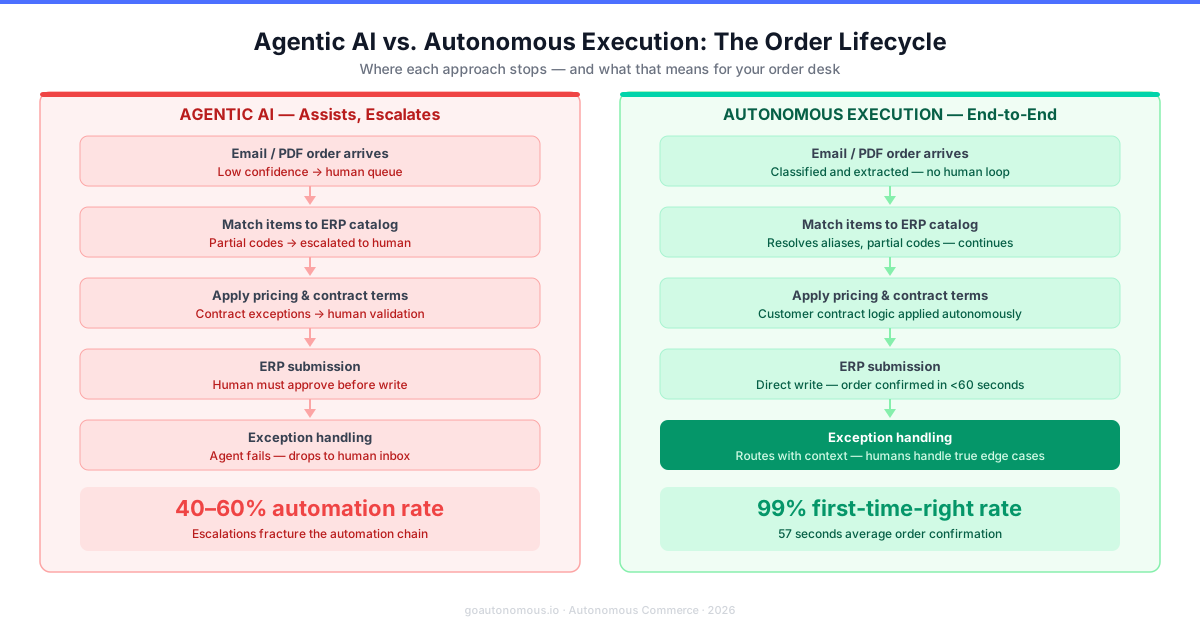
An agentic architecture handles each of those steps as a discrete task. Each agent is optimised for its function. The challenge is coordination: what happens when the pricing agent returns a result that conflicts with the contract agent’s interpretation? What happens when the availability agent finds partial stock and the order requires a split shipment? In agentic architectures, these inter-agent conflicts either require a control plane that can resolve them algorithmically, which adds latency and complexity, or they escalate to a human operator who reviews, decides, and re-enters the result. That escalation is the productivity ceiling.
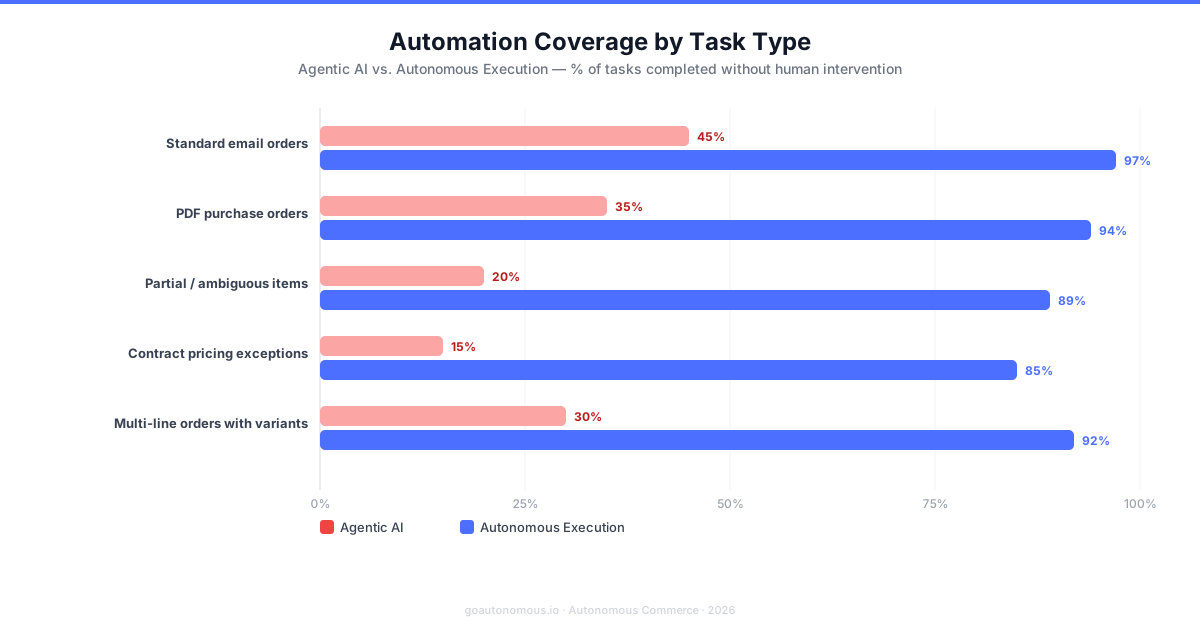
Autonomous Commerce handles the full sequence as a unified execution problem, not as a pipeline of connected tasks. The system maintains context across the entire order lifecycle, resolves cross-domain conflicts using learned business logic, and only surfaces genuinely novel exceptions, not routine complexity. For B2B manufacturers processing hundreds or thousands of orders daily, this distinction is the difference between 60% automation with 40% human review, and 95%+ straight-through processing with human attention reserved for genuinely strategic decisions.
The Go Autonomous overview for B2B manufacturers and distributors details how this execution model applies across industrial, chemical, and healthcare distribution verticals.
Why Escalation Is the Tell-Tale Sign of an Agentic Architecture
When evaluating any vendor claiming agentic or autonomous capabilities, the most diagnostic question is simple: what happens when the system encounters an exception it was not explicitly trained to handle?
In agentic architectures, the answer is escalation. The agent identifies the boundary of its confidence, flags the exception, and routes it to a human reviewer or a higher-level orchestration agent. This is rational design for task-scoped systems, you want agents to know their limits. But in a B2B order execution context, “escalation” translates directly to delay, cost, and capacity consumption. Every escalated order requires a human to read, understand, decide, and re-enter. At scale, escalation queues become the new manual inbox, more structured than email, but functionally identical in terms of labour demand.
Deloitte’s order-to-cash transformation research found that exception-driven escalation in B2B order management accounts for a disproportionate share of processing cost, often 30–50% of total order handling time concentrated in 10–20% of order volume. If your AI investment reduces routine processing time but does not reduce exception-escalation volume, you have automated the easy part and left the expensive part unchanged.
Autonomous Commerce inverts this. The system is designed to handle complexity natively, including the ambiguous, the contradictory, and the previously unseen, because B2B order complexity is not an edge case. It is the operating condition. The result is that the category of “exception requiring human review” shrinks over time as the system learns, rather than remaining constant as a structural feature of the architecture.
How Autonomous Commerce Handles the Full Revenue Cycle Without Human Loops
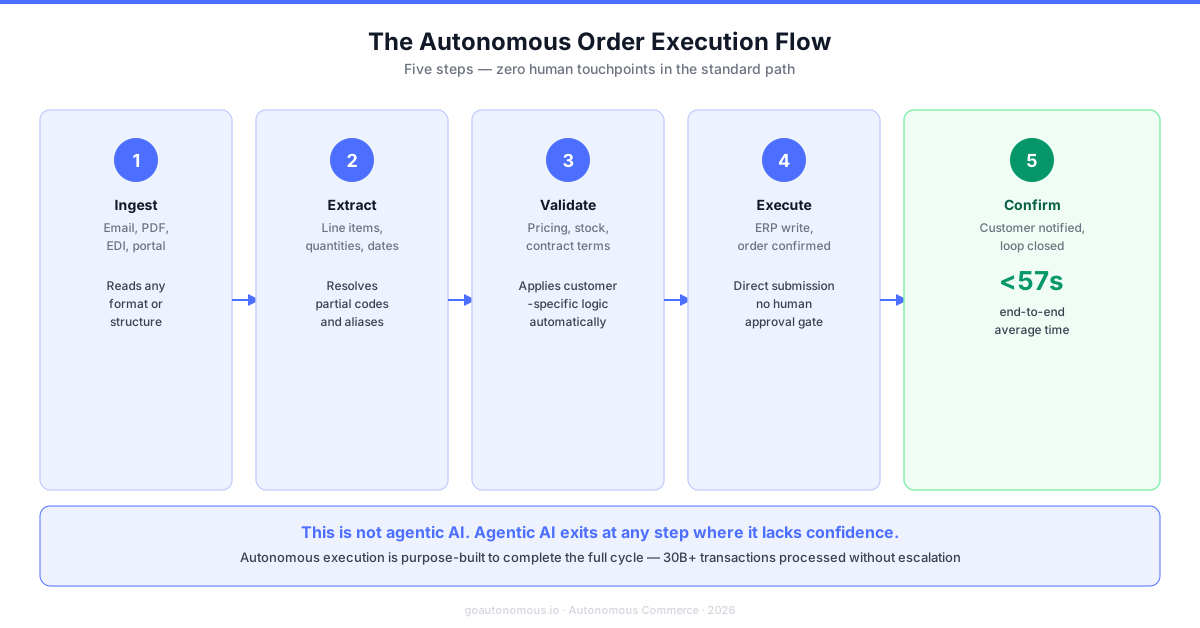
The Go Autonomous Autonomous Commerce product suite is built around a unified execution fabric that spans the entire revenue cycle, not a collection of specialist agents. The core components handle inbound order processing, quote generation, price inquiry resolution, tender management, and claims processing as a continuous operational loop, not as discrete handoffs.
The Flow component specifically addresses the multi-channel, multi-format reality of B2B order intake, email, PDF, EDI, portal, phone transcription, normalising inputs before they reach the execution layer. This is where most agentic deployments fail: they assume structured input and degrade when input format varies. Flow handles format variability as a core capability, not an edge case to be pre-processed by human operators.
The Go Autonomous white paper on the era of Autonomous Commerce articulates the full execution scope and the architectural principles that make end-to-end execution possible at enterprise scale. For operations leaders evaluating AI investments, this is the document that translates technology architecture into operational and financial terms.
Critically, autonomous execution does not require replacing your ERP, CRM, or pricing engine. The Autonomous Commerce platform operates as an execution layer that sits above existing systems, reads and writes to them via standard integrations, and handles the decision logic that those systems were never designed to automate. This is why implementation timelines are measured in weeks, not quarters, the system learns your business logic, it does not require you to re-engineer it.
The ROI Gap: Why Execution Scope Determines Financial Outcome
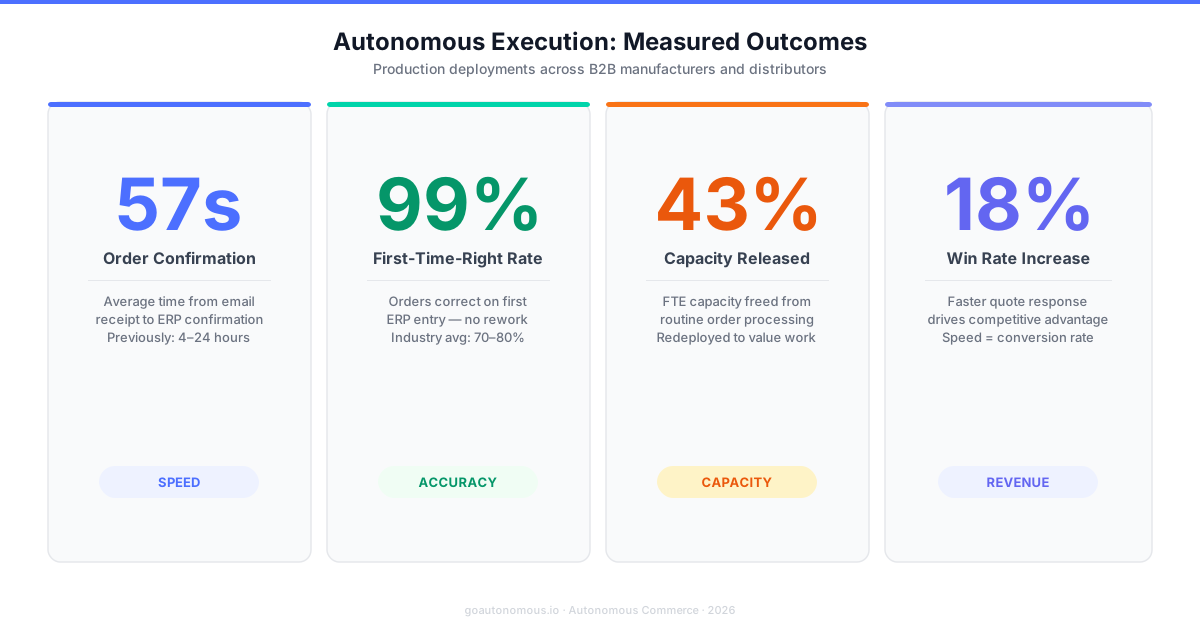
ROI in B2B AI investments is not determined by how much you automate, it is determined by where you automate. Automating the structured, predictable portion of order processing while leaving exception management to humans produces linear productivity gains: you need fewer people for routine tasks, but exception queues grow proportionally with volume. Automating the full execution cycle, including exceptions, produces compounding returns: processing capacity scales without proportional headcount, and exception rates decline as the system learns. The financial profile of these two outcomes is categorically different.
Working Capital, DSO, and the Hidden Cost of Every Escalation Loop in Manufacturing
Working capital impact is where the difference between agentic and autonomous execution becomes most financially concrete. Every hour an order sits in an escalation queue is an hour of revenue not yet recognised, inventory committed but not billed, and cash not yet moving through the cycle. For manufacturers with high order volumes and tight working capital management, the cumulative DSO impact of systematic escalation delays is material.
McKinsey’s B2B digital inflection point research identifies order processing speed and accuracy as two of the top three drivers of customer retention in B2B manufacturing and distribution. Customers who experience slow order acknowledgement or frequent correction loops are 2.5x more likely to evaluate alternative suppliers. The cost of escalation is therefore not just internal labour, it is a revenue retention risk that does not appear in any single escalation’s cost calculation.
IDC’s research on order-to-cash automation in manufacturing found that companies achieving high straight-through processing rates, above 85%, saw DSO improvements of 3–7 days on average, which translates directly to working capital release at scale. Companies with escalation-heavy architectures, regardless of automation level, saw DSO improvements plateau at 1–2 days because the exception tail absorbed the time savings from structured processing.
Danfoss, one of the world’s largest industrial manufacturers, implemented Autonomous Commerce across 26 countries and reduced order processing time to under one minute per order. The working capital and DSO implications of that change, across millions of annual order lines, are the kind of financial outcome that agentic task automation cannot reach, because the time savings compound across every order rather than concentrating in the structured subset. Full details are in the Danfoss press release.
Why Agentic ROI Plateaus and Autonomous ROI Compounds With Volume
The ROI trajectory of agentic versus autonomous architectures diverges predictably as order volume scales. Agentic systems produce strong initial ROI by eliminating the most repetitive, structured portion of manual work. That gain is real and measurable. But as volume grows, the exception tail, the portion of orders that require escalation, grows proportionally. The human capacity required to manage that tail grows with it, which means the total cost of order processing scales sub-linearly but not independently of volume. You need fewer people per order, but you still need more people as orders grow.
Autonomous Commerce produces a different curve. Because the system handles exceptions natively and improves its exception resolution over time, the human capacity requirement becomes increasingly fixed relative to volume. More orders do not require proportionally more human intervention. The cost per order falls as volume grows, which means the ROI compounds: each additional order processed is more profitable than the previous one, not equally profitable.
This is the financial logic behind why companies like Mediq, a healthcare distribution business with complex, high-exception order patterns, chose autonomous execution over point automation. The Mediq case illustrates how a distribution business with inherently variable order complexity achieves high straight-through processing rates precisely because the system is designed for complexity, not despite it.
For an architectural perspective on why autonomous execution compounds where task automation plateaus, the Go Autonomous white paper on the autonomous execution fabric and five AI lessons for enterprise provides the clearest technical and economic framing available.
Each time we added one or two million euros in revenue, we had to add another operator. From a cost perspective, that's an unsustainable way of operating a business.

Mikkel Diness Vindeløv’s framing captures the strategic problem precisely. Revenue growth that requires proportional headcount growth is not a scalable model, and it is exactly the model that agentic task automation preserves, at a lower ratio. Autonomous Commerce breaks that ratio entirely, which is why it represents a categorically different investment thesis, not just a more advanced version of the same efficiency play.
How to Audit Any ‘Agentic’ or ‘Autonomous’ Vendor Claim Against Your Operations Reality
The proliferation of “agentic” and “autonomous” claims in the market makes vendor evaluation harder, not easier. Every platform now carries at least one of these labels, and the marketing language has converged to the point where distinguishing genuine architectural differences from rebranded task automation requires deliberate interrogation. The five questions below are designed to cut through vendor positioning and reveal the actual scope of execution any system can deliver in your operational context.
Before applying these questions, it is worth being clear about what you are evaluating. The goal is not to find the vendor with the best answers to these questions in a sales context, it is to understand which architectural category their product actually belongs to, so you can set accurate ROI expectations and build a procurement case that holds up post-implementation. The Go Autonomous blog post on why autonomous commerce is not automation provides the conceptual foundation for this evaluation framework.
Five Questions That Separate Autonomous Execution from Sophisticated Task Routing
- What is your system’s escalation rate, and how does it change at 2x and 5x our current order volume? Any system that cannot answer this with data from existing deployments is telling you that escalation behaviour at scale is unknown. For autonomous execution, escalation rates should decline with volume as the system learns. For agentic task routing, escalation rates are structurally fixed by the architecture, they may improve with tuning, but they do not compound downward with scale.
- How does your system handle an order that contains three simultaneous exceptions, a non-catalogue product code, a pricing discrepancy against the master contract, and a partial availability situation? This is a realistic scenario in B2B manufacturing. Ask the vendor to walk through the decision logic step by step. Agentic architectures will describe a sequential escalation path. Autonomous Commerce will describe a unified resolution process that handles all three exceptions within a single execution context.
- What percentage of orders achieve straight-through processing in your existing deployments at comparable complexity levels? Straight-through processing, orders processed from receipt to ERP confirmation without human intervention, is the clearest metric of execution scope. Ask for this figure segmented by order complexity tier: simple reorders, standard orders with pricing, and complex orders with exceptions. The gap between complexity tiers reveals how much of the “automation” is actually task routing with human backstop.
- How does your system integrate with our ERP, and what happens when the ERP returns an error or ambiguous response? ERP integration failure modes are where agentic architectures most commonly create new manual work. If the answer involves a human review queue for ERP errors, the system has created a structured version of the problem it was sold to solve. Autonomous execution handles ERP response ambiguity within the execution layer, not by routing it to a human reviewer.
- Can you show us a live or recorded demonstration of your system processing one of our actual exception-heavy orders, not a curated demo dataset? The most reliable signal of genuine autonomous execution capability is performance on real, messy data. Vendors who can only demonstrate on curated datasets are showing you best-case performance, not operational performance. For agentic commerce manufacturing ROI comparisons, this distinction in evaluation methodology makes the difference between accurate and misleading ROI projections.
What a Real Autonomous Commerce Architecture Looks Like for B2B Manufacturers
A genuine Autonomous Commerce architecture for B2B manufacturers has several defining characteristics that distinguish it from agentic task routing systems. These are not marketing differentiators, they are architectural requirements for delivering the financial outcomes described above.
- Multi-format input normalisation at ingestion: The system accepts and normalises orders from email, PDF, EDI, portal, and voice without human pre-processing. Format variability is handled before the execution layer, not after it creates exceptions.
- Unified execution context across the full order lifecycle: A single execution context maintains all order-relevant information, customer master, contract terms, pricing rules, inventory state, credit position, from receipt through ERP confirmation. There is no context loss at handoff points because there are no handoff points in the conventional sense.
- Native exception resolution, not exception routing: The system resolves ambiguity and conflict using learned business logic, not by routing to humans or higher-level agents. The category of “exception requiring human review” is defined by genuinely novel situations, not by routine complexity that the system was not designed to handle.
- Bidirectional ERP integration with error handling: The system reads from and writes to your ERP in real time, handles ERP response errors within the execution layer, and maintains order state consistency without manual reconciliation steps.
- Measurable STP rate that improves over time: Straight-through processing rates are tracked, reported, and improve with deployment duration as the system learns customer-specific patterns and business rule variations. This improvement trajectory is the compounding ROI signal, it does not appear in agentic architectures by design.
- Enterprise-grade auditability and compliance logging: Every decision in the execution cycle is logged with reasoning, enabling audit trails for compliance, dispute resolution, and continuous improvement analysis. This is particularly critical in regulated industries like healthcare distribution, as demonstrated by the Mediq deployment.
The CWS Hygiene partnership with Go Autonomous illustrates how these architectural requirements translate into operational reality for a large-scale service and distribution business. The CWS Hygiene press release details the scope of the deployment and the operational changes it enables.
For industrial manufacturers specifically, the autonomous commerce for industrial manufacturers page covers the sector-specific implementation considerations, including multi-plant inventory coordination, customer-specific pricing complexity, and cross-border order management, that distinguish this industry’s execution requirements from generic B2B commerce.
If you are at the stage of building an internal business case for autonomous execution, the Go Autonomous booking page connects you with the team that can scope a deployment against your specific order volume, complexity mix, and systems environment. The conversation starts with your data, not with a generic ROI model.
The broader point, whether you are evaluating agentic platforms, autonomous execution, or any AI investment in your revenue cycle, is that execution scope is the variable that matters. Technology that handles the easy part well and routes the hard part to humans has a fundamentally different financial trajectory than technology that handles both. In 2026, the difference between those two trajectories is measurable, documented, and large enough to determine whether AI becomes a strategic advantage or an expensive operational layer.
The Autonomous Commerce Summit 2026 brings together the operations and commercial leaders who have already made this transition. If you want to understand what autonomous execution looks like in practice, not in a vendor demo, that is the fastest path to informed decision-making.
Sources
- Forrester: Predictions 2026. The Agentic Commerce Race and Some Potential Regrets in Digital Commerce
- SAP News: SAP at Hannover Messe 2026, Agentic AI and Resilient Manufacturing
- Digital Commerce 360: Agentic Commerce Faces Reality Check in B2B E-Commerce (March 2026)
- Gartner: AI Agents, Insights and Framework
- McKinsey: The B2B Digital Inflection Point, How Sales Have Changed
- IDC: Order-to-Cash Automation in Manufacturing
- Salesforce: Agent Fabric Control Plane Announcement
- Deloitte: Order-to-Cash Transformation
Frequently Asked Questions
Agentic commerce uses discrete, task-specific AI agents that each handle one step in a commercial workflow, order parsing, pricing lookup, availability check, and escalate to humans or orchestration layers when they encounter decisions outside their defined scope. Autonomous Commerce executes the full quote-to-cash cycle end-to-end, handling exceptions, cross-domain conflicts, and multi-step decisions without human intervention loops. The architectural difference produces different financial outcomes: agentic systems deliver linear productivity gains, while Autonomous Commerce delivers compounding ROI as volume scales.
The term ‘agentic’ spread rapidly in enterprise software because AI agent frameworks from major model providers became widely available in 2024 and 2025, creating competitive pressure for every enterprise vendor to develop an ‘agentic’ positioning. SAP’s order reliability agent, Salesforce’s Agent Fabric, and Forrester’s agentic commerce predictions all describe task-scoped AI capabilities, meaningful improvements over traditional automation, but architecturally distinct from end-to-end autonomous execution. Forrester’s own 2026 predictions flag potential regrets for enterprises that adopt agentic platforms without understanding this scope distinction.
Agentic AI in manufacturing produces strong initial ROI by automating structured, repetitive order processing tasks. But as order volume grows, exception-handling escalation also grows proportionally, meaning human capacity requirements scale with volume, not independently of it. Autonomous Commerce handles exceptions natively, so the human capacity requirement becomes increasingly fixed relative to volume. Each additional order costs less to process than the previous one, producing compounding ROI rather than linear gains. For large-volume manufacturers, this difference is material to working capital, DSO, and total cost of ownership.
Five diagnostic questions cut through vendor positioning: (1) What is your escalation rate at 2x and 5x our current volume? (2) How does your system handle simultaneous exceptions, non-catalogue codes, pricing discrepancies, and partial availability, in a single order? (3) What percentage of orders achieve straight-through processing at comparable complexity levels? (4) What happens when your ERP returns an error or ambiguous response? (5) Can you demonstrate your system processing one of our actual exception-heavy orders, not a curated demo dataset? Vendors who cannot answer questions 1–4 with operational data, or decline question 5, are signalling that their system’s exception-handling behaviour at scale is unknown.
Yes. Autonomous Commerce is deployed across both manufacturing and distribution environments. Distribution businesses often have higher order frequency, more diverse customer bases, and more variable order formats, precisely the conditions where exception-driven escalation creates the most overhead. Healthcare distributors like Mediq have implemented Autonomous Commerce to handle the complexity of clinical supply ordering at scale. Industrial distributors benefit from the same multi-format input normalisation and native exception resolution that manufacturers use for direct customer order management.
Traditional B2B order automation AI, RPA, rule-based processing, workflow automation, handles orders that match predefined templates and routes everything else to humans. It is brittle: any variation outside the template creates a failure mode. Agentic AI order management improves on this by using language models to handle more variation in input format and content, but still relies on escalation for cross-domain decisions. Autonomous Commerce differs in that it treats the full range of order complexity, including exceptions, conflicts, and novel situations, as the normal operating condition, not the edge case. The system is designed for the messy reality of B2B trade, not an idealised version of it.
See Autonomous Commerce in Action at the 2026 Summit
The Autonomous Commerce Summit 2026 brings together operations and commercial leaders from B2B manufacturing and distribution who are actively transforming how revenue is executed. Hear directly from companies that have made the shift to autonomous execution, and what it means for revenue, cost, and working capital. Attendance is by invitation only.
Request your invitation →