.svg)





What Is Autonomous Commerce? How B2B Manufacturers and Distributors Are Transforming Revenue Execution
Most B2B manufacturers have spent years digitizing operations — yet revenue still moves through manual queues. This post explains what Autonomous Commerce is, why traditional automation falls short, and what the shift to end-to-end AI execution looks like in practice.
Executive Summary: B2B manufacturers and distributors have invested heavily in digital transformation, yet most revenue still depends on people interpreting emails, validating EDI exceptions, and manually correcting orders. Autonomous Commerce is the operating model that closes this gap: AI that executes commercial work end-to-end, from incoming customer request to confirmed order, without human steps on routine transactions. This post explains what it is, why existing automation approaches fall short, and what adoption looks like in practice for manufacturers and distributors operating at scale.
Table of Content
What Is Autonomous Commerce?
Autonomous Commerce is an operating model in which AI executes B2B commercial work, quotes, orders, pricing, and fulfillment, end-to-end, without requiring human intervention on routine transactions. It is not a chatbot, a copilot, or a workflow tool. It is an execution layer that understands customer intent from any incoming channel and carries out the required commercial action using consistent logic, rules, and data.
Go Autonomous built the Autonomous Execution Fabric to deliver this capability for enterprise manufacturers and distributors. The platform connects all incoming demand channels, email, EDI, portals, documents, to one unified execution layer that interprets, validates, and completes transactions from the first customer request through to order confirmation.
The difference between digitisation and autonomous execution
Most organisations conflate digital transformation with autonomous execution. They are not the same. Digitisation moves work onto screens and into systems. Autonomous execution removes the human steps that remain between those systems. After a decade of ERP upgrades, portal deployments, and EDI rollouts, the vast majority of B2B manufacturers still have operations teams acting as the connective tissue between their technology stack, interpreting unstructured requests, correcting errors, and manually completing the transactions their systems could not handle automatically.
Autonomous Commerce addresses this directly. According to McKinsey’s research on B2B operations, companies that move to autonomous execution in commercial processes reduce order processing costs by 40–70% and cut cycle times from days to minutes. The technology is no longer experimental, it is in production across some of Europe’s largest manufacturers and distributors.

Why B2B Operations Still Break Despite Digital Investment
The core problem is not a lack of technology. It is a fundamental mismatch between the structured systems companies have built and the unstructured reality of how B2B customers actually send orders. Emails arrive with missing line items. EDI messages contain non-standard product codes. Portal submissions do not map cleanly to ERP fields. And every one of these deviations, which in B2B are routine, not exceptional, requires a human to interpret before anything can move.
The five friction points that slow B2B revenue
- Unstructured demand intake, email, PDF, fax, and non-standard EDI account for a significant share of incoming orders at most manufacturers, none of which can be processed without manual interpretation
- Exception volumes, industry analysis suggests 20–40% of incoming B2B transactions generate manual exceptions, tying up commercial operations teams on work that should be automated
- Data fragmentation, pricing, product, inventory, and customer agreement data sits across multiple systems; pulling it together for a single transaction requires either human effort or complex integrations
- Inconsistent decision-making, when humans are in the loop, decisions vary by individual, by team, and by workload; margins leak and customer experience becomes unpredictable
- Linear scaling, adding customers, markets, or channels means adding headcount; the model does not scale without proportional cost growth
Why automation tools and AI agents do not solve it
RPA and workflow automation speed up individual tasks but break when inputs deviate from the expected format. AI agents can read and suggest, but still require a human to review and act. Neither approach unifies the commercial logic, pricing, product rules, customer agreements, that governs how every transaction should be completed. The result is more tools, more exception queues, and operations teams spending their time managing automation rather than serving customers.
How Autonomous Commerce Works in Practice
The Go Autonomous platform processes incoming demand across all channels through a single execution layer. It reads the incoming request, regardless of format, resolves missing or inconsistent information using ERP and CRM data, applies the correct commercial rules, and completes the transaction. The human only sees it if something genuinely requires judgment that the system cannot resolve.
What makes this different from prior automation is context. The system understands not just what the customer is asking for, but who they are, what agreement they are on, what the correct pricing is, and what downstream steps the transaction should trigger. This context is what allows it to handle the complexity of real B2B commerce, not just the simple, standardised transactions that existing automation was built for.
What gets automated, and what does not
- Demand intake, incoming requests across email, EDI, portal, and document channels are read and classified automatically
- Validation and enrichment, missing fields are resolved using ERP data; product codes, pricing, and availability are confirmed in real time
- Commercial execution, quotes are generated, orders are confirmed, and downstream fulfillment steps are triggered according to the customer’s agreement and the company’s commercial rules
- Exception escalation, only transactions that require genuine human judgment are escalated, with full context already assembled so resolution is fast
Processes that involve genuine commercial negotiation, relationship decisions, or novel situations that fall outside established rules continue to involve humans. The goal is not to remove human judgment from B2B commerce, it is to reserve it for the transactions where it creates real value.
What B2B Leaders Are Achieving With Autonomous Commerce
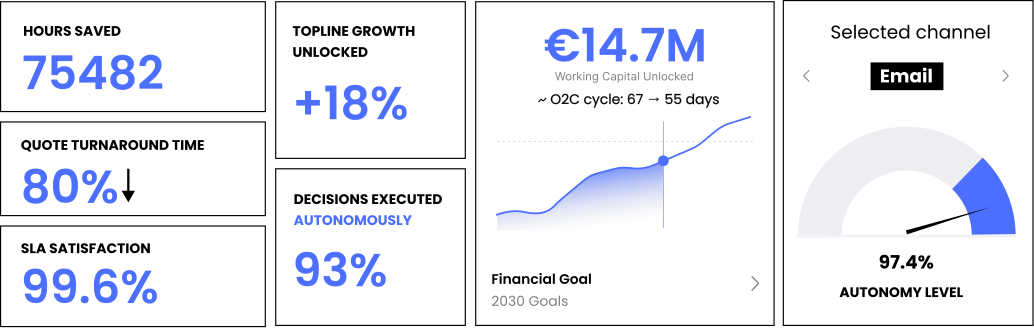
The outcomes from autonomous execution are visible across operations, finance, and customer experience. Manufacturers and distributors that have deployed Go Autonomous consistently report faster order cycles, lower cost-to-serve, and significant improvement in digital channel adoption, without requiring customers to change how they order.
A leading European industrial manufacturer reduced manual order processing across key markets, freeing headcount for higher-value work and releasing significant working capital tied to slow order-to-cash cycles. Full details in the customer story.
A global B2B technology distributor moved from fragmented digital adoption, where most orders still required manual handling, to near-full autonomous execution in under three months, without asking customers to change how they sent orders. Read the story →
The pattern across deployments is consistent: organisations that move to autonomous execution stop the linear relationship between volume growth and headcount growth. Operations teams shift from transaction processing to exception handling and customer relationship management, work that actually requires human expertise.
Is Your Organisation Ready for Autonomous Commerce?
Autonomous Commerce is not a technology project. It is an operating model decision. The organisations best positioned to benefit are manufacturers and distributors with €500M+ in revenue that are growing in commercial complexity, more customers, more channels, more markets, and are seeing the cost and cycle time consequences of scaling through people.
The practical starting question is straightforward: what percentage of your incoming orders and quotes reach a human queue, and why? If the answer involves email interpretation, EDI exceptions, document-based orders, or pricing validation, those are execution gaps that autonomous commerce is designed to close.
Go Autonomous works with commercial and operations leaders to assess where autonomous execution creates the most immediate impact. Request an executive briefing to walk through your specific operation and understand what a realistic transition looks like for your business.
Join the Autonomous Commerce Summit
Connect with operations and commercial leaders shaping the future of B2B commerce. Hear directly from manufacturers and distributors who have made the shift to autonomous execution.
Register your place →
Frequently Asked Questions
Autonomous Commerce is an operating model where AI executes B2B commercial work, quotes, orders, pricing, and fulfillment, end-to-end without human intervention on routine transactions. Unlike automation tools that handle predefined tasks, Autonomous Commerce understands intent from any channel and executes complete commercial actions using consistent rules and data.
RPA automates predefined, structured tasks and breaks when inputs vary. AI agents can read and suggest but still require human action. Autonomous Commerce executes end-to-end, from reading an unstructured customer request to completing the order in the ERP, without a human in the loop on routine transactions.
The Go Autonomous platform processes incoming demand across email, EDI, web portals, and document-based channels (PDF, Excel) through a single execution layer. Customers do not need to change how they send orders.
Most Go Autonomous deployments go live within weeks, not months. The platform connects to existing ERP and CRM systems and does not require customers to change their ordering behaviour, which removes the main barrier to fast deployment.
Manufacturers and distributors with €500M–€20B in revenue, operating across multiple markets and customer types, see the clearest ROI. These organisations have sufficient transaction volume and commercial complexity to make autonomous execution genuinely impactful, and enough at stake in speed, margin, and cost-to-serve to justify the investment.
No. Autonomous Commerce removes routine transaction processing from the commercial team’s workload. People are redirected to exceptions, complex negotiations, and relationship management, work that genuinely requires human expertise. The team does not shrink; it becomes more strategic.