.svg)





Autonomous Order Processing for B2B Distributors: Why Distribution Is the Highest-ROI Use Case
B2B distributors process more orders with thinner margins than any sector. Here's why autonomous order processing delivers its highest ROI in distribution.
B2B distribution is where manual order processing does the most damage, and where autonomous execution delivers its highest return. Distributors process more orders per employee, across more customer accounts, with more format variation, on thinner margins, than virtually any other sector in B2B commerce. This post is for operations and commercial leaders at B2B distributors who are evaluating autonomous order processing and want to understand the full ROI structure, not just the headline cost reduction. You will learn why distribution is structurally different from manufacturing for this investment, how the four-component ROI compounds, what real deployments look like, and what implementation requires that most vendors do not tell you upfront.
Table of Content
- Why Distribution Is Structurally Different, and Why That Makes Autonomous Order Processing More Valuable Here Than Anywhere Else
- The Four-Component ROI Structure for Autonomous Order Processing in Distribution
- Distribution vs. Manufacturing: Why the ROI Gap Is Structural, Not Incidental
- What Autonomous Order Processing Looks Like at Scale in Distribution
- What B2B Distribution Order Management AI Implementation Actually Requires
- Sources
- Frequently Asked Questions
- See Autonomous Commerce in Action at the 2026 Summit
Why Distribution Is Structurally Different, and Why That Makes Autonomous Order Processing More Valuable Here Than Anywhere Else
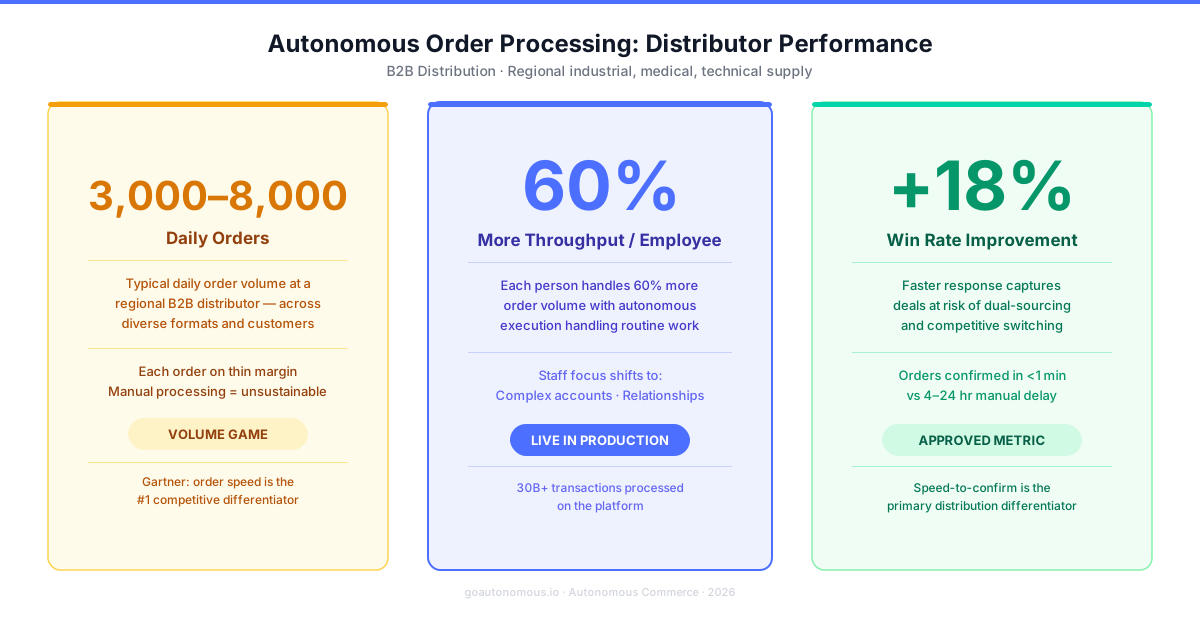
Start with the numbers that define distribution as a business. A regional industrial distributor might carry 200,000 SKUs from 800 suppliers and serve 12,000 customer accounts. On a normal trading day, that distributor processes 4,000–8,000 orders arriving in every format imaginable, structured EDI from the top 50 accounts, email from the next 2,000, phone calls and faxes from the long tail. Gross margin is 18–25%. Operating margin is 3–6%. Every operational cost line carries disproportionate weight when you are running on margins this thin.
Compare that to a typical B2B manufacturer. The manufacturer might carry a catalog of 2,000–10,000 SKUs, serve 200–600 customer accounts, and process 300–1,500 orders per day. Order patterns are more predictable. The customer base is smaller and more structured. Pricing tends to be stable. Many manufacturers have already solved their order processing challenge through EDI or customer portal adoption across their manageable account base.
Distribution has none of these characteristics. The complexity is not a temporary problem, it is the structural reality of the business model. Autonomous order processing for B2B distributors is not the same investment it is for manufacturers. The addressable volume is larger, the format diversity is wider, and the margin environment means that each efficiency point has a higher dollar value. That is what makes this the highest-ROI deployment context in B2B commerce.
The Volume-Margin Trap Unique to B2B Distribution
Distribution is caught in a trap that manufacturing rarely faces at the same intensity. Revenue growth in distribution means more orders. More orders, in a manual processing model, means more order desk headcount. More headcount means higher operating costs. But margin is already thin, so cost growth that tracks revenue growth does not improve profitability, it merely sustains it. Distributors who have been in business for two or three decades consistently describe the same pattern: each new sales milestone required a new hire on the order desk, and the ratio never improved.
This is the volume-margin trap. McKinsey research on B2B distribution operations identifies labor productivity in order processing as the single highest-impact efficiency lever available to distributors, ahead of warehouse automation, fleet routing, and pricing optimization, precisely because the volume-margin relationship is so unfavorable. Autonomous execution breaks the trap structurally: order volume scales; headcount does not. The ratio improves with every additional order processed autonomously.
One customer described it directly. Hempel, a global coatings manufacturer and distributor, found that each incremental revenue milestone required adding to the customer care team rather than serving it through productivity gains. That pattern is not sustainable at scale.
Each time we added one or two million euros in revenue, we had to add another operator. From a cost perspective, that's an unsustainable way of operating a business.

The pattern Vindeløv describes is not a management failure. It is the logical consequence of operating a high-volume, format-diverse order environment with manual processing. The only way out is to decouple order processing capacity from headcount, and that requires execution that is genuinely autonomous, not assisted.
Format Diversity in Wholesale Distribution Order Channels
The format diversity challenge is more acute in distribution than in manufacturing for a structural reason: distributors serve a longer tail of customers. A manufacturer with 400 accounts can, over time, push most of them toward structured order channels, EDI, customer portal, punchout. With sustained commercial effort and a manageable account base, that is achievable.
A distributor with 12,000 accounts cannot do this. The long tail, accounts 500 through 12,000, each represent a fraction of a percent of revenue. They will not invest in EDI integration with a distributor. They will not change their procurement process to match the distributor’s preferred channel. They will email an order in their own format, reference their own part numbers, specify their own delivery requirements, and expect a confirmation by end of business. When they do not get one, they call. When calling does not resolve it quickly, they place the order with someone else.
Forrester’s B2B digital commerce research shows that email remains the primary order channel for 50–70% of B2B transactions by volume, concentrated in the mid-market and SMB segments that make up the long tail of most distributors’ customer bases. Template-based RPA automation cannot handle this. It requires per-customer configuration and breaks on format changes. Autonomous execution that reads intent rather than format is the only technology that handles the full customer base without configuration overhead. The distinction between RPA and AI-driven autonomous execution matters specifically here, in distribution, the format tail is too long and too varied for rule-based approaches to reach meaningful automation rates.
Why Distribution Operations Face Higher Processing Cost per Order Than Manufacturing
Fully-loaded order processing cost in distribution, including order entry, validation, catalog matching, customer confirmation, and exception handling, runs €15–35 per order in manual environments. APQC process benchmarks for order management show that top-quartile distributors operating with high automation rates achieve cost per order of €3–7, while bottom-quartile manual operations run €40–60 per order fully loaded.
The gap between top and bottom quartile is almost entirely attributable to automation rate, not to team size, not to ERP system choice, not to market segment. This means the investment case for b2b distribution order automation is not speculative. The benchmark data exists. The performance difference between automated and manual operations is documented at scale. The question for any distributor is not whether autonomous processing improves economics, it is how large the improvement will be for their specific volume and cost structure.
The Four-Component ROI Structure for Autonomous Order Processing in Distribution
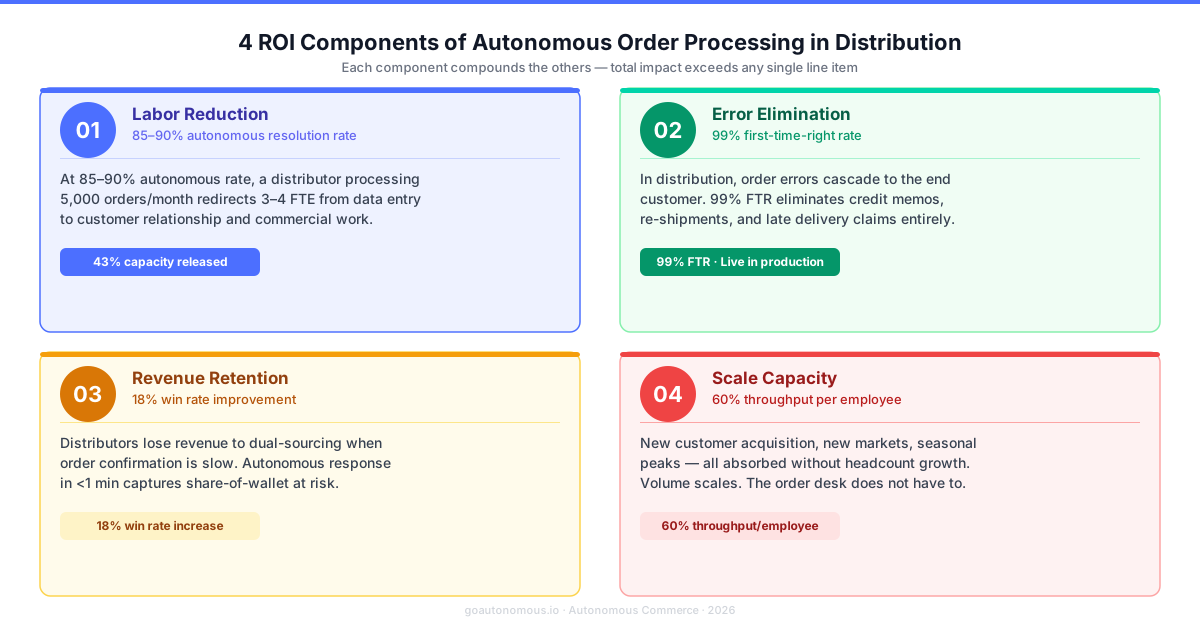
Distribution leaders evaluating this investment typically focus on direct labor savings. That is the most visible component, and it alone often justifies the investment. But there are three additional components that compound the return, and in high-volume distribution environments, the combined ROI across all four exceeds what direct labor reduction alone suggests by a factor of two to three. Understanding all four components is essential for building a CFO-grade investment case.
Component 1: Direct Labor Cost Reduction for Distribution Operations
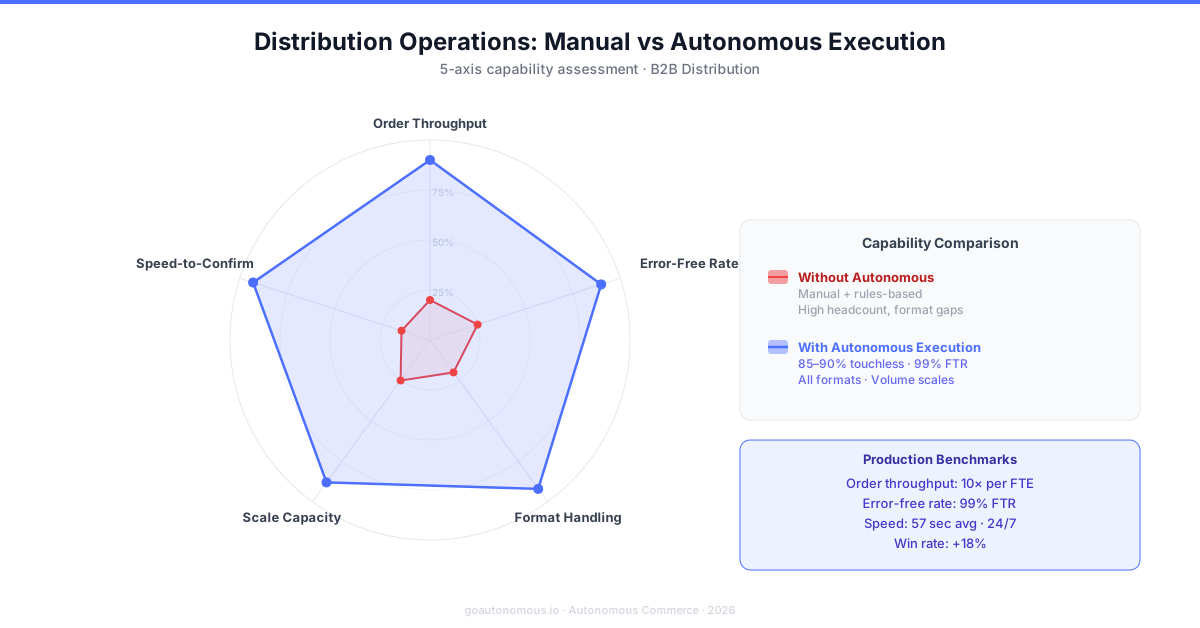
At autonomous resolution rates of 85–92%, a distributor processing 5,000 orders per day can reduce their active order desk from 25–40 FTEs to 5–8 FTEs managing exceptions and commercial escalations. At a fully-loaded cost of €55,000–€80,000 per FTE annually across European markets, this translates to €1.0–€2.8M in direct labor savings per year. The savings are recurring. They scale with order volume, as revenue grows, the autonomous platform absorbs the incremental orders without requiring proportional headcount growth.
This component is also the most straightforward to model for finance. Take current order desk headcount, apply the expected autonomous resolution rate, calculate the FTE reduction, multiply by fully-loaded cost. The number is concrete and auditable. It typically delivers payback on the investment in 9–14 months for distributors above 500 daily orders.
Component 2: Error and Exception Cost Elimination in Wholesale Order Processing
Manual order processing in distribution produces error rates of 1–4% at scale. The range varies by order channel, SKU complexity, and the quality of the order desk. At 5,000 daily orders and a 2% error rate, that is 100 error incidents per day. Each incident requires detection, investigation, customer communication, credit note issuance, re-shipment coordination, and carrier claim processing when applicable. Fully loaded, distribution order errors cost €50–€150 each to resolve, meaning 100 daily incidents represent €5,000–€15,000 in daily error resolution cost, or €1.25–€3.75M annually.
Autonomous processing eliminates the structural source of most of these errors: miskeyed data, wrong part number interpretation, incorrect unit-of-measure conversion, and delivery address ambiguity. First-time-right rates of 95–99% are documented in production deployments. The Nilfisk deployment of autonomous order management demonstrates this pattern, Nilfisk, a global cleaning equipment manufacturer and service distributor, achieved dramatic improvements in order accuracy by moving from manual entry to autonomous processing across their high-volume order intake. Errors that previously required rework, credits, and customer service hours dropped substantially across their operation.
Component 3: Revenue Recovery Through Speed Advantage
This is the component that most operations leaders underestimate, and most CFOs are initially skeptical about. But the mechanism is straightforward and the evidence is consistent.
Distribution customers dual-source. This is not unusual behavior, it is standard operating practice for any procurement function that has learned, through experience, that their primary distributor cannot confirm orders reliably within their required window. When a customer places an order and does not receive a confirmation within 2–4 hours, they call. When calling does not produce a resolution faster than submitting the same order to an alternative supplier, the order goes to the alternative. Over time, customers systematically shift volume toward the distributor that confirms fastest.
NAW Institute for Distribution Excellence research on distributor competitiveness identifies order confirmation speed as the top-ranked competitive differentiator among B2B buyers evaluating their distributor relationships, ranking above price, catalog breadth, and technical support. When a distributor moves to autonomous execution and consistently confirms orders in under 60 seconds, that speed is immediately visible to customers. Share-of-wallet consolidation follows within 6–12 months as customers recognize that the confirmation reliability has structurally improved.
For a distributor with €150M in annual revenue and confirmation times currently running 4–8 hours, a conservative 8% share-of-wallet improvement among existing customers from speed consolidation represents €12M in revenue from the same customer base, with no additional sales investment. This is why autonomous execution is a revenue and margin story, not just an efficiency story. The customer experience impact of consistent, near-instant order confirmation is a commercial advantage that compounds over time.
Component 4: Structural Scalability, Growth Without Proportional Cost
The fourth component is what makes this investment strategically different from a cost reduction project. Autonomous order processing removes the constraint that makes revenue growth expensive in distribution: the requirement to add order desk headcount proportionally to order volume growth.
A distributor that grows from €150M to €200M in revenue, a 33% revenue increase, would historically need to grow their order desk by a similar proportion to handle the additional orders. With autonomous execution handling 90% of volume, the incremental orders are absorbed by the platform. The exception handlers process the same proportion of orders they always have, but the total headcount addition is minimal. Operating leverage improves: revenue grows faster than cost. Deloitte’s distribution industry outlook identifies improving operating leverage as the primary strategic imperative for distributors facing margin compression from customer pricing pressure and supplier cost inflation. Autonomous order processing is one of the few investments that changes this ratio structurally rather than through one-time headcount reduction.
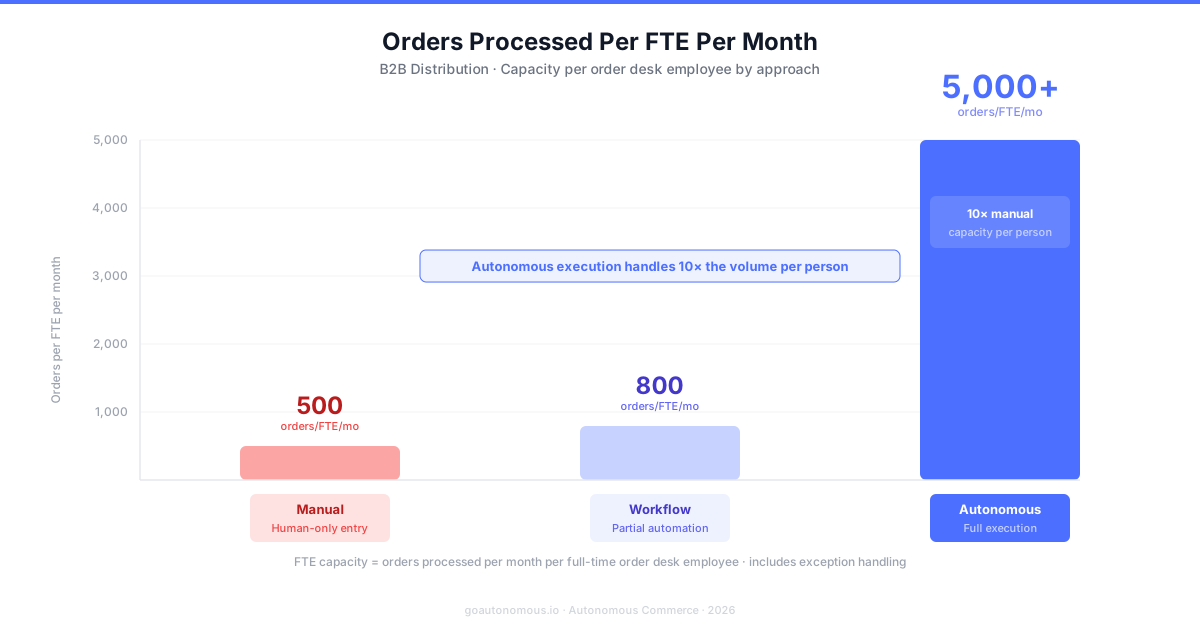
Combined, these four components produce ROI profiles that are materially larger than the direct labor calculation alone suggests. Distributors modeling all four consistently find internal rates of return in the 60–120% range on the investment, with payback in the first year driven by labor and error savings, and the revenue and scalability components accruing as compounding benefits in years two and three.
Distribution vs. Manufacturing: Why the ROI Gap Is Structural, Not Incidental
The claim that distribution delivers higher ROI from autonomous order processing than manufacturing is not intuitive to everyone. Manufacturers are large businesses with complex products and significant revenue per order, surely the complexity justifies the investment equally? The data says otherwise, and the reasons are structural.
Here is the comparison that makes the difference clear:
- Orders per employee per day. A distribution order desk employee manually processes 80–150 orders per day. A manufacturing order desk employee processes 30–60 orders per day, because each order is more complex and requires more commercial interaction. Autonomous processing replaces a larger share of work in distribution per deployed platform instance.
- Customer account base size. Distributors serve 5–50x more customer accounts than manufacturers of comparable revenue. Each additional customer account represents a different ordering format, different part number conventions, and different delivery requirements. The format diversity challenge that autonomous execution solves scales directly with account base size.
- SKU catalog depth. Distribution catalogs are 10–100x larger than manufacturer product catalogs. The catalog matching problem, identifying which SKU the customer is actually ordering when they use their own part number, a description, or a legacy reference, is proportionally harder in distribution. Autonomous execution addresses this at scale; manual lookup is increasingly slow as catalog size grows.
- Margin per order. Distribution margins of 18–25% on typically smaller average order values mean that processing cost represents a higher percentage of order margin than in manufacturing. An €18 processing cost on a €200 order at 20% gross margin consumes 45% of the gross margin on that order. The same €18 cost on a €2,000 manufacturing order at 45% gross margin consumes 2% of margin. The financial impact per order is categorically different.
- Confirmation speed sensitivity. Manufacturers’ customers are more tolerant of multi-day order confirmation times for complex, configured, or high-value orders. Distribution customers expect same-day or same-hour confirmation on commodity and semi-commodity orders. The revenue risk from slow confirmation is higher in distribution, and the revenue recovery from fast autonomous confirmation is correspondingly larger.
None of these differences are temporary. They are structural features of the distribution business model. Which is why autonomous commerce for distributors is not just a better ROI than the same investment in manufacturing, it is a categorically different investment in terms of what it changes about the competitive position of the business.
What Autonomous Order Processing Looks Like at Scale in Distribution
The proof points that matter in distribution are the ones from distribution businesses, not from manufacturing analogies or theoretical models. Three deployments document what autonomous execution actually delivers in high-volume distribution contexts.
Mediq: 91% Autonomous Order Handling for a Major European Medical Device Distributor
Mediq, a major European medical device distributor operating across multiple markets with thousands of healthcare provider customers, faced the classic distribution challenge at scale. High daily order volumes, diverse customer ordering formats ranging from structured EDI to informal email, and an order desk that had grown in proportion to revenue rather than improving in efficiency. The deployment of autonomous order processing produced a measured 91% autonomous resolution rate, meaning 91 of every 100 orders processed without any human intervention, from order receipt to ERP submission to customer confirmation.
That number is significant not just for its size, but for what it represents operationally. The 91% includes orders arriving in unstructured formats, orders referencing customer-internal part numbers that require catalog matching, orders with delivery address ambiguity that required rule-based resolution, and orders with pricing validation against account-specific contract terms. These are not simple pass-through transactions, they are the full complexity of distribution order processing, handled without human intervention. The 9% that required human handling were genuinely complex cases: commercial negotiations, unusual substitution requirements, and customer-specific exceptions that genuinely warranted human judgment. That is appropriate work for a skilled customer support team. Routine transaction processing is not.
Danfoss: Autonomous Order Intake Across 26 Countries
Danfoss, a global industrial manufacturer with a significant direct distribution operation, deployed autonomous order intake across 26 countries, standardizing a process that previously ran differently in each market. The cross-country deployment demonstrates something important for distributors operating across multiple geographies: autonomous execution handles language variation, regional format differences, and country-specific business rules within a single deployment. The alternative, building and maintaining country-specific order processing teams and workflows, is both expensive and inconsistent in execution quality. Orders that previously took days to confirm across international markets moved to under-one-minute confirmation times in autonomously handled cases.
Broader Distribution Outcomes: What the Pattern Looks Like
Across the Go Autonomous customer base, distributors consistently report three outcomes that align with the four-component ROI model: measurable reduction in order processing cost per order, significant improvement in first-time-right rates, and improvement in customer satisfaction scores driven by faster confirmation times. The relative size of each component varies by business, some distributors find the error elimination component exceeds the labor saving; others find the revenue recovery from speed dominates the calculation, but all three components materialize in production deployments. The ROI model is not theoretical. It is the pattern that emerges from actual deployments across the distribution sector.
What B2B Distribution Order Management AI Implementation Actually Requires
Most technology vendors describe implementation in terms of their platform’s capabilities. Distributors who have gone through the process describe it in terms of what they had to prepare on their side, and that preparation is where implementations succeed or stall. Here is what distribution-specific implementation actually requires, in the sequence it needs to happen.
- Catalog data quality audit. Distribution catalogs degrade over time. Discontinued SKUs remain in the system with no end-date. Supplier cross-references become stale when suppliers update their part numbers. Unit-of-measure conventions differ across customer account setups. Before any autonomous execution platform can reach target automation rates, the catalog must be clean enough for the system to resolve customer part number references reliably. This is not the vendor’s responsibility, it is the distributor’s. Budget 3–5 weeks for this work on a catalog of 100,000+ SKUs. It pays for itself in higher autonomous resolution rates from day one.
- Customer master data alignment. Autonomous execution needs accurate ship-to address records, correct contact associations for order confirmations, and up-to-date account-specific pricing and contract terms. Distributors with multiple ERP migrations in their history often have duplicate customer records, inconsistent address formats, and pricing data that does not match current contracts. Clean this before deployment, not after.
- Exception rule definition. Every order that cannot be autonomously resolved falls to human handling. The quality of exception handling depends on the clarity of the rules that define what constitutes an exception and how each type should be routed. Define these rules in advance, which exception types go to which team, what the resolution target time is, what information needs to be captured, and the exception queue runs efficiently. Leave these undefined and the exception process creates as much confusion as the manual process it replaced.
- Phased customer rollout by segment. Start with the 200–400 highest-volume accounts. These accounts generate the most orders and their patterns are best understood by the platform fastest. They are also the accounts where error consequences are highest, so proving reliability here builds confidence across the organization. Expand to the mid-tier after the top tier is running at target rates. The long tail follows last, these accounts benefit from autonomous processing too, but their individual volume does not justify prioritizing their format complexity in the initial configuration phase.
- ERP integration architecture. Autonomous execution sits between inbound order channels and the ERP. It needs read access to master data, catalog, customer records, pricing, and write access to create orders in the ERP. For distributors on SAP, Oracle, Microsoft Dynamics, Epicor, or Infor, standard integration APIs exist. No custom ERP development is required. The integration architecture should be confirmed with the ERP team and the vendor before the project starts, not discovered mid-implementation.
Aberdeen’s order management technology benchmark research shows that distributors who invest in data quality preparation before deployment reach target automation rates 55–65% faster than those who begin deployment without that preparation. The implementation timeline for a well-prepared deployment is 10–14 weeks from project start to production for the core customer segment. The breakdown is roughly 4 weeks on data quality and integration, 4 weeks on configuration and testing, and 2–6 weeks on phased customer rollout with monitoring. Distributors who skip the preparation phase consistently extend that timeline and achieve lower initial automation rates, which delays the ROI realization that justified the project.
If you are a B2B distributor evaluating this investment in 2026, the competitive question is not whether autonomous order processing works, the documented outcomes from Mediq, Danfoss, Nilfisk, and others resolve that question. The competitive question is how large the gap between early movers and late adopters becomes before the late adopters close it. In distribution, where processing speed is a primary competitive differentiator and customers consolidate volume toward the fastest confirming supplier, that gap widens with every quarter a competitor operates with autonomous execution and you do not.
Schedule a session with the Go Autonomous team to model the four-component ROI against your specific order volume, current automation rate, and cost structure. The variables that drive the return are concrete, daily order volume, current processing cost, error rate, confirmation time, and average order value. The calculation takes one conversation to complete, and the output is a specific number, not a range.
Sources
- Source: McKinsey & Company, B2B Distribution Operations Automation
- Source: Forrester Research, B2B Digital Commerce and Order Management Trends
- Source: APQC, Order Management Process Benchmarks
- Source: NAW Institute for Distribution Excellence, Digital Distributor of the Future
- Source: Deloitte, Distribution Industry Outlook
- Source: Aberdeen Group, Order Management Technology Benchmark Report
- Source: Gartner, Supply Chain Order Management Research
- Source: Boston Consulting Group, B2B Distribution Transformation
Frequently Asked Questions
Autonomous order processing is the execution of B2B orders, from receipt to ERP submission to customer confirmation, without human intervention. For distributors, this means inbound orders arriving by email, EDI, phone transcript, or portal are read, validated against the product catalog, matched to customer pricing, and submitted to the ERP automatically. The system handles the full process: catalog matching using customer-side part numbers or descriptions, delivery address resolution, pricing validation, and confirmation dispatch. Human handlers receive only the exception cases that genuinely require commercial judgment. This is distinct from RPA automation, which requires per-customer templates and breaks on format variation, and from assisted tools that suggest actions for a human to approve. Autonomous execution acts without human approval on the defined scope of orders that meet resolution criteria.
Four structural differences drive the higher ROI in distribution. First, distributors process more orders per employee per day than manufacturers, the labor savings from autonomous processing scale with volume. Second, distributors serve 5–50x more customer accounts, generating proportionally more format diversity that autonomous intent-based processing handles where template automation cannot. Third, distribution margins are thinner, 18–25% gross versus 40–60%+ in manufacturing, so processing cost represents a larger share of order margin, and efficiency improvements have larger dollar impact per order. Fourth, distribution customers are more sensitive to confirmation speed, meaning the revenue recovery from fast autonomous confirmation is larger and more immediate than in manufacturing. These are structural features of the distribution business model, not temporary conditions.
Distributors who prepare correctly, catalog data quality, customer master alignment, exception rule definition, consistently achieve 85–92% autonomous resolution within 90 days of production deployment on the core customer segment. Mediq, a major European medical device distributor, achieved 91% autonomous order handling in production. The remaining 8–15% are orders requiring commercial judgment, substitution decisions, or genuine exception handling. That share is appropriate work for a skilled customer support team, it is not a failure of the platform. Distributors who deploy without data preparation typically see initial rates of 60–70% and improve to 80–85% as the platform learns, but reaching 90%+ requires the foundational preparation to be complete at deployment.
The primary customer experience impact is order confirmation speed. Manual order processing in distribution produces confirmation times of 2–24 hours depending on volume, team size, and channel. Autonomous processing confirms autonomously handled orders in under 60 seconds, a 50–1,000x improvement in response time. Customers notice this change immediately and consolidate purchasing toward the distributor that is reliably fast. Beyond speed, autonomous processing also improves accuracy, fewer incorrect shipments, fewer credits, fewer follow-up calls. The combination of speed and accuracy is what drives the share-of-wallet consolidation that makes autonomous order processing a revenue story, not just a cost reduction story.
Implementation costs vary by distributor size, ERP environment, and scope of deployment, but most distributors above 500 daily orders see full investment payback within 9–14 months on direct labor cost reduction alone. When error elimination and revenue retention components are included, payback accelerates. The investment typically includes platform licensing, integration development, and data quality preparation, the last of which is often underestimated but is the primary driver of time-to-target-automation-rate. Distributors with clean catalog and customer data deploy faster, reach higher automation rates sooner, and realize ROI more quickly than those who invest in the platform before the data is ready.
Autonomous execution platforms integrate with distribution ERPs through standard APIs. For SAP, Oracle, Microsoft Dynamics, Epicor, and Infor, the most common ERP systems in distribution, integration uses existing APIs for master data retrieval (product catalog, customer data, pricing) and order creation. No custom ERP development is required. The platform sits between inbound order channels and the ERP, processing incoming orders and creating transactions through the same interfaces used by any other external integration. The distributor’s ERP team needs to be involved in the integration design phase, but the technical work is straightforward relative to full ERP implementation projects.
EDI and order portals require customers to conform to the distributor’s format, customers must invest in EDI integration or learn the portal interface. This works for the top 5–10% of accounts (largest, most sophisticated customers) who will make that investment. It does not work for the remaining 90% of the account base. Autonomous order processing works from the customer’s format, whatever they send, however they send it, the system processes it. This is the fundamental difference: EDI shifts the burden to the customer; autonomous execution absorbs the burden on behalf of the distributor. For distributors with long customer tails, thousands of accounts who will never invest in EDI, autonomous execution is the only technology that reaches meaningful automation rates across the full customer base.
See Autonomous Commerce in Action at the 2026 Summit
The Autonomous Commerce Summit 2026 brings together operations and commercial leaders from B2B manufacturing and distribution who are actively transforming how revenue is executed. Hear directly from companies that have made the shift to autonomous execution, and what it means for revenue, cost, and working capital. Attendance is by invitation only.
Request your invitation →