.svg)





Why B2B Manufacturers Still Run a 15-30 Person Order Desk on Top of SAP
SAP runs the ERP, but it doesn't autonomously handle unstructured inbound orders. Here's why manufacturers add an autonomous execution layer on top of SAP.
SAP is the system of record for most large B2B manufacturers, and it will remain so. But SAP was never designed to autonomously handle the inbound order intake problem: the volume of emails, non-standard EDI transactions, portal submissions, and PDF attachments that arrive every day in formats SAP cannot read without a human in between. This post is for operations and IT leaders at SAP-running manufacturers who have completed, or are mid-way through, a SAP transformation and are still asking why they need 15 to 30 people on an order desk. The answer is not that SAP is broken. The answer is that SAP needs an autonomous execution layer in front of it, and this post explains exactly what that means, how it integrates, and what manufacturers who have deployed it are seeing in practice.
Table of Content
- The SAP Order Management Gap That No ERP Upgrade Closes
- What an Autonomous Execution Layer Is, and How It Integrates with SAP
- Autonomous Execution in the SAP S/4HANA Migration Context
- What SAP-Running Manufacturers Are Seeing in Practice
- How to Evaluate Autonomous Execution Platforms for SAP Order Management
- Sources
- Frequently Asked Questions
The SAP Order Management Gap That No ERP Upgrade Closes
Walk into any order management operation at a global manufacturer running SAP and you will find the same structure: a team of customer service representatives whose primary job is to translate what customers send into what SAP can accept. They read the email. They match the customer’s part number to the SAP material number. They check if the requested delivery date is achievable against stock. They apply the correct pricing from the customer’s contract. Then they open SAP SD and manually create the sales order.
This is not a failure of the SAP implementation. It is the structural consequence of an ERP architecture built around a fundamental assumption: that order data arrives pre-structured, pre-validated, and ready to post. In SAP’s world, a sales order is a formal object with defined fields, sold-to party, ship-to party, material number, quantity, delivery date, pricing condition records, payment terms. The system manages that object with extraordinary precision from creation through delivery. What SAP does not do is autonomously read an email from a purchasing agent in Munich that says “please send 200 units of the brushless motor, same specs as order 4500017823, deliver to our Cologne warehouse by end of month” and turn that into a valid SAP sales order without a human involved.
That gap, between how customers actually communicate orders and what SAP requires to process them, is where the order desk lives. And it is the gap that autonomous commerce execution is purpose-built to close.
Why the SAP Order Desk Persists in B2B Manufacturing
The B2B order intake problem is fundamentally a format diversity problem. Customers do not order in SAP’s language. They order in their own language, their own part numbers, their own pricing references, their own delivery instruction formats, their own EDI variants, their own portal schemas. A global manufacturer selling to 2,000 customers might have 2,000 distinct order formats in practice. SAP SD requires one format: its own.
The order desk is the translation layer. Every person on that team is doing cognitive work that SAP cannot do: reading intent, resolving ambiguity, applying business rules, catching errors before they become delivery problems. That work has real value. The problem is that it scales linearly with order volume. Add revenue, add people. That is the economics of a manual SAP order desk, and it is why autonomous execution has become the priority for manufacturers serious about SAP order management automation in 2026.
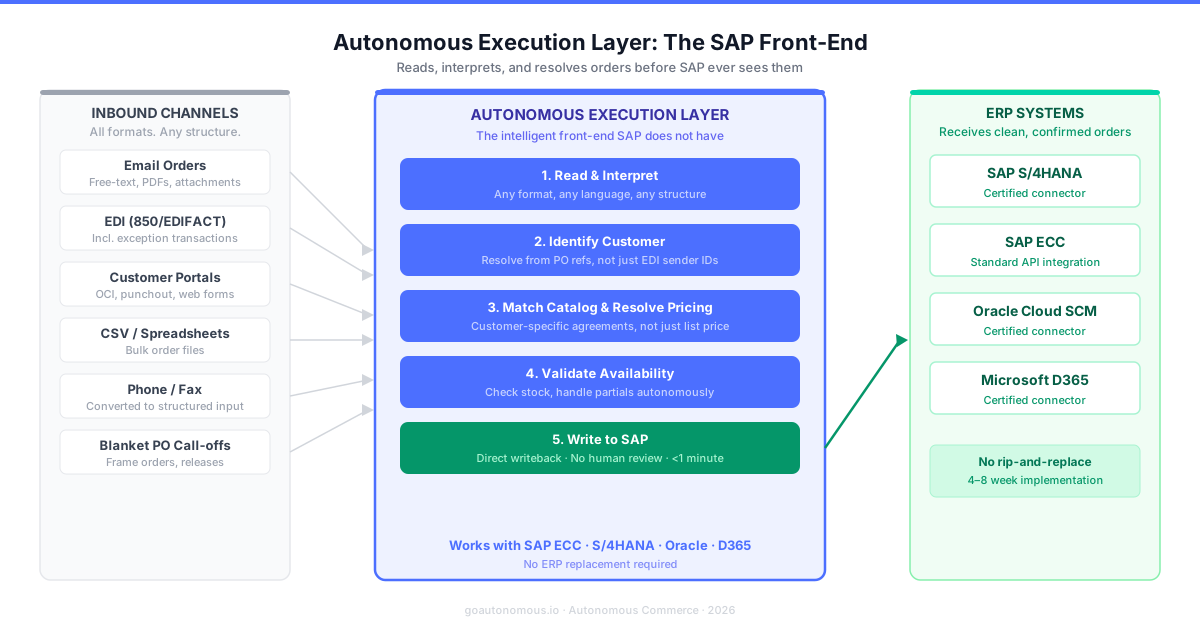
According to Gartner’s order management technology research, manufacturers in complex multi-channel B2B environments typically dedicate 10–25% of their customer-facing headcount to order translation and entry tasks that the ERP cannot handle without human facilitation. That figure has not moved meaningfully in a decade despite significant SAP investment, because the SAP investment was in ERP capability, not in the autonomous execution of unstructured inbound order intake.
What SAP Order Management Actually Handles, and What It Does Not
To understand the execution gap clearly, it helps to be precise about what SAP does and does not do in B2B order management for manufacturers.
SAP handles exceptionally well:
- Sales order management once the order is created in the system, status tracking, availability checking, delivery scheduling, invoicing
- Pricing and conditions management through condition records, customer-specific pricing, contract pricing, volume discounts, rebate structures
- Credit management, credit limit checks, blocked order queues, release workflows
- Structured EDI processing, IDoc-based inbound processing for EDI transactions that conform to SAP’s expected format and mapping
- Material master and customer master management, the master data that governs how orders are validated and processed
- Delivery, goods issue, and invoicing workflows, the operational execution of orders that are already in the system
SAP does not handle autonomously:
- Inbound emails from customers with order intent, reading, interpreting, and extracting structured order data from free-text communication
- PDF purchase orders, parsing customer-formatted PO documents into SAP-ready data
- Non-standard EDI variants, customer-specific EDI configurations that do not match SAP’s expected IDoc structure without custom mapping
- Customer part number to SAP material number resolution, matching customer product references to the correct SAP material numbers, including obsolete materials and successor products
- EDI rejection resolution, when inbound transactions fail SAP’s IDoc validation, manual intervention is required to diagnose and resubmit
- Exception handling during order processing, incomplete orders, delivery date conflicts, pricing mismatches, minimum order quantity violations
The first list is why SAP is indispensable. The second list is why the order desk still exists. An autonomous execution layer resolves the second list, and feeds SAP the clean, validated orders it needs to do what it does best.
Each time we added one or two million euros in revenue, we had to add another operator. From a cost perspective, that's an unsustainable way of operating a business.

This is the cost structure that breaks at scale. Revenue grows, headcount grows in lockstep, and the margin expansion that should come from volume never arrives because every additional euro of revenue adds another person to the order desk. The autonomous execution layer breaks that linear dependency between revenue and order desk headcount, and it does it without touching the SAP infrastructure that the business runs on.
What an Autonomous Execution Layer Is, and How It Integrates with SAP
An autonomous execution layer is a platform that sits between inbound order channels and the ERP. It receives orders from all channels simultaneously, email, EDI, customer portal, API, processes them regardless of format, validates them against live SAP master data, resolves common exceptions autonomously, and creates clean, valid sales orders in SAP without human intervention on routine transactions.
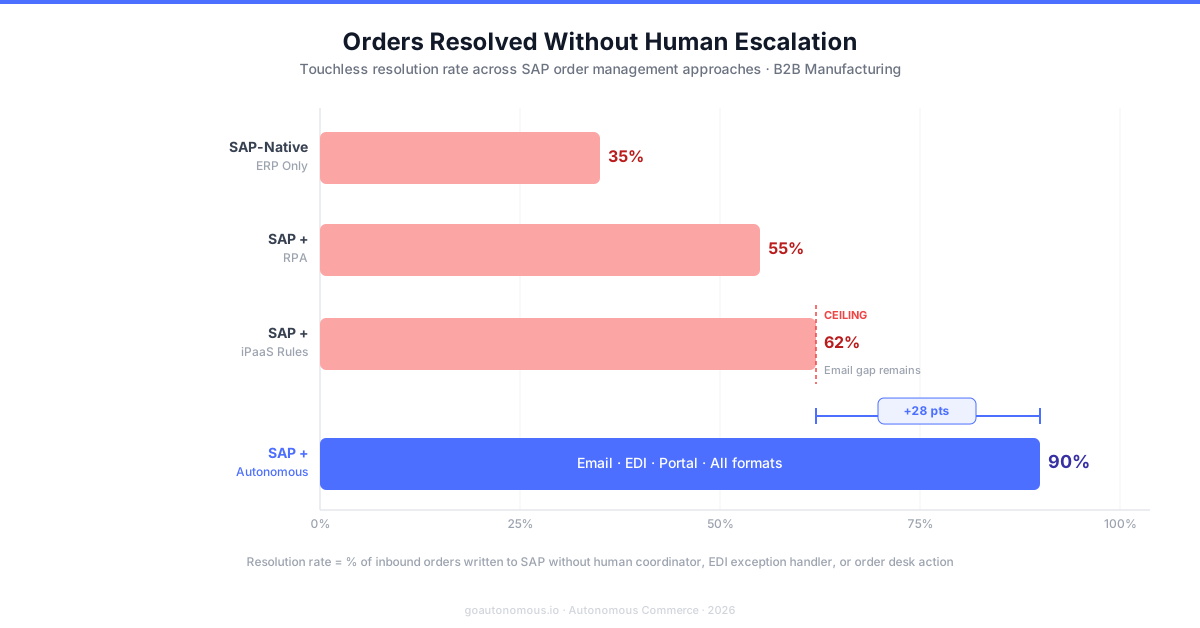
This is not RPA. RPA tools automate the mechanical steps of what a human does, they click through the SAP UI, paste values, submit forms. An autonomous execution layer works at the data and logic level: it understands order intent, applies business rules, connects to SAP APIs for validation, and posts orders directly through SAP’s standard interfaces. The difference between RPA and autonomous AI execution matters significantly in practice, RPA breaks when formats change, requires constant maintenance, and cannot handle genuine ambiguity. Autonomous execution handles variability by design.
SAP Integration Architecture for Autonomous Order Processing
The integration question is usually the first one that SAP architects and IT leaders raise when evaluating autonomous execution: how does an external platform connect to SAP, and what does that mean for SAP governance and upgrade paths?
The standard integration architecture uses SAP’s own published interfaces. For SAP S/4HANA, that means OData services, the same RESTful APIs that SAP exposes for any external system integration. For SAP ECC, the equivalent is BAPI and RFC calls, the established programmatic interface to ECC functions. The autonomous execution platform uses these interfaces for two purposes:
- Data retrieval for order validation, pulling live material master data, customer master data, pricing condition records, delivery scheduling, and inventory availability to validate incoming orders against current SAP state before posting them
- Sales order creation, posting validated orders directly into SAP SD through standard IDoc or API-based sales order creation, producing orders in SAP that are indistinguishable from manually entered ones in terms of data quality and completeness
This architecture has a critical implication for SAP governance: it requires no custom ABAP development inside the SAP system. The execution platform is external to SAP. It connects through published interfaces. The SAP implementation itself, its configuration, its change management processes, its upgrade schedule, is not affected. This matters enormously for manufacturers in heavily governed SAP environments where even minor changes go through formal change control cycles. The autonomous execution layer deploys without touching the ERP.
Forrester’s analysis of order management platforms for B2B manufacturers identifies API-first integration with ERP as the primary differentiator between platforms that deploy successfully in enterprise SAP environments and those that require expensive customization work inside the ERP. Manufacturers who select platforms requiring SAP customization consistently experience longer deployments, higher integration maintenance costs, and difficulty upgrading SAP independently of the execution platform.
Autonomous EDI Exception Handling for SAP S/4HANA Order Processing
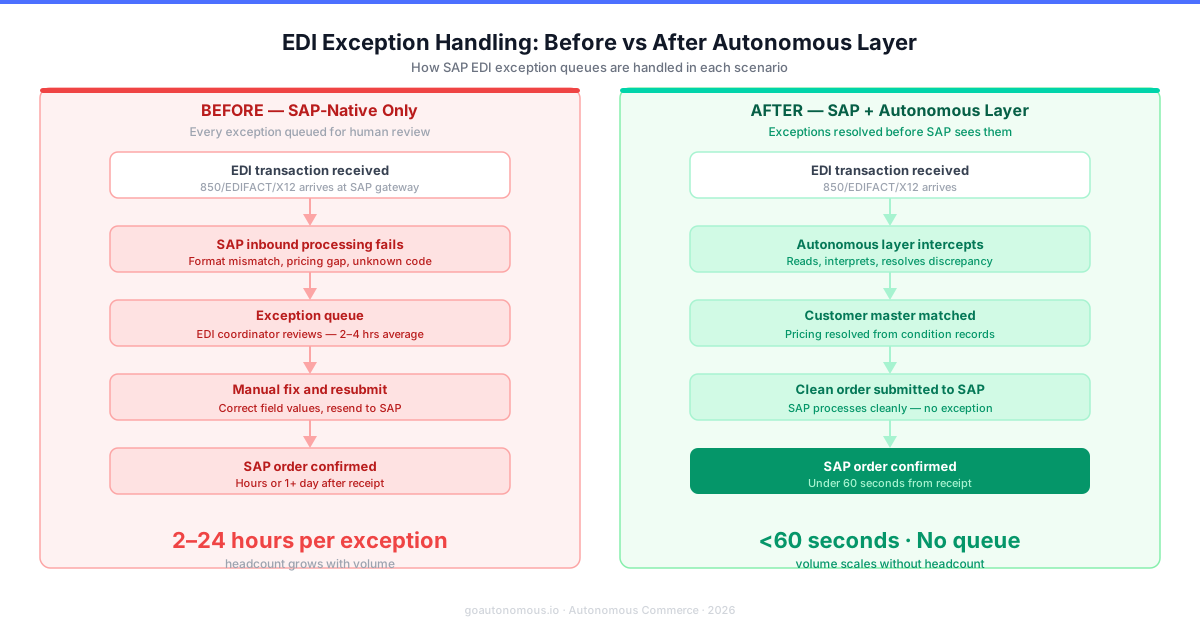
EDI is the channel where the gap between SAP’s capabilities and what manufacturers actually need is most visible. SAP processes structured EDI transactions correctly, when the IDoc arrives in the expected format, with the correct segments, matching SAP master data, within credit limits, the automation works. When it does not, the transaction fails and drops into an error queue.
EDI error queues in SAP are a persistent operational problem for manufacturers with complex customer EDI relationships. Common failure types include: customer-side mapping errors producing incorrect segment structures, material number references that have changed on the customer’s side without SAP master data updates, quantity or unit-of-measure mismatches, ship-to address codes that do not exist in the SAP customer master, and credit limit violations on orders that should qualify for automatic approval under existing contract terms.
Each of these failure types has a defined resolution path. Most of them can be resolved without human judgement, they require pattern recognition and rule application, which is exactly what autonomous execution does. A platform that understands the SAP EDI failure taxonomy, maintains the resolution logic for each type, and can act on it automatically eliminates the majority of EDI exception handling from the order desk workload. McKinsey’s research on B2B operations efficiency shows that EDI exception handling typically consumes 20–35% of order desk capacity in manufacturers running complex multi-customer EDI programs, making it one of the highest-value automation targets in SAP order management for distribution operations and manufacturing.
Material Number Matching and Catalog Resolution for SAP-Running Manufacturers
One of the most operationally painful aspects of SAP order management in B2B manufacturing is the gap between customer product references and SAP material numbers. Customers do not manage your SAP material master. They use their own part numbers, their own descriptions, their own catalog identifiers, or simply reference previous orders. A customer who orders “part 47-B brushless drive, 5kW, same as last November” is communicating clearly to a human and incomprehensibly to SAP without a lookup table that maps “47-B brushless drive” to the correct SAP material number.
Manual material number resolution is one of the hidden time costs of B2B order management in SAP environments. It requires product knowledge, access to cross-reference tables, and judgment for ambiguous cases where multiple materials could match. An autonomous execution layer builds and maintains this cross-reference intelligence automatically, learning from every order processed, building customer-specific part number mappings, and applying successor material logic when original materials have been discontinued in the SAP material master.
The efficiency gains from autonomous material number resolution compound over time. Early in deployment, the platform learns from exception cases. Within weeks, the match rate on customer references approaches the accuracy of an experienced order desk representative, and the speed is orders of magnitude faster, with zero variability across team members or shifts.
Autonomous Execution in the SAP S/4HANA Migration Context
A significant proportion of the manufacturers reading this post are either planning a SAP ECC to S/4HANA migration or are currently executing one. The migration context adds a specific dimension to the autonomous execution conversation that is worth addressing directly.
The question that comes up consistently: should we wait until the S/4HANA migration is complete before deploying autonomous order execution? The answer, based on what manufacturers who have done both have reported, is no, and the reasoning is straightforward.
First, the ROI on autonomous execution is independent of ERP version. The order desk labor cost, the exception handling backlog, the slow order confirmation times, these exist in ECC environments and S/4HANA environments equally. Waiting 18–24 months for the migration to complete before eliminating those costs means 18–24 months of foregone efficiency savings that do not return.
Second, the integration architecture that makes autonomous execution migration-safe is the same architecture that makes it valuable in the first place. A platform that integrates through SAP APIs, OData for S/4HANA, BAPI/RFC for ECC, transitions between ERP versions by updating the API endpoint configuration. The execution logic, the business rules, the customer-specific processing intelligence all carry forward without rebuilding. Accenture’s S/4HANA migration practice guidance explicitly recommends stabilizing order intake automation before migration cutover to reduce the operational risk of simultaneously managing ERP transition and manual order volume spikes.
Third, manufacturers who deploy autonomous execution before their S/4HANA migration arrive at cutover with a significant advantage: their order intake process is already documented, already automated, and already generating data about exception patterns and processing performance. That data is invaluable for the S/4HANA configuration work that governs how orders process post-migration. The autonomous execution layer essentially does a continuous audit of order intake patterns that the SAP configuration team would otherwise have to reconstruct from interviews and historical reports.
Deloitte’s manufacturing ERP transformation research identifies order management as one of the three highest-risk processes during S/4HANA migration, high volume, customer-facing, and dependent on master data that is often partially migrated or reconfigured during the project. Manufacturers who have automated order intake before migration report significantly lower operational disruption during cutover compared to those managing both the migration and a manual order desk simultaneously.
SAP B2B Commerce Execution Gap: The S/4HANA Promise vs. Reality
The S/4HANA migration promise, faster processing, real-time inventory, integrated analytics, modern UX, is real and delivered in the areas where SAP operates. What S/4HANA does not change is the fundamental architecture of inbound order intake. S/4HANA still requires structured data input. S/4HANA still processes EDI through IDocs that must conform to expected formats. S/4HANA still relies on human-readable emails being translated into SAP-ready sales orders by the order desk.
This is not a criticism of S/4HANA, it is a clarification of what ERP modernization delivers and what it does not. Manufacturers who complete their S/4HANA migration and then confront the unchanged reality of their order desk are not experiencing an implementation failure. They are experiencing the SAP B2B commerce execution gap that no ERP version resolves, because the gap is architectural, not configurational. The autonomous commerce execution model exists precisely to fill that architectural gap, sitting above the ERP, feeding it the structured, validated orders it requires, at a speed and scale no human team can match.
What SAP-Running Manufacturers Are Seeing in Practice
Autonomous execution in SAP environments is not a theoretical capability. Manufacturers are running it in production today, at scale, across the full range of inbound order channels. The outcomes are consistent enough to describe with confidence.
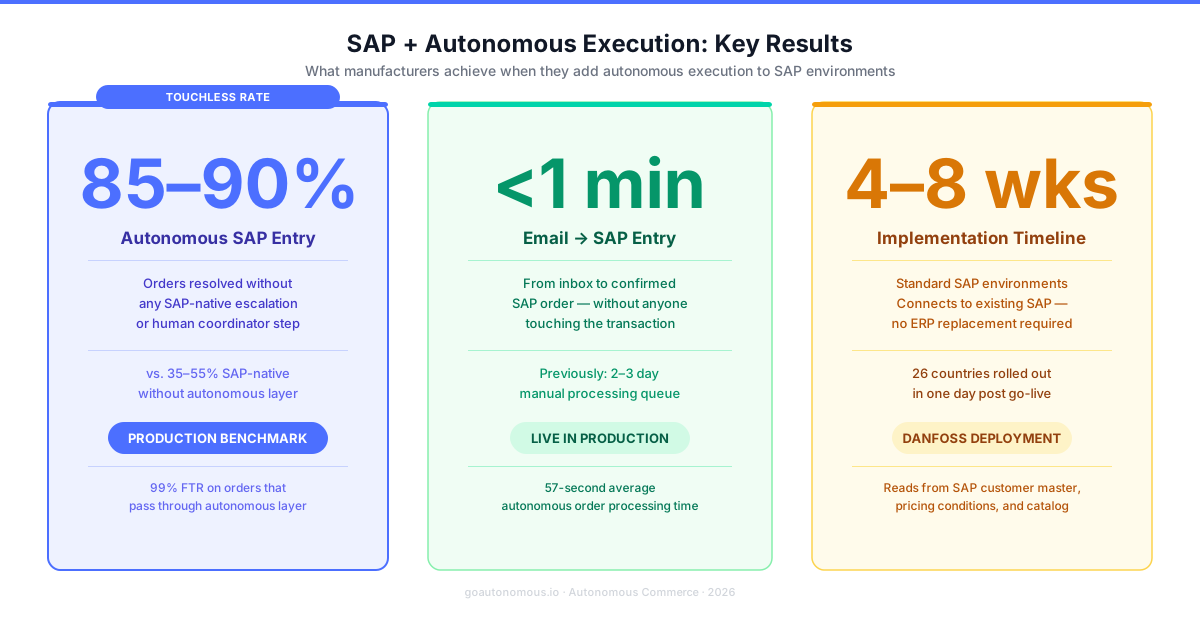
Danfoss, a global industrial manufacturer operating across 26 countries with SAP as their core ERP, deployed autonomous execution across their email and EDI order intake channels. Orders that previously took hours of manual processing are now confirmed in under one minute from receipt. The autonomous layer handles the channel diversity, the language diversity, the customer-reference-to-SAP-material-number translation, and the exception resolution, with SAP receiving clean, validated sales orders through its standard interfaces throughout. The Danfoss deployment demonstrates what SAP order desk automation at enterprise scale actually looks like in a complex global manufacturing operation.
Nilfisk, a leading cleaning technology manufacturer, applied autonomous execution to their order management operations. The impact was felt in two directions: the order desk team was freed from routine transaction processing to focus on exception cases and customer relationships, and customers experienced significantly faster order confirmation and acknowledgment. The measurable shift in customer experience outcomes, speed and accuracy of order handling, is consistently one of the first outcomes manufacturers report, because customers notice it before the internal efficiency metrics fully develop.
Across the manufacturers in the Go Autonomous success case portfolio, the pattern is consistent. The initial ROI case is built on direct cost reduction, order desk headcount, EDI exception handling labor, rework from manual entry errors. The secondary value is speed and accuracy improvement in customer-facing operations. The tertiary value, which takes longer to quantify but is often the most strategically significant, is the ability to grow revenue without growing the order desk, the structural cost improvement that Vindeløv described at Hempel and that shows up as margin expansion as the business scales.
Mediq, a medical distribution operation, achieved 91% autonomous order handling after deploying the execution layer, meaning 9 in 10 orders process end-to-end without a human involved, from inbound channel through ERP confirmation. That figure represents a structural shift in how order management operates: the team that previously processed orders now reviews the 9% that require human judgment, with the operational intelligence to understand why exceptions occur and how to reduce them further.
IDC’s analysis of AI deployment in manufacturing operations confirms that order management is consistently the highest-ROI application of autonomous AI in B2B manufacturing, ahead of demand forecasting, quality inspection, and predictive maintenance, because it combines high transaction volume, high labor cost, measurable error rates, and direct customer experience impact in a single process. The SAP context amplifies the opportunity: manufacturers have already made the ERP investment, the master data is clean, and the integration infrastructure is ready. The autonomous execution layer slots into an existing architecture rather than requiring a new one.
How to Evaluate Autonomous Execution Platforms for SAP Order Management
If you are running SAP and evaluating autonomous execution platforms, the evaluation criteria that matter most are different from general order management software assessments. The SAP integration depth, the exception handling logic, and the deployment architecture are the three areas where the gap between vendor claims and actual capability is widest.
Here is a practical evaluation framework for SAP-running manufacturers assessing autonomous order execution platforms:
- SAP integration method, Ask specifically which SAP interfaces the platform uses. OData for S/4HANA, BAPI/RFC for ECC, IDoc for EDI are the right answers. Screen-scraping the SAP UI, or requiring custom ABAP development, are disqualifying answers for any manufacturer concerned about maintenance cost and SAP upgrade compatibility.
- Live data validation, Confirm that the platform validates against live SAP master data at the time of order processing, not against a cached or replicated dataset. Pricing conditions, material status, credit availability, and inventory all change in real time, validation against stale data produces stale errors.
- EDI exception handling specificity, Ask the vendor to walk through your most common EDI rejection types and how the platform resolves each one autonomously. Vague answers about “AI handling exceptions” without a specific resolution mechanism for each failure type indicate the platform does not have deep SAP EDI expertise.
- Deployment timeline from signed contract to live processing, A purpose-built SAP integration should go live in 8–12 weeks for a standard deployment. Timelines beyond 16 weeks indicate heavy customization requirements that will also drive high ongoing maintenance cost.
- Migration compatibility, If you are planning an ECC to S/4HANA migration, ask explicitly how the platform transitions. The correct answer is a configuration update, not a new implementation. Platforms that require re-deployment for the S/4HANA connection should be evaluated accordingly.
- Reference customers in comparable SAP environments, Request references from manufacturers with comparable SAP complexity, similar order volume, similar channel mix, similar degree of customer EDI customization. General software references from non-SAP environments are not a useful signal for SAP-specific integration quality.
The topline growth and margin management impact of deploying the right platform is significant, but so is the cost of deploying the wrong one and then replacing it 18 months later. PwC’s digital manufacturing research shows that manufacturers who go through a second-round vendor replacement in order automation, having deployed an initial solution that could not handle SAP complexity at scale, spend on average 2.3x more than manufacturers who selected the right platform first. The evaluation investment upfront is always worth it.
Beyond the technical evaluation, the organizational question that matters is where autonomous execution sits in the operating model. The platform is not a replacement for the order management team, it is a force multiplier. The team that previously processed orders manually shifts to managing the exceptions the platform escalates, optimizing the business rules that govern autonomous processing, and using the operational intelligence the platform generates to improve customer terms, pricing accuracy, and delivery commitments. BCG’s B2B commercial transformation research shows that manufacturers who restructure the order management role around exception oversight and process optimization rather than transaction processing see the full value of autonomous execution within 6–12 months of deployment, the efficiency gains and the capability shift happening together.
If you are ready to see how this works against your specific SAP configuration and order intake volume, book a session with the Go Autonomous team. The conversation starts with your current SAP environment and works from there, no generic demo, no platform-first pitch.
Sources
- Source: Gartner, Order Management Technology Trends for B2B Manufacturers
- Source: Forrester. The Forrester Wave: Order Management Systems for B2B Manufacturers
- Source: McKinsey & Company. The Digital Future of B2B Operations
- Source: Accenture, SAP S/4HANA Migration Guidance for Manufacturing
- Source: Deloitte, Manufacturing ERP Transformation Research
- Source: IDC, AI Deployment ROI in B2B Manufacturing Operations
- Source: PwC, Digital Manufacturing Operations Report
- Source: BCG, B2B Commercial Transformation and Autonomous Operations
Frequently Asked Questions
SAP order management automation refers to the autonomous processing of inbound B2B orders, from email, EDI, portal, and API channels, into valid SAP sales orders without human intervention. Manufacturers need it because SAP itself requires structured, validated order data as input, but customers submit orders in dozens of unstructured formats. The gap between what customers send and what SAP accepts is where order desk labor is concentrated. Autonomous execution closes that gap by sitting between the inbound channels and SAP, reading orders in any format, validating against live SAP master data, and posting clean sales orders automatically.
No. SAP S/4HANA delivers significant improvements in ERP processing speed, real-time data, and analytics, but it does not change the fundamental architecture of inbound order intake. S/4HANA still requires structured data input to create sales orders. It still processes EDI through IDocs that must conform to expected formats. It does not autonomously read emails, parse PDF purchase orders, or resolve customer-side part number references into SAP material numbers. The SAP S/4HANA order processing automation gap requires a purpose-built execution layer that connects to S/4HANA, not an ERP upgrade.
Autonomous execution platforms integrate with SAP through published SAP interfaces, OData APIs in S/4HANA or BAPI/RFC calls in ECC, for both data retrieval and sales order creation. This means the execution platform is external to SAP and connects through the same interfaces any external system would use. No custom ABAP development is required inside the SAP system. The SAP implementation, its configuration, and its change management processes remain unchanged. This integration approach also makes the execution layer migration-safe: when moving from ECC to S/4HANA, the integration updates its API configuration without requiring changes to the execution platform.
Yes, and EDI exception handling is one of the highest-value use cases. EDI rejections in SAP environments typically fall into a defined set of failure types: customer-side mapping errors, material number mismatches, ship-to address discrepancies, quantity or unit-of-measure issues, and credit limit violations. An autonomous execution layer that understands the SAP EDI failure taxonomy can resolve 70–80% of these exception types automatically, without a human reviewing the error queue. The remaining 20–30% that require genuine human judgment are routed with full context, dramatically reducing the time an EDI coordinator needs to spend on each case.
Before, for manufacturers with significant manual order processing today. The ROI on autonomous execution is independent of ERP version: the order desk labor cost and EDI exception handling burden exist in ECC environments just as they do in S/4HANA environments. Deploying before migration eliminates those costs immediately, produces operational data that informs the S/4HANA configuration work, and reduces the risk of running manual order operations during the high-distraction period of a major ERP migration. The autonomous execution platform transitions from ECC to S/4HANA through a configuration update, not a reinstallation.
The outcomes reported by SAP-running manufacturers using autonomous execution are consistent: order confirmation times reduced from hours to under one minute from receipt, 85–90%+ of orders processed without human intervention on routine transactions, near-elimination of EDI exception handling backlog, and measurable improvement in customer satisfaction driven by faster acknowledgment and higher accuracy. Danfoss, operating across 26 countries in a SAP environment, confirms orders in under one minute across their full email and EDI volume. Mediq achieved 91% autonomous order handling. The pattern across deployments is consistent regardless of industry or SAP version.
A purpose-built autonomous execution platform with native SAP integration should deploy to live production processing in 8–12 weeks from contract signature for a standard deployment. This covers SAP API connection setup, inbound channel configuration (email, EDI, portal), business rule configuration for exception handling, and testing against live order volume. Deployments that take longer than 16 weeks typically indicate a customization-heavy integration architecture that will also be expensive to maintain as SAP and the execution platform evolve independently.