.svg)





B2B Order Processing Cost: The Number Your CFO Should Be Asking About in 2026
Most B2B manufacturers underestimate their true order processing cost by 3–5x. Here's how to calculate it, benchmark it, and reduce it with autonomous execution.
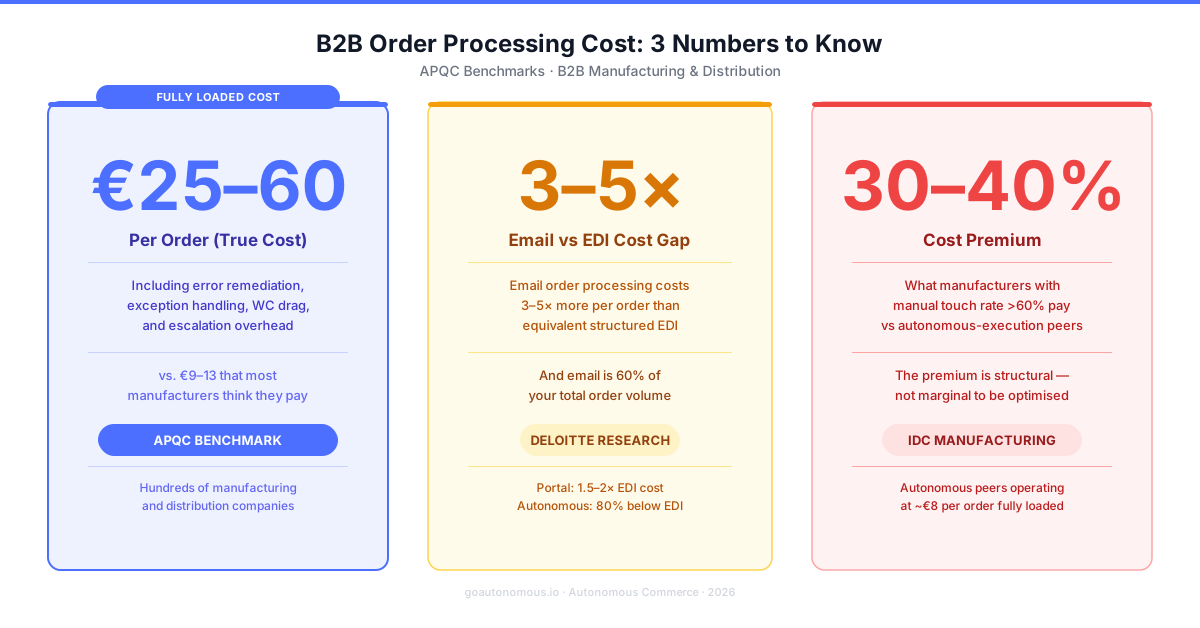
The true B2B order processing cost is 3–5x what most manufacturers estimate, and the gap is costing them millions in untracked operational spend. This guide is written for CFOs, VP Operations, and heads of customer operations in B2B manufacturing and distribution who want a rigorous framework for calculating, benchmarking, and permanently reducing their cost per order. The methodology here is grounded in APQC, Gartner, and McKinsey benchmarks. The outcome is a number your finance team can act on. And the lever that moves it furthest, fastest, is autonomous execution, not incremental process improvement.
Table of Content
- Why Your Current Cost-Per-Order Number Is Almost Certainly Wrong
- The Full Cost Breakdown: What Belongs in a B2B Order Processing Cost Calculation
- Category 1: Direct Order Entry Labor for B2B Manufacturers
- Category 2: Error Remediation. The Hidden Cost Driver in Manufacturing Operations
- Category 3: Exception Handling Queues in B2B Distribution Operations
- Category 4: Inbound Inquiry Volume Driven by Processing Delays
- Category 5: Technology and Infrastructure Cost Allocation
- Step-by-Step: How to Calculate Your True Cost Per Order in B2B Manufacturing
- B2B Operations Cost Benchmarks 2026: Where Do Manufacturers Stand?
- The Balance Sheet Dimension: Why CFOs Should Own This Metric
- Order Desk Cost Reduction in B2B: What It Takes to Actually Move the Number
- Real-World Outcomes: What Manufacturers Are Actually Achieving
- Building the Investment Case: A Framework for CFOs and Operations Directors
- Practical Next Steps: Where to Start with Order Processing Cost Reduction
- Sources
- Frequently Asked Questions
- See Autonomous Commerce in Action at the 2026 Summit
Why Your Current Cost-Per-Order Number Is Almost Certainly Wrong
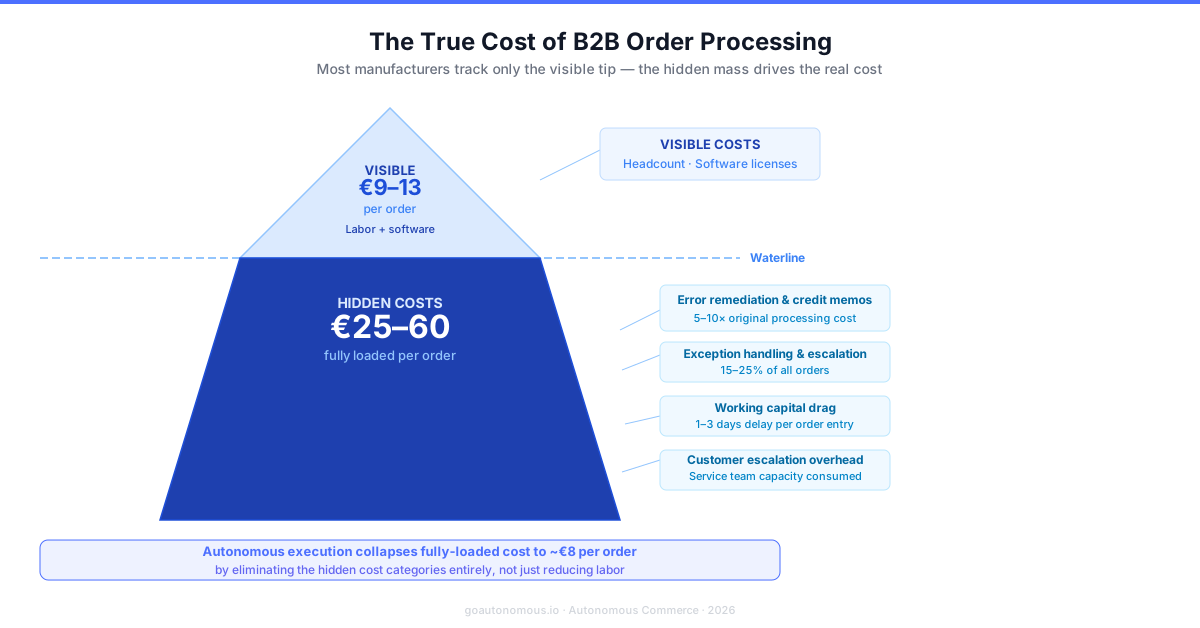
Ask ten operations leaders at B2B manufacturers what it costs to process an order. You will get ten different answers, and most of them will be wrong in the same direction: too low. The reason is not dishonesty or carelessness. It is how order processing costs are distributed across the chart of accounts. Customer service labor sits in one budget. IT license costs sit in another. Credit and returns processing belongs to finance. Logistics exception handling is buried in warehouse costs. Nobody owns the fully-loaded cost per order as a single metric, so nobody calculates it. The number that circulates internally is typically the cost of direct entry labor, the CSR time from email receipt to ERP submission, and nothing else.
That direct entry cost is the visible tip of an iceberg. Below the waterline is a larger mass of costs that are real, measurable, and directly attributable to order volume, they just never appear in the same calculation. Error remediation. Exception handling queues. Inbound customer inquiries driven by processing delays. Returns and credit notes from inaccurate entry. Technology overhead. The opportunity cost of order desk headcount that could be doing revenue-generating work instead. When these costs are aggregated against order volume, the fully-loaded cost per order is typically 3–5x the direct labor estimate. For a manufacturer processing 500 orders per day, the difference between a €10 estimate and a €40 fully-loaded reality is over €7 million in annual operational spend that has no line item, no owner, and no improvement roadmap.
This is not a marginal discrepancy. It is a measurement failure that sits at the heart of why so many manufacturers accept manual order processing as a fixed cost of doing business, when it is in fact a variable cost structure that autonomous order execution can permanently compress. The first step is calculating the real number. The second is understanding what drives it. The third is changing it.
Each time we added one or two million euros in revenue, we had to add another operator. From a cost perspective, that's an unsustainable way of operating a business.

Hempel’s experience is not unusual. In manual order processing environments, headcount scales with revenue because the model has no other mechanism. Every new customer, every new market, every seasonal spike in order volume requires more people to handle it. The cost-per-order figure stays roughly constant, but the absolute cost grows in lockstep with the business. This is the structural problem that a CFO needs to understand, and it is the reason that order processing cost is not just an operational efficiency metric but a strategic constraint on growth leverage.
The Full Cost Breakdown: What Belongs in a B2B Order Processing Cost Calculation
A rigorous cost-per-order calculation has five distinct cost categories. Most manufacturers measure one of them. Here is how to build the complete picture, and what each category typically contributes to the total.
Category 1: Direct Order Entry Labor for B2B Manufacturers
This is the cost that most manufacturers do track: the time a customer service representative spends reading an incoming order, interpreting it, matching it to catalog items, validating pricing and availability, entering it into the ERP, and sending the confirmation. In Western Europe, a fully-loaded CSR cost (salary plus employer contributions plus overhead allocation) runs €40,000–€65,000 per year. At 220 working days and 7 productive hours per day, that is roughly €26–€42 per productive hour. If each order takes 12–20 minutes of CSR time, the direct entry cost per order sits at €5–€14.
The caveat: most manufacturers undercount the labor input. They measure the time from open to ERP submission but ignore the supervisor review step for non-standard orders, the clarification emails sent to customers before the order can be entered, and the end-of-day reconciliation that checks for entry errors before the warehouse batch runs. A complete measurement of direct labor typically adds 20–35% to the initial estimate.
Category 2: Error Remediation. The Hidden Cost Driver in Manufacturing Operations
Manual order entry has error rates of 8–15% in typical B2B manufacturing environments, according to APQC’s order management benchmarks. Each error generates a downstream cost chain: the customer calls or emails to report the problem, a CSR investigates and identifies the root cause, the order is corrected and resubmitted, logistics may need to recall or redirect a shipment, and a credit note may need to be issued. The fully-loaded cost of a single order error remediation episode, including all downstream touchpoints, typically runs €30–€120 depending on whether physical goods have already moved.
At an 8% error rate on 500 daily orders, that is 40 error events per day. Even at the low end of remediation cost, €30 per incident, that is €1,200 per day, or €264,000 per year, from error remediation alone. Allocated across total order volume, this adds €2–€6 per order to the fully-loaded cost. Most manufacturers do not track this number. Their finance teams record the credit note value, not the labor and logistics cost of generating it.
Category 3: Exception Handling Queues in B2B Distribution Operations
Not every order can be processed directly. Orders that reference discontinued part numbers, exceed credit limits, arrive in non-standard formats, or contain pricing discrepancies relative to the customer’s contract require human judgment before they can proceed. These exceptions are routed to a queue, sometimes a physical tray, sometimes a workflow tool, and handled when a senior CSR or supervisor has capacity. Exception handling is disproportionately expensive because it requires more skilled labor, generates customer anxiety (the order is sitting unprocessed and the customer does not know why), and often triggers follow-up inquiries that consume additional time.
Gartner’s order management research consistently shows that exception handling accounts for 20–35% of total order desk labor cost in manufacturers with high email order volume and complex catalogs. The paradox is that many exceptions are not genuinely exceptional, they are the result of poorly maintained catalog data, unenforced business rules, or customer behavior that is entirely predictable but has never been encoded into processing logic. These are not judgment calls. They are rule applications waiting for automation.
Category 4: Inbound Inquiry Volume Driven by Processing Delays
Every hour that an order sits unconfirmed in a manual processing queue increases the probability that the customer calls or emails to ask about its status. In B2B environments, where customers are often managing production schedules or distribution commitments against order delivery timelines, this anxiety-driven inquiry behavior is rational. But it generates real cost for the manufacturer. An inbound “where is my order?” call takes 5–10 minutes of CSR time to resolve, time that is not spent processing new orders, and that did not need to be spent at all if the original order had been confirmed within minutes of receipt.
Forrester’s B2B commerce operations research shows that manufacturers with average order confirmation times above two hours receive inquiry contacts on 15–25% of orders before confirmation. Each contact averages 7 minutes of CSR time. At scale, this adds a meaningful cost per order, one that disappears almost entirely when order confirmation time drops to under 60 seconds through autonomous processing. The customer experience impact of faster confirmation is real, but the internal cost savings from reduced inbound inquiry volume are equally significant and far easier to quantify.
Category 5: Technology and Infrastructure Cost Allocation
Order management technology costs are real but often misallocated. The ERP order module license is typically buried in a company-wide software contract. The email parsing tool has its own license. EDI translation services are billed separately. The order management workflow platform is treated as an IT cost, not an operations cost. When these technology costs are aggregated and allocated per order, dividing total annual spend by annual order volume, they typically add €1–€5 per order to the fully-loaded cost. This is not a major driver on its own, but it is a cost that autonomous execution platforms consolidate and often reduce in absolute terms by replacing multiple point solutions with a single system.
Step-by-Step: How to Calculate Your True Cost Per Order in B2B Manufacturing
Here is a practical methodology for calculating your fully-loaded cost per order. You need data from HR, finance, and your order management system. Most of it exists, it just has not been assembled in one place.
- Define your order volume baseline. Pull total order volume for the trailing 12 months, broken down by channel: email, EDI, portal, phone, and any other channel. This is your denominator for all subsequent calculations. If your ERP does not capture channel at order level, estimate based on known channel mix from your order desk team.
- Calculate direct labor cost. Take all headcount whose primary function is order processing, CSRs, order entry specialists, customer service supervisors who actively review orders. Compute their fully-loaded annual cost (salary + employer taxes + benefits + pro-rated office and equipment overhead). Divide by annual order volume. This is your direct labor cost per order.
- Measure error and remediation cost. Pull your trailing 12-month figures for: inbound complaints related to order errors, credit notes issued for order inaccuracies, re-shipments, and returns attributed to incorrect order entry. Estimate the average labor time and logistics cost per incident. Multiply incident count by average cost. Divide by total order volume. This is your error cost per order.
- Estimate exception handling cost. Ask your order desk team what percentage of orders require escalation or non-standard handling. Measure the average time per exception. Multiply exception volume by the loaded hourly cost of the staff handling them. Divide by total order volume. Add this to your running total.
- Quantify inbound inquiry cost. Track for two weeks: how many inbound contacts per day are order status inquiries, and how long on average does each take to resolve? Annualize and cost against loaded CSR hourly rate. Divide by order volume.
- Allocate technology costs. Sum all software license fees, IT support time allocation, and infrastructure costs directly attributable to order management, ERP order modules, email parsing, EDI translation, workflow tools. Divide annual total by order volume.
- Sum the components. Add all five categories. The total is your fully-loaded cost per order. For most B2B manufacturers completing this exercise for the first time, the result is €20–€55 per order, against an initial estimate of €8–€15. The gap is your improvement opportunity, measured in euros per order multiplied by annual volume.
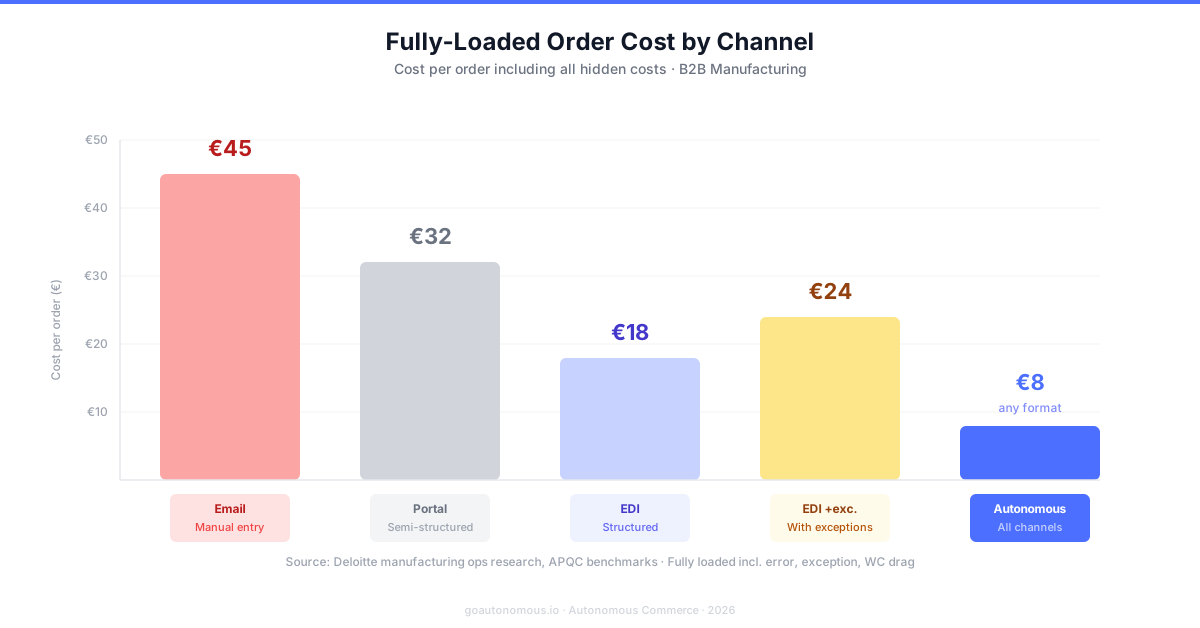
Run this calculation by channel, email versus EDI versus portal, and you will almost certainly find that email orders are 3–6x more expensive than EDI orders. That channel cost differential is the primary driver of efficiency gains when manufacturers automate the email channel first. The cost reduction is not evenly distributed across the order portfolio, it is concentrated in the channel where human interpretation is most required and most error-prone.
B2B Operations Cost Benchmarks 2026: Where Do Manufacturers Stand?
Benchmarking your cost per order against industry data is essential for prioritizing investment and building the internal case for change. The data here is drawn from APQC, Gartner, McKinsey, and Deloitte research published between 2023 and 2025, adjusted for current cost structures in Western European manufacturing and distribution.
The APQC Benchmark Range for Cost Per Order in B2B Manufacturing
APQC’s order management benchmarks place fully-loaded cost per order across B2B manufacturers in a range of $8–$52, with a median around $22–$25. Top-quartile performers, those with mature automation and high autonomous processing rates, cluster in the $8–$14 range. Bottom-quartile performers, typically those with predominantly manual email order processing and high catalog complexity, sit above $35.
The key finding from APQC is that process optimization within manual workflows, better training, faster entry tools, improved error-checking checklists, produces modest benchmark improvements. The step-change improvements come from changing the processing model: moving from human-reviewed to autonomously processed orders. Top-quartile performers are not better manual processors. They are organizations that have largely removed manual processing from the equation for standard orders.
Cost Per Order by Channel: What the Data Shows for Distribution Operations
Channel benchmarks show a consistent and wide spread. Based on Deloitte’s manufacturing operations research and McKinsey analysis of B2B commerce operations:
- Email orders (manual processing): €18–€60 fully loaded. High range reflects complex catalogs and high error rates. Lower range reflects well-structured customer email behavior and experienced order desk staff.
- Phone orders: €20–€65 fully loaded. Typically the highest-cost channel due to real-time constraint, one CSR is occupied for the full duration of the call, with no parallel processing possible.
- Portal/e-commerce orders: €5–€15 fully loaded. Lower direct entry labor, but customer service review and exception handling remain significant for most manufacturers who have not automated the portal-to-ERP submission step.
- EDI orders: €3–€10 fully loaded. Structured format reduces entry labor significantly; residual cost is in exception handling for EDI rejections and mapping failures.
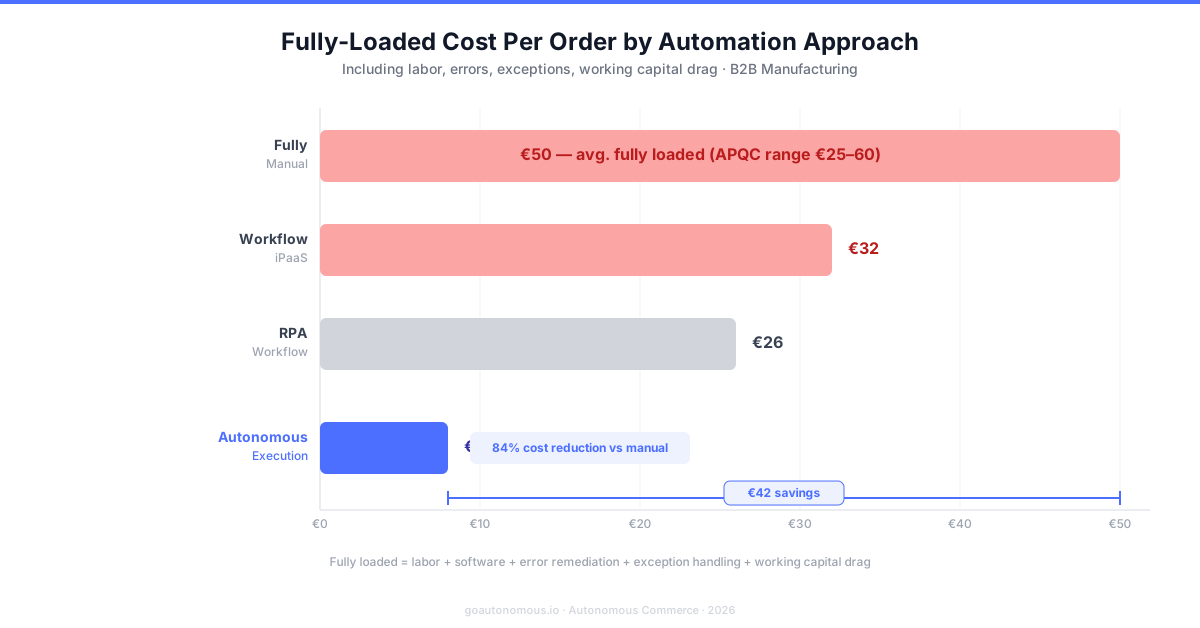
- Autonomously processed orders (AI-driven): €2–€7 fully loaded. Human labor cost is near-zero on autonomously handled orders; remaining cost is platform licensing and the fraction of exception volume that requires human resolution.
The strategic implication is clear. Email and phone channels, which account for 50–70% of B2B order volume at most manufacturers, according to McKinsey’s digital operations research, carry 3–8x the per-order cost of automated channels. Shifting these orders to autonomous processing compresses the blended cost per order faster than any other operational intervention.
Order Management ROI for Manufacturers: What Autonomous Execution Delivers
The ROI from autonomous order execution has been documented extensively across B2B manufacturing verticals. McKinsey’s analysis of digital operations transformation in manufacturing shows that manufacturers achieving 85%+ autonomous order resolution rates reach blended cost-per-order structures of €3–€8, a 5–10x improvement against manual email baselines. Forrester’s research on B2B operations automation puts payback periods for manufacturers above 200 daily orders at 8–14 months on direct cost reduction alone, before revenue-side benefits from faster confirmation and improved accuracy are included.
The comparison that matters for CFO conversations is not against peer manufacturers doing manual processing, it is against manufacturers who have already automated. Those organizations have permanently lower operating cost structures, better working capital positions, and the ability to absorb order volume growth without proportional headcount investment. That is the benchmark that should be driving the investment decision, not the comfort of being average among manual processors.
The Balance Sheet Dimension: Why CFOs Should Own This Metric
Order processing cost is conventionally treated as a P&L line item, an operational expense to be managed within budget. That framing undersells its strategic importance. The true B2B order processing cost has balance sheet implications, revenue implications, and growth leverage implications that make it a CFO-level metric, not just an operations metric.
Working Capital Impact of Order Cycle Time in Manufacturing
Every hour an order spends in a manual processing queue before reaching the ERP is an hour the billing clock has not started. The order has not been confirmed, inventory has not been committed, and the shipment has not been triggered. In a business with Net 30 or Net 45 payment terms, the aggregate working capital effect of slow order processing is material. If your average order-to-ERP time is four hours, common for manufacturers with email order volume and manual entry, and you process 500 orders per day, you are carrying the equivalent of 2,000 order-hours of working capital delay every single day.
PwC’s global digital operations study shows that manufacturers who reduce order-to-confirmation time from hours to minutes through autonomous processing see measurable improvement in their cash conversion cycle, not because payment terms change, but because the billing initiation event happens faster and the entire order-to-cash timeline compresses. For a €500M manufacturer, a one-day improvement in cash conversion cycle is worth millions in freed working capital. The revenue and margin management case for autonomous order processing extends well beyond the cost line.
Revenue Leakage from Slow Order Processing in B2B Manufacturing
In competitive B2B markets, industrial components, spare parts, consumables, medical supplies, customers who receive slow or uncertain order confirmation will dual-source. They will not always tell you. The order may arrive eventually, but the customer has learned that your operation is not reliable under time pressure, and they have established a relationship with an alternative supplier. The revenue leakage from this behavior is real and persistent. It does not show up in a single lost order. It shows up in declining order frequency per account, gradually eroding revenue per customer over 12–18 months.
Forrester’s B2B buyer research consistently identifies order confirmation speed as a top-three factor in supplier preference for repeat-purchase scenarios, ranked above price in situations where the customer already trusts the pricing relationship and is selecting primarily on reliability. Manufacturers who can confirm orders within 60 seconds have a structural advantage in customer retention that compounds over time. The customer experience dimension of autonomous order processing is not soft, it is a revenue retention mechanism with measurable value.
Growth Leverage: Decoupling Revenue from Headcount in B2B Operations
The CFO-level argument for autonomous order processing that transcends the current-period cost reduction is operating leverage. In a manual processing model, revenue growth requires proportional headcount growth, every additional €10M in order revenue requires additional order desk staff to handle the volume. The cost structure scales with the business, so operating margin does not improve with scale. This is the economics that Hempel’s VP of Customer Care described: every increment of revenue required another operator, making growth structurally expensive.
Autonomous order processing breaks this relationship. When the platform handles standard orders at scale, adding order volume does not require adding headcount. The existing team manages exceptions and handles commercial activities, upsell conversations, proactive outreach, dispute resolution, regardless of whether daily order volume is 300 or 3,000. BCG’s research on B2B operations transformation shows that manufacturers who invest in autonomous operations infrastructure before entering growth phases achieve significantly better operating leverage and margin expansion than those who invest during or after growth. The timing of the investment matters. Manufacturers who wait until growth pressure makes the change urgent are building manual scale they will then have to dismantle.
Order Desk Cost Reduction in B2B: What It Takes to Actually Move the Number
Understanding the cost is necessary. Reducing it requires choosing the right intervention, and most manufacturers start with the wrong one. Process optimization within manual workflows has real limits. Better training, standardized entry templates, improved quality checks, these interventions reduce error rates and entry time at the margin, but they do not change the fundamental cost structure. The cost per order improves by 10–20% at best, and the improvement is fragile because it depends on sustained human performance rather than systematic process change.
The interventions that produce durable, large-scale cost reduction in B2B order desk operations are structural, not procedural. They change how orders are processed, not how people process them better.
Why RPA Alone Does Not Solve the B2B Order Processing Cost Problem
Many manufacturers have tried robotic process automation as a first step in order desk cost reduction. The results are consistently disappointing relative to the investment. RPA can automate the mechanical steps of ERP entry once an order has been interpreted and structured, but interpretation is the hard part. Email orders arrive in hundreds of different formats, with ambiguous part number references, non-standard pricing requests, and missing information that requires customer contact before entry is possible. RPA has no capability to handle this variability. It automates the last 20% of the task, the keystroke sequence, while leaving the first 80%, reading, interpreting, validating, clarifying, to humans. The result is a marginally faster manual process, not a structural cost improvement. See the RPA versus AI comparison for a full analysis of why this matters for order processing specifically.
Autonomous Execution: How the Cost Structure Changes for Manufacturers
Autonomous order execution, AI that reads the order in whatever format it arrives, interprets it against the customer’s contract and product catalog, validates it against business rules, and submits it to the ERP without human review, addresses the full cost structure, not just the entry step. When 85–95% of orders are handled autonomously, the cost drivers that dominate the fully-loaded calculation are systematically eliminated:
- Direct entry labor cost drops to near zero on autonomously processed orders, the platform cost replaces the CSR cost.
- Error rates fall from 8–15% to 1–5%, because AI-driven entry applies business rules consistently and does not make the fatigue-driven mistakes that generate error remediation cost.
- Exception volume decreases as business rules are encoded into the system and continuously refined, exceptions that required human judgment initially are handled automatically once the pattern is established.
- Inbound inquiry volume drops as order confirmation times fall from hours to seconds, customers receive confirmation before they have time to wonder where their order is.
- Technology costs consolidate as the autonomous execution platform replaces multiple point solutions, reducing total license spend.
The net effect is a blended cost-per-order reduction of 50–75% for manufacturers who achieve high autonomous resolution rates. This is not a projection, it is the documented outcome from manufacturers operating at scale on autonomous order execution platforms. The Go Autonomous success cases document this pattern across industrial manufacturing, cleaning technology, and medical device distribution, among others.
Real-World Outcomes: What Manufacturers Are Actually Achieving
The ROI case for autonomous order execution is no longer hypothetical. Manufacturers across industrial, technical, and medical product categories have deployed autonomous order processing at scale and documented the results. The pattern is consistent, even though the companies and markets are different.
A global industrial manufacturer operating across 26 countries, Danfoss, deployed autonomous order processing across its international operations and achieved order confirmation times under one minute, across all 26 country markets, regardless of order format or language. The operational implication is significant: a standardized, sub-minute order-to-confirmation cycle eliminates the inquiry load and working capital delay that slow processing generates, at scale, without adding headcount in any of those markets.
A leading cleaning technology manufacturer, Nilfisk, moved to autonomous order management and documented the capacity release that resulted: order desk headcount previously absorbed in manual processing was redeployed to commercial and customer success activities, without increasing total staff. The cost-per-order reduction was real, but the strategic benefit was the change in what the team was doing with its time.
A major European medical device distributor, Mediq, achieved 91% autonomous order handling across its product portfolio. At that resolution rate, the manual processing cost structure that had previously governed the operation was effectively replaced by a platform cost structure, one that does not scale with order volume and does not require headcount additions as the business grows.
These are not edge cases or pilot programs. They are full-scale deployments at companies with complex catalogs, multi-country operations, and demanding customer bases. The full library of success cases covers additional manufacturers and distributors with documented outcomes across order throughput, accuracy, and cost structure.
Building the Investment Case: A Framework for CFOs and Operations Directors
Once you have calculated your fully-loaded cost per order, the investment case for autonomous execution follows a straightforward structure. The challenge is usually not the math, it is assembling the right inputs and presenting them in a way that connects to CFO priorities.
The framework has three components: current state cost, future state cost, and the value of operating leverage. Current state cost is your fully-loaded cost per order multiplied by annual order volume. This is the annual cost of your current model. Future state cost is the projected cost per order under autonomous execution, typically €3–€8 per order for manufacturers with high autonomous resolution rates, multiplied by the same order volume. The annual savings is the difference. This calculation alone typically justifies the investment for manufacturers above 150–200 daily orders, with payback periods of 8–18 months.
The operating leverage component is harder to quantify but often larger in present value terms. If your business is expected to grow order volume by 20% over the next three years, the difference between a manual processing model (which requires proportional headcount growth to absorb that volume) and an autonomous model (which absorbs the volume on the existing platform) is a substantial operating cost avoidance that should be included in the investment case. BCG’s research suggests this avoided cost often equals or exceeds the direct cost reduction in present value terms, particularly for manufacturers in high-growth markets or those planning geographic expansion.
Finally, include the revenue-side effects. Faster order confirmation, higher first-time-right rates, and reduced dual-sourcing behavior all have revenue value. These are directional inputs rather than hard forecasts, but excluding them understates the total return. Forrester’s analysis shows that improved order confirmation speed typically reduces customer churn by 5–15% among accounts that had experienced processing delays, a retention improvement with compounding revenue value. To build this case against your specific numbers, schedule a session with the Go Autonomous team, they will model the ROI against your actual order volume, channel mix, and cost structure.
Practical Next Steps: Where to Start with Order Processing Cost Reduction
The path from measuring your cost to reducing it runs through a small number of high-leverage decisions. Here is the sequence that consistently produces the fastest results for B2B manufacturers.
Start with measurement. Before any technology investment, complete the seven-step cost calculation described earlier in this post. You need a number that your operations and finance teams agree on. Without that shared baseline, investment decisions will be made on intuition rather than evidence, and post-investment results will be impossible to verify. One quarter of disciplined cost tracking is sufficient to establish the baseline.
Then prioritize the email channel. If email orders represent more than 30% of your volume, and for most manufacturers they represent 50–70%, as McKinsey documents, this is where the greatest cost concentration sits. Autonomous email order processing is the intervention with the fastest payback and the largest absolute cost reduction. It is also where the customer experience improvement is most visible, because email order customers are currently experiencing the longest confirmation delays.
Invest in catalog and master data quality in parallel. The autonomous resolution rate, the fraction of orders the system handles without human review, is directly determined by the quality of the catalog data it works against. Clean part number hierarchies, complete successor mappings, accurate pricing tiers, and current availability rules are the foundation that determines whether you reach 85% autonomous resolution or stall at 65%. This is not a technology project. It is a data governance project that the operations team owns. Autonomous Commerce platforms provide tooling to accelerate this work, but the decisions are operational and commercial, not technical.
Finally, build the cost-per-order metric into your operational reporting cadence. Make it a weekly number that operations leadership sees alongside throughput and quality metrics. The act of measuring changes behavior, it makes waste visible that informal norms have rendered invisible, and it creates accountability for improvement that does not exist when the metric is not tracked. The organizations that achieve the largest and most sustained reductions in order processing cost are the ones that treat cost per order as a first-class operational metric alongside order volume and customer satisfaction.
The B2B order processing cost problem is solvable. It is solvable at scale, in complex catalog environments, across multi-country operations, and with the commercial customer relationships that B2B manufacturers have spent decades building. The manufacturers who have solved it, documented in the Go Autonomous success cases, are not outliers. They are early movers in a structural shift that is redefining what efficient B2B operations looks like. The question is not whether the shift is coming. It is whether your organization is leading it or catching up to it.
Sources
- Source: APQC, Order Management Process Benchmarks and Key Performance Indicators
- Source: Gartner, Supply Chain Order Management Research and Benchmarks
- Source: McKinsey & Company. The Digital Future of Manufacturing Operations
- Source: Deloitte, Manufacturing Industry Outlook: Operations and Cost Drivers
- Source: Forrester. The State of B2B Commerce Operations
- Source: PwC, Global Digital Operations Study: Industrial Manufacturing
- Source: Boston Consulting Group, B2B Digital Operations Transformation and Operating Leverage
- Source: Aberdeen Group, Order Management Automation ROI: Manufacturing and Distribution
Frequently Asked Questions
Fully-loaded B2B order processing cost in manufacturing ranges from approximately $8 to $52 per order, based on APQC benchmarks. The median sits around $22–$25 per order. Email orders processed manually typically cost $18–$60 fully loaded. EDI and portal orders run $3–$12. Manufacturers with high autonomous processing rates, 85% or more of orders handled without human review, typically achieve $3–$8 per order. Most manufacturers who calculate this number for the first time find it is 3–5x their initial estimate, because error remediation, exception handling, and technology costs are distributed across multiple budget lines and never aggregated.
Beyond direct order entry labor, a complete cost-per-order calculation for B2B manufacturers must include: error remediation costs (investigation, rework, credit note issuance, re-shipment), exception handling labor for orders requiring non-standard processing, inbound customer inquiry costs driven by slow order confirmation, technology and software license costs attributable to order management, and the opportunity cost of order desk headcount not deployed on revenue-generating activities. These below-the-surface costs typically add 2–4x the direct labor cost to the fully-loaded total.
Every hour an order sits in a manual processing queue before reaching the ERP delays the billing cycle, pushing confirmation, inventory commitment, shipment, and invoice issuance further out. For manufacturers with Net 30 or Net 45 payment terms, the aggregate working capital effect of slow order processing is material. Autonomous execution compresses order-to-confirmation time from hours to seconds, accelerating the billing initiation event and improving the cash conversion cycle. PwC’s global digital operations research shows manufacturers who achieve sub-minute order confirmation see measurable working capital improvement as a secondary benefit of autonomous processing.
For manufacturers above 200 daily orders, payback periods of 8–14 months on direct cost reduction alone are typical, based on Forrester and McKinsey analysis. Internal rates of return range from 40–80%, driven primarily by labor cost elimination on email order channels and error cost reduction. Revenue-side benefits, improved customer retention from faster confirmation, reduced dual-sourcing, typically add 20–40% to the total return. The operating leverage benefit, absorbing volume growth without proportional headcount growth, often exceeds the direct cost reduction in present value terms for manufacturers in growth phases.
The interventions that produce durable order desk cost reduction without degrading service quality are structural, not procedural. Automating the email order channel removes the highest-cost, most error-prone processing from human hands, while simultaneously improving confirmation speed and accuracy, both of which are positive service quality outcomes. Encoding exception handling business rules into the autonomous system reduces the exception queue without reducing resolution quality. The manufacturers who have achieved the largest cost reductions, documented in the Go Autonomous success cases, have simultaneously improved customer-facing order metrics: faster confirmation, higher first-time-right rates, reduced inquiry volume.
The underestimation is structural: order processing costs are distributed across multiple budget lines, customer service labor, IT licenses, finance operations, logistics exceptions, with no single owner who aggregates them against order volume. The number that circulates internally is typically direct entry labor only. Error remediation, exception handling, inbound inquiry costs, and technology overhead are all real and measurable but sit in different parts of the chart of accounts. Organizations that complete a full cost allocation for the first time consistently find a number 3–5x higher than their previous estimate.
Best-in-class manufacturers operating autonomous order execution platforms achieve 85–95% autonomous resolution rates, meaning that fraction of orders are fully processed without human review, from receipt through ERP submission. At 85%+, the cost structure approaches the platform cost floor of $3–$8 per order. Below 70%, meaningful manual processing labor remains and the cost structure does not substantially differ from a manual baseline. The primary determinants of autonomous resolution rate are catalog data quality, business rule coverage, and the diversity of order formats handled. Mediq’s documented 91% autonomous handling rate across a complex medical device portfolio demonstrates that high resolution rates are achievable even in high-complexity product environments.
See Autonomous Commerce in Action at the 2026 Summit
The Autonomous Commerce Summit 2026 brings together operations and commercial leaders from B2B manufacturing and distribution who are actively transforming how revenue is executed. Hear directly from companies that have made the shift to autonomous execution, and what it means for revenue, cost, and working capital. Attendance is by invitation only.
Request your invitation →