.svg)





Why Order Processing Time Grows as Revenue Grows
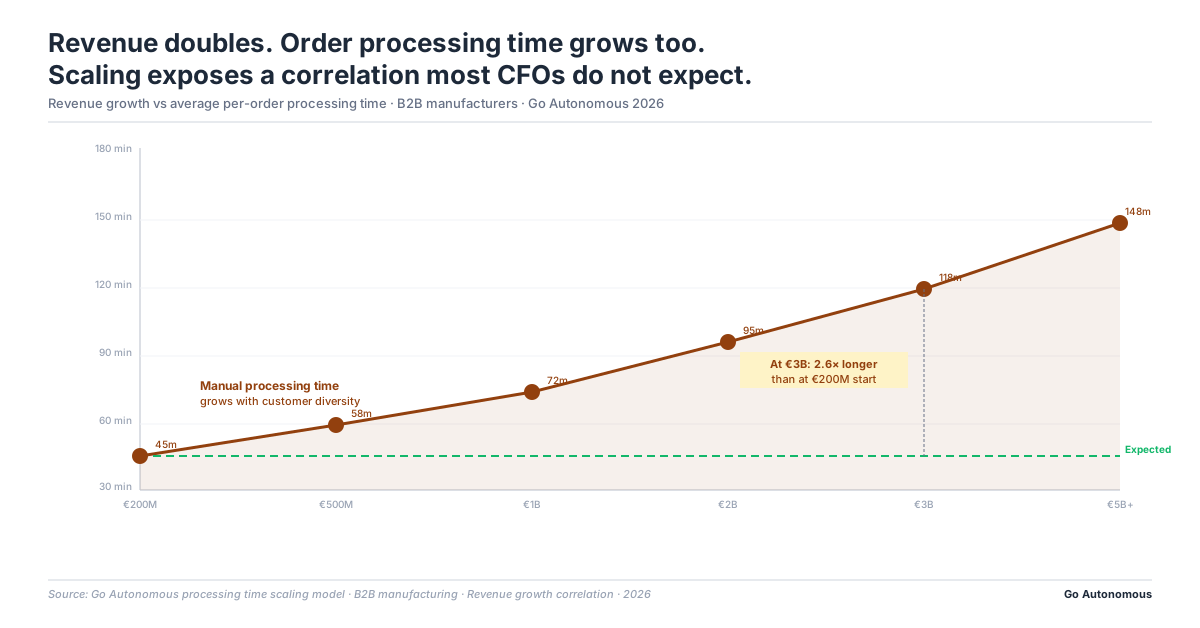
B2B manufacturers typically assume that scaling revenue will improve order processing efficiency through volume and process maturity. The data shows the opposite: order processing time per order tends to increase as revenue and customer diversity grow. This post explains the scaling paradox, its root causes, and what breaks the correlation between revenue growth and processing complexity.
B2B manufacturers growing from €200M to €500M in revenue do not simply process more of the same orders faster. They process a fundamentally more complex mix of orders: more geographies, more customer formats, more SKU references, more pricing structures. Processing time per order increases because complexity accumulates faster than standardization can absorb it. The result is that the operations team that was adequate at €200M is stretched at €500M — not because volume doubled, but because the order mix became harder to handle without scaling the team proportionally.
Table of Content
- Order Processing Time per Order Increases With Revenue: The Scaling Paradox
- Customer Diversity Is the Primary Driver: More Customers Means More Order Formats
- Adding Headcount to Absorb Volume Slows Coordination: The Management Cost of Scale
- The Architecture That Breaks the Correlation Between Revenue and Processing Complexity
- Frequently Asked Questions
- Why does B2B order processing time increase as a company grows?
- How do B2B manufacturers prevent order processing time from growing with revenue?
- What is the relationship between customer base size and order processing complexity?
- How does adding customer service headcount affect order processing efficiency at scale?
- How do high-growth B2B manufacturers keep order processing times flat while scaling revenue?
Order Processing Time per Order Increases With Revenue: The Scaling Paradox
Why Operators Expect Efficiency to Improve With Scale — and Why It Doesn’t
The standard expectation is intuitive: more orders means more process maturity, better-trained staff, and more standardized workflows. Economies of scale should apply to order operations the same way they apply to production runs. The expectation holds when volume growth comes from existing customers ordering more of the same products. It breaks down when growth comes from new customers, new geographies, and new product lines — which is the profile of most companies growing through €200M to €1B+ in revenue. Revenue growth in that range is rarely driven by uniform volume increase. It is driven by market expansion, which is inherently diversity-generating.
The Data Pattern: Processing Time per Order at €200M, €500M, and €1B+ Revenue
At €200M, a manufacturer typically serves a defined customer base with a manageable number of order formats and a customer service team that knows the accounts well. Processing time per order reflects familiarity: the team knows the exceptions before they become exceptions, and the format library is small enough to navigate efficiently. At €500M, the customer base has expanded, often internationally. Format diversity has grown. New accounts require onboarding time before their ordering conventions are absorbed. At €1B+, the format library is large enough that no individual team member knows all of it, and the training load for new hires has grown substantially. The relationship between topline growth and margin management depends critically on whether order operations costs scale with revenue or with order complexity — and for most manufacturers, it is the latter.
Each time we added one or two million euros in revenue, we had to add another operator. From a cost perspective, that's an unsustainable way of operating a business.

Customer Diversity Is the Primary Driver: More Customers Means More Order Formats
How Format Diversity Accumulates: Each New Account Adds at Least One New Variant
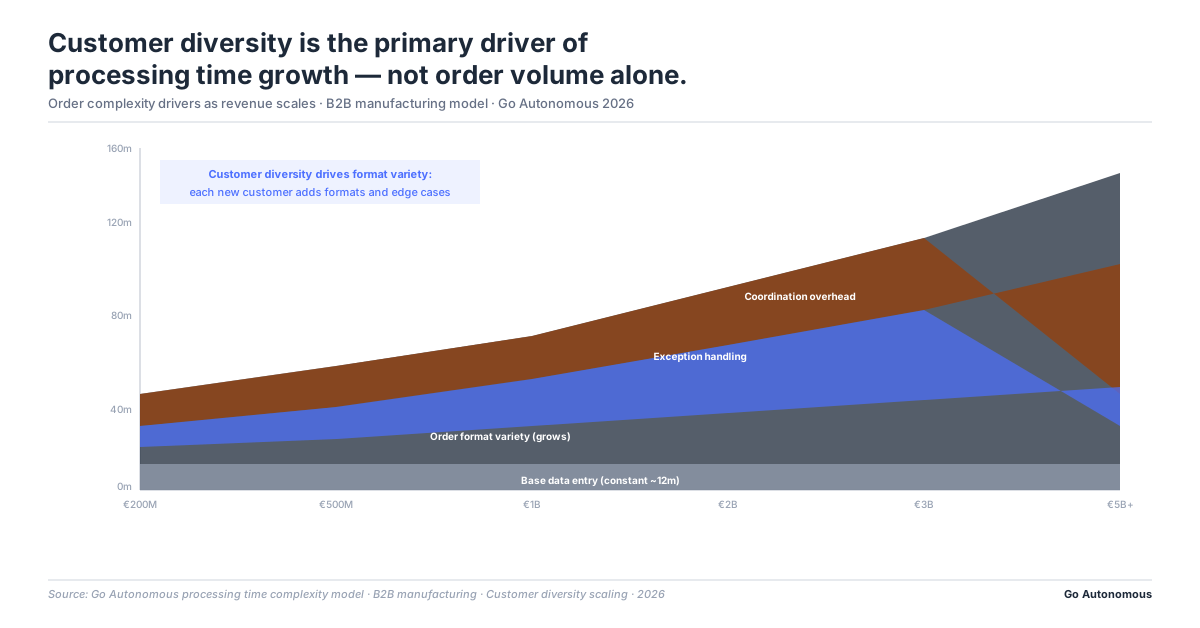
A stable customer base of 100 accounts may use 10–15 distinct order formats. A growing customer base of 400 accounts may use 60–80 formats. The accumulation is not linear — some new accounts use formats already in the library, but many introduce at least one new variant, whether a different product reference convention, a non-standard unit of measure, or a document structure the team has not seen before. New customers do not standardize to your format. They send what is convenient for their own internal systems. The operations team absorbs this growing format library with the same, or marginally larger, headcount. Processing time per order increases because the cognitive load of handling format diversity increases — not because the team is less capable.
International Growth Multiplies Format Complexity by Language, Convention, and Regulation
Domestic growth adds format diversity gradually. International expansion adds it in batches. A manufacturer entering a new European market may add 20–30 new accounts simultaneously, each with language variants, different product naming conventions, different document structures, and different regulatory field requirements. The operations team must absorb this new layer without a proportional increase in capacity. Processing time per order increases sharply during and after international expansion events, and rarely returns to pre-expansion levels without architectural intervention. The Autonomous Commerce platform addresses this by processing any order format through the same intake pipeline, so international expansion does not add format maintenance overhead to the operations team.
Adding Headcount to Absorb Volume Slows Coordination: The Management Cost of Scale
Queue Management, Handoffs, and Training: The Overhead of a Larger Team
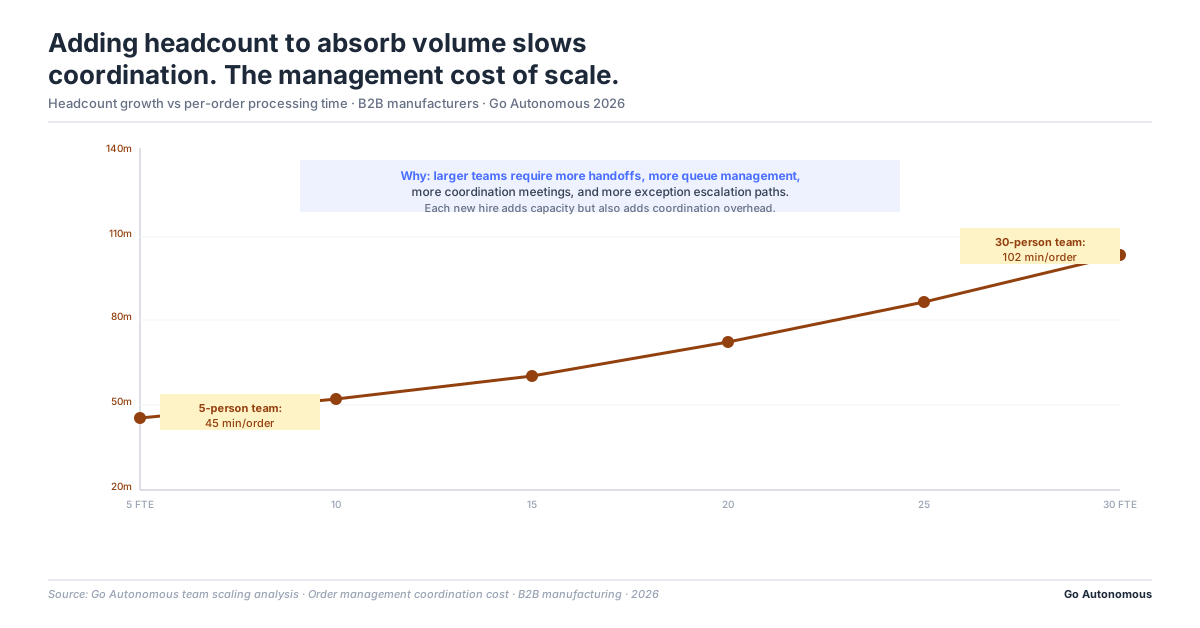
The standard response to growing order volume is to hire. More customer service representatives means more capacity — but also more coordination overhead. Queue management adds complexity as handoffs between shifts and team members multiply. Exception escalation paths become longer as the hierarchy grows. New team members require training on the full format library before they can handle the order mix independently, meaning experienced staff spend time on supervision and training rather than order processing. The efficiency gains expected from additional headcount are partially offset by the coordination costs those hires introduce.
Why Experienced Operators Are Constrained by Volume, Not Knowledge
Experienced customer service operators in high-growth manufacturers are not limited by capability. They know the format library, they know the customer accounts, and they can resolve exceptions efficiently. They are limited by volume: there are more orders arriving than they can handle with the time available, and the proportion of that volume that is genuinely complex has not changed just because total volume has grown. The result is that experienced operators spend increasing time on routine processing — the work that benefits most from automation — rather than on the relationship-sensitive and judgment-intensive work that actually requires their expertise. Processing time per order increases not because staff are slower, but because the mix of work has not been restructured to use their time where it adds value.
The Architecture That Breaks the Correlation Between Revenue and Processing Complexity
Format-Agnostic Intake: Processing Any Order the Same Way Regardless of Format
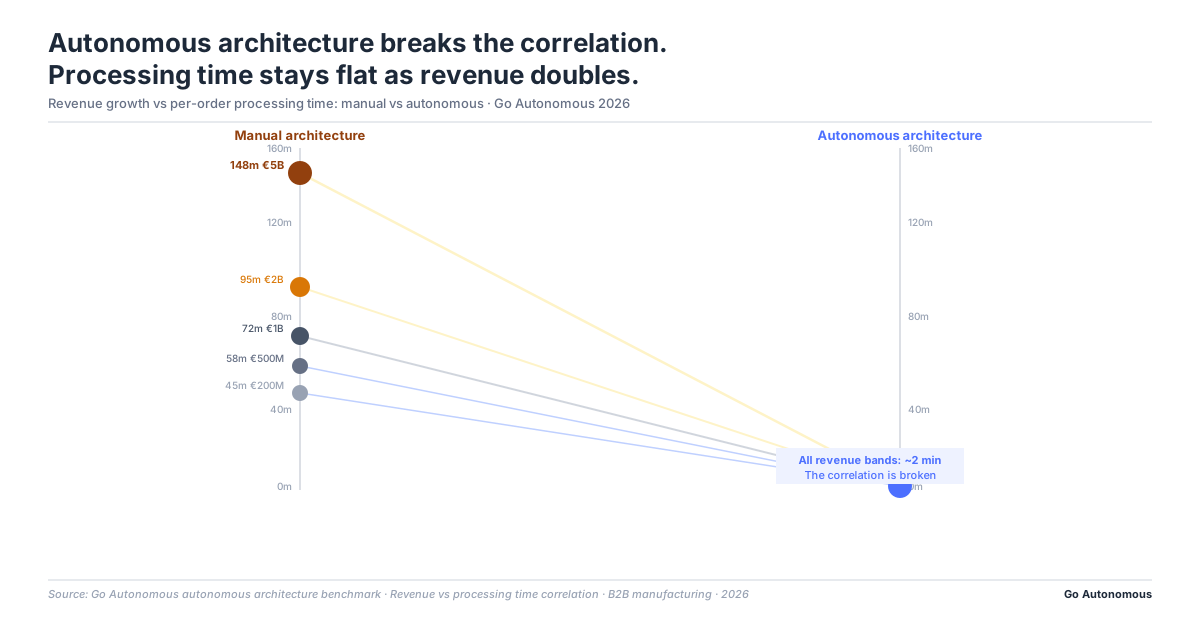
The correlation between revenue and processing complexity breaks when order intake is format-agnostic. AI that reads any order format — email, PDF, EDI, portal, spreadsheet — without requiring pre-defined mapping for each customer removes format diversity as a complexity driver. New customers do not add format maintenance overhead. International expansion does not require parallel processing workflows. Volume increases without proportional headcount increases because the cognitive load of format translation is handled at intake rather than distributed across the team. 85–90% of B2B revenue still requires human facilitation today because most intake architectures cannot handle unstructured formats without it. Format-agnostic intake changes that constraint at source.
What the Operations Team Looks Like When Processing Time Decouples From Revenue
Danfoss processes orders across 26 countries in a single day, with order confirmation times under 1 minute, across a volume that would have required substantial headcount growth under a manual model. Mediq handles 4,000 orders per week with zero headcount increase. The success cases across manufacturing and distribution share the same operational profile: order volume that has grown substantially, a customer service team that has not grown proportionally, and processing times that have decreased rather than increased. When processing time is no longer correlated with revenue, growth becomes a revenue event rather than a cost event. The operations team focuses on the edge cases and relationship decisions that genuinely require human judgment rather than absorbing the format library expansion that comes with each new market or customer segment.
If your order processing time per order has been creeping up despite investment in automation and process improvement, the root cause is almost certainly format diversity accumulating faster than your current architecture can absorb. Book a conversation with the Go Autonomous team to identify where the complexity is concentrating and what the decoupling architecture looks like for your operation.
Frequently Asked Questions
Why does B2B order processing time increase as a company grows?
B2B order processing time increases as a company grows because revenue growth is typically driven by new customers, new geographies, and new product lines — all of which add order format diversity faster than operations teams can standardize. Each new customer introduces new ordering conventions. International expansion adds language variants and different document structures. The format library the operations team must navigate grows with every new account, increasing the cognitive load and average handling time per order even when individual operators are not less efficient.
How do B2B manufacturers prevent order processing time from growing with revenue?
Preventing order processing time from growing with revenue requires making order intake format-agnostic. When an AI layer reads any order format — email, PDF, EDI, portal — without requiring pre-defined mapping per customer, new accounts and new markets do not add format maintenance overhead to the operations team. Volume can increase without proportional increases in processing time because the translation work is handled at intake rather than distributed across customer service staff.
What is the relationship between customer base size and order processing complexity?
Customer base size and order processing complexity are directly correlated. A customer base of 100 accounts typically uses 10–15 distinct order formats. A customer base of 400 accounts may use 60–80 formats. Each new customer introduces at least one new ordering convention — a different product reference system, a different document structure, a different unit of measure. Operations teams must absorb this growing format library with limited headcount, which increases average processing time per order as the library grows.
How does adding customer service headcount affect order processing efficiency at scale?
Adding customer service headcount increases capacity but also increases coordination overhead. New hires require training on the full format library, meaning experienced staff spend time on supervision rather than processing. Queue management and handoffs between team members multiply. Exception escalation paths lengthen. The marginal productivity of each additional hire decreases as the team grows, which is why headcount-based scaling produces diminishing returns on processing efficiency at larger team sizes.
How do high-growth B2B manufacturers keep order processing times flat while scaling revenue?
High-growth B2B manufacturers keep processing times flat by deploying format-agnostic intake that handles any order format without pre-defined mapping. This means new customers and new geographies do not add format maintenance overhead to the team. Manufacturers like Danfoss and Mediq have demonstrated that order volume can grow substantially without proportional headcount growth when the intake architecture removes format diversity as a complexity driver. The operations team focuses on genuine exceptions and relationship decisions rather than routine format translation.