.svg)





Why B2B Order Backlogs Form During Demand Spikes and Never Fully Clear
B2B manufacturers routinely experience demand spikes — end-of-quarter pushes, seasonal peaks, post-promotion surges — that overwhelm order processing capacity. The backlog that forms during these periods typically takes 3–7 days to clear after the peak ends, and in some cases never fully clears before the next peak arrives. This post explains the mechanics of the persistent backlog and the architecture that eliminates it.
B2B manufacturers know the pattern: a demand spike hits, the order queue doubles, the team works overtime, and 5 days after the peak ends they are still clearing the tail. This is not a staffing problem or a systems problem in isolation — it is a structural consequence of fixed-capacity processing meeting variable-volume demand. The backlog does not clear as fast as it formed, because the forces that slow clearance (status calls, rework, fatigue) emerge precisely when the team is most stretched. Manual order processing has a throughput ceiling. Any spike above it creates a queue that outlasts the event.
Table of Content
- B2B Order Backlogs During Demand Spikes Take 3–7 Days to Clear: The Queue Outlasts the Peak
- Manual Processing Has a Fixed Throughput Ceiling: Any Spike Above It Creates a Backlog
- A Backlog That Does Not Fully Clear Before the Next Peak Becomes a Permanent Capacity Deficit
- Elastic Processing Capacity: How Autonomous Execution Handles Volume Without a Ceiling
- Frequently Asked Questions
- Why do B2B order backlogs persist for days after a demand spike ends?
- How do B2B manufacturers prevent order backlogs during seasonal demand peaks?
- What is the customer impact of order confirmation delays during B2B demand spikes?
- How long does it take to clear an order backlog after a peak period in B2B manufacturing?
- How does autonomous order processing prevent backlog formation during demand spikes in B2B distribution?
B2B Order Backlogs During Demand Spikes Take 3–7 Days to Clear: The Queue Outlasts the Peak
Why Manual Processing Creates a Backlog at Any Volume Above Team Capacity
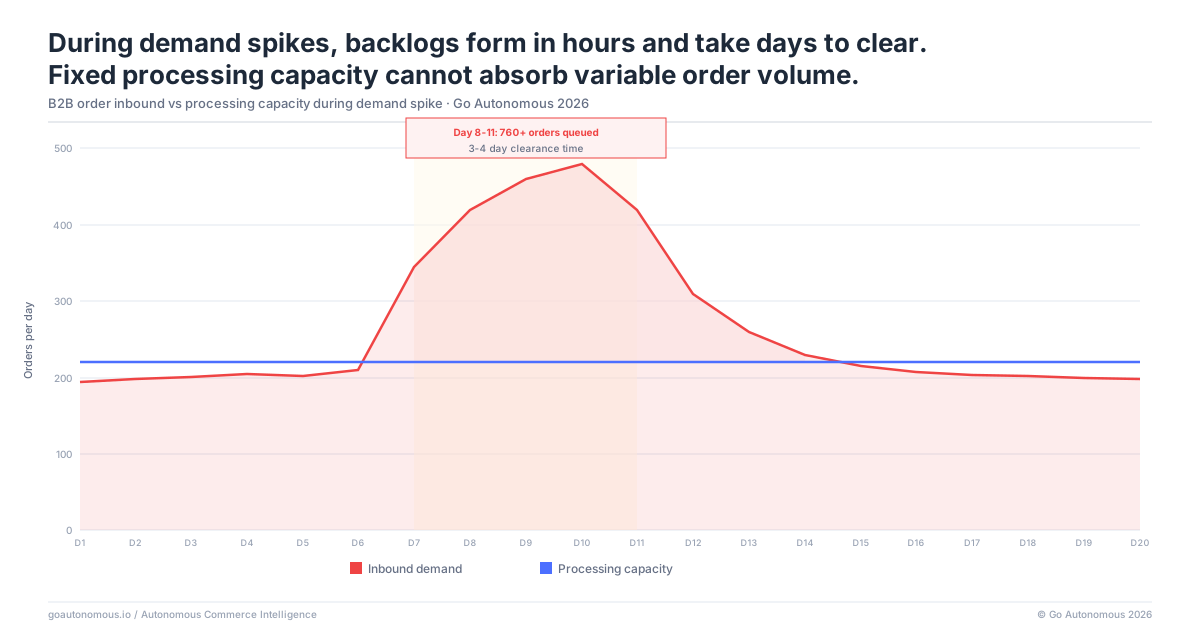
When inbound order rate exceeds team processing capacity, a backlog forms. The math is straightforward: if a team processes 100 orders per day and 300 orders arrive on day one of a spike, 200 orders are deferred. On day two, 200 more orders arrive and the team processes 100, reducing the backlog by zero. The queue grows as long as inbound rate exceeds processing rate.
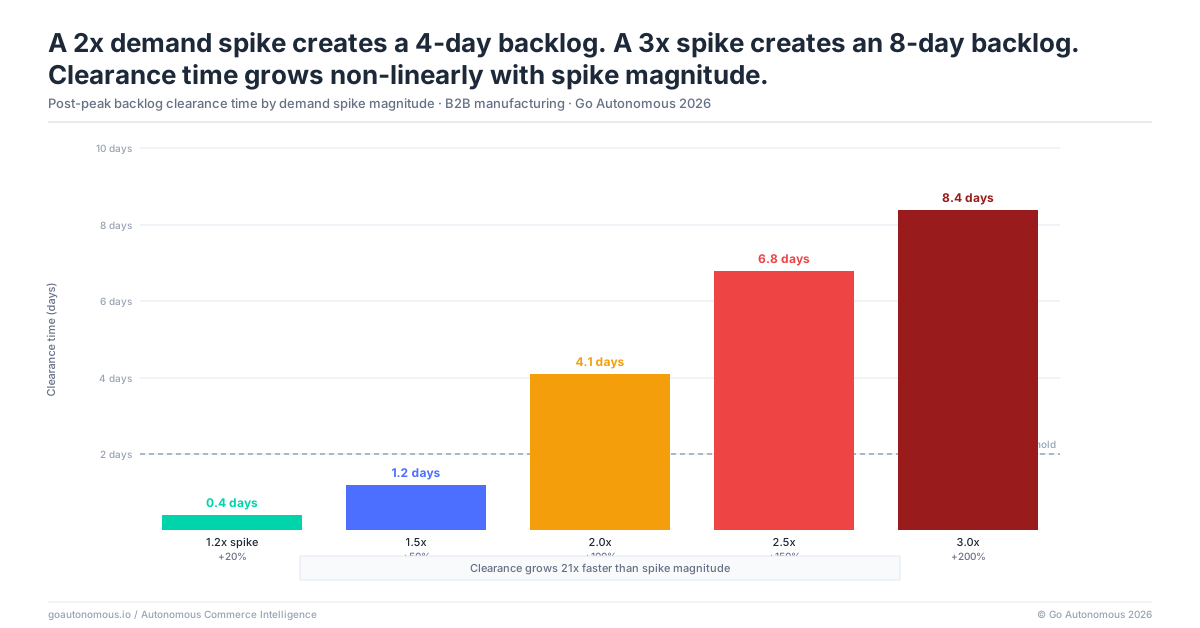
A backlog that forms during a 3-day demand spike does not clear in 3 days. It clears 3–7 days after the spike because the team returns to normal processing rate (100 per day) while also working through the accumulated backlog. A spike that doubled normal volume for 3 days generates a backlog that takes 5–6 working days to fully clear at base processing rate. The total impact window is roughly 3x the spike duration.
The Self-Reinforcing Backlog: How Status Calls and Rework Slow Clearance
Clearance is further complicated by two forces that emerge from the backlog itself. First, the orders in the backlog generate status inquiries. Customers who placed an order and have not received confirmation begin calling or emailing to check status. These calls consume processing time — the same team that is trying to clear the backlog is now also handling inbound status inquiries from customers whose orders are in that backlog. Status calls add friction precisely when capacity is most constrained.
Second, rush processing to clear the backlog increases error rates. Processing speed and accuracy trade off in manual work: a team moving quickly to reduce queue depth makes more data entry errors, misapplies pricing, and skips validation steps. These errors generate rework — orders that require correction, reprocessing, or customer callbacks extend the tail further. The backlog shrinks more slowly than the raw math suggests because the process of clearing it generates work that re-enters the queue.
The combined effect is that efficiency gains from peak-period effort are consistently lower than expected. Teams that work 20% harder during clearance often clear the backlog only 10–12% faster because status calls and rework consume the additional capacity they created.
Each time we added one or two million euros in revenue, we had to add another operator. From a cost perspective, that's an unsustainable way of operating a business.

Manual Processing Has a Fixed Throughput Ceiling: Any Spike Above It Creates a Backlog
What the Ceiling Looks Like in Practice: Team Size, Shift Hours, and Orders-Per-Hour
A manual order processing team has a throughput ceiling defined by three variables: number of staff, shift hours available, and average orders-per-hour per rep. A team of 10 processing 8 orders per hour each across a 7-hour shift processes 560 orders per day. That is the ceiling. Any day where inbound orders exceed 560 creates a backlog. The ceiling is fixed in the short term because all three variables are slow to change: hiring takes weeks, shift extension has legal and cost limits, and orders-per-hour cannot be significantly improved without system changes.
Operations managers typically know their ceiling intuitively. They know how many orders their team can process per day at sustainable pace and at peak effort. What they cannot control is the inbound rate, which is driven by customer behavior, seasonal patterns, and sales cycle dynamics that do not align with internal capacity planning.
Why Emergency Measures — Overtime, Temp Staff — Shift the Ceiling Without Removing It
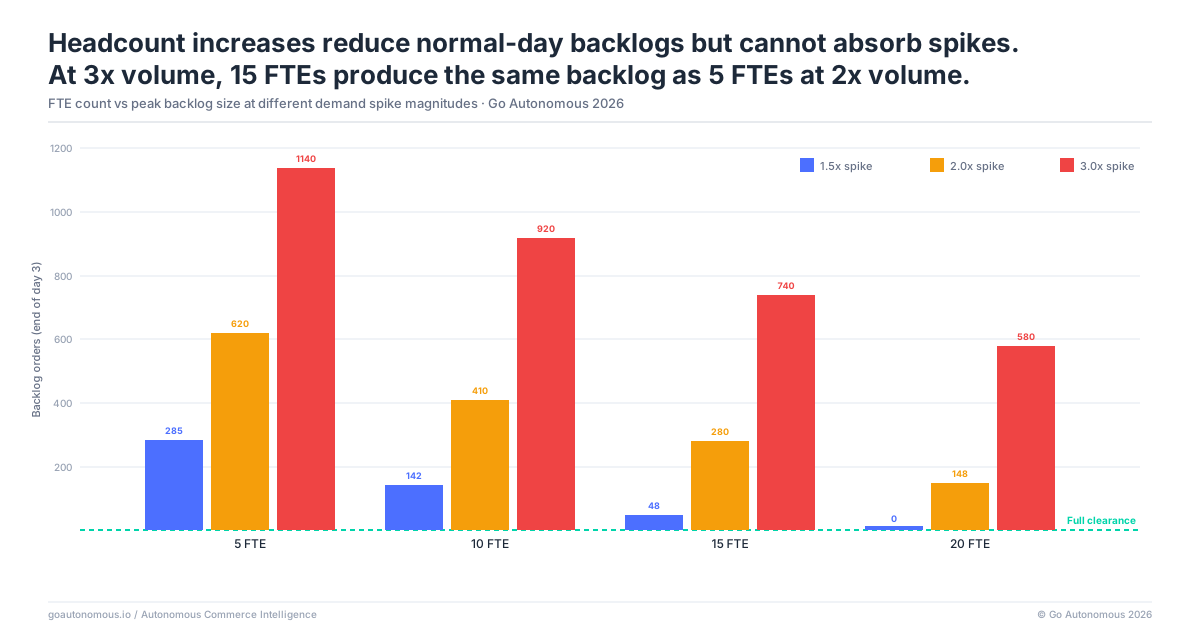
Operations managers facing demand spikes typically respond with two emergency measures: overtime for existing staff and temporary additional headcount. Both shift the ceiling temporarily. Overtime adds hours to the available shift time. Temp staff add headcount. Neither eliminates the ceiling — they extend it until the emergency period ends.
Overtime shifts introduce fatigue-related accuracy degradation after the first or second extra shift. A team that processes 8 orders per hour at base capacity may process 7.5 per hour on day three of overtime, and 6.5 per hour by the end of the first overtime week. The ceiling rises slightly but then begins to fall as fatigue accumulates. Temporary staff have lower throughput and higher error rates during their ramp period — they may process 4–5 orders per hour during the first week while learning the system, contributing less than half the capacity of an experienced rep.
The structural reality Mikkel Diness Vindeløv identified at Hempel applies here directly: adding headcount to serve additional revenue is structurally unsustainable. Each demand spike requires the same emergency response, at increasing cost. The ceiling is never removed, only temporarily extended — and the extension costs more each time as labor costs rise and experienced reps become harder to retain through repeated peak-period stress cycles.
A Backlog That Does Not Fully Clear Before the Next Peak Becomes a Permanent Capacity Deficit
The Pattern in Seasonal Businesses: Each Peak Builds on the Previous Backlog
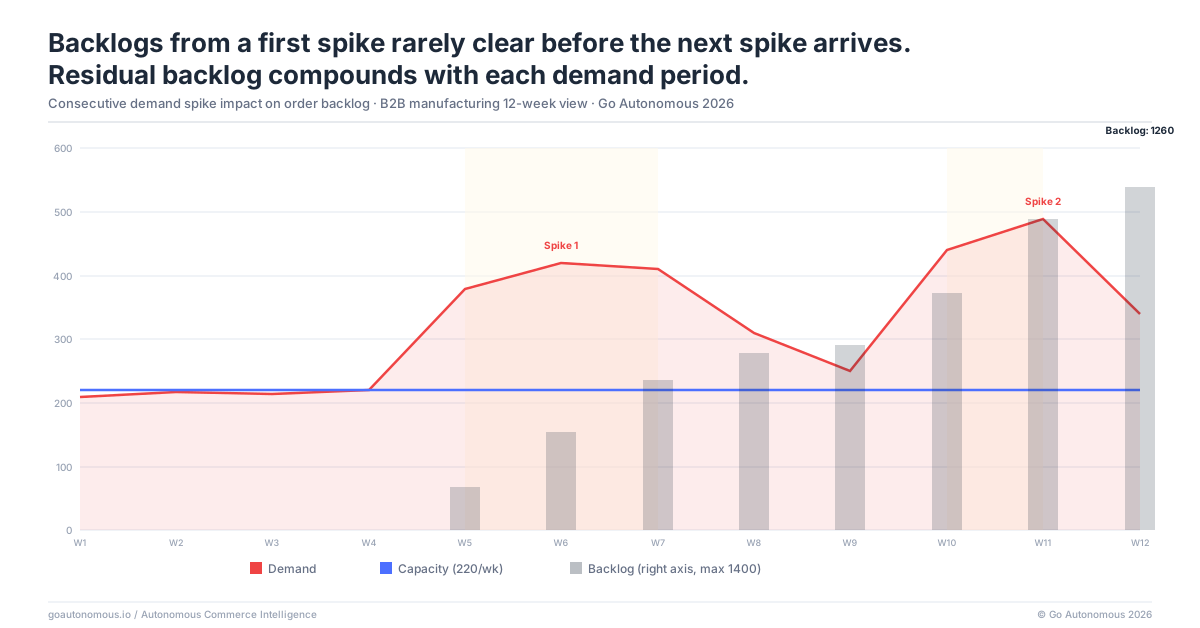
For manufacturers with recurring peak periods — seasonal demand cycles, quarterly sales pushes, annual contract renewal windows — the backlog often does not fully clear before the next peak arrives. The residual from peak one is still being processed when peak two begins. The team enters the second peak already behind.
Over multiple cycles, this creates a ratchet effect: each peak adds to a baseline backlog that never returns to zero. What was initially a temporary spike condition becomes a permanent operating state of delayed order confirmation. The team is always clearing yesterday’s orders while receiving today’s. The confirmation delay becomes structural — not a spike response, but a baseline operating characteristic.
What Customers Experience When Confirmation Delays Are Structural, Not Occasional
When confirmation delays are structural, customers adapt their behavior in ways that create additional operational complexity. They place orders earlier than operationally needed, building in buffer for expected delays — which changes the demand signal and makes forecasting less reliable. They place duplicate orders across multiple suppliers as a hedge against non-confirmation, then cancel the slower supplier’s order when one confirms — generating cancellation processing work. They split orders across multiple suppliers permanently, reducing the revenue concentration that justified the customer relationship investment.
Each adaptation makes the customer’s supply chain less dependent on any single supplier and more distributed. Once a customer has restructured their sourcing to hedge against a supplier’s confirmation delays, they rarely reverse that restructuring even when the delays are resolved. The confirmation delay has become load-bearing for their supply chain planning, and removing it does not automatically recover the lost order share.
This is the long-term revenue cost of persistent order backlogs in customer experience: not just the friction of the delay itself, but the permanent reduction in order concentration that follows from customers who have adapted to that friction.
Elastic Processing Capacity: How Autonomous Execution Handles Volume Without a Ceiling
How AI Processing Scales to Demand Spikes Without Backlog Formation
Autonomous order processing does not have a fixed throughput ceiling. The system that processes 200 orders per hour processes 2,000 orders per hour with the same confirmation time and the same accuracy. Demand spikes are order volume events, not capacity crises. No queue forms because the processing rate always matches or exceeds the inbound rate, regardless of volume.
No status calls are generated because confirmation arrives before customers think to ask. No rework backlog accumulates because accuracy does not degrade at peak volume — the AI applies the same validation logic to the 2,000th order it processes in an hour as it does to the first. The self-reinforcing dynamics that slow manual clearance (status calls consuming capacity, rush errors generating rework) do not exist in an autonomous processing environment.
What Operations Looks Like When Peak Periods Are Not Capacity Events
When autonomous processing handles order intake, peak periods change character entirely. End-of-quarter demand surges are commercial opportunities — more orders processed at the same unit cost and the same confirmation speed. Seasonal peaks generate revenue without generating operational emergencies. The team that previously spent peak periods managing backlog, handling status calls, and coordinating emergency overtime is instead focused on exception resolution, customer relationships, and commercial priorities.
Mediq handles 4,000 orders per week consistently with 75% faster processing and zero headcount increases — see their story at Go Autonomous success cases. Danfoss manages order intake across 26 countries in a day with under-1-minute confirmation times: Danfoss autonomous order intake case study. Both represent operations where peak periods have been permanently decoupled from capacity constraints.
To understand how elastic processing capacity applies to your operation, book a session with the Go Autonomous team.
Frequently Asked Questions
Why do B2B order backlogs persist for days after a demand spike ends?
B2B order backlogs persist after demand spikes because the processing team returns to its normal throughput rate once the spike ends, while still working through the accumulated queue. A spike that doubled volume for 3 days creates a backlog that takes 5–6 days to clear at base processing rate. Status calls from customers asking about unconfirmed orders and rework from rush-processing errors further slow clearance.
How do B2B manufacturers prevent order backlogs during seasonal demand peaks?
Preventing order backlogs during demand peaks requires processing capacity that scales with inbound volume without a fixed ceiling. Emergency measures like overtime and temporary staff shift the ceiling temporarily but do not remove it and introduce accuracy degradation. Autonomous order processing eliminates the ceiling entirely by matching processing rate to inbound rate regardless of volume, so no queue forms during any spike.
What is the customer impact of order confirmation delays during B2B demand spikes?
Customers experiencing confirmation delays during demand spikes adapt their ordering behavior in ways that persist long after the delays end: placing orders earlier than needed, placing duplicate orders with multiple suppliers, and permanently splitting order volume across suppliers as a hedge. These adaptations reduce revenue concentration with any single supplier and are rarely reversed once the customer has restructured their sourcing.
How long does it take to clear an order backlog after a peak period in B2B manufacturing?
A B2B order backlog formed during a demand spike typically takes 3–7 days to clear after the peak ends. The recovery time is proportional to the excess volume: a spike that doubled normal volume for 3 days typically requires 5–6 working days to clear at base processing rate. Status calls and rework from rush-processing errors extend the tail further, making actual clearance time longer than the raw math suggests.
How does autonomous order processing prevent backlog formation during demand spikes in B2B distribution?
Autonomous order processing prevents backlog formation by eliminating the fixed throughput ceiling that causes queues to form. The system processes 200 orders per hour or 2,000 orders per hour with identical confirmation time and accuracy, so demand spikes are volume events rather than capacity crises. No queue forms, no status calls are generated, and accuracy does not degrade at high volume.