.svg)





Why Multi-Country B2B Orders Break Before Oracle Ever Sees Them
Oracle Order Management Cloud is designed to centralize and standardize order processing. Multi-country B2B manufacturing and distribution operations work against that standardization: language variants, country-specific regulatory fields, local pricing structures, and different order format conventions create configuration complexity that Oracle cannot resolve at the intake layer. This post maps where Oracle OM Cloud automation breaks in multi-country operations and what the upstream fix looks like.
Oracle Order Management Cloud delivers what it promises: centralized, standardized, automated order processing. The problem is not Oracle. The problem is what happens before Oracle sees the order. In multi-country B2B manufacturing and distribution operations, 50–70% of order volume arrives by email or other unstructured channels, in the buyer’s language, using local product references, with country-specific regulatory fields that vary by jurisdiction. Oracle OM Cloud’s automation capabilities are bypassed entirely at the intake layer, and the manual work required to normalize these inputs consumes the efficiency gains the platform was purchased to deliver.
Table of Content
- Oracle OM Cloud Centralizes Order Processing: Multi-Country B2B Execution Fragments It
- Language, Regulatory Fields, and Local Pricing: Where Multi-Country Orders Break Before Oracle Sees Them
- Supporting Multi-Country Operations With Oracle Requires Configuration That Does Not Scale
- An AI Intake Layer Upstream of Oracle Handles Country-Specific Variants Before They Reach OM Cloud
- Frequently Asked Questions
- How does Oracle Order Management Cloud handle orders from multiple countries in different languages?
- What are the main challenges of using Oracle OM Cloud for multi-country B2B order management?
- How do multinational B2B manufacturers manage country-specific regulatory requirements in Oracle Order Management?
- Can AI normalize multi-country B2B order formats before they enter Oracle Order Management Cloud?
- How do B2B distributors operating across Europe reduce Oracle OM Cloud configuration overhead for multi-country operations?
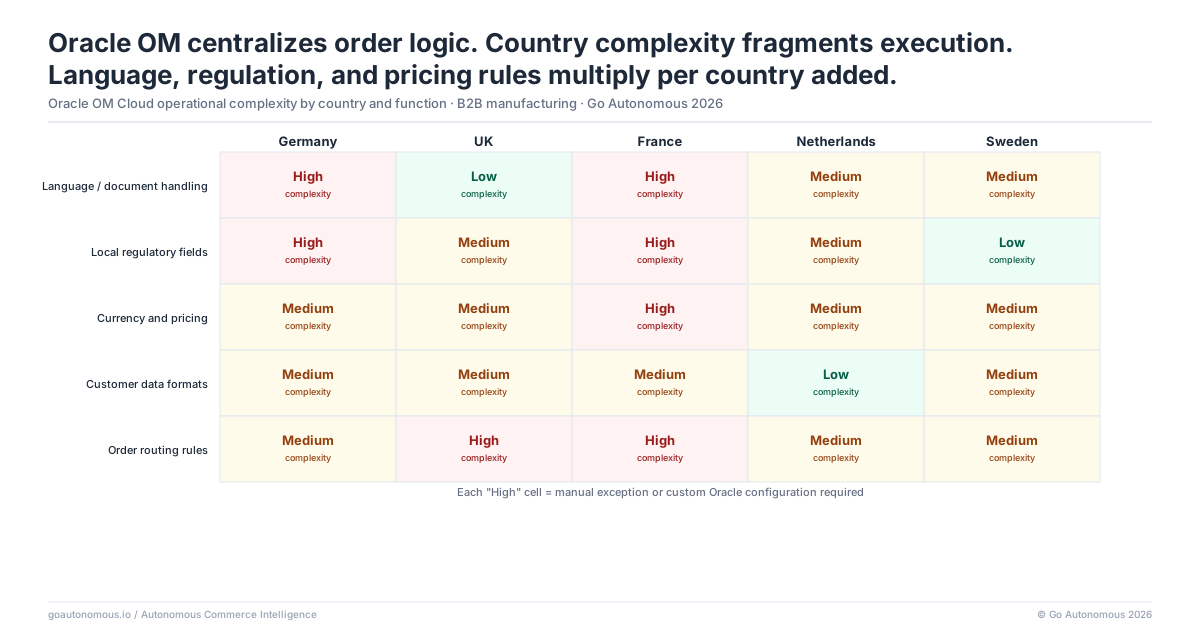
Oracle OM Cloud Centralizes Order Processing: Multi-Country B2B Execution Fragments It
What Oracle OM Cloud Is Built to Do: Standardize, Centralize, and Automate
Oracle Order Management Cloud’s core value proposition is centralization: one system, one process, consistent execution across business units and geographies. For B2B manufacturers operating across 10–30 countries, this centralization promise is compelling. One platform for all order processing removes the fragmentation of country-specific systems, creates a unified view of order status and inventory, and enables consistent service levels regardless of where the order originates.
Oracle OM Cloud delivers on that promise: once an order is in the system. The orchestration, fulfillment routing, ATP checking, and exception handling that Oracle manages are genuinely powerful for organizations operating at multi-country scale. The issue is at the point of entry, not within the system. Oracle assumes it will receive structured, validated, complete order data. In multi-country B2B operations, that assumption is almost never met at the intake layer.
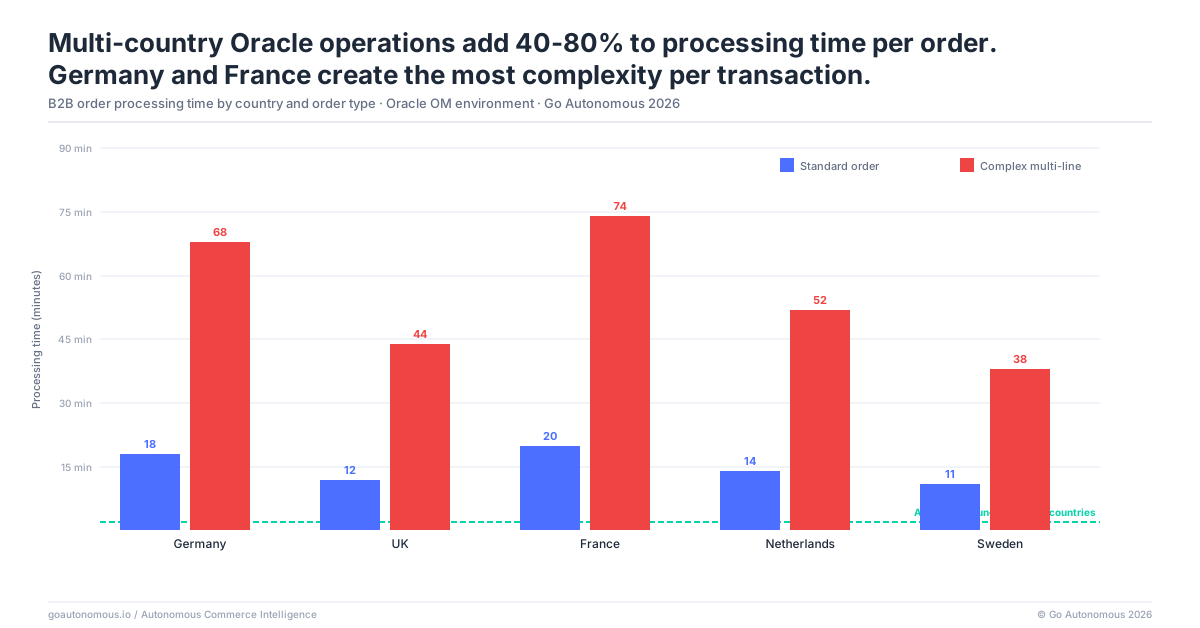
What Multi-Country B2B Operations Actually Look Like: Language, Regulation, and Format Variance
A manufacturer selling to customers across Germany, France, the UK, Sweden, and the Netherlands receives orders in five languages, with five different standard order formats, and five different sets of mandatory regulatory fields for VAT compliance and customs documentation. German customers send orders in German with European product codes and German VAT numbers. French customers send in French with French-language product descriptions. UK customers send in English but with Brexit-specific regulatory fields that did not exist pre-2021. Each country context requires different handling before the order can be entered into Oracle.
This intake fragmentation is not an edge case: it is the normal operating condition for any manufacturer with meaningful cross-border revenue. The autonomous commerce challenge in multi-country operations is precisely at this layer: how to handle structurally heterogeneous input and produce consistently structured Oracle-ready output without routing everything through a manual processing team.
Each time we added one or two million euros in revenue, we had to add another operator. From a cost perspective, that's an unsustainable way of operating a business.

Language, Regulatory Fields, and Local Pricing: Where Multi-Country Orders Break Before Oracle Sees Them
Language Variants: Why Customer Orders From Non-English Markets Require Translation Before Entry
The first failure point is language. Orders from German, French, Dutch, or Scandinavian customers arrive in the customer’s language. A centralized processing team cannot be assumed to read all of these fluently. Even where language skills exist, reading a technical order in a second language under time pressure introduces error risk. Product descriptions in German may use compound terms that do not translate directly to Oracle item master records. French product references may use local catalog naming conventions that differ from the manufacturer’s internal product codes.
The result: language variants require either local processing (which defeats centralization) or translation-before-entry (which adds time and manual handling before Oracle sees the order). Both workarounds add cost and delay without addressing the root cause, which is that the intake layer has no mechanism to read multi-language input and produce structured English-language Oracle entries automatically.
Regulatory Field Requirements: VAT Numbers, Customs Codes, and Country-Specific Mandatory Fields
The second failure point is regulatory field completeness. Each country has its own mandatory fields for VAT compliance, customs documentation, and local regulatory requirements. A German B2B order requires a valid VAT registration number for intra-EU supply. A UK order post-Brexit requires commodity codes for customs purposes. Some Nordic markets require specific delivery address formats for postal routing. Missing or incorrect regulatory fields block orders at the compliance layer: either in Oracle’s validation rules or downstream at invoicing.
Manual entry teams may not know which fields are mandatory for each country, particularly when handling orders across 15–20 jurisdictions. The error pattern is consistent: fields that are optional in the team’s primary market are mandatory in others, and the difference is not obvious from the order document itself. The compliance block happens after the order has been entered, requiring rework and re-entry. The difference between RPA and AI matters here: rule-based automation can enforce known field requirements, but it cannot infer missing values or adapt to regulatory changes without reconfiguration.
The third failure point is local pricing. Country-specific pricing structures, local currency invoicing requirements, and country-specific contract terms create pricing complexity that manual entry gets wrong more often in cross-border contexts. A centralized team looking up pricing for a French customer against a contract held in the French regional pricing group makes different errors than a team looking up domestic pricing: the contract structure is less familiar, the currency conversion may be manual, and the specific discount tiers may differ from the team’s primary market experience.
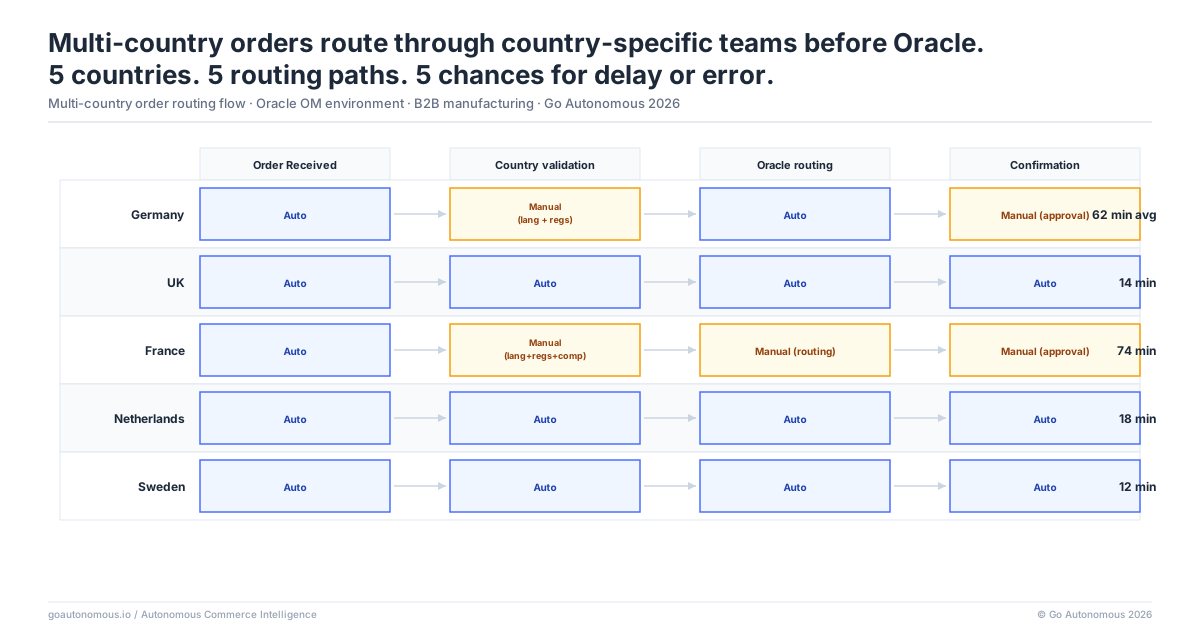
Supporting Multi-Country Operations With Oracle Requires Configuration That Does Not Scale
Country-Specific Oracle Configurations: The Maintenance Overhead Per Country
The Oracle-internal response to multi-country complexity is configuration: country-specific business rules, local pricing groups, language-specific validation logic, country-level order type definitions. This approach works for the countries that are configured and stable. For a manufacturer with 20 countries in Oracle, this means 20 sets of country-specific configurations, each requiring maintenance as local regulations change, pricing structures evolve, and new order format conventions emerge from customer-side system changes.
The maintenance burden is not evenly distributed. High-volume markets have dedicated Oracle administrators who keep configurations current. Lower-volume markets may have configurations that have not been updated in 12–18 months, meaning the business rules Oracle applies are out of date with current regulatory requirements. The gap between configuration state and operational reality grows in proportion to the number of markets and inversely with the resources dedicated to each market’s Oracle configuration.
Why Configuration-Based Solutions Break When Markets Expand
The configuration approach breaks most visibly at market expansion. Adding a new country to a multi-country Oracle operation requires: building new order type definitions, creating country-specific pricing groups, configuring local VAT and tax rules, defining country-specific validation logic, testing the configuration against local order samples, and training the processing team on the new country’s requirements. This is typically a 6–12 week implementation project for a single new market.
For a manufacturer growing through geographic expansion, which is a core growth motion for most of Go Autonomous’s ICP, this configuration overhead is a direct brake on revenue expansion speed. The new market cannot be served efficiently until Oracle is configured for it. The configuration project runs in parallel with commercial launch, creating a period where the new market is served manually while Oracle configuration is completed. As Mikkel Diness Vindeløv identified at Hempel: each new market added operational overhead proportionally, making the scaling economics unsustainable.
The same dynamic applies to regulatory changes. When the EU updates VAT reporting requirements, as it does regularly through ViDA and other initiatives, Oracle configurations across all affected markets require updates. These updates require specialist Oracle configuration work, testing, and deployment. The gap between regulatory effective date and Oracle configuration update is a compliance risk window that grows with the number of markets the organization operates in.
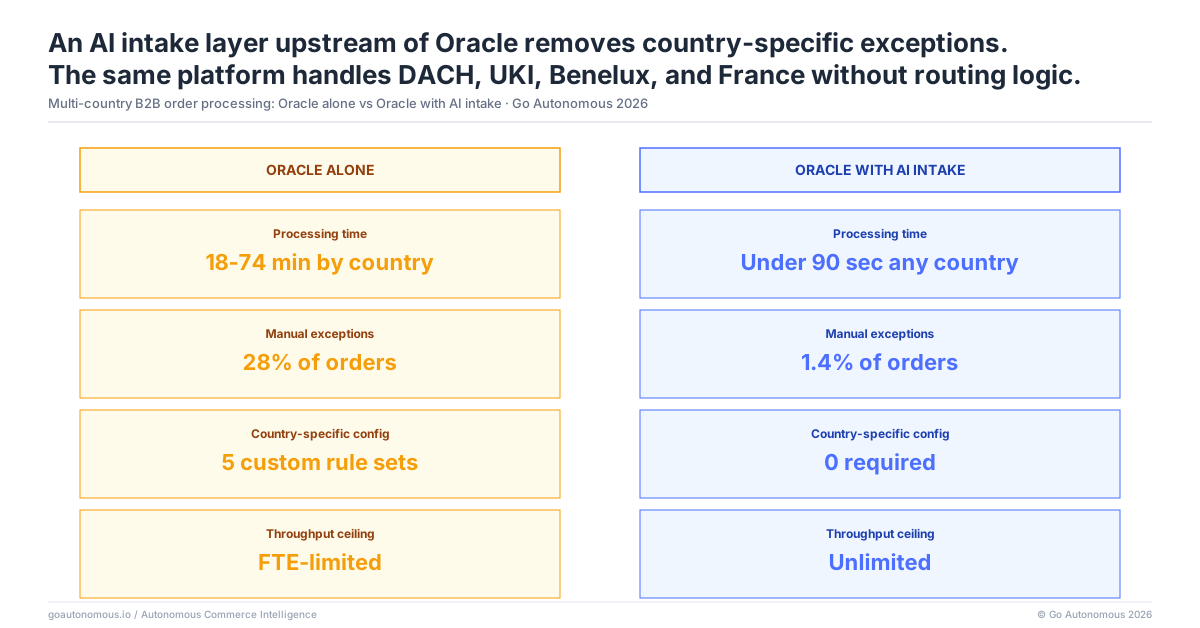
An AI Intake Layer Upstream of Oracle Handles Country-Specific Variants Before They Reach OM Cloud
How AI Normalizes Multi-Country Order Variants Into Oracle-Ready Input
The solution is not to configure Oracle differently for every country: it is to normalize country-specific variants before they reach Oracle. An AI intake layer reads orders from any language and format: it extracts structured fields from German-language email orders, maps French product descriptions to Oracle item master records, identifies missing regulatory fields and resolves them from customer master data, applies the correct country-specific pricing group, and validates field completeness against country-specific regulatory requirements.
Oracle receives a normalized, validated, correctly priced sales order regardless of what country the order originated from, what language it was written in, or what format the customer used. The intake complexity that previously required manual handling, country-specific Oracle configurations, and regular maintenance is absorbed at the AI layer. Oracle’s automation capabilities are fully utilized because Oracle is only ever presented with clean, structured input.
What Multi-Country Oracle Operations Look Like After Closing the Intake Gap
After closing the intake gap, multi-country Oracle operations change structurally. Country expansion no longer requires Oracle reconfiguration: the AI intake layer is trained on new country variants without touching Oracle. Regulatory changes require AI retraining rather than ERP configuration projects. Language variants are normalized automatically, eliminating the need for country-specific processing teams or translation workflows.
The processing team focuses on genuine exceptions: orders with ambiguous product references that cannot be confidently mapped, orders with pricing structures that require commercial judgment, and customer-specific arrangements that fall outside standard rules. These are the cases that genuinely require human expertise. The volume that does not require human expertise, standard configurations, known customers, complete regulatory fields, flows directly into Oracle without touching the team.
Danfoss manages order intake across 26 countries in a day with under-1-minute confirmation times using this approach: Danfoss autonomous order intake case study. The multi-country outcome pattern is consistent across the customer base: see Go Autonomous success cases for the full range. The efficiency gains from closing the intake gap extend beyond processing speed: they compound through reduced Oracle configuration overhead, eliminated compliance risk windows, and faster market expansion timelines.
To understand how an AI intake layer would work with your Oracle OM Cloud environment, book a session with the Go Autonomous team.
Frequently Asked Questions
How does Oracle Order Management Cloud handle orders from multiple countries in different languages?
Oracle Order Management Cloud processes orders once they are in the system but does not natively handle intake from multi-language, multi-format order sources. Orders arriving in German, French, Dutch, or other languages require translation and normalization before entry into Oracle. This is typically handled manually by processing teams or through country-specific Oracle configurations, both of which add cost and delay at the intake layer.
What are the main challenges of using Oracle OM Cloud for multi-country B2B order management?
The main challenges are at the intake layer: language variants from non-English markets require translation before Oracle entry, country-specific regulatory fields (VAT numbers, customs codes) vary by jurisdiction and create compliance blocks when missing, and local pricing structures create pricing errors when looked up manually across country-specific contract structures. These intake failures bypass Oracle’s automation capabilities before the order reaches the system.
How do multinational B2B manufacturers manage country-specific regulatory requirements in Oracle Order Management?
Most multinational manufacturers manage country-specific regulatory requirements through Oracle configuration: country-level order type definitions, local VAT rules, country-specific validation logic, and local pricing groups. This approach works for stable, high-volume markets but requires dedicated Oracle administrator resources per country and breaks at market expansion or regulatory change events.
Can AI normalize multi-country B2B order formats before they enter Oracle Order Management Cloud?
Yes. An AI intake layer upstream of Oracle reads orders in any language and format, extracts structured fields, maps local product references to Oracle item master records, applies the correct country-specific pricing group, validates regulatory field completeness, and presents a normalized Oracle-ready sales order for creation. Oracle receives clean, consistent input regardless of the order’s country of origin, language, or format.
How do B2B distributors operating across Europe reduce Oracle OM Cloud configuration overhead for multi-country operations?
B2B distributors reduce Oracle configuration overhead by moving intake normalization upstream into an AI layer. Country expansion requires AI training on new country variants rather than Oracle reconfiguration projects. Regulatory changes require AI retraining rather than ERP configuration updates. The Oracle configuration remains stable while the AI intake layer absorbs the variability of multi-country order formats, languages, and regulatory requirements.