.svg)





AI Agents in B2B Sales: Why Autonomous Execution Beats Assisted Selling at Scale
AI agents are now embedded in every major B2B sales platform, from Salesforce Einstein to SAP Joule, yet 85 to 90 percent of B2B revenue still requires human facilitation at every step. This post explains why AI assistance has a structural ceiling, what the execution layer is that assistants cannot replace, and how manufacturers and distributors operating at scale are closing the gap in 2026.
AI agents are now embedded in every major B2B sales platform, from Salesforce Einstein to Microsoft Copilot for Sales to SAP Joule. Each promises to accelerate revenue. None of them executes the order. This post is written for VP Sales, CRO, and VP Operations at manufacturers and distributors who are being asked to evaluate AI investments and want a clear answer to one question: what is actually different about autonomous execution, and why does it matter at scale? By the end, you will understand why every AI assistant on the market hits the same ceiling, what the execution layer does that assistants cannot, and how to evaluate whether your sales operations are ready to move past the assistance model.
Table of Content
- What Is Autonomous Execution in B2B Sales, and How Does It Differ from Assisted Selling?
- Why AI Sales Agents Hit a Ceiling Without an Execution Layer
- How Autonomous Execution Works in B2B Sales Operations: Architecture and Integration
- What B2B Sales Operations Look Like Before and After Autonomous Execution
- What B2B Manufacturers and Distributors Are Deploying in 2026
- How to Evaluate Whether Your Sales Operations Are Ready for Autonomous Execution
- Step 1: Quantify Your Current Human Dependency Ratio
- Step 2: Map Where Friction Debt Concentrates
- Step 3: Assess Master Data Quality and Policy Codification Readiness
- Step 4: Define the Exception Envelope and Escalation Path
- Step 5: Set the Target Autonomous Rate and Time-to-Value Expectation
- What Is the Difference Between AI Automation and Autonomous Execution for B2B Manufacturers?
- See How Autonomous Execution Changes the Economics of Your Order Operations
- Frequently Asked Questions
- What is the difference between AI sales agents and autonomous execution for B2B manufacturers?
- How does autonomous order processing integrate with SAP S/4HANA?
- What is Human Dependency Ratio in B2B order management?
- Why do B2B sales AI tools like Salesforce Einstein not process orders automatically?
- How long does it take to deploy autonomous order processing at a B2B manufacturer?
- What is Friction Debt in B2B sales operations?
- What is a realistic autonomous order processing rate for a B2B distributor?
What Is Autonomous Execution in B2B Sales, and How Does It Differ from Assisted Selling?
Autonomous execution in B2B sales is the capability of an AI system to receive a commercial request, interpret it, validate it against pricing and inventory logic, write back to the ERP, and confirm the transaction, without a human in the processing loop. Assisted selling is the capability of an AI system to help a human do that same work faster. These are not two points on a spectrum. They are architecturally different approaches to the same revenue flow problem.
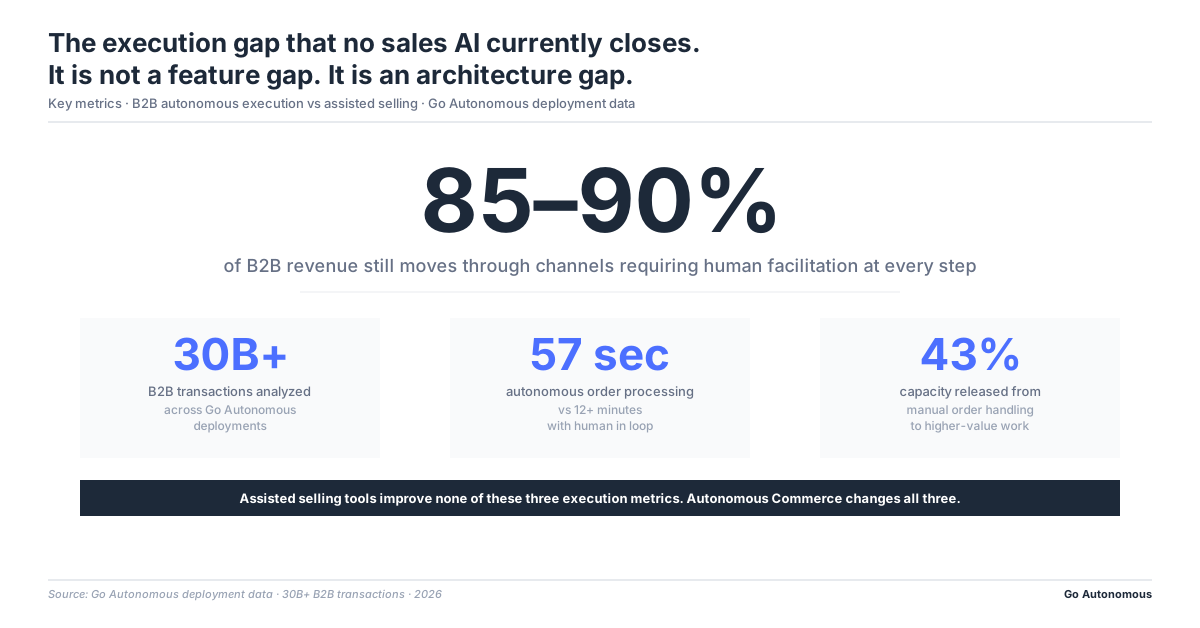
The distinction matters because 85 to 90 percent of B2B revenue still moves through channels that require human facilitation at every step, according to Go Autonomous deployment analysis across more than 30 billion processed B2B transactions. That is not a technology gap. It is an execution architecture decision that most manufacturers have not consciously made.
What Does “Assisted Selling” Actually Mean in Practice?
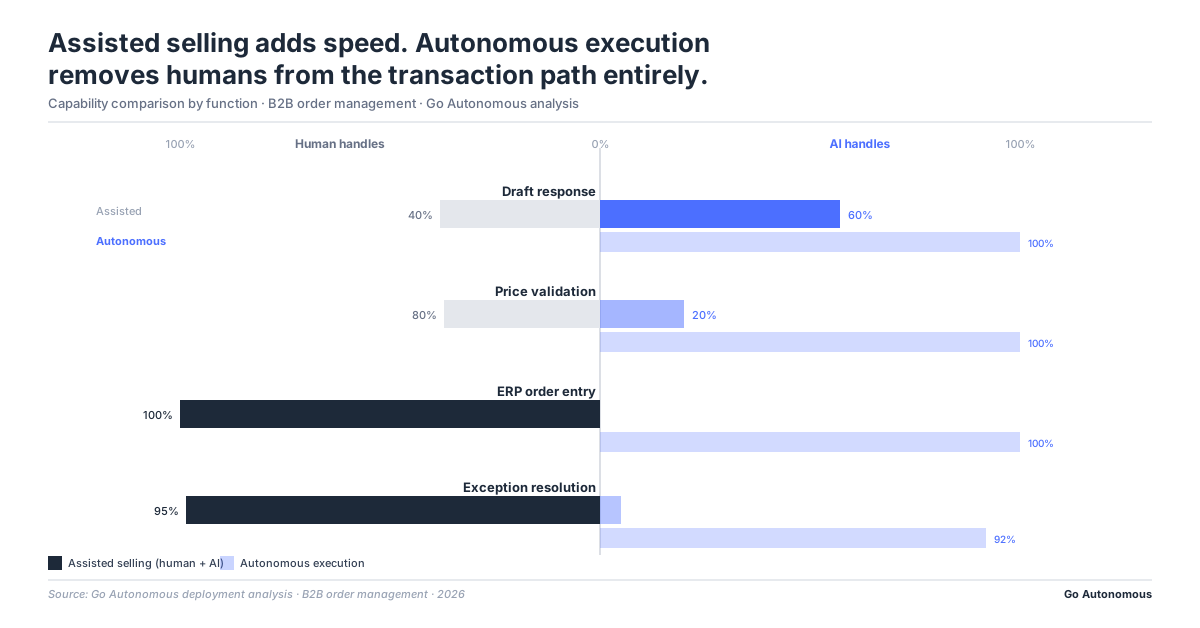
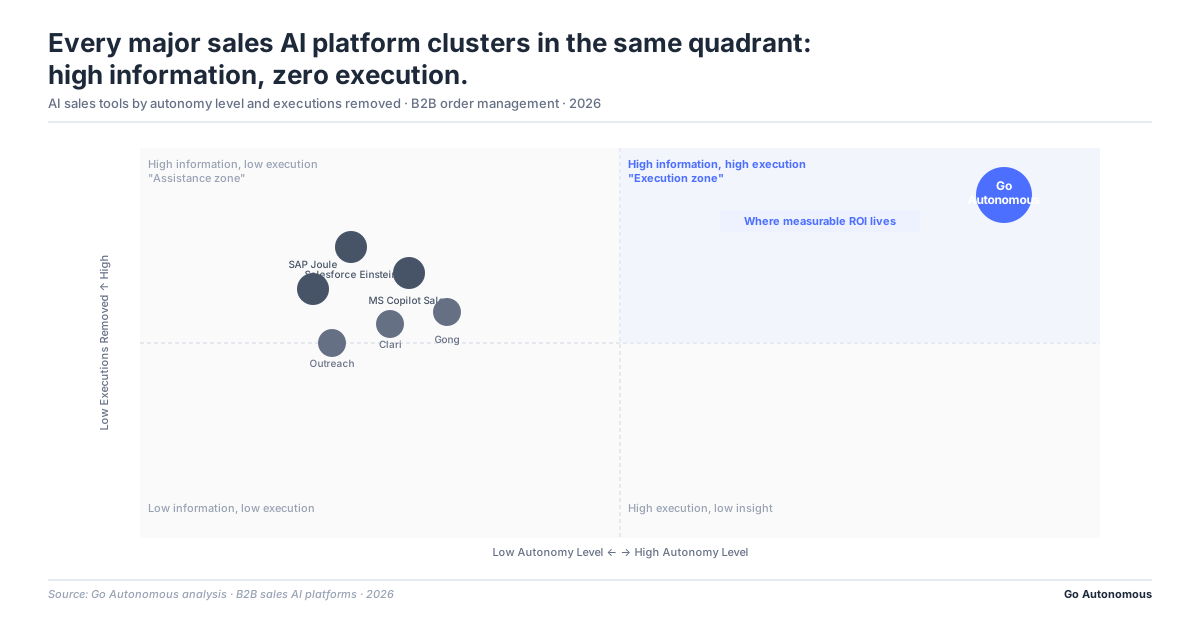
Assisted selling means the AI surfaces a recommendation, a draft response, a suggested next action, or a predicted win probability. The human then acts on that recommendation. Every tool in the current category, Salesforce Einstein, Microsoft Copilot for Sales, SAP Joule, Gong, Clari, Outreach, operates in this mode. They make the human faster. They do not remove the human from the transaction path.
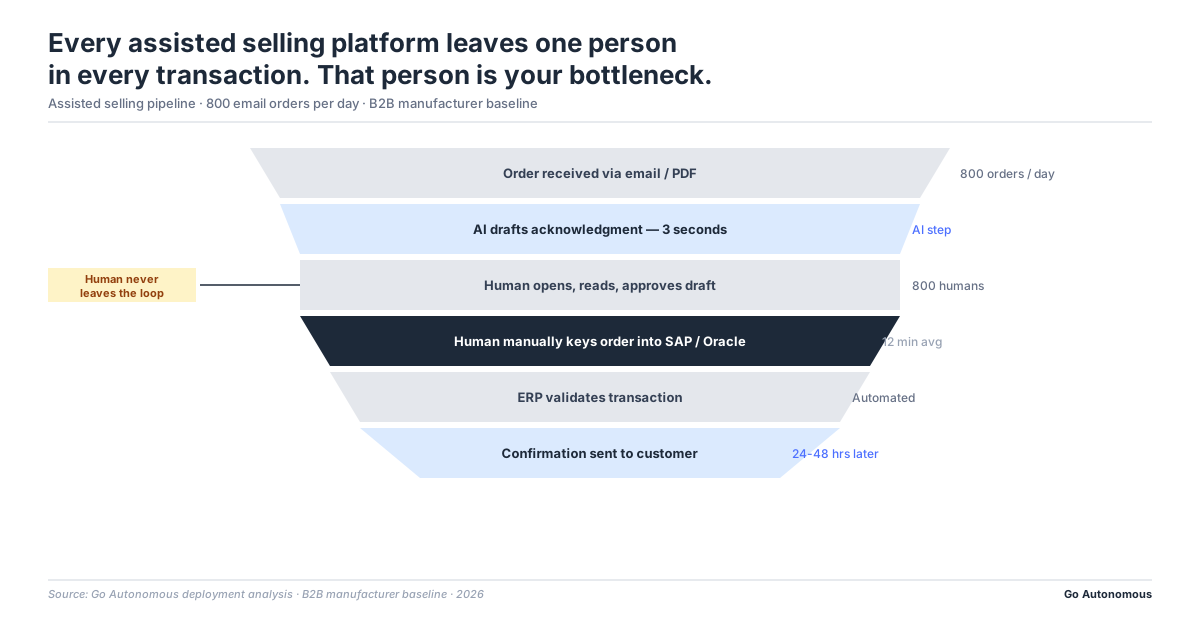
For a manufacturer processing 800 email orders per day, this means the AI might draft the acknowledgment email in three seconds instead of eight minutes. The operator still opens the email, reads the AI draft, approves it, and sends it. Then the order still needs to be manually entered into SAP S/4HANA or Oracle Order Management Cloud, validated against the customer’s contract terms, checked against available stock, and released to fulfillment. The AI saved eight minutes on the email. It touched nothing else in the chain.
What Is the Execution Layer in B2B Sales Operations?
The execution layer is the part of the commercial workflow that processes demand signals into confirmed transactions. It sits between the customer’s request (email, EDI 850, portal submission, PDF purchase order) and the ERP event that triggers fulfillment. In most manufacturers and distributors today, this layer is staffed by customer service teams, order management specialists, and inside sales representatives whose primary function is moving data from one system to another, with judgment applied at every step where the data does not perfectly match the expected format.
Autonomous execution replaces the human processing loop in this layer. The AI reads the incoming request, resolves ambiguities against codified business rules, validates the transaction against pricing masters and inventory, writes the confirmed order to the ERP, and notifies the customer, all without operator involvement unless a genuine exception falls outside the defined policy envelope. This is what separates Autonomous Commerce from the AI assistance category: it executes, not assists.
How Do You Measure Whether Your Sales Operations Depend on Human Execution?
The relevant metric is Human Dependency Ratio (HDR): the number of manual decisions still required per unit of revenue processed. HDR measures whether transactions could complete without human involvement, not merely whether a human touched them. A company with 1,000 orders per day and an HDR of 0.8 still needs a human decision on 800 of those orders before they move forward. AI assistants reduce the time cost of those decisions. They do not change the dependency count.
Human Dependency Ratio (HDR) is the number of manual decisions required to process one unit of revenue through the commercial pipeline. It is calculated as total manual decisions divided by total revenue-generating transactions. An HDR above 0.5 means more than half of all transactions require at least one human decision to progress. For manufacturers and distributors at scale, a high HDR is the structural reason that revenue growth requires proportional headcount growth.
For a deeper diagnostic on where HDR accumulates in your operations, Go Autonomous has published the Friction Debt framework, which breaks down the monetary cost of human decisions at every stage of the revenue flow.
Why AI Sales Agents Hit a Ceiling Without an Execution Layer
The current generation of AI sales tools is genuinely capable within its design scope. The problem is that the design scope stops at the edge of the execution layer. Every tool in the category was built to augment human judgment, not to replace the human in the transaction path. That design choice creates a structural ceiling: no matter how good the AI recommendation gets, the bottleneck shifts to human processing capacity, not AI quality.
What Does Salesforce Einstein Do, and Where Does It Stop?
Salesforce Einstein generates opportunity scores, predicts deal close probability, drafts email responses via Einstein GPT, and surfaces next-best-action recommendations inside Sales Cloud. It does this well. What it does not do is read an inbound purchase order, reconcile the line items against the customer’s contract pricing, write the confirmed order to the ERP, or trigger the fulfillment workflow. Einstein augments the sales rep’s decision-making. The rep still executes the transaction.
What Does Microsoft Copilot for Sales Do, and Where Does It Stop?
Microsoft Copilot for Sales summarizes CRM activity, drafts meeting follow-ups, pulls relevant deal context into Teams conversations, and helps reps prepare for customer interactions. Integrated with Dynamics 365 Sales, it reduces time spent on administrative tasks significantly. However, it operates entirely in the recommendation and summarization layer. It does not process an order. It does not resolve a pricing exception on an inbound EDIFACT message. It does not write back to the ERP when a quote is accepted.
What Does SAP Joule Do, and Where Does It Stop?
SAP Joule is a generative AI assistant embedded across S/4HANA, SuccessFactors, and Ariba. It allows users to query data in natural language, summarize complex reports, and navigate multi-step workflows via conversational commands. For order management specifically, Joule can surface order status, flag anomalies, and help users navigate transaction screens faster. It does not autonomously process inbound orders that arrive outside the ERP. It does not handle email-based purchase orders, PDF attachments, or unstructured EDI variants that fall outside the standard message schema.
What Do Gong and Clari Do, and Where Do They Stop?
Gong analyzes recorded sales conversations and surfaces deal risk signals, coaching recommendations, and pipeline health metrics. Clari focuses on revenue forecasting, pipeline inspection, and deal inspection at the CRM layer. Both platforms are excellent at giving revenue leaders visibility into what is happening in the pipeline. Neither platform touches what happens after a deal closes. The order confirmation, the quote-to-order conversion, the exception resolution, the ERP writeback: those all remain in the human execution layer. Gong and Clari optimize the top of the funnel. The execution layer below it remains unchanged.
Why Good Advice Plus Human Execution Is Still the Same Bottleneck
The critical insight is this: AI assistance compresses the time a human spends making a decision. It does not eliminate the requirement for a human to make it. At a manufacturer processing 600 order-related emails per day, cutting the human response time from 12 minutes to 4 minutes is a genuine improvement. It is also a 67 percent reduction in a cost that should be zero. The structural bottleneck, human dependency, remains entirely intact. Revenue growth above a certain threshold still requires more operators.
According to McKinsey’s research on sales force effectiveness, B2B sales teams spend roughly 65 percent of their time on non-selling activities. AI assistance tools target this problem directly and move that number. However, the underlying architecture, a human-dependent execution loop, persists. The assistance layer makes that loop faster. The execution layer removes it.
Each time we added one or two million euros in revenue, we had to add another operator. From a cost perspective, that's an unsustainable way of operating a business.

This scaling dynamic is the defining commercial failure of the assistance model at volume. The AI makes each operator more efficient. The fundamental constraint, that revenue cannot flow without operators in the loop, is never addressed. For a company growing at 15 percent per year, the headcount pressure compounds until it becomes the primary drag on margin expansion.
How Autonomous Execution Works in B2B Sales Operations: Architecture and Integration
Autonomous execution in B2B sales operations is a four-layer architecture that sits between the customer’s channel of choice and the ERP system that records the transaction. Understanding how it integrates with existing infrastructure is essential before evaluating whether it applies to a specific operational context.
How Does Autonomous Commerce Integrate with SAP S/4HANA and Oracle Order Management?
Autonomous Commerce integrates at the ERP writeback layer via API or certified connector, not by replacing the ERP. SAP S/4HANA continues to be the system of record for all confirmed transactions. What changes is the layer that processes incoming commercial requests before they reach the ERP. The autonomous execution layer reads an inbound email order, interprets the line items, resolves the customer identity against the SAP master data, checks pricing against the contract record, validates availability, and writes the confirmed sales order directly to S/4HANA, without an operator performing any of those steps manually. The ERP receives a clean, validated transaction. Oracle Order Management Cloud and Microsoft Dynamics 365 Order Management follow the same integration pattern.
For EDI channels, the autonomous layer handles standard ANSI X12 EDI 850 and EDIFACT ORDERS messages as well as non-standard and hybrid EDI variants that fall outside the strict schema requirements of most EDI provider platforms like TrueCommerce, SPS Commerce, and DiCentral. This matters because a significant portion of B2B order volume arrives in formats that are structurally valid but operationally messy: wrong SKU codes, partial pricing, missing delivery addresses, or split-line ambiguities that rules-based EDI processors reject and route to manual queues.
What Does the Autonomous Execution Layer Actually Process?
The Go Autonomous platform processes the full spectrum of inbound commercial requests that currently land in human queues: email purchase orders (the highest-friction channel, representing 50 to 70 percent of B2B transaction volume at most manufacturers), PDF attachments, portal-submitted orders, EDI batches, blanket PO call-offs, RFQs, and price inquiries. Each channel requires different parsing logic, different validation rules, and different exception handling pathways. The platform handles all of them within a unified execution fabric that connects to the ERP via a single integration layer.
Go Autonomous deployment data, drawn from more than 30 billion processed transactions, shows that the fastest autonomous order processing benchmark reaches 57 seconds from receipt to confirmed ERP writeback. At that throughput, the execution bottleneck effectively disappears. Orders process at the speed of customer intent, not operator availability.
For a structured view of how this compares to current state operations, see the white paper The Autonomous Execution Fabric: Five AI Lessons on Enterprise AI, which documents the architectural principles behind enterprise autonomous deployment.
How Does Friction Debt Accumulate in the Execution Layer?
Friction Debt is the total monetary cost of human decisions still embedded in the revenue flow. It accumulates at every point where a human must intervene to move a transaction forward: pricing exceptions requiring manager approval, SKU mismatches requiring customer service resolution, delivery address ambiguities requiring outbound calls, and credit limit checks requiring finance sign-off. Each intervention carries a decision time cost, a loaded labor cost, and a downstream revenue delay cost.
The Friction Debt framework provides the methodology for calculating this number across your operations. For most manufacturers processing 500 to 2,000 orders per day, the friction debt figure is larger than the annual IT budget allocated to addressing it. That gap, between the cost of the problem and the investment directed at solving it, is why the assistance model persists: it is cheaper to improve what exists than to replace the architecture underneath.
The commercial case for autonomous execution is clearest when friction debt is calculated explicitly. “Every data field touched by a human is friction debt.” Until that number is on the operating dashboard, the cost of remaining in an assisted-selling model is invisible and therefore impossible to budget against.
What Happens to Exception Handling Under Autonomous Execution?
Exception handling is the most common objection to autonomous execution: what happens when the order does not fit the standard pattern? The answer depends on how exceptions are defined and how the policy envelope is designed. Under autonomous execution, the platform processes every transaction that falls within the codified business rules without human involvement. Genuine exceptions, those that require a judgment the system cannot make because the policy does not cover the scenario, are routed to human operators with full context pre-populated.
The critical shift is that operators handle exceptions only, not routine processing. At a well-deployed implementation, the exception rate drops to under 10 percent of total volume. Operators who previously spent 80 percent of their time on routine entry spend that same time on exceptions that genuinely require human judgment: complex pricing negotiations, dispute resolution, relationship management on strategic accounts. This is what operational efficiency at scale looks like when the architecture changes, not incremental improvement but structural reallocation.
What B2B Sales Operations Look Like Before and After Autonomous Execution
The operational change is not marginal. The following table maps the core dimensions of B2B sales operations across the two states. These are not theoretical projections. They reflect the operational reality of manufacturers and distributors running Autonomous Commerce in production today.
| Dimension | Before: Assisted Selling Model | After: Autonomous Execution Model |
|---|---|---|
| Order intake channel | Email, EDI, PDF, and portal submissions all route to human queues. Operators process each order manually, one at a time. | All channels feed a single autonomous layer. Orders are parsed, validated, and written to the ERP without operator involvement for in-policy transactions. |
| Processing speed | 4 to 20 minutes per order depending on complexity and queue depth. Peak periods extend to hours. | Fastest benchmark: 57 seconds from receipt to confirmed ERP writeback. Consistent regardless of volume or time of day. |
| Headcount scaling | Every significant revenue increase requires additional operators. Scaling is linear: more revenue equals more headcount. | Revenue scales without a proportional headcount increase. The execution layer absorbs volume growth. Operators handle exceptions only. |
| Error rate | Manual data entry introduces keying errors, pricing mismatches, and wrong-quantity fulfillments. First-time-right rates below 85 percent are common. | Go Autonomous deployment data shows a 99 percent first-time-right rate across processed transactions. No manual entry, no keying errors. |
| Quote-to-order conversion | Slow quote turnaround compresses conversion windows. Customers revert to competitors who respond faster or place orders through easier channels. | Automated quote generation and order confirmation compresses the conversion window. According to Go Autonomous customer outcomes, win rate increases of 18 percent are directionally consistent. |
| Operator role | Customer service and inside sales teams spend the majority of their time on routine transaction processing. Strategic and relationship work is squeezed out. | Operators handle exceptions and high-value interactions. Capacity is reallocated from data entry to commercial activity. Go Autonomous deployment data shows 43 percent of processing capacity released. |
| CX outcome | Response times vary by queue depth, shift patterns, and individual operator workload. Order status visibility is limited. | Consistent sub-minute response times regardless of volume. Customers receive automated confirmation and can track order status without contacting customer service. |
The pattern across every dimension is the same: the assisted model improves the efficiency of human processing. The autonomous model removes human processing from the routine transaction path entirely. For customer experience outcomes, the difference is felt immediately. For commercial outcomes, the compounding effect of consistently faster execution at higher accuracy is what drives the revenue and margin impact.
Automating customer requests comes with at least two substantial benefits. Being able to answer customers faster drives lead times down and sales up.
What B2B Manufacturers and Distributors Are Deploying in 2026
The deployment landscape in 2026 has bifurcated sharply. One group of manufacturers and distributors is investing in the AI assistance layer: Salesforce Einstein, Copilot for Sales, SAP Joule integrations, Gong and Clari for pipeline intelligence. These are legitimate investments that improve sales team productivity within the existing execution architecture. The second group is investing at the execution layer, replacing the human-dependent processing loop with autonomous systems that process commercial requests without operator involvement.
What Industries Are Moving to Autonomous Execution First?
The leading adopters are manufacturers and distributors with high order volume, complex product catalogs, and multi-channel order intake. Industrial manufacturers, specialty chemical distributors, medical supply companies, and fluid handling equipment suppliers share a common operational profile: thousands of SKUs, hundreds of customers with individually negotiated contract pricing, and order intake that arrives across email, EDI, portal, and phone simultaneously. This profile creates maximum friction debt and maximum return from removing the human execution dependency.
Geographically, adoption is concentrated in the Nordics, DACH, and Benelux regions, where labor costs are high, digital infrastructure is mature, and operational leadership has long invested in supply chain efficiency. However, the same patterns apply across UKI and France, where the combination of high-volume order processing and competitive pressure on delivery speed creates identical economic conditions.
The Danfoss deployment is a published example of autonomous execution at global scale: order intake processing across 26 countries, with orders confirmed in under one minute for in-scope transactions, running on SAP S/4HANA as the system of record. The structural change is that Danfoss customer service teams no longer process standard orders manually. They handle exceptions and focus on relationship-intensive interactions.
How Do Manufacturers Evaluate AI Investments at the Execution Layer vs the Assistance Layer?
The evaluation framework differs because the ROI model differs. AI assistance tools are evaluated primarily on sales rep productivity metrics: calls made per day, pipeline coverage, CRM data quality, time spent on administrative tasks. These are measurable and typically show returns within 90 days of deployment.
Autonomous execution investments are evaluated on operational economics: cost per order, order cycle time, first-time-right rate, headcount required per million EUR of revenue processed, and the working capital impact of faster order-to-cash cycles. According to Forrester research on B2B commerce automation, companies that automate core order management workflows see measurable reductions in cost-to-serve within the first deployment year. The calculation is more complex than productivity metrics, but the scale of the return is proportionally larger.
For manufacturers considering this transition, the white paper Welcome to the Era of Autonomous Commerce provides the category framing and economic model that most evaluation teams use as their reference point.
What Does the Transition from Assisted to Autonomous Look Like Operationally?
The transition does not require replacing existing AI tools. Salesforce Einstein, Gong, Clari, and Copilot for Sales continue to serve their designed purpose in the sales engagement and pipeline management layer. Autonomous execution addresses a different problem in a different part of the commercial workflow. The two layers are complementary: one optimizes the pre-close sales process, the other executes the post-close transaction without human dependency.
Operationally, the transition begins with a scope definition: which order channels, which customer segments, which product categories, and which transaction types fall within the initial autonomous execution envelope. The policy codification phase converts tacit operator knowledge into system-executable rules. This is the most labor-intensive part of the deployment, and it is also where the friction debt calculation becomes precise: every exception that cannot be codified is a policy gap that represents ongoing manual processing cost.
After go-live, the system’s autonomous rate, the percentage of transactions processed without human involvement, becomes the primary operational KPI. Most deployments target above 85 percent within the first six months. Customer outcomes across the Go Autonomous portfolio show that reaching this threshold requires three things: clean master data, codified pricing and allocation policies, and clearly defined exception routing rules that give operators the context they need to resolve out-of-scope transactions quickly.
How to Evaluate Whether Your Sales Operations Are Ready for Autonomous Execution
Readiness for autonomous execution is not primarily a technology question. It is a data quality, policy maturity, and operational scope question. Most manufacturers and distributors at the scale where autonomous execution becomes economically compelling already have the ERP infrastructure, the customer base, and the order volume. What they assess before committing is whether the operational preconditions are in place.
Step 1: Quantify Your Current Human Dependency Ratio
Start with the HDR calculation: how many of your inbound transactions require at least one manual decision before they progress? Count email orders that require manual data entry. Count EDI messages that fail validation and route to manual queues. Count PO attachments that require a human to open the file, read the line items, and enter them into the ERP. Add price inquiries that go to inside sales because the portal does not support the customer’s contract terms. Count the total, divide by total transaction volume, and you have your baseline HDR.
For most manufacturers processing over 500 orders per week, this number is above 0.6. That means more than 60 percent of all transactions require human intervention before they can progress. This is the structural dependency that autonomous execution addresses. The HDR calculation typically surfaces a number that surprises even operations-focused leadership teams, because the cost has been absorbed gradually over years of headcount additions rather than appearing as a single line item on the operating budget.
Step 2: Map Where Friction Debt Concentrates
Not all manual decisions carry equal cost. Map the friction debt by transaction type: how much does a manually processed email order cost in operator time? How much does a failed EDI message cost when it routes to a specialist queue? How much does a pricing exception cost when it requires manager approval and customer follow-up before the order can be released? The concentration of friction debt usually follows an 80/20 pattern: 20 percent of transaction types account for 80 percent of total manual processing cost.
This mapping exercise also reveals the scope of the initial autonomous deployment. You do not need to automate everything at once. Automating the highest-friction 20 percent of transaction types typically delivers the majority of the cost and speed benefit. The remaining 80 percent can follow in subsequent deployment phases.
Step 3: Assess Master Data Quality and Policy Codification Readiness
Autonomous execution requires that the system can make decisions the operator currently makes. This requires two things: master data that is accurate and complete (customer records, contract pricing, product catalog, delivery terms), and policies that are codified clearly enough for a system to apply them consistently. Most manufacturers have partial data quality and partially codified policies. The question is not whether they are perfect, but whether they are complete enough to handle the target transaction scope.
A common finding during the assessment phase is that pricing policies are codified at the contract level but not at the edge case level: what happens when a customer orders outside their contracted product set? What happens when they order above their credit limit by less than 5 percent? What happens when the preferred delivery address does not match the master record? Each of these scenarios currently generates a manual decision. Each one, once codified, becomes a system decision that reduces HDR.
Step 4: Define the Exception Envelope and Escalation Path
The exception envelope is the set of scenarios where the autonomous system routes a transaction to a human operator rather than processing it. Defining this clearly before deployment is what separates a well-performing autonomous implementation from one that creates operational disruption. The envelope should be tight: only route to humans when the policy genuinely does not cover the scenario. Route everything else autonomously.
When a transaction is routed to a human, the system should pre-populate all relevant context: the original customer request, the identified ambiguity or policy gap, the customer’s account history, and suggested resolution options. This reduces the operator’s handling time for genuine exceptions to under two minutes in most cases, even when the transaction itself is complex.
Step 5: Set the Target Autonomous Rate and Time-to-Value Expectation
Before committing to deployment, set a specific target autonomous rate for the first 90 days. A realistic initial target for a manufacturer with moderate data quality and partially codified policies is 70 to 75 percent autonomous processing. Reaching 85 percent or above typically requires one iteration on policy gaps identified after go-live, usually within the first 60 days.
The time-to-value expectation should be anchored to the HDR calculation: at your current transaction volume, what does a 30-percentage-point reduction in HDR save in operator time and cost per quarter? For manufacturers processing 1,000 orders per day at an average 10 minutes of manual processing time per order, that calculation produces a number in the range of millions of EUR annually. The deployment investment is typically recovered within the first year, and the topline growth impact from faster processing, higher first-time-right rates, and improved customer experience compounds beyond that.
What Is the Difference Between AI Automation and Autonomous Execution for B2B Manufacturers?
AI automation scales what humans do. Autonomous execution removes the human from the routine path. This distinction maps directly to the HDR metric: automation reduces the time per manual decision, which lowers cost but does not lower the dependency count. Autonomous execution reduces the number of transactions that require a human decision at all, which changes the dependency structure fundamentally. “Automation scales labor. Autonomy eliminates dependency.” For a comparison of where traditional automation tools sit relative to the execution layer, see the RPA vs AI analysis published on the Go Autonomous blog.
See How Autonomous Execution Changes the Economics of Your Order Operations
If the patterns described in this post match what you see in your own operations, the next step is straightforward: calculate your Human Dependency Ratio and map where friction debt concentrates in your order intake and quote processing workflows. Most leadership teams at manufacturers and distributors are surprised by how large these numbers are when they are calculated explicitly, because the cost has been absorbed incrementally through headcount additions rather than appearing as a single budget line. Go Autonomous works with 500M to 20B EUR manufacturers and distributors in the Nordics, DACH, Benelux, UKI, and France. If you are processing hundreds or thousands of orders per day with a significant manual processing dependency, we can show you exactly what autonomous execution looks like in your environment: your ERP, your order channels, and your commercial workflows. Book a conversation with our team.
Sources
- McKinsey: The future of B2B sales is hybrid — research on how B2B sales teams spend their time and the shift toward digital-first sales models
- Forrester B2B Commerce Research — benchmarks on order management automation and cost-to-serve reduction in B2B commerce operations
- Salesforce State of Sales Report — data on sales rep time allocation and AI adoption across B2B sales organizations
- The Autonomous Execution Fabric: Five AI Lessons on Enterprise AI — Go Autonomous white paper on the architectural principles behind enterprise autonomous deployment
- Welcome to the Era of Autonomous Commerce — Go Autonomous category-defining white paper on the shift from assisted to autonomous commerce
Frequently Asked Questions
What is the difference between AI sales agents and autonomous execution for B2B manufacturers?
AI sales agents assist human decision-making by surfacing recommendations, drafting responses, and predicting outcomes. Autonomous execution removes the human from routine transaction processing entirely. AI agents make operators faster. Autonomous execution makes operators unnecessary for in-policy transactions. The critical difference is that AI agents do not write to the ERP, process the order, or confirm the transaction without a human in the loop.
How does autonomous order processing integrate with SAP S/4HANA?
Autonomous order processing integrates with SAP S/4HANA via API or certified connector at the ERP writeback layer. The autonomous execution layer sits above the ERP, processing inbound commercial requests from email, EDI, and portals, then writing validated, confirmed sales orders directly to S/4HANA. The ERP remains the system of record. What changes is that orders arrive already validated, already priced, and ready for fulfillment release without manual operator entry.
What is Human Dependency Ratio in B2B order management?
Human Dependency Ratio (HDR) is the number of manual decisions required to process one unit of revenue through the commercial pipeline. It is calculated as total manual decisions divided by total revenue-generating transactions. An HDR above 0.5 means more than half of all transactions require at least one human decision before they can progress. For manufacturers at scale, a high HDR is the structural reason that revenue growth requires proportional headcount growth. Learn more about the metric and its calculation in the Autonomous Commerce Blueprint.
Why do B2B sales AI tools like Salesforce Einstein not process orders automatically?
Salesforce Einstein, Gong, Clari, and similar tools were designed to augment human judgment in the sales engagement layer, not to execute transactions. Their architecture assumes a human makes the final decision and initiates the ERP action. They have no integration into the order intake processing layer, no capability to read and validate purchase orders, and no mechanism to write confirmed orders to an ERP. They optimize the pre-close sales process, not the post-close execution workflow.
How long does it take to deploy autonomous order processing at a B2B manufacturer?
Most deployments reach initial go-live within 8 to 16 weeks, depending on ERP complexity, data quality, and the number of order channels in scope. Reaching a 70 to 75 percent autonomous rate typically occurs within the first 30 to 60 days after go-live. Reaching 85 percent or above usually requires one policy iteration cycle, identifying and codifying the exception categories that were not captured in the initial scope, which typically happens within 60 to 90 days post-deployment.
What is Friction Debt in B2B sales operations?
Friction Debt is the total monetary cost of human decisions still embedded in the revenue flow. It accumulates at every point where a human must intervene to move a transaction forward: pricing exceptions, SKU mismatches, address ambiguities, credit limit checks. It has three components: decision time (the wait between a decision being needed and made), decision cost (the loaded labor cost of each intervention), and decision drag (the downstream revenue impact of delayed or slow processing). See the full framework at the Friction Debt Blueprint page.
What is a realistic autonomous order processing rate for a B2B distributor?
A realistic initial target is 70 to 75 percent autonomous processing within the first 30 to 60 days after go-live, assuming moderate master data quality and partially codified pricing policies. Reaching 85 percent or above is achievable within 90 days for most manufacturers after a policy iteration phase. Go Autonomous deployments target above 85 percent as the steady-state benchmark for well-scoped implementations. The Mediq healthcare distribution case illustrates what this looks like in a high-complexity distribution environment.