.svg)





Intelligent Document Processing vs Autonomous Commerce: Why IDP Is the Wrong Layer for B2B Order Execution
Intelligent document processing extracts data from purchase orders. It does not validate that data, apply pricing contracts, or write to the ERP. For B2B manufacturers and distributors still carrying high Human Dependency Ratios in their order processing layer, IDP addresses the symptom while the root cause stays intact. This post explains where IDP stops, what Autonomous Commerce adds, and how to evaluate which problem your operation actually has.
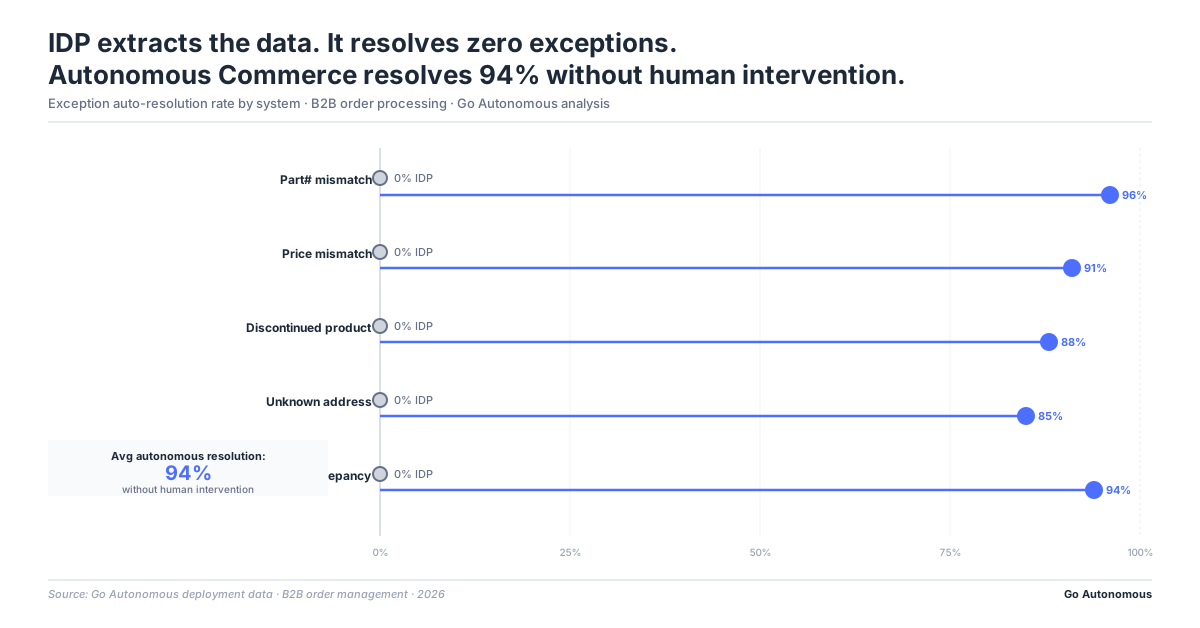
It is 9:15 AM. Your operations team has just received 80 purchase order PDFs. The IDP tool your company deployed eight months ago extracts the data automatically. Line items appear in a structured queue within minutes. No manual keying. The team is impressed. Then a CSR opens the first extracted record and the real work begins: the customer’s part number does not match the SAP material code, the price on the PO is 4% below the contracted tier, two line items reference a product that was discontinued three months ago, and the delivery address is a site that your logistics system does not recognise. The extraction worked. The order is still not confirmed.
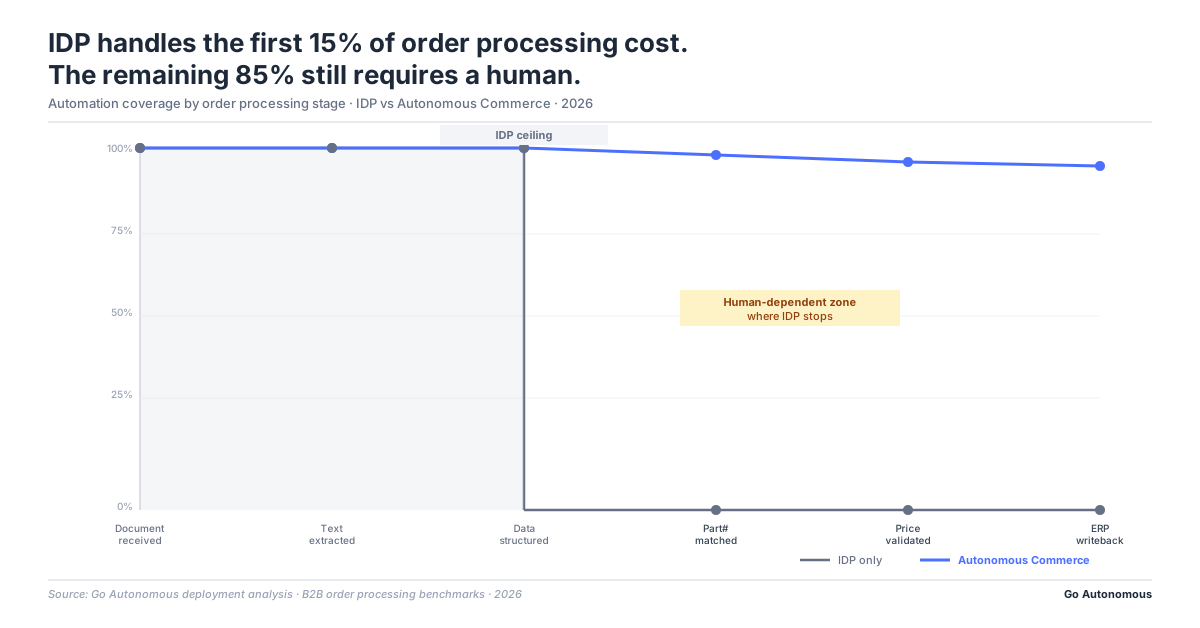
This is the extraction trap. Intelligent document processing solves one specific problem, reading unstructured documents and turning them into structured data, at genuine scale and with genuine accuracy. What it does not solve is what happens to that data after extraction. For most B2B manufacturers and distributors, that gap is where most of the Human Dependency Ratio lives, and where most of the cost accumulates.
Table of Content
- What Intelligent Document Processing Actually Does: The Extraction Layer Defined
- The Extraction Trap: Why IDP Creates a New Handoff Instead of Eliminating One
- Why ERP Native IDP Connectors Do Not Close the Execution Gap
- IDP vs. Autonomous Commerce: A Decision Scoring Framework
- What Changes Operationally When Autonomous Commerce Handles the Full Stack
- Evaluate Whether Your Operation Has an Extraction Problem or an Execution Problem
- The Cost of Standing Still on the Execution Layer
- Frequently Asked Questions
- What is the difference between intelligent document processing and autonomous order processing?
- Does IDP software automatically create sales orders in SAP?
- How does ABBYY Vantage compare to Autonomous Commerce for B2B order management?
- What is the accuracy rate of IDP tools for B2B purchase orders?
- What is Human Dependency Ratio in B2B order processing?
- Can IDP tools handle B2B order exceptions and pricing discrepancies?
- How does Autonomous Commerce integrate with existing IDP deployments?
What Intelligent Document Processing Actually Does: The Extraction Layer Defined
Intelligent document processing tools apply machine learning and computer vision to read documents, extract structured data, and classify the content. For B2B order management, the relevant documents are purchase orders, request-for-quotation PDFs, order amendment letters, and blanket PO call-offs. The leading IDP platforms in this space are ABBYY Vantage, Hyperscience, Rossum, and Infrrd. Each has different strengths, but all share the same architectural scope: they operate at the extraction layer.
What is the difference between intelligent document processing and autonomous order processing?
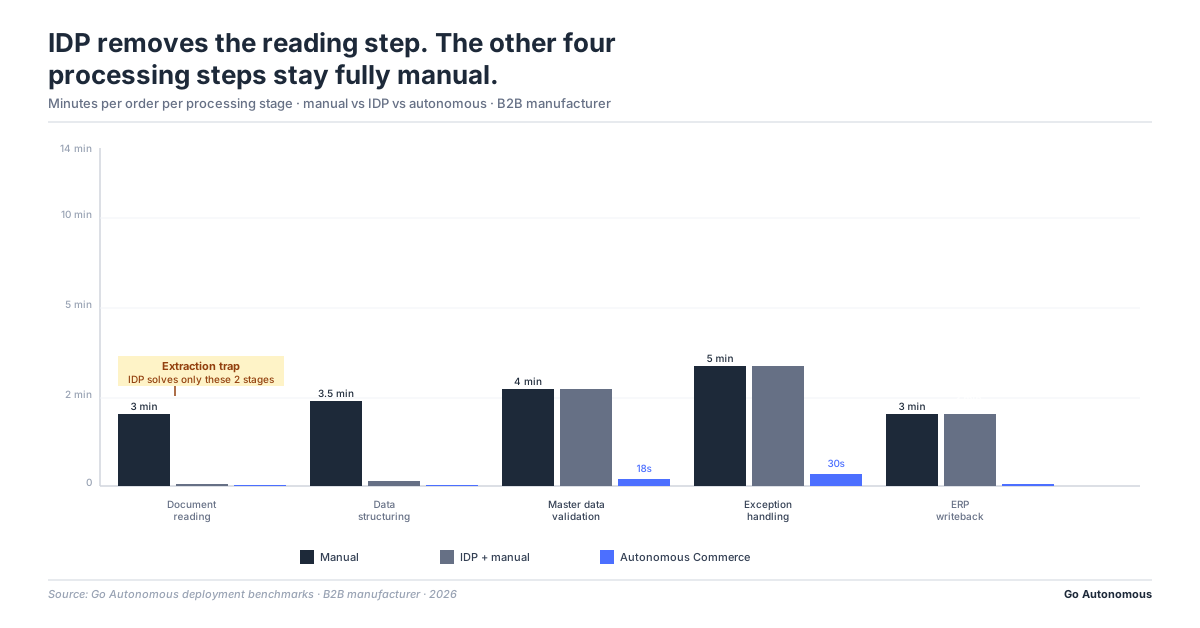
Intelligent document processing converts unstructured document content (PDFs, scanned images, email attachments) into structured data fields. Autonomous order processing takes structured order data, validates it against ERP master data and pricing contracts, resolves discrepancies, and writes the confirmed order to the ERP without human intervention. IDP eliminates the reading and extraction step. Autonomous order processing eliminates the validation, enrichment, exception handling, and ERP writeback steps. These are sequential layers in the same process, not alternatives to each other.
ABBYY Vantage uses a low-code document skills approach, allowing organizations to train custom extraction models for specific document types including POs, invoices, and delivery notes. Hyperscience applies a human-in-the-loop model that routes low-confidence extractions for human review before processing. Rossum uses a neural-network-based extraction engine optimized for financial and procurement documents. Infrrd focuses on handwritten and complex multi-format documents common in certain industrial sectors.
All four stop at the same boundary: they produce structured data. They do not evaluate what to do with it.
What is the accuracy rate of IDP tools for B2B purchase orders?
IDP accuracy on structured B2B purchase orders typically falls in the 85 to 95 percent range for well-trained models on familiar document formats. Accuracy drops for handwritten documents, non-standard layouts, orders in multiple languages, or POs that reference custom customer part numbers rather than standard EAN or SKU codes. For complex B2B orders with custom pricing, non-standard items, or blanket PO call-off structures, the practical accuracy rate is closer to 80 to 90 percent, meaning 10 to 20 percent of extracted records still require human review before they can be acted on.
That 10 to 20 percent exception rate is not a failure of IDP technology. It reflects the genuine complexity of B2B commercial documents. The problem is that this exception rate still routes directly to human operators for review, often the same team the IDP deployment was supposed to relieve. IDP reduces the volume of work. It does not eliminate the dependency.
The Extraction Trap: Why IDP Creates a New Handoff Instead of Eliminating One
The fundamental issue with IDP as an order execution solution is architectural. IDP removes the document-reading step from the human workflow. It does not remove the human from the workflow. For every extracted record, a human or downstream system still needs to perform the following steps before an order can be confirmed in the ERP:
- Account resolution: Match the customer name or identifier on the extracted document to an account ID in SAP S/4HANA, Oracle Order Management Cloud, or Microsoft Dynamics 365. Customer names in PO headers rarely match ERP account names exactly.
- SKU mapping: Map the customer’s part number or product description to the correct ERP material code. In complex B2B environments, a single product can have dozens of different customer-specific part number variations.
- Price validation: Compare the extracted unit prices against the contracted pricing tier for that specific customer, product, and volume combination. Pricing master data is often held across multiple systems and contract documents.
- Availability check: Validate extracted quantities against current stock, open production orders, or committed delivery windows.
- Exception routing: Route any discrepancy identified in the above steps to the appropriate human for resolution. At 80 to 90 percent extraction accuracy, this queue is never empty.
- ERP writeback: Enter the validated, enriched order data into the ERP system to generate the sales order and trigger the fulfillment process.
IDP handles none of these steps. It hands off a structured data record to a human or a separate integration layer that must then perform all of them. In practice, this means IDP reduces the data-entry time per order but does not compress the end-to-end cycle time significantly for complex orders with exceptions. The Human Dependency Ratio of the process decreases modestly. It does not approach zero.
Human Dependency Ratio (HDR) measures the cognitive load required to generate revenue: specifically, the number of manual decisions still required per unit of revenue processed. It is the most honest metric for evaluating whether an automation investment has created genuine autonomy or simply moved the human bottleneck from one step to another. A process with IDP deployed but no autonomous validation, enrichment, or ERP writeback has a lower HDR than a fully manual process. It does not have a low HDR. The goal of autonomous execution is to drive HDR toward zero, not to shift it downstream.
Adopting Autonomous Commerce at Danfoss is not just about speed and efficiency. It's about empowering our customer service teams and sales force to focus on building relationships and providing personalized support.

Why ERP Native IDP Connectors Do Not Close the Execution Gap
SAP S/4HANA, Oracle Order Management Cloud, and Microsoft Dynamics 365 all offer native or partner-ecosystem IDP connectors. SAP integrates with ABBYY and other document capture vendors through its Business Technology Platform. Oracle has document understanding capabilities embedded in its cloud services. Microsoft’s Power Automate includes AI Builder document processing that connects to Dynamics 365 workflows.
These integrations solve the connectivity problem. Extracted data flows directly into the ERP input layer without manual copying. However, the same validation and enrichment gap persists. The ERP receives structured data from the IDP tool. The ERP then checks that data against its own master records, pricing tables, and inventory availability. Any discrepancy produces an exception that requires human resolution before the sales order can be created.
Does IDP software automatically create sales orders in SAP?
IDP software does not automatically create sales orders in SAP. IDP extracts structured data from documents and routes it to downstream systems. SAP S/4HANA creates a sales order only after that data is validated against customer master records, material master data, pricing conditions, and availability. Discrepancies between extracted data and SAP master data produce exceptions that require human resolution before order creation. The IDP-to-SAP flow eliminates manual data entry but does not eliminate human decision-making on exceptions.
The gap between IDP output and confirmed SAP sales order is precisely where Autonomous Commerce operates. It is not in competition with IDP. It is the execution layer that completes what IDP starts: taking the extracted data, validating it autonomously against ERP master data and pricing contracts, resolving discrepancies within policy, and writing the confirmed sales order to SAP, Oracle, or Dynamics 365 without routing the exception queue to a human team.
For the relationship between this execution gap and the broader question of automation approaches, the analysis of RPA versus AI agents for order processing describes the same architectural ceiling from a different angle: the boundary between tools that move data and platforms that make decisions about data.
How does ABBYY Vantage compare to Autonomous Commerce for B2B order management?
ABBYY Vantage is a document extraction platform. It reads PDF purchase orders, extracts line items, quantities, and pricing into structured data fields, and routes that data to downstream systems via API or native connectors. Autonomous Commerce is an order execution platform. It receives inbound orders from all channels (including IDP tool outputs), validates and enriches the data against ERP master records, resolves discrepancies autonomously, and confirms the order in the ERP. ABBYY Vantage solves the reading problem. Autonomous Commerce solves the execution problem. They are complementary, not competing.
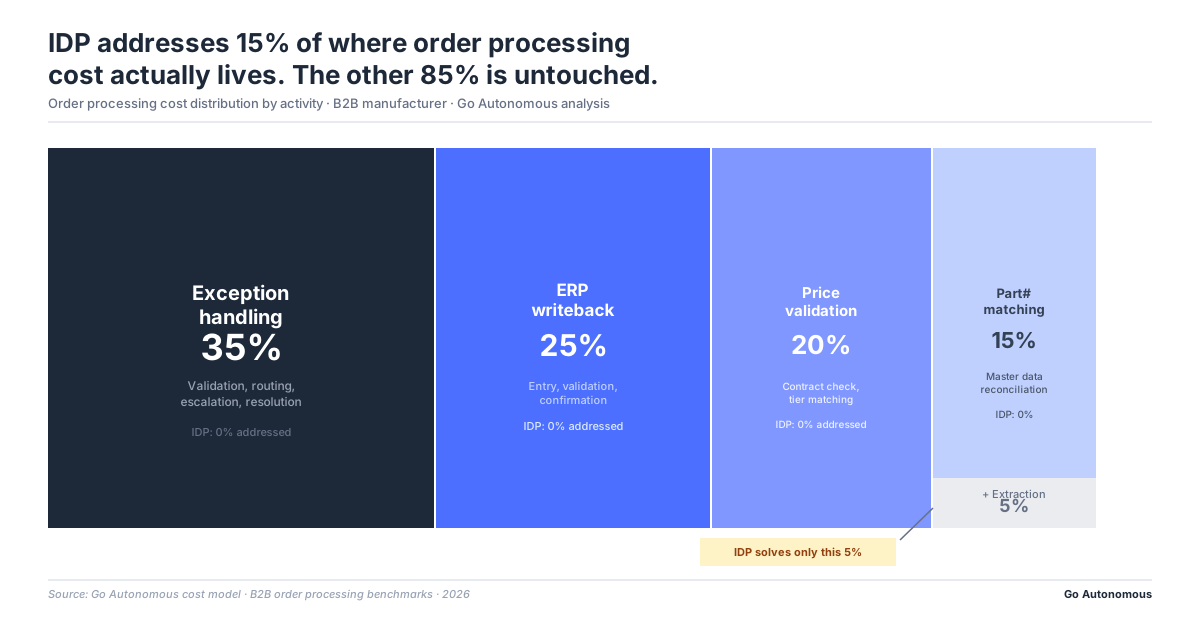
The distinction matters practically because purchasing one does not reduce the need for the other. A manufacturer that deploys ABBYY Vantage without an autonomous execution layer has eliminated manual keying but retained all the downstream validation, exception handling, and ERP writeback steps that account for the majority of processing cost and cycle time. The Friction Debt of the process decreases at the extraction node and remains largely intact everywhere else.
IDP vs. Autonomous Commerce: A Decision Scoring Framework
The right technology choice depends on where your operation’s Human Dependency Ratio is highest. Use this framework to identify which layer is the primary constraint.
| Criterion | Signal in Your Operation | What It Means for Your Technology Choice |
|---|---|---|
| Primary bottleneck is document reading and data entry | CSRs spend more than 40% of their time manually reading POs and keying data into the ERP. Order volumes are high but documents are relatively standardized. | IDP is the right first investment. It addresses the largest manual labor component directly. Autonomous execution can be layered in afterward. |
| Primary bottleneck is exception handling and validation | Data entry is already partly automated or low-volume, but 20% or more of orders require manual review, escalation, or correction before ERP entry. | Autonomous Commerce is the right investment. The extraction problem is already solved or small. The validation and decision-making problem is the constraint. |
| Both bottlenecks are significant | High document volume, non-standardized formats, and a large exception queue that occupies multiple senior CSRs daily. | Evaluate IDP and Autonomous Commerce as a combined stack. Many Go Autonomous deployments ingest IDP output directly and take ownership from extraction onward. |
| ERP master data quality is poor | Frequent SKU mismatches, outdated pricing contracts, or inconsistent customer account data in SAP, Oracle, or Dynamics 365. | Address master data quality before deploying either IDP or autonomous execution. Both layers depend on clean ERP reference data to function at high accuracy. IDP accuracy and autonomous exception resolution both degrade proportionally with master data quality. |
| Order channels are multi-format and multi-source | Orders arrive via email, EDI 850, EDIFACT, web portal, phone, and fax in varying ratios. No single format dominates. | Autonomous Commerce handles all channels natively. IDP tools require format-specific training models for each document type. Multi-channel environments favor autonomous execution as the primary investment, with IDP handling specific document-heavy channels. |
| Customer base has complex pricing contracts | Tiered pricing, volume rebates, customer-specific discounts, and blanket PO call-off structures create frequent price discrepancies on extracted data. | IDP cannot validate pricing. Autonomous execution with pricing contract integration is the right layer. IDP alone will produce a large and persistent exception queue for pricing discrepancies. |
What Changes Operationally When Autonomous Commerce Handles the Full Stack
When Autonomous Commerce operates above the IDP layer, or replaces it entirely for structured digital channels, the operational picture shifts at every step downstream of document receipt. The extraction, validation, enrichment, and ERP writeback steps collapse into a single autonomous process. The exception queue does not disappear. It shrinks to the genuinely ambiguous cases that no policy or data rule can resolve, and those cases arrive in the operator’s queue with full context: what the system found, what it tried, what it could not resolve, and what a human decision is actually needed for.
For a manufacturer operating across multiple countries with different pricing structures, local ERP configurations, and customer-specific part number conventions, this change is not incremental. The Human Dependency Ratio does not drop by 30%. It drops by 70% or more on the orders that flow through clean policy paths. The remaining 20 to 30% that require genuine human judgment arrive with the information needed to make that judgment in under 30 seconds rather than the 15 minutes a manual review of the original document would have required.
The commercial result is what changes the business case. Automation scales labor. Autonomy eliminates dependency. IDP scales the reading step. Autonomous Commerce eliminates the dependency on humans to process orders at scale.
See the published customer success cases from manufacturers and distributors who have deployed autonomous execution across their order intake operations, including multi-country deployments with high-complexity pricing environments.
AI-driven automation serves as a powerful motivator for process optimization. With immediate and tangible results that are transparent to all stakeholders, the impact of master data cleanup and enrichment is unmistakable.
How does autonomous order processing reduce the Human Dependency Ratio for manufacturers?
Autonomous order processing reduces the Human Dependency Ratio by replacing recurring decision points in the order flow with codified policy that the system executes without human input. Each time a pricing discrepancy, SKU mismatch, or availability conflict is resolved by a policy rule rather than a human judgment call, the HDR for that transaction category drops. Over time, as more policy is codified and the system handles a broader range of exception types, HDR on the overall order portfolio approaches zero for the classes of orders where autonomous resolution is consistently reliable.
The Autonomous Execution Fabric white paper covers the five enterprise AI lessons that govern how this policy codification works in practice, including the master data quality requirements that determine how quickly HDR drops after deployment.
Evaluate Whether Your Operation Has an Extraction Problem or an Execution Problem
Most manufacturers and distributors who contact Go Autonomous have already deployed or evaluated IDP. The question is whether extraction alone has moved the Human Dependency Ratio enough to justify stopping there, or whether the execution gap downstream of extraction is the larger cost driver. Go Autonomous works with 500M to 20B EUR manufacturers and distributors in the Nordics, DACH, Benelux, UKI, and France. We can work alongside your existing IDP deployment or provide end-to-end coverage across all inbound order channels. If the exception queue is still full after extraction, or if cycle time is still measured in hours rather than minutes, the execution layer is the constraint. Book a conversation with our team and we will map exactly where your Human Dependency Ratio is highest and what autonomous execution would change.
The Cost of Standing Still on the Execution Layer
A manufacturer processing 400 email and PDF orders per day, with IDP reducing keying time by 60%, still has a team spending roughly 600 to 800 person-hours per week on the validation, enrichment, and exception steps that IDP does not touch. At 45 EUR per hour fully loaded, that is 1.4 to 1.8 million EUR per year in execution cost that IDP deployment left on the table. This does not include the commercial cost of extended cycle time: orders that take 24 to 48 hours to confirm rather than minutes carry a measurable customer satisfaction impact and, for customers with purchase portals and EDI mandates, a direct supplier scorecard penalty.
- Processing overhead after IDP: For complex B2B orders with non-standard pricing and multi-SKU line items, IDP typically eliminates 30 to 50% of manual processing time. The remaining 50 to 70% lives in validation and exception handling steps that IDP does not reach.
- Exception queue cost: A persistent exception queue routing 15 to 25% of orders to senior CSRs or sales operations resources represents a disproportionate cost concentration. High-complexity exceptions frequently consume 20 to 30 minutes each to resolve, compared to 3 to 5 minutes for routine order entry.
- Cycle time disadvantage: Customers who receive order confirmation in under 60 seconds report significantly higher repeat purchase rates and lower churn than customers waiting hours for confirmation. That cycle time gap compounds across a year of order volume into measurable revenue impact. For reference, see Go Autonomous deployment data on efficiency gains in autonomous order processing.
- Headcount scaling floor: IDP reduces the headcount growth rate required to process growing order volumes. It does not eliminate it. Autonomous execution at the validation and exception layer removes the scaling dependency entirely for the order classes where policy coverage is sufficient.
The topline growth and margin management case for autonomous execution is not about replacing IDP. It is about closing the gap IDP creates between extraction and execution, and capturing the 50 to 70% of processing cost that document reading tools were never designed to address.
Sources
- APQC: Order Management Process Performance Benchmarks
- Gartner: Intelligent Document Processing Market Guide
Frequently Asked Questions
What is the difference between intelligent document processing and autonomous order processing?
Intelligent document processing converts unstructured documents such as PDF purchase orders into structured data fields. Autonomous order processing takes that structured data, validates it against ERP master data and pricing contracts, resolves discrepancies, and writes the confirmed order to the ERP without human intervention. IDP eliminates the document reading and extraction step. Autonomous order processing eliminates the validation, enrichment, exception handling, and ERP writeback steps that follow extraction.
Does IDP software automatically create sales orders in SAP?
No. IDP software extracts structured data from documents and routes it to downstream systems. SAP S/4HANA creates a sales order only after that data is validated against customer master records, material master data, pricing conditions, and availability. Discrepancies between extracted data and SAP master data produce exceptions that require human resolution before order creation. IDP eliminates manual data entry but does not eliminate human decision-making on exceptions.
How does ABBYY Vantage compare to Autonomous Commerce for B2B order management?
ABBYY Vantage is a document extraction platform that reads PDF purchase orders and extracts line items, quantities, and pricing into structured data fields. Autonomous Commerce is an order execution platform that receives inbound orders, validates and enriches the data against ERP master records, resolves discrepancies autonomously, and confirms the order in the ERP. ABBYY Vantage solves the reading problem. Autonomous Commerce solves the execution problem. They address sequential layers in the same process.
What is the accuracy rate of IDP tools for B2B purchase orders?
IDP accuracy on structured B2B purchase orders typically falls between 85 and 95 percent for well-trained models on familiar document formats. Accuracy drops for non-standard layouts, handwritten documents, orders in multiple languages, or POs that use customer-specific part numbers rather than standard SKU codes. For complex orders with custom pricing or blanket PO call-off structures, practical accuracy is closer to 80 to 90 percent, meaning 10 to 20 percent of extracted records still require human review.
What is Human Dependency Ratio in B2B order processing?
Human Dependency Ratio measures the number of manual decisions required per unit of revenue processed. It is the most accurate metric for evaluating whether an automation investment has created genuine autonomy or simply moved the human bottleneck downstream. A process with IDP deployed but no autonomous validation or ERP writeback has a lower HDR than a fully manual process but does not have a low HDR. Autonomous Commerce drives HDR toward zero by replacing recurring decision points with codified policy the system executes without human input.
Can IDP tools handle B2B order exceptions and pricing discrepancies?
IDP tools do not handle order exceptions or pricing discrepancies. They extract data and route it downstream. When extracted data contains a pricing mismatch, an unrecognized part number, or a quantity that conflicts with available stock, the exception is routed to a human operator for resolution. Autonomous Commerce handles these exceptions by validating extracted data against ERP master data and pricing contracts, resolving discrepancies within policy, and escalating only the cases that require genuine human judgment.
How does Autonomous Commerce integrate with existing IDP deployments?
Autonomous Commerce can ingest structured data output from IDP tools including ABBYY Vantage, Rossum, and Hyperscience via API. The platform then takes ownership of the validation, enrichment, and ERP writeback steps that IDP leaves open. For organizations that have already deployed IDP, Autonomous Commerce acts as the execution layer above it, closing the gap between extracted data and confirmed ERP sales order without replacing the IDP investment.