.svg)





Master Data Quality in B2B Order Management: Why Clean Data Is the Foundation Autonomous Execution Requires
Between 20 and 40 percent of B2B order exceptions trace directly to master data issues. Clean product, customer, and pricing master data is not just an IT requirement. It is the commercial foundation that determines how well autonomous execution scales.
Research across enterprise B2B manufacturers consistently shows that between 20 and 40 percent of order exceptions trace directly to master data quality issues. A product code that does not match between the customer’s purchasing system and the supplier’s ERP. A customer account with outdated contract pricing. A delivery address that changed two quarters ago and was never updated. These are not complex execution failures. They are data governance failures with cascading operational consequences: manual lookups, delayed fulfillment, disputed invoices, and a mounting pile of Friction Debt that a growing CSR team cannot outrun.
This post is written for Order Management Directors, VP Operations, and CDOs at B2B manufacturers and distributors who are evaluating or scaling autonomous commerce deployment. The argument is direct: master data quality is not a precondition that blocks you from starting. It is a parallel workstream that determines how fast your autonomous execution rate climbs after you do.
Table of Content
- Why Master Data Quality Determines Whether Autonomous Order Execution Succeeds or Stalls
- The Three Master Data Domains That Drive Most B2B Order Exceptions
- What Senior Leaders Need to Know About Data Quality and AI Readiness
- How to Assess Master Data Readiness Before Scaling Autonomous Commerce
- See What Autonomous Execution Looks Like When Your Data Is in the Loop
- What the Board Is Actually Asking About Data Quality and Autonomous Execution
- Frequently Asked Questions
- What is master data quality in B2B order management?
- Why do master data issues cause order exceptions in B2B manufacturing?
- What is the connection between master data quality and autonomous order execution?
- How do you improve product master data quality for B2B order automation?
- What percentage of B2B order exceptions are caused by master data quality problems?
- How does autonomous execution expose and fix master data gaps in B2B distribution?
Why Master Data Quality Determines Whether Autonomous Order Execution Succeeds or Stalls
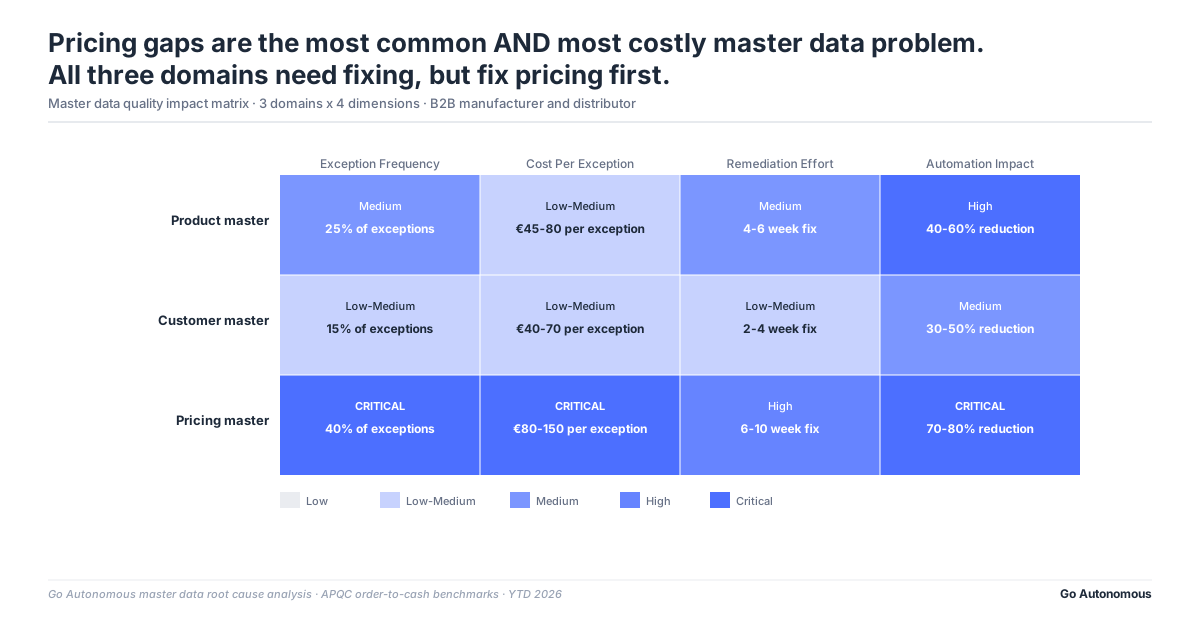
Master data quality determines the automation ceiling for any autonomous order execution system. An AI model reading incoming orders can only be as accurate as the data it validates against. Poor product master, outdated customer pricing, and inconsistent delivery address records generate exception rates that neutralize the efficiency gains of autonomous processing.
This is the amplification problem. Autonomous execution operates at speed. When bad data enters a manual process, a single CSR catches it, resolves it, and moves on. When bad data enters an autonomous system processing 1,000 orders per day, that same error fires across every order that references the affected record until someone corrects the source. Scale multiplies good data. It also multiplies bad data.
The Go Autonomous category framework captures this cost precisely. Friction Debt is the total monetary cost of human decisions still happening in your revenue flow. Master data quality issues are one of the primary sources of Friction Debt in B2B order management. Every unresolved product code mismatch, every pricing record that does not reflect the current contract, every delivery address that requires a manual lookup: each one is a recurring decision cost that the system cannot absorb. Until friction debt is a number on the operating dashboard, the cost of being not-yet-autonomous is invisible.
The fundamental premise is not that data must be perfect before deployment. It is that fixing data is not just an IT initiative. It carries a direct revenue and cost impact. A 10-point improvement in autonomous resolution rate across 800 orders per day translates to 80 fewer manual exceptions daily, each carrying a resolution cost of 15 to 45 EUR in fully loaded handling time. At scale, that is the business case for data investment framed in commercial terms rather than IT project terms.
Each time we added one or two million euros in revenue, we had to add another operator. From a cost perspective, that's an unsustainable way of operating a business.

The Three Master Data Domains That Drive Most B2B Order Exceptions
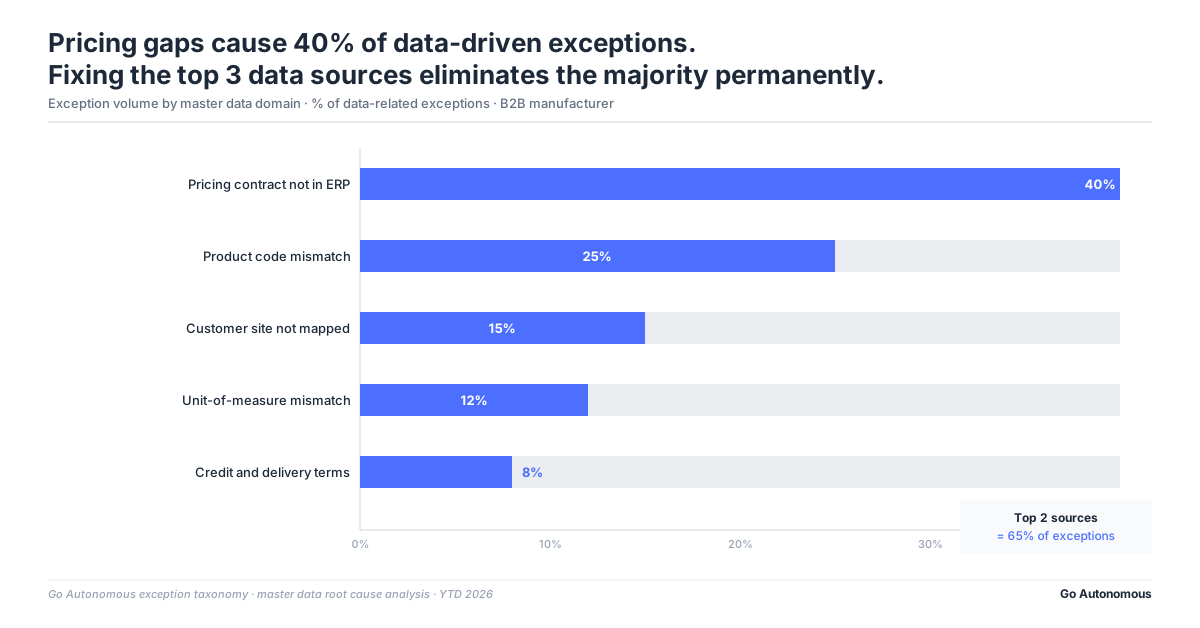
Not all master data gaps carry equal weight. In practice, three domains account for the majority of exception volume at manufacturers and distributors running high-frequency order intake across EDI, email, and portal channels.
What Is Product Master Data and Why Does It Cause Order Processing Errors?
Product master data failures in B2B order processing occur when the supplier’s internal item record does not match the reference the customer uses to place the order. A customer calls it SKU-X in their SAP S/4HANA purchasing module. The supplier’s Oracle Order Management Cloud records it as SKU-Y. The EDIFACT ORDERS message or EDI 850 transaction arrives with the customer’s code. The system cannot resolve it to a valid item record. The order goes into exception.
The specific failure modes are predictable. Units of measure discrepancies: the customer orders in eaches, the supplier’s ERP records in cartons. Substitution rules that exist in a sales manager’s head but are not codified in the item master. Minimum order quantity thresholds that differ between the contract and the current ERP record. Packaging specifications that changed during a product refresh but were never synchronized with the customer’s catalog.
Each of these produces an exception that an autonomous system cannot resolve without a human decision, because the data needed to make that decision does not exist in a structured, accessible form. The exception queue grows. The Human Dependency Ratio stays high.
What Customer Master Data Issues Create the Most Order Exceptions in Manufacturing?
Customer master data exceptions in B2B manufacturing cluster around three record types: account standing, delivery logistics, and pricing entitlement. Each generates a different class of exception, and each requires a different resolution path when a human must handle it manually.
Account standing issues include outdated credit limits that block orders from releasing in the ERP, VAT number mismatches that flag invoicing, and contact records that reference individuals who left the customer organization two years ago. These are low-complexity to fix but high-frequency in their impact: a single stale credit limit record can hold an order for 24 to 48 hours while a finance team member investigates.
Delivery address gaps are operationally simpler but disproportionately common. A distributor with 500 active customer accounts may have 30 to 50 addresses that were updated on the customer side but never synchronized in the supplier’s ERP. Each unmatched address requires manual confirmation before the order can be released to the warehouse.
Pricing master gaps are the most commercially significant. When the contract price in the customer’s system differs from the price in the supplier’s ERP, the exception requires a pricing manager’s involvement, not just a data entry correction. Every pricing mismatch exception is a multi-person, multi-step resolution that extends order cycle time and, in many cases, triggers a disputed invoice downstream.
How Does Pricing Master Quality Affect the Autonomous Execution Rate in B2B Distribution?
Pricing policy codification is the single most impactful data quality investment for autonomous execution rate improvement in B2B distribution. If a pricing rule is not in the system, every order touching a non-standard price requires a human decision. That decision cannot be delegated to an autonomous layer until the rule is codified as policy.
The scale of this problem is larger than most operations teams realize. A distributor with 200 active customer accounts and 10 years of individually negotiated pricing will often find that 30 to 40 percent of those pricing arrangements exist only in spreadsheets, email threads, or institutional memory. None of those can be queried by an autonomous system. All of them become exceptions.
This is precisely where the Human Dependency Ratio metric becomes the critical management instrument. HDR rises with every uncodified pricing rule. The goal is not to eliminate human judgment from pricing decisions. It is to encode completed judgments as policies that the system can apply consistently, so that human judgment is reserved for genuinely novel situations rather than re-applied to the same recurring question every day.
AI-driven automation serves as a powerful motivator for process optimization. With immediate and tangible results that are transparent to all stakeholders, the impact of master data cleanup and enrichment is unmistakable.
What Senior Leaders Need to Know About Data Quality and AI Readiness
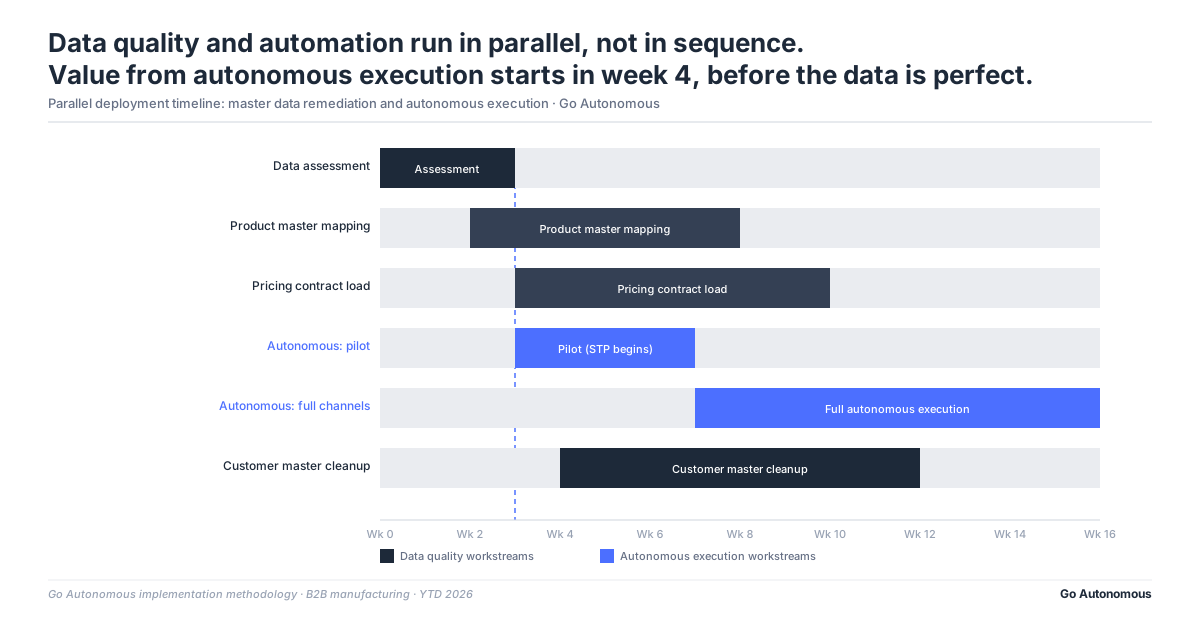
Data quality is not a prerequisite that must be complete before deploying autonomous execution. It is a parallel workstream. The two activities are not sequential. They are mutually reinforcing when run concurrently.
Autonomous execution surfaces data issues faster and more precisely than manual processing. A CSR handling 50 orders per day encounters data gaps at the rate of their individual throughput. An autonomous system processing 1,000 orders per day encounters them at 20 times the rate, logs them with full context, and generates a structured exception report that the data governance team can act on systematically. The system becomes the most efficient data quality diagnostic tool available.
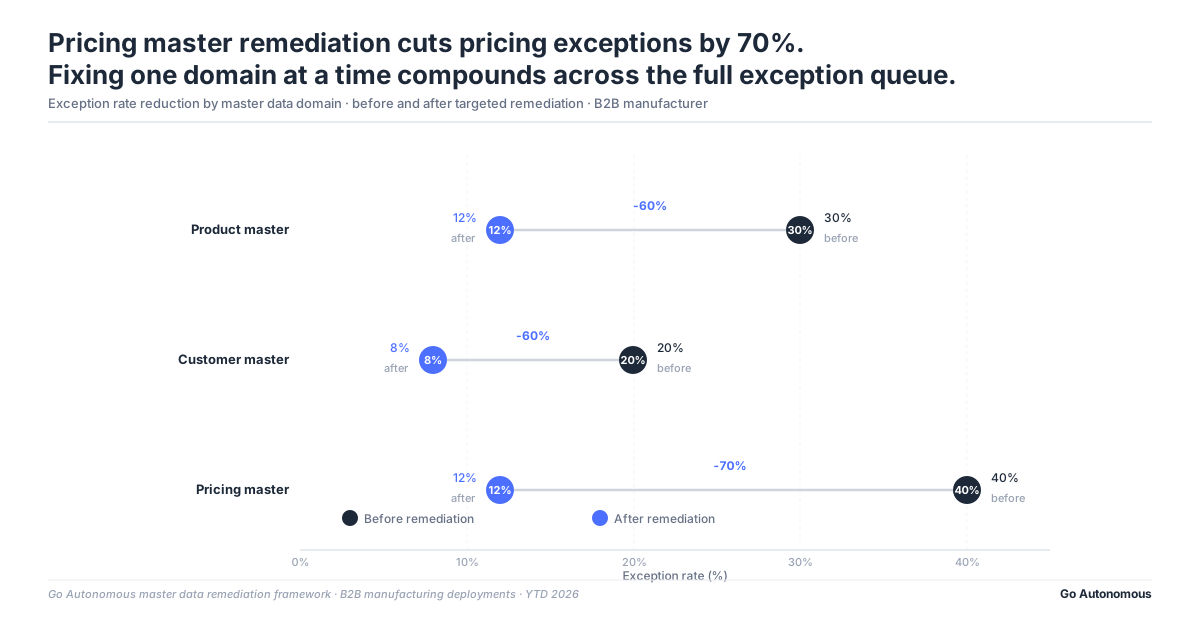
The business case for data investment changes when it is framed as autonomous execution enablement. The ROI of cleaning a pricing master is not just fewer manual lookups per week. It is a higher autonomous resolution rate across every order that references those pricing rules from the moment the correction is made. That compounding return is not visible when data quality is treated as a back-office IT project.
The Danfoss deployment illustrates the point at scale. Deploying autonomous order execution across 26 countries in a single day required a level of data consistency that the rollout both demanded and accelerated. The initiative created urgency and organizational alignment around data governance that years of internal IT projects had not achieved. Order processing went from 42 hours to under one minute. Eighty percent of decisions now run autonomously. That outcome is a data quality story as much as it is a technology story.
For CDOs and VP Operations considering sequencing, the relevant question is not “is our data ready?” It is: “at what autonomous resolution rate does the business case close?” If the answer is 60 percent touchless, that threshold may be reachable with current data. Starting deployment reveals exactly which data gaps stand between current state and target. That is more useful information than any pre-deployment audit can produce.
The Autonomous Execution Fabric white paper covers the enterprise AI implementation lessons that apply directly here: the organizations that achieved high autonomous resolution rates did not start with perfect data. They started with deployment and used execution feedback loops to drive data improvement in parallel.
How to Assess Master Data Readiness Before Scaling Autonomous Commerce
The following table shows what changes operationally when master data quality improves alongside autonomous execution deployment. The before state reflects the current condition at most manufacturers operating with legacy ERP data governance. The after state reflects what becomes achievable once clean data and autonomous processing run together.
| Area | Before: Data Quality Issues | After: Clean Data + Autonomous Execution |
|---|---|---|
| Order exception rate | 20 to 40% of orders require manual intervention due to data errors | Under 5% exception rate for orders touching clean master data |
| Processing cost per exception | 5 to 8 manual lookups or corrections per exception | Near-zero intervention for straight-through orders |
| Pricing accuracy | Variable: disputes arise when customer price differs from ERP record | Consistent: policy-driven pricing with exceptions only on genuinely novel cases |
| ERP maintenance load | Reactive: data updated only when errors surface in processing | Proactive: autonomous execution feedback loops surface data gaps at intake before they cause exceptions |
| Customer experience | Variable service quality based on data completeness | Reliable, SLA-consistent execution regardless of order channel or customer profile |
| Scalability | Every revenue increase requires proportional data maintenance investment | Autonomous validation reduces per-order maintenance overhead as volume scales |
The assessment follows four steps. Each step produces a number that feeds directly into the business case for data investment framed as autonomous execution enablement, not as IT hygiene.
- Measure exception rate by root cause: Determine what percentage of order exceptions are traceable to master data issues versus genuine order complexity. Most ERP platforms can produce this breakdown from exception reason codes if those codes are maintained consistently. The target is a number: “37 percent of our exceptions last quarter were product code mismatches. 22 percent were pricing discrepancies. 14 percent were delivery address failures.” That number is the baseline the data investment must improve.
- Audit pricing policy codification: Identify how many active pricing arrangements live in spreadsheets, email threads, or undocumented sales agreements versus in the ERP pricing master. Any pricing rule not in the system becomes a mandatory human exception in autonomous processing. This audit typically surfaces a number that surprises leadership: 30 to 50 percent of active pricing arrangements at distributors with long-tenured account managers are not in the ERP.
- Map customer code mismatches: For the top 100 customers by order volume, compare the product codes those customers use in their purchasing systems against the item records in your ERP. Code mismatches at this cohort level typically account for the majority of product master exception volume. A structured code mapping exercise for the top 20 customers often eliminates 40 to 60 percent of product master exceptions entirely.
- Identify the quick wins: Address the top 20 percent of data gaps that drive 80 percent of exceptions. In most deployments, a small number of high-frequency customer-product combinations account for a disproportionate share of exception volume. Fixing those records first produces the fastest autonomous resolution rate improvement. The Mediq deployment reached 75 percent faster processing and 4,000 orders per week with zero headcount added, in part because the data preparation focused on high-volume, high-frequency transaction patterns rather than attempting to clean the full item master before going live.
According to McKinsey’s research on data and analytics strategy for enterprise AI, organizations that treat data quality as a parallel deployment workstream rather than a precondition achieve production-grade AI outcomes significantly faster than those that wait for full data readiness before committing to deployment. The Nilfisk deployment follows the same pattern: autonomous order management at Nilfisk scaled because data governance and execution deployment ran in parallel rather than in sequence.
For operational reference across the full Go Autonomous customer base, the organizations that achieved the highest autonomous resolution rates were not those that started with the cleanest data. They were those that built the tightest feedback loop between execution exceptions and data remediation. Every exception becomes a data governance ticket. Every resolved ticket raises the autonomous resolution rate. The system improves itself.
Sources
See What Autonomous Execution Looks Like When Your Data Is in the Loop
Master data gaps are not a reason to delay autonomous order execution. They are a reason to start, because deployment surfaces the specific gaps that matter most at the transaction level your business actually runs. Go Autonomous works with 500M to 20B EUR manufacturers and distributors in the Nordics, DACH, Benelux, UKI, and France. We have seen this pattern across every deployment: the organizations that move first gain both the efficiency returns and the data clarity that competitors waiting for “clean data” never reach. If your order exception rate is above 10 percent and you have not mapped the data root causes, that number is not a data problem. It is a revenue leak. If the patterns described in this post apply to your operations, we can show you exactly what autonomous execution looks like in your environment: your ERP, your order channels, and your commercial workflows. Book a conversation with our team.
What the Board Is Actually Asking About Data Quality and Autonomous Execution
Before any initiative of this scale reaches sign-off, the same questions come up. Here are the direct answers.
“Can we start deploying autonomous execution before our master data is fully clean?”
Yes, and in most cases you should. The organizations that wait for full data readiness before committing to deployment consistently find that “ready” is a moving target. Autonomous execution deployment creates the organizational urgency, the structured exception data, and the business case that drives data quality improvement faster than any standalone data governance project. Start with your highest-volume, most structured order flows. Use the exception output from those flows to drive targeted data cleanup. The Danfoss deployment across 26 countries demonstrates that deployment scope and data consistency can scale together, not sequentially.
“What is the ROI of data quality investment when connected to autonomous commerce?”
The ROI frame changes entirely when data investment is linked to autonomous execution rate. A pricing master cleanup that would otherwise reduce manual exceptions by 15 percent becomes, in an autonomous execution context, a direct improvement in autonomous resolution rate across every order touching those pricing records. If your business processes 500 orders per day and the autonomous resolution rate improves from 55 to 70 percent, that is 75 additional straight-through orders per day at a fraction of the handling cost of manual exceptions. That is the calculation to present to the board: not “we saved 15 percent of exceptions” but “we increased our autonomous execution yield by 15 percentage points across half a million euros in daily order value.”
“How long does it take to improve master data quality enough to see execution rate improvement?”
The quick wins are measurable within weeks, not quarters. Mapping product code cross-references for the top 20 customers, codifying the 50 most frequently applied pricing exceptions as formal policy rules, and correcting the 30 delivery addresses that generate the most exceptions: these are targeted interventions with immediate impact on autonomous resolution rate. The deeper work of full pricing policy codification and item master rationalization takes longer, typically three to six months of sustained effort. However, the execution rate improvement curve is not flat. It rises with every targeted data fix, from the first week of deployment onward. See operational efficiency outcomes from manufacturers and distributors who have gone through this process.
Frequently Asked Questions
What is master data quality in B2B order management?
Master data quality in B2B order management refers to the accuracy, completeness, and consistency of the foundational data records that order processing systems validate against: product master (item codes, units of measure, substitution rules), customer master (account standing, delivery addresses, contact records), and pricing master (contract pricing, volume tiers, promotional rates). Poor master data quality is a primary driver of order exceptions in B2B manufacturing and distribution, with research indicating 20 to 40 percent of exceptions trace directly to master data issues.
Why do master data issues cause order exceptions in B2B manufacturing?
Master data issues cause order exceptions in B2B manufacturing when the data a customer uses to place an order does not match the records in the supplier’s ERP. A product code in an EDI 850 or EDIFACT ORDERS message that does not resolve to a valid item record triggers an exception. A contract price that differs between the customer’s purchasing system and the supplier’s SAP S/4HANA pricing master triggers a pricing exception. Each unresolved mismatch requires a human decision to progress, raising the Human Dependency Ratio and reducing the autonomous execution rate.
What is the connection between master data quality and autonomous order execution?
Master data quality sets the ceiling for the autonomous execution rate any system can achieve. An autonomous order processing platform validates incoming orders against ERP master records in real time. Where those records are accurate, orders resolve straight-through without human intervention. Where records are incomplete, outdated, or inconsistent, the system generates exceptions that require manual resolution. Improving master data quality directly raises the autonomous resolution rate, which is why data governance and autonomous execution deployment should run as parallel workstreams rather than sequentially.
How do you improve product master data quality for B2B order automation?
The fastest path to product master quality improvement for order automation starts with mapping customer-supplier product code cross-references for the highest-volume accounts. For each top customer, identify where their purchasing system codes differ from the supplier ERP item records and create structured mapping tables the autonomous system can query. Resolving code mismatches for the top 20 customers typically eliminates 40 to 60 percent of product master exception volume. Beyond code mapping, codify substitution rules, minimum order quantities, and packaging specifications that currently exist only in sales team knowledge.
What percentage of B2B order exceptions are caused by master data quality problems?
Research across enterprise B2B manufacturers consistently indicates that between 20 and 40 percent of order exceptions trace directly to master data quality issues. The three primary categories are product master mismatches (incorrect or unresolved item codes, unit of measure discrepancies), customer master gaps (outdated delivery addresses, credit limit records, VAT numbers), and pricing master discrepancies (contract pricing differences between the buyer’s purchasing system and the supplier’s ERP). The exact proportion varies by industry, ERP configuration, and the maturity of the supplier’s data governance practices.
How does autonomous execution expose and fix master data gaps in B2B distribution?
Autonomous execution surfaces master data gaps faster and more precisely than manual order processing because it operates at higher volume with consistent exception logging. A system processing 1,000 orders per day generates structured exception data across every transaction, identifying the specific record field that caused each exception, the customer and product combination involved, and the frequency of recurrence. This structured exception output becomes the highest-quality data governance input available. Each resolved exception raises the autonomous resolution rate directly, creating a continuous improvement loop between execution and data quality that manual processing cannot replicate.