.svg)





Cost Per Order in B2B Manufacturing: 2026 Data
Manual order processing costs B2B manufacturers €15–35 per order in 2026 — a figure most finance teams significantly underestimate. This post breaks down where the cost comes from, how exceptions multiply it, and what operations teams running autonomous execution actually pay.
Manual order processing costs B2B manufacturers €15–35 per order in 2026. Most finance teams estimate €2–5. The gap between those two figures represents a structural cost problem that compounds with every new customer, every new market, and every revenue increment. This post maps where the real cost comes from, how exceptions multiply it, and what changes when autonomous execution replaces the manual workflow.
Table of Content
- The True Cost per Order Is €15–35, Not the €2–3 Estimate in Most Business Cases
- Order Exceptions Are the Cost Multiplier: Each Exception Adds 4–8x Processing Time
- Per-Order Cost Scales With Revenue in a Way That Erodes Margin
- Autonomous Execution Reduces Per-Order Cost Below €2 Without Headcount Reduction
- The Autonomous Execution Fabric: How the €2 Cost Floor Extends Across Every Transaction Type
- Frequently Asked Questions
- What is the average cost per order for B2B manufacturers in 2026?
- Why is B2B order processing so expensive compared to B2C?
- How do B2B manufacturers calculate the true cost per order?
- What is the cost impact of order exceptions in B2B manufacturing?
- How much can manufacturers reduce per-order processing costs with AI automation?
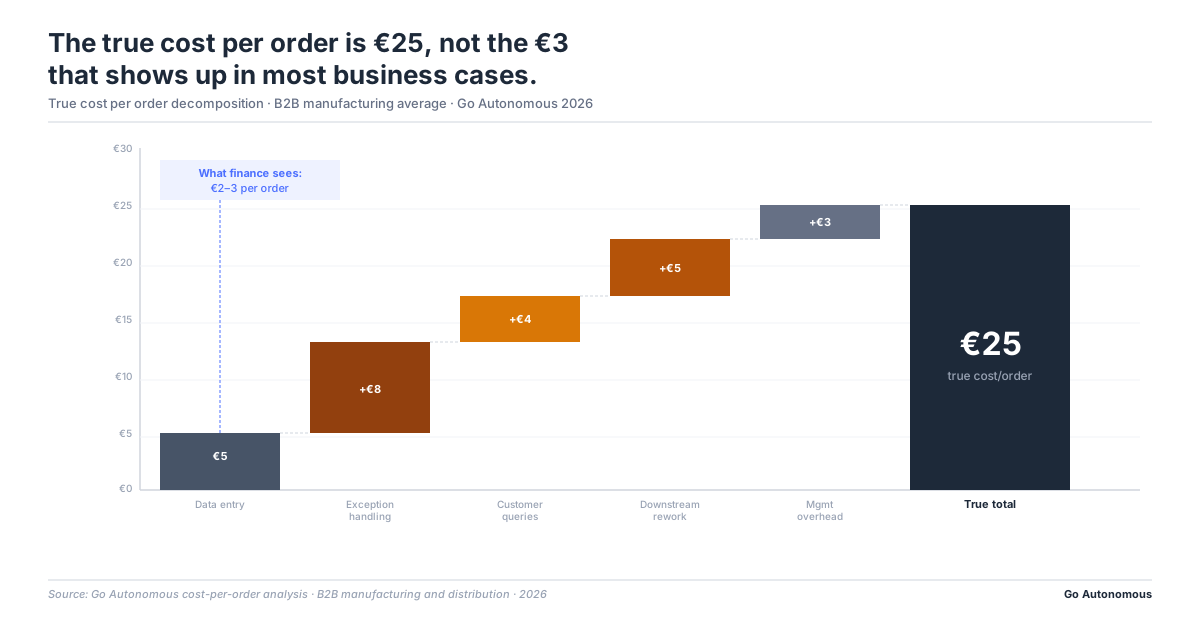
The True Cost per Order Is €15–35, Not the €2–3 Estimate in Most Business Cases
Why Finance Underestimates: The Visible Cost vs. the Loaded Cost
Finance teams typically estimate order processing cost by calculating the direct labor of a customer service rep keying an order: 5–10 minutes at standard labor rate. That yields €2–5. It is the wrong number. It captures only the moment of entry, not the full workflow that surrounds it. The loaded cost includes time spent locating the order in a shared inbox, resolving field mismatches before entry, escalating pricing disputes to sales, correcting downstream errors after entry, communicating order status back to the customer, and re-processing orders that were rejected at the ERP level. None of those activities appear on the order entry timesheet. All of them are real labor cost tied to a specific order.
Labor Is 70–80% of Per-Order Cost — and Most of It Is Invisible on the P&L
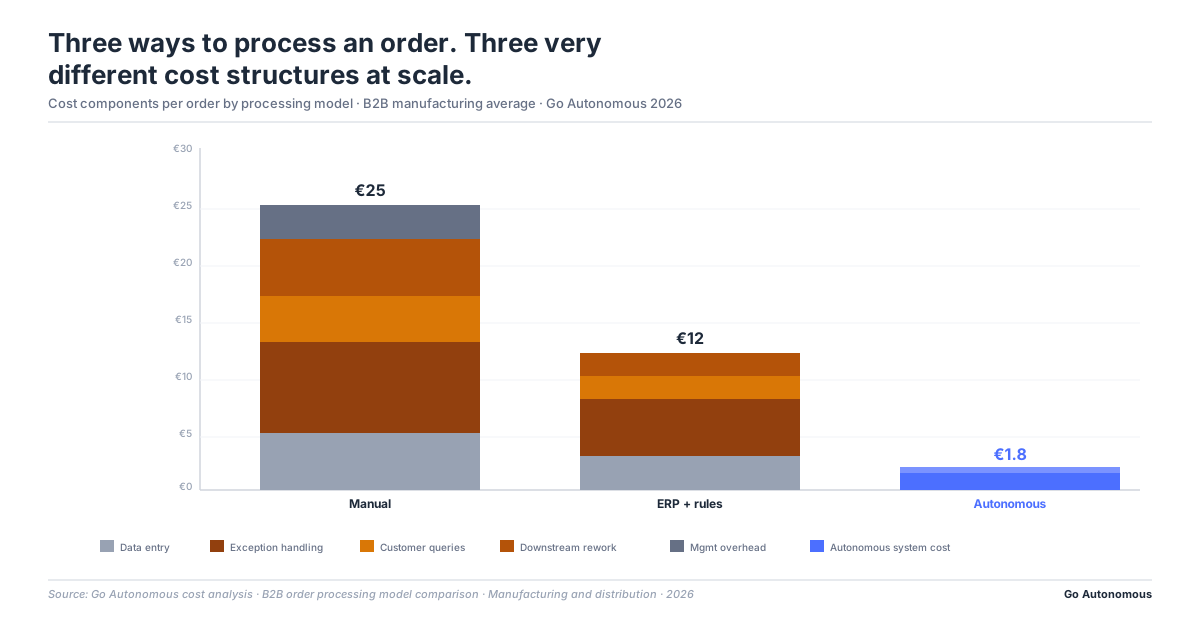
Labor is 70–80% of the true per-order cost. But most of that labor does not appear under “order processing” in the P&L. It appears as customer service headcount, sales support headcount, quality rework hours, and management time spent resolving escalations. When you load in system licensing costs, error correction costs, and the overhead of supervisors who handle exceptions, the per-order cost lands between €15 and €35 depending on order complexity, customer mix, and product catalog depth. Operations teams that have done rigorous cost-per-order analysis consistently find the number is 5–10x higher than the initial business case estimate.
Each time we added one or two million euros in revenue, we had to add another operator. From a cost perspective, that's an unsustainable way of operating a business.

Order Exceptions Are the Cost Multiplier: Each Exception Adds 4–8x Processing Time
What Qualifies as an Exception: The Full Taxonomy
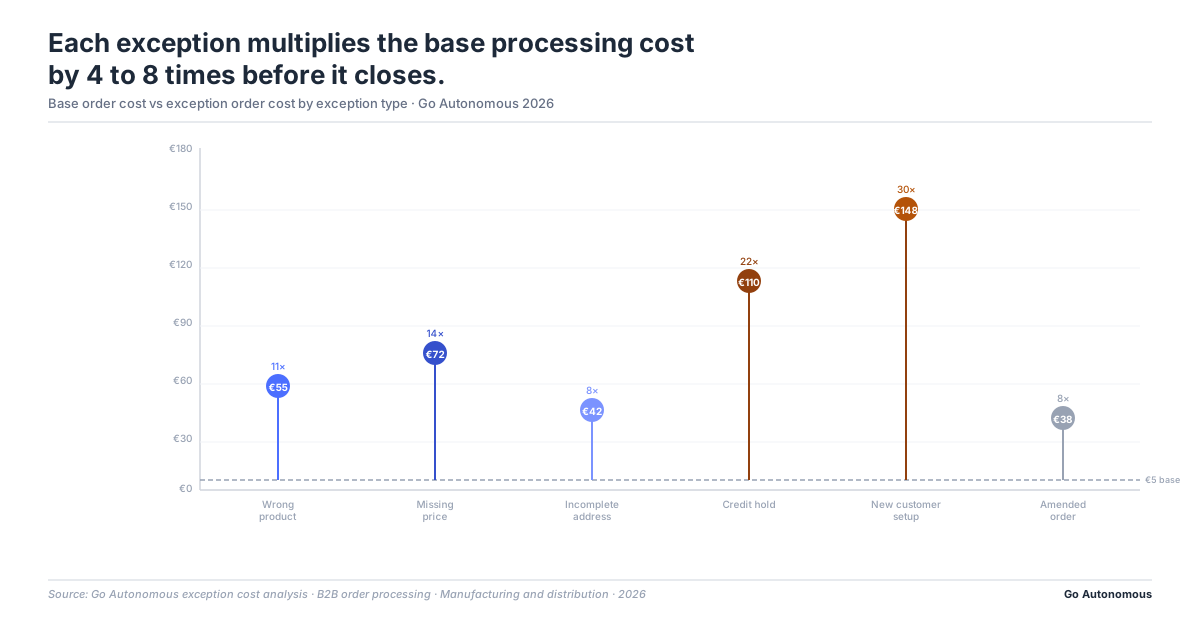
An exception is any condition that prevents an order from flowing straight through to a confirmed sales order without human intervention. The taxonomy is broader than most operations teams realize. It includes: missing mandatory fields (delivery address, contact name, purchase order reference), unrecognized SKU references where the customer’s product number does not match the ERP catalog, pricing mismatches where the quoted price differs from the contracted rate, quantity discrepancies where the ordered quantity does not align with minimum order or packaging unit constraints, incorrect unit of measure, expired or unapproved payment terms, and shipping address codes that do not exist in the master data. Each of these requires a human to stop, investigate, make a decision, and frequently contact the customer — before the order can continue.
The Hidden Exception Rate: 20–40% of B2B Orders Touch an Exception Workflow
On average, 20–40% of B2B orders trigger at least one exception. Each exception adds 4–8x the base processing time. If a clean order takes 10 minutes, an exception-bearing order takes 40–80 minutes. When that exception requires a customer callback with a 24-hour response window, the elapsed time from receipt to confirmed order stretches to 48–72 hours. The cost impact is multiplicative: a 30% exception rate across a base of €20 per order effectively raises the blended per-order cost to €26–32 when exception processing time is fully loaded. Autonomous Commerce platforms are architected specifically to resolve exceptions without human intervention, by applying business rules and AI reasoning to conditions that would otherwise stop a manual workflow.
Per-Order Cost Scales With Revenue in a Way That Erodes Margin
The Headcount Trap: Each €1–2M in Revenue Requires Another Operator
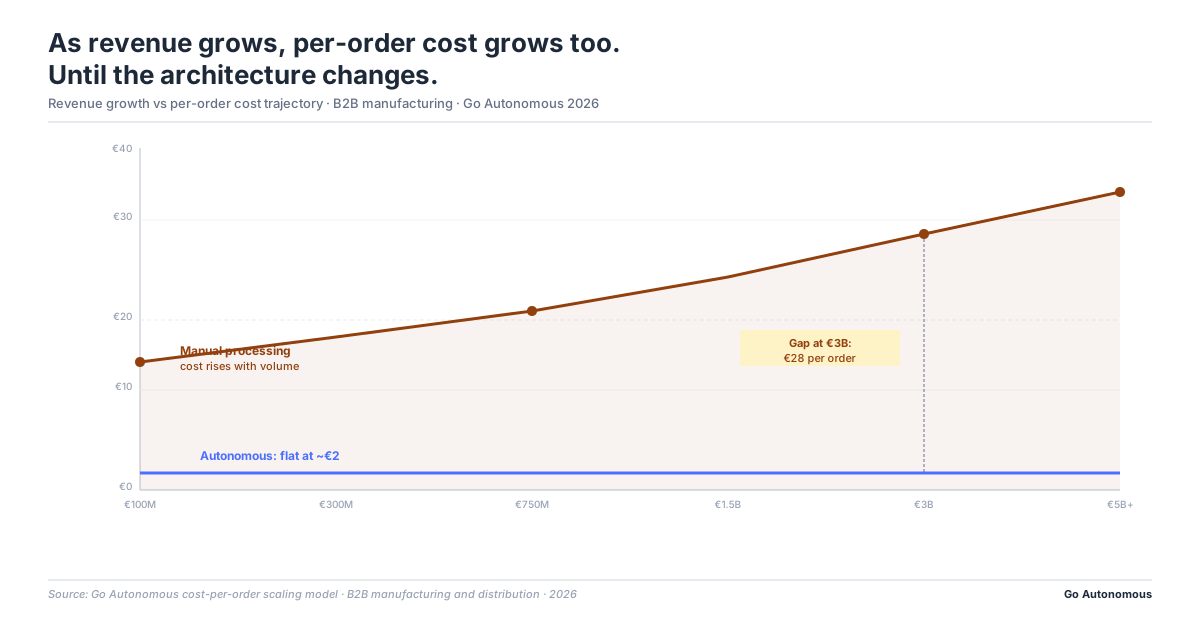
The critical structural problem with manual order processing is that the cost does not stay flat as revenue grows. More revenue means more orders, more customers, more format diversity, and proportionally more exceptions. Each increment of revenue requires proportionally more processing capacity. This is not a startup problem or a scaling anomaly — it is the inherent economics of labor-dependent order intake. The Hempel example illustrates the pattern precisely: each additional €1–2M in revenue required adding another customer service operator. That is not a unit economics problem that goes away with better training or tighter SLAs. It is a structural problem that only changes when the processing model changes.
Why Order Processing Cost Is a Margin Problem, Not Just an Efficiency Problem
Most conversations about order processing cost are framed as efficiency. The more accurate frame is margin. When processing cost scales linearly with revenue, the gross margin on incremental orders is lower than the gross margin on existing orders — because the incremental orders require incremental headcount to process. Growth does not dilute the per-order cost; it locks it in. The connection between order processing cost and margin management is direct: until the cost structure changes, revenue growth and margin improvement pull in opposite directions for manufacturers with high manual processing ratios. The companies that have closed this gap are those that have replaced the linear cost model with one that scales sublinearly — where order volume can grow without proportional headcount growth.
Autonomous Execution Reduces Per-Order Cost Below €2 Without Headcount Reduction
What Changes When AI Processes the Order Instead of a Human
Autonomous execution does not compress the manual workflow. It replaces it. An AI system reads the inbound order from any format — email, PDF, spreadsheet, web portal export — extracts every required field, validates each field against ERP master data, resolves standard exceptions using configurable business rules, and creates the confirmed sales order. The steps that exist only because a human had to perform them disappear: the inbox check, the attachment open, the manual lookup, the re-keying, the confirmation email. What remains is the core logic of order validation, executed in seconds at a cost below €2 per order. The cost reduction is not a rounding error — it is a structural change in what the processing function requires.
The New Cost Floor: Under €2 per Order, Under 60 Seconds per Transaction
The Autonomous Execution Fabric: How the €2 Cost Floor Extends Across Every Transaction Type
The cost reduction described in this post (from €15–35 to below €2 per order) is the output of the Autonomous Execution Fabric, not a point solution for order entry. The Autonomous Execution Fabric is a full commercial execution layer that connects directly to your SAP, Oracle, or Microsoft Dynamics environment and processes every inbound commercial transaction without human assembly. The cost floor changes because the Fabric eliminates every manual step that added cost: inbox monitoring, document handling, field lookup, re-keying, status communication, and exception routing.
The Fabric handles more than orders. The same €15–35 cost structure that applies to manual order processing applies equally to manual quote processing, manual returns authorization, manual credit note creation, and manual tender handling. Each of these transaction types requires the same human steps: receive the request, identify the customer, look up the relevant data, apply business rules, create the record, and communicate back. The Autonomous Execution Fabric processes all of these transaction types without human assembly, bringing each below the €2 cost floor regardless of channel: email, EDI, customer portal, or direct API.
Operations that pay €15–35 per order are typically paying similar loaded costs per quote, per return, and per credit note. The root cause is the same in each case: a commercial transaction arrives from a customer and requires a human to assemble it before it can enter the ERP. The Autonomous Execution Fabric closes this across the entire commercial execution layer. A manufacturer that implements the Fabric for order intake gains the same cost transformation across every other transaction type simultaneously. The ROI compounds because you are not solving one transaction type; you are restructuring the cost of commercial execution across the board.
The new cost floor for autonomous order processing is below €2 per order, with processing time under 60 seconds per transaction. This is not a theoretical benchmark — it reflects live production performance across large-scale B2B manufacturing and distribution operations. Danfoss reduced order processing time from 42 hours to under 1 minute, achieving 80% autonomous processing across 26 countries in a single day. Operations teams that have reached this cost floor report that customer service capacity is reallocated to exception management, escalations, and relationship-critical interactions — work that genuinely benefits from a human. Additional customer outcomes across manufacturing and distribution follow the same pattern: cost below €2, processing under 60 seconds, and headcount redirected rather than reduced. To see how this applies to your order volumes and cost structure, book a session with the Go Autonomous team.
Frequently Asked Questions
What is the average cost per order for B2B manufacturers in 2026?
The average loaded cost per order for B2B manufacturers in 2026 is €15–35. Most finance teams estimate €2–5 based on direct labor entry time, but the true cost includes exception handling, error correction, customer communication, management escalation, and system overhead. The gap between the estimate and the actual cost is 5–10x.
Why is B2B order processing so expensive compared to B2C?
B2B orders are more complex than B2C transactions. They involve negotiated pricing, custom product references, multi-line orders, purchase order matching, and contract terms that vary by customer. They arrive in unstructured formats — email, PDF, fax — rather than through standardized checkout flows. Each of these factors adds processing time and exception risk that does not exist in B2C.
How do B2B manufacturers calculate the true cost per order?
True cost per order requires loading all labor involved in the order lifecycle: entry time, exception handling time, error correction time, customer communication time, and management escalation time. Add system costs and overhead allocated to order processing, then divide by total orders processed. Most manufacturers that complete this analysis find the true cost is 5–10x higher than the initial estimate used in business cases.
What is the cost impact of order exceptions in B2B manufacturing?
Order exceptions affect 20–40% of B2B orders and add 4–8x the base processing time per exception. If base processing takes 10 minutes, an exception adds 40–80 minutes. When exceptions require customer callbacks with 24-hour response cycles, the total elapsed time from receipt to confirmed order can stretch to 48–72 hours. The blended per-order cost rises significantly when exception rates are factored in.
How much can manufacturers reduce per-order processing costs with AI automation?
Manufacturers using autonomous execution report per-order costs below €2, down from €15–35 for manual processing. Processing time drops from 20–45 minutes to under 60 seconds. The cost reduction comes from eliminating the manual steps that exist only because a human had to perform them: inbox monitoring, attachment handling, manual lookup, re-keying, and confirmation. Danfoss achieved 80% autonomous processing across 26 countries with order processing time reduced from 42 hours to under 1 minute.