.svg)





B2B Order Processing Benchmark Report 2026
Manual order processing in B2B still costs €15–35 per order for most manufacturers and distributors in 2026. This benchmark report covers cost per order, touchless rates, exception rates, and what operations teams running autonomous execution actually achieve.
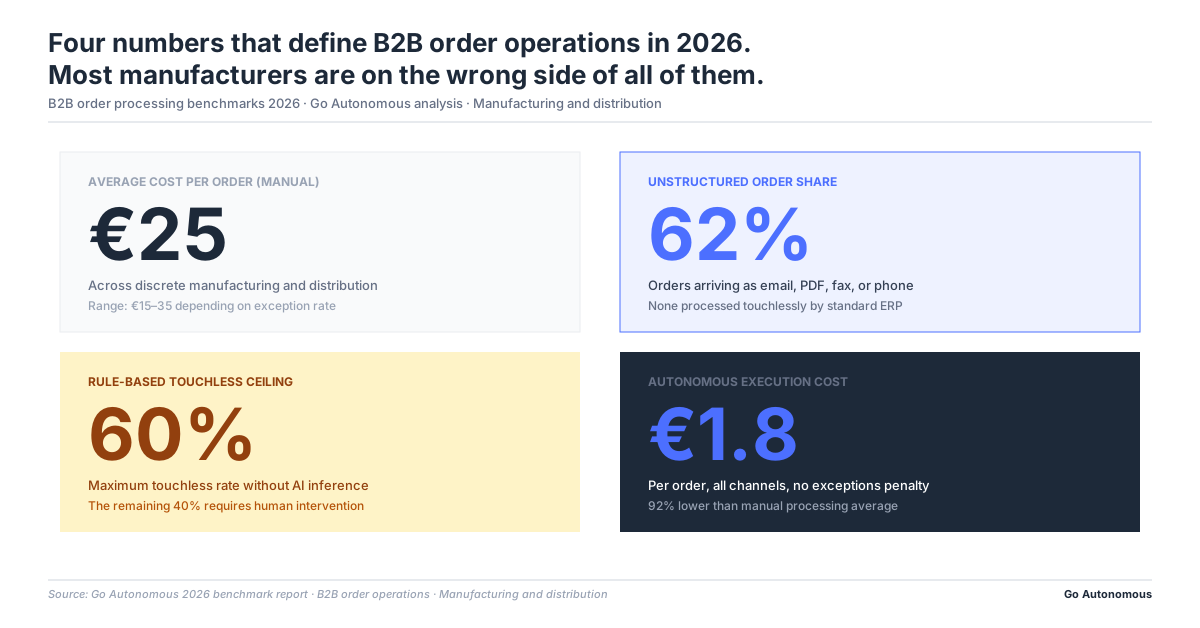
Manual B2B order processing costs €15–35 per order in 2026, and most manufacturers and distributors have no accurate measure of their true per-order cost. Rule-based automation plateaus at roughly 60% touchless, leaving the highest-cost orders — exceptions, non-standard formats, and new customer intake — handled entirely by people. Manufacturers running autonomous execution operate below €2 per order with confirmation times under 60 seconds. The gap between industry average and autonomous execution is not incremental; it is structural. This report benchmarks all four key metrics so operations leaders can locate where their own performance sits.
| Metric | Industry Average | Best-in-Class | Autonomous Execution |
|---|---|---|---|
| Cost per order | €15–35 | €8–12 | Under €2 |
| Order confirmation time | 24–48 hours | 4–8 hours | Under 60 seconds |
| Touchless rate | 40–60% | 65–75% | 80–95% |
| Exception rate | 20–40% | 10–15% | Under 5% |
Table of Content
- Manual Order Processing Costs €15–35 per Order in 2026
- 50–70% of B2B Order Volume Arrives Outside Structured Channels
- The 60% Touchless Ceiling: Rule-Based Automation Hits a Structural Limit
- Manufacturers Running Autonomous Execution Operate Below €2 per Order
- The Autonomous Execution Fabric: The Architecture Behind the Benchmark Numbers
- Frequently Asked Questions

Manual Order Processing Costs €15–35 per Order in 2026
Where the Cost Goes: Labor, Exception Handling, and Downstream Corrections
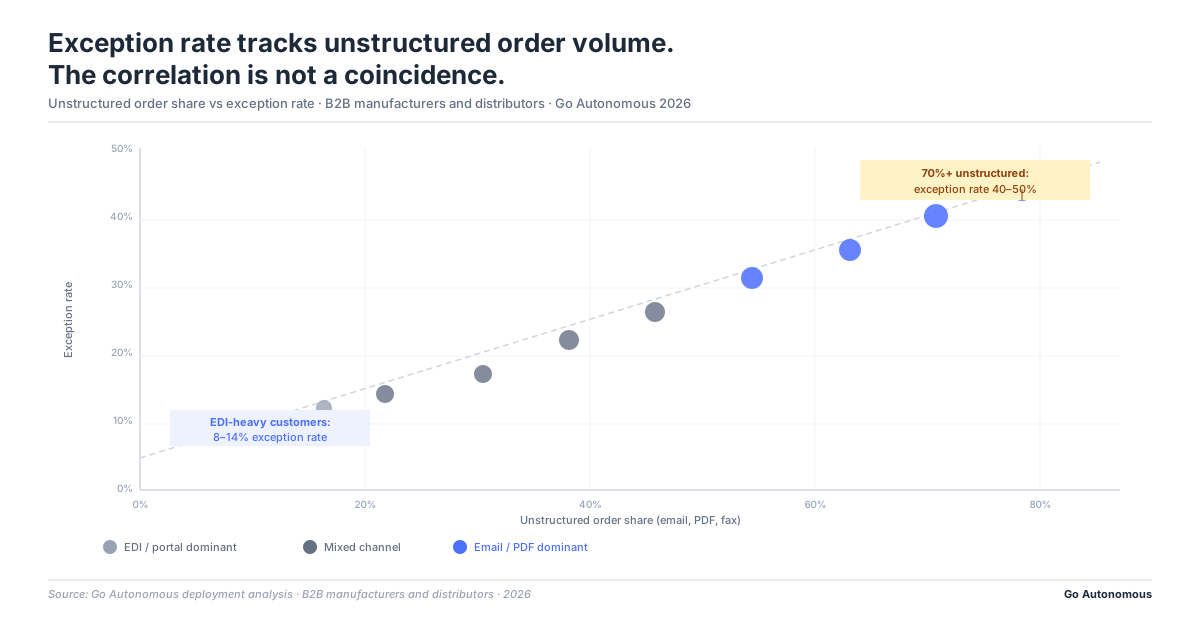
Labor accounts for 70–80% of the per-order cost in manual processing environments. A customer service representative receives an order via email or PDF, opens the document, identifies the customer in the ERP, maps each line item to the correct SKU, verifies pricing, and creates the sales order record. For a clean order with no discrepancies, this takes 10–20 minutes. For an order with exceptions — and 20–40% of B2B orders trigger at least one — the time multiplies by 4–8x. An exception that would take 12 minutes on a clean order can consume 48–96 minutes when escalation, clarification with the customer, and rework are included. The full cost picture only emerges when exception resolution, escalation handling, and downstream corrections are all included in the measurement.
Why Finance Usually Underestimates the True Per-Order Cost
Finance typically measures the direct labor cost of order entry: the time a CSR spends at the keyboard creating the record in SAP or another ERP. That measure captures 30–40% of actual cost. It misses exception resolution time, which is handled by the same team but logged under a different activity. It misses escalation time, where a supervisor or pricing manager intervenes. It misses downstream corrections: wrong item, wrong price, wrong delivery address. Each correction triggers a credit note, a re-order, or a customer service call. When all of these are attributed to the original order event, the €15–35 range is conservative for operations with high exception rates. Best-in-class operations with disciplined automation and clean master data can compress to €8–12. Autonomous execution breaks the structural floor and delivers costs below €2 per order.
Each time we added one or two million euros in revenue, we had to add another operator. From a cost perspective, that's an unsustainable way of operating a business.

50–70% of B2B Order Volume Arrives Outside Structured Channels
EDI and Portal Coverage: The Structured Half of B2B Commerce
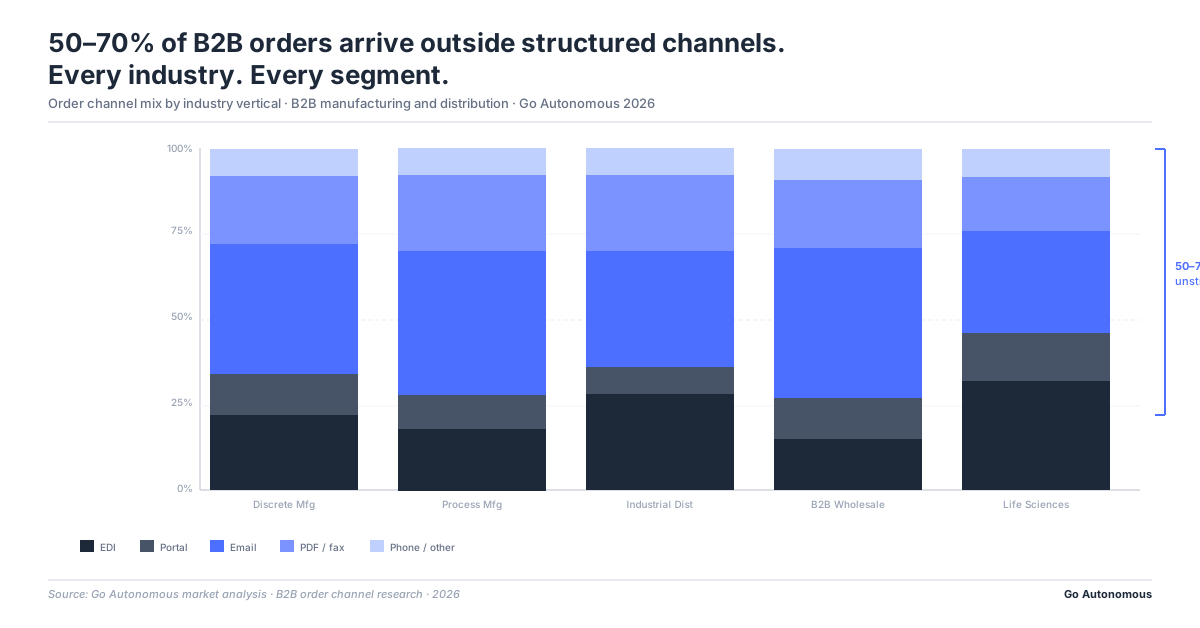
EDI and customer portals handle the predictable, high-volume accounts: large customers who invested in integration, enterprise buyers with procurement systems that output structured transactions, and accounts large enough to justify the setup cost on both sides. For these accounts, orders arrive in a mapped format that connects directly to the ERP without human intervention. This is the structured half, and it is well-managed in most B2B operations. The problem is what it excludes. EDI penetration in B2B manufacturing and distribution covers the top accounts by volume but typically reaches only 20–40% of total customer count. The rest of the customer base — smaller accounts, regional buyers, newer customers, and international accounts from markets without EDI infrastructure — sends orders in a different format.
What Happens to Orders Arriving as Email, PDF, and Free-Text Formats
The other 50–70% of order volume arrives as email body text, PDF purchase order attachments, fax images, or exports from customer-side portals that do not map to your product catalog. Each of these requires manual extraction before it reaches the ERP. A PDF purchase order from a distributor using their own part numbering system requires a CSR to look up the cross-reference, verify quantities and units of measure, confirm pricing, and then key the order manually. The Autonomous Commerce platform is designed specifically for this input layer: reading orders from any inbound format, extracting structured fields, and delivering a confirmed record to the ERP without a human in the loop. Until that layer exists, 50–70% of order volume is a manual workload that scales directly with revenue growth.
The 60% Touchless Ceiling: Rule-Based Automation Hits a Structural Limit
What the 60% Covers: Predictable Accounts and High-Volume SKUs
Rule-based automation delivers real results on the predictable half of order volume. Known customers, standard SKU references, clean field mapping, no pricing disputes: these orders flow through automation without friction. For manufacturers and distributors with strong EDI programs and well-maintained master data, touchless rates of 55–65% are achievable with rules-based approaches. This is meaningful. It is also a ceiling. The rule sets that achieve 60% touchless are optimized for the orders that were always going to be easy. They are not equipped for what lives in the remaining 40%.
Why the Remaining 40% Cannot Be Automated by Rules Alone
The orders that sit outside the 60% touchless boundary share a common characteristic: they require judgment, not pattern matching. Non-standard product references that do not match catalog SKUs. Partial orders where the quantity ordered does not match standard pack sizes. Field mismatches where a customer’s purchase order uses different units of measure than your ERP expects. Pricing discrepancies where a quoted price differs from the current list price. New customers who have never submitted an order before and whose format has never been seen by the system. None of these can be resolved by adding another rule. Rules encode known patterns; judgment handles unknown variation. The comparison between RPA and AI shows exactly where this structural limit appears and why more rules do not move the ceiling. Adding rules to a plateaued system increases maintenance cost without improving the touchless rate.
Manufacturers Running Autonomous Execution Operate Below €2 per Order
From Benchmark to Below Benchmark: What the Architecture Shift Looks Like
The shift from rule-based automation to autonomous execution is architectural, not configurational. Rule-based systems apply predefined logic to incoming order data and pass or fail each order based on whether it matches a known pattern. Autonomous execution uses AI inference to read, interpret, and act on orders the way a trained CSR would: identifying customer intent from a PDF, mapping non-standard product references to catalog items, distinguishing resolvable ambiguity from a genuine exception that requires escalation. The result is that orders which would have failed a rules check — and required human intervention — are processed automatically. This pushes the touchless rate from 60% to 80–95% and reduces the cost-per-order floor below €2.
Three Operational Outcomes That Follow When Cost Breaks Below €2
When per-order cost drops below €2, three operational dynamics shift simultaneously. First, order confirmation time falls from 24–48 hours to under 60 seconds — customers receive acknowledgment immediately, which reduces inbound status calls and improves satisfaction. Second, the exception rate drops below 5%, meaning the remaining CSR team handles only genuinely complex cases rather than spending time on resolvable format mismatches. Third, headcount growth decouples from revenue growth. Operations teams no longer need to add processors as order volume increases; the AI layer absorbs volume without adding cost per unit. Danfoss reduced order processing from 42 hours to under 1 minute, runs 80% autonomous, and now covers 26 countries in a single day. Across the broader customer base, the pattern is consistent: VELUX handles 130,000+ orders across 9 markets with 88% decision autonomy; Mediq processes 4,000 orders per week at 75% faster rates without adding headcount.
The Autonomous Execution Fabric: The Architecture Behind the Benchmark Numbers
The four metrics benchmarked in this report (cost per order, touchless rate, exception rate, and confirmation time) are not independent variables. They are outputs of the same execution architecture. The Autonomous Execution Fabric is a full commercial execution layer that connects directly to your SAP, Oracle, or Microsoft Dynamics environment and processes every inbound commercial transaction without human assembly. What this benchmark labels “autonomous execution” is the operating state when that layer is running across your full order intake volume.
The Fabric handles more than order intake. Across the same commercial transaction layer, it processes pricing requests from customers who need a quote before committing to a purchase order, generates and delivers quotes, issues returns authorizations, produces credit notes, and processes contract tenders. Each of these transaction types arrives through the same channels as orders: email, customer portal, EDI, and direct API. Each carries the same intake complexity: unstructured formats, non-standard product references, pricing ambiguity. The touchless rate and cost benchmarks in this report apply equally to the full transaction stack, not only to order lines.
Operations teams that close the order processing gap typically discover the same structural problem present across adjacent transaction types. A manufacturer that eliminates manual assembly from order intake will find that quote processing, returns handling, and credit note generation carry identical cost dynamics: high manual effort, low throughput, and headcount that grows proportionally with volume. The Autonomous Execution Fabric addresses the full commercial execution layer at once. The sub-€2 cost-per-order benchmark is achievable because the architecture removes human assembly across every transaction type, not just the one that was measured first.
For operations leaders benchmarking their own performance against these numbers, the diagnostic question is not whether automation is in place — most have it. The question is whether the architecture can handle the orders that rules cannot. If your touchless rate has been flat at 55–65% for more than two years, the ceiling is structural. Book a benchmarking session to see where your current operations sit against this data and what the path to below-€2 processing looks like for your environment.
Frequently Asked Questions
What is a good cost per order for B2B manufacturers?
Best-in-class B2B manufacturers achieve a cost per order of €8–12 through optimized rule-based automation and strong master data management. The industry average sits at €15–35, with the wide range driven by exception rates and how much downstream rework is included in the measurement. Manufacturers running autonomous execution — AI that reads, interprets, and enters orders without human intervention — operate below €2 per order.
What does touchless order rate mean in B2B order management?
Touchless order rate is the percentage of incoming orders processed from receipt to ERP entry without any human intervention. An order is touchless if it arrives, is validated, and creates a confirmed sales order record entirely through automation. The industry average touchless rate is 40–60%; best-in-class rule-based environments reach 65–75%; autonomous execution environments achieve 80–95%.
How do B2B manufacturers reduce order processing costs in 2026?
Reducing order processing costs requires addressing two layers: the structured input layer (EDI, portals) and the unstructured input layer (email, PDF, fax). Rule-based automation handles the structured layer but plateaus at 60% touchless. Breaking below €2 per order requires AI inference that reads and processes unstructured orders without human intervention, pushing touchless rates to 80–95% and reducing exception handling overhead.
What is the average order exception rate in B2B distribution?
The average exception rate in B2B distribution is 20–40% of total order volume. Each exception adds 4–8x the base processing time, which is why exception rate is the single largest driver of per-order cost variance. Best-in-class operations with strong automation bring exceptions below 10–15%. Autonomous execution environments that handle non-standard inputs through AI inference reduce exceptions below 5%.
How long does B2B order confirmation take on average?
The industry average for B2B order confirmation is 24–48 hours from receipt to acknowledged sales order. Best-in-class operations with high EDI penetration and automated processing confirm within 4–8 hours. Manufacturers running autonomous execution confirm orders in under 60 seconds, which eliminates inbound status inquiries and significantly improves customer experience metrics.