.svg)





B2B Order Management Software: What Manufacturers Actually Need in 2026
Most B2B order management software makes your existing process faster. Manufacturers and distributors at scale need something different — a system that executes orders without a human in the loop. Here is what that looks like in 2026.
B2B order management software is one of the most evaluated and least understood categories in enterprise technology. Manufacturers and distributors consistently deploy systems that solve the wrong half of the problem, tracking orders after they are entered, rather than executing them autonomously from the moment they arrive. This guide cuts through the category noise and defines what B2B order management software must do in 2026 for companies processing high-volume, multi-channel B2B orders across EDI, email, portal, and emerging AI buyer channels.
Table of Content
- What Is B2B Order Management Software?
- Why B2B Order Management Is Fundamentally More Complex for Manufacturers and Distributors
- How AI-Native Order Management Differs From Traditional B2B OMS
- What to Look For: 7 Requirements That Separate Autonomous Execution From Order Routing
- Why Rules-Based B2B Order Management Software Fails at Scale
- How Go Autonomous Executes Orders Your Current OMS Cannot
- See Autonomous Order Management in Production at the 2026 Summit
- Frequently Asked Questions
What Is B2B Order Management Software?
B2B order management software is a system that manages the lifecycle of business-to-business orders, from the moment an order is placed by a customer through fulfillment, invoicing, and confirmation. In the traditional definition, an OMS tracks order state, routes orders to the appropriate fulfilment location, coordinates with inventory and warehouse management systems, and provides status visibility to both internal teams and customers.
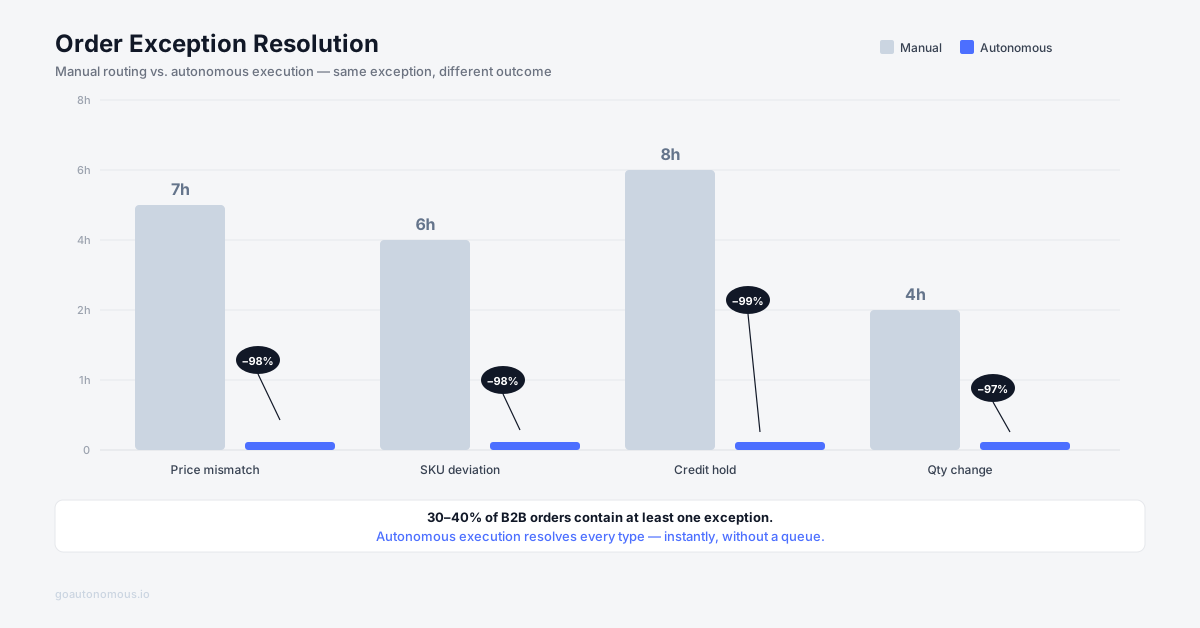
That definition describes what B2B order management software does in the back half of the order cycle. For manufacturers and distributors, the front half, order intake, validation, exception resolution, pricing confirmation, and ERP entry, is where manual labour, latency, and error concentrate. Most order management software assumes a clean, validated order arrives at its front door and routes it from there. For most B2B manufacturers, that assumption is wrong approximately 30-40% of the time.
In 2026, the most significant differentiation in B2B order management software is not in the tracking and routing functionality, that is commoditised. It is in whether the software executes the full order flow autonomously from intake to ERP confirmation, or whether it requires a human decision at the validation and entry steps. That distinction defines whether your commercial operations scale as software or continue to scale as headcount.
What B2B Order Management Software Covers: The Full Cycle
A complete B2B order management system covers six stages: order receipt (the moment an order arrives through any channel), order validation (checking the order against inventory, pricing, and customer master data), exception resolution (handling orders that deviate from clean-order templates), ERP entry (writing the confirmed order to the system of record), fulfilment coordination (triggering warehouse and logistics workflows), and order acknowledgment (confirming the order back to the customer). Traditional OMS platforms handle stages four through six robustly. Autonomous order management handles all six, including the three that most traditional systems leave to humans.
How B2B Order Management Software Differs From ERP Order Modules
ERP order modules, the order management functionality built into SAP, Oracle, and Microsoft Dynamics, are designed to manage confirmed orders within the ERP environment. They assume an order has already been validated and entered. B2B order management software sits in front of the ERP, handling the intake, validation, and exception resolution before the order reaches the ERP entry step. The two systems are complementary, not competing: the OMS processes what the ERP records. The operational efficiency case for dedicated order management software is strongest precisely because ERP order modules were never designed to handle multi-channel intake or autonomous exception resolution.
Why B2B Order Management Is Fundamentally More Complex for Manufacturers and Distributors
Most B2B order management software is designed for relatively clean commercial environments, SaaS companies, e-commerce distributors, or wholesale businesses with high-volume, low-complexity transactions. The requirements for industrial manufacturers and B2B distributors are structurally different. Understanding this difference is essential before evaluating any OMS solution.
Multi-Channel Order Intake Creates Structural Complexity
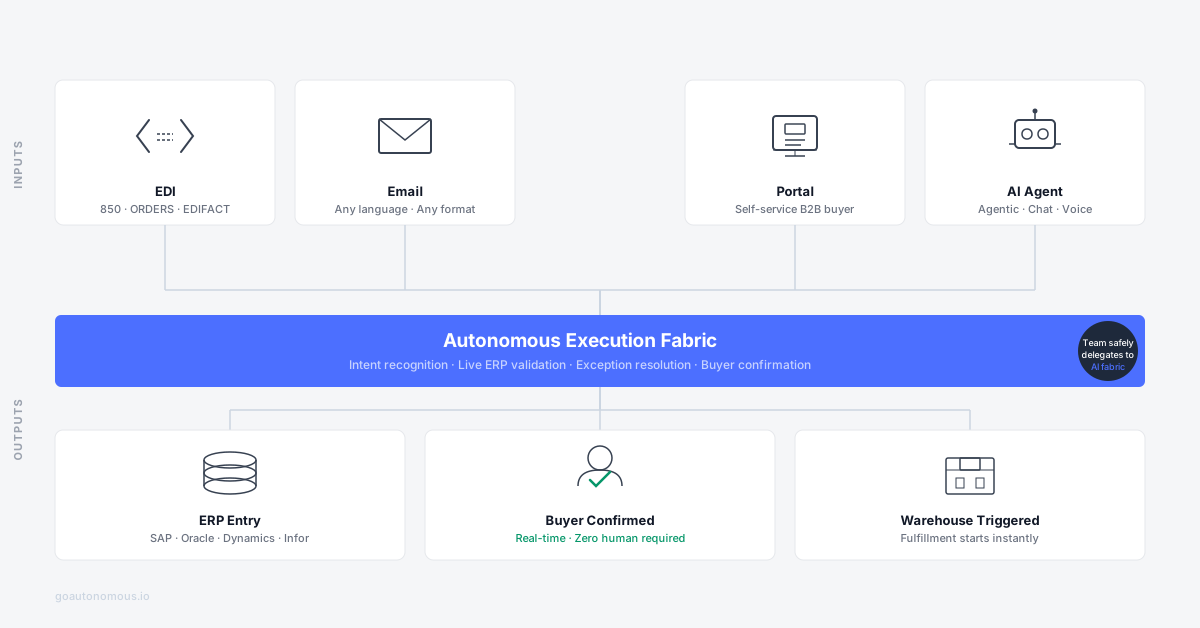
A manufacturer or distributor above €200M in revenue typically receives orders through four structurally different channels simultaneously. EDI transactions from large industrial customers arrive as machine-formatted files that vary by trading partner, the same ANSI X12 or EDIFACT standard interpreted differently by each customer’s ERP configuration. Email orders from mid-market customers arrive as unstructured text, spreadsheet attachments, or PDF purchase orders, each formatted differently. Portal orders follow a defined schema but are siloed from the other channels. And increasingly, orders arrive from AI procurement agents, structured API calls or natural language requests generated by autonomous buying systems on the customer side.
Each channel generates its own category of exceptions. EDI exceptions are typically structural, segment errors, non-standard codes, trading partner-specific field usage. Email exceptions are content-related, ambiguous line items, missing information, pricing references that do not match the customer’s contracted tier. Portal exceptions are workflow-related, orders modified after submission, cross-channel discrepancies, approval workflow failures. An order management system that handles one or two channels natively but requires separate integrations for others creates a fragmented exception management environment that is more expensive to operate than a fully manual process for any channel it does not handle natively.
ERP Dependency Makes Validation Non-Trivial
Every B2B order validation decision for a manufacturer requires live ERP data. Confirming item availability requires reading current inventory levels from SAP or Oracle. Validating pricing requires checking the customer’s contracted tier, active promotions, and volume discount thresholds, all stored in the ERP customer master. Confirming an order requires writing back to the ERP and triggering a fulfilment workflow that may touch warehouse management, transportation planning, and accounts receivable simultaneously.
This ERP dependency creates a performance requirement that most order management software does not meet: real-time, bi-directional ERP integration that can read live data and write confirmed orders within the same transaction, without a batch cycle or a human review step in between. Software that syncs with the ERP on a batch basis, or that reads a cached snapshot of inventory and pricing rather than live data, creates the conditions for confirmation errors that are more damaging commercially than slow confirmation.
Customer-Specific Pricing Creates an Exception at Every Deviation
B2B manufacturers and distributors typically maintain hundreds or thousands of customer-specific pricing tiers, contract pricing tables, volume discount schedules, and promotional pricing agreements. A customer who submits a purchase order referencing a price that does not match their current contracted tier is not making an error, they may be referencing an older contract, a verbal agreement not yet updated in the system, or a price from a previous quote. In a rules-based OMS, this triggers an exception and a human review. In an AI-native order management system, the discrepancy is resolved autonomously if it falls within configured tolerance bands, or escalated with full context if it requires judgment. The difference in exception volume, and the cost of managing it, is substantial at scale.
Each time we added one or two million euros in revenue, we had to add another operator. From a cost perspective, that's an unsustainable way of operating a business.

How AI-Native Order Management Differs From Traditional B2B OMS
The term “AI-powered” now appears in the marketing of virtually every B2B order management software vendor. Understanding the difference between AI as a feature, applied to specific functions within a traditional OMS architecture, and AI as the execution layer, replacing the manual decision step entirely, is the most important evaluation skill for any operations leader currently in market.
Traditional OMS Architecture: Route and Queue
Traditional B2B order management software follows a route-and-queue architecture. Orders arrive, are checked against configured rules, and are either passed to the next processing step (if clean) or routed to a human review queue (if they generate a rule-check failure). AI features in this architecture typically add predictive flagging, identifying which orders are likely to generate exceptions before they do, or workflow automation, reducing the number of manual steps in the review and resolution process.
The human remains load-bearing in this architecture. Remove the human, and the process stops at every exception. The queue grows proportionally with order volume. At 500 orders per day with a 35% exception rate, that is 175 human reviews per day that AI features in a traditional OMS reduce but cannot eliminate. The comparison between rules-based and AI-native order processing makes this structural difference explicit.
AI-Native Order Management Architecture: Reason and Execute
AI-native order management is built on a reason-and-execute architecture. When an order arrives, through any channel, the system extracts commercial intent, validates against live ERP data, reasons about any deviations, and either confirms the order autonomously or escalates a targeted exception with full context and a recommended resolution. The human is not a step in the standard flow. They are the escalation path for the minority of orders that require judgment.
This architecture produces measurably different operational outcomes. Autonomous execution rates of 80%+ on total order volume are achievable in well-configured deployments within 6 months. Order-to-acknowledgment times drop from hours to minutes on the autonomous flow. Cost-per-order on autonomous flows falls to a fraction of the manual processing cost. And exception resolution quality improves because the operations team, no longer responsible for processing clean orders, focuses entirely on the genuine exceptions that benefit from human expertise.
What “Autonomous Execution Rate” Means and Why It Is the Right Metric
The autonomous execution rate, the percentage of inbound orders processed from intake to ERP confirmation without any human intervention, is the single metric that distinguishes AI-native order management from AI-improved traditional OMS. Any vendor who cannot provide this metric from comparable production deployments is either not tracking it or has not achieved meaningful autonomous execution in a real manufacturing or distribution environment. Require this number, verified by reference customers with comparable order complexity, before advancing any OMS vendor through an evaluation.
What to Look For: 7 Requirements That Separate Autonomous Execution From Order Routing
The following seven requirements define the difference between B2B order management software that reduces manual work and software that removes it. Evaluate every vendor against these criteria before assessing any other feature.
- Native multi-channel intake, no separate integrations per channel. EDI, email, portal, and agentic buyer orders must be processed through a single execution layer. Channel-specific modules that require separate configuration and maintenance create four independent exception management problems rather than one unified one.
- Real-time, bi-directional ERP integration. Inventory and pricing data must be read live at the moment of validation, not from a cache or a batch sync. Confirmed orders must write back to the ERP immediately, without a human review step between the autonomous decision and the ERP entry.
- AI-native exception handling, reasoning, not routing. Exceptions must be resolved through intent inference and contextual reasoning, not through rule-check failures that route to a human queue. Vendors should demonstrate exception resolution on a sample of your actual exception types during evaluation, not in a scripted demo environment.
- Documented autonomous execution rate from comparable deployments. The vendor must provide autonomous execution rate data from manufacturers and distributors with comparable order volume, channel mix, and ERP environment. Projections without production data are not sufficient.
- First autonomous orders within 90 days. Implementation timelines beyond 90 days for first autonomous order processing are a signal that the system requires extensive rules configuration, which means it will continue to generate exceptions on scenarios the rules did not anticipate.
- Exception escalation with full context and recommended action. When escalation occurs, the reviewer must receive the original order, the specific exception, the available resolution options, and a recommended action. Escalations that require the reviewer to reconstruct context from multiple systems add cost that partially offsets the savings on automated flows.
- Agentic buyer channel readiness. The system must receive, validate, and confirm orders from AI procurement agents in near real time. Gartner projects AI agents will manage $15 trillion in B2B purchases by 2028. Manufacturers whose OMS cannot receive agentic orders at machine speed will route that volume to suppliers who can. This is not a future requirement, it is an active procurement channel among large enterprise buyers today.
Why Rules-Based B2B Order Management Software Fails at Scale
Rules-based order management software works well within the bounds of what it was configured for. The problem is that B2B manufacturing and distribution orders routinely exceed those bounds, not because customers are making errors, but because the commercial reality of industrial B2B is inherently variable.
A rules-based system handles the scenario it anticipated. An AI-native system handles the scenario it has never seen before by reasoning about commercial intent. The practical consequence of this difference, at 300-500 orders per day with a 30-40% exception rate, is the difference between an exception queue of 90-200 human reviews per day and an exception queue of 15-30 genuine edge cases that benefit from judgment.
The five exception types that most frequently expose the limits of rules-based OMS in manufacturing and distribution are:
- SKU substitutions: Discontinued items replaced by successor SKUs that the customer’s purchasing system still references by the old code.
- Pricing discrepancies: Customer PO prices that reference an older contract tier, a verbal quote, or a promotional price that expired.
- Partial availability: Orders where some line items are in stock and others are not, requiring a decision about partial shipment versus hold.
- Non-standard EDI segments: Trading partner-specific EDI usage that falls outside the configured parsing rules.
- Blanket PO releases with deviations: Release orders against open blanket POs where quantities, delivery dates, or ship-to addresses differ from the blanket terms.
Each of these exception types has a correct resolution that is deterministic once the context is understood. AI-native order management understands the context and executes the resolution. Rules-based OMS routes it to a human who then understands the context and executes the same resolution manually, at 10-30 times the cost and 100 times the latency. The Autonomous Execution Fabric white paper documents how enterprises have resolved this architectural problem in production deployments.
Autonomous Commerce isn't just about speeding up workflows, it's a strategic lever for faster revenue, optimized margins and reduced cost-to-serve. By unifying all B2B transaction channels into one intelligent layer, you drive speed, accuracy and scale.
How Go Autonomous Executes Orders Your Current OMS Cannot
Go Autonomous is purpose-built as an autonomous execution layer for B2B manufacturers and distributors, not a traditional OMS with AI features added. The platform processes orders from EDI, email, eCommerce portals, and agentic buyer channels through a single intent-recognition and execution engine. It integrates natively with SAP, Oracle, and Microsoft Dynamics, reading live inventory and pricing data and writing confirmed orders back to the ERP without an intermediate human review step on standard flows.
The commercial outcomes that manufacturers and distributors achieve through this architecture are documented at goautonomous.io/success-cases/. Specific deployment examples, including a global manufacturer processing orders across 26 countries with sub-minute confirmation times (Danfoss) and a leading industrial company eliminating the order desk for the majority of its order volume (Nilfisk), illustrate what autonomous execution delivers in production at enterprise scale.
The evaluation starting point for manufacturers and distributors is a commercial operations diagnostic, a mapping of your current order channel mix, exception rate by type, cost-per-order baseline, and ERP environment. The diagnostic produces an autonomous execution rate projection for your specific operation and a deployment sequence that reaches first autonomous orders within 90 days. If you want to run that diagnostic, a conversation with Go Autonomous is the right next step.

For operations leaders building the internal business case for autonomous order management investment, the CFO’s AI Mandate white paper provides the financial framework, including how to model working capital improvement, cost-per-order reduction, and the commercial recovery from faster confirmation speed. The case for autonomous order management is stronger than it appears from the efficiency metrics alone: the revenue recovered from faster confirmation and reduced churn from order processing friction typically exceeds the direct cost savings by a factor of two to three.
The right B2B order management software for manufacturers in 2026 is the system with the highest autonomous execution rate on your actual order mix, not the most features, not the largest installed base, not the lowest implementation cost. That metric is the one that determines whether your commercial operations have a ceiling or not. See how autonomous execution connects to topline growth →
Sources
See Autonomous Order Management in Production at the 2026 Summit
The Autonomous Commerce Summit 2026 brings together operations leaders from B2B manufacturing and distribution who have moved beyond traditional OMS to autonomous execution. If you are evaluating order management software and want to see what the end state looks like in production, not in a vendor demo, this is where that conversation happens. Attendance is by invitation only.
Request your invitation →
Frequently Asked Questions
B2B order management software manages the lifecycle of B2B orders from placement through fulfilment. The critical differentiation in 2026 is whether the software requires human review at validation, the traditional model, or executes the full order flow autonomously from intake to ERP confirmation.
Traditional OMS routes orders to human queues at exception points. AI-native OMS reasons about exceptions and confirms standard orders autonomously, achieving 80%+ autonomous execution rates versus zero for traditional systems. AI-native OMS replaces the manual process; traditional OMS makes it faster.
Seven requirements: native multi-channel intake, real-time ERP integration, AI-native exception handling, documented autonomous execution rate, 90-day implementation to first autonomous orders, exception escalation with full context, and agentic buyer channel readiness.
Rules handle anticipated scenarios. B2B manufacturing orders deviate 30-40% of the time through substitutions, pricing discrepancies, partial availability, and EDI variations. Each deviation routes to a human in rules-based systems. AI-native order management resolves these through contextual reasoning.
Yes. Real-time bi-directional integration, reading live inventory and pricing, writing confirmed orders back immediately, is required for autonomous execution. Batch integrations still require human review and do not support autonomous confirmation.
AI-native deployments reach first autonomous orders within 90 days. Traditional OMS runs 12-24 months. AI adapts to your order patterns; rules require every scenario to be anticipated and coded in advance.
ROI comes from cost reduction (cost-per-order drops 80-90% on autonomous flows), working capital improvement (faster confirmation compresses cash conversion), and commercial recovery (reduced churn, faster quote conversion). Most manufacturers achieve full cost recovery within 12-18 months.