.svg)





Why B2B Order Error Rates Spike During Peak Volume Periods
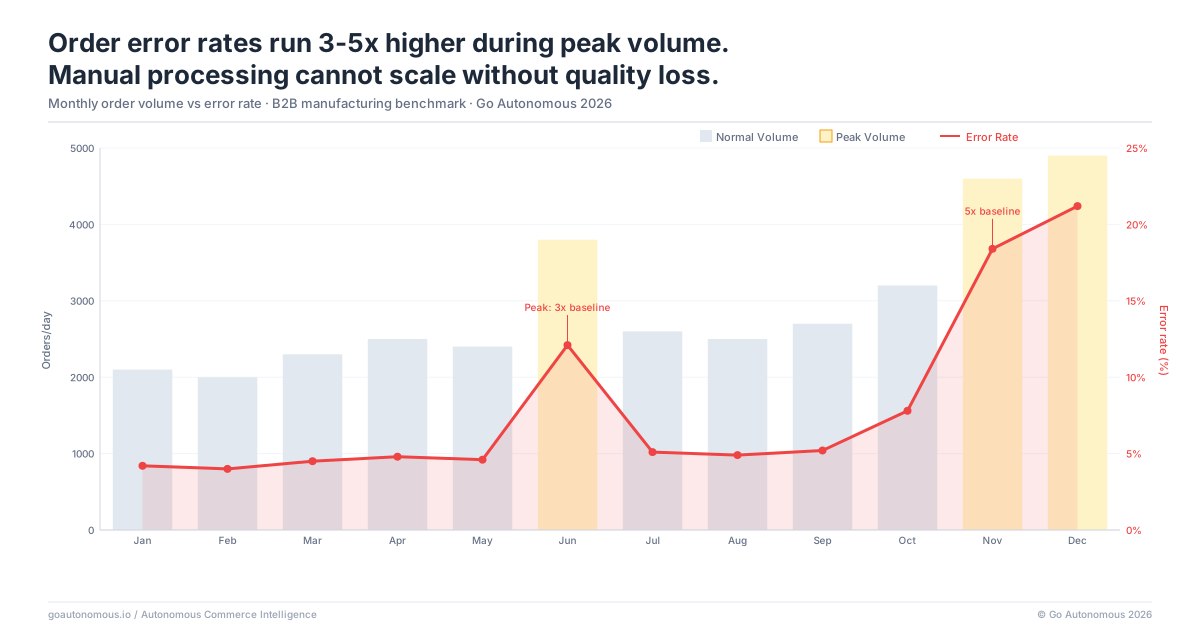
B2B order error rates during end-of-quarter pushes, seasonal peaks, and post-promotion surges run 3–5x higher than baseline. The spike is not random — it is the predictable output of a manual processing system operating above its throughput ceiling. This post explains why volume peaks reliably produce more errors and what the alternative processing architecture looks like.
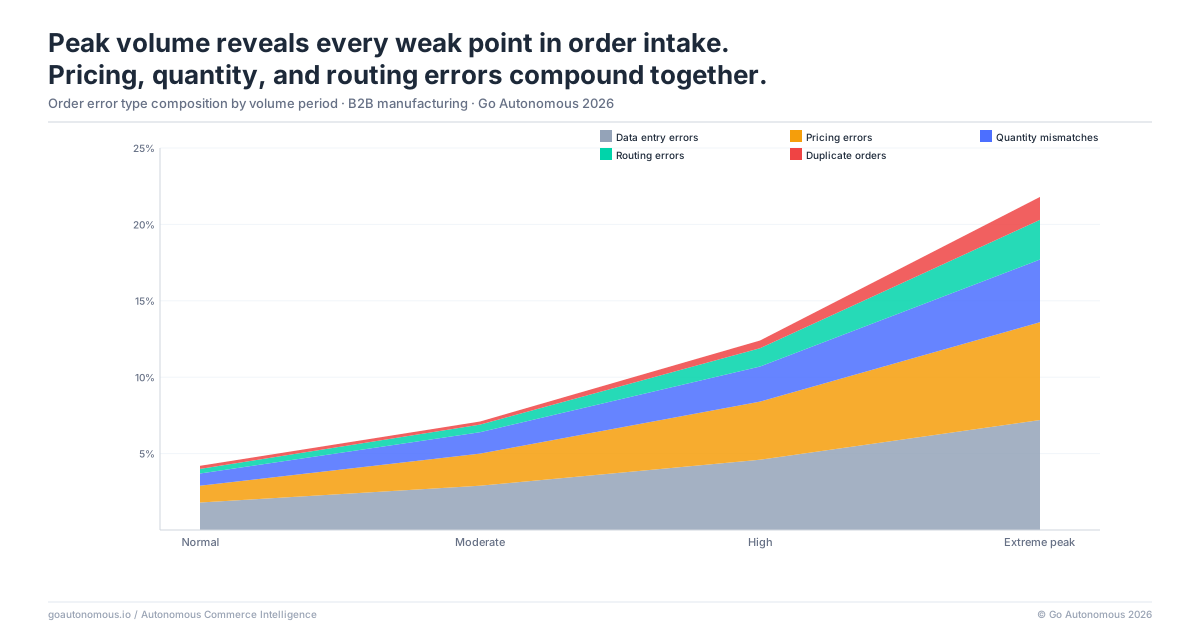
B2B order error rates during end-of-quarter pushes, seasonal peaks, and post-promotion surges run 3–5x higher than baseline. A team maintaining 2% errors at normal volume routinely sees 6–10% during peak periods. The spike is not random and it is not a people problem. It is the predictable output of a manual processing system operating above its throughput ceiling.
This post explains why volume peaks reliably produce more errors, what the rework cascade costs, and what the alternative processing architecture delivers across both normal and peak periods.
Table of Content
- Order Error Rates at Peak Volume Run 3–5x Higher Than Baseline: The Surge Multiplier Is Structural
- Manual Processing Has a Throughput Ceiling: Volume Peaks Always Exceed It
- Peak Period Errors Generate Rework That Outlasts the Peak by Days or Weeks
- Autonomous Processing Maintains Error Rate Regardless of Volume: No Throughput Ceiling
- The Autonomous Execution Fabric: Why Peak Volume No Longer Drives Error Rate
- Frequently Asked Questions
- Why do B2B order error rates increase during high-volume periods?
- How do B2B manufacturers maintain order accuracy during demand spikes?
- What is the true cost of order errors during peak volume periods in B2B manufacturing?
- How much higher are order error rates during end-of-quarter pushes compared to baseline?
- How does AI order processing prevent accuracy degradation during volume spikes in B2B distribution?
Order Error Rates at Peak Volume Run 3–5x Higher Than Baseline: The Surge Multiplier Is Structural
What Counts as an Order Error: The Full Cost-Bearing Taxonomy
An order error is any discrepancy between what the customer ordered and what was confirmed, shipped, or invoiced. The taxonomy includes wrong product or SKU, wrong quantity, wrong delivery address, wrong pricing, wrong payer reference, wrong delivery date commitment, and missing line items. Each category carries different downstream costs. A wrong SKU triggers a return and replacement. A wrong delivery address triggers a logistics recovery event. A wrong price triggers an invoice dispute. A missing line item triggers a follow-up order and a customer complaint.
The 20–40% of orders that trigger at least one exception in normal operations see that rate climb during peaks. Each exception adds 4–8x base processing time. At peak volume, the exception queue grows faster than the team can clear it, generating compounding delays across the entire order book. Tracking efficiency gains through peak periods requires measuring not just throughput but error-adjusted throughput.
Why Experienced Teams Still Produce Higher Error Rates at Peak Volume
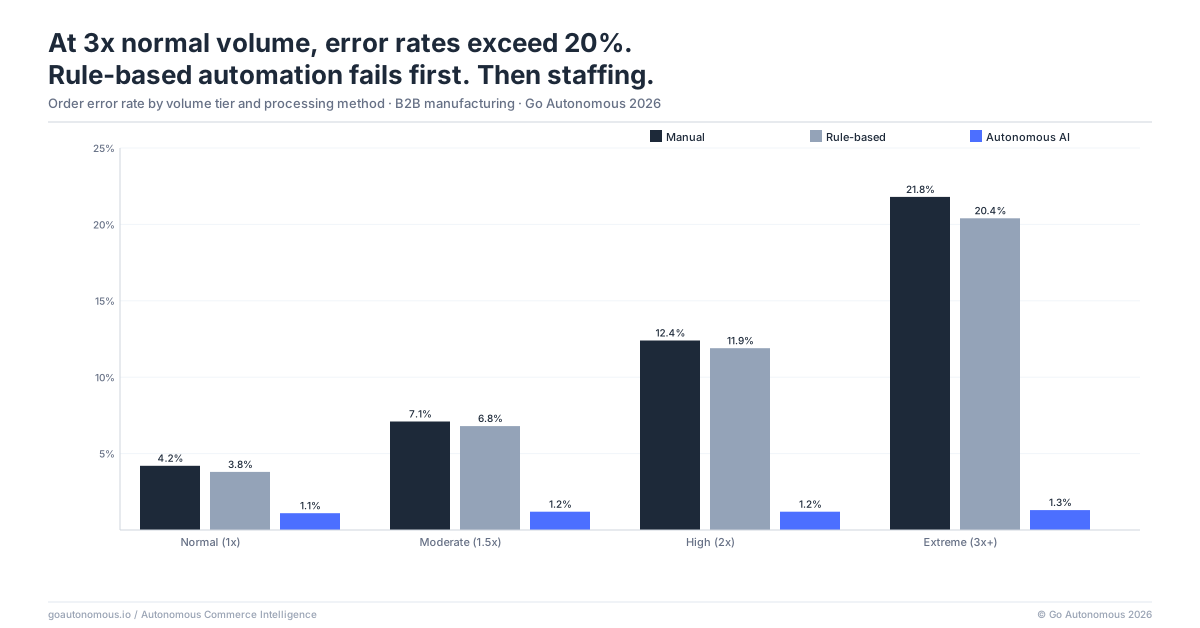
Error rate spikes during peak periods are not caused by inexperience or negligence. They are caused by human processing having a throughput ceiling. Above that ceiling, error rate increases as queue pressure mounts: orders are processed faster, verification steps are compressed, fatigue accumulates across shifts. An experienced team processes more accurately than an inexperienced team at any volume level, but neither team is immune to volume-induced accuracy degradation.
The mechanism is well-understood in operational psychology: speed-accuracy tradeoff. Humans cannot simultaneously maximize both speed and accuracy at sustained high throughput. When queue length signals urgency, processing speed increases and accuracy decreases. This is not a management failure — it is a physiological constraint. A team maintaining 2% error rate at 500 orders per day routinely sees 6–10% at 1,500 orders per day, even with the same people and the same processes.
Each time we added one or two million euros in revenue, we had to add another operator. From a cost perspective, that's an unsustainable way of operating a business.

Manual Processing Has a Throughput Ceiling: Volume Peaks Always Exceed It
What Happens to Queue Length When Inbound Order Rate Exceeds Processing Rate
Manual order processing capacity is determined by team size, shift hours, and per-order processing time. For a team of 10 processors each handling 50 orders per shift, maximum daily throughput is roughly 500 orders. Demand peaks in B2B manufacturing — end-of-quarter pushes, seasonal highs, post-campaign surges — regularly produce 2–3x normal volume for periods of 3–10 days. At 1,000–1,500 inbound orders per day against a 500-order capacity ceiling, queue length grows by 500–1,000 orders per day. By day three of a peak, the backlog is 1,500–3,000 orders and the team is processing today’s arrivals plus yesterday’s backlog simultaneously.
This is the condition under which error rates spike. The team is not just processing at ceiling — they are processing above ceiling, with a growing backlog creating increasing urgency. Every shortcut that saves 2 minutes per order is taken. Every verification step that takes 5 minutes and “usually isn’t necessary” is skipped. The shortcuts and skipped verifications are where errors enter.
Temporary Headcount Additions During Peaks Increase Errors: The Training Gap
The standard response to a throughput ceiling is to add temporary staff or require overtime. Both responses add cost while failing to resolve the error rate increase. Temporary staff process orders more slowly and make more errors because they lack familiarity with product catalog, customer data, exception patterns, and ERP navigation. A temporary processor who does not know that Customer X always uses non-standard product codes will create exceptions on every order they touch. Overtime shifts produce lower accuracy in the final hours as fatigue compounds across a 10–12 hour day.
The pattern Mikkel Vindeløv describes at Hempel — adding an operator for each increment of revenue — is structurally identical to peak management via headcount addition. The cost grows linearly with volume. The error rate does not improve because the processing architecture has not changed. Adding people to a manual process does not change the process; it scales the process linearly while scaling costs linearly and failing to improve accuracy.
Peak Period Errors Generate Rework That Outlasts the Peak by Days or Weeks
The Post-Peak Backlog: Wrong Orders, Invoice Disputes, and Customer Escalations
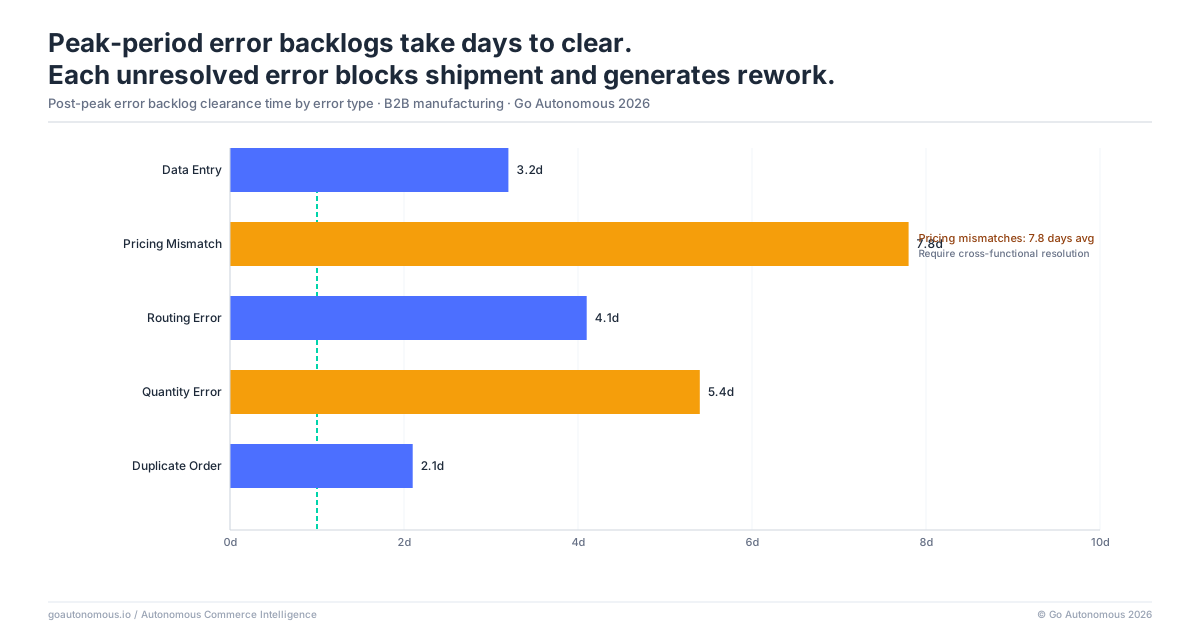
Errors made during a peak period do not resolve when volume normalizes. A wrong product shipped requires a return authorization, a replacement shipment, and a credit note — three separate transactions generated by one error. An invoice with wrong pricing triggers a dispute that finance must investigate, correct, and communicate. A shipment sent to the wrong delivery address creates a logistics recovery event: the carrier must be contacted, the shipment redirected or recalled, and the customer managed through the delay.
Each error generates downstream events that run for days or weeks. A 3-day peak period with elevated error rates may produce rework activity for 10–15 days after volume normalizes. The operations team emerging from a demand spike faces not just normal inbound volume but normal inbound volume plus a rework queue of 200–500 error-driven follow-up tasks. This is why peak periods feel like they never end — the errors from the spike are still being resolved two weeks later.
Why the Operations Cost of a Peak Period Is 2–3x the Cost of the Peak Itself
Manual processing cost is typically calculated as direct labor time per order. At €15–35 per order for manual processing, a 3-day peak producing 3,000 orders costs €45,000–€105,000 in direct processing. The rework generated by elevated error rates during that peak adds 2–3x to the true cost. Returns, replacement shipments, credit notes, dispute resolution, customer escalation management, and logistics recovery events collectively cost more than the original processing — and they are rarely attributed back to the peak period in management reporting.
The cost attribution problem reinforces the cycle. Finance sees peak processing costs as the cost of peak volume. Operations management does not see the full cost of errors made during the peak because those costs appear in subsequent weeks under different cost categories: returns, credit notes, dispute resolution, logistics exceptions. The true cost of manual peak processing is systematically underestimated.
Autonomous Processing Maintains Error Rate Regardless of Volume: No Throughput Ceiling
How AI Processing Scales to Volume Spikes Without Accuracy Degradation
Autonomous order processing does not have a throughput ceiling. An AI processing 100 orders per hour produces the same accuracy at 1,000 orders per hour. There is no fatigue, no speed-accuracy tradeoff, no training gap for temporary coverage, and no skip-verification shortcut taken under queue pressure. The same rules applied to order number 1 are applied to order number 10,000. Peak periods are a volume event, not an accuracy risk.
Processing cost also changes structurally. Manual processing at €15–35 per order produces variable costs that scale linearly with volume. Autonomous processing below €2 per order does not increase in cost proportionately with volume spikes. The economics of a demand peak are entirely different: the operations team handles the same volume at lower cost and lower error rate, with no headcount addition required.
What Operations Looks Like When Peak Periods Are Not a Risk Event
Mediq handles 4,000 orders per week with zero headcount increase and 75% faster processing (see success cases). Danfoss processes across 26 countries in a single day with order confirmations in under 1 minute (see Danfoss case). When volume peaks stop being accuracy risk events, the operations team stops planning for error recovery and starts planning for growth. Peak period preparation shifts from headcount planning and overtime scheduling to demand forecasting — which is a fundamentally different and more productive use of management attention.
The Autonomous Execution Fabric: Why Peak Volume No Longer Drives Error Rate
The peak volume error rate problem is one manifestation of a processing architecture where human throughput ceilings constrain commercial operations. The Autonomous Execution Fabric is a full commercial execution layer that connects directly to your SAP, Oracle, or Microsoft Dynamics environment and executes every inbound commercial transaction without human assembly. It processes 100 orders with the same accuracy as 1,000. The throughput ceiling does not exist because the Fabric does not have one. Peak periods are volume events, not accuracy risks.
The Fabric handles the full commercial transaction scope: orders across every intake channel (email, EDI, customer portal, and direct API), pricing requests, quote processing, returns authorizations, credit notes, and contract tenders. Each of these transaction types is subject to the same throughput ceiling in manual processing. Peak periods that spike order volume also spike quote requests, return authorizations, and pricing inquiries simultaneously. The Fabric handles all of them at constant accuracy regardless of the combined volume.
The error rate problem during peaks is structurally identical across every commercial transaction type. The speed-accuracy tradeoff is not specific to orders: it applies anywhere a human is assembling and entering data under queue pressure. The Autonomous Execution Fabric closes the gap across all commercial transaction types by removing the manual assembly step from the processing chain. Error rate holds constant. Cost per transaction holds constant. The operations team manages exceptions rather than volume.
The autonomous commerce model removes the structural link between volume and error rate that makes peak periods costly. Volume scales. Accuracy holds. To see what this means for your operation, book a conversation with the Go Autonomous team.
Frequently Asked Questions
Why do B2B order error rates increase during high-volume periods?
B2B order error rates increase during high-volume periods because manual processing has a fixed throughput ceiling. When inbound order volume exceeds that ceiling, queue pressure causes processors to increase speed at the cost of accuracy — compressing verification steps and taking shortcuts. This speed-accuracy tradeoff is a physiological constraint, not a management failure. A team at 2% error rate under normal volume typically sees 6–10% during demand peaks.
How do B2B manufacturers maintain order accuracy during demand spikes?
B2B manufacturers maintain order accuracy during demand spikes by deploying autonomous order processing, which has no throughput ceiling. AI applies the same processing rules to order number 10,000 as to order number 1, without fatigue, speed-accuracy tradeoff, or verification shortcuts. Operations like Mediq handle 4,000 orders per week with zero headcount increase and sustained accuracy.
What is the true cost of order errors during peak volume periods in B2B manufacturing?
The true cost of order errors during peak volume periods in B2B manufacturing is 2–3x the direct processing cost of the peak itself. Errors generate downstream rework — returns, replacement shipments, credit notes, invoice disputes, logistics recovery events, and customer escalations — that run for 10–15 days after volume normalizes. This rework cost is typically attributed to different cost categories in management reporting and is systematically underestimated.
How much higher are order error rates during end-of-quarter pushes compared to baseline?
Order error rates during end-of-quarter pushes and other peak volume periods typically run 3–5x higher than baseline. An operation maintaining 2% error rate at normal volume routinely sees 6–10% during peaks. The multiple is consistent across industries because it reflects the structural throughput ceiling of manual processing, not team-specific factors.
How does AI order processing prevent accuracy degradation during volume spikes in B2B distribution?
AI order processing prevents accuracy degradation during volume spikes by eliminating the throughput ceiling that causes human error rates to increase. The AI applies identical processing rules at 100 orders per hour or 1,000 orders per hour. There is no fatigue, no queue-pressure shortcut, and no training gap from temporary staff. Processing cost also stays below €2 per order at any volume, versus €15–35 for manual processing.