.svg)





Why Pricing Exceptions Are Your Highest-Cost Order Exception Type
Not all order exceptions cost the same. Pricing exceptions — orders where the price on the purchase order does not match what the ERP has on file — consistently take longer to resolve and involve more departments than any other exception type. This post explains why pricing exceptions are uniquely expensive, what the full cross-functional resolution cost looks like, and how they are prevented at intake.
Pricing exceptions are the most expensive order exception type in B2B manufacturing and distribution. They take 3–5x longer to resolve than other exception types, involve three departments in every meaningful case, and generate shipment holds that create downstream logistics and relationship costs. The full cross-functional cost runs €100–300 per exception. Operations reports that show €20–40 per exception are capturing only the customer service portion. The remainder is absorbed invisibly across sales, finance, and logistics.
Table of Content
- Pricing Exceptions Take 3–5x Longer to Resolve Than Any Other Exception Type
- Pricing Exceptions Require Cross-Functional Resolution: Sales, Finance, and Operations All Touch It
- Every Unresolved Pricing Exception Holds a Shipment and Generates a Customer Escalation
- Pricing Validation at Intake Catches the Exception Before It Enters the Resolution Queue
- Frequently Asked Questions
- Why are pricing exceptions more expensive to resolve than other order exception types in B2B manufacturing?
- Which departments are involved in resolving a pricing exception in B2B order management?
- How do B2B manufacturers prevent pricing exceptions at order entry?
- What is the average cost of resolving a pricing exception in B2B distribution?
- How does automated pricing validation reduce pricing exception rates in B2B order processing?
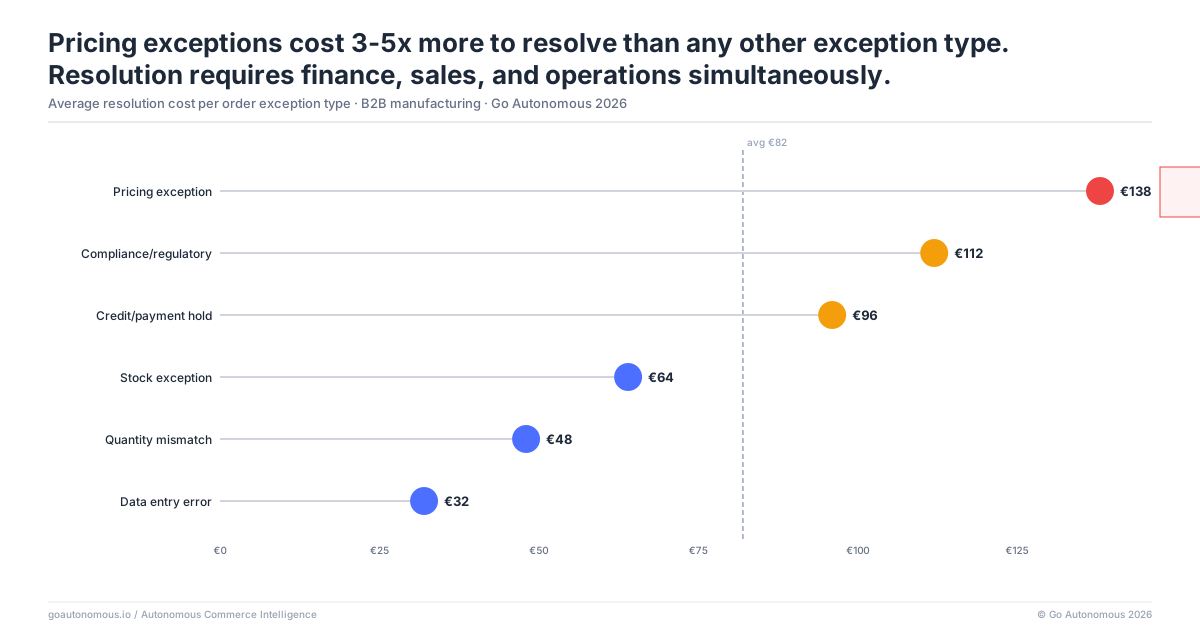
Pricing Exceptions Take 3–5x Longer to Resolve Than Any Other Exception Type
Why Pricing Exceptions Cannot Be Resolved by Customer Service Alone
Most order exceptions can be resolved within a single department. An unrecognized SKU is resolved when a customer service rep cross-references the product catalog and identifies the correct item. A delivery address discrepancy is resolved by contacting the customer. A quantity mismatch is resolved by checking the order against the customer’s contract minimums. The customer service rep has the information and authority to close the exception.
A pricing exception is structurally different. When the price on the customer’s purchase order does not match the ERP contract price, resolving it requires answering three questions that sit in three different departments. Is the contracted rate correct, or has the contract been updated without system synchronization? That is a contract management question. Was a discount authorized for this customer or this order? That is a sales question. What is the financial impact of accepting the customer’s price versus invoicing correctly? That is a finance question.
No single department has the authority or information to answer all three. The customer service rep can identify the discrepancy and initiate the resolution process, but they cannot close it. Efficiency losses in exception handling compound when exceptions require cross-functional coordination rather than single-department resolution.

The Escalation Path: From Customer Service to Sales to Finance to Resolution
The typical pricing exception resolution path runs: customer service identifies the discrepancy and logs the exception (15–30 minutes), escalates to the account manager or inside sales rep who owns the customer relationship (30–60 minutes to respond and investigate), escalates to finance for credit analysis if the discrepancy is material (60–120 minutes), returns to customer service or sales for communication with the customer, and closes when a decision is made and the order is corrected or accepted as submitted.
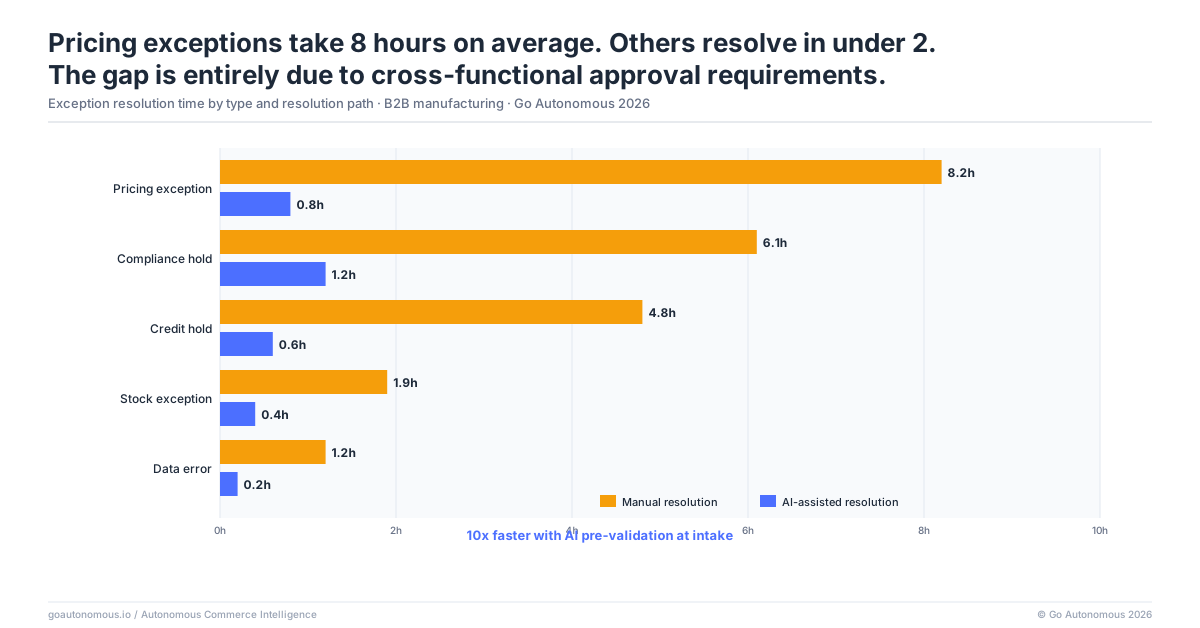
Total elapsed time: 2–4 hours for a straightforward pricing discrepancy, longer if the account manager is unavailable, the contract terms are ambiguous, or the customer disputes the ERP contract price. Compare this to 15–45 minutes for most other exception types. The 3–5x resolution time differential is not a process inefficiency that can be trained away: it is a structural consequence of the multi-department coordination requirement.
Each time we added one or two million euros in revenue, we had to add another operator. From a cost perspective, that's an unsustainable way of operating a business.

Pricing Exceptions Require Cross-Functional Resolution: Sales, Finance, and Operations All Touch It
The Department-by-Department Time Budget for a Pricing Exception
Each department involved in a pricing exception absorbs cost independently and tracks it separately. Customer service logs 30–45 minutes per exception across identification, escalation, and closure. The account manager or inside sales rep logs 30–60 minutes for the investigation and customer communication. Finance logs 30–60 minutes for the credit analysis and approval. If the exception generates a shipment hold, operations logs time for the hold, release, and any expedited logistics required to recover the delivery timeline.
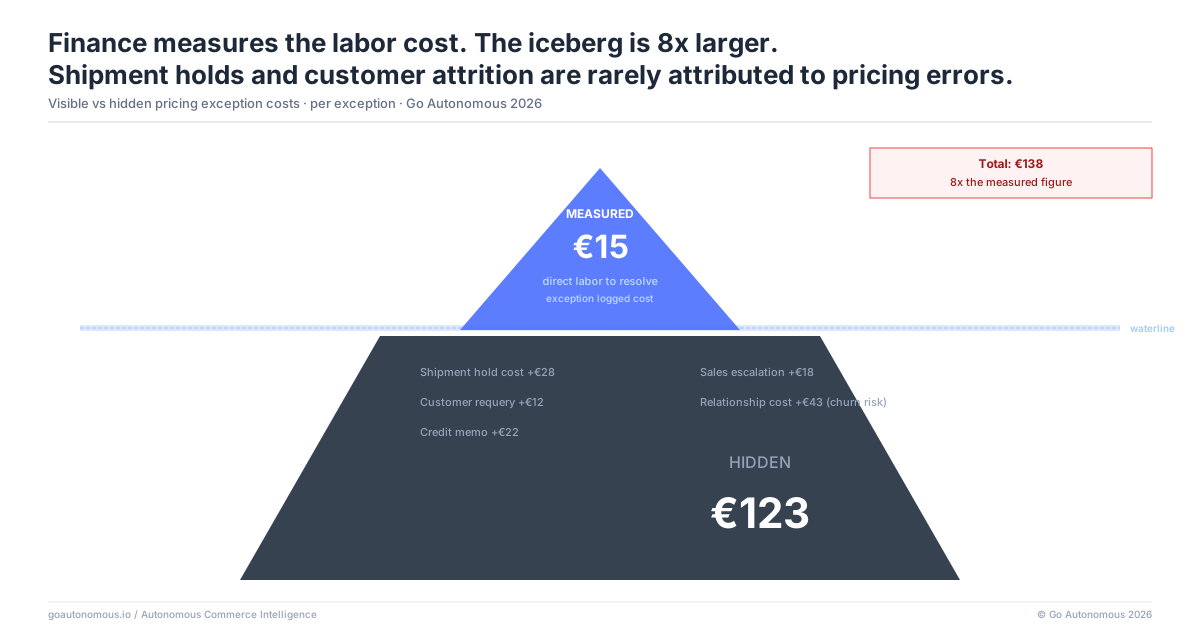
Aggregated across all departments, a single pricing exception that runs through the full resolution path costs €100–300 in direct labor. Operations reports that capture only the customer service time show €20–40 per exception. This undercount is not deliberate: each department records its own costs and no one aggregates them. The full cost of pricing exceptions is systematically invisible in standard operations reporting.
Why Pricing Exception Volume Is Systematically Underestimated in Operations Reports
The underestimation of pricing exception volume compounds the underestimation of per-exception cost. Pricing exceptions that are resolved informally, outside the formal exception management system, are not counted. An account manager who accepts a customer’s price to avoid a dispute and adjusts the order manually may not log this as an exception: it appears as a price override rather than a resolved exception.
When pricing exceptions are recounted to include informal resolutions and price overrides, actual pricing exception volume is typically 1.5–2x the formally logged figure. Combined with the undercount in per-exception cost, the true annual cost of pricing exceptions is often 3–4x what operations reports indicate. The Mikkel Vindeløv dynamic applies directly: revenue growth increases order volume, which increases pricing exception volume, which increases cross-functional resolution overhead at the same rate revenue grows.
20–40% of orders trigger an exception of some type. In B2B manufacturing and distribution, pricing exceptions are among the most frequent: contract complexity, multi-tier pricing, promotional pricing, and customer-specific discount structures create ample opportunities for discrepancies. For operations that process hundreds or thousands of orders per day, pricing exceptions represent a significant and growing cost center.
Every Unresolved Pricing Exception Holds a Shipment and Generates a Customer Escalation
The Business Case for Releasing on the Customer’s Price vs. Holding for Resolution
When a pricing exception is not resolved before the shipment window, operations faces a choice with no good options. Holding the shipment pending resolution protects margin and contract integrity but creates a delivery delay. If the exception takes 2–4 hours to resolve and the shipment window was that morning, the order misses its promised delivery date. Customer escalation follows. Expedited shipping may be required to recover the timeline, adding logistics cost.
Releasing the shipment at the customer’s price preserves the delivery timeline but creates a downstream invoicing problem. Finance must reconcile the difference. If the customer’s price was below the contracted rate, the difference is lost margin. If the supplier invoices for the contracted price after shipping at the customer’s price, an invoice dispute is generated, which runs through another cross-functional resolution cycle. Neither outcome is acceptable as a default policy.
What Pricing Exceptions Communicate to Strategic Accounts About Operational Reliability
For strategic accounts, recurring pricing exceptions signal unreliable pricing processes. A buyer who receives a delivery hold notification and an explanation that there is a pricing discrepancy on their purchase order is receiving information about the supplier’s contract management quality. If this happens more than once per quarter, it becomes a procurement-level concern.
Buyers who experience repeated pricing disputes begin routinely auditing supplier invoices, which adds overhead to their own accounts payable process. This overhead becomes a factor in supplier evaluation. In contract renewal conversations, a pattern of pricing disputes is cited as evidence of operational complexity and priced into the relationship as friction cost. The commercial impact extends beyond the direct resolution cost of each individual exception.
For the broader picture of how exception rates affect customer experience and retention in B2B manufacturing, the pattern is consistent: exception volume correlates with customer satisfaction scores and contract renewal rates.
Pricing Validation at Intake Catches the Exception Before It Enters the Resolution Queue
How Automated Pricing Validation Works: From Inbound Order to ERP Contract Price Check
Pricing validation at intake works as follows: when an inbound order arrives, the AI layer identifies the customer, retrieves the applicable contract price from the ERP, and compares it against the price stated on the purchase order. If the prices match, the order proceeds. If they do not match, the AI determines whether the discrepancy falls within an authorized tolerance range. If it does, the order is corrected to the contract price and confirmed automatically. If it falls outside the tolerance range, it is flagged for human review before a sales order is created.
This intervention happens in seconds, at the moment the order arrives. No sales order is created with the wrong price. No shipment hold is generated. No escalation path is triggered. The exception is surfaced to the right person — the account manager or finance — with full context: the customer’s price, the contracted price, the discrepancy amount, the order value, and the applicable contract reference. The resolution decision requires 5–10 minutes rather than 2–4 hours because all the information is pre-assembled.
What Operations and Finance Look Like When Pricing Exception Rate Drops Below 1%
When automated pricing validation catches discrepancies at intake, the formal pricing exception rate drops sharply. Discrepancies that previously became exceptions are resolved before they become exceptions. The cross-functional resolution workflow still runs for genuine disputes, but it runs on far fewer cases and with better information, reducing per-exception resolution time as well as volume.
Finance recovers the time previously spent on invoice reconciliation and credit analysis for pricing disputes. Operations recovers the time previously spent managing shipment holds. Customer service recovers the time previously spent on the escalation coordination role. Account managers recover the time previously spent on pricing dispute calls with customers.
VELUX processes 130,000 or more orders with 88% decision autonomy, with pricing validation embedded in the intake process (see Go Autonomous success cases). The autonomous commerce model applies the same validation logic at intake across all order types, including pricing. The difference between RPA and AI in this context is significant: rule-based automation plateaus at approximately 60% touchless because it cannot handle the ambiguity and variation in pricing structures that AI resolves.
If pricing exceptions are your largest exception category by resolution time and cross-functional cost, the intervention point is intake. Book a session to see how pricing validation at intake works for your contract structure and ERP configuration.
Frequently Asked Questions
Why are pricing exceptions more expensive to resolve than other order exception types in B2B manufacturing?
Pricing exceptions require cross-functional resolution involving customer service, sales, and finance. Each department must answer a different question: Is the contracted rate correct? Was a discount authorized? What is the financial impact? No single department has the authority to close the exception alone. This multi-department coordination adds 2–4 hours of elapsed resolution time, compared to 15–45 minutes for single-department exceptions like unrecognized SKUs or address discrepancies.
Which departments are involved in resolving a pricing exception in B2B order management?
A pricing exception in B2B order management typically involves customer service (exception identification and escalation), the account manager or inside sales rep (contract verification and customer communication), and finance (credit analysis and approval of any price adjustment). If the exception triggers a shipment hold, operations is also involved in managing the hold and release. Each department records only its own cost, making the full cross-functional cost invisible in standard operations reporting.
How do B2B manufacturers prevent pricing exceptions at order entry?
Automated pricing validation at intake is the primary prevention method. When an inbound order arrives, an AI layer retrieves the applicable contract price from the ERP and compares it to the price on the purchase order. Discrepancies within an authorized tolerance are corrected automatically. Discrepancies outside tolerance are flagged for human review before a sales order is created. This prevents pricing exceptions from entering the resolution queue by catching them at the moment of receipt.
What is the average cost of resolving a pricing exception in B2B distribution?
The full cross-functional cost of resolving a pricing exception in B2B distribution runs €100–300 per exception, aggregated across customer service, sales, finance, and operations. Standard operations reports that capture only the customer service portion show €20–40 per exception. The remainder is absorbed across sales time on investigation and customer communication, finance time on credit analysis, and operations time on shipment hold management. The true cost is 3–5x the figure typically reported.
How does automated pricing validation reduce pricing exception rates in B2B order processing?
Automated pricing validation catches price discrepancies at the moment an order arrives, before a sales order is created. The AI compares the purchase order price to the ERP contract price in seconds. Discrepancies within tolerance are corrected automatically. Material discrepancies are flagged with full context for rapid human review. Since no sales order is created with an incorrect price, no shipment hold is generated and no cross-functional escalation is triggered for routine discrepancies. Exception rates drop sharply as a result.