.svg)





B2B Order Accuracy Rate: 2026 Benchmarks and What Wrong Orders Cost Downstream
B2B order accuracy rates in manufacturing and distribution range from 92% to 98% depending on intake method, customer base diversity, and automation level. The 6-percentage-point gap between top and bottom quartile represents a significant operational and commercial cost difference. This post benchmarks order accuracy rates in 2026 and calculates the full downstream cost of the accuracy gap.
B2B order accuracy rates in manufacturing and distribution range from 92% to 98% in 2026. The 6-percentage-point gap between top and bottom quartile operations is not random variation. It maps directly to intake method: operations with high EDI coverage and low manual entry land at 97–98%, while operations dependent on email and phone order intake land at 92–94%. The downstream cost of the accuracy gap, measured in returns, expedited replacements, credit notes, and customer relationship damage, is routinely underestimated because the cost is distributed across operations, finance, and logistics rather than appearing as a single line item.
This post benchmarks where B2B order accuracy sits in 2026, what drives the variance across operations, and what the full downstream cost of an inaccurate order looks like when all correction steps are counted.
Table of Content
- B2B Order Accuracy Rates Range From 92–98%: The Gap Between Quartiles Is Measurable in Revenue
- The Cost of a Wrong Order Is Not the Order Itself: It Is the Correction Cascade
- Order Accuracy Correlates With Intake Channel: Structured Channels Out-Perform Manual Entry by 3x
- The Architecture That Consistently Delivers 99%+ Order Accuracy at Scale
- The Autonomous Execution Fabric: Accuracy Enforcement Across Every Commercial Transaction
- Frequently Asked Questions
- What is a good order accuracy rate for B2B manufacturers in 2026?
- What is the true cost of an inaccurate order in B2B manufacturing?
- How do B2B manufacturers improve order accuracy rates above 98%?
- Why do B2B distributors with EDI have higher order accuracy than those relying on email?
- How does AI order processing improve order accuracy rates compared to manual entry?
B2B Order Accuracy Rates Range From 92–98%: The Gap Between Quartiles Is Measurable in Revenue
How Order Accuracy Is Defined and Measured: The Inconsistency That Hides Real Performance
Order accuracy in B2B lacks a consistent definition across organizations, which obscures real performance. Some operations define accuracy as the percentage of orders entered into the ERP without a correction before confirmation. Others measure at point of shipment: did the correct product ship in the correct quantity? Others measure at point of customer receipt: did the customer receive exactly what was on the purchase order? Each definition produces a different number for the same operation.
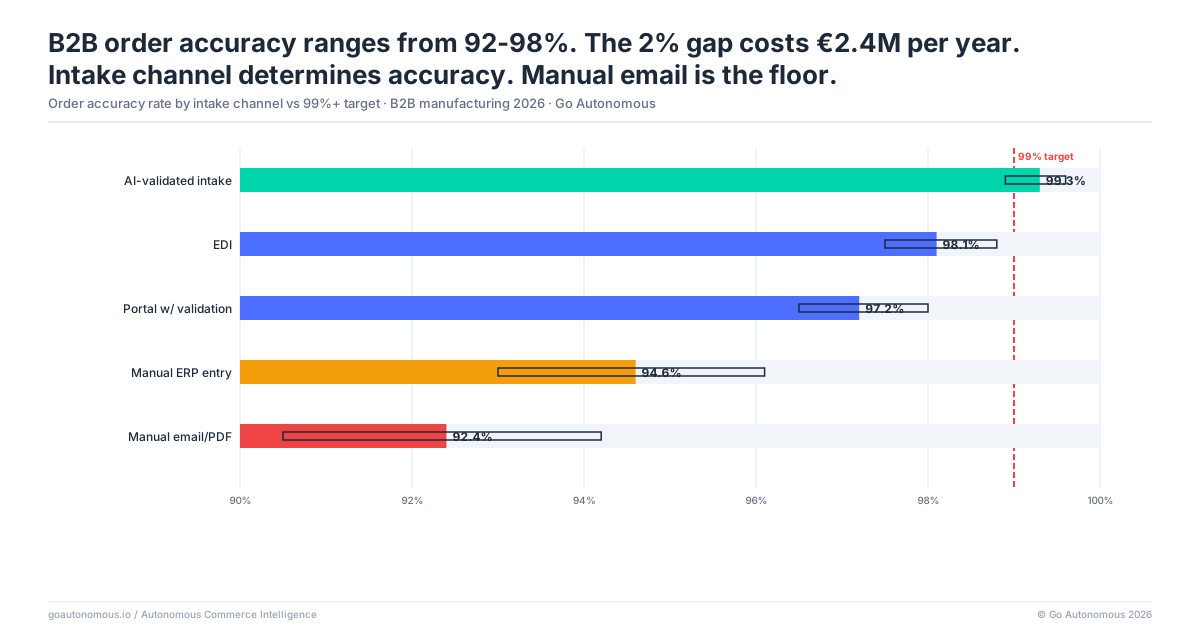
Operations that measure accuracy at point-of-ERP-entry report the highest rates, because errors caught internally before any confirmation is sent are excluded. Operations measuring at point-of-customer-receipt report the lowest rates, because they capture every error including those corrected internally. True accuracy, measured as the percentage of orders that reach the customer without requiring any post-entry correction at any stage, is the operationally meaningful metric. Across B2B manufacturing and distribution, that number ranges from 92–98% in 2026, with the median around 95%.
Which Operations Land at 98% and Which Land at 92%: The Intake Method Correlation
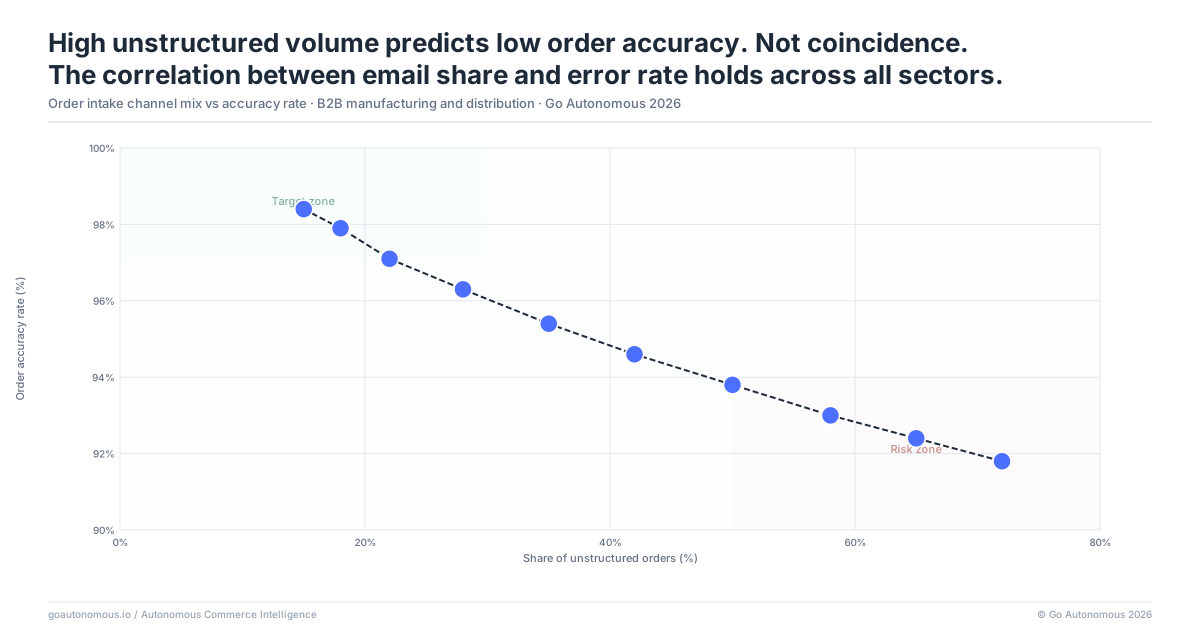
The most reliable predictor of where an operation lands in the 92–98% range is its intake channel mix. Operations with high EDI coverage, where structured digital orders arrive pre-validated against the trading partner’s data model, consistently achieve 97–98% accuracy. Portal orders, submitted through structured fields with mandatory validation, perform similarly. Both channels eliminate the human transcription step that introduces the majority of errors.
Operations where 50–70% of order volume arrives by email and phone, which describes the majority of B2B manufacturers and distributors, land in the 92–95% range. The accuracy gap is not primarily a function of team quality or training investment. It is a function of how many human transcription decisions are required to convert an inbound order into an ERP entry. More manual decisions mean more errors, regardless of team capability. Reducing manual entry load is the structural intervention that moves accuracy from the bottom quartile to the top.
Each time we added one or two million euros in revenue, we had to add another operator. From a cost perspective, that's an unsustainable way of operating a business.

The Cost of a Wrong Order Is Not the Order Itself: It Is the Correction Cascade
What Happens Operationally After an Inaccurate Order Is Detected
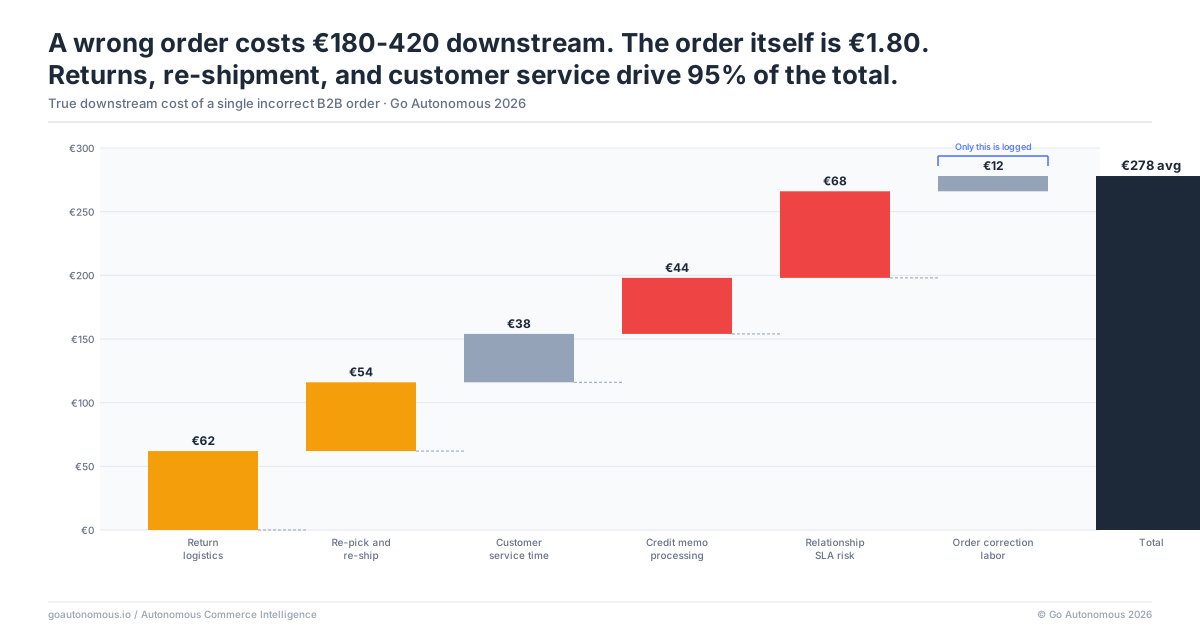
An inaccurate order triggers a correction sequence with multiple steps, each carrying a direct cost. Detection is the first step: the error must be identified, either by an internal quality check before shipment, or by the customer after receipt. Internal detection before shipment requires the order to be cancelled or revised, re-entered, re-confirmed to the customer, and re-queued for fulfillment. The original processing cost is duplicated. Detection after delivery is more expensive: the correct order must be determined, a replacement must be expedited (often at premium logistics cost), and the incorrect shipment must be returned or written off.
Beyond the direct logistics and processing costs, a credit note must be issued and processed by finance. The root cause must be investigated and documented. Customer communication must be managed. For any error that reaches the customer, total correction cost runs 3–5x the original order processing cost on low-margin products, where the product value is small relative to the handling, logistics, and administrative overhead of correction.
The Customer-Side Cost: Returns, Expedited Shipping, and Relationship Damage
The supplier bears the direct correction cost. The customer bears a different cost: production line disruption if the wrong product arrived when a specific component was needed, administrative overhead to process the return and reorder, and eroded confidence in the supplier’s reliability. In B2B manufacturing, an inaccurate order from a key supplier can delay a production run. The cost to the customer of that delay often exceeds the product value many times over.
Strategically, repeated inaccurate orders signal process unreliability. Procurement teams at large enterprises track supplier performance metrics including order accuracy. A supplier in the bottom quartile on accuracy becomes vulnerable to displacement at contract renewal. The revenue risk from sustained accuracy underperformance extends beyond the cost of individual correction events. The Hempel dynamic applies here: scaling order volume with manual intake scaled the error volume and the associated cost, not just the revenue.
Order Accuracy Correlates With Intake Channel: Structured Channels Out-Perform Manual Entry by 3x
EDI and Portal Order Accuracy vs. Email and Phone Order Accuracy
EDI order accuracy exceeds 97% consistently because the data validation happens at the point of transmission. The trading partner’s system generates a structured message conforming to the agreed data schema. If it does not conform, the message is rejected before it enters the supplier’s system. Errors that do pass through are typically data quality issues in the buyer’s system, not transcription errors in the supplier’s intake process. Portal orders achieve similar accuracy for the same reason: structured mandatory fields prevent submission of incomplete or invalid orders.
Email order accuracy runs 3–8 percentage points lower than EDI/portal accuracy. Phone order accuracy is lower still, because the transcription is done in real time under conversational pressure with no written reference. The accuracy gap between channels is not primarily a speed tradeoff. EDI and portal orders are not slower to process; they are faster, because validated data enters the ERP without a transcription step. The accuracy penalty of manual channels comes with a speed penalty, not a speed benefit.
Why Manual Entry Is a Structural Accuracy Problem, Not a Training Problem
Training investments improve accuracy among new or under-experienced reps. They do not close the accuracy gap between manual entry and automated intake. Human data entry has an irreducible error rate that persists even among experienced, well-trained teams: cognitive fatigue across high-volume shifts, ambiguity in handwritten or poorly formatted purchase orders, time pressure during peak periods, and the probability of attention lapses during repetitive tasks all contribute errors that training cannot eliminate. The ceiling for manual entry accuracy is structurally below the ceiling for validated automated intake.
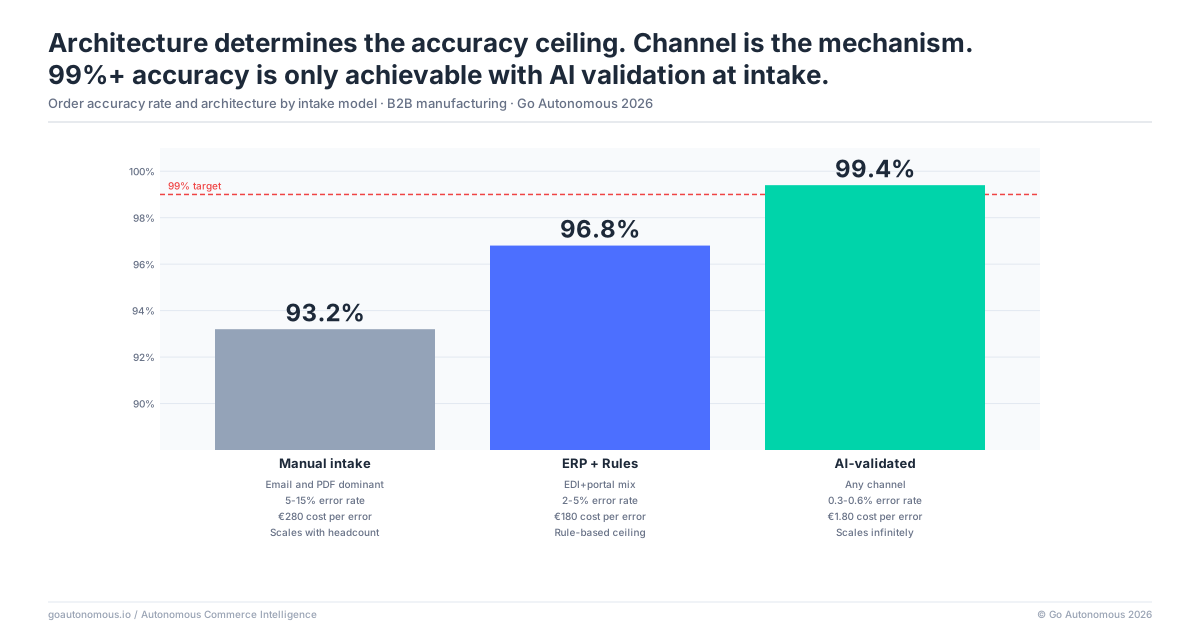
This is why the rule-based automation approaches — including RPA solutions that attempt to automate manual entry steps — plateau at approximately 60% touchless rates. Rule-based systems handle well-structured, predictable inputs well. They fail on the 20–40% of orders that contain exceptions: non-standard formatting, missing fields, ambiguous item descriptions, and quantity-pricing combinations that fall outside defined rules. Those exceptions land back on human reps, reproducing the accuracy problem for the most complex, error-prone subset of orders.
The Architecture That Consistently Delivers 99%+ Order Accuracy at Scale
Validation at Entry: How AI Achieves Accuracy That Manual Processing Cannot
Operations achieving 99%+ order accuracy do so by removing human data transcription from the critical path. An AI intake layer reads inbound orders from any channel: email, PDF attachment, portal submission, or EDI. For each order, it validates every field against ERP master data before creating the order: product code exists and is active, quantity is within valid range, delivery address matches a known ship-to location, price aligns with the applicable trade agreement. Genuine ambiguities, items that cannot be matched with sufficient confidence, are routed to human review. Everything else is created automatically with validated data.
The accuracy rate this architecture achieves is structural. It does not degrade at peak volume because the validation logic runs identically on the 100th order as on the first. It does not vary by shift or by individual rep. It handles exception orders by routing them for review rather than by attempting to guess through ambiguity. The result is that the only orders requiring human attention are orders with genuine data gaps, not orders that a human could have processed correctly but happened to introduce an error into.
What Operations Looks Like When Order Accuracy Exceeds 99% Consistently
VELUX processes over 130,000 orders across 9 markets with 88% decision autonomy, demonstrating that high accuracy at scale is achievable without proportional headcount growth. Mediq handles 4,000 orders per week with zero headcount increase and 75% faster processing. The pattern is consistent: operations that automate intake reduce error rates, reduce correction costs, and reallocate the customer service capacity previously consumed by rework to activities that create commercial value.
The Autonomous Execution Fabric: Accuracy Enforcement Across Every Commercial Transaction
Order accuracy improvement, as described in this post, is one dimension of what the Autonomous Execution Fabric delivers. The Fabric is a full commercial execution layer that connects directly to SAP, Oracle, or Microsoft Dynamics and executes every inbound commercial transaction without human assembly. It validates field by field against ERP master data at the point of entry: product code, quantity, pricing, delivery address, and all required regulatory fields. The result is not an improvement on manual accuracy. It is a structural replacement of the human transcription step that introduces errors in the first place.
The Autonomous Execution Fabric handles more than order entry accuracy. It executes across every commercial transaction type: orders from email, EDI, customer portal, and direct API; pricing requests and quote assembly; returns authorizations and credit note creation; contract tenders. Each of these transaction types is subject to the same accuracy problem this post describes. Manual handling of any of them introduces the same interpretation errors, master data mismatches, and validation gaps that drive orders from 98% down to 92%. The Fabric closes that gap across all transaction types, not just the one that prompted the accuracy review.
Why this matters beyond order accuracy alone: operations running 92% order accuracy typically run comparable error rates across pricing requests, returns authorizations, and quote confirmations. The root cause is the same across all of them. A customer service rep reading an email order makes the same class of errors as a rep reading an email return request or performing a manual pricing lookup. The Autonomous Execution Fabric addresses the root cause structurally, so the accuracy improvement compounds across the entire commercial transaction surface, not just the order line that triggered the initial measurement.
When accuracy exceeds 99%, the operational profile changes. The returns process shrinks. Finance month-end reconciliation no longer generates a correction backlog. Customer service escalations related to order errors drop. Procurement teams at strategic customer accounts see consistent performance metrics, which strengthens renewal positioning. The full mechanics of Autonomous Commerce are built around this outcome: execution accuracy at scale, independent of intake channel or order volume. Book a session to benchmark your current accuracy rate and map the gap to top-quartile performance.
Frequently Asked Questions
What is a good order accuracy rate for B2B manufacturers in 2026?
Top-quartile B2B manufacturers and distributors achieve 97–98% order accuracy in 2026, typically through high EDI coverage and automated intake. The median across operations relying on mixed intake channels, including email and phone, sits around 95%. Operations with high manual entry volume typically land in the 92–94% range.
What is the true cost of an inaccurate order in B2B manufacturing?
The true cost of an inaccurate order includes internal correction time, return logistics, expedited replacement shipping, credit note processing, customer communication, and root cause investigation. For low-margin products, total correction cost runs 3–5x the original order processing cost. For orders that reach the customer and generate a formal dispute, the cost is further amplified by customer service investigation and finance adjustment time.
How do B2B manufacturers improve order accuracy rates above 98%?
Reaching above 98% order accuracy requires removing human transcription from the order entry process. AI intake layers that read inbound orders from any channel, validate all fields against ERP master data before entry, and route only genuine ambiguities to human review structurally achieve 99%+ accuracy. Training improvements and quality checks alone cannot bridge the gap because human data entry has an irreducible error rate.
Why do B2B distributors with EDI have higher order accuracy than those relying on email?
EDI orders are validated at the point of transmission against a defined data schema. Errors that do not conform to the schema are rejected before entering the supplier’s system. Email orders require human transcription, which introduces errors from cognitive fatigue, formatting ambiguity, and time pressure. EDI accuracy exceeds 97% consistently; email accuracy typically runs 3–8 percentage points lower.
How does AI order processing improve order accuracy rates compared to manual entry?
AI order processing validates every field against ERP master data before creating the order. Unlike human entry, the validation logic runs identically at any volume, on any shift, without fatigue or attention degradation. Genuine ambiguities are routed to human review rather than entered with uncertainty. The result is a structural accuracy ceiling above 99%, which manual entry cannot achieve at comparable volume.