.svg)





What SAP, Oracle, and Microsoft Dynamics 365 Cannot Execute: The Order Intake Gap Every Operations Director Needs to Understand
SAP S/4HANA, Oracle Order Management Cloud, and Microsoft Dynamics 365 are world-class transaction systems — but they validate what they have already been told. The order intake gap is the distance between a customer sending an order and the ERP registering a valid, releasable transaction, and it is where 60 to 80 percent of order handling cost lives.
SAP S/4HANA, Oracle Order Management Cloud, and Microsoft Dynamics 365 were not designed to read your customers’ emails, interpret PDF purchase orders, or resolve pricing mismatches in an attachment. They were designed to validate transactions the system has already been told about, and they do that job correctly. The order intake gap sits upstream of every ERP: it is the distance between a customer sending an order and the ERP registering a valid, releasable transaction. That gap is where 60 to 80 percent of order handling cost lives, staffed by customer service teams whose sole function is to close it, one transaction at a time. This post diagnoses why the gap is structural, not a configuration problem, and what the execution layer looks like that actually closes it.
Table of Content
- The Order Processing Problem That Survives Every ERP Upgrade
- What SAP S/4HANA, Oracle Order Management Cloud, and Microsoft Dynamics 365 Are Actually Designed to Do
- Where the Order Intake Gap Lives: The 60 to 80 Percent of Order Handling Cost Upstream of the ERP
- ERP Scope vs. Autonomous Execution: What Each Layer Handles
- What the Execution Layer Looks Like When the Order Intake Gap Is Closed
The Order Processing Problem That Survives Every ERP Upgrade
It is 8:14 AM on a Tuesday. Your order management team has arrived to find 63 new emails in the shared inbox. Twelve are PDF purchase orders from key accounts. Nine are order amendments, references to orders already in SAP but now changed. Seven are pricing queries, customers asking why the invoice does not match the quote. The remaining 35 are a mix: blanket PO call-offs, emergency add-ons, partial cancellations, and a handful in languages that will need translation before anyone can act on them.
Your ERP is open, running, and ready. SAP S/4HANA is waiting for input. The problem is that none of those 63 emails are input yet. They are intent. And converting commercial intent into a validated, releasable ERP transaction is entirely manual work, performed by people whose judgment is required at every step.
This is the order intake gap. It exists in every B2B manufacturing and distribution operation that processes significant email and PDF order volume. It has survived every ERP upgrade, every integration project, and every process improvement initiative. Not because those initiatives were poorly executed, but because the gap is not a system configuration problem. It is an architectural boundary: the point where ERP scope ends and where commercial intent interpretation must begin.
What is the order intake gap in B2B manufacturing?
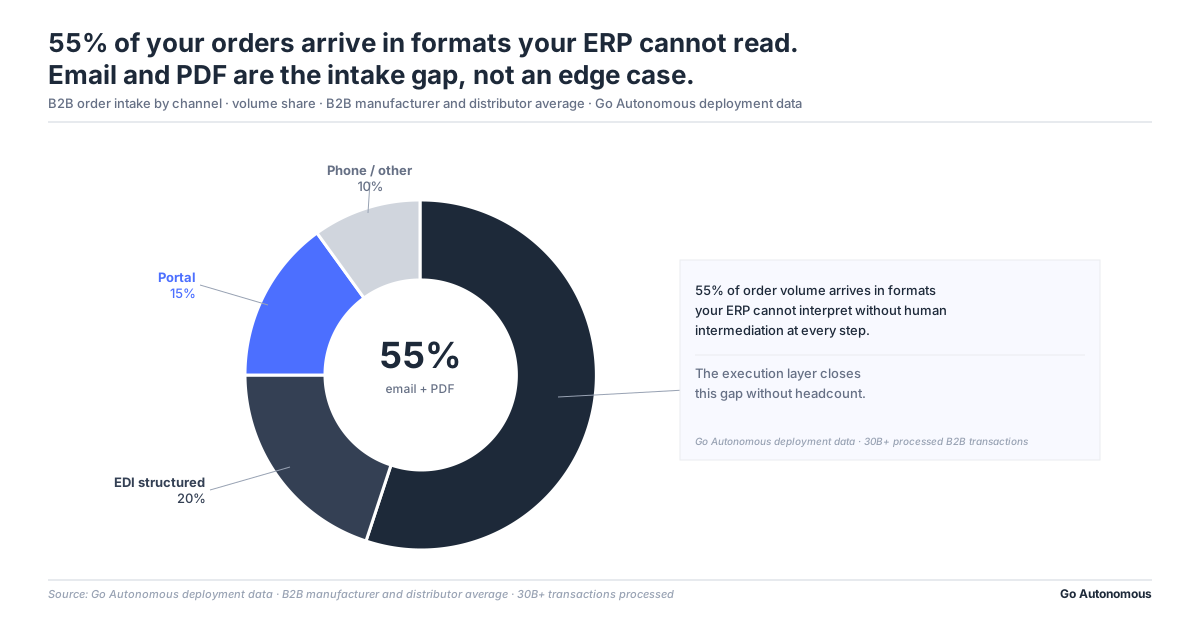
The order intake gap in B2B manufacturing is the processing distance between a customer communicating an order and an ERP system registering a validated, fulfillment-ready transaction. It encompasses every step that requires human judgment: reading and interpreting unstructured order content, matching customer part numbers to internal SKUs, resolving pricing mismatches, validating order completeness, and making the decision that the transaction is ready to release. For manufacturers where 50 to 70 percent of order volume arrives by email or PDF, this gap represents the dominant cost center in order-to-cash operations.
According to APQC benchmarking data, order management process costs as a percentage of revenue vary by more than threefold between top and bottom quartile performers, with the primary differentiator being the degree of manual intervention in order intake. The gap compounds: each manual touch introduces processing time, error risk, and queue dependency. At peak periods, fiscal quarter-end, or during supply disruptions, exception queues that normally process in hours back up to days.
Why does this problem persist after ERP implementation?
The problem persists because ERP systems were never designed to solve it. SAP S/4HANA, Oracle Order Management Cloud, and Microsoft Dynamics 365 are transaction systems. Their scope begins when structured, validated data is presented to them. The work of extracting structured data from unstructured commercial communications, interpreting intent, applying pricing logic, and determining completeness sits entirely outside their architectural scope. ERP upgrades, new workflow modules, and integration projects have moved this work slightly downstream in some organizations. None have eliminated the fundamental human dependency.
Each time we added one or two million euros in revenue, we had to add another operator. From a cost perspective, that's an unsustainable way of operating a business.

What SAP S/4HANA, Oracle Order Management Cloud, and Microsoft Dynamics 365 Are Actually Designed to Do
These platforms are not failing at order intake. They are succeeding at exactly what they were built for: transaction integrity, validation, and downstream execution. Understanding their actual scope is the prerequisite for understanding where the intake gap lives and why closing it requires a different architectural layer.
What does SAP S/4HANA handle in B2B order processing and what does it not handle?
SAP S/4HANA handles transaction validation, inventory availability checking, pricing calculation from established pricing masters, credit limit enforcement, and fulfillment triggering. What it does not handle is the upstream interpretation work: reading an email, parsing a PDF, matching a customer’s non-standard part reference to an internal SKU, or resolving a discrepancy between a purchase order price and a contract price. SAP processes orders that have already been validated and structured. It does not validate or structure them from raw commercial communications.
The same architectural scope applies to Oracle Order Management Cloud and Microsoft Dynamics 365. Oracle OM Cloud excels at orchestrating complex order flows across multiple fulfillment sources, managing backorders, and coordinating promising logic. Microsoft Dynamics 365 integrates tightly across sales and finance workflows and handles multi-entity operations efficiently. Both platforms are built on the assumption that the order has already been received, interpreted, and validated before it reaches them. That assumption is where the gap lives.
This is not a criticism. Transaction integrity requires clean, validated input. An ERP that attempted to interpret ambiguous commercial intent would be unreliable for its core function. The architectural boundary is a deliberate design choice, optimized for what these systems are most critical for: financial accuracy, inventory control, and fulfillment coordination. Operations Directors who understand their ERP well already know this. The question is what operates in the space upstream.
Where the Order Intake Gap Lives: The 60 to 80 Percent of Order Handling Cost Upstream of the ERP
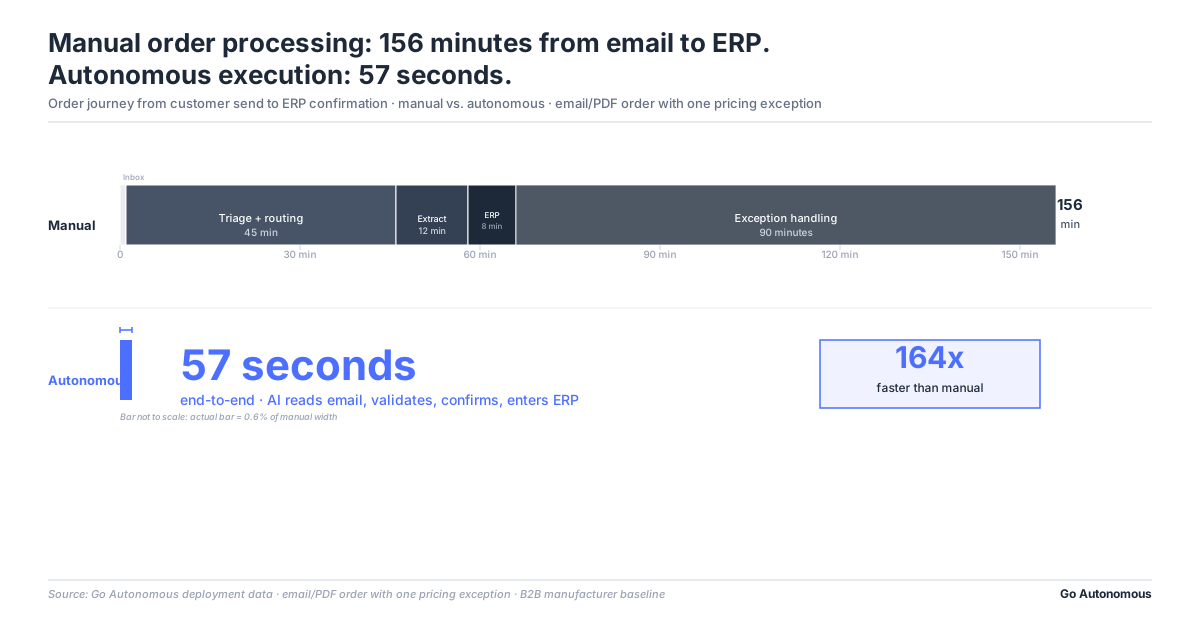
The order intake gap sits in the space between a customer’s commercial intent and a system’s validated transaction record. For a manufacturer processing 500 email and PDF orders per day, with an average handling time of 12 minutes per order, that gap consumes 1,000 person-hours per week. At a fully loaded cost of 45 EUR per hour, that is 2.3 million EUR per year spent on the act of receiving revenue. None of it generates commercial value. All of it is structural friction between demand and fulfillment.
The metric that captures this precisely is Friction Debt.
Friction Debt is the total monetary cost of human decisions still happening in the revenue flow. It is the operating metric of Autonomous Commerce and the single number most leadership teams have never put on their dashboard. Friction Debt has three components: Decision time (the average wait between a decision being needed and a decision being made), Decision cost (the loaded cost of the people whose judgment is required, multiplied by frequency), and Decision drag (the downstream effect on revenue: quotes that close late, orders that ship late, exceptions that compound into customer churn). Every data field touched by a human is friction debt.
What percentage of B2B order handling cost occurs before the ERP receives the order?
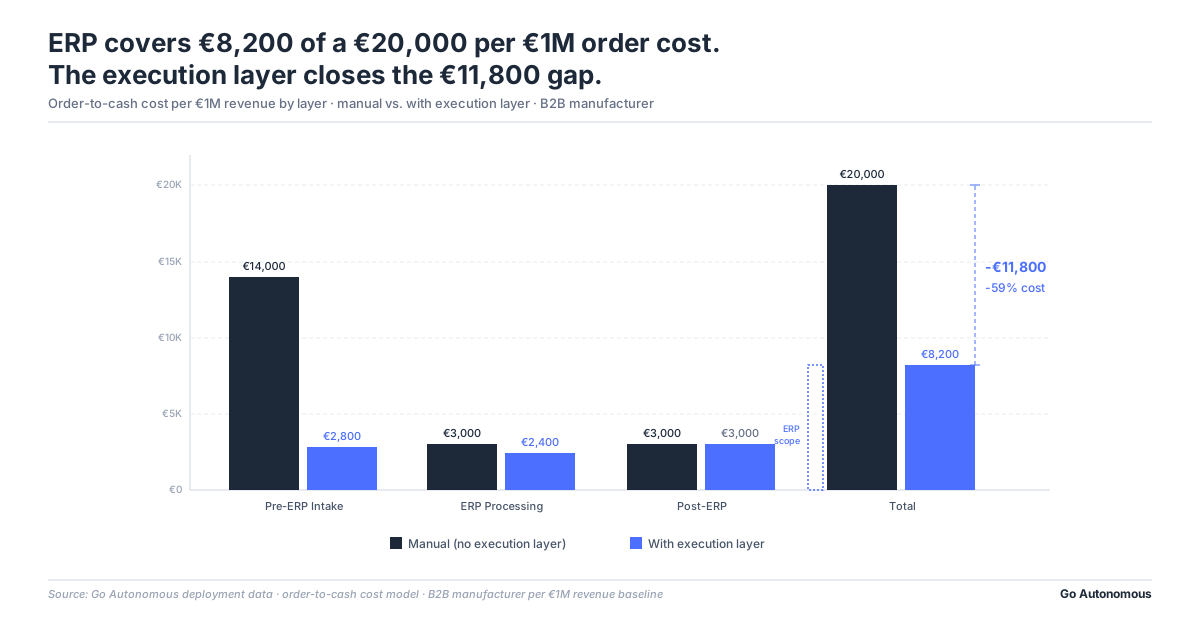
Go Autonomous deployment analysis across more than 30 billion processed B2B transactions shows that 60 to 80 percent of total order handling cost occurs in the pre-ERP intake phase: reading, interpreting, validating, correcting, and routing orders before they reach the system. This proportion increases with order complexity, channel diversity, and exception frequency. For manufacturers processing high volumes of email and PDF orders with variable line item structures, complex pricing tiers, and frequent customer-specific exceptions, the pre-ERP cost share consistently exceeds 70 percent.
The upstream cost concentration means that ERP optimization, however well executed, addresses a minority of total order handling cost. Performance improvements inside SAP, Oracle, or Dynamics deliver real value. They do not address the 60 to 80 percent that never reaches them in an autonomous state.
Why do B2B manufacturers still need manual order entry even with SAP or Oracle ERP?
B2B manufacturers still require manual order entry because neither SAP nor Oracle can read a PDF, interpret a customer’s non-standard part reference, resolve a pricing conflict between an attachment and a contract, or determine whether an incomplete order should be held or released with a query. These are judgment calls that require contextual understanding of the customer relationship, the pricing agreement, and the operational constraints. They are not rule violations, they are interpretation tasks. ERP systems execute rules against validated data. They do not interpret ambiguous commercial communications.
The result is a structural staffing dependency. Customer service representatives function as the intake layer, converting commercial intent into ERP-ready transactions. Their workload scales directly with order volume. Each increment of revenue growth requires a proportional increase in intake staffing. This is the headcount scaling trap that defines operational cost ceilings at every manufacturer still running manual intake at scale.
A related cost accumulates in what Revenue at Rest measures: revenue trapped inside processing queues waiting for a human to move it forward. Quotes sitting in inboxes. Orders pending manual validation. Amendments waiting for someone with the right context to action them. If revenue is not moving, it is not revenue. It is inventory.
ERP Scope vs. Autonomous Execution: What Each Layer Handles
The table below maps specific order processing tasks to what each ERP handles versus what requires an autonomous execution layer. The distinction is scope, not quality. These platforms are excellent at what they are designed to do. The intake column is simply outside their designed scope.
| Order Processing Task | SAP S/4HANA | Oracle OM Cloud | MS Dynamics 365 | Autonomous Commerce |
|---|---|---|---|---|
| Read and interpret email order content | No | No | No | Yes |
| Match PDF line items to internal SKU catalog | Partially (EDI/portal only) | Partially (EDI/portal only) | Partially (EDI/portal only) | Yes, including unstructured formats |
| Resolve pricing discrepancy in attachment | No | No | No | Yes, policy-driven |
| Validate order completeness before release | Yes (validated data only) | Yes (validated data only) | Yes (validated data only) | Yes, including unstructured input |
| Handle customer-specific exception routing | Rules-based only | Rules-based only | Rules-based only | Policy-driven autonomous |
| Match non-standard customer part references to ERP SKUs | No | No | No | Yes |
| Translate and normalize multi-language order documents | No | No | No | Yes |
| Apply blanket PO call-off logic from contract terms | Partially (manual setup required) | Partially (manual setup required) | Partially (manual setup required) | Yes, autonomous interpretation |
| Validate order completeness before release | Yes (post-intake) | Yes (post-intake) | Yes (post-intake) | Yes (pre- and post-intake) |
| Release to fulfillment | Yes | Yes | Yes | Yes, with ERP writeback |
Note the EDI and portal columns. SAP S/4HANA, Oracle, and Dynamics handle structured electronic orders well because EDI 850 and portal submissions present pre-validated, structured data in a format the ERP can consume directly. The intake gap exists in the unstructured channels: email, PDF, fax, and phone, which still account for 50 to 70 percent of B2B order volume according to Go Autonomous deployment analysis. Closing the gap on structured channels through EDI with major trading partners does not close it for the email-heavy long tail of orders, which often represent the highest-complexity, highest-exception transactions.
What the Execution Layer Looks Like When the Order Intake Gap Is Closed
Autonomous Commerce operates as the execution layer between commercial intent and ERP transaction. It does not replace SAP, Oracle, or Dynamics. It completes the scope they were never designed to cover, then writes the validated transaction back to the ERP for downstream processing, fulfillment, and financial recording.
How does Autonomous Commerce integrate with SAP S/4HANA and Oracle for order management?
Autonomous Commerce integrates with SAP S/4HANA and Oracle Order Management Cloud through the ERP’s existing APIs and data interfaces, writing validated order transactions back into the system as if they had been manually entered by a CSR. The autonomous layer handles all upstream interpretation: reading the email or PDF, extracting line items, matching SKUs, validating pricing against the customer’s pricing master, resolving exceptions through codified policy, and confirming order completeness. When the transaction is ready, it passes to the ERP in a format the system expects. From the ERP’s perspective, a clean validated order arrived. The autonomous layer handled everything that happened before that point.
This architecture requires no modification to the ERP itself. The ERP continues to do what it is best at: transaction integrity, inventory management, pricing calculation from established masters, and fulfillment coordination. The autonomous layer adds the interpretation and decision capability the ERP was never designed to provide. For Operations Directors who have spent years defending the integrity of their ERP environment, this distinction matters: autonomous execution extends the ERP’s reach without introducing risk to the system of record.
The white paper The Autonomous Execution Fabric: Five AI Lessons on Enterprise AI describes the integration architecture in detail, including how exception policies are embedded and how human escalation paths are maintained for genuinely novel situations.
What does autonomous order intake execution actually change for an operations team?
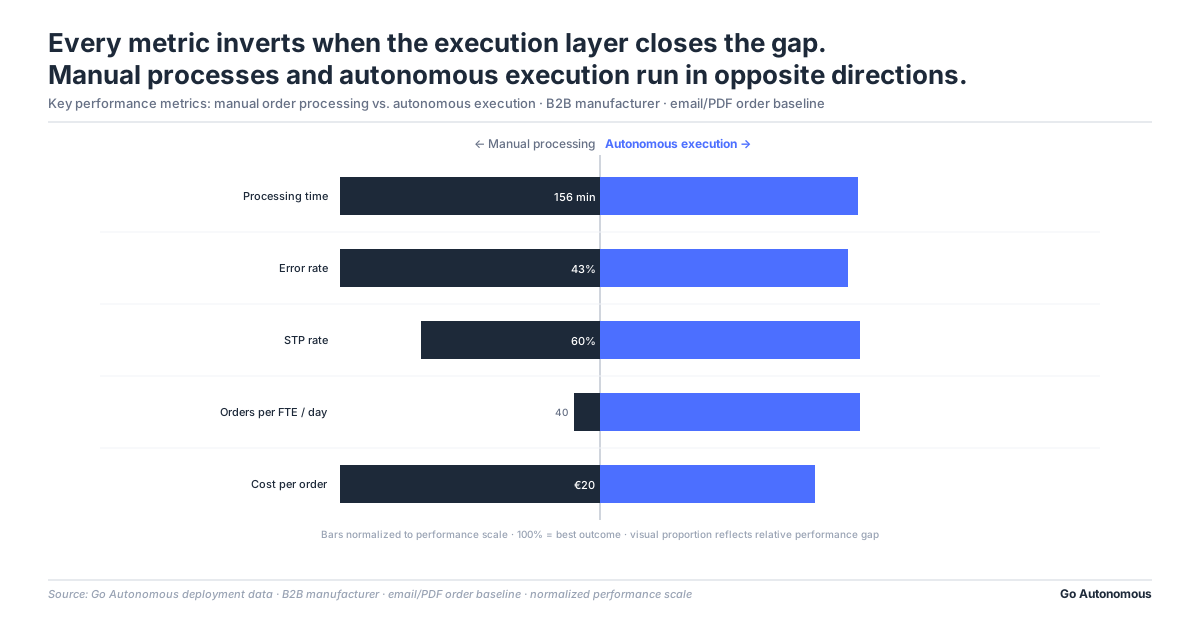
Four changes happen simultaneously when the intake gap closes. First, order cycle time compresses: the time from customer order submission to ERP-confirmed, fulfillment-ready transaction drops from hours to minutes. Second, CSR capacity shifts from intake processing to exception handling and customer relationship work, the tasks that require genuine human judgment and relationship context. Third, the Human Dependency Ratio for order intake falls sharply: the number of manual decisions required per order processed moves toward zero for standard transactions, with human involvement reserved for genuinely complex or novel situations. Fourth, Revenue at Rest in the intake queue reduces to near zero, because orders no longer wait for human availability before moving.
For manufacturers running at scale, these four changes combine into a measurable impact on topline revenue capture and margin. Orders that previously waited in queues now move immediately. Customers who previously waited hours for order confirmation now receive it in under a minute. The operational cost structure decouples from revenue volume: a 20 percent growth in order volume no longer requires a 20 percent increase in intake headcount.
This is not RPA or workflow automation. RPA scales labor; autonomy eliminates dependency. An RPA script that extracts data from a PDF and enters it into SAP still requires a human to handle the cases the script cannot parse, the pricing exceptions it was not configured for, the customer references it does not recognize. Autonomous execution handles the full intake scope, including the exceptions, through policy-driven decision-making rather than rule-based scripting. The distinction is the difference between digitizing a manual process and replacing it.
Manufacturers and distributors across the Nordics, DACH, and Benelux who have deployed this architecture have shifted significant intake volume from manual processing to autonomous execution. Danfoss deployed this architecture across 26 countries simultaneously, reducing order confirmation time from 42 hours to under one minute, with 80 percent of transactional decisions now executing without human input and a 50 percent reduction in overall processing time, all on the same ERP infrastructure. At Mediq, processing approximately 4,000 orders per week in a regulated healthcare distribution environment across the Nordics, order handling time on the largest orders fell by 75 percent with no headcount addition. Both deployments used the same architectural approach: the autonomous execution layer reads commercial intent from any inbound channel, resolves it against ERP master data, and writes the confirmed transaction back without modification to the ERP itself.
See Nilfisk, Danfoss, Mediq, and the broader customer success cases for outcome patterns across manufacturing and distribution deployments.
Sources
- APQC Order Management Benchmarking: process cost benchmarks across manufacturing and distribution order-to-cash cycles
- McKinsey, The Future of B2B Sales Is Hybrid: analysis of B2B digital channel adoption, manual processing dependency, and the revenue impact of slow order execution
Map Your Order Intake Gap Before It Maps Your Growth Ceiling
The manufacturers most exposed to the order intake gap are those where revenue growth has consistently required proportional CSR headcount growth. If your intake team has grown by 30 percent over the past three years while your ERP has been upgraded twice, the gap has not narrowed. It has grown with the business, and the cost of staffing it has grown with it. Go Autonomous works with 500M to 20B EUR B2B manufacturers and distributors in the Nordics, DACH, Benelux, UKI, and France. The starting point is always the same: mapping where the ERP’s scope ends and where human judgment currently fills the gap. That map becomes the deployment roadmap for autonomous execution. In our work with operations teams across more than 25 countries, the mapping conversation consistently surfaces intake cost concentrations that had never been quantified as a single number on a dashboard. That number is the operational case for acting. Book a conversation with our team.
The Cost of Standing Still
For a manufacturer processing 400 email and PDF orders per day, with 65 percent arriving through unstructured channels, the cost of the order intake gap is not abstract. It is a line item that does not appear on any dashboard but accumulates every working day. Here is what that cost structure looks like.
- Processing overhead: At 12 minutes average handling time per unstructured order, 260 daily unstructured orders consume 52 person-hours per day. At 45 EUR fully loaded per hour, that is 2,340 EUR in daily intake cost, or approximately 585,000 EUR per year, on the act of receiving revenue before it reaches the ERP.
- Speed-to-fulfillment disadvantage: Manual intake introduces 4 to 8 hours of average latency between customer order submission and ERP confirmation, depending on queue depth and team availability. Against a competitive baseline of under 60 seconds for autonomous intake, that latency is a measurable customer experience gap. In competitive markets, late order confirmation correlates with order cancellation and customer attrition.
- Exception backlog accumulation: At fiscal quarter-end and during peak periods, exception queues that process in 2 to 3 hours under normal conditions back up to 1 to 2 days. The same five people who handle standard exceptions are the ones managing peak overflow. Revenue sits in queues. Customers escalate. Senior team members spend days on intake triage instead of complex account management.
- Headcount scaling trap: Every 20 percent increase in order volume requires a proportional increase in intake staffing. The cost curve does not flatten. It follows revenue growth directly. This is what Hempel’s VP of Customer Care described precisely: each increment of revenue requiring another operator. Until the intake architecture changes, that relationship is structural.
- Customer experience erosion: Order acknowledgment delays, error rates from manual entry, and inconsistent exception handling are the customer-facing symptoms of the intake gap. In markets where buyers have alternatives, slow and error-prone order processing is a churn signal. The cost of lost customers from intake friction does not appear in the order processing cost center, which is why it is systematically underestimated.
The total picture, when intake overhead, speed disadvantage, peak cost, headcount scaling, and customer experience erosion are priced together, consistently exceeds the investment required to close the gap through autonomous execution. The operations teams that have made this calculation are not waiting for the next ERP upgrade to address it. They are deploying the execution layer that the ERP was never designed to be.
Frequently Asked Questions
What is the order intake gap in B2B manufacturing and distribution?
The order intake gap is the processing distance between a customer communicating an order and an ERP system registering a validated, fulfillment-ready transaction. It includes every step requiring human judgment: reading emails or PDFs, matching SKUs, resolving pricing discrepancies, and confirming order completeness. For manufacturers with high email and PDF order volume, this gap represents 60 to 80 percent of total order handling cost.
What does SAP S/4HANA not handle in B2B order processing?
SAP S/4HANA does not read emails, parse PDF purchase orders, match customer part references to internal SKUs, or resolve pricing mismatches in attachments. Its scope begins when structured, validated data is presented to it. All upstream interpretation work, converting unstructured commercial intent into a validated transaction record, falls outside SAP’s architectural design and must be handled by a separate execution layer or by human CSR teams.
Why do manufacturers still need manual order entry even with an ERP system?
Manufacturers still require manual order entry because ERP systems like SAP, Oracle, and Dynamics 365 are transaction validation systems, not intent interpretation systems. They process orders that have already been structured and validated. The work of reading a customer’s email, interpreting line items, resolving a pricing conflict, and determining whether an order is complete enough to release requires contextual judgment that ERP systems were not designed to provide.
How does Autonomous Commerce integrate with SAP S/4HANA and Oracle Order Management?
Autonomous Commerce integrates with SAP S/4HANA and Oracle Order Management Cloud through existing APIs and data interfaces, writing validated order transactions back into the ERP as if entered by a CSR. The autonomous layer handles upstream interpretation, reading emails and PDFs, matching SKUs, resolving exceptions through codified policy, and confirming completeness. The ERP receives a clean validated transaction and continues its core function unchanged. No modification to the ERP is required.
What percentage of B2B order handling cost occurs before the ERP receives the order?
Go Autonomous deployment analysis across more than 30 billion processed B2B transactions shows that 60 to 80 percent of total order handling cost occurs in the pre-ERP intake phase. This includes reading, interpreting, validating, correcting, and routing orders before they reach the ERP. The proportion increases with order complexity, channel diversity, and the share of email and PDF orders in total volume.
What is Friction Debt and how does it apply to order processing?
Friction Debt is the total monetary cost of human decisions still happening in the revenue flow. In order processing, it accumulates across three components: Decision time, the wait between a decision being needed and being made; Decision cost, the loaded cost of staff whose judgment is required multiplied by frequency; and Decision drag, the downstream revenue impact of slow processing including late shipments and customer churn. Friction Debt is paid down by codifying recurring human judgments into system policies.
What is the difference between RPA and Autonomous Commerce for order intake?
RPA automates specific, rule-defined steps in order intake, such as extracting fields from a structured PDF and entering them into SAP. It still requires human intervention when inputs fall outside the configured rules. Autonomous Commerce handles the full intake scope including exceptions, using policy-driven decision-making rather than rule-based scripting. RPA scales labor; Autonomous Commerce eliminates the dependency on human judgment for standard and exception transactions.