.svg)





EDI Automation vs Autonomous Commerce: Why the 50-Year-Old Standard Is Holding B2B Commerce Back
A decade ago, manufacturers invested heavily in EDI infrastructure. Today, 60 to 70 percent of their inbound B2B orders still arrive via email. This post examines why EDI and Autonomous Commerce are fundamentally different architectural layers, and what that distinction means for your order management operation.
A decade ago, a €2B manufacturer invested heavily in EDI infrastructure. The IT team built mappings for every major trading partner. Certifications were completed. The transactions flowed. Today, that same manufacturer processes orders across 26 countries, and 60 to 70 percent of its inbound B2B order volume still arrives via email. The EDI investment was real. The coverage gap it left behind is equally real. Every order that falls outside the EDI perimeter still goes to a human inbox, still gets manually validated against a pricing contract, and still gets entered into SAP by a customer service representative who could be doing something else.
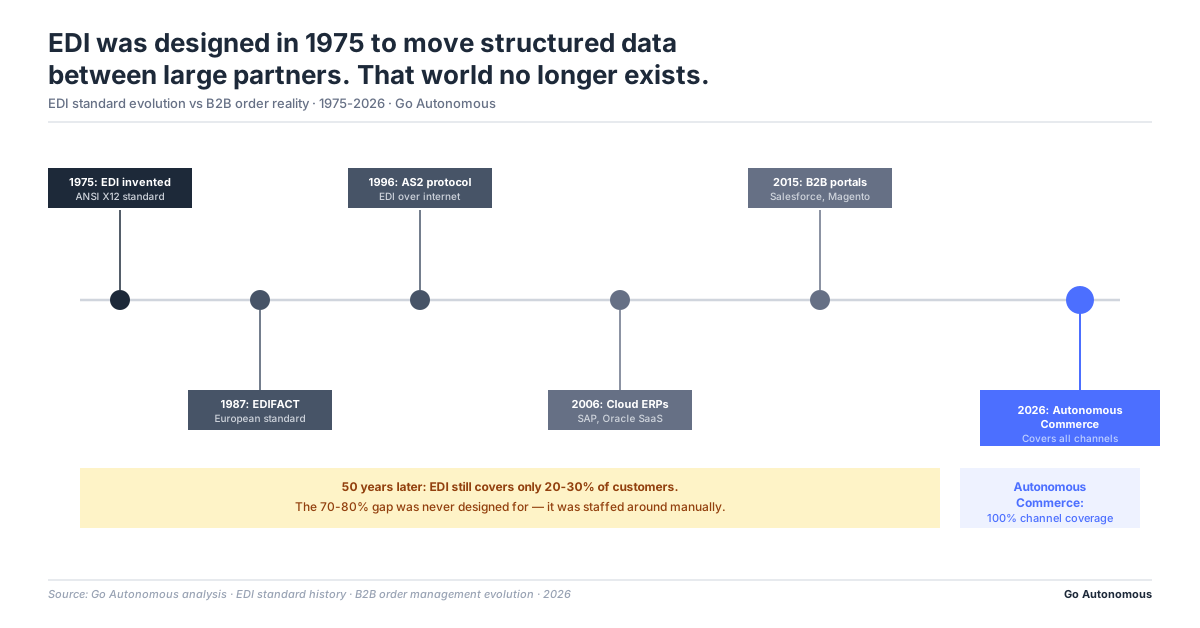
This is not a criticism of EDI. EDI (Electronic Data Interchange) does exactly what it was designed to do: move structured, high-volume transactions between large trading partners with pre-agreed formats and established integration maps. The problem is that most B2B manufacturers and distributors have built their digital operations around a protocol that covers a fraction of their customer base, then staffed around the rest manually. That staffing cost, compounded annually as the business grows, is the real price of treating EDI as a complete order automation solution rather than one component of a broader execution architecture.
Autonomous Commerce is a different architectural layer. It is not a replacement for EDI. It is the execution intelligence that extends beyond what EDI was ever designed to handle. This post explains the structural difference between the two, names the specific tools and standards involved, and provides a decision framework for manufacturers and distributors evaluating where the architectural gaps in their current setup are costing them most.
Table of Content
- What EDI Actually Does, and Where It Stops
- EDI via TrueCommerce/SPS Commerce vs Autonomous Commerce: A Structural Comparison
- Why Autonomous Commerce Is an Enterprise Architecture Decision, Not a Channel Tool
- Where EDI Hits Its Structural Ceiling at Scale
- See What Autonomous Commerce Adds to Your Existing EDI Architecture
- Who Should Act Now, and Who Can Wait
- Frequently Asked Questions
- What is the difference between EDI and autonomous order processing for B2B manufacturers?
- Why don't all B2B manufacturers use EDI for all orders?
- Can Autonomous Commerce replace EDI for B2B order management?
- What is the EDI order processing cost per transaction for manufacturers?
- How does Autonomous Commerce integrate with existing EDI infrastructure?
- What EDI standards does Autonomous Commerce support?
- What is the Human Dependency Ratio and how does it apply to EDI-based order management?
What EDI Actually Does, and Where It Stops
EDI is a communication protocol, not an execution layer. It standardizes the format and transmission of business transactions between pre-configured trading partners. An EDI 850 purchase order sent from a retailer to a manufacturer arrives in a structured format that maps directly to the manufacturer’s ERP order entry fields. The same applies to EDI 855 purchase order acknowledgments, EDIFACT messages in European trading contexts, and cXML or OCI punchout flows in procurement-connected environments. The transaction arrives structured. The ERP receives it. The order processes.
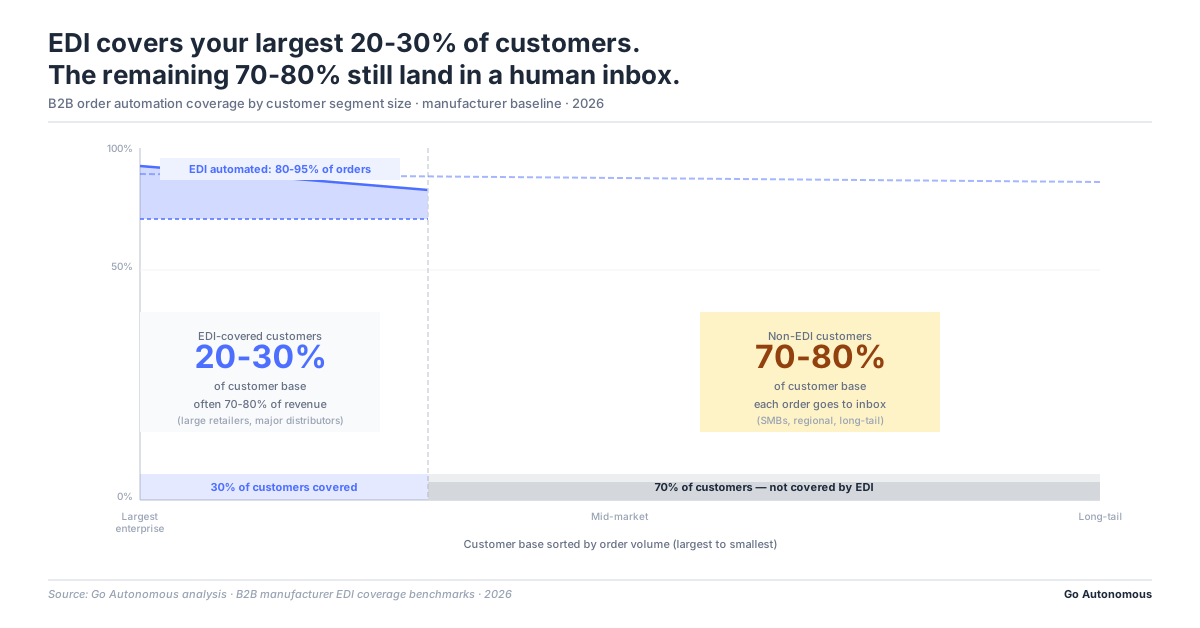
For the 20 to 30 percent of a manufacturer’s customer base that has EDI infrastructure, this works well. Large retailers, major distributors, and enterprise procurement systems maintain the integration maps and transaction standards required. The orders are predictable, high-volume, and consistent. EDI platforms like TrueCommerce, SPS Commerce, DiCentral, and OpenText EDI provide the connectivity, translation, and routing infrastructure that makes this work at scale.
Why don’t all B2B manufacturers use EDI for all their orders?
Most B2B manufacturers cannot use EDI for all orders because EDI requires setup per trading partner, including custom mapping, certification, and ongoing maintenance. Small and mid-sized customers do not have the technical infrastructure to participate. Onboarding a new customer to EDI typically takes weeks to months and requires IT resources on both sides. This makes EDI economically viable only for large, high-volume trading relationships, which represent 20 to 30 percent of most manufacturers’ customer counts but a disproportionate share of structured order volume.
The remaining 70 to 80 percent of customers send orders via email, web portals, phone, or fax. None of these formats are natively structured. None of them map cleanly to an ERP order entry field without human translation. So manufacturers operate a dual system: EDI for big accounts, manual processing for everyone else. The manual side is where most of the cost lives, because it scales linearly with order volume. Every new customer, every new order, every new product line adds to the manual handling load. EDI handles the tail of the Pareto curve by revenue, but does nothing for the long tail by order count.
Each time we added one or two million euros in revenue, we had to add another operator. From a cost perspective, that's an unsustainable way of operating a business.

Beyond coverage, EDI has a second structural limitation: it sends the transaction but does not validate it. An EDI 850 that arrives with a pricing discrepancy, a discontinued product code, or a quantity that violates the blanket PO call-off terms still generates an exception in the ERP. That exception routes to a human. The EDI transaction transmitted cleanly. The validation failed. The human still handles it. EDI providers like TrueCommerce and SPS Commerce offer exception reporting dashboards, but exception resolution remains a manual activity. The protocol was never designed to make autonomous execution decisions. It was designed to transmit structured data reliably between consenting parties.

EDI via TrueCommerce/SPS Commerce vs Autonomous Commerce: A Structural Comparison
The table below compares EDI and Autonomous Commerce across the dimensions that matter most for a VP Operations or Order Management Director evaluating their current architecture. The goal is not to position one as superior to the other, but to make clear that they operate at different layers and address different problems.
| Dimension | EDI via TrueCommerce / SPS Commerce / DiCentral | Autonomous Commerce |
|---|---|---|
| Order channel coverage | Structured EDI only: 850/855, EDIFACT, cXML, OCI punchout. Requires setup per trading partner. Covers 20 to 30% of customer base at most manufacturers. | All channels: EDI, email, web portal, phone transcription, fax. No per-partner setup required for non-EDI channels. Covers 100% of inbound order volume. |
| Setup cost per trading partner | High for each new EDI partner: custom mapping, testing, certification, IT resources on both sides. Typical onboarding: weeks to months per partner. | New customers onboard in days for non-EDI channels. EDI feeds route through the existing connection. No per-customer mapping project required. |
| Processing speed | EDI batch processing: minutes to hours depending on batch window frequency. Real-time EDI available for some partner configurations but not universal. | Order-to-ERP in under 60 seconds for non-exception transactions across all channels. Real-time processing independent of batch windows. |
| Exception handling | Exceptions flagged and reported. Resolution requires human review. EDI platforms surface the exception; they do not resolve it. Manual routing is the standard outcome. | Known exception types (pricing tolerance mismatches, approved substitutions, partial availability) resolved autonomously using codified rules. Novel exceptions routed to humans. |
| ERP writeback | Structured EDI transactions map to ERP fields via translation layer. Non-EDI orders enter through separate, manual process. No unified writeback for mixed-channel operations. | Unified writeback for all channels after autonomous validation. SAP S/4HANA, Oracle Cloud SCM, and Microsoft Dynamics 365 receive confirmed orders from a single execution layer regardless of intake channel. |
| Scalability to new customers and channels | Scaling EDI coverage requires a new onboarding project per customer. Adding a new order channel (e.g., a new portal or marketplace) requires a new integration build. | New customers on non-EDI channels add no per-customer configuration. New channels integrate at the platform level, not the individual customer level. Scale is structural, not project-by-project. |
What is Friction Debt in B2B order management?
Friction Debt is the total monetary cost of human decisions still happening in your revenue flow. It is calculated as manual touches multiplied by decision time per touch, multiplied by the fully loaded cost rate of the people whose judgment is required. In B2B order management, Friction Debt accumulates in every order that falls outside the EDI perimeter and is handled manually, in every EDI exception that routes to a human for resolution, and in every new customer onboarded without an EDI map who therefore generates manual handling indefinitely. Most manufacturers running a dual EDI/manual system have never quantified their total Friction Debt. When they do, the number is typically much larger than the operational cost line suggests, because it compounds with every revenue increase and every customer acquisition that adds to the non-EDI base.
“Every data field touched by a human is friction debt.” That framing applies directly to the EDI coverage gap. Every email order that a customer service representative reads, interprets, validates, and enters into SAP is a collection of data fields touched by a human that could have been handled by the execution layer. At 400 such orders per day at 13 minutes each, that is approximately 87 hours of friction debt per day.
Why Autonomous Commerce Is an Enterprise Architecture Decision, Not a Channel Tool
The most common misunderstanding about Autonomous Commerce in conversations with CDOs and CIOs is that it is a channel-specific tool: something that handles email orders so the EDI team does not have to. That framing is too narrow. Autonomous Commerce is an execution intelligence layer that sits above the ERP and across all order intake channels simultaneously. It is not an email processing tool that also happens to handle portals. It is the layer that decides what happens to every inbound commercial transaction, regardless of format, before it reaches the system of record.
From an enterprise architecture perspective, this places Autonomous Commerce in a different category than EDI platforms, document intelligence tools like ABBYY or Rossum, or iPaaS platforms like MuleSoft or Boomi. EDI platforms handle structured transaction transmission. Document intelligence tools extract data from unstructured documents. iPaaS platforms integrate systems. None of these make execution decisions. Autonomous Commerce makes execution decisions: it reads the order, validates it against the pricing and contract policy, resolves exceptions within codified rules, and confirms the transaction. The execution decision is the function that was previously performed by a human, and it is the function that no other layer in the current architecture performs.
At CWS Hygiene, we're taking an important first step toward bringing autonomy to our commercial operations. We see Autonomous Commerce as a vital pillar of our enterprise architecture for the future.
For CDOs and IT Directors evaluating this as an architecture decision, the key question is not “does this replace our EDI investment?” It does not. EDI continues to handle structured, large-partner transactions as it always has. The question is: “what is the execution layer that handles everything else, and resolves the exceptions that EDI generates?” Autonomous Commerce is the answer to that question.
How does Autonomous Commerce integrate with existing EDI infrastructure?
Autonomous Commerce integrates with existing EDI infrastructure by connecting to the same EDI feeds that currently route to the ERP, while adding execution intelligence above those feeds. Incoming EDI transactions from TrueCommerce, SPS Commerce, DiCentral, or OpenText pass through the Autonomous Commerce execution layer for validation before ERP writeback, rather than routing directly to the ERP. This means EDI exceptions, those transactions that would previously have generated a queue in the ERP exception management module, are resolved autonomously using codified contract rules before they reach the ERP at all. The ERP receives only validated, confirmed transactions.
For non-EDI channels, the platform connects directly: email via document intelligence (ABBYY, Rossum), web portal via API or scraping, phone via transcription-to-order conversion. All channels feed the same execution layer, which applies the same validation logic regardless of source. The result is a unified order intake operation rather than parallel processes for structured and unstructured volume.
The Danfoss deployment illustrates this at scale: a global manufacturer processing orders across 26 countries, including markets where EDI is the primary channel for large accounts and email remains the dominant channel for smaller distributors and end customers. Autonomous Commerce unified the intake operation without replacing the EDI infrastructure already in place. The existing EDI investments continued functioning. The manual handling load for non-EDI volume was removed from the customer service team.
For organizations assessing how this fits their current architecture, the Autonomous Execution Fabric white paper addresses the integration patterns, implementation sequence, and the five most common lessons from enterprise deployments.
Where EDI Hits Its Structural Ceiling at Scale
EDI works well until the business grows beyond the customer segment it was designed for. The structural ceiling becomes visible in three specific scenarios.
What causes manual order processing to persist after EDI implementation?
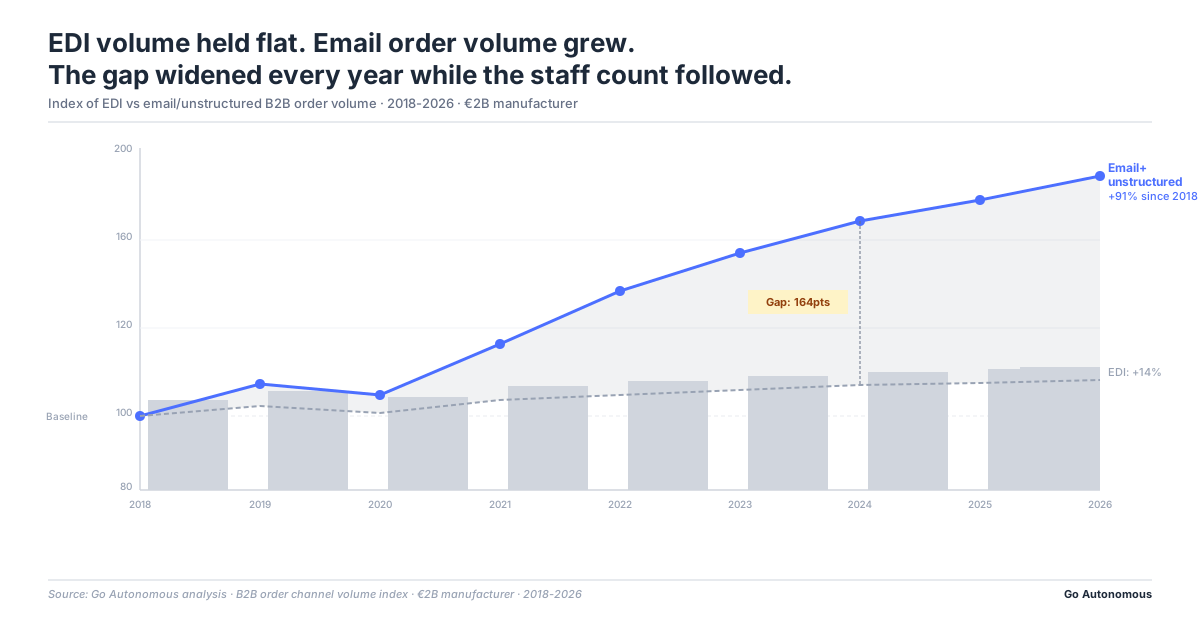
Manual order processing persists after EDI implementation because EDI covers only the customers who have the technical infrastructure to send structured transactions. The majority of customers, typically 70 to 80 percent by count, continue sending orders via email, phone, and portal. These channels generate no EDI transaction and require the same manual handling they always did. EDI implementation does not reduce the manual handling rate. It creates a two-tier operation where structured volume is automated and unstructured volume remains manual, with the manual tier representing the majority of the customer base.
Scenario 1: Market expansion into new geographies or customer segments. Every new trading partner who cannot participate in EDI adds to the manual processing load permanently. A manufacturer expanding into mid-market distribution channels, or into markets where EDI adoption is lower, will see its manual handling volume grow faster than its EDI-connected volume. Without an execution layer that handles non-EDI channels, that expansion directly increases the customer service headcount requirement.
Scenario 2: Contract complexity exceeds EDI transaction scope. EDI transmits the transaction. It does not encode the logic of a complex pricing agreement. When a manufacturer has blanket PO call-offs with tiered volume rebates, regional price overrides, and approved product substitution lists, that logic lives in the ERP pricing master. An EDI transaction that conflicts with any element of that logic generates an exception. At high volumes, exception rates of even 5 to 10 percent translate to hundreds of daily manual interventions. The comparison between rules-based automation and AI-driven execution illustrates why rules-based approaches, including EDI exception handling tools, hit this ceiling.
Scenario 3: The headcount treadmill becomes visible at the board level. A manufacturer growing at 15 percent per year with a dual EDI/manual system adds roughly 15 percent more manual processing volume annually on top of its existing load. Customer service headcount grows proportionally. At some point, the CFO or Chief Operating Officer asks why revenue growth requires linear headcount growth. The answer, always, is that the execution architecture has a structural dependency on human labor for the majority of its order processing volume. This is the moment where Autonomous Commerce transitions from an IT conversation to a commercial architecture conversation. See the operational efficiency gains that follow when that dependency is removed.
The Human Dependency Ratio captures this dynamic precisely.
The Human Dependency Ratio (HDR) measures the number of manual decisions required per unit of revenue processed. A business with a rising HDR alongside rising revenue has not built an autonomous system. It has built a larger treadmill. The distinction between a business with a falling HDR and one with a stable or rising HDR is the difference between a scalable commercial operation and one that structurally requires more people every time it grows. “If revenue grows 20 percent but manual decisions also grow 20 percent, you have not built an autonomous system. You have built a bigger treadmill.”
For a view of how this plays out across customer deployments, the outcomes consistently follow the same pattern: the organizations that remove the structural dependency see the HDR fall, the headcount curve flatten, and the customer service team shift from execution to engagement.
There is also a related post worth reading alongside this one: Is It Finally Time for EDI to Face Its Extinction? covers the longer-term question of where EDI fits in a fully autonomous commercial architecture. This post focuses on the immediate architectural decision: what Autonomous Commerce adds to an existing EDI investment, and where the coverage gap is costing most today.
Sources
- Danfoss press release: Streamlines Order Intake with AI-Powered Agents and Autonomous Commerce, Go Autonomous
- Is It Finally Time for EDI to Face Its Extinction? Go Autonomous blog
- Forrester Research: B2B Commerce and Order Management research
See What Autonomous Commerce Adds to Your Existing EDI Architecture
The question is not whether to replace EDI. It is where the 60 to 70 percent of your order volume that EDI does not cover is going, and what it is costing to handle it manually. For most manufacturers and distributors at €500M or more in revenue, that cost is significant, compounds with every new customer acquired, and scales directly with revenue growth. Autonomous Commerce does not replace your EDI investment. It extends execution capability to the channels EDI was never designed for, and it resolves the exceptions that EDI generates before they reach the ERP. Go Autonomous works with 500M to 20B EUR manufacturers and distributors in the Nordics, DACH, Benelux, UKI, and France. If the architectural patterns described in this post apply to your operation, we can show you exactly what autonomous execution looks like in your environment: your ERP, your current EDI feeds, and the order channels that are still running on manual processing. Book a conversation with our team.
Who Should Act Now, and Who Can Wait
This is a decision framework, not a push. The right answer depends on where your operation sits today relative to these specific signals.
Act now if:
- More than 50 percent of your inbound order volume arrives via email, phone, or portal, and you have more than 200 orders per day in those channels. At this scale, the manual processing cost is a material operating expense that does not reduce without an architectural change.
- Your customer service headcount has grown in proportion to revenue over the past two years and you have no structural mechanism to break that relationship. This is the most reliable indicator that your Human Dependency Ratio is not falling.
- Your EDI exception rate is above 5 percent and exceptions are handled manually. If EDI exceptions are generating a daily queue for your operations team, the problem is not your EDI platform. The problem is the absence of an execution layer that resolves exceptions without human routing.
- You are in a geographic or market expansion phase where new customers will predominantly be non-EDI. Every non-EDI customer you onboard without an execution layer adds permanent manual processing load. Acting before the expansion locks in the architecture that scales with it.
- Your ERP contract or platform is due for renewal or migration in the next 18 months. This is the natural window to align the execution layer architecture with the ERP roadmap rather than retrofitting afterward.
You can wait if:
- Your order volume is under 100 per day and the majority of customers are large structured EDI accounts. At this scale, the manual processing cost is manageable and the ROI case for autonomous execution is less immediate.
- Your customer base is highly concentrated in a small number of large accounts with stable, well-mapped EDI connections. The long tail of smaller customers is genuinely small. Your coverage gap is narrow.
- You are in the middle of a major ERP migration and your IT organization has no capacity for additional integration work. In this case, a post-migration evaluation window, 6 to 12 months after go-live, is a more practical timeline to assess the execution layer architecture.
Frequently Asked Questions
What is the difference between EDI and autonomous order processing for B2B manufacturers?
EDI is a communication protocol that transmits structured transactions between pre-configured trading partners. It covers roughly 20 to 30 percent of a typical manufacturer’s customer base. Autonomous order processing is an execution layer that handles all inbound order channels including EDI, email, portal, and phone, validates orders against pricing contracts, and resolves exceptions automatically. EDI sends the transaction. Autonomous Commerce decides what to do with it and all the orders EDI was never designed to handle.
Why don’t all B2B manufacturers use EDI for all orders?
EDI requires per-partner setup including custom mapping, testing, and certification. This onboarding takes weeks to months and requires IT resources on both sides. Small and mid-sized customers do not have the infrastructure to participate. As a result, most manufacturers have EDI coverage with 20 to 30 percent of their customer base, the large ones, and process the remaining 70 to 80 percent manually via email, phone, and portal.
Can Autonomous Commerce replace EDI for B2B order management?
Autonomous Commerce does not replace EDI. It extends execution capability to channels EDI was never designed for and adds validation intelligence above EDI transactions. Existing EDI feeds from TrueCommerce, SPS Commerce, DiCentral, or OpenText continue operating. Autonomous Commerce adds the execution layer that handles non-EDI orders and resolves EDI exceptions autonomously before they reach the ERP, rather than routing them to a human queue.
What is the EDI order processing cost per transaction for manufacturers?
EDI transaction costs vary by volume and provider, but the larger cost driver at most manufacturers is the parallel manual processing operation handling the 60 to 70 percent of orders that arrive outside EDI. At 12 to 14 minutes of manual handling per order and a fully loaded cost of 45 EUR per person-hour, a manufacturer processing 400 non-EDI orders daily spends approximately 1.5 to 2M EUR per year on manual order intake alone.
How does Autonomous Commerce integrate with existing EDI infrastructure?
Autonomous Commerce integrates with existing EDI infrastructure by connecting to the same EDI feeds from TrueCommerce, SPS Commerce, DiCentral, or OpenText and adding execution validation above them. EDI transactions pass through the execution layer for contract and pricing validation before ERP writeback. EDI exceptions are resolved autonomously using codified rules rather than routing to human queues. Non-EDI channels connect separately, and all channels write to the ERP through the same unified execution layer.
What EDI standards does Autonomous Commerce support?
Autonomous Commerce processes orders arriving via EDI 850 purchase orders, EDI 855 purchase order acknowledgments, EDIFACT (common in European B2B commerce), ANSI X12, cXML, and OCI punchout. Beyond EDI, the platform processes email orders via document intelligence, web portal orders via API, and phone orders via transcription conversion, applying the same validation logic across all formats.
What is the Human Dependency Ratio and how does it apply to EDI-based order management?
The Human Dependency Ratio (HDR) measures the number of manual decisions required per unit of revenue processed. In EDI-based order management, HDR appears in two places: the manual handling of all non-EDI orders (70 to 80 percent of customer base), and the manual resolution of EDI exceptions. A manufacturer whose HDR grows in proportion to revenue is structurally dependent on human labor for execution, regardless of its EDI investment. Autonomous Commerce reduces HDR by removing both sources of manual dependency.