.svg)





B2B Quoting in 2026: What Best-in-Class Quote Operations Look Like for Manufacturers and Distributors
Most B2B manufacturers and distributors take 24–72 hours to respond to a quote request. Best-in-class operations respond in under 4 hours. The gap is not a people problem — it is a process and architecture problem. This post defines what best-in-class B2B quoting looks like in 2026 across speed, accuracy, coverage, and commercial outcomes.
Most B2B manufacturers and distributors take 24 to 72 hours to respond to an inbound quote request. Best-in-class operations respond in under 4 hours. That gap directly determines win rate: research on B2B buying behavior consistently shows that the first qualified supplier to respond wins the deal at a disproportionate rate. The gap is not a people problem. It is a process and architecture problem rooted in four sequential manual steps that no CRM or CPQ investment has yet eliminated at scale. This post defines what best-in-class B2B quoting looks like in 2026, why so many operations fall short across speed, accuracy, and coverage, and what it takes to close all four gaps simultaneously.
Table of Content
- Most B2B Manufacturers Take 24–72 Hours to Quote: Best-in-Class Operations Respond in Under 4
- Best-in-Class B2B Quote Operations Have Four Defining Characteristics
- The Quoting Coverage Gap: 30–40% of RFQs Never Receive a Quote
- Autonomous Quoting Closes All Four Gaps Simultaneously
- The Autonomous Execution Fabric: Quote Execution as Part of Full Commercial Transaction Coverage
- Frequently Asked Questions
- What is a good B2B quote response time benchmark for manufacturers in 2026?
- What percentage of B2B RFQs go unanswered in manufacturing and distribution?
- How do B2B manufacturers improve quote accuracy and reduce invoice disputes from pricing errors?
- What is the difference between CPQ and autonomous quoting for B2B manufacturers?
- How do B2B distributors increase quote coverage without adding sales or quoting headcount?
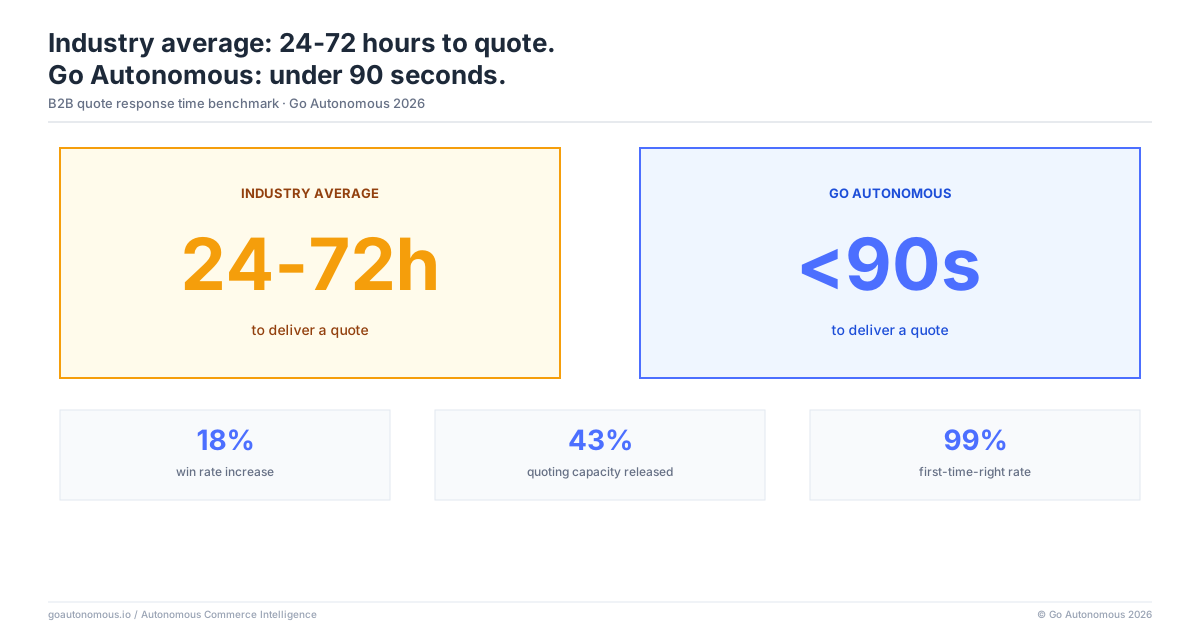
Most B2B Manufacturers Take 24–72 Hours to Quote: Best-in-Class Operations Respond in Under 4
What the 24–72 Hour Quote Cycle Actually Contains: Lookup, Pricing, Approval, and Formatting
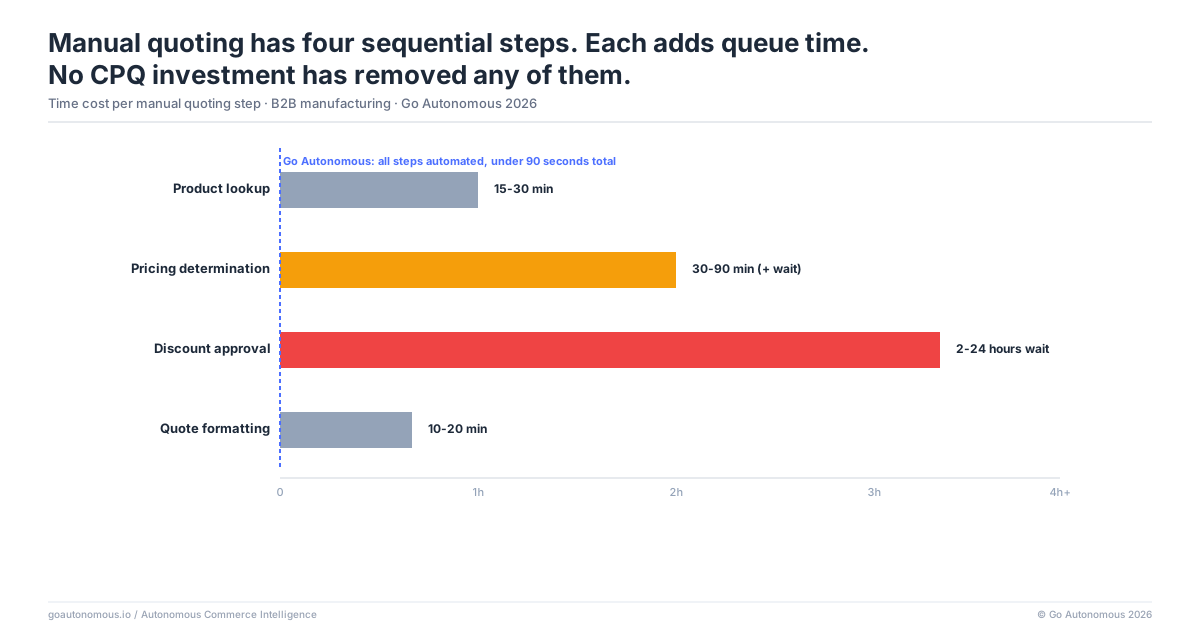
The B2B quoting process in most manufacturing and distribution operations involves four sequential steps: looking up product availability and specifications, determining the applicable pricing (contracted rate, volume discount, or spot price), getting approval if the quote requires a discount or falls outside standard pricing, and formatting and sending the quote document. In a manual environment, each step carries queue time.
A sales rep who receives an RFQ by email must stop their current work, locate the relevant product information, check pricing with the pricing team or inside the ERP, wait for approval if the discount threshold is crossed, and produce a formatted quote document. The 24 to 72 hour cycle is the result of these sequential dependencies, not of insufficient effort. This is why efficiency gains in commercial operations require structural change, not incremental coaching.
Why Quote Response Time Has Not Improved Despite CRM and CPQ Investment
CPQ tools and CRM platforms have improved quote formatting, document management, and pipeline tracking. They have not addressed the core bottlenecks: pricing lookup latency and approval wait time. A CPQ system that still requires a human to initiate the process, enter product selections, and route for approval has not compressed the 24 to 72 hour cycle in any meaningful way. It has digitised the paperwork, not the process.
The fundamental constraint is that 85 to 90% of B2B revenue still requires human facilitation at some point in the commercial cycle. In quoting, that facilitation concentrates at the two most time-sensitive points: pricing determination and approval. Until those steps are automated, quote response time will remain measured in days, not hours.
Each time we added one or two million euros in revenue, we had to add another operator. From a cost perspective, that's an unsustainable way of operating a business.

Best-in-Class B2B Quote Operations Have Four Defining Characteristics
Speed: Sub-4-Hour Response on Standard Requests, Same-Day on Complex
Best-in-class B2B quoting operations share four characteristics that distinguish them from average performers. Speed is the most visible: standard quote requests receive a response within 4 hours, and complex multi-line or engineered-to-order requests are completed within the same business day. This is not aspirational. Operations running autonomous commerce infrastructure achieve these benchmarks routinely across high inbound volumes.
Coverage: The Ability to Quote Any Request, Not Just Standard SKUs
The second characteristic is coverage. A best-in-class operation can respond to any inbound RFQ, including non-standard configurations, without routing it to a specialist queue that adds 3 to 5 days. In most operations, coverage collapses precisely when demand is highest: complex requests during peak seasons are the requests most likely to go unanswered because they require the most assembly time from the most constrained people.
Accuracy: Quote Pricing That Matches What Gets Invoiced
The third characteristic is accuracy: the price quoted matches the price invoiced. Quote accuracy errors that lead to invoice disputes cost more than the margin difference, because every dispute requires escalation time from both the supplier’s and the customer’s finance teams. Best-in-class operations keep quote-to-invoice discrepancies below 1%. The fourth characteristic is commercial follow-through: quote status is tracked, follow-up is systematic, and win/loss data is captured for every submitted quote. Most operations achieve one or two of these characteristics. Best-in-class operations achieve all four consistently, even at scale. The cost structure difference is significant: manual processing runs €15 to €35 per order, while autonomous execution drops below €2.
The Quoting Coverage Gap: 30–40% of RFQs Never Receive a Quote
Which RFQs Get Deprioritized: Non-Standard, Low-Margin, and High-Complexity Requests
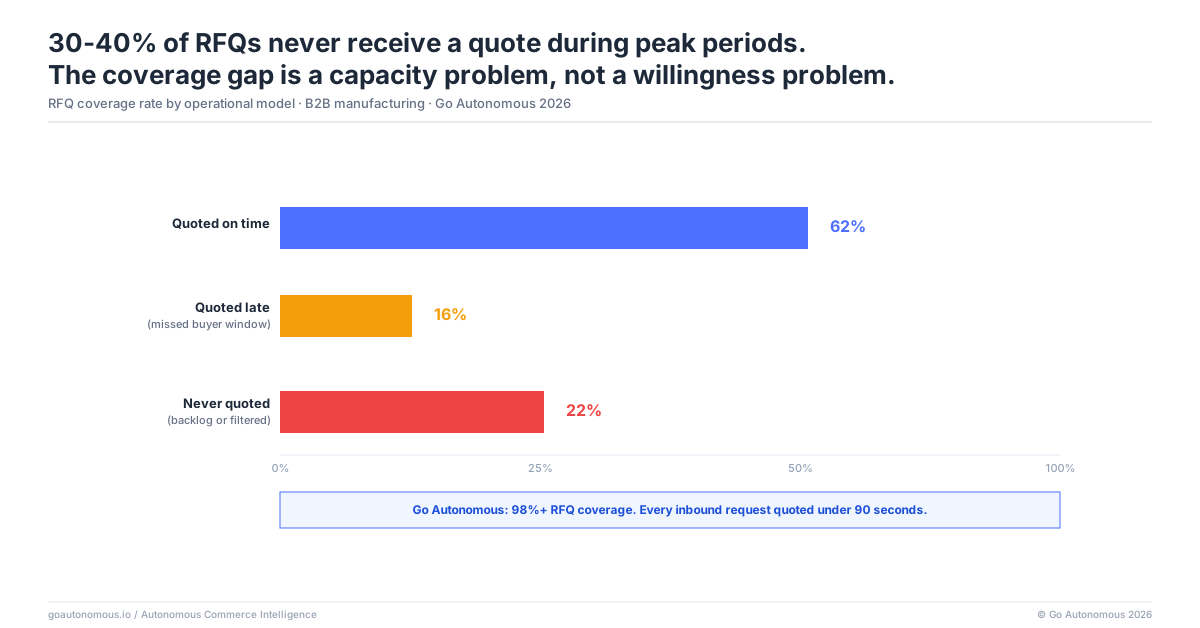
The least discussed dimension of B2B quoting performance is coverage: the percentage of inbound RFQs that actually receive a response. In operations without autonomous quoting, an estimated 30 to 40% of RFQ volume either receives a delayed response beyond the customer’s decision window, or receives no response at all. The deprioritised requests share common characteristics:
- Non-standard product configurations that require specialist input before a price can be determined
- Requests from smaller or newer accounts competing for attention with high-value account requests
- Complex multi-line RFQs that require more assembly time than the team can accommodate during peak periods
- Requests arriving late in the working day or outside business hours, where response slips to the following day
Each of these represents a rational prioritisation decision under resource constraints. Collectively, they represent a structural revenue leak that does not appear in standard commercial reporting.
What the Customer Does When Their RFQ Goes Unanswered
When a customer sends an RFQ and receives no response, they do not wait. They move to the next supplier on their list. The commercial cost of unanswered RFQs is revenue that was never won, not revenue that was lost in a competitive quote. It does not appear in win/loss analysis because no quote was ever submitted. It does not appear in pipeline data because no opportunity was ever created.
This is the coverage gap: a structural drain on addressable revenue that is invisible inside most commercial reporting systems. Understanding the full scope of what autonomous commerce addresses starts here. Fifty to 70% of order volume arrives via email and unstructured formats, meaning the inbound channel itself creates a triage burden that prioritisation decisions amplify. The operations that have closed this gap share one structural change: they removed the human triage step entirely for standard and semi-standard requests.
Autonomous Quoting Closes All Four Gaps Simultaneously
How AI-Assisted Quoting Reads an RFQ and Produces a Validated Quote Without Manual Assembly
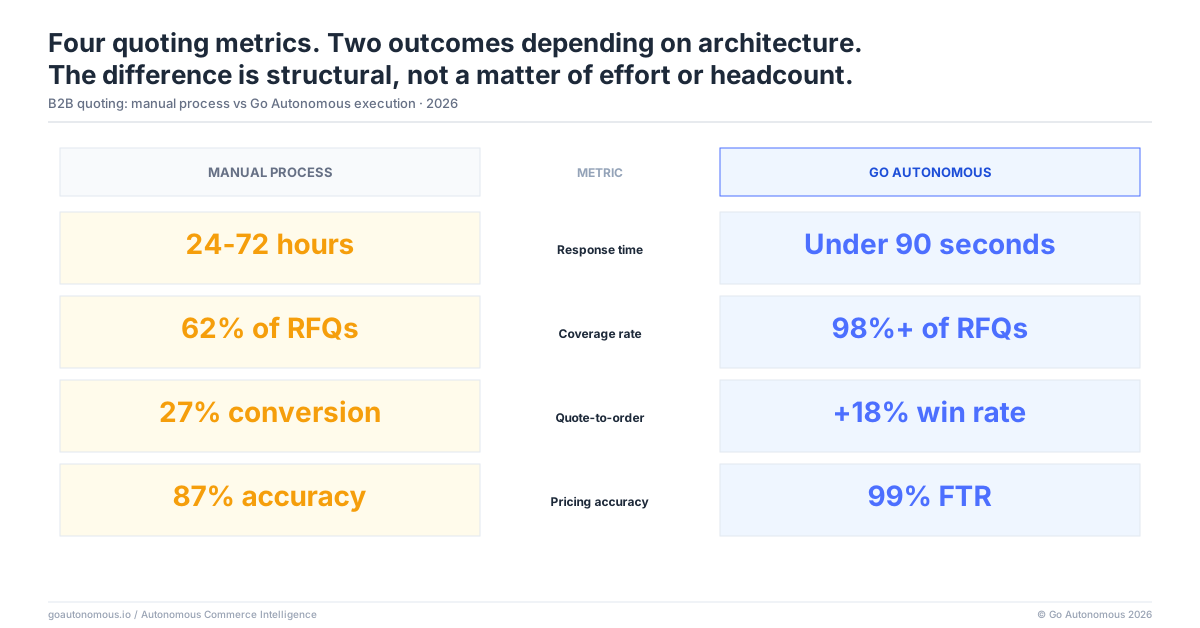
Autonomous quoting addresses all four best-in-class characteristics by removing the manual assembly steps that create delays and coverage gaps. An inbound RFQ, regardless of whether it arrives by email, portal, EDI, or phone transcription, is read by the AI. Product specifications are matched to the catalog. Contracted or applicable pricing is retrieved directly from the ERP. Approval logic is applied automatically for standard discount scenarios. A formatted quote document is produced for review, or sent directly for fully standard requests.
Response time drops from 24 to 72 hours to under 1 hour for standard requests. Coverage improves because no request requires a human specialist to initiate processing: every inbound RFQ enters the same queue and receives the same priority. Quote accuracy improves because pricing is pulled directly from the ERP rather than looked up manually, eliminating the transcription and version-mismatch errors that generate invoice disputes.
Rule-based automation, by contrast, plateaus at approximately 60% touchless rate. The remaining 40% of orders trigger an exception, and each exception adds 4 to 8 times the base processing time. The distinction between RPA and autonomous AI matters here: rule-based systems handle the straightforward cases and fail on the complex ones. Autonomous quoting handles both.
What Sales Teams Gain When Quote Volume Is No Longer a Constraint
Sales teams shift from quote assembly to quote strategy: reviewing, adjusting, and following up on quotes rather than producing them. The Danfoss deployment is instructive. Before autonomous commerce, quote and order processing ran from 42 hours down to under 1 minute. The operation now runs across 26 countries from a single day of deployment. Danfoss achieved 80% autonomous processing without reducing its commercial coverage.
VELUX processes over 130,000 orders across 9 markets with 88% decision autonomy. Nilfisk removed manual order handling at scale. The pattern is consistent: the operations that have moved to autonomous quoting have expanded their topline growth and margin management capacity, not just their operational efficiency. Every RFQ that receives a response within the customer’s decision window is a potential win that would otherwise have been invisible. At scale, that compounds into a meaningful share-of-wallet shift.
See what manufacturers and distributors have achieved at Go Autonomous success cases. The customer experience impact of faster, more accurate quoting is documented across multiple deployments.
The Autonomous Execution Fabric: Quote Execution as Part of Full Commercial Transaction Coverage
Autonomous quoting is the front end of the Autonomous Execution Fabric: a full commercial execution layer that connects directly to your SAP, Oracle, or Microsoft Dynamics environment and executes every inbound commercial transaction from first contact through confirmed order. The Fabric reads an inbound RFQ from any channel (email, EDI, customer portal, or direct API), retrieves pricing from the ERP, applies discount and margin logic, and produces a validated quote — then, on acceptance, converts that quote directly to a confirmed sales order in the ERP without re-entry or re-validation.
The Fabric handles more than quote generation. After a quote is accepted, the same execution layer processes the resulting order, applies contracted pricing to the confirmed transaction, creates the SAP or Dynamics sales order, and triggers invoice generation at shipment. Returns, credit notes, and contract tenders flow through the same layer. The commercial benefits of autonomous quoting — faster response, full coverage, accurate pricing — extend through the entire transaction lifecycle, not just the front-end quoting step.
Best-in-class quoting performance is a property of the full commercial execution model, not an isolated improvement to the quote assembly step. Operations that automate quoting but leave order processing, returns, and credit note issuance on manual workflows find that the bottleneck migrates rather than disappears. The Autonomous Execution Fabric closes the execution gap across all commercial transaction types simultaneously, which is why the operations that have achieved the benchmarks described in this post typically run all commercial transactions through the same architecture.
If your operation is still running 24 to 72 hour quote cycles, the gap between where you are and best-in-class is measurable, and closable. Book a conversation with Go Autonomous to see what the architecture looks like for your product range and inbound volume.
Frequently Asked Questions
What is a good B2B quote response time benchmark for manufacturers in 2026?
Best-in-class B2B manufacturers respond to standard quote requests within 4 hours. Complex multi-line or engineered-to-order requests are completed within the same business day. The industry average remains 24 to 72 hours due to sequential manual steps in pricing lookup, approval routing, and document formatting. Operations running autonomous quoting infrastructure consistently achieve sub-1-hour response times on standard requests.
What percentage of B2B RFQs go unanswered in manufacturing and distribution?
Estimates indicate that 30 to 40% of inbound RFQ volume in manufacturing and distribution either receives a delayed response beyond the customer’s decision window, or receives no response at all. The most commonly deprioritised requests are non-standard configurations, requests from smaller accounts, and complex multi-line RFQs received during peak periods. This coverage gap does not appear in standard win/loss analysis because no quote is ever submitted.
How do B2B manufacturers improve quote accuracy and reduce invoice disputes from pricing errors?
Quote accuracy errors arise when pricing is looked up manually and transcribed into a quote document separately from the ERP. Autonomous quoting improves accuracy by retrieving pricing directly from the ERP at quote generation time, eliminating manual transcription errors. Best-in-class operations keep quote-to-invoice discrepancies below 1%. The downstream benefit is a reduction in invoice disputes, which consume escalation time from both the supplier’s and the customer’s finance teams.
What is the difference between CPQ and autonomous quoting for B2B manufacturers?
CPQ tools improve document formatting, product configuration logic, and pipeline tracking but still require a human to initiate the process, enter product selections, and route for approval. They have not addressed the core bottlenecks of pricing lookup latency and approval wait time. Autonomous quoting removes the human initiation step: an inbound RFQ is read by AI, matched to the catalog, priced from the ERP, and routed or sent automatically. The result is a structural reduction in response time and a coverage improvement that CPQ alone cannot deliver.
How do B2B distributors increase quote coverage without adding sales or quoting headcount?
Coverage improves when the human triage step is removed from standard and semi-standard requests. Autonomous quoting processes every inbound RFQ through the same automated pipeline regardless of complexity, account size, or time of receipt. This eliminates the prioritisation decisions that cause smaller accounts and non-standard requests to be deprioritised or ignored. Distributors like Mediq have processed 4,000 orders per week at 75% faster throughput with zero headcount increase by deploying autonomous commerce infrastructure.