.svg)





What Happens to Orders EDI Cannot Handle
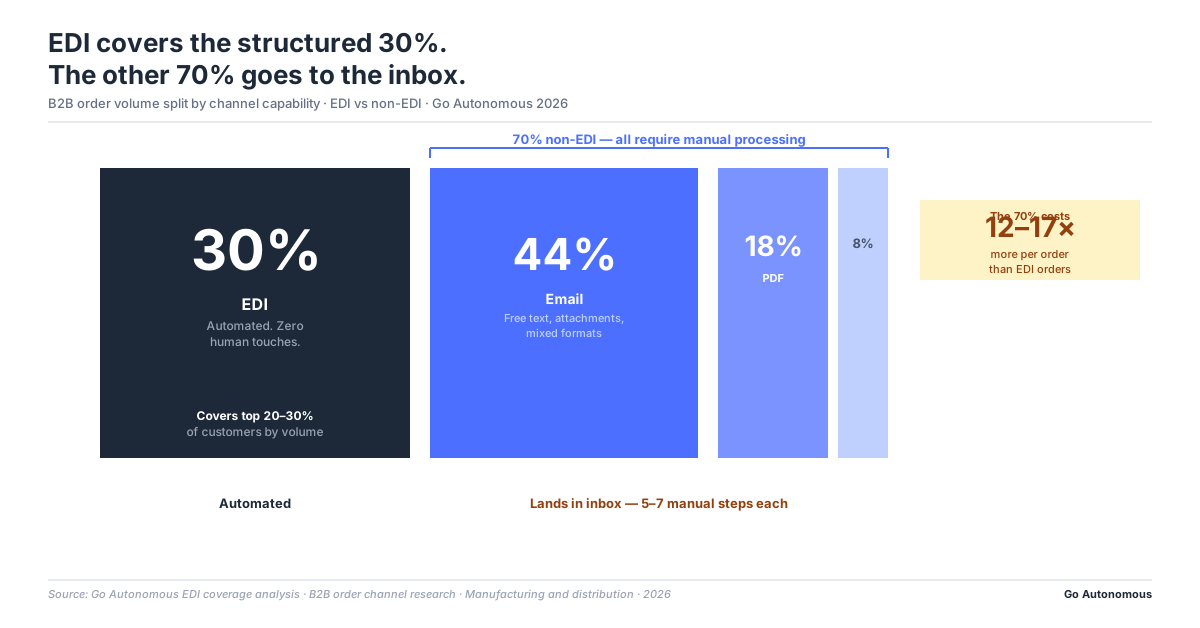
EDI automation covers roughly 30% of B2B order volume — the structured, high-volume accounts that signed up for it. The remaining 70% arrives as email, PDF, fax, or customer portal exports, and every one of those orders follows a manual process that has not fundamentally changed since the fax machine. This post explains exactly what happens to non-EDI orders and why the gap keeps growing.
EDI automation covers roughly 30% of B2B order volume. The structured, high-volume trading relationships that invested in EDI integration years ago send orders that flow directly into the ERP. Every other order — arriving as email, PDF, fax, or portal export — follows a manual workflow that has not fundamentally changed in two decades. For most manufacturers and distributors, this unstructured 70% is not a minor edge case. It is the majority of daily order volume, and it scales directly with revenue growth.
Table of Content
- EDI Covers the Structured 30% — the Other 70% Goes to Your Inbox
- Non-EDI Orders Follow a Manual Workflow That Has Not Changed in 20 Years
- The Non-EDI Tail Grows as Revenue Grows: Scaling Exposes the Gap
- AI-Based Intake Processing Handles What EDI Never Could
- The Autonomous Execution Fabric: Format-Agnostic Processing for Every Transaction EDI Misses
- Frequently Asked Questions
- What percentage of B2B orders do not go through EDI?
- How do manufacturers handle orders from customers who do not use EDI?
- What are the alternatives to EDI for B2B order processing?
- Why do most B2B distributors still receive orders by email despite having EDI?
- How does AI order processing compare to EDI for non-standard B2B orders?
EDI Covers the Structured 30% — the Other 70% Goes to Your Inbox
Which Customers Use EDI: Large Accounts With Dedicated Integration Teams
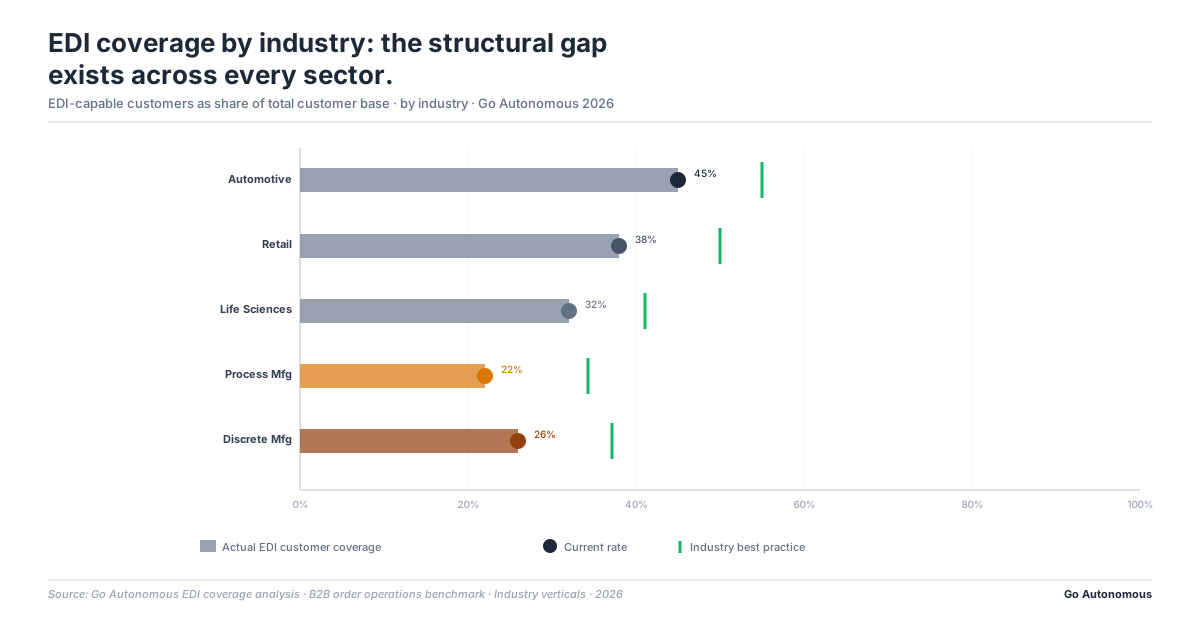
EDI was designed for high-volume, long-standing trading relationships where both parties can justify the integration investment. Large retail chains, major automotive buyers, and enterprise procurement organisations have EDI infrastructure and dedicated teams to maintain it. These accounts tend to be concentrated: 20–35% of the customer base, but often a significant share of total revenue. For them, EDI works well. Orders arrive in a structured format, map directly to ERP fields, and require no human handling. The integration cost was absorbed years ago, and the ongoing overhead is low.
Who Does Not Use EDI: Mid-Market Customers, International Accounts, New Customers
The majority of a typical B2B manufacturer’s customer base does not use EDI, and will not. Mid-market customers lack the IT resources to build and maintain EDI connections. International buyers operate on different standards — EDIFACT, X12, regional variants — that require separate integrations. New customers onboard without EDI and often never convert, because neither side prioritises the integration investment for an account that is still proving its volume. The result: 50–70% of B2B order volume arrives via email, PDF, web form, or fax. Autonomous Commerce platforms are specifically architected to handle this unstructured majority — not by extending EDI, but by replacing the manual workflow that EDI was never able to reach.
Each time we added one or two million euros in revenue, we had to add another operator. From a cost perspective, that's an unsustainable way of operating a business.

Non-EDI Orders Follow a Manual Workflow That Has Not Changed in 20 Years
The Inbox-to-ERP Journey: Each Step That a Human Must Own
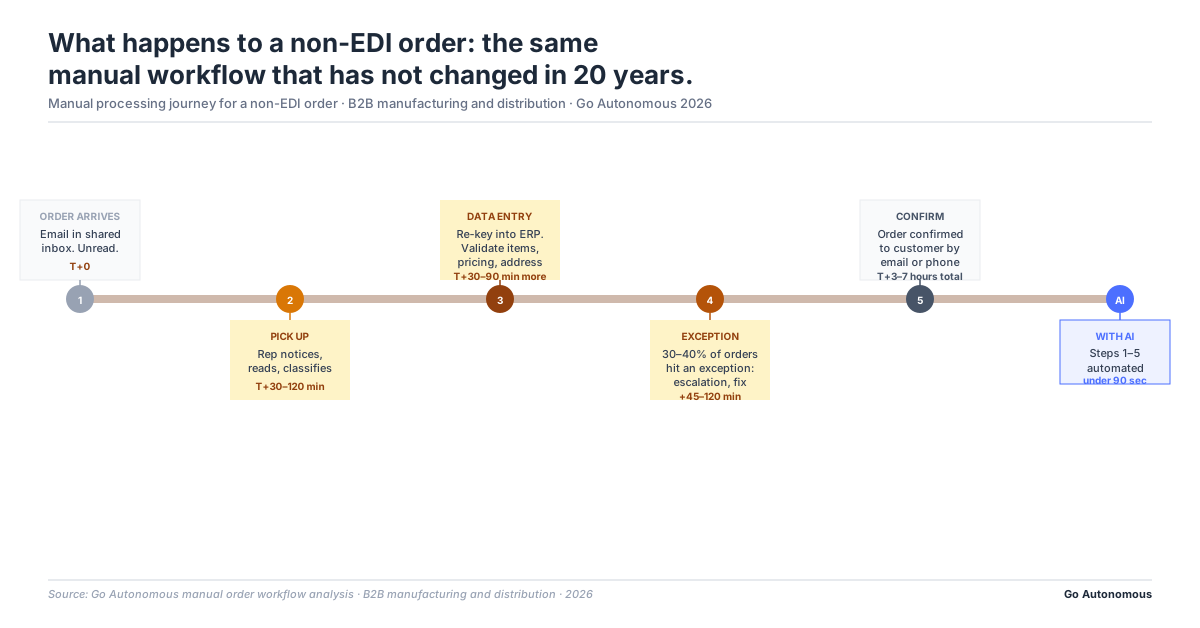
When a non-EDI order arrives — typically an email with a PDF purchase order attached — the workflow is entirely manual. A customer service representative monitors the shared inbox, identifies the incoming order, opens the attachment, reads the document, locates the customer record in the ERP, looks up each SKU against the product catalog (translating customer part numbers to internal numbers where needed), keys every line item, verifies pricing against the contracted rate, creates the sales order, and sends a confirmation back to the customer. Every one of these steps requires human attention. None of them add commercial value. They exist because the ERP cannot read the email, and the email contains information the ERP needs.
What a Non-EDI Order Actually Costs Before It Reaches the System
The cost of this manual workflow is €15–35 per order when fully loaded. That includes the 20–45 minutes of direct handling time, the exception resolution time for the 20–40% of orders that have at least one field problem, the customer communication overhead, and the management time spent on escalations. Operations teams that benchmark their true per-order cost consistently find the number 5–10x higher than the finance estimate. The manual process is also error-prone: keying errors, missed pricing updates, and wrong SKU mappings create downstream corrections in the ERP that add cost invisible to the original order entry measurement. For every non-EDI order that flows cleanly, a meaningful fraction creates re-work that compounds the base cost.
The Non-EDI Tail Grows as Revenue Grows: Scaling Exposes the Gap
New Customer Growth Adds New Formats, Not EDI Conversions
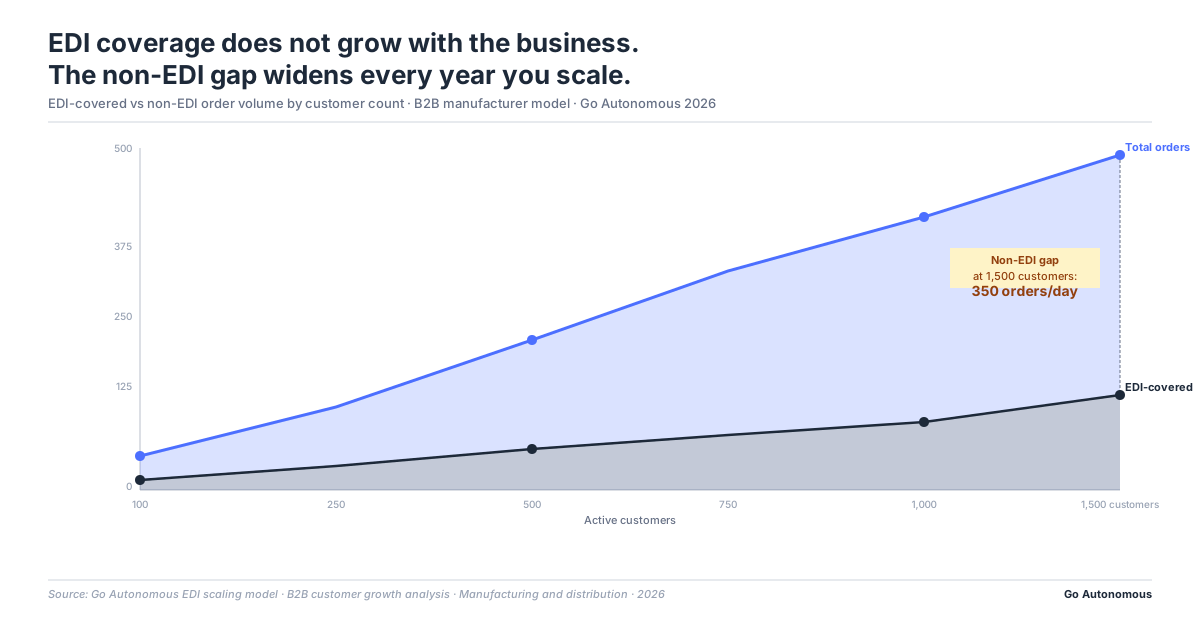
Every new customer a B2B manufacturer or distributor acquires adds to the non-EDI backlog. New customers do not arrive with EDI integrations in place. Sales closes the account; operations inherits the order format — whatever the customer already uses, which is almost always email or PDF. International expansion compounds the problem. New markets bring new purchasing conventions, different document layouts, different language requirements, and different delivery address formats. The share of order volume covered by EDI does not grow with revenue. It stays flat or shrinks as the new-customer order volume grows faster than EDI conversions.
The Coordination Cost of a Growing Non-EDI Backlog
As the non-EDI backlog grows, the coordination cost grows with it. More orders in the shared inbox means more monitoring, more prioritisation decisions, more risk of orders being missed or delayed. Customer service managers add headcount to absorb the volume. Each additional operator adds fixed cost that scales with order volume, not with order value. This is the pattern Mikkel Vindeløv at Hempel described: each additional €1–2M in revenue required another operator. The underlying driver is not revenue complexity — it is the non-EDI order backlog that manual processing cannot absorb without proportional headcount growth. The margin impact of this cost structure is direct: incremental revenue carries higher processing cost per order than the existing base, which compresses the margin on growth.
AI-Based Intake Processing Handles What EDI Never Could
How AI Reads Non-EDI Orders: Format-Agnostic Extraction
EDI will not expand to cover the non-EDI customer base. The economics do not justify the integration investment for mid-market accounts, new customers, or customers with variable order patterns. The solution is not a better version of EDI — it is a format-agnostic AI intake layer that processes what EDI cannot. An AI system reads incoming orders from email body text, PDF attachments, spreadsheet exports, and web form submissions. It extracts every required field, maps customer product references to ERP catalog numbers, validates pricing against contracted rates, and resolves standard exceptions using configurable business rules — all without human intervention. The order lands in the ERP as a clean, validated sales order within seconds of receipt.
EDI + AI Intake: Covering 95%+ of Order Volume Without Manual Exceptions
The Autonomous Execution Fabric: Format-Agnostic Processing for Every Transaction EDI Misses
The AI intake layer described in this post is the order processing component of the Autonomous Execution Fabric. The Autonomous Execution Fabric is a full commercial execution layer that connects directly to your ERP (SAP, Oracle, or Microsoft Dynamics) and processes every inbound commercial transaction without human assembly, regardless of the channel or format it arrived in. EDI was designed for one transaction type (purchase orders) in one format (structured messaging between pre-integrated partners). The Fabric is designed for every transaction type from every customer, in whatever format that customer uses.
The Fabric handles more than orders that EDI misses. The same customers who send orders via email also send pricing inquiries via email, return requests via email, and credit claims as PDF attachments. None of these arrive through EDI. Each follows the same manual workflow: someone reads the message, interprets the request, looks up the relevant data, and creates a record. The Autonomous Execution Fabric processes returns authorizations, quote requests, pricing updates, credit notes, and contract tenders across the same inbound channels (email, PDF, customer portal, direct API), applying the same autonomous execution that eliminates the manual order entry workflow.
B2B operations that address the non-EDI order gap often find the same structural problem driving cost across every other non-structured commercial transaction. For customers who will never adopt EDI, the Fabric is the only path to automation. It covers 100% of what those customers send, not just the transaction types that EDI was designed for. Combined with existing EDI programs, the Autonomous Execution Fabric brings structured, automated processing to every commercial transaction across the full customer base.
For manufacturers already running EDI, AI intake is additive, not a replacement. EDI continues to handle the structured accounts that use it. AI intake handles everything else: the emails, the PDFs, the portal exports, the faxes. Combined, the two channels bring structured, automated processing to 90%+ of total order volume. Danfoss now processes orders in under 1 minute across 26 countries, covering the full geographic scope in a single day — a result that EDI alone could not achieve across the full customer and market mix. Additional customer outcomes across manufacturing and distribution show the same structural shift: from manual backlog management to near-complete autonomous processing, without requiring EDI conversion from the customer base. To understand how this applies to your order volume and format mix, book a session with the Go Autonomous team.
Frequently Asked Questions
What percentage of B2B orders do not go through EDI?
Approximately 65–80% of B2B orders do not go through EDI, depending on the industry and customer mix. EDI typically covers 20–35% of customer accounts — the large, long-standing trading partners that have invested in integration. The remainder of order volume arrives via email, PDF, web form, or fax and requires manual processing.
How do manufacturers handle orders from customers who do not use EDI?
Most manufacturers handle non-EDI orders through a manual inbox-to-ERP workflow: a customer service representative monitors a shared inbox, opens email attachments, reads the purchase order, looks up each item in the ERP catalog, keys every line item, validates pricing, and creates the sales order. This process takes 20–45 minutes per order and costs €15–35 when fully loaded.
What are the alternatives to EDI for B2B order processing?
The primary alternative to EDI for unstructured B2B order processing is AI-based intake automation. Unlike EDI, which requires both parties to invest in structured integration, AI intake reads orders from any format — email, PDF, spreadsheet, web portal — without requiring changes from the customer. It extracts order fields, maps product references, validates pricing, and creates ERP sales orders automatically.
Why do most B2B distributors still receive orders by email despite having EDI?
EDI requires both parties to build and maintain the integration. Most customers — mid-market accounts, newer customers, international buyers — lack the IT resources or purchasing volume to justify the investment. New customers onboard without EDI and rarely convert because neither side prioritises the integration. As a result, even distributors with mature EDI programs receive 50–70% of their order volume by email.
How does AI order processing compare to EDI for non-standard B2B orders?
AI order processing handles what EDI cannot: unstructured formats, variable templates, and customers who have not invested in integration. EDI requires a structured, pre-agreed format. AI reads free-form email text and PDF attachments the way a human would, but faster and without entry errors. For manufacturers already running EDI, AI intake is additive — covering the non-EDI customer base and bringing total structured processing to 90%+ of order volume.