.svg)





The B2B Order Confirmation Gap: Why 48 Hours Between PO Receipt and ERP Entry Is a Strategic Problem
Most manufacturers treat the 48-hour gap between PO receipt and ERP entry as a process inefficiency. At scale, it is a strategic cost that compounds with every point of revenue growth. This post calculates the real cost and shows why autonomous execution is the only structural fix.
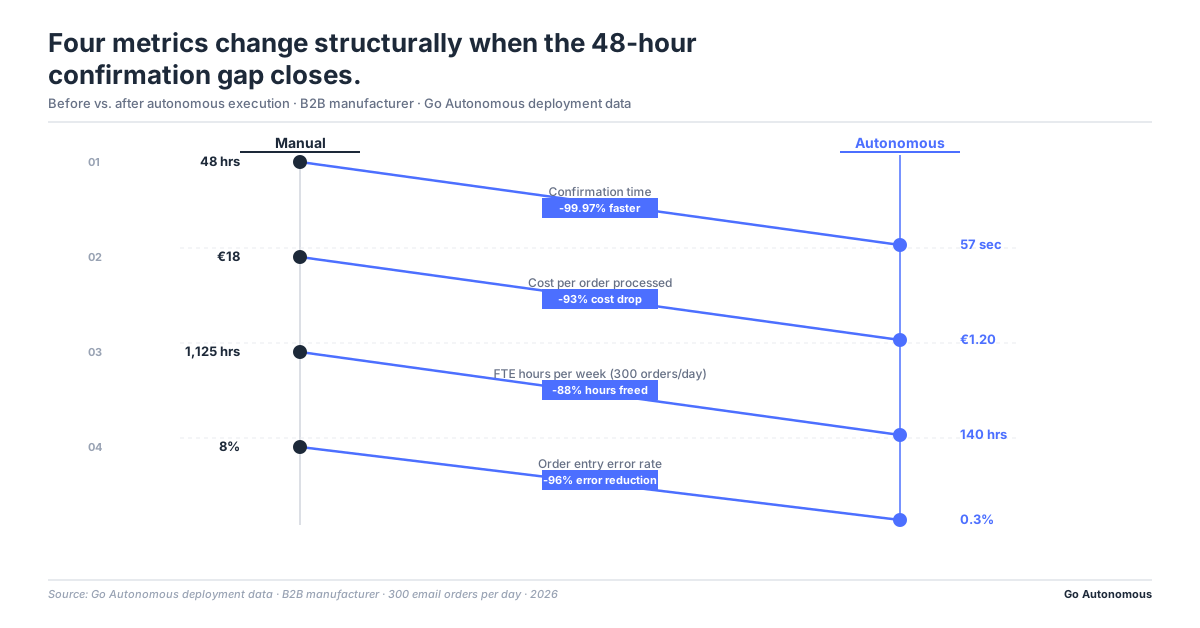
A manufacturer generating €500M in annual revenue and processing 300 email orders per day spends approximately 1,125 person-hours per week on the act of receiving revenue. At a fully loaded cost of €45 per hour, that is roughly €2.5M per year spent before a single order reaches the ERP. None of that cost generates margin. None of it improves the product. All of it exists because someone has to read the PO, validate the line items, check the pricing contract, resolve the mismatch in attachment row 7, and manually enter the result into SAP S/4HANA or Oracle Order Management Cloud. That is the order confirmation gap. And for most B2B manufacturers, it averages 24 to 48 hours per order received by email.
The gap is not a failure of the ERP. SAP S/4HANA validates transactions with precision. It does not read the email, interpret the PDF attachment, or resolve the pricing discrepancy between the PO and the current contract. That interpretation work sits entirely in human hands, and it sits there regardless of how sophisticated the downstream system is. This post diagnoses why the confirmation gap persists, calculates the cost at scale, and explains why the only structural fix operates at the execution layer, not the ERP layer.
Table of Content
- What Is the B2B Order Confirmation Gap, and Why Does It Persist?
- Calculating the Real Cost of a 48-Hour B2B Order Confirmation Window
- How Order Channel Mix Determines Confirmation Gap Severity in B2B Manufacturing
- Why SAP, Oracle, and Dynamics 365 Do Not Close the Confirmation Gap Themselves
- How Friction Debt Accumulates in the Order Confirmation Process
- Three Strategic Consequences of the Order Confirmation Gap at €500M+ Revenue Scale
- The Autonomous Execution Fabric: Why the Confirmation Gap Requires a Full Execution Layer
- See How Autonomous Execution Closes the Confirmation Gap in Your Environment
- What the Board Is Actually Asking
- Frequently Asked Questions
- What is a typical B2B order confirmation time for manufacturers?
- How do you reduce order processing time in B2B distribution?
- Why does ERP order entry still take 24 to 48 hours in manufacturing?
- What is the cost of slow order confirmation for B2B manufacturers?
- What is Revenue at Rest in B2B order management?
- Does deploying autonomous order processing require replacing your ERP?
- How does autonomous order execution affect B2B working capital?
What Is the B2B Order Confirmation Gap, and Why Does It Persist?
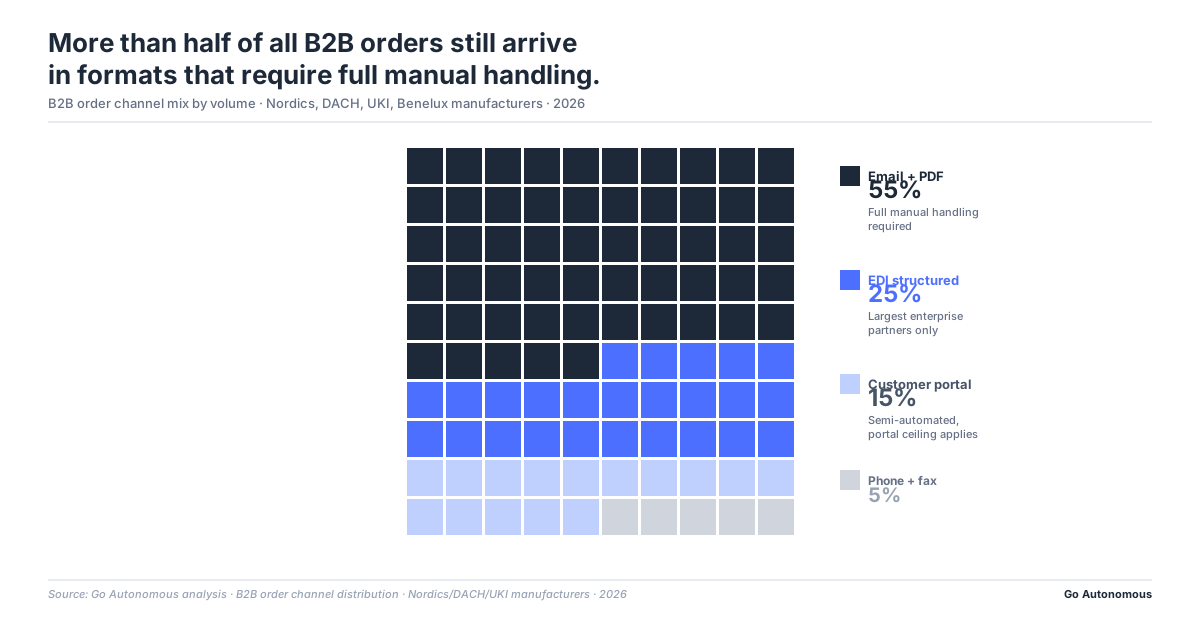
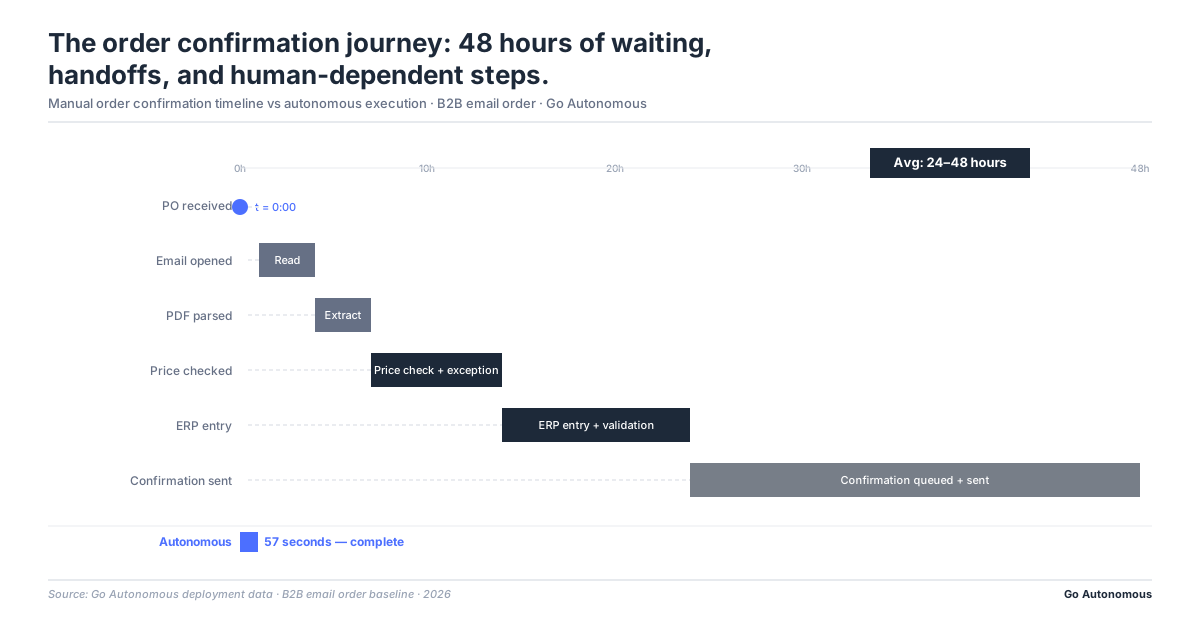
The order confirmation gap is the elapsed time between when a purchase order arrives at a manufacturer or distributor and when that order is confirmed, validated, and entered into the ERP. For email and PDF-based orders, which still represent 50 to 70 percent of B2B order volume at most manufacturers, this gap averages 24 to 48 hours in practice. In peak periods, quarterly close windows, or during high-volume seasonal surges, it extends further.
The gap persists because Autonomous Commerce has not yet displaced the underlying execution architecture at most manufacturers. Three structural forces keep it alive.
Why Email Orders Still Drive the Majority of B2B Transaction Volume
Email remains the dominant channel for B2B order submission at manufacturers and distributors in the Nordics, DACH, Benelux, and UKI markets. Buyers send PDFs. Buyers forward purchase order confirmations from their own procurement systems. Buyers paste line items into the body of an email. The variety is not the exception. It is the operational baseline. EDI structured orders via TrueCommerce or SPS Commerce cover the largest, most technically capable customers. Customer portal orders via Salesforce Commerce Cloud or SAP Commerce Cloud capture the segment that adopted digital channels. But for most manufacturers, portal adoption rarely exceeds 40 percent of the customer base. The remaining majority defaults to email. This means the majority of order volume still requires a human to read, interpret, and act before anything reaches the ERP.
What Causes Manual Order Processing to Persist After ERP Implementation?
ERP implementation does not eliminate the confirmation gap. SAP S/4HANA, Oracle Order Management Cloud, and Microsoft Dynamics 365 Order Management are validation and execution systems. They require clean, structured input. The unstructured work that precedes entry: reading the PDF, matching the customer’s part numbers to the manufacturer’s SKUs, checking the tiered pricing contract, flagging minimum order quantities, resolving line-item discrepancies, occurs entirely outside the ERP. It occurs in email inboxes. It occurs in the judgment of customer service operators who have worked the account for three years and know what the customer probably meant. The ERP does not see this work. It only sees the order when it is ready. The confirmation gap is exactly the cost of everything that happens before “ready.”
How Does Revenue at Rest Form in B2B Order Management?
Every order sitting in an inbox waiting to be processed represents revenue that has been received but is not yet moving.
Revenue at Rest is the total economic value of orders that have been received but not yet processed, confirmed, or entered into the ERP. It is not backlog. Backlog is anticipated volume in the pipeline. Revenue at Rest is trapped economic value that should be moving and is not. At a €500M manufacturer with a 48-hour average confirmation window, a significant portion of weekly order value sits in processing queues at any given moment. That trapped value represents a stretched cash conversion cycle, delayed fulfillment triggers, and a working capital position worse than the order book suggests.
Calculating the Real Cost of a 48-Hour B2B Order Confirmation Window
Precision matters here. The calculation is not abstract.
A manufacturer processing 300 email orders per day at 15 minutes of human handling each commits 4,500 minutes, or 75 hours, per day to pre-ERP order work. Across a five-day week, that is 375 hours. At a fully loaded cost of €45 per hour (inclusive of salary, employer contributions, overhead), the weekly processing cost is €16,875. Annualized: €877,500 for 300 orders per day. Scale to 500 orders per day, the figure approaches €1.5M annually. At 800 orders per day, which is a realistic volume for a €1B+ distributor with a large customer base, the cost exceeds €2.4M before a single order has generated margin.
These figures cover direct processing cost only. They do not include the cost of order errors that reach the ERP: wrong quantities entered, wrong SKUs mapped, pricing overrides that require correction downstream. According to APQC benchmarking data on order management performance, error-related rework adds 20 to 30 percent to the base processing cost at manufacturers without structured validation layers. They also exclude the customer service cost of inbound confirmation-chasing: buyers who submitted an order 36 hours ago and have not received confirmation calling to ask where it stands.
The strategic consequence compounds further. When order volume grows, the processing cost grows proportionally. Every point of revenue growth requires a proportional headcount increase to match it. There is no compression curve. The cost per order does not fall as volume rises in a manual processing model.
Each time we added one or two million euros in revenue, we had to add another operator. From a cost perspective, that's an unsustainable way of operating a business.

This is the core structural problem. It is not a staffing problem. It is an architecture problem. The architecture requires human judgment on every unstructured input, and the volume of unstructured input scales directly with revenue.
What Does Working Capital Released Look Like When Confirmation Time Compresses?
Working Capital Released is capital unlocked by compressing order-to-cash cycles through autonomous execution. The formula: reduction in O2C cycle days multiplied by average daily revenue. A manufacturer with €500M annual revenue that compresses the average confirmation window from 48 hours to under 30 minutes reduces O2C cycle time by roughly two days. At €500M annual revenue, two days of working capital released equals approximately €2.7M freed from the balance sheet. That is not an operational saving. It is a balance sheet improvement that arrives without capital expenditure.
How Order Channel Mix Determines Confirmation Gap Severity in B2B Manufacturing
Not all order channels create the same gap. The severity depends on channel architecture. The following scenario table maps order types to the approaches manufacturers currently use and why each has a ceiling.
| Order channel / scenario | Current approach | Why this applies and where it stops |
|---|---|---|
| EDI structured orders via TrueCommerce or SPS Commerce | Automated EDI ingestion, direct ERP write | Fast and accurate for the customers who send compliant EDI 850 transactions. Covers 20 to 40 percent of customer base at most manufacturers. Does not cover tail customers, spot buyers, or customers on non-standard formats. Cannot handle exceptions or discrepancies autonomously. |
| Email PDF purchase orders | ABBYY, Rossum, or similar IDP tools for extraction, then human review and ERP entry | Intelligent Document Processing tools extract line items and map fields. They do not validate pricing contracts, resolve discrepancies, or write to the ERP without human confirmation. The extraction removes typing time. The confirmation gap remains at the validation and entry step. |
| Customer portal orders (SAP Commerce Cloud, Salesforce Commerce Cloud) | Structured portal input with ERP integration | Near-zero confirmation gap when working correctly. Limited to customers who adopted the portal. Adoption rarely exceeds 40 percent in established customer bases. Blanket PO call-offs and amendment instructions still arrive outside the portal via email. |
| Phone orders and verbal call-offs | CSR manual entry during or after the call | Highest error rate per order. No structured input. Requires the CSR to interpret intent, confirm pricing, and enter directly. Fastest confirmation time in theory but highest rework rate in practice. |
| Blanket PO call-offs via email or fax | Manual matching to master blanket agreement, then entry | Requires the operator to locate the blanket PO in the ERP, match the call-off quantities to contract terms, verify remaining balance, and enter the release. Complex and error-prone. Typically 30 to 60 minutes per call-off at manufacturers without automated blanket management. |
| Autonomous Commerce execution (all channels) | AI reads, validates, resolves, and writes to ERP across all inbound channels | Closes the confirmation gap regardless of channel. Reads email PDFs, portal submissions, EDI, and structured data. Validates against pricing contracts and master data. Resolves standard exceptions autonomously. Writes to SAP S/4HANA, Oracle Order Management Cloud, or Dynamics 365. Confirmation in minutes, not hours. |
The pattern is consistent. Every channel-specific solution solves for one scenario. EDI covers structured large customers. Portals cover digitally mature buyers. IDP tools reduce typing but not validation time. The confirmation gap persists because the gap is not a channel problem. It is an execution architecture problem. The only solution that closes it across all channels is an execution layer that operates at the intake point, before the ERP, and handles every channel natively.
Why SAP, Oracle, and Dynamics 365 Do Not Close the Confirmation Gap Themselves
The question VP Operations teams ask after an ERP implementation is always the same: if we just spent €15M on SAP S/4HANA, why is the confirmation gap still 48 hours? The answer is architectural.
What SAP S/4HANA Order Management Handles and Where It Stops
SAP S/4HANA Order Management processes orders that have already been structured, validated, and entered. It confirms availability, calculates pricing based on master data, triggers fulfillment, and manages the downstream O2C workflow with precision. What it does not do: read an email, interpret a PDF attachment, resolve a discrepancy between the buyer’s part number and the internal SKU, or negotiate a pricing exception against a non-standard contract. The work that fills the confirmation gap is pre-ERP work. SAP never sees it.
Why IDP Tools Like ABBYY and Rossum Reduce Time but Not the Gap
Intelligent Document Processing solutions from ABBYY and Rossum extract structured data from unstructured documents. They identify line items, quantities, part numbers, and delivery addresses from PDF purchase orders with high accuracy. However, extraction is not execution. After extraction, the data still requires human validation: does the part number match? Does the pricing align with the current contract? Is the delivery date feasible? Is the quantity within minimum order constraints? IDP reduces the typing step. The validation and judgment step, which is where most of the confirmation gap lives, remains human. According to Go Autonomous deployment analysis across manufacturers using IDP point solutions, the confirmation gap compresses by 20 to 35 percent with IDP alone. It does not close.
How Autonomous Commerce Closes the Gap That ERP and IDP Leave Open
The Autonomous Commerce platform operates at the intake layer, between the inbound order channel and the ERP. It reads the incoming PO regardless of format (email PDF, portal submission, EDI, structured XML), validates line items against pricing contracts and master data, resolves standard exceptions autonomously, and writes a confirmed, clean order directly to the ERP. The human operator receives notification only when a genuine exception falls outside the system’s codified resolution rules.
Confirmation time compresses from 48 hours to under 30 minutes for the majority of order types. For structured EDI and portal orders, confirmation is effectively immediate. For email PDF orders, which carry the highest handling complexity, the platform’s execution layer closes the gap that IDP alone leaves open because it combines extraction with validation, contract checking, and ERP writeback in a single execution flow.
Danfoss deployed Autonomous Commerce across 26 countries, processing orders from multiple channels into a single execution fabric connected to their ERP. The result: order confirmation time reduced to under one minute for qualifying order types. For detail on the deployment, see the Danfoss press release.
On the biggest orders, we have been able to take out 75% of order handling time. That is phenomenal.
How Friction Debt Accumulates in the Order Confirmation Process
Most manufacturers have never measured the cost of their confirmation gap as a single number. They have measured cost per order, headcount per revenue band, and order cycle time. These are process efficiency metrics. They do not capture the structural cost of keeping humans in the execution flow.
Friction Debt is the total monetary cost of human decisions still happening in the revenue flow. It is the sum of decision time (the wait between a decision being needed and a decision being made), decision cost (the loaded cost of the people whose judgment is required, multiplied by frequency), and decision drag (the downstream effect on revenue: orders that confirm late, customers who follow up, exceptions that compound into escalations). Every manual validation step in the order confirmation process is friction debt accumulating. It is not visible on a cost per order dashboard. It is not measured by touchless rate. It does not appear on the P&L as its own line. Until it is a number on the operating dashboard, the true cost of the confirmation gap stays invisible.
The efficiency gains that autonomous execution delivers are a direct reduction in friction debt. Fewer human decisions per order means lower friction debt per unit of revenue processed. At scale, the difference between a 48-hour confirmation window and a 30-minute one represents not just operational savings but a fundamentally different cost structure for growth.
Three Strategic Consequences of the Order Confirmation Gap at €500M+ Revenue Scale
At sub-€100M revenue, the confirmation gap is a process inconvenience. At €500M and above, it becomes a strategic constraint. Three consequences emerge that are not visible at smaller scale.
Why the Confirmation Gap Delays Cash Conversion for B2B Manufacturers
Revenue received but not in the ERP is not, in financial terms, processed revenue. It cannot trigger fulfillment. It cannot initiate invoicing. It extends the order-to-cash cycle by exactly the length of the confirmation window. For a manufacturer with €500M revenue and a 48-hour average confirmation window, this translates directly into a longer DSO and a larger working capital requirement. Finance teams see the symptom (elevated DSO) without always tracing the root cause to the pre-ERP confirmation delay. The margin and revenue management implications extend further: orders confirmed late miss same-day fulfillment windows, particularly relevant for next-day delivery commitments in distribution.
How the Confirmation Gap Creates Customer Service Strain That Compounds with Volume
A buyer who submitted a purchase order 36 hours ago and has not received confirmation will call. Or email. Or escalate through their procurement team. In a manual processing environment, this inbound confirmation-chasing is a secondary workload that compounds the primary processing backlog. The customer service team is simultaneously processing the unconfirmed orders and answering calls about orders they have not yet had time to confirm. The two workloads compete for the same resources. As order volume grows, both workloads grow. The result is a customer experience degradation that is structurally linked to the confirmation gap, not to service quality or staffing levels.
Why Throughput Caps Are a Direct Result of Confirmation Gap Architecture
The most strategically significant consequence: throughput is capped by the number of operators who can process orders. Adding revenue requires adding headcount in direct proportion. There is no operating leverage in the processing layer. A manufacturer that doubles revenue with manual order confirmation must roughly double its processing headcount to maintain the same confirmation window. This is not a productivity problem solvable by training or tooling. It is an architectural constraint that requires an execution-layer change to resolve. Manufacturers who have deployed Autonomous Commerce have broken this proportionality: revenue grows while processing headcount stays flat or shrinks, because the confirmation work shifts from human operators to the autonomous execution layer. That is the structural difference between optimizing the current architecture and replacing it.

The Autonomous Execution Fabric: Why the Confirmation Gap Requires a Full Execution Layer
The 48-hour confirmation gap this post describes is a symptom of a structural absence: no execution layer operating between inbound order receipt and ERP entry. The Autonomous Execution Fabric fills that absence. It is a full commercial execution layer that connects directly to your SAP, Oracle, or Microsoft Dynamics environment and executes every inbound commercial transaction without human assembly. The moment an order arrives, the Fabric reads it, validates it against your pricing contracts and ERP master data, resolves standard exceptions using codified rules, and writes a confirmed order to your ERP, in minutes rather than hours.
The confirmation gap is where the Fabric’s scope becomes operationally significant. The Fabric does not solve for email orders only. It processes orders across every intake channel simultaneously: email PDFs, EDI batches, customer portal submissions, and direct API orders all flow through the same execution layer and write to the same ERP connection. Beyond order confirmation, the Fabric handles pricing requests, quote processing, returns authorizations, credit notes, and contract tenders. Every commercial transaction that currently generates a confirmation gap shares the same root cause: a human must intervene to move it forward. The Fabric removes that requirement across every transaction type, not just the ones that surface the longest delays.
This is why fixing the email order queue alone does not close the confirmation gap at scale. Operations that have automated email order entry but still manually process blanket PO call-offs, pricing exception tickets, and returns requests carry Friction Debt across multiple transaction types simultaneously. The structural problem is identical in every case: no execution layer capable of acting without human input. The Autonomous Execution Fabric addresses the root cause once, across all commercial transaction types, rather than patching each channel separately as volume and complexity grow.
See How Autonomous Execution Closes the Confirmation Gap in Your Environment
If your operations team is processing a significant share of orders by email, and your average confirmation window runs longer than 4 hours, the pattern described in this post is costing you more than a process inefficiency line item. It is capping your throughput, stretching your cash conversion cycle, and adding headcount cost proportional to every point of revenue growth. Go Autonomous works with 500M to 20B EUR manufacturers and distributors in the Nordics, DACH, Benelux, UKI, and France. If the confirmation gap described here reflects your order operations, we can show you exactly what autonomous execution looks like in your environment: your ERP, your order channels, and your specific exception patterns. Book a conversation with our team.
What the Board Is Actually Asking
Before any initiative of this scale reaches sign-off, the same questions come up. Here are the direct answers.
“We already have SAP and EDI. Why is the confirmation gap still a problem?”
SAP and EDI solve for the ERP execution layer and the structured-customer channel respectively. Neither addresses the 50 to 70 percent of orders that arrive as email PDFs, phone-in requests, or non-standard formats. The confirmation gap lives in the space between inbound order receipt and ERP entry. That space is not covered by ERP capability or EDI connectivity. Autonomous Commerce operates precisely in that space.
“What does the return on this look like, and how quickly?”
Return comes from three sources: direct processing cost reduction (quantifiable against current FTE cost per order), working capital released through DSO compression (calculable from current O2C cycle length and average daily revenue), and throughput capacity freed for revenue growth without proportional headcount increase. For a manufacturer processing 500 or more email orders per day, the direct processing cost reduction alone typically justifies the investment within the first 12 months. The working capital release adds a balance sheet benefit that sits outside the P&L calculation entirely.
“What is the implementation risk, and how long does it take?”
The autonomous execution layer connects to the existing ERP and order channels. It does not replace SAP, Oracle, or Dynamics 365. It operates upstream of them. The implementation timeline for manufacturers who have deployed Autonomous Commerce has been measured in weeks to months, not years. The primary integration requirement is the ERP writeback connection and the pricing contract data model. Both are standard integration patterns for manufacturers already running modern ERP platforms. Risk is lower than an ERP migration because the core system of record remains unchanged.
“What happens to our customer service team?”
The customer service team stops processing routine orders and starts handling genuine exceptions, relationship management, and commercial conversations. The work that autonomous execution takes over is the work that does not require judgment: reading PDFs, entering line items, checking standard pricing contracts, confirming structured orders. The work that remains requires exactly the skills experienced operators have: resolving unusual situations, managing escalations, developing customer relationships. Most deployments result in capacity reallocation rather than headcount reduction, particularly in growth environments where the freed capacity absorbs new order volume without new hires.
Frequently Asked Questions
What is a typical B2B order confirmation time for manufacturers?
For email and PDF-based orders, the average B2B order confirmation time at manufacturers and distributors is 24 to 48 hours. EDI structured orders from large customers can confirm in minutes. Customer portal orders confirm near-immediately when implemented correctly. Email orders, which represent 50 to 70 percent of order volume at most manufacturers, are the primary source of confirmation delay.
How do you reduce order processing time in B2B distribution?
The most effective way to reduce order processing time in B2B distribution is to deploy an autonomous execution layer that reads inbound orders from any channel, validates them against pricing contracts and master data, resolves standard exceptions, and writes to the ERP without human intervention. IDP tools like ABBYY and Rossum reduce typing time but not validation time. Only end-to-end autonomous execution closes the full confirmation gap.
Why does ERP order entry still take 24 to 48 hours in manufacturing?
ERP platforms like SAP S/4HANA and Oracle Order Management Cloud require clean, structured input before an order can be entered. The 24 to 48 hour delay occurs in the pre-ERP stage: reading the email or PDF, interpreting line items, matching customer part numbers to internal SKUs, validating pricing, and resolving discrepancies. The ERP cannot perform these tasks. A human operator must complete them first.
What is the cost of slow order confirmation for B2B manufacturers?
A manufacturer processing 300 email orders per day at 15 minutes each spends approximately 1,125 person-hours per week on pre-ERP processing. At a fully loaded cost of €45 per hour, the annual processing cost exceeds €2.5M before accounting for error rework, customer service follow-up calls on unconfirmed orders, and the working capital impact of a stretched order-to-cash cycle.
What is Revenue at Rest in B2B order management?
Revenue at Rest is the total economic value of orders that have been received but not yet processed, confirmed, or entered into the ERP. It is not backlog. It is trapped economic value that should be moving through the order-to-cash cycle. It directly extends DSO and increases working capital requirements for manufacturers operating with manual confirmation processes.
Does deploying autonomous order processing require replacing your ERP?
No. Autonomous order processing operates upstream of the ERP, at the intake layer. It reads inbound orders, validates and resolves them, then writes clean structured data into the existing ERP. SAP S/4HANA, Oracle Order Management Cloud, and Microsoft Dynamics 365 all remain in place. The autonomous layer adds execution capability before ERP entry; it does not replace the ERP.
How does autonomous order execution affect B2B working capital?
Compressing the order confirmation window from 48 hours to under 30 minutes reduces the order-to-cash cycle by approximately two days for most manufacturers. A manufacturer with €500M annual revenue that compresses DSO by two days releases approximately €2.7M in working capital. This balance sheet improvement arrives alongside the operational cost reduction, providing a dual return that extends beyond the P&L.