.svg)





Revenue Velocity: The Metric That Measures Whether Autonomous Execution Is Actually Accelerating Your Business
Revenue Velocity measures the rate at which demand converts to confirmed, executable revenue. For B2B manufacturers, it exposes the economic gap between revenue growth and revenue flow.
Two B2B manufacturers with identical annual revenue of one billion euros. One processes incoming orders in an average of 4 hours. The other takes 3 business days. By every traditional metric, they are performing identically. Revenue Velocity reveals the difference: the first business converts demand to cash three times faster, compresses its working capital cycle, and responds to peak demand without accumulation in the queue.
This post defines Revenue Velocity as a metric, explains why it separates high-performing manufacturers from those growing in volume but not in flow, and shows what autonomous execution does to the number.
Table of Content
- What Is Revenue Velocity and How Does It Differ From Total Revenue?
- Why B2B Manufacturers Measure Revenue Growth but Not Revenue Flow
- How Autonomous Execution Raises Revenue Velocity for Manufacturers and Distributors
- See What Autonomous Execution Does to Your Revenue Velocity
- What the Board Is Actually Asking About Revenue Velocity
- Frequently Asked Questions
- What is revenue velocity in B2B manufacturing?
- How do you calculate revenue velocity for a B2B distributor?
- What is the difference between revenue growth and revenue velocity?
- How does autonomous order execution improve revenue velocity?
- Why does revenue velocity matter more than order volume at scale for B2B manufacturers?
What Is Revenue Velocity and How Does It Differ From Total Revenue?
Revenue Velocity is the rate at which demand converts to confirmed, executable revenue. It is the commercial equivalent of throughput: not how much revenue a business generates, but how fast it generates it. A business with identical revenue but shorter order-to-cash cycles carries less working capital, serves customers faster, and scales without proportional headcount growth.
Total revenue is a volume measure. It counts what arrived during a period. Revenue Velocity is a flow measure. It counts how fast demand moved from commercial intent to confirmed cash. Two companies with 1B EUR revenue but different processing speeds have fundamentally different economics. One carries more working capital to finance its slow cycle. The other converts demand to cash before its slower competitor has entered the order in the ERP.
What Is Revenue Velocity in B2B Manufacturing?
In B2B manufacturing, Revenue Velocity measures the average time between a demand signal, such as a purchase order, RFQ, or blanket PO call-off, and confirmed, executable revenue in the system. High Revenue Velocity means standard orders confirm within minutes. Low Revenue Velocity means orders queue in email inboxes, wait for manual validation, or stall on pricing exceptions while the customer waits for confirmation.
The metric matters most at scale. A manufacturer processing 200 orders per week with a 24-hour processing lag is carrying approximately 200 orders in the pipeline at any moment that are confirmed demand but not yet confirmed revenue. At 1B EUR annual revenue and an average order value that implies thousands of weekly transactions, that lag compounds into a structural working capital exposure that never appears on the revenue line but shows up clearly in DSO and cash conversion cycle figures.
How Do You Calculate Revenue Velocity for a B2B Distributor?
The practical calculation starts with average order-to-confirmation time, measured from channel receipt to ERP-confirmed order. Divide total confirmed revenue in a period by the average processing time across all order types in that period. Compare across periods: if revenue grows 15% but average processing time also grows 15%, Revenue Velocity has not improved. Volume has grown but the pipe diameter has not. A business with flat revenue but 40% faster processing has meaningfully improved Revenue Velocity even though the top line looks unchanged.
For distributors handling high volumes of structured EDI orders alongside unstructured email orders, the blended average obscures the real picture. EDI orders from SAP S/4HANA, Oracle Cloud SCM, or Microsoft Dynamics 365 partners may confirm automatically. Email orders with PDF attachments may sit for 18 hours before manual entry. The Revenue Velocity gap between channels is where autonomous execution creates the most immediate impact.
Why B2B Manufacturers Measure Revenue Growth but Not Revenue Flow
Revenue growth appears on the income statement. Revenue Velocity does not. That is the structural reason most manufacturers track one and ignore the other. The cost of slow revenue flow shows up in DSO, in working capital ratios, in headcount-to-revenue ratios, and in customer satisfaction scores when order confirmation times are slow. None of those figures are labeled “Revenue Velocity” in a standard management report, so the connection to processing speed remains invisible.
According to Salesforce State of Sales research on quote cycle times, sales teams that respond to inquiries within the first hour are significantly more likely to qualify leads than those responding later. The same dynamic applies to order confirmation. Customers who submit orders and wait 48 hours for confirmation are already evaluating whether their next order goes to a competitor with a faster portal or EDI-direct connection. Revenue Velocity is not just a finance metric. It is a retention metric.
What Is the Difference Between Revenue Growth and Revenue Velocity?
Revenue growth measures the increase in confirmed revenue over a period. Revenue Velocity measures the speed at which new demand converts to that confirmed revenue. A business can grow revenue 20% year-over-year while its Revenue Velocity deteriorates, if the processing team grows proportionally to handle the volume increase and cycle times stay constant. In that scenario, the business has built a larger treadmill. It has not built faster economics. “In an autonomous environment, the goal is not just more revenue. It is faster revenue with less lag.”
The distinction matters to CFOs and boards because it predicts working capital requirements at scale. A business with high Revenue Velocity needs less working capital to finance the order-to-cash cycle at any given revenue level. A business with low Revenue Velocity and growing revenue needs proportionally more working capital each year, even if the top line looks healthy. Revenue at Rest, the volume of demand that exists but has not yet converted to confirmed revenue, accumulates in proportion to Revenue Velocity deterioration. See the Revenue at Rest blueprint for the measure of orders sitting in processing queues.
For the sector-wide context: 85 to 90 percent of B2B revenue still moves through channels that require human facilitation at every step, according to Go Autonomous deployment analysis across 30 billion-plus processed B2B transactions. That is not a technology gap. It is a Revenue Velocity constraint built into every manufacturer and distributor still processing orders through email-dependent workflows.
The healthcare industry is undergoing a significant transformation, and digitalization is no longer a choice. It's a necessity. Automating repetitive processes not only ensures operational efficiency but also enables us to focus on delivering exceptional value to our customers.
The pressure June Rosendahl describes at Mediq is not specific to healthcare distribution. Across manufacturing sectors in the Nordics, DACH, and Benelux, the same convergence is occurring: digital-first customers expect confirmation speed that manual processing cannot deliver, and the cost of maintaining manual workflows grows proportionally with the revenue that flows through them. Revenue Velocity is the metric that quantifies that gap.
How Autonomous Execution Raises Revenue Velocity for Manufacturers and Distributors
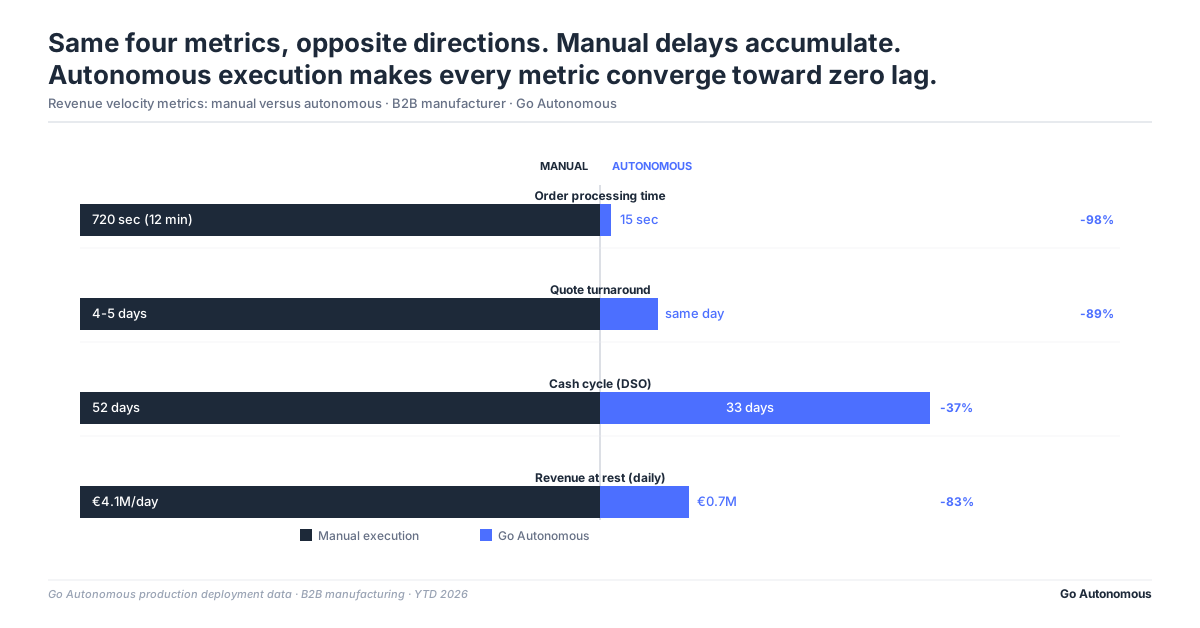
Autonomous execution raises Revenue Velocity by removing the human latency between demand signal and confirmed revenue. When the Autonomous Commerce platform processes an incoming order, it reads the channel (email with PDF attachment, EDI 850, portal submission, cXML punchout), extracts commercial intent, validates pricing and inventory, and writes the confirmed order to the ERP. Standard orders complete in under 60 seconds. The Revenue Velocity improvement is structural: it does not depend on team size, shift schedules, or peak demand periods.
For complex orders requiring pricing policy resolution, contract tier validation, or exception handling, the platform routes to a human operator with full context pre-populated. The operator makes the decision. The platform executes. Exception resolution that previously took hours across email threads closes in minutes. The Human Dependency Ratio drops as exception resolution speed increases and the autonomous handling rate expands.
How Does Autonomous Order Execution Improve Revenue Velocity?
Autonomous execution improves Revenue Velocity across three mechanisms. First, it eliminates the processing delay between channel receipt and ERP entry for standard orders. Second, it compresses exception handling time from hours to minutes by pre-populating decision context for operators. Third, it runs at consistent speed regardless of volume spikes, eliminating the Revenue Velocity degradation that occurs during quarter-end surges when manual teams hit capacity.
Rules-based automation tools, including RPA platforms such as UiPath, Blue Prism, and Automation Anywhere, improve velocity for structured, predictable inputs. They process EDI orders reliably. They do not handle the unstructured email, the mismatched product code, or the quantity that conflicts with the pricing tier in the customer contract. Those cases require reasoning. Autonomous Commerce applies AI-based reasoning to resolve them autonomously or routes them with full context. The coverage rate that determines Revenue Velocity improvement is the proportion of order volume resolved without human intervention: the autonomous rate, not the EDI rate.
Danfoss reduced order processing time from 42 hours to under 1 minute, with 80 percent of decisions made autonomously across 26 countries. That improvement is a Revenue Velocity transformation: demand that previously took nearly two business days to convert to confirmed revenue now converts in under a minute. See the Danfoss case study for the full outcome picture.
Adopting Autonomous Commerce at Danfoss is not just about speed and efficiency. It's about empowering our customer service teams and sales force to focus on building relationships and providing personalized support.

The Danfoss outcome Carlos García describes connects Revenue Velocity to commercial capacity reallocation: when the execution layer handles order confirmation autonomously, the commercial team refocuses on relationships and complex sales rather than order entry and exception follow-up. The topline growth and margin management impact is downstream of Revenue Velocity: faster execution frees commercial capacity that was previously absorbed by operational maintenance.
At Mediq, autonomous execution handles 4,000 orders per week with 75 percent faster processing and zero headcount increase. The Revenue Velocity improvement is captured not just in processing speed but in the capacity to scale order volume without proportional team growth. For more on operational efficiency gains from autonomous execution, including the headcount-to-revenue ratio impact, the Go Autonomous outcomes overview covers the full picture. See the Mediq case study for distribution sector specifics.
Why Does Revenue Velocity Matter More Than Order Volume at Scale for B2B Manufacturers?
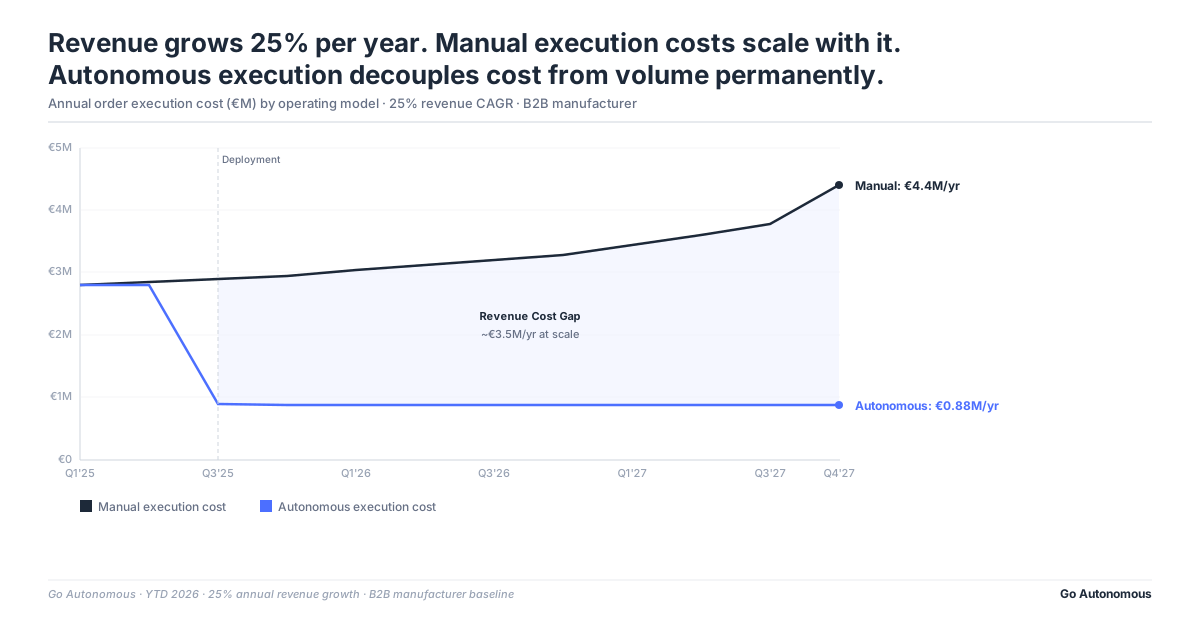
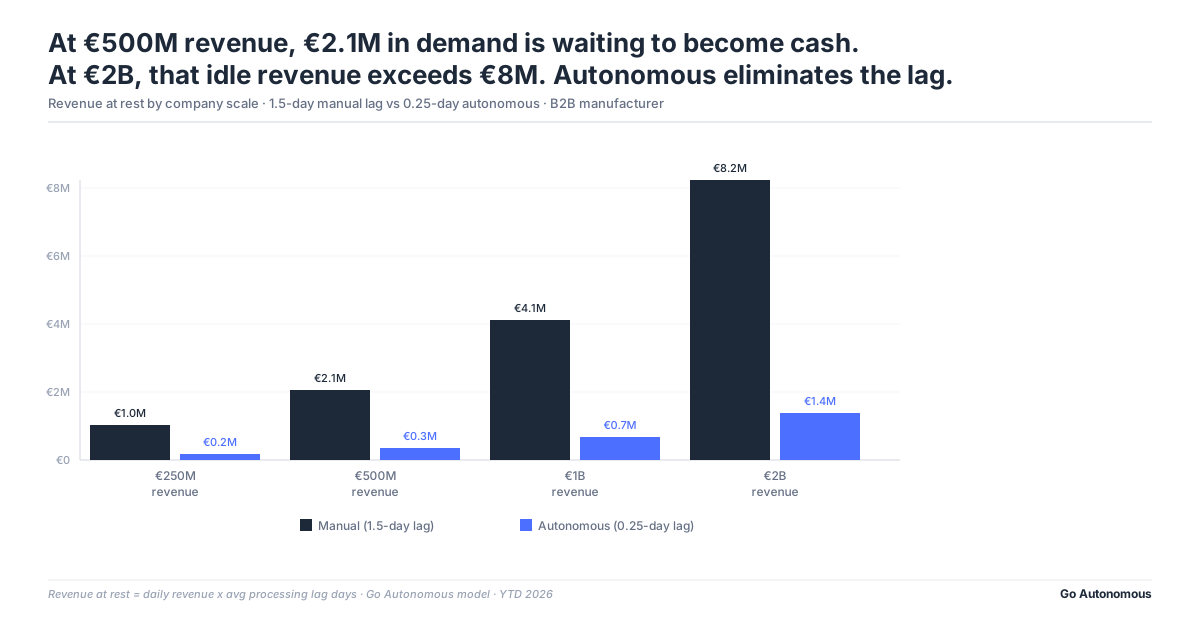
At low order volumes, processing lag is manageable. At 500M EUR revenue with thousands of weekly transactions, each additional day of average processing time represents millions in working capital tied up in unconfirmed revenue. The working capital cost of slow Revenue Velocity grows in direct proportion to revenue scale. A manufacturer at 200M EUR annual revenue with a 2-day processing lag has a smaller absolute exposure than the same manufacturer at 1B EUR. The ratio is the same but the absolute capital locked in the cycle is five times larger.
The dimension matrix below shows the operational contrast between low and high Revenue Velocity environments. These are not theoretical states. They reflect the operational profile of manufacturers and distributors before and after autonomous execution deployment across the Go Autonomous customer base.
| Dimension | Low Revenue Velocity | High Revenue Velocity |
|---|---|---|
| Average order processing time | 1 to 3 business days | Under 30 minutes for standard orders |
| Quote turnaround time | 2 to 5 business days | Same-day or fully automated |
| Cash conversion cycle | Extended and variable | Compressed and predictable |
| Headcount per million EUR processed | Grows proportionally with revenue | Flat or declining as volume scales |
| Exception rate | 20 to 40% of order volume | Under 10% with autonomous resolution |
| Revenue at Rest | High: significant backlog in processing queues | Near zero: minimal processing lag |
See What Autonomous Execution Does to Your Revenue Velocity
If your order intake is email-heavy, your processing times are measured in hours rather than minutes, and your commercial team spends significant time on order management rather than relationship development, your Revenue Velocity is constrained by execution architecture rather than demand. That constraint does not resolve through ERP optimization, RPA deployment, or headcount increases. It resolves when the execution layer between commercial intent and ERP record operates autonomously. Go Autonomous works with 500M to 20B EUR manufacturers and distributors in the Nordics, DACH, Benelux, UKI, and France. If the patterns described in this post apply to your operations, we can show you exactly what autonomous execution looks like in your environment: your ERP, your order channels, and your commercial workflows. Book a conversation with our team.
What the Board Is Actually Asking About Revenue Velocity
Before any initiative of this scale reaches sign-off, the same questions come up. Here are the direct answers.
“Is our revenue velocity actually improving, or are we just seeing volume growth?”
The diagnostic is straightforward: compare order processing time averages across the last 4 quarters. If average processing time is flat or growing while revenue grows, velocity has not improved. Volume has grown but the pipe is the same diameter. To separate velocity from volume, measure the proportion of orders confirming within 30 minutes, 2 hours, and same business day. If those proportions are not improving, neither is Revenue Velocity. ERP investment, CRM rollouts, and headcount increases do not move those proportions. Autonomous execution does.
“What does our current order processing time cost us in working capital?”
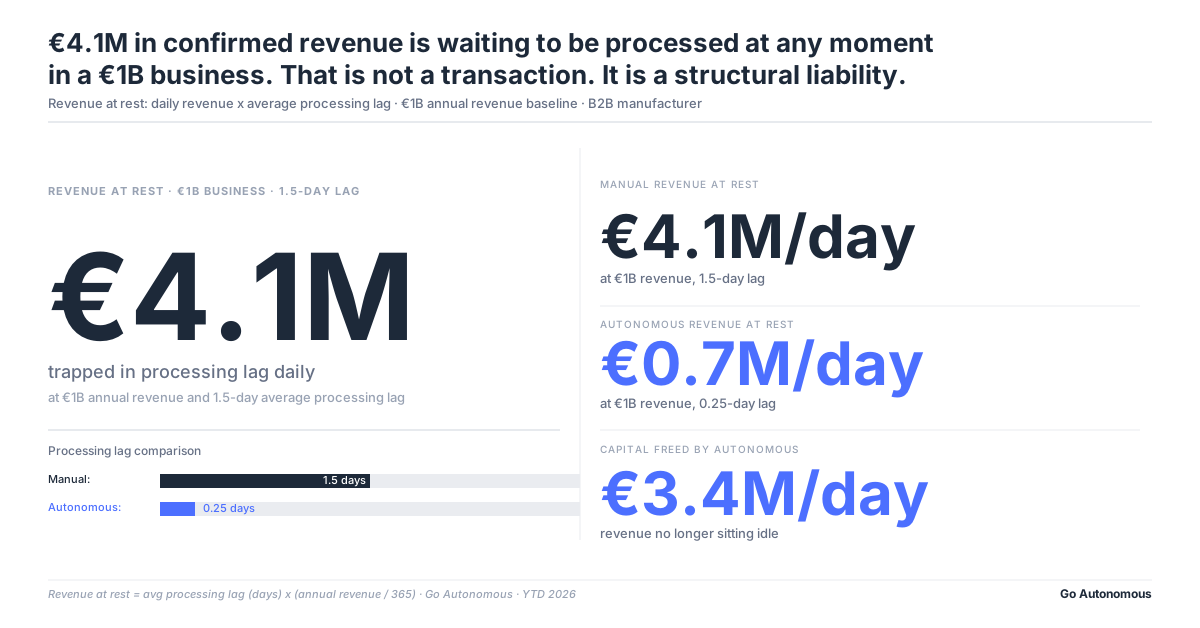
The formula: average processing time in days multiplied by daily order volume multiplied by average order value. That gives you the revenue in transit at any moment, waiting to become confirmed orders. At 1B EUR annual revenue with a 1.5-day average processing time, approximately 4.1M EUR sits in the pre-confirmation window at any given time. Compress that to 2 hours and the number drops by more than 90 percent. The freed working capital does not require new financing. It is already in the business, trapped in the processing lag.
“At what order volume does slow processing become a strategic disadvantage?”
The threshold varies by industry and customer concentration. In industrial manufacturing, the signal appears when customers begin requesting EDI-direct or portal-direct channels specifically to bypass email-based confirmation delays. In distribution, it appears when competitors offer confirmed order acknowledgment within minutes and your SLA is measured in business days. At 500M EUR revenue, a 2-day processing average positions your operation as a slow-execution supplier relative to peers deploying autonomous execution. That positioning affects renewal decisions before it appears in churn data.
Sources
- Salesforce State of Sales: Quote Cycle Time Research
- Go Autonomous: Danfoss Case Study
- Go Autonomous: Mediq Case Study
Frequently Asked Questions
What is revenue velocity in B2B manufacturing?
Revenue Velocity in B2B manufacturing is the rate at which demand converts to confirmed, executable revenue. It measures how fast incoming orders move from channel receipt to ERP-confirmed order status. High Revenue Velocity means standard orders confirm within minutes. Low Revenue Velocity means orders queue in email inboxes, wait for manual validation, or stall on pricing exceptions for hours or days.
How do you calculate revenue velocity for a B2B distributor?
Measure average order-to-confirmation time across all order types: time from channel receipt to ERP-confirmed order. Track the proportion of orders confirming within 30 minutes, 2 hours, and same business day. Compare these proportions across periods. If revenue grows but processing time proportions stay flat, volume has grown but Revenue Velocity has not improved. The ratio of confirmed revenue to average processing time gives the velocity figure.
What is the difference between revenue growth and revenue velocity?
Revenue growth measures the increase in confirmed revenue over a period. Revenue Velocity measures how fast demand converts to confirmed revenue during that same period. A business can grow revenue 20% while Revenue Velocity deteriorates, if processing team size grows proportionally and cycle times remain constant. High Revenue Velocity with flat revenue indicates faster economics. Revenue growth with flat velocity indicates a larger but not faster operation.
How does autonomous order execution improve revenue velocity?
Autonomous order execution improves Revenue Velocity by removing human latency between order receipt and ERP confirmation. Standard orders confirm in under 60 seconds instead of hours. Exception handling compresses from hours to minutes because operators receive pre-populated decision context rather than raw emails. Processing speed stays constant during volume peaks because the autonomous execution layer does not have a capacity ceiling tied to team size.
Why does revenue velocity matter more than order volume at scale for B2B manufacturers?
At scale, each additional day of average processing time represents millions in working capital tied up in unconfirmed revenue. The absolute working capital cost of low Revenue Velocity grows in direct proportion to revenue scale. A manufacturer at 1B EUR revenue with a 2-day processing lag has five times the working capital exposure of the same business at 200M EUR. Revenue Velocity also affects customer retention: slow confirmation speeds at high volume create commercial pressure from competitors offering faster execution.