.svg)





Quote-to-Cash Automation for B2B Manufacturers: Why Most Systems Stop at the Quote
Most quote-to-cash platforms automate quote generation and stop. Here's what closing the full Q2C cycle actually requires for B2B manufacturers.
Quote-to-cash automation is one of the most misunderstood terms in B2B operations. Most platforms marketed as Q2C solutions automate the quoting step alone, leaving order validation, pricing resolution, ERP entry, and confirmation to manual teams. For manufacturers processing high order volumes across email, portal, and EDI channels, that execution gap between signed quote and confirmed revenue is where working capital accumulates, win rates erode, and headcount compounds. This post explains where the real gap sits, why it grows with revenue, and how autonomous execution closes the full cycle from quote request to ERP entry, without human loops at any stage.
Table of Content
- What Quote-to-Cash Automation Actually Covers, and Where Most Systems Stop
- Why Rules-Based Q2C Automation Creates a Permanent Execution Gap
- How Autonomous Execution Closes the Full Quote-to-Cash Cycle
- From Quote Request to ERP Confirmation Without Human Loops
- How Autonomous Q2C Works for B2B Manufacturers With Complex Pricing and Multi-Channel Orders
- What Danfoss Achieved Closing the Q2C Gap Across 26 Countries
- How a Leading Cleaning Technology Manufacturer Scaled Order Volume Without Adding Headcount
- How to Evaluate the Q2C Execution Gap in Your Manufacturing Operations
- The Implementation Path: What Closing the Q2C Gap Actually Requires
- Sources
- Frequently Asked Questions
- See Autonomous Commerce in Action at the 2026 Summit
What Quote-to-Cash Automation Actually Covers, and Where Most Systems Stop
Quote-to-cash (Q2C) refers to the complete revenue execution cycle in B2B commerce: from the moment a customer requests a price to the moment that revenue is confirmed in the ERP and invoiced. In manufacturing and distribution, this cycle runs across six stages, quote creation, quote delivery and negotiation, order receipt, order validation, ERP entry and confirmation, and invoice generation. Most automation tools sold as Q2C solutions address stage one. Some reach stage two. Almost none address stages three through five. That gap is the problem.
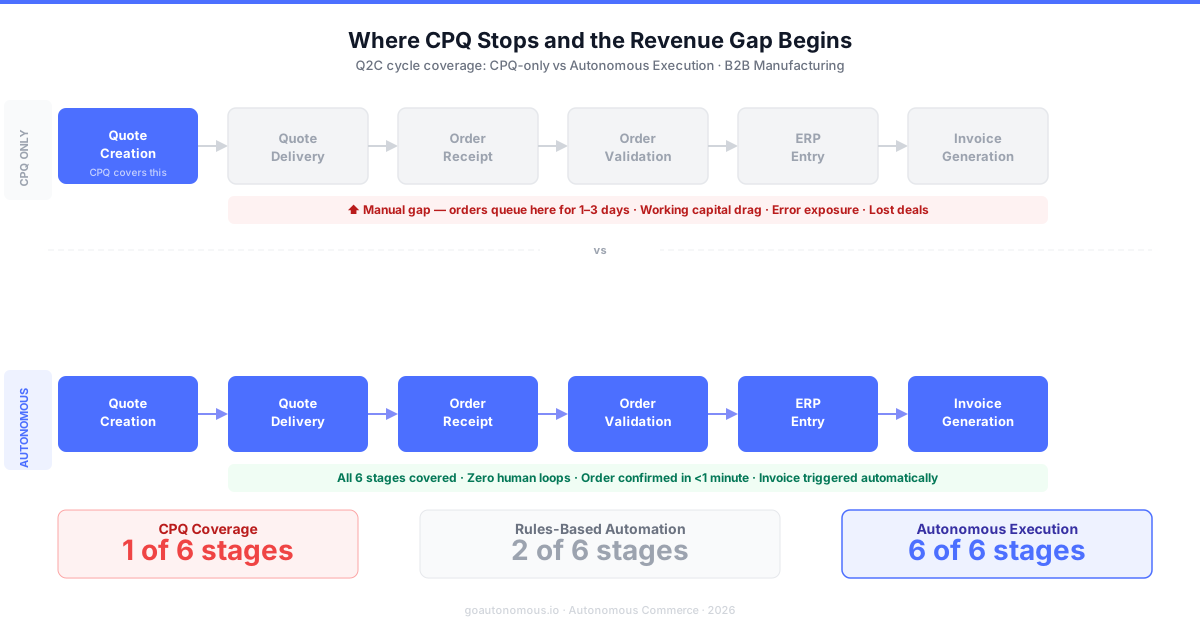
The consequence is predictable and measurable. A manufacturer invests in a CPQ platform, reduces quote generation time significantly, and then watches that gain evaporate because the customer’s purchase order arrives by email three days later, sits in a queue for two more days, and requires manual entry into SAP before the order is confirmed. The quote was fast. The cash was not. Improving one stage while leaving the others manual does not change the Q2C outcome, it moves the bottleneck downstream and calls the result automation. Understanding where autonomous commerce differs from that approach starts with being precise about what the full Q2C cycle actually contains.
The Six-Stage Q2C Cycle for B2B Manufacturers, and Where Manual Work Concentrates
Each stage in the Q2C cycle has a distinct automation challenge. Quote creation is the structured problem: configure the right product, apply the right price, generate the right document. CPQ handles this well when the product catalog is finite and the pricing logic is rules-based. Stage two, quote delivery and negotiation, involves follow-up, revision, and approval routing. Most CRM platforms partially address this.
Stages three through five are where the manual work concentrates in most B2B manufacturing environments. Order receipt means reading an incoming purchase order, which may arrive as a PDF, an EDI transaction, a portal submission, or a free-form email, and understanding what the customer is actually ordering. Order validation means checking that request against pricing agreements, available inventory, and order rules. ERP entry means writing the validated order into SAP S/4HANA, Oracle Cloud SCM, Microsoft Dynamics 365, or whichever system of record the manufacturer operates. Every one of these steps, in most organizations, involves a person. That is the b2b quote to cash process problem that most automation investments have not solved.
McKinsey’s research on order-to-cash automation consistently identifies the execution steps after quote delivery as the highest-value automation opportunity in manufacturing operations, not because quoting is easy, but because order entry, validation, and exception handling are where the most manual labor, error, and delay concentrate. The autonomous commerce approach to Q2C covers this full cycle end-to-end, not just the structured quoting component.
Why CPQ Is Not Quote-to-Cash Automation for Manufacturing Operations
Configure-Price-Quote platforms have been positioned as the answer to Q2C complexity for over a decade. CPQ addresses one problem well: structured pricing configuration for products with significant variant complexity. When a sales team needs to quote a custom product configuration with tiered pricing and conditional discounts, CPQ generates a clean, compliant proposal. That is the extent of what CPQ does.
CPQ does not receive orders. It does not validate incoming purchase orders against existing customer pricing agreements. It does not resolve discrepancies between what a customer sends and what the ERP expects. It does not write confirmed orders to any ERP. Everything that happens after the quote leaves the CPQ system happens in a different tool, usually by a different team, almost always with significant manual intervention. Forrester’s order management systems research identifies the gap between CPQ output and confirmed ERP entry as one of the least automated segments of the B2B revenue cycle, a finding that has been consistent across multiple waves of their research.
The practical implication is this: a manufacturer running CPQ has automated quoting. It has not automated Q2C. The order desk still handles everything after the quote. The exception queue still fills every morning. The ERP entries still require a person to touch each order. CPQ is a quoting tool. It is not a revenue cycle automation tool. Understanding that distinction is the prerequisite for selecting the right approach to autonomous quote to cash.
How Email-Based Orders Fall Outside Every Q2C Tool B2B Manufacturers Already Own
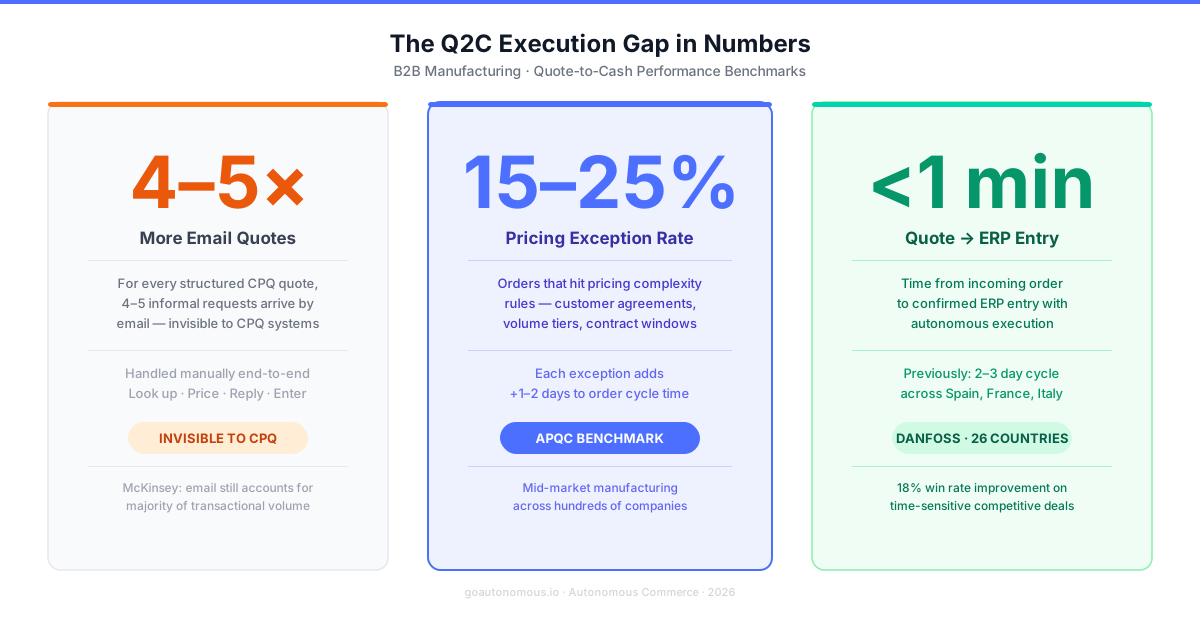
For every structured quote flowing through a CPQ system, most manufacturers receive four or five informal quote requests arriving by email, portal message, or phone. A customer sends a two-line email: “Please quote 500 units of part A4412, delivery by end of month, ship to our Hamburg facility.” That request enters no CPQ workflow. It lands in an inbox. Someone reads it, looks up the pricing agreement, checks availability, and writes back a quote, manually, end to end. When the customer confirms, someone else enters the order into the ERP manually, end to end.
This informal order volume is where most Q2C team time is consumed, yet it is invisible to most automation investments. It does not appear in CPQ utilization reports. It does not flow through the order management system. It represents the actual daily workload of commercial customer service teams in manufacturing. McKinsey’s B2B digital research shows that email and informal channels still account for the majority of transactional volume in manufacturing and distribution, regardless of how much has been invested in structured digital order channels. The revenue cycle automation gap for manufacturers is, in large part, an email problem that CPQ, EDI, and portal solutions were never designed to solve.
Each time we added one or two million euros in revenue, we had to add another operator. From a cost perspective, that's an unsustainable way of operating a business.

That dynamic, revenue growing, headcount growing with it, margin compressing, is the structural outcome of a Q2C process that has not been automated end to end. The quote is fast. The execution is not. And adding people is the only lever available when the execution steps remain manual. The operational efficiency gains from closing the full Q2C cycle break that scaling equation at its root.
Why Rules-Based Q2C Automation Creates a Permanent Execution Gap
Rules-based automation fails at specific, predictable friction points in the Q2C cycle. These are not edge cases, they are the structural characteristics of B2B manufacturing commerce that make rules an insufficient foundation for closing the execution gap. Understanding where rules break is the key to understanding why autonomous execution is a different category of solution, not a more sophisticated version of the same approach.
The Pricing Complexity Problem: Why Customer-Specific Agreements Break Standard Workflows
Customer-specific pricing is the defining characteristic of B2B manufacturing commerce. Unlike consumer transactions, where a single price applies to every buyer, B2B manufacturers maintain hundreds or thousands of customer-specific pricing agreements. A distributor buying under a volume commitment pays differently from a strategic account under a long-term contract, which pays differently from a transactional buyer at standard list price. Each agreement has its own structure, its own conditions, and its own exceptions.
Rules-based automation handles the simplest pricing scenario: the buyer matches the customer master, the item matches the catalog, and the price tier applies straightforwardly. When any of those conditions is ambiguous, a buyer references an old part number, a pricing agreement is under renegotiation, a volume threshold applies conditionally based on quarterly cumulative orders, the rule fails and the quote or order escalates to a human for resolution. APQC benchmarking research on order management processes consistently shows pricing exception rates of 15 to 25 percent in mid-market manufacturing environments, with each exception adding an average of one to two days to order cycle time.
Pricing complexity is not a solvable rules problem. The number of potential pricing scenarios across a manufacturer’s full customer base is combinatorial. Writing rules for every scenario is not feasible, and maintaining those rules as agreements evolve grows faster than any team can sustain. The result is a permanently elevated exception rate that keeps the q2c execution gap open regardless of how much the rules library expands. Rules-based automation has a ceiling. That ceiling is set by pricing complexity. Most B2B manufacturers hit that ceiling well below 100 percent autonomous order handling.
What a Stalled Order Costs in Working Capital and DSO for Manufacturing Finance Teams
Every day an order sits in a processing queue before ERP entry is a day the invoice has not been generated. For manufacturers on net-30 or net-45 payment terms, a two-day queue in order processing translates directly into two days of additional days-sales-outstanding, not as an accounting abstraction, but as actual cash that has not yet begun its collection cycle.
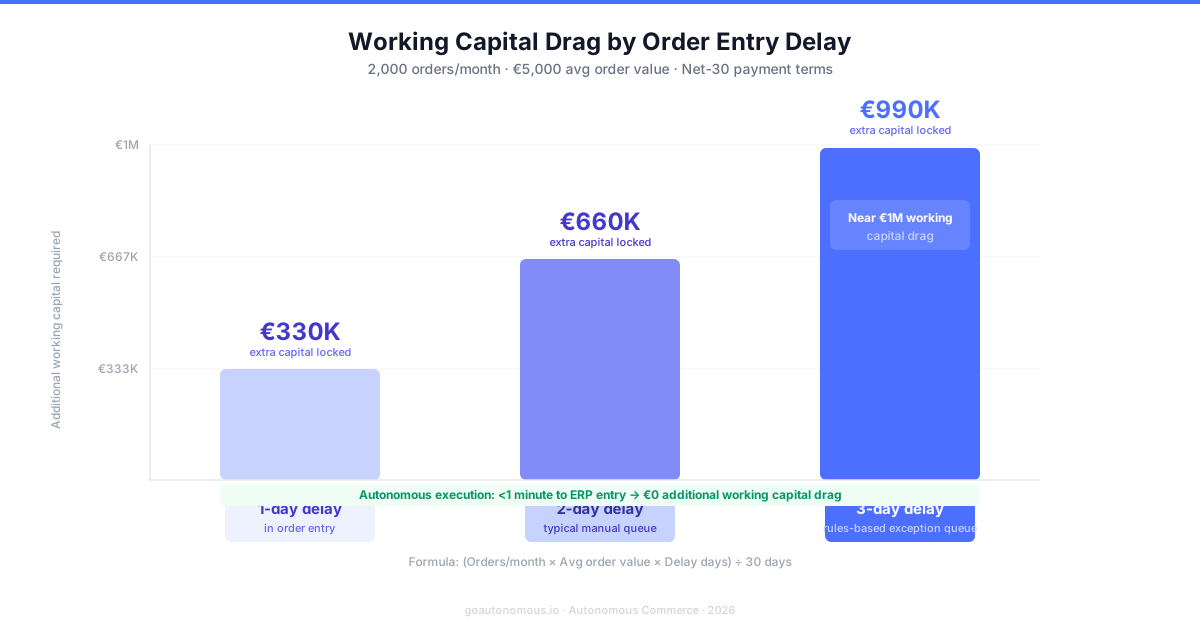
At meaningful order volumes, this matters significantly to the balance sheet. Consider a manufacturer processing 3,000 orders per month at an average order value of €4,000. A two-day order entry delay means approximately €800,000 in additional working capital requirement at any given time, relative to a manufacturer achieving same-day ERP entry. That is capital tied up in the processing queue, not deployed, not earning, not available for reinvestment. Deloitte’s order-to-cash transformation research identifies working capital recovery as the primary financial benefit of Q2C transformation for manufacturing CFOs, not labor savings, but cash cycle compression. The topline growth and margin management case for autonomous Q2C sits directly on this foundation.
Why the Revenue Cycle Automation Gap Grows Proportionally With Revenue
The Q2C execution gap grows proportionally with revenue unless the underlying process changes. More revenue means more customers, more quote volume, more order volume, and more exceptions. The order desk that handles 1,000 orders per month cannot handle 2,000 without proportional headcount growth, unless the exception rate falls and the manual touch rate per order falls with it. In a rules-based automation environment, neither of those things happens automatically. More volume means more exceptions, not fewer.
This is the structural economics of a manually dependent Q2C process at scale. Incremental automation approaches do not change it. Adding workflow tools, improving CRM-to-ERP connectors, or deploying RPA for specific repetitive steps reduces friction at the margin but does not change the fundamental scaling characteristic of the process. Each incremental euro of revenue continues to require incremental human effort in the Q2C cycle. Understanding this structural problem is what motivates the shift from automation to autonomous execution, and why the manufacturers doing it are not treating it as an IT project but as a strategic business transformation.
The companies that have made this shift share a common starting point: they had already tried incremental automation and the Q2C gap remained. CPQ was deployed. Workflow tools were added. ERP connectors were improved. The exception queue kept growing. The headcount kept growing. The gap between signed quote and confirmed revenue stayed at two to four days. That is the moment when the conversation about autonomous execution becomes urgent rather than exploratory. You can see how manufacturers reached that point and what they did about it at the Go Autonomous success cases library.
How Autonomous Execution Closes the Full Quote-to-Cash Cycle
Closing the full Q2C cycle requires a system that handles every stage autonomously, not just quote generation, but order receipt, validation, pricing resolution, and ERP writeback. Autonomous execution is not a faster version of rules-based automation. It is a fundamentally different approach: instead of matching incoming requests against predefined rules, the system understands the request in context, resolves ambiguity from available data, and executes the transaction end to end without a review step. The sections below describe what that looks like in practice for B2B manufacturers operating at scale.
From Quote Request to ERP Confirmation Without Human Loops
In a fully autonomous Q2C workflow, the cycle runs as follows. A customer sends a quote request, by email, portal message, or EDI transaction. The system reads the request, identifies the customer, resolves the relevant pricing agreement, checks inventory availability, generates the quote, and sends the response. No one forwards the email. No one looks up the pricing. The response goes out in minutes, not hours.
When the customer confirms, by replying to the email, clicking a portal button, or sending a purchase order, the system reads that confirmation, validates the order against the quote, resolves any discrepancies within defined tolerance parameters, and writes the confirmed sales order to the ERP. The ERP entry is indistinguishable from a manually entered order. The customer receives an order confirmation. The invoice cycle begins. The cash cycle starts. No human touched the transaction from request to ERP entry.
That is autonomous quote to cash execution. Not a faster queue. Not a smarter routing rule. Full cycle closure, autonomously, from first customer contact to confirmed revenue in the system of record. The autonomous commerce platform is built specifically to operate this full cycle, not as a bolt-on to CPQ or CRM, but as the execution layer that handles everything after the commercial decision has been made.
How Autonomous Q2C Works for B2B Manufacturers With Complex Pricing and Multi-Channel Orders
The hardest part of autonomous Q2C execution is not reading the order, it is resolving the pricing. Customer-specific agreements, volume thresholds, promotional conditions, and regional price variations create a resolution problem that rules cannot handle at scale. Autonomous execution approaches this differently: the system resolves pricing from the full context of the customer relationship, the agreement in place, and the order being submitted, not from a fixed rule set.
This matters particularly for manufacturers with large customer bases and diverse order channels. A distributor sending orders by EDI, a regional contractor sending orders by email, and a key account submitting orders through a dedicated portal all require different handling, different format parsing, different pricing resolution paths, different ERP entry logic. Autonomous execution handles all three channels with the same underlying system, without channel-specific rules maintenance. The customer experience is consistent regardless of channel because the execution layer abstracts channel complexity from the customer interaction entirely.
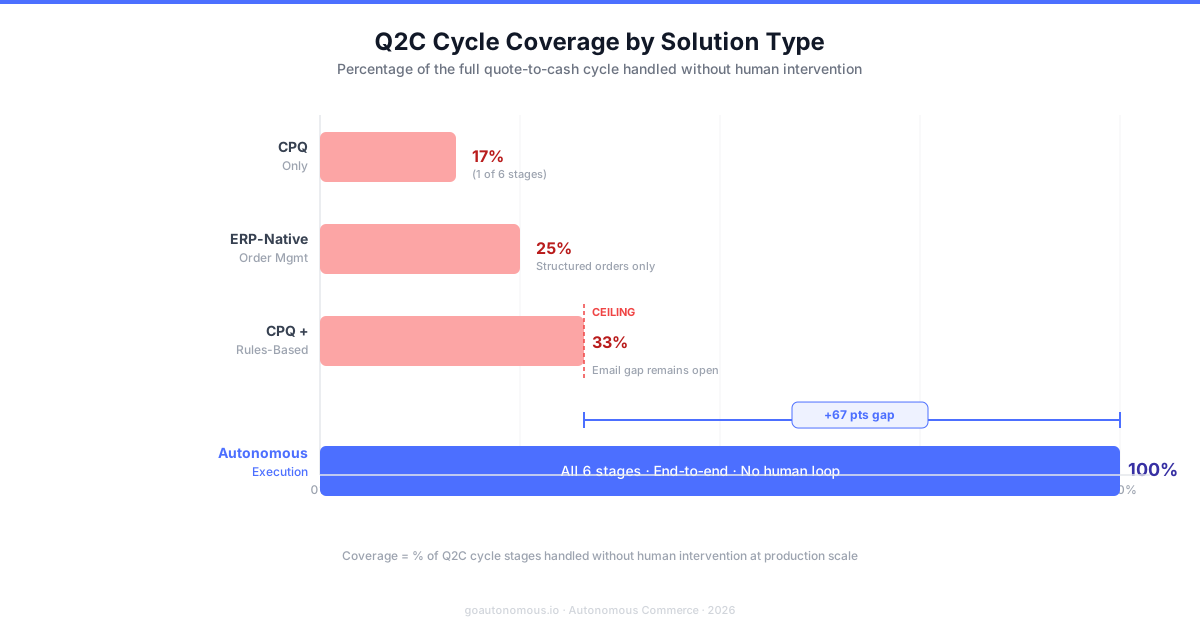
For order to cash automation in manufacturing specifically, this channel-agnostic execution capability is the critical differentiator. EDI-only solutions handle EDI orders. Portal solutions handle portal orders. Email is left to the team. Autonomous execution covers all three, which means the full order volume is covered, not just the structured portion. Aberdeen Group’s research on B2B order management strategies consistently identifies multi-channel order handling as the leading operational challenge for mid-market manufacturers, and the primary barrier to achieving meaningful automation rates across the full order book.
What Danfoss Achieved Closing the Q2C Gap Across 26 Countries
Danfoss, a global industrial manufacturer operating across 26 countries, implemented autonomous Q2C execution to close the order processing gap in markets where email order volume was highest, Spain, France, and Italy, before scaling the approach globally. The outcome was a reduction in order processing time from multiple days to under one minute per order, across all channels, without replacing the ERP or restructuring customer relationships. The commercial team did not lose their role. They stopped spending it on data entry and started spending it on relationships and margin conversations.
The Danfoss implementation demonstrates a point that is important for any manufacturer evaluating autonomous Q2C: the system does not require customers to change their behavior. Customers who were sending orders by email continued sending orders by email. Customers using EDI continued using EDI. The change was entirely on the manufacturer’s side, the execution layer now handles those inputs autonomously, regardless of format, and delivers confirmed ERP entries at the speed of software rather than the speed of a staffed queue. See the full Danfoss implementation detail here.
How a Leading Cleaning Technology Manufacturer Scaled Order Volume Without Adding Headcount
Nilfisk, a leading cleaning technology manufacturer, faced the classic scaling problem: order volume was growing, and the operations team needed to keep pace without proportional headcount growth. The order desk was processing a high volume of incoming orders across multiple channels, with significant variation in format and a meaningful exception rate driven by product complexity and customer-specific pricing. Manual processing was the constraint on growth, not product, not demand, but order execution capacity.
After implementing autonomous order handling, Nilfisk achieved a material shift in the ratio of orders processed autonomously versus manually, demonstrating what revenue cycle automation for manufacturers looks like when it covers the full execution cycle rather than just the structured portion. The commercial customer service team redirected capacity from routine order entry to exception management, customer relationship work, and commercial development. Read the full Nilfisk case here.
The pattern is consistent across implementations. When autonomous execution takes over routine Q2C execution, the human team’s time shifts from transaction processing to judgment work. That is not a reduction in the team’s importance, it is an upgrade in what the team does. The efficiency gains are measurable in processing cost and DSO. The strategic benefit is a team that spends its time on what actually requires human judgment, rather than on work that software should have been doing for years.
How to Evaluate the Q2C Execution Gap in Your Manufacturing Operations
Quantifying the current Q2C gap is the prerequisite for any credible investment case. Three operational metrics give a complete picture of where the gap sits and how large it is. Together they define the baseline against which autonomous Q2C execution ROI is calculated, and they are available in most manufacturers’ existing ERP and CRM systems without any additional instrumentation.
Three Metrics That Reveal Where Revenue Is Leaking in Your Q2C Cycle for B2B Manufacturers
The first metric is quote response time: how many hours on average between a quote request arriving and the quote leaving your team. This measures the efficiency of the quoting stage. If it consistently exceeds 24 hours for standard requests, the informal quote process, email, portal, phone, is consuming significant team capacity with no meaningful automation support.
The second metric is quote-to-order conversion lag: how many days between a customer confirming a quote and the order appearing in your ERP as a confirmed sales order. This measures the efficiency of the execution stage, the gap between signed quote and recognized revenue. If this exceeds 24 hours, the order entry process is creating measurable working capital drag and delaying the invoicing cycle.
The third metric is manual touch rate on incoming orders: what percentage of purchase orders require at least one human action, review, correction, lookup, or escalation, before ERP entry. This measures the automation coverage of the current system. If the manual touch rate exceeds 50 percent, the automation investment to date has not addressed the exception-heavy portion of order volume, which is precisely where the Q2C cost concentrates.
- Quote response time above 24 hours on standard requests indicates the informal quote process is running manually with no automation coverage.
- Conversion lag above 24 hours indicates the order entry stage is creating structural working capital drag, compounding daily across order volume.
- Manual touch rate above 50 percent indicates the current automation approach has not solved the exception problem, rules are covering the easy cases and leaving the costly ones to the team.
- Q2C headcount growing in line with order volume is the clearest signal that the process is structurally manual, automation investments have not changed the scaling equation.
IDC research on B2B commerce automation consistently finds that manufacturers with a manual touch rate above 60 percent are carrying 30 to 40 percent more order processing cost than peers operating with autonomous execution, and that DSO runs two to four days longer, with corresponding working capital impact. The cost difference is structural, not marginal. It does not close through incremental improvement. It closes through a fundamentally different execution approach.
Building the ROI Case for Autonomous Q2C in Distribution and Manufacturing
The financial case for autonomous Q2C has three components: working capital recovery, processing cost reduction, and revenue impact from faster conversion. Working capital recovery is the most immediately quantifiable. Take your monthly order volume, multiply by average order value, multiply by average days saved in the order entry lag, and divide by 30. That is the working capital released by same-day ERP entry. For most mid-market manufacturers, this number runs into the hundreds of thousands of euros annually.
Processing cost reduction is the second component. The fully-loaded cost of a manually processed order, including the order desk FTE time, exception resolution time, error correction, and re-entry, runs significantly higher than most operations leaders estimate when it is tracked carefully. Gartner’s supply chain research on order-to-cash benchmarks the cost per manually processed order across manufacturer segments, and the variance between manual and autonomous processing is typically an order of magnitude once the full cost is captured.
Revenue impact is the third component and the most strategically significant. A manufacturer that responds to quote requests in minutes instead of hours converts more competitive opportunities. Response speed is a differentiating factor in markets where multiple suppliers are quoting simultaneously, independent of price, independent of product. McKinsey’s B2B sales research shows that speed of response is among the top factors influencing supplier selection in manufacturing procurement. Autonomous quote to cash does not just reduce the cost of serving existing customers. It improves win rate on new business where timing is competitive.
What Mediq Achieved on Autonomous Order Handling Rate in Healthcare Distribution
Healthcare distributor Mediq operates in one of the more demanding B2B order environments, high order frequency, strict product compliance requirements, and customers who expect both accuracy and speed. Achieving a 91 percent autonomous order handling rate in that environment demonstrates what is possible when the autonomous Q2C execution layer is built to handle the full complexity of the customer base, not just the structured portion. Read the Mediq case here.
The 91 percent rate means that nine out of ten orders entering Mediq’s system are processed from receipt to ERP entry without any human action. The remaining nine percent, which includes genuine exceptions, new customer setups, and unusual order configurations, receive focused human attention because the routine work is no longer competing for that attention. That is the operational model that autonomous Q2C execution enables: not a replacement of human judgment, but a clear separation between what software should handle and what humans should handle. See how other B2B companies have made this shift at scale.
The Implementation Path: What Closing the Q2C Gap Actually Requires
Autonomous Q2C execution does not require replacing the ERP, rebuilding the customer portal, or asking customers to change how they order. The implementation path is narrower than most manufacturers expect, and the timeline is faster than an ERP implementation by a significant margin. What it does require is a clear-eyed view of where the current system stops and where autonomous execution needs to begin.
Five Steps to Evaluate and Deploy Autonomous Q2C in a Manufacturing Environment
Most manufacturers moving to autonomous Q2C execution follow a consistent evaluation and deployment path. The steps below reflect what works in practice, not a theoretical framework, but the sequence that produces fast time-to-value without disrupting live order operations during implementation.
- Baseline measurement: Establish current quote response time, order-to-ERP lag, manual touch rate, and exception rate by category. These four numbers define the gap and set the ROI baseline. Without them, every vendor claim about improvement is unverifiable.
- Order channel audit: Map every channel through which orders arrive, email, portal, EDI, phone, fax, and any others. Quantify volume by channel and exception rate by channel. Email is almost always the largest channel by volume and the highest by manual touch rate. Any Q2C solution that does not handle email natively cannot close the gap.
- Pricing complexity assessment: Catalog the number of distinct customer pricing agreements, the exception types that occur most frequently, and the resolution time per exception type. This determines whether rules-based automation has a viable ceiling or whether the complexity requires autonomous resolution.
- ERP integration scoping: Define what the autonomous execution layer needs to read from and write to in the ERP. Customer master, pricing conditions, inventory availability, and sales order creation are the minimum. Most ERP platforms expose these via standard APIs. Integration scope is rarely the constraint.
- Phased deployment: Start with the highest-volume, most standardized order type, typically email orders from existing customers with established pricing agreements. Achieve autonomous handling on that segment first, measure the results, and expand the deployment scope incrementally. This approach produces measurable ROI within weeks rather than months.
The manufacturers that achieve the fastest time-to-value in autonomous Q2C are those that resist the temptation to solve every edge case before going live. The goal is autonomous handling of the routine majority, with a well-defined escalation path for genuine exceptions. Getting to 70 or 80 percent autonomous handling quickly and then expanding beats spending six months designing a system that handles everything in theory and nothing in production.
If your organization is at the point where the Q2C gap analysis above maps to your current situation, response times over 24 hours, conversion lag over two days, manual touch rate above 50 percent, the right next step is a live demonstration of autonomous execution on your order types. Book a session here to see the full Q2C cycle running on realistic manufacturing order scenarios.
Sources
- McKinsey & Company: Order-to-Cash. The Next Frontier for Applying Digital and AI
- McKinsey & Company: The B2B Digital Inflection Point, How Sales Have Changed
- Forrester: The Forrester Wave, Order Management Systems, Q4 2022
- APQC: Order Management Process Performance Benchmarks
- Deloitte Insights: Order-to-Cash Transformation
- IDC: B2B Commerce Automation Research
- Gartner: Order-to-Cash Supply Chain Insights
- Aberdeen Group: B2B Order Management Strategies
Frequently Asked Questions
Quote-to-cash automation in B2B manufacturing covers the full revenue execution cycle, from receiving a customer quote request through order validation, ERP entry, and invoice generation. Most tools marketed as Q2C solutions automate only the quote creation stage. True end-to-end quote-to-cash automation handles order receipt, pricing resolution, validation, and ERP writeback without human intervention at any stage of the cycle.
Customer-specific pricing agreements create exception rates that rules-based automation cannot resolve at scale. When an incoming order references pricing conditions outside a standard tier, a conditional volume threshold, a renegotiated agreement, or a regional price variant, the rule fails and the order escalates to a human. Because B2B pricing complexity is combinatorial rather than a fixed rule set, writing more rules does not solve the problem. Autonomous execution resolves pricing from the full context of the customer relationship, not from predefined conditions.
CPQ (Configure-Price-Quote) platforms handle structured quote configuration for products with variant complexity. They stop when the quote is delivered. Autonomous quote-to-cash execution covers what happens after: receiving the customer’s purchase order, validating it against the quote and pricing agreements, resolving discrepancies, and writing the confirmed order to the ERP. CPQ automates the quoting step. Autonomous execution automates the full revenue cycle.
Faster order entry means earlier invoicing. For a B2B distributor operating on net-30 payment terms, a two-day reduction in order entry lag translates directly into two days of lower DSO. At scale, across thousands of orders per month, this compression releases significant working capital. Autonomous Q2C execution achieves same-day or same-hour ERP entry, compressing the invoicing cycle to its structural minimum and recovering the working capital tied up in processing queues.
Implementation timelines for autonomous Q2C execution typically run four to eight weeks from kickoff to live processing on the first order segment. This assumes ERP API access is available (standard for SAP S/4HANA, Oracle Cloud SCM, and Microsoft Dynamics 365) and the initial deployment scope focuses on the highest-volume, most standardized order type. Full channel coverage, email, portal, and EDI, typically follows in a second deployment phase within three to four months.
Autonomous Q2C execution covers all order channels, email, EDI, customer portal, and structured order files, with the same underlying system. Email is typically the largest channel by volume and the highest by manual touch rate in manufacturing environments, and it is the channel least addressed by CPQ, EDI, and portal solutions. A Q2C approach that does not handle email natively cannot achieve meaningful automation rates across the full order book.
A manufacturer is operationally ready when three conditions are present: quote response time consistently exceeds 24 hours for standard requests, the order-to-ERP entry lag exceeds 24 hours, and Q2C headcount is growing in proportion with order volume. All three indicate a structurally manual Q2C process that automation investments have not addressed. The financial case is typically strongest at order volumes above 500 per month, where the working capital and processing cost benefits are large enough to produce a payback period under 12 months.
See Autonomous Commerce in Action at the 2026 Summit
The Autonomous Commerce Summit 2026 brings together operations and commercial leaders from B2B manufacturing and distribution who are actively transforming how revenue is executed. Hear directly from companies that have made the shift to autonomous execution, and what it means for revenue, cost, and working capital. Attendance is by invitation only.
Request your invitation →