.svg)





B2B Pricing Error Rate: How Often Manufacturers Ship at the Wrong Price
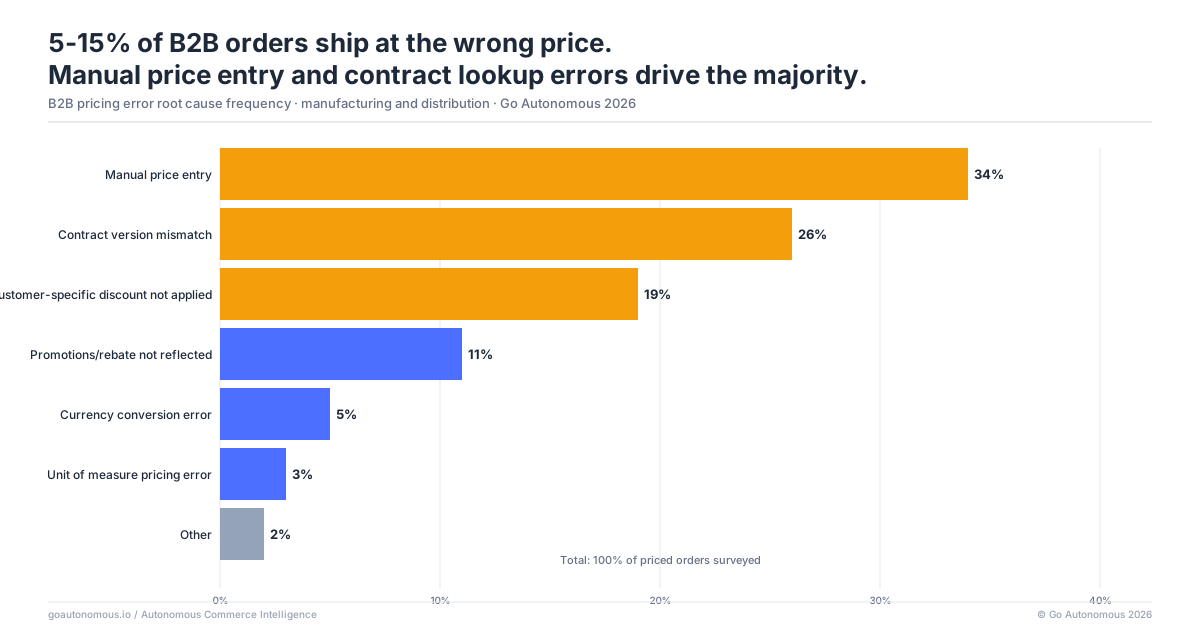
Between 5% and 15% of B2B orders in manufacturing and distribution involve a pricing discrepancy — a wrong contract price, an expired discount, or a manual entry error that sends an invoice customers will dispute. This benchmark post covers pricing error rates in 2026, where in the process errors originate, and what the downstream cost of a wrong-price order actually is.
Between 5% and 15% of B2B orders in manufacturing and distribution involve a pricing discrepancy at some point in the order-to-invoice cycle. The range reflects the share of orders processed manually from email and PDF versus those covered by EDI and well-maintained price books. Operations at the high end of this range generate invoice dispute volumes that represent a meaningful cost center — one that is typically reported under finance rather than operations, and therefore never traced back to the pricing process that created it.
This benchmark covers 2026 pricing error rates, where errors originate, and what the full downstream cost of a wrong-price order actually is across manufacturing and distribution operations.
Table of Content
- 5–15% of B2B Orders Involve a Pricing Error: Finance Rarely Tracks the Full Range
- Pricing Errors Originate at Quote and Persist Through Order: The Contract-to-Invoice Gap
- Wrong-Price Orders Generate an Invoice Dispute Cascade Costing 3–4x the Original Error
- Automated Pricing Validation at Order Entry Eliminates the Wrong-Price Order
- The Autonomous Execution Fabric: Pricing Accuracy Across Every Transaction Type and Channel
- Frequently Asked Questions
- What is the average pricing error rate for B2B manufacturers in 2026?
- What causes pricing errors in B2B order management?
- How do B2B manufacturers reduce invoice disputes from pricing errors?
- What is the full cost of a pricing error in a B2B manufacturing order?
- How does automated pricing validation reduce pricing errors in B2B distribution operations?
5–15% of B2B Orders Involve a Pricing Error: Finance Rarely Tracks the Full Range
How Pricing Errors Are Defined and Measured — or Not Measured
A pricing error is any discrepancy between the price agreed in a contract or quote and the price applied on the sales order or invoice. The definition encompasses: wrong base price applied from an outdated price list, incorrect discount rate calculated or applied, wrong contract pricing used for the wrong customer or ordering entity, pricing condition from a superseded contract applied instead of the current one, and manual entry errors in price fields during order creation.
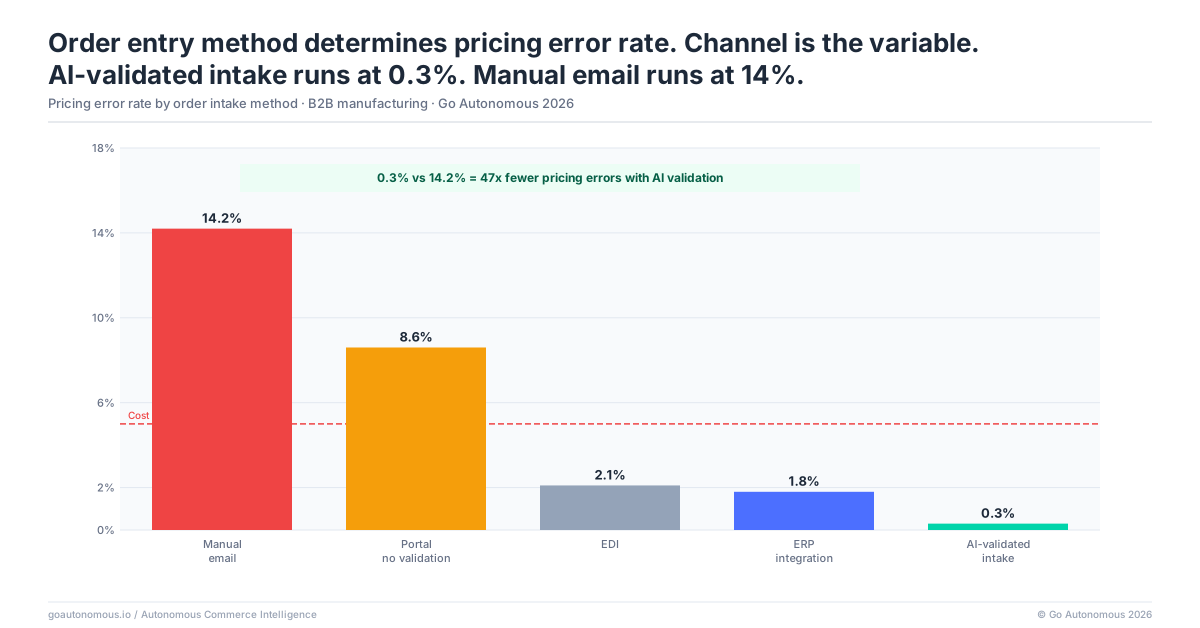
Most operations do not track pricing error rate as a standalone metric. Finance tracks invoice disputes — which represent pricing errors that reached the customer and were contested. Errors caught and corrected before invoicing are not aggregated in any standard report. The 5–15% range covers the full cycle, including pre-invoice corrections. The share that becomes invoice disputes — the visible portion — is typically 2–6% of orders, but this underrepresents the true pricing error rate because it excludes errors resolved internally and errors that were never noticed by the customer. Monitoring efficiency gains across the order-to-invoice cycle requires tracking the full range, not just disputes.
Why Finance Sees Only the Dispute-Stage Errors: The Invisible Pre-Invoice Pricing Gap
The pricing error range that finance does not see includes: errors caught by a customer service rep during order review and corrected before order confirmation, errors caught during invoice generation by a billing reviewer, and errors that reached the customer but were not contested because the customer did not notice or did not consider the amount worth disputing. Under-billings — where the customer received a lower price than contracted — are rarely disputed by the customer and frequently missed in internal audit until year-end reconciliation. Over-billings that fall below the customer’s dispute threshold generate goodwill costs rather than formal disputes: the customer absorbs the loss, remembers it, and factors it into their supplier evaluation at the next contract renewal.
Operations with high email and PDF order volume sit at the high end of the pricing error range. When 50–70% of order volume arrives through unstructured channels requiring manual pricing application, the opportunity for pricing error is present in every order. EDI-covered orders have automated pricing application and a much lower error rate — but EDI covers a fraction of total order volume in most manufacturing and distribution operations, with the majority still arriving through channels that require human pricing lookup and entry.
Each time we added one or two million euros in revenue, we had to add another operator. From a cost perspective, that's an unsustainable way of operating a business.

Pricing Errors Originate at Quote and Persist Through Order: The Contract-to-Invoice Gap
Where Pricing Errors Enter: Manual Quote Assembly, Outdated Price Lists, Manual Entry
The most common origin of a B2B pricing error is the quote stage. A customer service rep assembles a quote using an outdated price book — one that has not been updated since the last contract renewal. The error enters the sales order unchanged because the rep who created the quote is also the rep who enters the order, and there is no separate pricing validation step. It passes through warehouse picking and shipping without triggering a price check. The invoice goes out with the wrong number.
The second most common origin is manual order entry from customer purchase orders. A customer’s PO references a contract price from their records. The processor entering the order looks up the price in an internal system — sometimes a different system than the one the contract was originally set up in — and applies what they find, which may be a different version, a different tier, or an approximation. The price applied may be wrong by a small percentage: a 12% discount instead of 15%, or a list price instead of a contract price. The order ships. The invoice goes out. The customer’s accounts payable reconciles the invoice against their PO and flags the discrepancy.
Why Pricing Errors That Enter at Quote Are Rarely Caught Before Invoice
Pricing errors that originate at quote persist through the order-to-invoice cycle because there is typically no automated price validation step between quote creation and invoice generation. The sales order is created from the quote. The invoice is created from the sales order. If the pricing on the quote is wrong, the invoice will be wrong unless a human reviews the price at one of these transition points — which, in high-volume environments, does not happen systematically.
The contract-to-invoice gap is the distance between the agreed price and what actually ships. It is not a compliance failure in the sense of intentional non-compliance — it is an operational failure: the correct price was in a contract, and the process did not reliably retrieve and apply that price at each order entry point. The gap exists because pricing data lives in contracts, and order entry lives in an ERP, and the connection between the two is a human lookup step rather than an automated retrieval.
Wrong-Price Orders Generate an Invoice Dispute Cascade Costing 3–4x the Original Error
The Full Dispute Resolution Workflow: Who Touches It and How Long It Takes
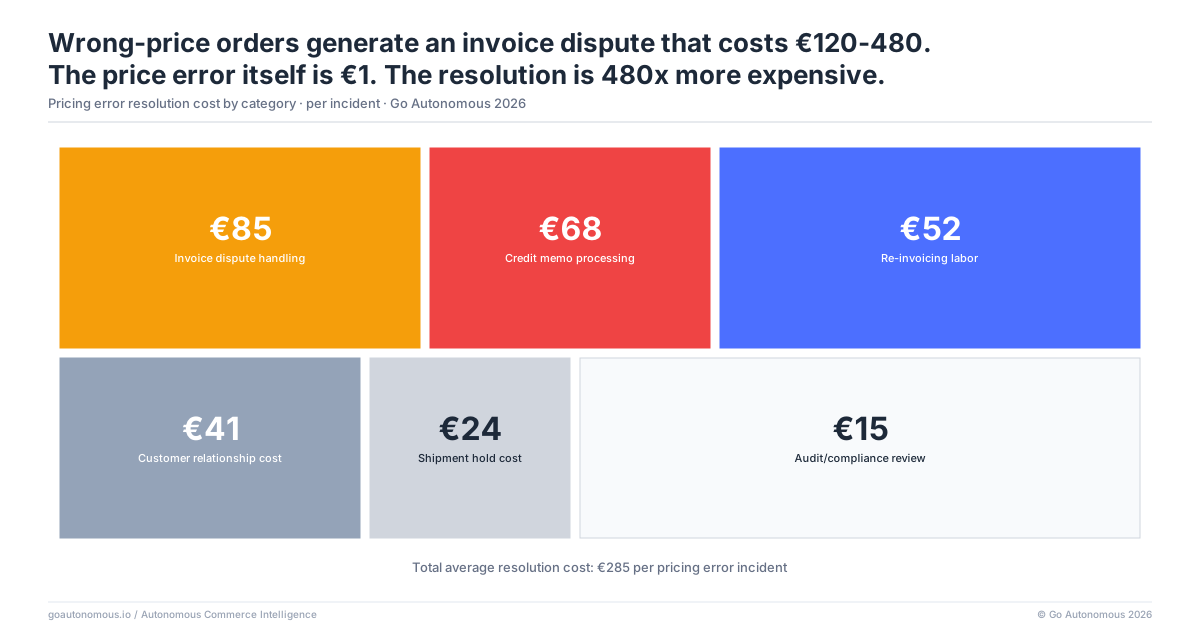
An invoice dispute is not a simple price correction. It requires: customer notification to acknowledge the dispute, internal investigation to identify the source order and the applicable contract pricing, determination of the correct price and the amount of the discrepancy, creation of a credit note or supplemental invoice, communication back to the customer with the correction documentation, update of any downstream records in finance and CRM, and, if the error represents a pattern, investigation of other orders from the same customer in the same period.
Across finance, customer service, and sales, this workflow runs 2–4 hours for a straightforward dispute where the source error is clear. When the source is ambiguous — the price applied does not match any obvious contract or price book version — investigation can run 4–8 hours across multiple people. At loaded labor rates, the dispute resolution cost for a single wrong-price order is €80–400 before accounting for the value of the original pricing discrepancy. The discrepancy itself may be €50–500. The cost of resolving it is often larger than the discrepancy being corrected.
The Relationship Cost: What Pricing Disputes Signal to Strategic Accounts
For strategic accounts — customers representing €1M+ in annual revenue — repeated pricing disputes signal process unreliability that extends beyond the individual transaction. The customer’s procurement and accounts payable teams invest time in dispute resolution that they attribute to the supplier’s operational quality. When pricing disputes recur across multiple orders, the customer’s assessment of the supplier shifts: from a reliable partner to one that requires oversight. This assessment manifests at contract renewal as a negotiating position, at tender evaluation as a risk factor, and in day-to-day purchasing as a preference for alternative suppliers on non-critical orders.
The pattern Mikkel Vindeløv describes applies here in reverse: each increment of growth adds more customers, more contracts, more pricing complexity, and more exposure to pricing errors. The scaling cost is not just headcount — it is the cumulative relationship cost of pricing disputes across a growing customer base. Operations that solve the pricing error problem structurally remove a compounding liability from their customer relationship portfolio.
Automated Pricing Validation at Order Entry Eliminates the Wrong-Price Order
How Pricing Validation Works: From Inbound Order to ERP-Applied Contract Price
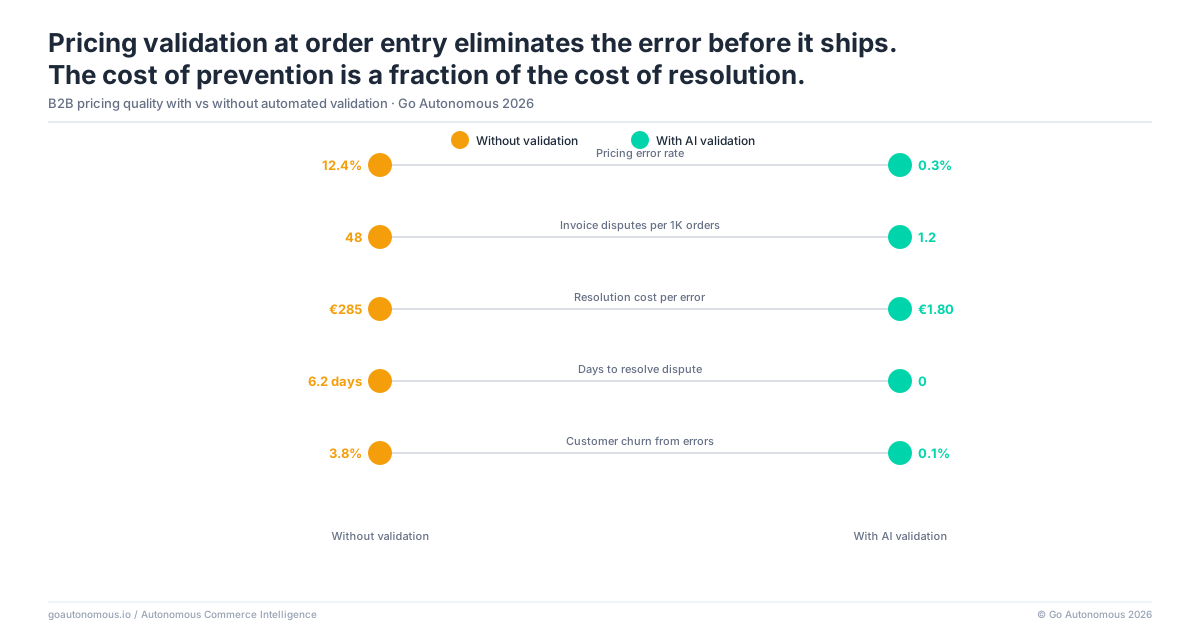
Automated pricing validation at order entry works by connecting the inbound order directly to the authoritative pricing source in the ERP. When an order arrives (from email, portal, EDI, or any channel), an AI layer identifies the customer, retrieves the applicable contract pricing record from the ERP or contract management system, applies it to each line item, and creates the sales order with validated prices. The lookup is not a human step — it is an automated retrieval from the single authoritative source.
The result: the correct price is applied every time. The price on the sales order matches the contract. The price on the invoice matches the sales order. There is no gap between contract and invoice because the contract was the source for every price applied in the order. Pricing disputes drop to genuine commercial disagreements — a customer challenging the contract price itself — rather than processing errors where the wrong price was applied from the wrong source.
What Finance Operations Look Like When Pricing Error Rate Drops Below 1%
Operations running automated pricing validation see invoice dispute volume drop materially within the first 60–90 days of deployment. Finance teams that were processing 200–500 dispute cases per month see that queue compress to genuine edge cases: contract interpretation disputes, new customer pricing not yet set up, special bid situations. The routine dispute — wrong price applied from wrong source — disappears. Collections improve because invoices are correct on first issue. Days sales outstanding (DSO) decreases because disputed invoices are no longer held in the customer’s accounts payable review queue.
The Autonomous Execution Fabric: Pricing Accuracy Across Every Transaction Type and Channel
Pricing errors in B2B order management originate at the point where human lookup replaces automated retrieval. The Autonomous Execution Fabric is a full commercial execution layer that connects directly to your SAP, Oracle, or Microsoft Dynamics environment and executes every inbound commercial transaction without human assembly. For pricing, the Fabric retrieves the applicable contract price from the ERP at the moment each transaction arrives and applies it to the sales order or quote directly. The human lookup step is removed. The correct contracted price is applied every time, regardless of which channel the transaction arrived through.
Pricing accuracy matters across more than inbound orders. The Fabric handles all commercial transaction types: orders across email, EDI, customer portal, and direct API; pricing requests; quote assembly; return authorizations; credit note processing; and contract tender responses. Each transaction type where price is a component carries the same exposure to manual pricing error. A quote assembled with an outdated price book creates downstream problems when the customer’s purchase order references that quoted price. A return authorization processed at the wrong price creates a credit note discrepancy. The Fabric applies correct pricing from the ERP at intake across all of these transaction types.
Pricing error rates are systematically underestimated in operations reporting because the full cost is distributed across finance, customer service, and sales. The Autonomous Execution Fabric closes the gap at its source: the manual lookup and entry step between contracted price and applied price. When pricing is retrieved from the authoritative ERP source at intake rather than approximated from memory or a secondary document, the error rate drops toward zero across all commercial transaction types simultaneously. The invoice dispute queue shrinks. Month-end reconciliation workload drops. Customer relationships improve because pricing is reliable.
VELUX processes 130,000+ orders across 9 markets with 88% decision autonomy, including pricing application (see success cases). The autonomous commerce approach applies the same contract-connected pricing logic across all order channels, not just EDI. To see what automated pricing validation delivers for your operation’s error rate and dispute volume, book a conversation with the Go Autonomous team.
Frequently Asked Questions
What is the average pricing error rate for B2B manufacturers in 2026?
The pricing error rate for B2B manufacturers in 2026 ranges from 5% to 15% of orders, depending on the share of volume processed manually versus through EDI. Operations with high email and PDF order volume sit at the high end of this range. Finance-visible invoice disputes represent only 2–6% of orders — the visible portion of a higher underlying error rate that includes pre-invoice corrections and uncontested errors.
What causes pricing errors in B2B order management?
Pricing errors in B2B order management are primarily caused by manual pricing lookup and entry: customer service reps applying outdated price books, incorrect discount rates calculated during quote assembly, and manual entry errors during sales order creation. The root cause is that pricing data lives in contracts and ERP systems while order entry relies on human lookup to connect the two, creating an error-prone gap between the agreed price and the price applied.
How do B2B manufacturers reduce invoice disputes from pricing errors?
B2B manufacturers reduce invoice disputes from pricing errors by implementing automated pricing validation at the point of order entry. AI that retrieves contract pricing directly from the ERP and applies it to each order line eliminates the manual lookup step where errors originate. The correct contract price is applied automatically to every order regardless of the channel it arrives through, dropping the dispute rate to genuine commercial disagreements rather than processing errors.
What is the full cost of a pricing error in a B2B manufacturing order?
The full cost of a pricing error in a B2B manufacturing order is 3–4x the value of the pricing discrepancy itself. Dispute resolution requires 2–4 hours of labor across finance, customer service, and sales for a straightforward case, at loaded rates of €80–400 per dispute. This does not include the relationship cost with strategic accounts where repeated pricing disputes signal process unreliability and affect contract renewal negotiations.
How does automated pricing validation reduce pricing errors in B2B distribution operations?
Automated pricing validation reduces pricing errors in B2B distribution by connecting inbound orders directly to the authoritative contract pricing record in the ERP, eliminating the manual lookup and entry steps where errors originate. The correct price is retrieved and applied automatically for every order, regardless of the channel. Operations running automated pricing validation see invoice dispute volumes drop by 80–90% within 60–90 days, with disputes limited to genuine genuine contract interpretation cases rather than processing errors.