.svg)





Email Order Processing Automation: How B2B Manufacturers Handle the Orders They Never Talk About
Email is how most B2B orders actually arrive — and most manufacturers still process them manually. Here's how autonomous execution changes that.
Email is how most B2B orders actually arrive, not portals, not EDI, not APIs. Research consistently puts email at 50–70% of total B2B order volume in industrial manufacturing and distribution, yet email is almost never the first channel manufacturers automate. This post is for operations and commercial leaders who want to understand why email order processing automation is the highest-leverage investment in their order management stack, what makes it technically hard, why RPA fails, and how autonomous execution handles unstructured email orders end-to-end without a human in the loop.
Table of Content
- Why Email Still Dominates B2B Order Volume
- The True Cost of Manual Email Order Processing
- Why RPA and Traditional Automation Fail on Unstructured Email Orders
- How Autonomous Execution Handles Unstructured Email Orders End-to-End
- Real-World Outcomes from Email Order Processing Automation
- The Implementation Path: From Email Chaos to Autonomous Order Intake
- What to Look for in an Email Order Automation Platform
- B2B Email Order Management: The Practical Next Step
- Sources
- Frequently Asked Questions
- See Autonomous Commerce in Action at the 2026 Summit
Why Email Still Dominates B2B Order Volume
The B2B ordering process has not evolved at the same pace as B2C commerce. While consumer e-commerce standardized around cart-and-checkout, B2B purchasing has remained fragmented, because B2B buying itself is fragmented. An industrial manufacturer selling into 30 or 40 countries will have enterprise customers running SAP S/4HANA, Oracle, Dynamics 365, and a dozen legacy ERP systems, each generating purchase orders in its own format. Asking those customers to log into a vendor portal or conform to an EDI standard works for the top 20 accounts. For the other 80%, email is the path of least resistance. And it always will be.
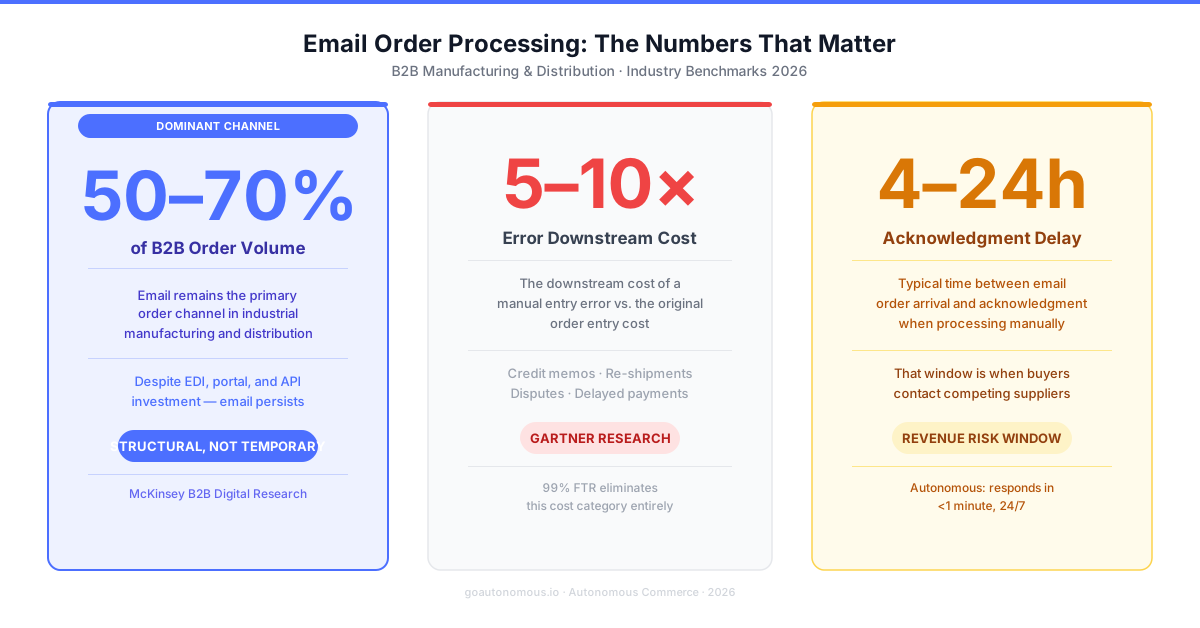
This is not a transitional problem waiting to be solved by technology adoption curves. McKinsey’s analysis of B2B manufacturers’ order channels found that email order volume remains stable even as EDI and portal adoption grows, because the long tail of customers expands faster than structured-channel adoption. New markets, new customers, new product lines all re-introduce email as the default. The channel is not shrinking. It is structural.
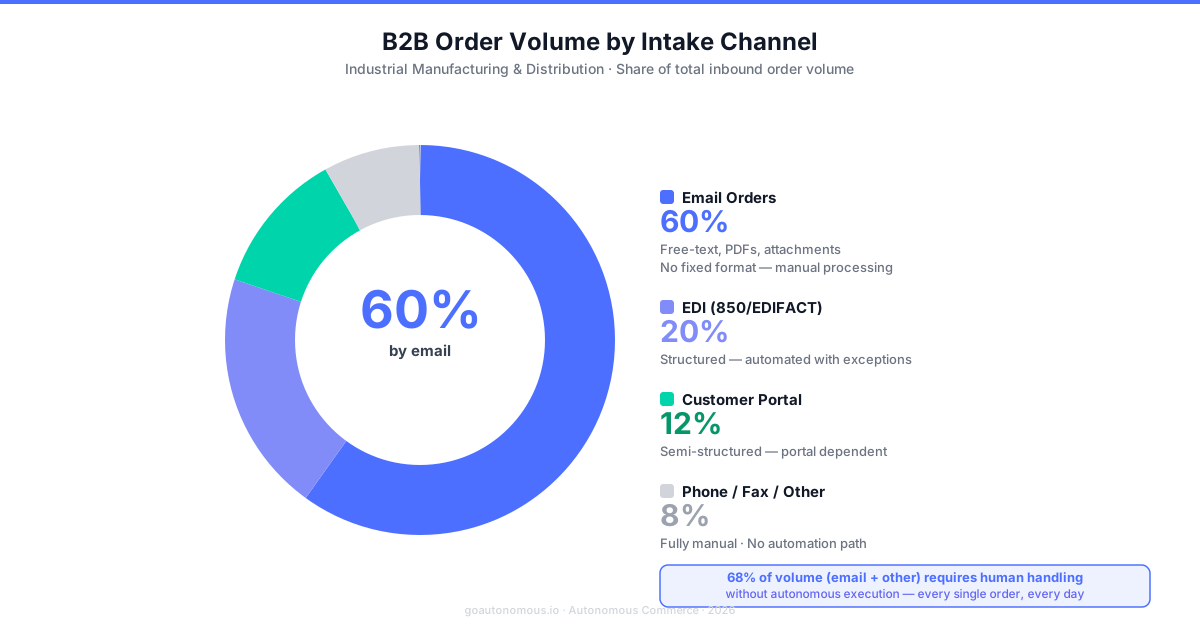
The Long Tail of Customer Formats in B2B Manufacturing Operations
What makes email orders different from EDI or portal orders is the complete absence of structure. An EDI 850 document has a defined schema. A portal order follows your form fields. An email order can be anything: a one-line message (“please send 50 units of part #4432A to our Hamburg warehouse, same as last time”), a multi-page PDF attachment in the customer’s own layout, a spreadsheet with columns named whatever their purchasing team decided years ago, or a scanned image of a paper purchase order. The same customer may send orders in different formats depending on who placed them and what system they happened to be working in that day.
For a manufacturer processing 500 to 2,000 email orders per day, this is not a minor variance, it is the dominant operational challenge. Every order requires a human to read, interpret, extract the relevant fields (item numbers, quantities, delivery address, requested ship date, special instructions), validate against the catalog, and enter into the ERP. Benchmarking data from APQC puts the average cost of a manually processed order in manufacturing at $15–$50 per order, a range that widens significantly when the order requires clarification, rejection, or rework.
Why Email Order Volume Holds Even as Portals Grow
The assumption behind most portal investments is that if you build a clean enough ordering interface, customers will use it. That is correct for procurement-led customers, large enterprises with formal purchasing workflows who benefit from catalog alignment and order tracking integration. It is wrong for the much larger segment of customers who generate purchase orders through their own internal systems and simply forward the output to you. Those buyers are not changing their internal purchasing workflow to use your portal. They will keep generating POs in their ERP and emailing them to your order desk.
Forrester’s B2B e-commerce research consistently shows that even among companies with active self-service portals, email accounts for a substantial share of reorder volume, because repeat buyers use familiar, low-friction internal processes rather than learning a new vendor interface. The implication is direct: email order processing is not a problem you solve by replacing email. It is a problem you solve by automating what happens to email after it arrives. That is what Autonomous Commerce is designed to do.
The True Cost of Manual Email Order Processing
When manufacturers calculate the cost of their order desk, they typically count headcount and software licenses. That number significantly understates the real cost, for three reasons that only become visible when you map the full email-to-ERP workflow rather than just the entry step.
Each time we added one or two million euros in revenue, we had to add another operator. From a cost perspective, that's an unsustainable way of operating a business.

That dynamic, revenue requiring proportional headcount growth, is the defining characteristic of manual email order operations. It is also exactly what autonomous execution breaks by decoupling throughput from team size.
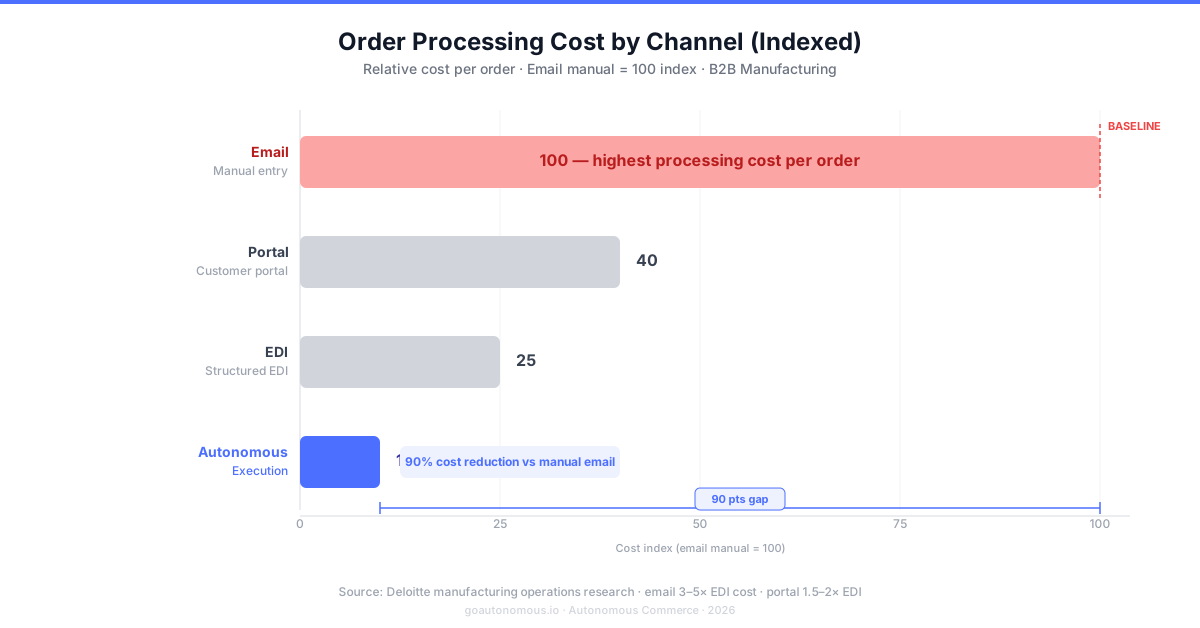
The Visible Cost: Order Entry Labor for B2B Manufacturers
The most obvious cost is the time it takes a customer service representative to process an email order. A straightforward order, clear format, no clarifications required, all items in stock, takes 8–15 minutes from receipt to ERP entry. A complex order with non-standard formatting, partial catalog matches, or ambiguous delivery instructions can take 30–45 minutes. At scale, this translates directly to headcount: Deloitte’s manufacturing operations benchmarks indicate that manufacturers processing more than 500 email orders per day typically dedicate 8–20 FTEs to order entry alone, with annual costs ranging from €400,000 to €1.2M depending on geography and wage levels.
What makes this cost particularly resistant to reduction through hiring efficiency is the non-linear relationship between volume and complexity. Email order volume does not grow smoothly, it spikes during promotional periods, quarter-ends, and supply disruptions. Staffing for average volume creates backlogs during peaks. Staffing for peaks creates idle capacity during troughs. Neither works, and the manual nature of the work means people cannot be dynamically reallocated to other tasks during slow periods. The result is a labor model that is simultaneously over-staffed and under-resourced, depending on the week.
The Hidden Cost: Error Rates and Downstream Rework in B2B Distribution
Manual order entry introduces errors at a rate that compounds through the supply chain. Gartner’s supply chain research indicates that manual entry in manufacturing environments carries an error rate of 1–3% per field, meaning a typical order with 15–20 data fields has a meaningful probability of containing at least one error. Those errors cascade: incorrect quantities create over- or under-shipments, wrong SKU numbers generate returns, incorrect delivery addresses create logistics failures.
The downstream cost of an order error consistently exceeds the original entry cost by 5–10x once you account for customer service time, return shipping, restocking, credit notes, and relationship damage. Manufacturers operating at high email order volume often find their true cost per order, including error remediation, is 2–3x their initial estimate. This is the compounding operational friction that grows faster than individual process improvements can address. See how customer experience outcomes shift when orders are processed correctly the first time, every time.
The Strategic Cost: Order Speed and Revenue Impact for Distributors
Beyond labor and errors, there is a revenue cost that rarely appears in process improvement calculations: the impact of order acknowledgment speed on customer retention and repeat purchase rate. In B2B distribution especially, confirmation time correlates directly with customer satisfaction. Boston Consulting Group’s B2B sales research shows that customers who receive order confirmation within one hour have measurably higher retention and order frequency than those who wait hours or days.
For manufacturers processing email orders manually, acknowledgment times of 4–24 hours are typical. That gap has direct revenue consequences. Customers who don’t receive fast confirmation often don’t cancel the order, they place a backup order with an alternative supplier. When both suppliers ship, the manufacturer handles a return and a relationship problem simultaneously. This is one of the most direct connections between top-line growth and order execution speed, and it almost never shows up in order management cost calculations.
Why RPA and Traditional Automation Fail on Unstructured Email Orders
The reason email order processing has not been automated sooner is not lack of effort, it is that the dominant automation approaches of the last decade are poorly suited to the problem. Understanding exactly why they fail matters for manufacturers evaluating options today, because the vendors selling those solutions rarely explain the failure modes clearly.
Why RPA Cannot Handle Unstructured Order Processing Automation at Scale
Robotic Process Automation works by replicating fixed workflows: reading from defined fields, clicking through consistent interfaces, writing to stable outputs. Applied to email orders from a single, consistent sender, a customer who always uses the same template, RPA can automate a portion of the process. Applied to the real diversity of email formats a manufacturer receives across hundreds of customers, it fails quickly.
A rule-based parser cannot reliably interpret “same as last time, but add 200 units of the new model” across all customers and all product lines. There is no rule that handles that sentence in context. Gartner’s analysis of RPA deployments in B2B order management shows exception rates of 30–50% for email-heavy workflows, meaning a human still handles nearly half of all orders. That exception rate defeats the purpose of automation. Go Autonomous has a detailed breakdown of why RPA falls short for B2B order automation that covers the technical failure modes in depth.
The deeper problem with RPA in email contexts is maintenance overhead. Every time a customer changes their order template, the RPA rule breaks and requires manual intervention to update. With dozens or hundreds of customers each using their own format, and each format subject to change without notice, maintenance cost quickly exceeds labor savings. RPA is a solution that requires continuous manual attention to keep running.
Template-Based Email Parsers Hit a Coverage Ceiling for Manufacturers
A more sophisticated approach is template-based email parsing, building or training a parser for each customer’s specific format, then applying the matching template when their orders arrive. This works well for the top 10–20 customers who send consistently formatted orders and justify the implementation effort. It does not scale to the long tail of customers who together account for 40–60% of email order volume.
Template-based approaches also fail on edge cases within even well-defined formats: a rush order sent directly from a salesperson rather than through the customer’s ERP, an order forwarded with added commentary, a PDF with slightly different margins that breaks positional extraction logic. The result is automation that handles 60–70% of orders and requires manual intervention for the rest. That is an improvement, but it is not automated email order management, it is partial automation with full staffing requirements for the remainder. IDC’s manufacturing digital transformation research confirms this pattern: partial automation at the email channel creates false confidence while leaving the majority of labor cost intact.
First-Generation AI Parsers Extract But Don’t Execute for B2B Manufacturers
More recently, AI-powered email parsing tools have emerged, using large language models to extract order data from free-form text and attachments. These represent a genuine improvement over rule-based systems in coverage and accuracy. But extraction is only the first step of the order processing workflow. An extracted order still needs to be validated against your catalog, enriched with customer data, priced, and entered into your ERP.
First-generation AI parsers stop at extraction. They produce structured output, a JSON object or populated form, and then require a human to review, validate, and submit. This reduces manual effort but does not eliminate it. Manufacturers running these tools typically still staff 40–60% of their previous order entry headcount to handle validation and submission. What is needed is not extraction, it is the full workflow from email receipt to ERP confirmation without a human in the loop. That is what Autonomous Commerce delivers.
How Autonomous Execution Handles Unstructured Email Orders End-to-End
The difference between AI-assisted and autonomous email order processing is the same as the difference between a copilot and an autopilot. Both use intelligence. Only one removes the human from the execution loop on every clean order. Autonomous Commerce operates on the autopilot model: the AI reads the email, understands the order intent, validates against live catalog and customer data, resolves common exceptions through defined business rules, and submits to the ERP, all without waiting for human approval on each transaction.
From Inbox to ERP: The Automated Email Order Intake Workflow
When an email order arrives in the shared inbox, the AI reads the full message and all attachments, plain text body, PDF, Word document, Excel file, or scanned image. It extracts the order intent: which items are requested, in what quantities, for which delivery address, with what timing requirements and special instructions. That extraction is not template-matching, it is semantic understanding of what the customer is asking for, regardless of how they expressed it.
The extracted intent is then validated in real time against multiple live data sources: your product catalog (to confirm SKU availability and resolve partial matches or obsolete part numbers), your customer master data (to match the delivery address, apply contract pricing, check credit status), and your inventory and lead-time data (to confirm fulfillment feasibility for the requested ship date). Where the order is complete and valid, it submits to the ERP directly. The customer receives an order confirmation automatically, on average in under 60 seconds. Manufacturers running autonomous execution confirm orders in under 57 seconds on average.
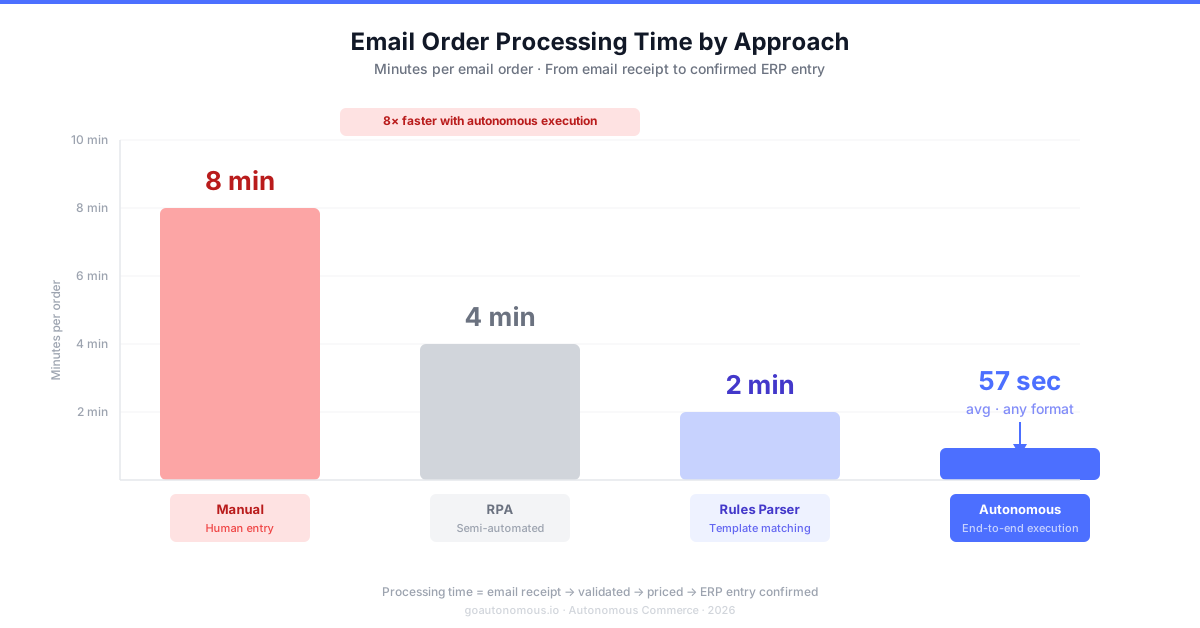
Handling Ambiguity Without Escalating Every Exception to a Human
The hardest part of email to ERP automation for B2B is not the clean orders, it is the messy ones. A customer requests a part number superseded six months ago. An order arrives for a quantity below the minimum order threshold. The delivery address in the email does not match any address on file. These are where rule-based automation fails, because they require judgment, not just execution.
Autonomous execution handles these cases through a combination of AI reasoning and configurable business rules. Discontinued part numbers are automatically mapped to their current successors, with the customer notified of the substitution. Minimum order quantity violations trigger an automated clarification request, specifying exactly what adjustment is needed and requesting confirmation. Address mismatches trigger a lookup against the customer’s historical delivery locations to find the closest match before escalating. Accenture’s research on industrial operations transformation confirms this pattern: the highest-performing autonomous order processing deployments are those with the most sophisticated exception handling logic, because they resolve cases autonomously that would otherwise require a human every time.
Continuous Learning Across Formats in Automated Email Order Management
Unlike template-based parsers that require manual updates when customer formats change, autonomous execution adapts continuously. When a customer starts using a new order format, the system handles it through semantic understanding of order intent, no rule update required. When a new customer begins ordering by email, it processes their format without configuration. This is the structural advantage of AI over template-based systems: generalization rather than memorization.
This learning capability means autonomous resolution rates improve over time. Manufacturers typically see 60–70% autonomous handling in the first weeks of deployment, rising to 85–90%+ within 90 days as the system builds familiarity with customer patterns, catalog nuances, and business rule application. The 10–15% that still requires human handling by that point are genuinely complex cases: disputed terms, unusual commercial arrangements, orders requiring business judgment. That is the work your order desk should be doing, not routine data entry that a machine can execute more accurately and in a fraction of the time.
Real-World Outcomes from Email Order Processing Automation
The impact of autonomous email order processing is measurable across three dimensions that operations and commercial leaders track: efficiency, accuracy, and revenue performance. These are not projections, they are outcomes documented across live deployments in industrial manufacturing and B2B distribution.
On efficiency: manufacturers who move from manual email order processing to autonomous execution consistently eliminate 60–80% of order entry labor within 90 days of full deployment. That is not incremental improvement, it is a structural change in how the order desk operates. Labor that remains is redirected to exception handling, relationship management, and commercial activities that generate value rather than process transactions. The efficiency gain data across Go Autonomous deployments confirms this pattern across different industries and geographies.
On accuracy: autonomous processing eliminates manual entry errors that drive downstream rework. First-time-right rates on autonomously processed orders consistently reach 95–99%, compared to 85–92% for well-managed manual operations. At scale, 1,000 orders per day, a 5-point improvement in first-time-right rate eliminates 50 daily errors and the rework, credit notes, and customer friction they generate. The customer experience improvements from faster, more accurate order processing show up in retention rates and repeat order frequency.
On revenue: order processing speed translates directly to commercial outcomes. PwC’s global digital operations study found that manufacturers achieving sub-hour order confirmation rates see measurable improvements in customer retention, a direct revenue impact that never appears in process improvement calculations but shows up clearly in annual customer value metrics.
Danfoss: Email Order Automation Across 26 Countries
Danfoss, a global industrial manufacturer operating across 26 countries, deployed autonomous order intake to handle the volume and format diversity inherent in a business of that scale. With customers across every major industrial region, each generating purchase orders through their own procurement systems, Danfoss faced exactly the long-tail email order challenge that template-based automation cannot solve. Autonomous execution now processes orders in under one minute from receipt, a confirmation speed that was operationally impossible at that volume and geographic span with manual processing.
Nilfisk: Autonomous Order Handling for a Global Cleaning Technology Manufacturer
Nilfisk, a leading cleaning technology manufacturer, deployed autonomous order management to address the order desk challenge common to manufacturers selling through complex, multi-tier distribution networks: high volume, high format diversity, and customer service expectations that manual processing cannot consistently meet. The deployment demonstrates how autonomous execution applies across different product categories and market structures, the underlying challenge of unstructured email order intake is consistent regardless of industry vertical.
Mediq: 91% Autonomous Order Handling in B2B Medical Distribution
Mediq, a major European medical device distributor, achieved 91% autonomous order handling, meaning 9 out of 10 orders are processed from email receipt to ERP confirmation without any human involvement. In medical distribution, where order accuracy is directly linked to patient outcomes and regulatory compliance, that accuracy rate is not just an efficiency metric, it is a quality standard. Mediq’s outcome represents the upper bound of what automated email order intake for manufacturing and distribution can deliver when catalog data quality and exception rules are well-configured.
The pattern across these deployments is consistent: the manufacturing and distribution companies achieving the highest autonomous resolution rates share a common profile, high email order volume, strong catalog data quality, and clearly defined exception handling rules. The technology performs. The preparation work determines how fast it gets there. For a broader view of outcomes across B2B manufacturing and distribution deployments, the Go Autonomous success cases document directional results across multiple verticals.
The Implementation Path: From Email Chaos to Autonomous Order Intake
The most common objection to email order processing automation is implementation complexity. “Our orders are too diverse, our catalog too large, our customers too inconsistent.” These concerns are real, and they describe precisely the problem that autonomous execution is designed for. The implementation sequence that achieves target automation rates fastest follows a consistent structure across manufacturers and distributors of different sizes and industries.
- Channel audit. Map all inbound order channels and quantify email order volume, format diversity, and current handling costs. This baseline is essential for measuring ROI and prioritizing which email sub-channels and customer segments to automate first.
- Catalog and customer data quality. Autonomous execution is only as reliable as the data it validates against. Clean, current product data, including successor mappings for discontinued SKUs, and complete customer address, pricing, and credit data are prerequisites for high autonomous resolution rates. This is the step most manufacturers underestimate.
- Business rules definition. Define the exception handling logic: what happens when minimum order quantities are not met, when a part number is ambiguous between two active SKUs, when delivery address doesn’t match records. The specificity of these rules directly determines how many exceptions are resolved autonomously versus escalated to a human queue.
- Phased rollout by customer segment. Start with your highest-volume email customers, those sending 20 or more orders per month, where efficiency gains are immediate and the system builds familiarity quickly. Expand to the long tail once the core workflow is validated.
- Continuous improvement cycle. Monitor autonomous resolution rates, exception types, and first-time-right rates weekly. Use that data to refine business rules and address systematic failure modes. The target is 85%+ autonomous resolution within 90 days of full deployment.
IDC’s research on AI-powered order management implementations confirms that manufacturers who follow a structured implementation sequence achieve target automation rates 2–3x faster than those attempting broad deployment without preparation. The preparation work is not optional overhead, it is what makes autonomous email order management reliable at scale.
What to Look for in an Email Order Automation Platform
Not all email order automation solutions are equivalent. Manufacturers evaluating platforms should probe specifically on these dimensions, because the differences are material to the outcomes they will achieve, and vendors rarely volunteer the failure modes of their own approach.
- End-to-end execution, not just extraction. The platform must take the order from email receipt to ERP submission without requiring a human review step on clean orders. Extraction-only solutions still require staffing the validation and submission workflow, they reduce effort per order, they do not eliminate it.
- Multi-format support without template configuration. The platform should handle new customer formats and attachment types without manual template setup. Ask specifically: “What happens when a new customer starts ordering by email tomorrow, in a format we’ve never seen?” If the answer involves configuration work, it is a template-based system.
- Configurable exception handling logic. The platform should allow you to define specific business rules for common exception types rather than routing all exceptions to a human queue. The exceptions that can be resolved autonomously through business rules represent a large share of total exception volume.
- Live ERP integration, not batch sync. Order confirmation should be generated from live ERP data, inventory, pricing, customer credit status, not a cached or synchronized copy. Stale data produces inaccurate confirmations and generates customer service calls that eliminate the efficiency gains.
- Full audit trail. Every order decision, what was extracted, what was validated, what business rule was applied, what was submitted to ERP, should be logged and auditable. This is not optional for manufacturers in regulated industries or under customer SLAs.
- Measurable autonomous resolution rate. Any platform worth deploying provides real-time visibility into what percentage of orders are processed without human involvement. If a vendor cannot show you this number, they are not measuring what matters.
Go Autonomous Autonomous Commerce satisfies each of these requirements, handling email orders alongside EDI, portal, and API channels through a unified execution layer. The platform is not an extraction tool with a human review step appended. It is an execution system: from email inbox to ERP confirmation, autonomously, for the orders that meet your defined criteria. Book a session with the Go Autonomous team to see how autonomous execution works against your specific email order formats and volume characteristics.
B2B Email Order Management: The Practical Next Step
If your manufacturing or distribution operation processes significant email order volume, and if 50–70% of your orders arrive by email, you do, then email order processing automation is not a nice-to-have efficiency project. It is the highest-leverage investment available in your order management stack. The labor cost is real. The error cost is real. The revenue impact of slow confirmation is real. And the technology to address all three simultaneously now exists and is in production across manufacturers at scale.
The manufacturers and distributors who have already made this shift are not running experiments. They are processing the majority of their email orders autonomously, confirming to customers in under a minute, and redeploying the order desk capacity they freed toward work that requires human judgment. The Autonomous Commerce platform is built for exactly this transition, from inbox chaos to end-to-end autonomous execution.
The starting point is not a technology decision, it is an honest assessment of where your email order volume stands today, what it costs, and what your current automation coverage actually achieves. Most manufacturers who run that assessment find the gap between current state and what is possible is larger than they expected. The Go Autonomous team works through that assessment in a single working session, no commitment required, and the output is a clear picture of where autonomous execution applies and what the business case looks like for your specific operation.
Sources
- Source: McKinsey & Company. The Digital Future of B2B Manufacturing Operations
- Source: APQC, Order Management Process Benchmarks and Key Performance Indicators
- Source: Forrester Research, B2B E-Commerce Growth and Channel Persistence
- Source: Deloitte, 2025 Manufacturing Industry Outlook
- Source: Gartner, Supply Chain Order Management and Automation Research
- Source: Boston Consulting Group, B2B Sales and Operations Transformation
- Source: Accenture, Industrial Operations Transformation and AI Deployment Patterns
- Source: PwC, Global Digital Operations Study: Industrial Manufacturing
- Source: IDC, Manufacturing Digital Transformation and AI Order Management Research
Frequently Asked Questions
Email order processing automation is the use of AI to receive, read, validate, and submit B2B purchase orders that arrive by email, without requiring manual data entry at any step. An autonomous system extracts order intent from any email format or attachment type, validates it against live product catalog and customer data, and submits directly to the ERP. The customer receives an automatic order confirmation, typically in under 60 seconds. The key distinction from partial automation: the system executes end-to-end, not just extracts and hands off to a human.
RPA requires structured, consistent inputs and predefined rules for every scenario. B2B email orders arrive in hundreds of different formats, free text, PDFs, Excel attachments, scanned documents, that change without notice across customers and over time. RPA exception rates in email-heavy order workflows run 30–50%, meaning a human still handles nearly half of all orders. Every time a customer changes their order template, the RPA rule breaks and requires manual maintenance. AI-powered autonomous execution handles format diversity and change without per-customer template configuration.
Research from McKinsey, Forrester, and IDC consistently shows that 50–70% of B2B orders in manufacturing and distribution arrive by email, even at companies with active portals and EDI connections. Email persists because customers generate purchase orders in their own internal systems and email the output to suppliers. They are not going to change their internal purchasing workflow to use a vendor portal. This is a structural channel, not a transitional one waiting to be replaced.
An autonomous system monitors the shared inbox, reads every incoming email and attachment regardless of format, extracts order intent (items, quantities, delivery address, requested ship date, special instructions), validates against live catalog and customer data, resolves common exceptions through configured business rules, and submits to the ERP. The customer receives a confirmation email automatically. Human review is required only for genuinely complex exceptions, typically 10–15% of orders after the first 90 days of deployment.
Manufacturers typically see autonomous handling rates of 60–70% in the first weeks of deployment, rising to 85–90%+ within 90 days as the system adapts to customer patterns and business rules are refined. Mediq, a European medical device distributor, achieved 91% autonomous order handling. The remaining 10–15% by that point represent genuinely complex cases, disputed terms, unusual commercial arrangements, or orders requiring business judgment, which is exactly the work your order desk team should be doing.
Direct labor savings are typically 60–80% reduction in order entry headcount within 90 days. Indirect savings, reduced error rates, fewer returns, less rework, faster confirmation, typically equal or exceed the direct savings. Total cost-per-order reduction of 50–70% is achievable. For a manufacturer processing 500+ email orders per day, this represents €400K–€1M+ in annual cost reduction. The revenue impact of faster confirmation, improved customer retention and reduced duplicate orders placed with alternative suppliers, adds a further commercial benefit that is harder to quantify but consistently present.
A structured implementation covering catalog data quality, exception rules definition, ERP integration, and phased customer rollout typically takes 8–12 weeks to reach production. Manufacturers who invest in data quality and business rules configuration before go-live achieve target automation rates significantly faster than those who attempt broad deployment without preparation. The first 30 days focus on integration and configuration; the following 60 days on validation, exception rule refinement, and autonomous rate improvement toward the 85%+ target.
See Autonomous Commerce in Action at the 2026 Summit
The Autonomous Commerce Summit 2026 brings together operations and commercial leaders from B2B manufacturing and distribution who are actively transforming how revenue is executed. Hear directly from companies that have made the shift to autonomous execution, and what it means for revenue, cost, and working capital. Attendance is by invitation only.
Request your invitation →