.svg)





Is EDI Holding Your B2B Operations Back? The Case for Autonomous Commerce
EDI has powered B2B order exchange for 50 years — but its structural limitations are now costing manufacturers in speed, coverage, and cost-to-serve. This post examines where EDI breaks down in modern B2B operations and what the shift to autonomous execution delivers instead.
Executive Summary: Electronic Data Interchange has served B2B commerce well for five decades, but it was designed for a world of stable trading partners, standardised formats, and predictable volumes. Modern B2B operations are none of those things. This post examines where EDI structurally fails today’s manufacturers and distributors, why layering more automation on top of it does not solve the core problem, and how Autonomous Commerce provides a fundamentally different execution model that works across every channel, including the ones EDI was never designed to handle.
Table of Content
What EDI Was Built For, and Where It Stops
Electronic Data Interchange (EDI) was a genuine breakthrough when it emerged in the 1960s and 1970s. It standardised machine-to-machine document exchange between trading partners, purchase orders, invoices, shipping notices, replacing paper-based processes with structured electronic formats. For large manufacturers and distributors with stable, high-volume relationships and consistent transaction types, it delivered real efficiency gains and became the standard infrastructure for procurement-driven B2B commerce.
The structural problem is that EDI was engineered for a different era. It assumes static formats, fixed trading partners, and predictable transaction types. Modern B2B commerce, with its expanding customer bases, diverse ordering channels, and constant format variation, operates outside the conditions EDI was designed for. The technology has not fundamentally changed; the business environment it operates in has changed dramatically.
The coverage gap EDI creates
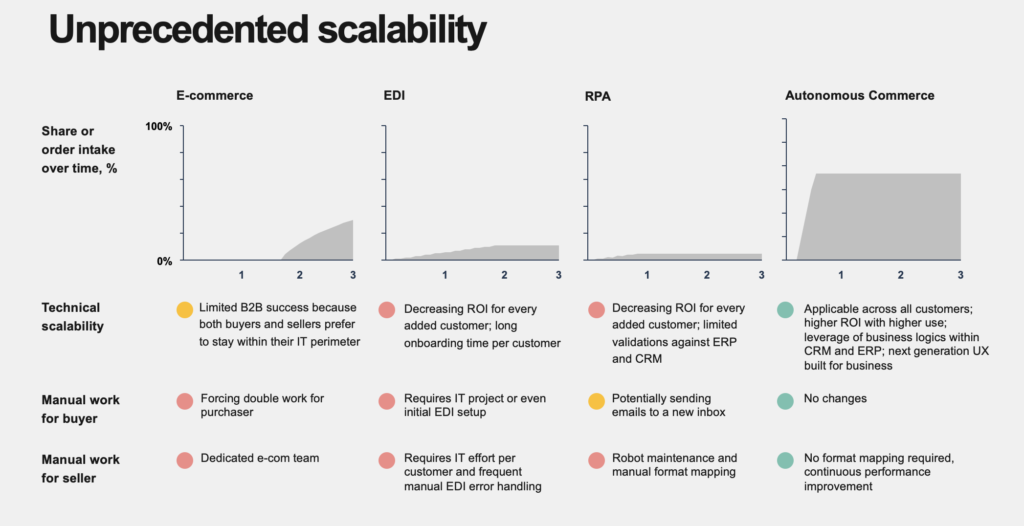
EDI works with customers who have EDI capability and have been onboarded with custom mappings. This represents a subset, often a minority, of most manufacturers’ customer bases. Smaller customers, newer partners, and markets without mature EDI infrastructure default to email, PDF, and phone. The result is a two-tier operation: EDI-connected customers receive fast, automated processing, while everyone else waits in a manual queue. As customer bases grow and diversify, this gap widens rather than closes.
The Real Cost of Running EDI at Scale
The operational cost of EDI is routinely underestimated by finance teams that see it as infrastructure. Below the surface, EDI is a fragile system held together by specialist knowledge, custom integrations per trading partner, and a constant stream of exception handling. According to industry analysis, between 20–40% of EDI transactions generate exceptions requiring manual intervention, messages that arrive with wrong product codes, missing fields, or formats that deviate from the agreed standard. [SOURCE NEEDED: specific citation for EDI exception rate]
Where EDI cost accumulates
- Partner onboarding cost, every new trading partner requires custom mapping work, typically taking weeks and costing significant specialist time
- Ongoing maintenance, product catalogue changes, new business rules, format updates, and partner-side system changes all require EDI mapping revisions; each revision is a project
- Exception queue management, the 20–40% of transactions that generate EDI exceptions land in a manual queue that scales linearly with volume growth
- Specialist dependency, EDI knowledge is concentrated in a small number of individuals; turnover creates operational risk that most organisations underestimate until it materialises
- Coverage ceiling, investment in EDI only benefits the customers already connected; it does not address the email, document, and portal orders that sit outside the EDI flow
The business impact of EDI’s structural limits
The combined effect of these factors is an operation that looks automated but depends heavily on manual intervention to function. Cycle times fluctuate based on exception volumes and staffing. Customer experience is inconsistent, EDI-connected customers receive fast responses while others wait hours or days. Margins are exposed when exception handling introduces pricing errors or missed validations. And every new customer, product line, or market adds complexity without a proportional reduction in manual effort.
Autonomous Commerce: A Different Execution Model for B2B
Go Autonomous built its Autonomous Execution Fabric to address the fundamental limitation that EDI and traditional automation cannot solve: the inability to handle unstructured, variable, real-world B2B demand at scale. The platform processes incoming requests from email, EDI, portals, and documents through a single execution layer that understands intent rather than pattern-matching against predefined formats.
In practice, this means an email order with missing line items, a non-standard EDI message, or a PDF attachment with handwritten changes are all processed through the same layer, interpreted, validated against ERP and pricing data, and completed without a human manually reviewing each one. The same commercial rules, the same response speed, the same quality, regardless of how the customer sent the request.
Three capabilities EDI cannot match
- Channel-agnostic execution, processes email, EDI, portal, and document orders through identical logic; no two-tier customer treatment
- Intent-based interpretation, understands what the customer is trying to order even when the format is incomplete or inconsistent, resolving gaps using ERP and customer history data
- Self-maintaining, no custom mappings per partner; product and rule changes propagate through the execution layer without specialist intervention for each trading partner
Manufacturers and distributors operating with Go Autonomous report that the efficiency gains appear quickly, not because the technology is complex to deploy, but because it starts handling the channels and transaction types that existing automation was never covering. See customer outcomes →
Can EDI and Autonomous Commerce Coexist?
Yes, and for most organisations, coexistence is the practical starting point. Existing EDI connections with large, established trading partners do not need to be unwound immediately. The immediate priority is stopping the expansion of EDI as the default approach for new customers and channels, and deploying autonomous execution for the order volume that EDI was never reaching: email, documents, smaller customers, new markets.
Over time, as autonomous execution demonstrates its reliability across the full transaction range, including the complex, exception-prone cases that EDI routes to manual queues, organisations naturally consolidate toward it. Not because EDI fails, but because a single execution layer covering all channels is simpler, more consistent, and less expensive to maintain than running parallel systems with different coverage, different quality levels, and different specialist dependencies.
The transition does not require a big-bang cutover. Go Autonomous works alongside existing systems and expands coverage incrementally. Talk to our team about what a practical migration path looks like for your operation.
Join the Autonomous Commerce Summit 2026
Connect with operations and commercial leaders shaping the future of B2B commerce. Hear directly from manufacturers and distributors who have made the shift to autonomous execution.
Register your place →
Frequently Asked Questions
EDI requires structured, predefined formats and custom mapping per trading partner. It breaks when inputs deviate from the expected pattern, which in B2B happens routinely. It also only covers customers who have EDI capability, leaving email, document, and portal orders in a manual queue. Maintenance costs are high and scale poorly as customer bases grow.
EDI remains useful for high-volume, standardised transactions with large trading partners. The question is whether it should be the primary execution infrastructure, or a channel within a broader autonomous commerce layer that covers all incoming demand regardless of format.
Industry analysis suggests 20–40% of incoming B2B orders processed through EDI generate exceptions requiring manual handling. In industries with high product complexity or format diversity, this figure is typically higher.
Go Autonomous processes EDI alongside email, portal, and document orders through a single execution layer. EDI messages, including non-standard or exception-generating ones, are interpreted, validated, and completed using the same logic applied to every other channel.
For most organisations, the practical path is not immediate replacement but parallel operation, with autonomous execution handling channels and customers that EDI does not cover, while existing EDI connections with large partners are maintained and gradually consolidated over time.
Go Autonomous deployments typically go live within weeks. Because the platform reads existing channels without requiring customers to change how they send orders, there is no buyer-side change management, which is typically the longest part of any EDI onboarding project.