.svg)





B2B Order Exception Handling: Why Exceptions Are Where the Real Cost Hides in Order-to-Cash
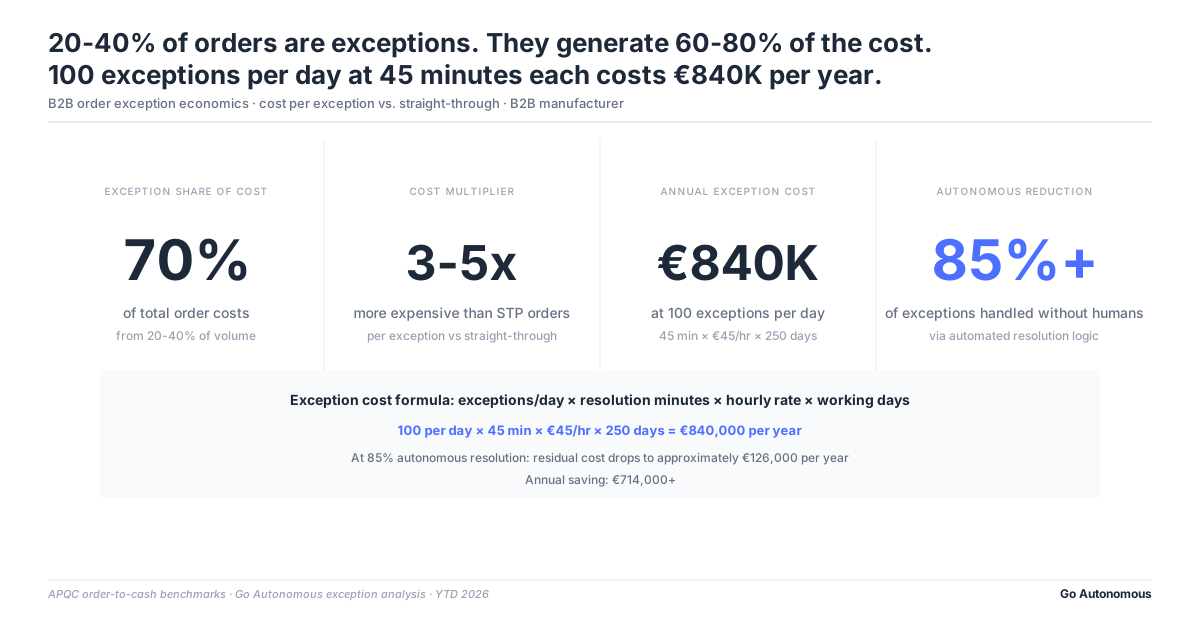
Order exceptions are not edge cases. For most B2B manufacturers, they account for 20 to 40% of order volume and 60 to 80% of total order management cost. Autonomous execution resolves the structural root cause.
B2B order exception handling is where most manufacturers discover that their order management cost calculations are wrong. The straight-through orders are cheap, fast, and invisible. The exceptions are expensive, slow, and everywhere. For most B2B manufacturers and distributors, exceptions account for 20 to 40 percent of total order volume and 60 to 80 percent of total order management cost. That ratio is structural. It does not improve by adding headcount or upgrading the ERP.
Table of Content
- Why B2B Order Exceptions Are the Most Expensive Line Item That Never Appears on a Dashboard
- The Anatomy of a B2B Order Exception: Five Types and Their Real Processing Cost
- Why Existing Approaches to B2B Exception Management Hit a Structural Ceiling
- How Autonomous Execution Changes the B2B Exception Handling Architecture
- See How Autonomous Exception Handling Works in Your Order Environment
- The Cost of Standing Still
Why B2B Order Exceptions Are the Most Expensive Line Item That Never Appears on a Dashboard
B2B order exceptions cost three to five times more per order to process than straight-through transactions, yet they rarely appear as a discrete cost line in any operations dashboard. Most companies measure touchless rate and average cost per order across all transactions, which blends the cheap and the expensive into a number that obscures the real problem.
The exception iceberg illustrates this well. Visible costs, the CSR hours spent investigating and resolving exceptions, represent only 30 to 40 percent of the total cost. The hidden costs are larger. Revenue at risk from delayed fulfillment accumulates every hour an exception sits unresolved. Customer experience degrades each time a buyer receives no update on an outstanding order. Working capital is locked because delayed order resolution means delayed invoicing, which stretches days sales outstanding and keeps cash out of the business longer than necessary.
What Is Friction Debt in B2B Order Management?
Friction Debt is the total monetary cost of human decisions still embedded in your revenue flow. Every exception that requires a human to investigate, validate, escalate, or approve adds to the friction debt balance. Unlike standard operational metrics, Friction Debt captures the cumulative drag of decisions that could have been codified but were not.
Applied to B2B order exception handling, Friction Debt has three components. Decision time is the average lag between an exception being identified and a resolution being reached. Decision cost is the fully loaded cost of the people whose judgment is required to resolve it, multiplied by frequency. Decision drag is the downstream commercial effect: quotes that convert late, orders that ship late, and exceptions that compound into customer churn.
Until Friction Debt is a number on the operating dashboard, the cost of unresolved exception volume is invisible. That invisibility is not an accounting problem. It is a structural measurement gap that keeps exception handling off the agenda at the scale where it can actually be addressed.
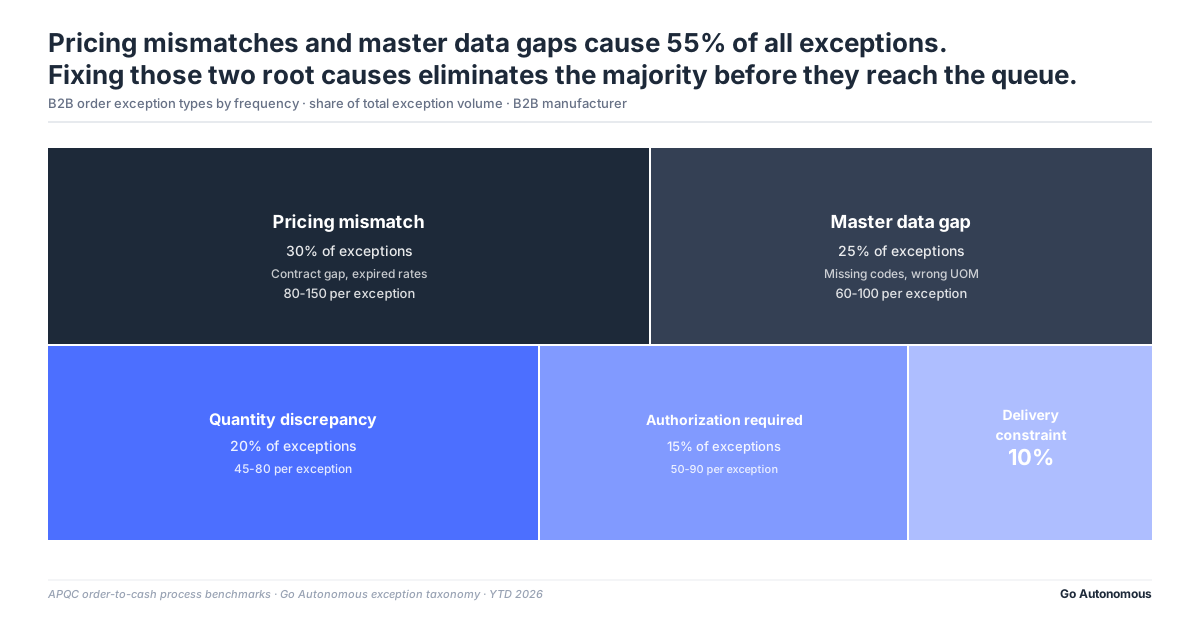
The Anatomy of a B2B Order Exception: Five Types and Their Real Processing Cost
Not all exceptions carry the same cost or resolution complexity. Understanding the five major exception types is the prerequisite for building any structured approach to reducing them at scale.
What Causes Pricing Mismatch Exceptions in B2B Order Processing?
Pricing mismatch exceptions occur when the price on a customer’s purchase order differs from the current price in the ERP system. The gap is almost never intentional. It originates from blanket PO pricing agreed months earlier that was not updated in the system, contract pricing specific to a customer segment that was not correctly mapped, or promotional pricing applied in one channel but not reflected in the order intake flow. Resolution requires a CSR to locate the correct pricing agreement, confirm it with the account manager or pricing team, and manually update the order before it can proceed. Each step introduces a handoff, and each handoff adds to resolution time.
How Do Quantity Discrepancies Generate Downstream Cost in Manufacturing Order Management?
Quantity discrepancy exceptions arise when the ordered quantity on a customer PO does not match available inventory, minimum order quantities, or pack sizes defined in the product master. In manufacturing environments with strict MOQ or batch size rules, a discrepancy of even one unit can block an entire order. The downstream cost compounds quickly: fulfillment is delayed, the warehouse receives conflicting signals, and the customer receives no confirmation while the exception sits in a queue awaiting resolution. According to APQC process benchmarking data on order management exception rates, quantity and product configuration issues consistently rank among the top three exception categories across manufacturing sectors.
What Are the Five Major Exception Types in B2B Order Processing?
- Pricing mismatch: Customer purchase order price differs from system price due to blanket PO pricing, contract pricing, or promotional rates that were not synchronized across channels.
- Quantity discrepancy: Ordered quantity conflicts with available inventory, minimum order quantities, or pack size rules defined in the product master.
- Master data gap: Customer account number, delivery address, or product code is absent or incorrectly mapped in the ERP, blocking automatic order creation.
- Authorization required: Order value or discount level exceeds the approval threshold defined in the pricing policy, requiring manager sign-off before the order can proceed.
- Delivery constraint: Requested delivery date cannot be met, and an alternative must be proposed and confirmed by the customer before fulfillment is triggered.
Each exception type has a different resolution path, a different decision owner, and a different resolution time profile. Master data gaps are often the fastest to resolve once identified, but they are the most likely to repeat on the next order from the same customer if the root data issue is not corrected at source. Authorization exceptions are often the slowest, because they depend on a manager who may be in meetings, traveling, or handling other priorities when the exception arrives.
Each time we added one or two million euros in revenue, we had to add another operator. From a cost perspective, that's an unsustainable way of operating a business.

Why Existing Approaches to B2B Exception Management Hit a Structural Ceiling
Most manufacturers have tried at least one of three approaches to reducing exception volume. Each delivers some improvement at low exception volumes. Each hits a hard ceiling as order complexity and transaction count grow. The ceiling is not a software limitation. It is a structural consequence of designing solutions around labor efficiency rather than dependency elimination.
Why Does RPA Fail to Reduce B2B Order Exception Volume at Scale?
RPA tools such as UiPath, Blue Prism, and Automation Anywhere can route exceptions, move data between systems, and trigger notifications. What they cannot do is read context. A pricing mismatch exception requires understanding which pricing agreement applies to this customer, on this product category, under this contract term. A rules-based bot can follow a script. It cannot interpret an email attachment, cross-reference a blanket PO against a contract schedule, and determine the correct resolution without a human in the loop. The result is that RPA and traditional automation accelerate the handoff to humans rather than replacing the human decision. Exception volume stays constant. Resolution speed improves modestly. The structural cost does not change.
Why Do ERP Native Exception Queues Not Solve the Exception Processing Problem?
SAP Order Management, Oracle Cloud Order Management, and Microsoft Dynamics 365 all provide native exception queue management. These tools structure the exception backlog and give operations teams visibility into what is outstanding. However, they require manual resolution at every step. The ERP surfaces the exception. A human decides how to resolve it. The ERP records the decision. Every exception still requires a human judgment; the ERP simply organizes the queue in which those judgments accumulate. The Human Dependency Ratio does not improve. It is measured more clearly, but it does not change.
Human Dependency Ratio (HDR) measures the number of manual decisions required per unit of revenue processed. As a Go Autonomous metric, it exposes the structural reliance that touchless rate obscures. A process can be measured as efficient while still requiring a human judgment at every exception. HDR makes that dependency visible as a commercial metric rather than a process metric.
Why Does Adding CSR Headcount Not Reduce the B2B Exception Rate?
Larger customer service teams resolve exceptions faster within a given volume. They do not reduce the exception rate. The ratio of exceptions to total orders remains constant because the sources of exceptions, pricing misalignments, master data gaps, policy thresholds, and delivery constraints, are upstream of the CSR team. Adding headcount scales labor. It does not change the architecture that generates exceptions in the first place.
Automation scales labor. Autonomy eliminates dependency. That distinction is the structural gap that defines whether exception management improves or simply grows alongside order volume.
How Autonomous Execution Changes the B2B Exception Handling Architecture
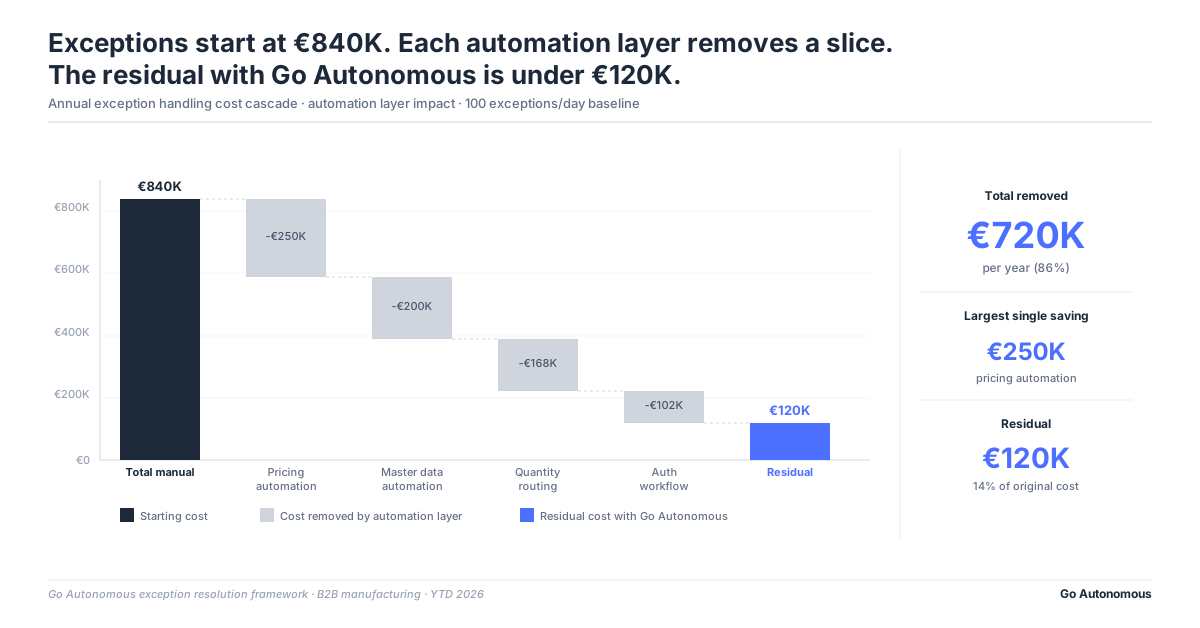
The Autonomous Commerce platform changes exception handling not by processing exceptions faster, but by reclassifying which cases require human judgment at all. Three capability layers define the architecture.
How Does AI Read Exception Context in B2B Order Processing?
Autonomous execution reads the full exception context: the email thread, the original purchase order, the customer’s pricing history, the contract schedule, and the product master. A pricing mismatch exception that has been resolved identically 200 times becomes a policy, not a decision. The AI applies the resolution, updates the order, and closes the exception without routing it to a human. The human sees only the cases where the context is genuinely novel, the discount level is outside policy range, or a contract interpretation requires judgment.
What Does Policy Codification Mean for Autonomous Exception Management?
Policy codification is the mechanism by which autonomous execution pays down Friction Debt. Each exception type that has been resolved consistently in the same way represents tacit knowledge sitting in the heads of experienced CSRs. When that pattern is codified as a policy, the execution system applies it autonomously. Over time, the volume of exceptions that reach humans drops. The cases that do reach humans are genuinely novel, and those cases receive better attention because the routine work has been removed from the queue.
A global manufacturer operating across 26 countries, like Danfoss after deploying autonomous execution, processed 80 percent of decisions autonomously. The practical effect is that the exception rate visible to human operators dropped by a commensurate proportion. CSR teams shifted from reactive exception resolution to proactive account management and genuine exception escalation.
Read the full Danfoss case study to see what autonomous exception handling looks like in a multinational manufacturing environment.
How to Evaluate Whether Your B2B Exception Rate Requires Autonomous Execution
Use the decision scoring card below to assess whether your current exception handling architecture requires autonomous execution or whether incremental improvements to existing tools are sufficient.
| Criterion | Signal or Indicator | What It Means for You |
|---|---|---|
| Exception rate above 20% of order volume | More than 1 in 5 orders requires manual intervention before it can proceed | Processing overhead is structural. Adding headcount will not reduce the ratio. |
| Exception resolution time exceeds 4 hours on average | CSRs spend core working hours on individual exceptions rather than order throughput | Friction Debt is accumulating. Each exception costs 3 to 5 times a straight-through order. |
| Senior staff handle routine exception escalations regularly | Pricing or threshold exceptions require manager approval on standard cases | Decision-making is not codified. Tacit knowledge is the bottleneck, not headcount. |
| Exception backlog grows during volume peaks | Month-end, Q4, or promotional periods create unmanageable queues that delay fulfillment | Linear scaling is the only option without autonomy. |
| Customer complaints correlate with exception lag | Fulfillment complaints and exception resolution delays move together in your data | Revenue risk is embedded in exception management. It is not just an operational cost. |
| CSRs navigate 3 or more systems to resolve a single exception | Switching between SAP, email, CRM, and spreadsheet per exception is the standard workflow | Integration gaps are creating Friction Debt at the process layer with each transaction. |
Automating customer requests comes with at least two substantial benefits. Being able to answer customers faster drives lead times down and sales up.
For manufacturers and distributors running high exception volumes across complex multi-channel order intake, the Autonomous Execution Fabric white paper maps the five implementation lessons that determine whether autonomous execution delivers policy-grade exception resolution or simply replicates manual workflows in a new tool.
Sources
- APQC Resource Library – Process benchmarking on order management exception rates in B2B manufacturing and distribution.
See How Autonomous Exception Handling Works in Your Order Environment
If your exception rate is above 20 percent of order volume and your resolution time consistently exceeds half a working day, the patterns described in this post apply directly to your operations. The structural cost of B2B order exception handling does not compress through incremental process improvement. It requires a change in execution architecture: from routing exceptions to humans, to codifying decisions so that humans only see cases that genuinely require their judgment. Go Autonomous works with 500M to 20B EUR manufacturers and distributors in the Nordics, DACH, Benelux, UKI, and France. We can show you exactly what autonomous exception handling looks like in your environment: your ERP, your order channels, and your current exception backlog. Book a conversation with our team.
The Cost of Standing Still
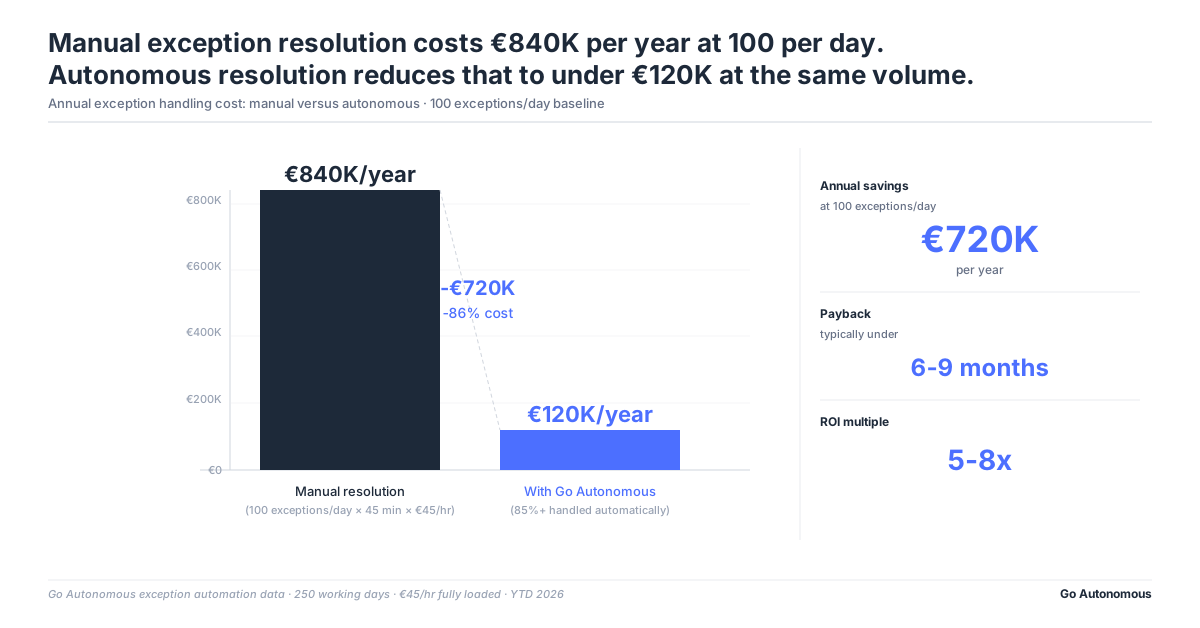
Consider a manufacturer with 500M EUR annual revenue processing 400 orders per day at a 25 percent exception rate. That is 100 exceptions per day entering the queue. At an average resolution time of 45 minutes per exception, the team commits 75 hours of CSR time daily to exception resolution alone.
- Direct processing cost: At a fully loaded CSR cost of 45 EUR per hour, exception resolution costs approximately 3,375 EUR per day. Annualized, that is over 840,000 EUR in direct processing cost for a single exception workstream before revenue risk is factored in.
- Revenue at risk: Exceptions that delay order confirmation by 24 to 48 hours push invoicing back by the same window. For a 500M EUR manufacturer, each day of delayed invoicing across 100 exception orders represents significant Revenue at Rest: capital that exists but is not moving toward cash.
- Working capital impact: Delayed invoicing extends days sales outstanding. A consistent 2 to 5 day lag across exception-impacted orders compounds into a measurable DSO increase and the associated working capital cost at this revenue scale.
- Customer churn risk: Exceptions that take more than 48 hours to resolve generate customer service contacts. Repeated resolution delays on the same account create churn risk that does not appear in the exception handling cost calculation but is directly caused by it.
- Efficiency ceiling: Review the efficiency gains achieved by manufacturers who moved from exception-heavy manual processing to autonomous execution, and calculate your own version of this cost picture before the next operating review.
The 840,000 EUR figure is the direct cost of exception processing for a single manufacturer at this scale. It does not include the revenue at risk, the working capital drag, the churn risk, or the customer outcomes that deteriorate each time an exception resolution takes longer than it should. For most organizations that have not calculated this number explicitly, it is the first time the cost of standing still becomes a budget item rather than a process inefficiency.
Frequently Asked Questions
What is the average exception rate for B2B order management?
The average B2B order exception rate across manufacturing and distribution environments ranges from 20 to 40 percent of total order volume. However, exception rates vary significantly by industry, order channel mix, and pricing complexity. Manufacturers with high blanket PO volumes or complex contract pricing structures typically see exception rates at the higher end of this range. APQC process benchmarking data identifies pricing mismatches, quantity discrepancies, and master data gaps as the most frequent exception categories.
How do you calculate the real cost of B2B order exceptions?
The real cost of B2B order exceptions has three components. Direct cost equals the number of exceptions per day multiplied by average resolution time multiplied by fully loaded CSR cost per hour. For a manufacturer processing 100 exceptions per day at 45 minutes each and 45 EUR per hour, that is approximately 3,375 EUR per day, or over 840,000 EUR annually. Add to this the revenue at risk from delayed invoicing, the working capital cost of extended days sales outstanding, and the customer churn risk from inconsistent resolution quality.
What types of exceptions are most common in B2B order processing?
The five most common exception types in B2B order processing are pricing mismatches (customer PO price differs from ERP price), quantity discrepancies (ordered quantity conflicts with MOQ or inventory), master data gaps (missing customer account or product code in ERP), authorization requirements (order value exceeds approval threshold), and delivery constraints (requested delivery date cannot be met). Pricing mismatches and master data gaps typically generate the highest resolution times because they require cross-referencing contract data outside the ERP.
Why does exception rate stay high even after ERP implementation?
ERP systems such as SAP S/4HANA, Oracle Cloud Order Management, and Microsoft Dynamics 365 structure exception queues and provide visibility into outstanding cases, but they require manual resolution at every step. The ERP surfaces the exception; a human still decides how to resolve it. Exception rate stays high after ERP implementation because the sources of exceptions, pricing policy gaps, master data quality issues, and incomplete approval workflows, are upstream of the ERP order module and require human judgment to resolve.
How does autonomous execution reduce B2B order exceptions for manufacturers?
Autonomous execution reduces B2B order exceptions by reading the full exception context, including email threads, purchase orders, pricing history, and contract schedules, and applying codified policy decisions without routing to a human. Exception types that have been resolved identically many times become autonomous decisions. Humans see only genuinely novel cases. Manufacturers who have deployed autonomous execution, such as Danfoss operating across 26 countries, report that 80 percent of decisions are now made autonomously, which substantially reduces the exception volume reaching human operators.
What is Friction Debt in B2B order management?
Friction Debt is the total monetary cost of human decisions still embedded in the revenue flow. In B2B order management, it accumulates through three components: decision time (the lag between an exception being identified and being resolved), decision cost (the fully loaded cost of the people required to resolve it, multiplied by frequency), and decision drag (the downstream commercial effect on fulfillment speed, invoicing, and customer retention). Friction Debt is a Go Autonomous proprietary metric designed to make the cost of manual exception handling visible as a budget item rather than a process inefficiency.