.svg)





Autonomous Commerce in Healthcare Distribution: How Leading Distributors Are Exiting the Order Triage Loop
Healthcare distributors processing high order volumes across mixed channels spend a significant portion of every working day in triage mode. Autonomous Commerce removes that loop by executing orders across all channels without human routing.
It is 8:15 AM on a Monday at a Nordic healthcare distributor. The weekend’s order backlog has landed: 140 emails from smaller care facilities, 23 EDI batches from hospital groups, 11 portal submissions, and 7 faxes from regional clinics. The customer service team begins sorting. Which orders are urgent? Which have pricing mismatches? Which reference framework contracts that were updated last quarter? Which line items reference a product code that changed in the ERP migration six months ago? By 10:30 AM, the clean orders are moving. The exceptions are still sitting in a shared inbox, waiting for the right person to open them.
This is the order triage loop. It is not a technology gap. It is a structural condition that most healthcare distributors have accepted as the cost of operating in a complex, multi-channel environment. Autonomous Commerce changes the structure, not just the speed. The execution layer reads every incoming order regardless of channel, validates it against live contracts and formularies, resolves standard exceptions without human intervention, and routes only genuine edge cases to operators. The triage loop shrinks to near-zero.
This post is written for VP Operations and Head of Digital at healthcare distributors with €500M or more in annual revenue. If your team starts every day in triage mode, this is the operational pattern that changes it.
Table of Content
- What the Order Triage Loop Actually Costs a Healthcare Distributor
- What Autonomous Order Execution Changes for Healthcare Distribution Operations
- Healthcare Order Handling: Before and After Autonomous Execution
- How Mediq Is Transforming Order Handling in Nordic Healthcare Distribution
- Evaluating Autonomous Execution for Healthcare Distribution: What Operations Teams Should Assess First
- The Autonomous Execution Fabric: How Healthcare Distributors Close the Triage Loop Across All Commercial Transactions
- See How Autonomous Order Execution Works in a Healthcare Distribution Environment
- The Cost of Standing Still
- Frequently Asked Questions
- How does autonomous order processing work in healthcare distribution?
- What is the order handling process at a medical supply distributor?
- How do healthcare distributors manage EDI and email orders together?
- What is the average order processing time in pharmaceutical and healthcare distribution?
- What is the Human Dependency Ratio and how does it apply to healthcare distributors?
- Can Autonomous Commerce integrate with SAP S/4HANA for healthcare distribution?
- Why do healthcare distributors have high order exception rates compared to other industries?
What the Order Triage Loop Actually Costs a Healthcare Distributor
Healthcare distribution runs on urgency. Patient care facilities order on tight timelines. Hospital procurement teams hold distributors to strict SLAs. A delayed order confirmation does not just create an operational inefficiency. It creates a customer service escalation, and in some cases a care delivery gap. That urgency is exactly what makes the triage loop so expensive.
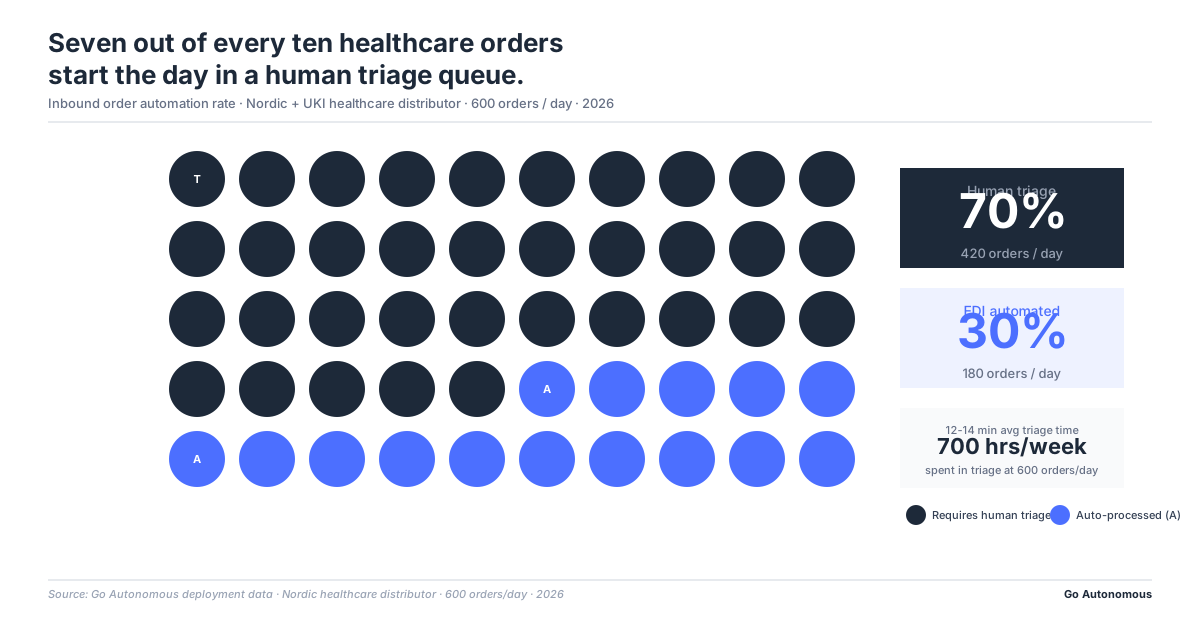
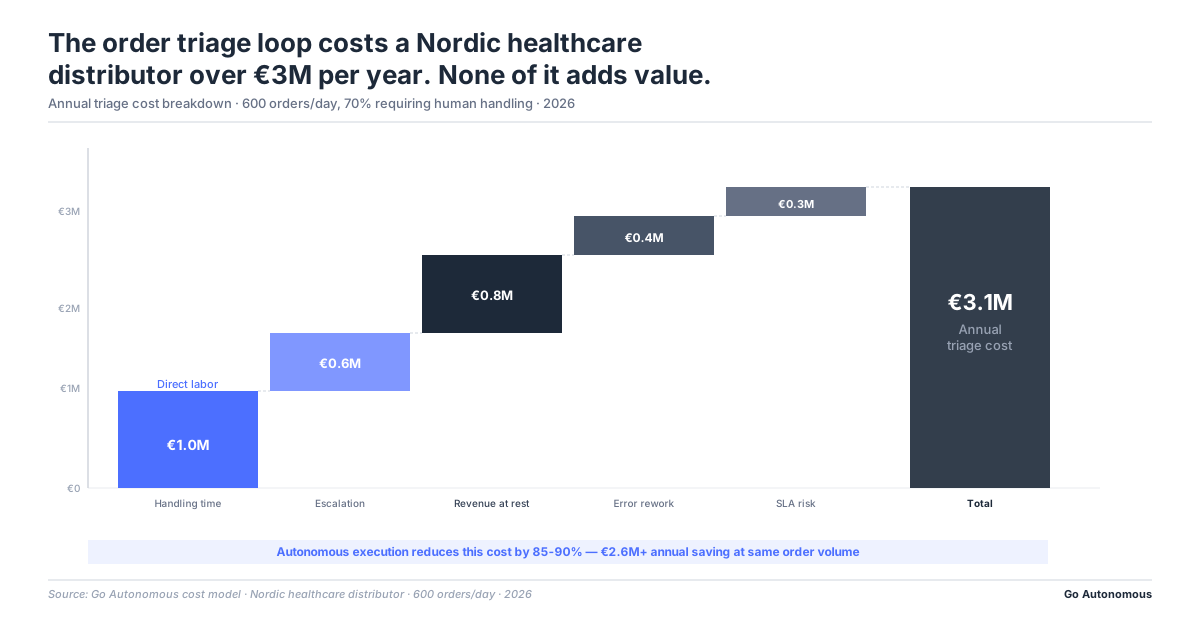
Consider a distributor processing 600 inbound orders per day across its Nordics and UKI footprint. Roughly 30 percent arrive via EDI from large hospital groups. These move cleanly into SAP S/4HANA through structured batch processing. The remaining 70 percent arrive via email, web portal, phone, and fax from smaller care facilities, GP practices, care homes, and regional clinic networks. Each of those orders requires a human to read it, match it to a customer account, validate pricing against the applicable framework contract, check stock availability, and enter it into the ERP. At an average handling time of 12 to 14 minutes per order, that is roughly 700 person-hours per week spent on order intake alone.
What causes the triage loop in healthcare order processing?
The triage loop in healthcare order processing is caused by channel fragmentation combined with contract complexity. Hospital groups with EDI infrastructure send structured orders that flow directly into the ERP. Smaller facilities send unstructured orders via email or phone, each requiring manual interpretation. Between those two groups sits a middle tier of customers using web portals with varying data quality. No single intake mechanism handles all three, so the operations team becomes the routing layer by default.
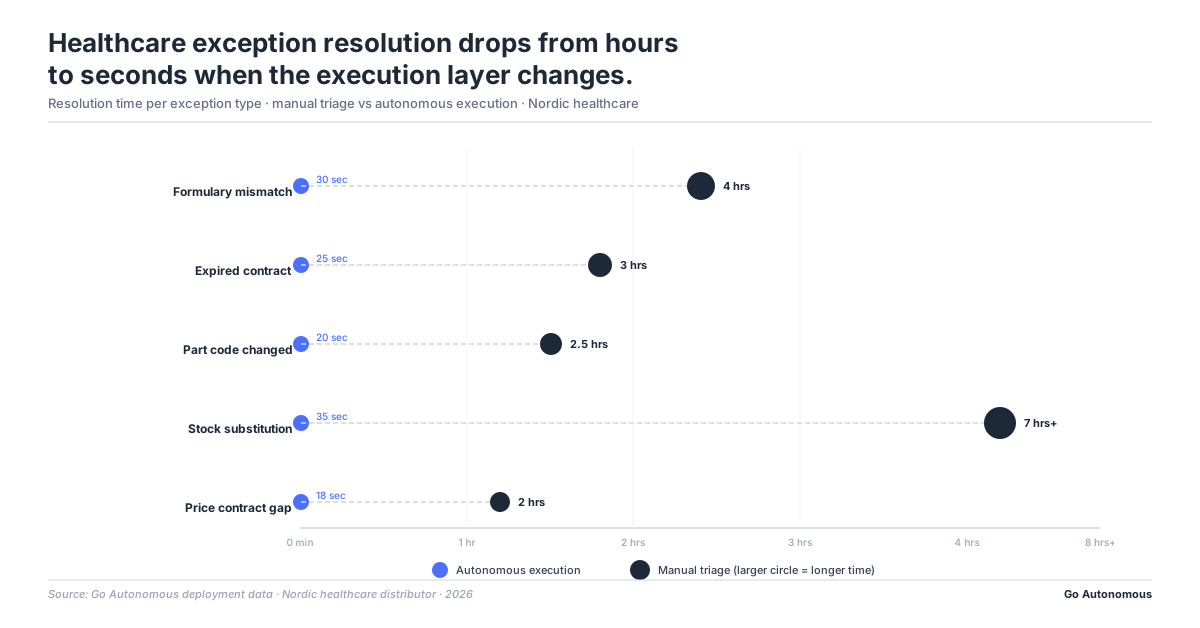
Beyond channel mix, healthcare distributors carry specific complexity that amplifies triage time. Framework contracts with NHS trusts, Scandinavian regional health authorities, and large care groups specify product codes, pricing tiers, and approved substitutions. These change regularly. A pricing mismatch on an order from a hospital trust that has updated its framework terms is not a simple exception: it requires checking the contract version, validating against the master data, and in some cases contacting the account manager for approval. That is not a 2-minute task. In a high-volume operation, it compounds into hours.
The result is what operations teams describe as a two-speed system: EDI accounts flow, everyone else waits. The customers who wait are often the ones most dependent on rapid confirmation, because smaller care facilities operate without the procurement infrastructure of a large hospital group.
How does Friction Debt accumulate in healthcare distribution operations?
Friction Debt is the total monetary cost of human decisions still happening in your revenue flow. It is calculated as the sum of manual touches multiplied by decision time per touch, multiplied by the fully loaded cost rate. In healthcare distribution, Friction Debt accumulates in three specific places: order intake validation, exception routing, and contract-price reconciliation. These are not one-time costs. They are daily operating expenses that compound with every revenue increase, every new customer added, and every contract renewal that changes pricing logic.
The key insight about Friction Debt is that it is invisible on a standard P&L. The cost sits inside headcount lines labeled “customer service” or “order management.” The team looks fully utilized because it is fully utilized, processing exceptions from the moment the day starts. Until Friction Debt is quantified as a discrete number, it cannot be budgeted against and it cannot be reduced systematically. Most healthcare distributors have never put this number on their operations dashboard. The teams doing it fastest are starting there.

What Autonomous Order Execution Changes for Healthcare Distribution Operations
Autonomous Commerce does not replace the ERP. SAP S/4HANA, Oracle Cloud SCM, and Microsoft Dynamics 365 remain the systems of record for inventory, pricing master, and order confirmation. What changes is everything that happens before the order reaches the ERP, and the handling of everything that would otherwise require a human to intervene.
The Autonomous Commerce platform operates as an execution intelligence layer above the ERP and across all intake channels. It connects to email (processing unstructured orders via document intelligence tools like ABBYY or Rossum), EDI feeds (TrueCommerce, SPS Commerce for structured healthcare EDI including EDIFACT and ANSI X12), and web portals. Every incoming order, regardless of source format, passes through the same validation logic: customer identity, contract version, pricing tier, product code validity, stock availability. The system resolves standard exceptions autonomously using codified rules drawn from the existing pricing policy and contract structure.
How does autonomous order processing work in healthcare distribution?
Autonomous order processing in healthcare distribution works by applying execution intelligence across all incoming order channels simultaneously. The platform reads orders from email, EDI, portal, and fax, validates each against the live contract and pricing master, resolves known exception types without human routing, and writes confirmed orders directly to the ERP. Only orders with genuinely novel exceptions, those that fall outside any codified rule, reach a human operator. In practice, this means the customer service team handles the 3 to 5 percent of orders that require judgment, not the full intake volume.
For healthcare distributors specifically, the platform handles several exception types that currently consume significant triage time. These include: pricing mismatches where the submitted price differs from the framework contract by an acceptable tolerance (auto-resolved using the contract rule), product code substitutions where a discontinued SKU maps to an approved replacement (auto-resolved using the product master), and partial stock availability where a split shipment is contractually permitted (auto-resolved using the SLA terms). Each of these has a defined resolution path. Codifying that path removes it from the triage queue permanently.
The downstream effect on customer service teams is structural. When the triage loop is removed, operators are not idle. They are redirected to the interactions that actually require human judgment: new customer onboarding, contract negotiation support, escalation handling, and proactive outreach to accounts with irregular order patterns. This is the shift from reactive execution to commercial engagement that every Head of Customer Experience at a healthcare distributor is trying to achieve, and failing to achieve, because the team’s capacity is fully consumed by triage.
Adopting Autonomous Commerce at Danfoss is not just about speed and efficiency. It's about empowering our customer service teams and sales force to focus on building relationships and providing personalized support.

That shift, from execution to engagement, is not a productivity gain. It is a commercial capacity gain. The team that spent 70 percent of its time processing orders now spends 70 percent of its time serving customers. That ratio change is measurable in customer satisfaction scores, contract renewal rates, and net revenue retention. For healthcare distributors under pressure to deepen relationships with NHS frameworks and Nordic health authority accounts, it is a strategic lever, not an operational footnote.
Healthcare Order Handling: Before and After Autonomous Execution
The table below describes what order handling looks like across key operational dimensions, contrasting the current state at most healthcare distributors with what autonomous execution delivers in practice. This is not a theoretical comparison: it reflects the operational patterns observed across deployments in the Nordics and UKI, including the work done with healthcare distributors running complex multi-channel environments.
| Dimension | Before: Manual Triage Model | After: Autonomous Execution |
|---|---|---|
| Order intake channel | EDI for large accounts; email, phone, fax, portal for all others. Each channel handled separately by different team members. | All channels processed through a single execution layer. EDI, email, portal, and fax enter one pipeline; the system normalizes format and validates against contracts. |
| Processing time per order | 12 to 14 minutes average for non-EDI orders. EDI orders are faster but still require exception review in batch windows. | Non-exception orders confirmed in under 60 seconds. Exception handling time shifts to genuine edge cases only. |
| Exception handling | All exceptions routed to the customer service queue. Pricing mismatches, product code issues, and partial availability all require human review regardless of resolution complexity. | Known exception types resolved autonomously using codified contract rules and product master data. Only novel exceptions reach human operators. |
| Team capacity utilization | 60 to 70 percent of team capacity consumed by order intake and triage. Proactive customer engagement is a secondary activity. | Exception-only handling frees the majority of team capacity for commercial interactions: account management, contract support, proactive outreach. |
| Order accuracy | Manual entry introduces transcription errors. Product code mismatches and pricing errors reach the ERP and require downstream correction. | System validates against live contract and product master before ERP writeback. First-time-right rate increases significantly as manual entry is removed from the flow. |
| Customer confirmation speed | Confirmation sent after manual validation, often hours after order receipt. Urgent orders from care facilities may not receive same-day confirmation. | Automated confirmation sent immediately upon autonomous validation. Customers receive confirmation in minutes rather than hours, regardless of order source channel. |
How Mediq Is Transforming Order Handling in Nordic Healthcare Distribution
Mediq is one of the largest healthcare distributors in the Nordic market, operating across multiple countries and serving hospital groups, care facilities, and community health networks. The operational challenge Mediq faced was precisely the multi-channel complexity described above: large institutional customers connected via EDI, smaller facilities ordering via email and phone, and a customer service team spending a significant portion of its capacity on order intake rather than customer engagement.
The deployment of Autonomous Commerce at Mediq introduced an execution layer that processes incoming orders across all channels, validates against framework contracts, and handles standard exceptions without human routing. The result was a significant reduction in order handling time and a reallocation of customer service team capacity toward higher-value interactions. Mediq’s teams moved from reactive triage to proactive engagement, a structural change that would not have been achievable by adding headcount or optimizing the existing process.
For healthcare distributors evaluating a similar path, the Mediq deployment demonstrates two things that matter most. First, that autonomous execution works in complex healthcare environments with framework contracts, multi-country operations, and diverse customer segments. Second, that the change is not primarily a technology project. It is a commercial capacity project: the goal is not a faster inbox, it is a different operating model for the customer service organization.
We believe that Autonomous Commerce is the right way to go for us. It will help our customer service teams immensely, and ultimately, this will benefit our customers who will experience shorter response times and higher accuracy.
What is the Human Dependency Ratio in healthcare order management?
The Human Dependency Ratio (HDR) is the number of manual decisions required per unit of revenue processed. In healthcare distribution, HDR is the clearest measure of how dependent the order management operation is on human judgment for execution tasks that a well-configured system could handle. A healthcare distributor with a high HDR is not running an efficient operation. It is running an operation that requires more people every time revenue grows, because each new order, each new customer, and each new contract adds to the decision load.
The critical distinction between HDR and touchless rate is important here. Touchless rate measures whether a human touched a transaction. HDR measures whether the transaction could have completed without a human. A transaction can be touched by a human and still flow efficiently. A transaction with structural human dependency cannot progress without one. Healthcare distributors running triage-heavy operations have a high HDR even if their EDI touchless rate looks acceptable, because the EDI orders represent only the portion of volume that was already structured. The full HDR picture includes every email order, every portal exception, and every phone call that generates a manual entry.
“Automation scales labor. Autonomy eliminates dependency.” That distinction is the operational dividing line. A team that processes more orders by adding headcount has not reduced its HDR. It has scaled its dependency. Autonomous execution reduces HDR by removing the structural requirement for human judgment on orders that follow known patterns.
Evaluating Autonomous Execution for Healthcare Distribution: What Operations Teams Should Assess First
The decision to deploy Autonomous Commerce is not primarily a technology evaluation. It is a commercial architecture decision. The right starting point is not a vendor comparison. It is an honest assessment of where the current operation’s Human Dependency Ratio is highest and what that dependency is costing in operational capacity and customer experience quality.
For healthcare distributors, the assessment should cover four areas:
- Channel distribution: What percentage of inbound orders arrive via EDI versus unstructured channels? The gap between EDI coverage and total order volume is the clearest indicator of triage load. If 70 percent of orders are non-EDI, that is a structural execution problem, not a staffing problem.
- Exception volume and type: What proportion of orders require human intervention? And more importantly, what are the exception types? If the majority of exceptions are pricing mismatches, product code substitutions, or partial availability queries, these are codifiable. A high codifiable-exception rate means a large portion of triage work is systematically removable.
- Contract complexity: How many active framework contracts does the organization manage, and how frequently do they change? Healthcare distributors with large NHS, Nordic regional health authority, or pan-European care group contracts carry substantial contract complexity. Autonomous execution requires that complexity to be codified in the pricing policy. The codification process is the critical dependency, not the technology deployment.
- Customer service capacity allocation: What percentage of customer service team time is currently spent on order intake and triage versus proactive customer engagement? This ratio is the single most direct measure of what autonomous execution unlocks. Organizations where 60 percent or more of team capacity goes to execution tasks are the ones that see the largest commercial capacity shift.
For the technical integration layer, the deployment connects to existing ERP infrastructure (SAP S/4HANA, Oracle Cloud SCM, or Microsoft Dynamics 365) without replacing it. EDI feeds from TrueCommerce or SPS Commerce continue operating. Email order processing runs through document intelligence (ABBYY, Rossum) feeding the same execution layer. The Autonomous Commerce platform sits above all of these as the validation and routing intelligence. It does not require an ERP migration or a channel consolidation project before it can deploy.
For broader context on the operational efficiency gains that autonomous execution delivers across manufacturing and distribution, and for a view of how this compares to earlier automation approaches, the patterns are consistent: the organizations achieving the largest reductions in cost-to-serve are the ones that moved from task-level automation to execution-layer autonomy. See customer success cases for the full picture across industries and geographies.
Healthcare distribution adds one dimension that most other verticals do not: the downstream consequence of slow execution is not just a dissatisfied customer. It is a care facility that cannot confirm supply for a patient-critical product. That urgency is the reason healthcare distributors have historically over-staffed their order management functions. Autonomous execution does not just reduce that cost. It removes the structural reason the overstaffing was necessary in the first place.
If your organization is reviewing digital transformation priorities for order management, the Welcome to the Era of Autonomous Commerce white paper provides the full strategic framework for how this category is redefining what execution looks like at scale.
Sources
- Mediq Autonomous Commerce case study, Go Autonomous
- Mediq press release: Transforms Order Handling with Autonomous Commerce, Go Autonomous
- McKinsey Operations Insights: B2B operations and digital transformation benchmarks
The Autonomous Execution Fabric: How Healthcare Distributors Close the Triage Loop Across All Commercial Transactions
The order triage loop described in this post is the most visible manifestation of a broader structural gap: no execution layer capable of handling all inbound commercial transactions without human routing. The Autonomous Execution Fabric closes that gap at the architecture level. It is a full commercial execution layer that connects directly to your SAP, Oracle, or Microsoft Dynamics environment and executes every inbound commercial transaction without human assembly, regardless of channel, format, or transaction type.
In healthcare distribution specifically, the Fabric handles the full commercial transaction portfolio, not just the order intake queue. That means orders from every channel simultaneously: hospital EDI batches, care facility email PDFs, portal submissions, and phone-in call-offs, all processed through the same execution layer and validated against the same framework contracts and pricing master. Beyond orders, the Fabric processes pricing requests against tiered framework agreements, returns authorizations for recalled or over-delivered items, credit notes, and contract tenders. Every transaction type that currently feeds your triage loop runs through the same execution layer, using the same ERP connection.
The operational significance for healthcare distributors is direct. The triage loop does not exist because order intake is uniquely complex. It exists because the same root cause, human dependency on every transaction type, applies across orders, returns, pricing queries, and credit requests simultaneously. A distributor that exits the triage loop for standard orders but still manually processes returns authorizations and pricing exception tickets has removed one part of the problem while the underlying structural dependency remains. The Autonomous Execution Fabric addresses the root cause across all commercial transaction types at once, which is why the capacity reallocation it enables is structural rather than incremental.
See How Autonomous Order Execution Works in a Healthcare Distribution Environment
Healthcare distribution carries order management complexity that most verticals do not: multi-channel intake from hospital EDI to care facility emails, framework contracts with frequent pricing updates, and SLA requirements where confirmation speed directly affects care delivery. The triage loop this complexity creates is a structural cost that grows with every new customer, every contract renewal, and every revenue target increase. Autonomous Commerce removes the structural requirement for human triage on orders that follow known patterns, freeing customer service capacity for the commercial interactions that actually build account value. Go Autonomous works with 500M to 20B EUR manufacturers and distributors in the Nordics, DACH, Benelux, UKI, and France. If the patterns described in this post apply to your operations, we can show you exactly what autonomous execution looks like in your environment: your ERP, your order channels, and your commercial workflows. Book a conversation with our team.
The Cost of Standing Still
For a healthcare distributor processing 600 orders per day with 70 percent arriving via unstructured channels, the arithmetic of the triage model is unambiguous. At 13 minutes average handling time for non-EDI orders and a fully loaded team cost of 45 EUR per hour, that is approximately 680 person-hours per week and 1.5M EUR per year spent exclusively on order intake and validation. That figure does not include the downstream cost of errors that reach the ERP and require correction, or the commercial cost of customer confirmation delays that affect care facility satisfaction and contract renewal probability.
- Processing overhead: Every 10 percent increase in order volume adds proportional headcount cost as long as triage is the operating model. A distributor growing at 15 percent per year compounds this cost annually, while competitors who have removed the triage loop do not.
- Confirmation speed disadvantage: Care facilities and smaller health networks route discretionary orders toward distributors who confirm fastest. Manual triage means confirmation times measured in hours. Autonomous execution compresses that to minutes. Over a large customer base, that speed difference is a retention and win-rate factor.
- Headcount ceiling: The triage model has a practical staffing ceiling. Beyond a certain volume, adding more order management staff does not improve speed, it adds coordination overhead. Autonomous execution removes the ceiling by taking structural execution dependency off the headcount line.
- Friction Debt accumulation: Every exception type that is currently handled manually but could be codified is generating Friction Debt daily. Each day without codification is a day that debt compounds. Healthcare distributors who have quantified this number find that the cost of autonomous execution deployment is recovered within months, not years, from Friction Debt reduction alone.
The distributors who exit the triage loop first gain a structural cost advantage that is difficult for slower-moving competitors to close. The customer experience improvements from faster confirmation and higher accuracy compound over time into measurable improvements in contract retention and net revenue retention. Standing still is not a neutral decision. It is a choice to let Friction Debt accumulate while competitors pay it down.
Frequently Asked Questions
How does autonomous order processing work in healthcare distribution?
Autonomous order processing in healthcare distribution reads incoming orders from all channels including EDI, email, portal, and fax. The execution layer validates each order against live framework contracts and pricing master data, resolves standard exceptions automatically using codified rules, and writes confirmed orders to the ERP. Only orders with genuinely novel exceptions reach a human operator, typically 3 to 5 percent of total volume.
What is the order handling process at a medical supply distributor?
At most medical supply distributors, order handling involves receiving orders across multiple channels, sorting and prioritizing them manually, validating each against framework contracts and product master data, entering non-EDI orders into the ERP, and handling exceptions individually. This triage process consumes 60 to 70 percent of customer service team capacity and is the primary driver of order confirmation delays.
How do healthcare distributors manage EDI and email orders together?
Most healthcare distributors manage EDI and email orders through parallel, disconnected processes. EDI batches from large hospital accounts flow into the ERP via platforms like TrueCommerce or SPS Commerce. Email orders from smaller facilities are handled manually by the customer service team. Autonomous Commerce unifies these channels by processing both through a single execution layer that normalizes format, validates against contracts, and routes exceptions consistently regardless of order source.
What is the average order processing time in pharmaceutical and healthcare distribution?
For EDI orders, processing time is typically minutes to hours depending on batch windows. For email and phone orders, manual handling averages 12 to 15 minutes per order from receipt to ERP entry, before accounting for exceptions. Autonomous execution compresses non-exception processing to under 60 seconds across all channels, replacing hours-long manual validation cycles with immediate confirmation.
What is the Human Dependency Ratio and how does it apply to healthcare distributors?
The Human Dependency Ratio (HDR) measures the number of manual decisions required per unit of revenue processed. For healthcare distributors, a high HDR means the operation cannot scale revenue without proportional headcount increases. Autonomous execution reduces HDR by codifying routine exception handling and removing structural human dependency from the standard order flow, breaking the link between revenue growth and headcount growth.
Can Autonomous Commerce integrate with SAP S/4HANA for healthcare distribution?
Yes. Autonomous Commerce integrates with SAP S/4HANA, Oracle Cloud SCM, and Microsoft Dynamics 365 as the execution intelligence layer above the ERP. It does not replace the ERP or require a migration. The platform handles order intake, validation, and exception resolution before writing confirmed orders to the ERP through the standard integration layer, preserving existing master data structures, pricing logic, and fulfillment workflows.
Why do healthcare distributors have high order exception rates compared to other industries?
Healthcare distributors have higher exception rates because of complex framework contracts (NHS trusts, regional health authorities, care group agreements), frequent pricing and product catalog changes, and a fragmented customer base spanning large hospital groups and small care facilities. Each contract tier carries different pricing rules, approved substitutions, and SLA terms. When these do not match an incoming order precisely, the order requires manual resolution, creating the triage loop that consumes most of the operations team’s day.