.svg)





B2B RFQ Win Rate by Response Time: What the Data Shows About Speed and Revenue
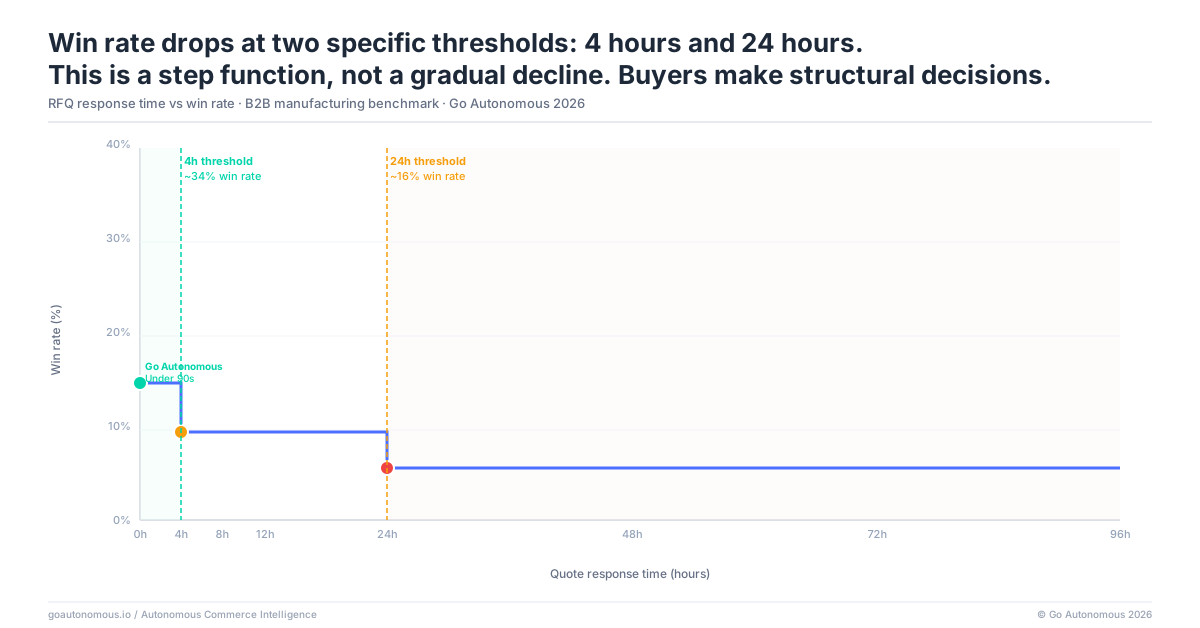
The relationship between quote response time and win rate in B2B manufacturing and distribution is not linear — it is a step function. Win probability is highest in the first 4 hours, drops significantly between 4 and 24 hours, and approaches baseline after 48 hours. This post presents the data on RFQ response time and win rate, explains the mechanism behind the step-function drop, and shows what operations architecture produces consistently fast quote responses at scale.
B2B quote win rate does not decline gradually as response time increases. It drops at two specific thresholds: 4 hours and 24 hours after RFQ receipt. A manufacturer or distributor responding in under 4 hours operates in a fundamentally different competitive position than one responding in 48 hours — not because buyers prefer faster suppliers on principle, but because procurement timelines create structural decision windows that late quotes miss entirely. At scale, the revenue gap from slow quoting is material, and it is systematically invisible in standard CRM reporting. The path to consistent sub-4-hour response is not faster teams; it is removing manual assembly from the quote process.
Table of Content
- B2B Win Rate Drops at Two Critical Thresholds: 4 Hours and 24 Hours After RFQ Receipt
- The Revenue Impact of a 48-Hour Average Quote Response Time at Scale
- Industries and Deal Types Where Response Time Has the Highest Win Rate Impact
- Achieving Sub-4-Hour Quote Response at Scale Requires Removing Manual Assembly From the Process
- The Autonomous Execution Fabric: Consistent Sub-4-Hour Response Across All Commercial Transaction Types
- Frequently Asked Questions
- What is the relationship between B2B quote response time and win rate?
- How quickly should B2B manufacturers respond to RFQs to maximize win rate?
- What is the revenue impact of slow quote response time in B2B manufacturing?
- How do B2B distributors achieve fast RFQ response times across high quote volumes?
- What is the win rate difference between responding to an RFQ in 4 hours vs 48 hours in B2B manufacturing?
B2B Win Rate Drops at Two Critical Thresholds: 4 Hours and 24 Hours After RFQ Receipt
The Step-Function Pattern: Why Win Probability Does Not Decline Gradually
B2B quote win rate does not decline gradually as response time increases — it drops at specific thresholds that correspond to buyer decision behavior. The pattern is a step function, not a slope. Win probability is high in the first window, then falls sharply at the 4-hour mark, remains lower through the 4-to-24-hour band, and drops again after 24 hours to near-baseline for quotes that arrive beyond 48 hours.
The reason is structural, not attitudinal. Procurement teams do not penalize slow suppliers because they dislike waiting — they move forward with the suppliers who have already provided usable information by the time they need to advance their internal process. A quote that arrives after the evaluation frame has been set by faster competitors is not evaluated on equal terms. It is evaluated as a challenger to a position already established by others.
This step-function pattern is consistent across industries and deal types, though the magnitude of the drop and the exact threshold timing vary by procurement complexity, deal value, and the number of suppliers contacted. For commodity-adjacent products where price is the primary variable, the first-response advantage is pronounced. For engineered or configured products where technical fit matters more, the window is somewhat wider, but the threshold structure still applies.
What Happens in the Buyer’s Decision Process Between Hour 1 and Hour 24
The first threshold is 4 hours: buyers who receive a quote within 4 hours of submitting an RFQ are still in active evaluation mode. They have not yet received multiple competing quotes, the RFQ is the current focus of the procurement conversation, and the supplier who responds first shapes how subsequent responses are evaluated. A quote received at hour 2 becomes the reference point — the price, the lead time, the terms — against which everything else is compared.
After 4 hours, a procurement team that sent the same RFQ to multiple suppliers begins receiving responses from the faster suppliers. The evaluation focus shifts to those responses. The team begins internally discussing the options on the table. A quote arriving at hour 6 or hour 10 enters a conversation that has already started without it.
The second threshold is 24 hours: buyers who have not received a quote within 24 hours have typically moved to the next stage with whichever suppliers responded. The procurement conversation has progressed to follow-up questions, clarifications, or informal shortlisting based on what was received. A late quote does not reset the evaluation — it arrives as an interruption to a process that has already advanced. In many cases, the buyer’s internal stakeholders have already formed a preference based on what they reviewed.
The mechanism is not psychological preference for faster suppliers. It is that procurement teams operate against deadlines, and suppliers who miss the decision window are evaluated against a context shaped by competitors. The commercial consequence is direct: being consistently late means being consistently evaluated at a disadvantage, across the full volume of RFQs received. For manufacturers and distributors focused on topline growth and margin management, this is one of the highest-leverage inefficiencies to address.
Each time we added one or two million euros in revenue, we had to add another operator. From a cost perspective, that's an unsustainable way of operating a business.

The Revenue Impact of a 48-Hour Average Quote Response Time at Scale
Calculating the Win Rate Penalty Across an Annual RFQ Volume
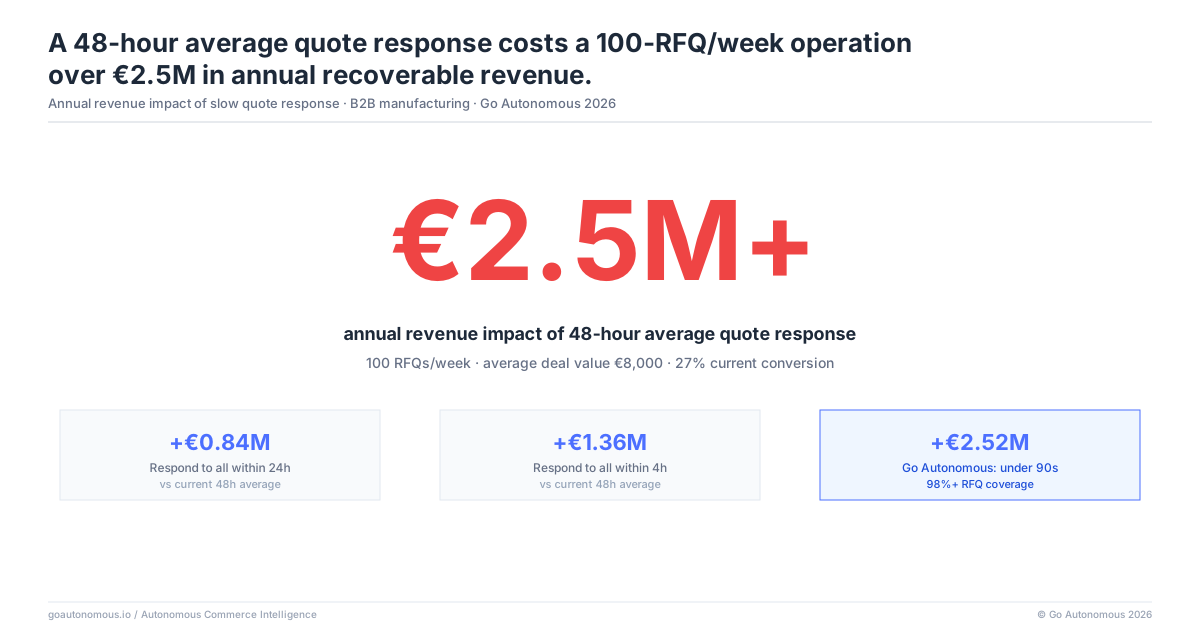
The revenue impact of a 48-hour average quote response time becomes material when calculated across full annual RFQ volume. A manufacturer receiving 500 RFQs per month at an average deal value of €25,000 has €12.5M in monthly RFQ opportunity. If responding in under 4 hours produces a 35% win rate and responding in 48 hours produces a 20% win rate, the 15 percentage point difference represents €1.875M in monthly revenue. Annualised, that is €22.5M that is not lost to competitive pricing, product fit, or relationship quality — it is lost to timing alone.
The scale of that figure surprises most commercial leaders when they calculate it, because the loss is invisible. Sales teams that are quoting accurately and following up diligently do not see a signal that response time is the constraint. They see deals won and deals lost, without systematic visibility into the deals that were never competitively evaluated because the quote arrived too late to matter.
How the Revenue Gap From Slow Quoting Accumulates Without Appearing in Sales Reports
This revenue gap does not appear in sales reports as lost deals. RFQs that expired without a quote submission appear as no-activity, not as losses. Quotes submitted after the buyer had already moved forward appear as active pipeline — they may even generate polite responses that keep the opportunity open in the CRM while the buyer has effectively already decided. The commercial impact of quote response time is systematically invisible in standard sales analytics because CRM systems track quotes submitted, not quotes that should have been submitted but were not.
Win/loss analysis almost never captures timing as a loss reason, because the losing supplier often does not know that timing was the factor. Buyers rarely say “you were too slow.” They say “we went with another supplier” or “we will keep you in mind for next time.” The timing problem is masked by polite deflection.
The practical implication is that the true cost of a slow quoting operation is not visible in standard reporting. Revenue that could have been won through faster response does not appear as a loss — it appears as a gap in pipeline that sales teams attribute to market conditions or competitive pricing. For manufacturers and distributors operating at €500M to €20B in revenue, identifying and closing this gap is a direct path to measurable efficiency gains without increasing headcount or discounting price.
Industries and Deal Types Where Response Time Has the Highest Win Rate Impact
Spot Pricing Requests: Where the Response Time Effect Is Strongest
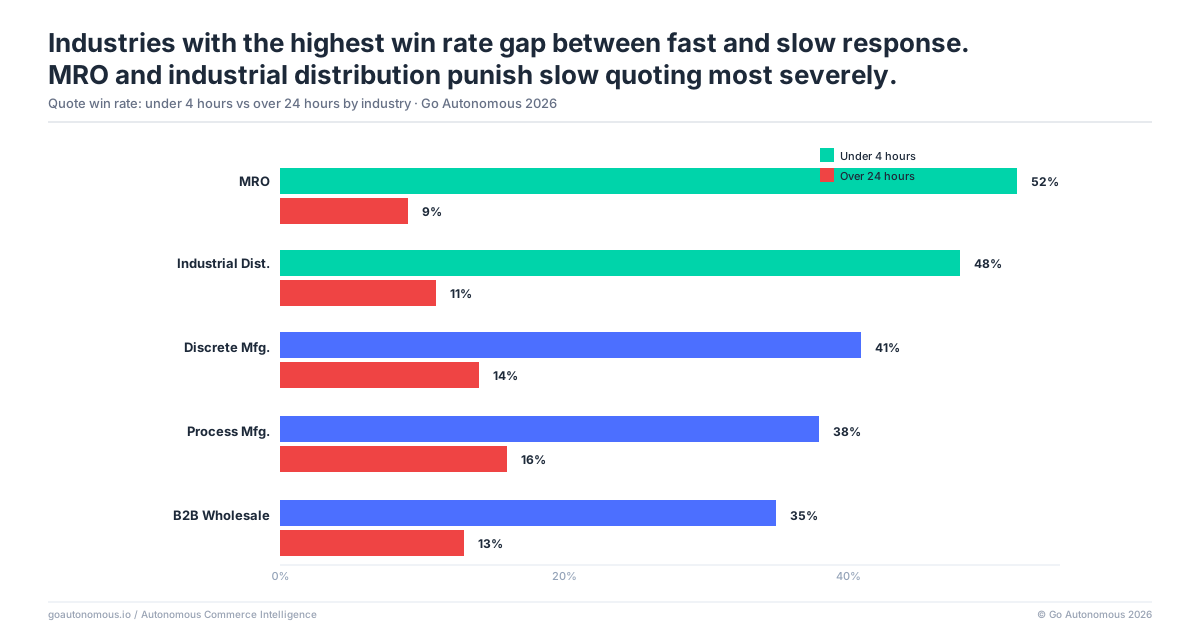
The response time effect on win rate is not uniform across all RFQ types. It is strongest for spot pricing requests: requests outside contracted pricing where the buyer is actively shopping for the best available price from multiple suppliers simultaneously. For spot requests, the first qualified quote received sets the competitive baseline that all subsequent quotes are evaluated against. Being first does not guarantee a win, but being late guarantees a disadvantage.
Spot requests are also the highest-volume unstructured RFQ category for most manufacturers and distributors. They arrive by email, through distributor portals, via sales rep inboxes, and through customer service teams. The unstructured nature of spot request volume is itself a constraint on response time: a team that must manually read, interpret, and route each request before beginning quote assembly cannot achieve consistent sub-4-hour response at scale. The volume and the format combine to create the bottleneck.
Among the customers who have addressed this with autonomous commerce capabilities, the spot request category is consistently where the largest win rate improvement appears. VELUX, processing over 130,000 orders across 9 markets with 88% decision autonomy, achieved this improvement precisely because the high-volume, unstructured segment of their quote and order flow was automated end-to-end rather than filtered through manual handling.
Multi-Source RFQs: How Procurement Teams Structure Competitive Quoting
The response time effect is also strong in multi-source RFQ scenarios, where procurement teams send the same specification to 3 to 5 suppliers and select from those who respond within the decision window. The structure of multi-source RFQs creates an explicit timing gate: the buyer is not waiting for all responses before evaluating, but advancing the evaluation based on who has responded by the time the internal review is scheduled.
A supplier who consistently responds in under 4 hours will be evaluated in more competitive scenarios than a supplier who responds in 48 hours — not because procurement teams prefer them on principle, but because they are systematically present at the decision point. The supplier responding in 48 hours may be technically superior in product quality, pricing, or service terms, but if those attributes are not in the room when the decision is being made, they do not influence the outcome.
Over a full year of RFQ volume, the difference in evaluation presence compounds into a significant win rate and revenue gap. A supplier who is present at 80% of competitive evaluations because they respond in time, versus one present at 40% because they respond late, is operating in a structurally different revenue trajectory — even if their win rate among evaluations they participate in is identical. The customer experience impact of consistent, fast response also builds account-level preference over time, reinforcing the win rate advantage across the relationship.
Achieving Sub-4-Hour Quote Response at Scale Requires Removing Manual Assembly From the Process
What Manual Quote Assembly Actually Takes: Lookup, Pricing, Approval, Formatting
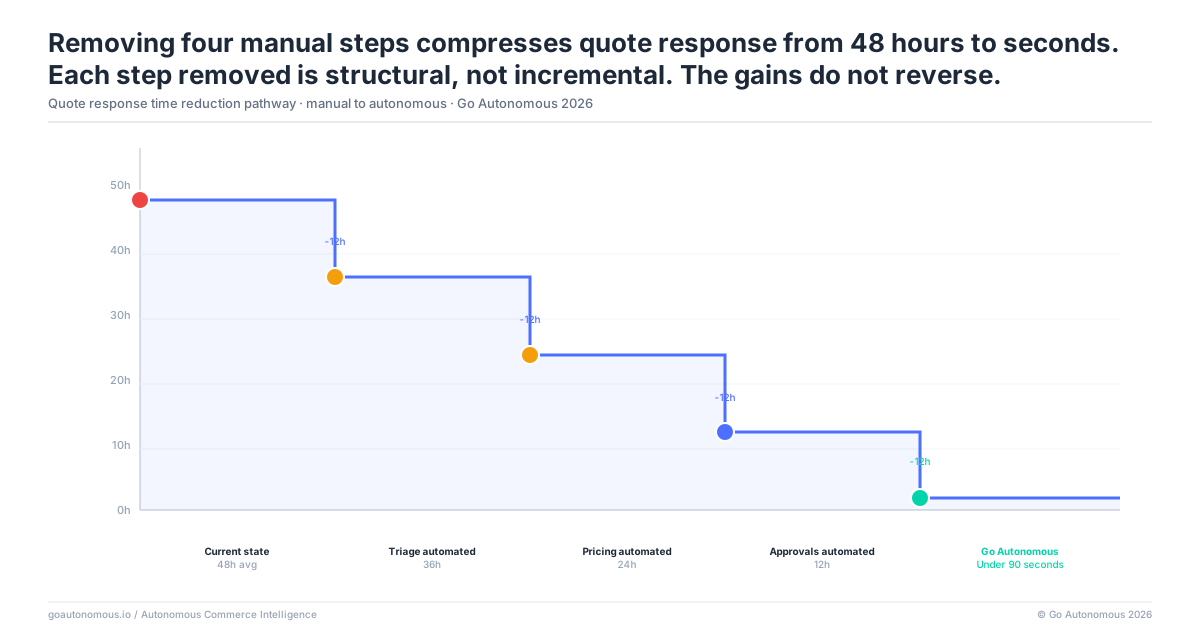
Achieving consistent sub-4-hour quote response at scale is not possible through team effort alone. The constraint is not motivation or capacity — it is the structure of the manual quote assembly process itself. A manual workflow that requires product lookup against catalog and inventory, pricing verification against ERP or pricing tables, discount and exception approval routing, and document formatting and delivery cannot reliably complete in under 4 hours across all RFQ types during all volume conditions.
The 4-hour target is achievable on simple requests when the right team members are available and not handling other work. It fails on complex requests with multiple line items or configured products. It fails during peak order periods when the team is handling inbound order volume simultaneously. It fails outside business hours when the RFQ arrives at 4pm on a Friday and the earliest realistic response is Monday morning. And it fails when specialist input is required from product, pricing, or commercial teams who are not immediately available.
The manual quoting process is not slow because the people executing it are inefficient. It is slow because the process contains dependencies that cannot be compressed below a certain floor without removing the dependencies themselves. Compare this to RPA vs AI: rule-based automation can handle structured, predictable requests, but plateaus at roughly 60% touchless because it breaks on the exceptions, the unstructured formats, and the requests that require judgment. The 40% that exceeds RPA’s capability is precisely the high-value, complex quote volume where response time matters most.
How Autonomous Quoting Compresses the Response Cycle Without Reducing Quote Quality
Autonomous quote processing removes the assembly steps that create the delay. An incoming RFQ, regardless of whether it arrives by email, portal, EDI, or sales inbox, is read and parsed to extract product identifiers, quantities, delivery requirements, and commercial context. It is then matched against the product catalog and inventory position. Applicable pricing is retrieved from the ERP, discount logic is applied against customer tier and volume thresholds, and a formatted quote is produced for human review or direct sending, depending on complexity and value thresholds.
The human’s role shifts from assembly to review and judgment: adjusting quotes that require commercial discretion above the automated logic, escalating requests that need specialist input for configured or engineered products, and following up on submitted quotes to advance the deal. Standard requests exit the queue in under an hour regardless of volume or team workload. Complex requests are flagged for human action with all the assembly work already done, so the specialist reviews a near-complete quote rather than starting from an empty template.
The 4-hour threshold is met consistently, not occasionally. The consistency is the critical point: a team that hits sub-4-hour response on 60% of requests and misses it on 40% achieves a blended win rate that is worse than the numbers suggest, because the 40% of late responses includes the peak-volume periods and the most complex requests, which are also typically the highest-value deals. Consistent sub-4-hour response, across all volume conditions and request types, is what produces the full win rate benefit.
Danfoss demonstrated the ceiling of what this architecture can deliver: processing quotes and orders across 26 countries in a single day, with 80% handled autonomously, compressing cycle times from 42 hours to under 1 minute for standard requests. That is not a marginal improvement — it is a structural change in the commercial operation. See what B2B manufacturers have achieved at success cases, and the platform overview at autonomous commerce.
The Autonomous Execution Fabric: Consistent Sub-4-Hour Response Across All Commercial Transaction Types
Achieving consistent sub-4-hour RFQ response across all volume conditions requires removing manual assembly from the quote process. The Autonomous Execution Fabric is the execution layer that makes this possible: it connects directly to your SAP, Oracle, or Microsoft Dynamics environment and processes every inbound commercial transaction without manual intervention. For quote requests, the Fabric reads the RFQ from any intake channel (email, EDI, customer portal, or direct API), retrieves pricing from the ERP, applies discount logic, and delivers a validated quote — in minutes, not hours, at any volume and at any time of day.
The Fabric handles the full commercial transaction set, not only quote requests. Orders that follow accepted quotes are processed through the same layer. Pricing requests, returns, credit notes, and contract tenders all run through the Autonomous Execution Fabric without entering a human processing queue. This matters for RFQ win rate because the operations with the fastest quote response times are also the ones where order confirmation, returns processing, and invoice issuance are equally fast — because they all run through the same execution model, not through separate manual workflows.
Win rate at the 4-hour threshold is a downstream outcome of execution architecture. Operations that miss the 4-hour window do not miss it because their people work slowly. They miss it because the process contains dependencies that cannot be compressed below a certain floor when humans are in the assembly chain. The Autonomous Execution Fabric removes those dependencies across all commercial transaction types. The result is not just faster quotes — it is a commercial operation where every transaction type runs at execution speed, and the team’s capacity is reserved for the judgment decisions that actually require it.
If your team is consistently losing ground on RFQ response time and the revenue impact is not visible in your current reporting, the starting point is a process audit — mapping where quote assembly time actually goes, and which steps are dependencies versus delays. The Nilfisk case and the Danfoss case both started with that audit. Book a call with Go Autonomous to walk through where the response time gap is in your operation and what architecture closes it.
Frequently Asked Questions
What is the relationship between B2B quote response time and win rate?
The relationship is a step function, not a gradual decline. Win rate is highest when quotes are delivered within 4 hours of RFQ receipt. It drops significantly between 4 and 24 hours as buyers advance their evaluation with faster-responding suppliers. After 48 hours, win probability approaches baseline because the buyer’s decision frame has typically been set by competitors who responded earlier.
How quickly should B2B manufacturers respond to RFQs to maximize win rate?
The target threshold for maximum win rate impact is under 4 hours from RFQ receipt. Within this window, buyers are still in active evaluation mode, have not yet received multiple competing quotes, and the first qualified response shapes how subsequent responses are assessed. Consistent sub-4-hour response across all volume conditions and RFQ types requires removing manual assembly steps from the quoting process.
What is the revenue impact of slow quote response time in B2B manufacturing?
The revenue impact is material at scale and systematically invisible in standard CRM reporting. A manufacturer processing 500 RFQs per month at €25,000 average deal value faces €12.5M in monthly opportunity. A 15-percentage-point win rate difference between sub-4-hour and 48-hour response represents €1.875M in monthly revenue, or €22.5M annually, that is lost purely to timing rather than price or product fit. This gap does not appear as lost deals in sales reports — it appears as no-activity on expired RFQs.
How do B2B distributors achieve fast RFQ response times across high quote volumes?
Consistent fast RFQ response at scale requires removing manual assembly from the quote process. Autonomous quote processing reads incoming RFQs from any channel, matches them to the product catalog, retrieves pricing from the ERP, applies discount logic, and produces a formatted quote for human review or direct sending. This compresses standard request cycle times to under one hour and handles peak volume periods without response time degradation. The human team shifts from assembly to review, exception handling, and commercial judgment.
What is the win rate difference between responding to an RFQ in 4 hours vs 48 hours in B2B manufacturing?
The win rate gap between sub-4-hour and 48-hour RFQ response in B2B manufacturing and distribution is typically in the range of 10 to 20 percentage points, depending on product type, deal value, and the number of suppliers contacted in the RFQ. For spot pricing requests and multi-source RFQs where buyers evaluate simultaneously across suppliers, the gap is at the higher end of that range. The compounding effect across annual RFQ volume makes this one of the highest-leverage levers in the commercial operation.