.svg)





Why B2B Manufacturers Lose Deals at the Quote Stage: The RFQ Backlog Nobody Measures
B2B manufacturers lose a significant share of quotable revenue not in competitive evaluation but before a quote is ever submitted. When RFQs queue behind other work, arrive after hours, or require specialist input that is not immediately available, the customer moves on. This post examines the RFQ backlog problem, why it does not appear in standard sales reporting, and what operations architecture prevents it.
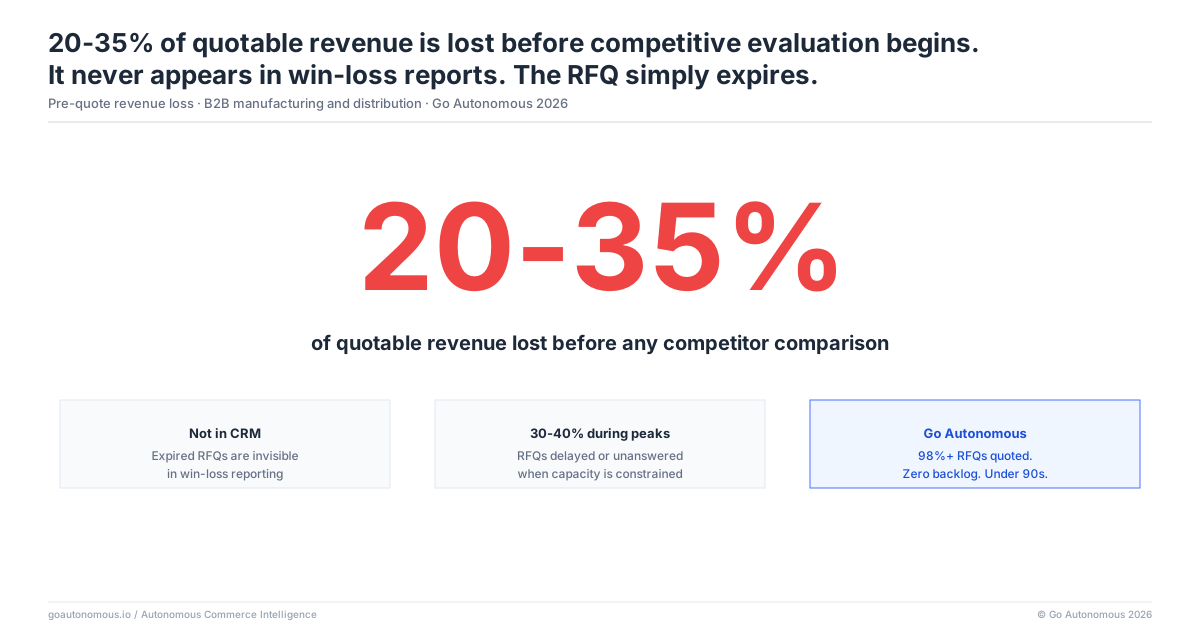
B2B manufacturers and distributors invest heavily in competitive positioning, pricing strategy, and sales enablement — and still lose 20–35% of quotable revenue before competitive evaluation ever begins. The mechanism is not a pricing miss or a capability gap. It is an unanswered RFQ. When a procurement team submits a request for quotation and receives no response within their decision window, they advance with whoever did respond. The loss is real, the revenue is gone, and it never appears in any win/loss report.
The RFQ backlog is the most underreported sales metric in B2B manufacturing and distribution. It forms when quoting competes with order processing for the same team capacity, and it concentrates its damage on the highest-value, most complex requests — exactly the deals where slow response is most costly. Understanding the mechanics of the pre-quote revenue gap is the starting point for closing it.
Table of Content
- B2B Manufacturers Lose Revenue at the Quote Stage Before Competitive Evaluation Begins
- The RFQ Backlog Forms Because Quoting Competes With Order Processing for the Same Team
- Complex and Non-Standard RFQs Are the Most Valuable and the Most Delayed
- Separating Quote Execution From Quoting Capacity Eliminates the RFQ Backlog
- The Autonomous Execution Fabric: Decoupling Commercial Execution From Human Capacity
- Frequently Asked Questions
- Why do B2B manufacturers lose deals before a quote is ever submitted?
- What is the RFQ backlog and how does it affect B2B manufacturer win rates?
- How long does a B2B customer wait for a quote before going to a competitor?
- How do B2B manufacturers reduce quote response time without adding sales headcount?
- What is the commercial impact of slow RFQ response in B2B distribution operations?
B2B Manufacturers Lose Revenue at the Quote Stage Before Competitive Evaluation Begins
The Invisible Loss: RFQs That Expire Before a Quote Is Submitted
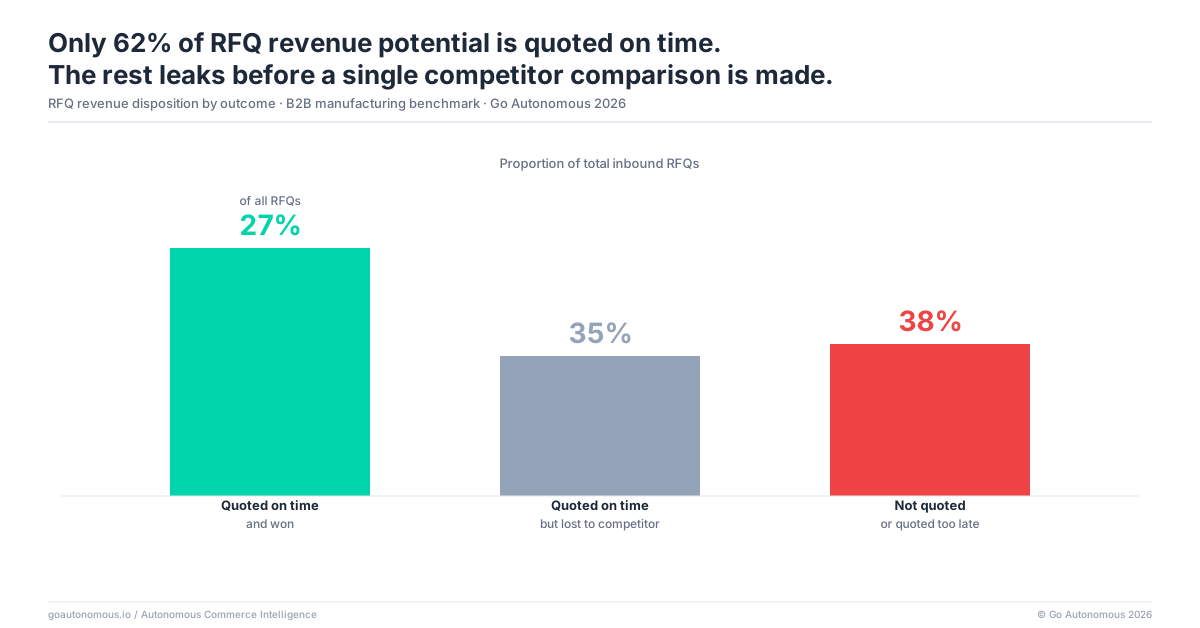
Standard win/loss analysis captures competitive outcomes: which deals were won, which were lost to competitors, and at what price point the customer chose an alternative. It does not capture the deals that never entered competitive evaluation because a quote was never submitted in time. When a procurement team sends an RFQ and receives no response within their decision window, they do not wait for the delayed quote. They move forward with the suppliers who responded. The commercial result is identical to a lost deal, but it never appears in CRM as a loss. It registers as an expired opportunity, a ghosted lead, or simply no record at all.
Why Win/Loss Analysis Misses the Pre-Quote Revenue Gap
The pre-quote revenue gap is structurally invisible to conventional sales reporting because CRM systems record outcomes for opportunities that were actively worked. An RFQ that was never quoted is either logged as a dead lead with no explanation or never entered into the pipeline at all. Sales managers reviewing win rates are looking at the denominator of deals that reached proposal stage. The deals that did not reach proposal stage are outside the denominator entirely. For operations where 30–40% of RFQs are delayed or unanswered during peak periods, the gap is not a reporting artifact. It is a structural revenue leak that compounds quarter over quarter.
Closing the pre-quote gap requires measuring it separately from competitive win rate. The relevant metric is quote submission rate: the percentage of inbound RFQs for which a quote was submitted within the customer’s decision window. For most manufacturers and distributors operating with manual quoting processes, that rate is unknown — which is itself a signal that the gap exists. The path to topline growth and margin management in B2B manufacturing runs directly through quote submission rate, not just competitive win rate.
Each time we added one or two million euros in revenue, we had to add another operator. From a cost perspective, that's an unsustainable way of operating a business.

The RFQ Backlog Forms Because Quoting Competes With Order Processing for the Same Team
Why Customer Service and Inside Sales Teams Cannot Prioritize Quoting During Peak Order Volume
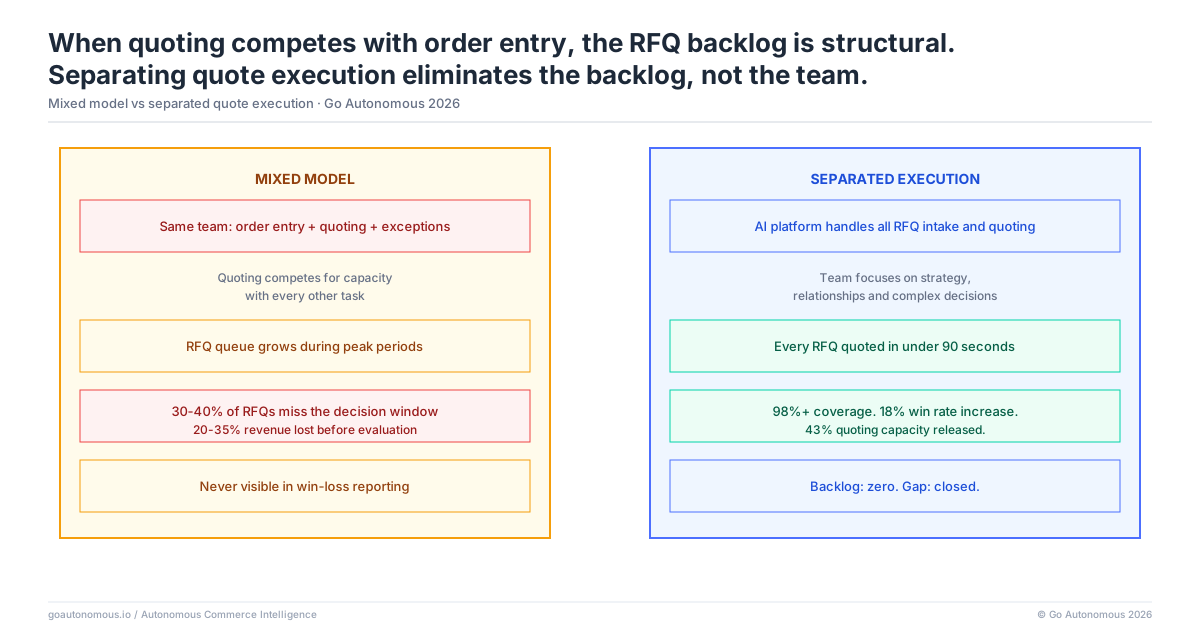
The RFQ backlog is not a discipline problem or a prioritization failure at the individual level. It is a structural resource conflict. The teams responsible for producing quotes — customer service, inside sales, and order management — are typically the same teams responsible for processing confirmed orders, resolving exceptions, and handling customer status inquiries. During periods of high order volume, each of those responsibilities competes for the same hours. Confirmed orders must be processed because they represent committed revenue with delivery obligations. Exceptions must be resolved because they block fulfillment. Status calls must be answered because they are inbound from existing customers.
RFQs, by contrast, represent potential revenue. They can wait. They do wait. And when an RFQ waits long enough, the potential revenue it represented disappears. This is the core dynamic that creates the backlog: the work that is most urgent in the short term (order processing, exceptions) continuously displaces the work that is most valuable in the medium term (quoting). The backlog does not form because teams are inefficient. It forms because the incentive structure rewards confirmed-order execution over prospective-order quoting, and both tasks compete for the same capacity pool.
How RFQ Aging Works: The 4-Hour Window After Which Win Probability Drops
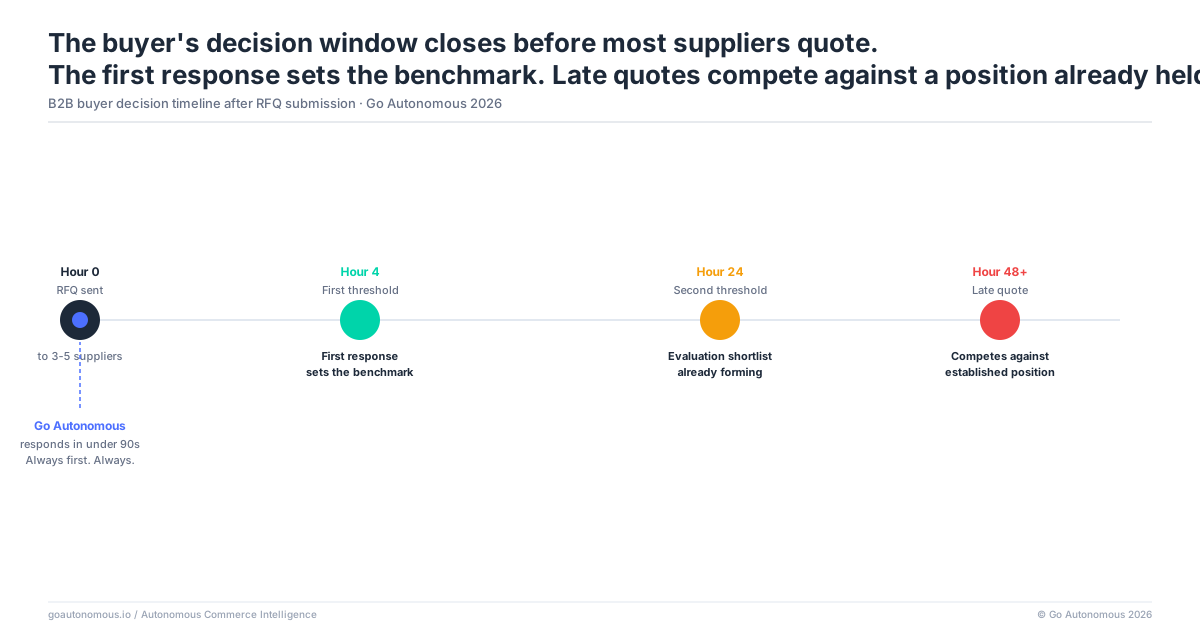
Research on B2B quote response behavior consistently shows that win probability declines sharply after 4 hours from RFQ receipt and deteriorates further after 24 hours. A customer who submits an RFQ at 8am and receives a quote at 9am the next business day is, in most cases, already in active discussion with a competitor who responded the same morning. The customer’s decision process does not pause while the slow responder catches up. It advances with the available options.
The 4-hour threshold is particularly damaging for manufacturers and distributors operating across time zones or with customers who run procurement on compressed cycles. An RFQ that arrives at 4pm local time enters a queue that will not be worked until 8am the next morning — a 16-hour gap before the clock even starts on the response. By the time a quote is produced and delivered, 24 to 48 hours have elapsed. The structural problem is the shared resource pool. Each increment of revenue growth that adds quoting volume without adding dedicated quoting capacity compresses response times further and deepens the backlog. This dynamic is precisely what makes the Hempel experience representative: growth itself becomes the mechanism through which win rate erodes.
Complex and Non-Standard RFQs Are the Most Valuable and the Most Delayed
Why Non-Standard Requests Require Specialist Input That Introduces 3–5 Day Delays
The RFQs most likely to be delayed are the highest-value ones. Standard requests for catalog products at contracted prices can often be processed quickly by any rep with ERP access and familiarity with the account’s pricing structure. Non-standard requests — custom configurations, requests outside contracted pricing tiers, multi-line complex bills of materials, or requests from new accounts without established pricing — require specialist input that is not available on demand. A pricing manager must approve deviation from standard terms. A product specialist must validate configuration compatibility. A sales engineer must confirm technical feasibility before pricing can be applied.
These specialists are shared resources. Their queues are measured in days, not hours. An RFQ that requires specialist review on Monday afternoon may not receive that review until Wednesday or Thursday, depending on the specialist’s workload and the number of other complex requests ahead of it in the queue. The delay is not negligence. It is the predictable output of a system where shared specialist capacity serves an unstructured inbound volume without prioritization by commercial urgency.
The Commercial Cost of Slow Response on High-Value Requests
The commercial cost of this inversion is concentrated in the highest-value segment of the pipeline. A €500K custom configuration RFQ that requires three days of specialist input is simultaneously the highest-value request in the queue and the one most likely to arrive after the customer’s decision window has closed. Large-ticket complex RFQs, which should receive the fastest response because of their commercial importance, systematically receive the slowest response because of their operational complexity. The result is that the distribution of quoting capacity is inverted relative to commercial value: standard, lower-value requests that could be processed quickly are delayed because the team is handling other work, and complex, higher-value requests are further delayed because they require specialist input that is not available on demand.
Improving customer experience in B2B manufacturing and distribution requires addressing this inversion directly. The procurement teams submitting high-value RFQs have alternative suppliers who are competing for the same business. Slow response on a €500K request does not communicate operational complexity to the customer. It communicates that the supplier is not prioritizing their business. The customer draws the appropriate conclusion and advances with a competitor. The deal is lost before any competitive evaluation of price, specification, or capability occurs.
Separating Quote Execution From Quoting Capacity Eliminates the RFQ Backlog
How Autonomous Quote Processing Handles Standard RFQs Without Queue Time
Eliminating the RFQ backlog requires separating quote execution from quoting capacity. When standard RFQs are processed autonomously — AI reads the request regardless of format, retrieves applicable pricing from ERP and contracted terms, applies discount logic and margin rules, and produces a formatted quote — the team’s capacity is no longer the constraint on standard volume. A standard quote request submitted at 4pm on a Friday exits the queue in minutes, not when the team returns on Monday morning. The response time for standard requests drops from 24–72 hours to under one hour. Win probability at the 4-hour threshold improves structurally because the threshold is no longer being missed.
The architecture is not rule-based automation. Rule-based automation plateaus at roughly 60% touchless because it cannot handle the variation and exception volume inherent in real B2B quoting: non-standard product descriptions, partial matches against catalog items, pricing requests for configurations that do not have a direct ERP equivalent. RPA versus AI is the relevant distinction: rule-based systems fail at the boundary of their rule set, where the most valuable and complex requests live. Autonomous execution handles that boundary by reasoning through the request rather than pattern-matching against predefined rules. The 50–70% of order and quote volume that arrives via email and unstructured channels — the volume that breaks every rule-based system — is precisely the volume that autonomous execution is designed to handle.
What the Sales Team Gains When Quote Production Is No Longer the Constraint
When standard quote production is no longer a capacity constraint, the commercial team’s attention redistributes to the requests that actually require human judgment. Pricing decisions outside contracted terms. Technical specification questions that require product expertise. Negotiation on high-value accounts where relationship context matters. The RFQ backlog that was suppressing win rate on standard business disappears. The specialist queue for complex business shrinks because standard volume no longer competes for the same attention. The team is not larger. It is focused on the work where human judgment produces commercial value, rather than on production work that can be executed autonomously.
The measurable outcomes are visible in the operations of manufacturers and distributors who have made the architectural shift. Danfoss moved from 42 hours to under one minute on order processing across 26 countries, with 80% of volume handled autonomously. Nilfisk released 43% of team capacity from manual processing work. VELUX processed over 130,000 orders across 9 markets with 88% decision autonomy. In each case, the constraint was not team skill or commercial strategy. It was the structural coupling between execution volume and human capacity — a coupling that autonomous commerce is specifically designed to break. The efficiency gains are not incremental process improvements. They are the result of removing the human bottleneck from execution entirely.
The Autonomous Execution Fabric: Decoupling Commercial Execution From Human Capacity
The RFQ backlog forms because quoting competes with order processing for the same team. The Autonomous Execution Fabric addresses both sides of that competition: a full commercial execution layer that connects directly to your SAP, Oracle, or Microsoft Dynamics environment and executes every inbound commercial transaction without tying up the team that would otherwise be processing orders. The Fabric reads inbound RFQs from any channel (email, EDI, customer portal, or direct API), retrieves pricing from the ERP, and produces validated quotes — in parallel with processing the confirmed orders arriving through the same channels at the same time.
The Fabric handles more than the quoting side. The same execution layer processes orders, pricing requests, returns, credit notes, and contract tenders. Because all of these transaction types run through the Fabric rather than through the shared team capacity, none of them compete with each other. An order spike during a peak period does not suppress quote response time. A high-volume day for return requests does not delay RFQ responses. Each transaction type is executed independently, at the same speed, regardless of what else is arriving.
The pre-quote revenue gap is the most visible symptom, but the root cause is structural: when all commercial transaction types compete for the same human capacity, each additional transaction type reduces the capacity available for all others. The Autonomous Execution Fabric eliminates this competition across all commercial transaction types. The capacity released is not reallocated to another transaction queue — it is redirected to the commercial judgment work that requires human expertise and produces strategic value.
For B2B manufacturers and distributors where the RFQ backlog is suppressing win rate, the starting point is measuring quote submission rate against decision windows — not just competitive win rate against submitted quotes. The revenue that is being lost before evaluation begins is the most recoverable revenue in the pipeline, because it requires no competitive displacement. It requires only a faster response. See what manufacturers have achieved with autonomous execution, and book a session to assess what the pre-quote gap costs your operation.
Frequently Asked Questions
Why do B2B manufacturers lose deals before a quote is ever submitted?
B2B manufacturers lose deals before submitting a quote when RFQ response time exceeds the customer’s decision window. Procurement teams that receive no response within 4–24 hours advance with suppliers who did respond. The loss is commercially identical to a competitive loss but does not appear in win/loss reporting because no quote was ever submitted.
What is the RFQ backlog and how does it affect B2B manufacturer win rates?
The RFQ backlog is the accumulation of unanswered or delayed quote requests that forms when quoting competes with order processing for the same team capacity. During peak order volume, confirmed-order execution is prioritized over prospective-order quoting. RFQs age past the customer’s decision window and the associated revenue is lost before competitive evaluation begins, depressing overall win rates without appearing as competitive losses in CRM data.
How long does a B2B customer wait for a quote before going to a competitor?
Research on B2B quote response behavior shows win probability declines sharply after 4 hours from RFQ receipt and deteriorates further after 24 hours. Customers in active procurement cycles do not pause their process to wait for a delayed response. They advance with the suppliers who responded within their decision window, making sub-4-hour response time the operational threshold for competitive participation.
How do B2B manufacturers reduce quote response time without adding sales headcount?
B2B manufacturers reduce quote response time by separating quote execution from quoting capacity through autonomous processing. When AI reads incoming RFQs, retrieves applicable pricing, applies discount and margin rules, and produces formatted quotes automatically, standard requests are handled in minutes regardless of team workload or time of day. This removes the structural coupling between order volume and quote response time, freeing the team to focus on complex, non-standard requests that require human judgment.
What is the commercial impact of slow RFQ response in B2B distribution operations?
Slow RFQ response in B2B distribution results in pre-quote revenue loss on standard business, disproportionate loss on high-value complex requests that require specialist input, and a structural suppression of win rate that does not appear in standard sales metrics. For distributors where 30–40% of RFQs are delayed during peak periods, the cumulative revenue impact is significant and compounds as order volume grows without corresponding growth in quoting capacity.