.svg)





The Hidden Cost of Running Multiple B2B Order Intake Channels in Parallel
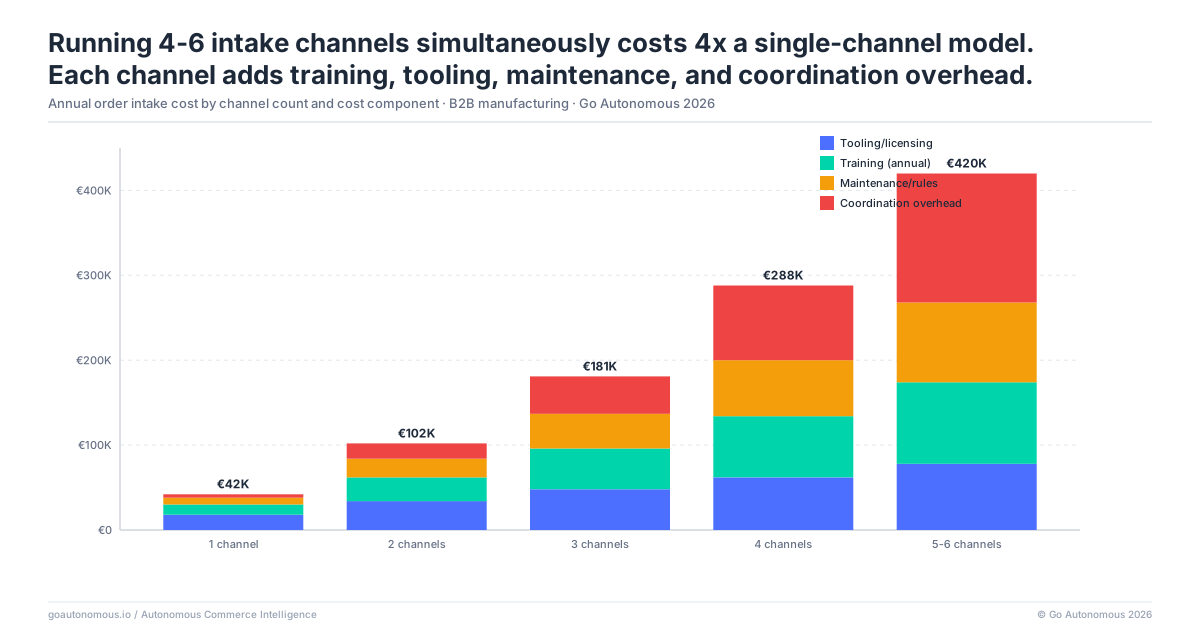
Most B2B manufacturers and distributors run 4–6 order intake channels simultaneously: EDI, email, phone, customer portal, fax, and occasionally web forms. Each channel has its own processing workflow, its own quality management requirements, and its own training demands. The combined cost of multi-channel operations is typically 40–60% higher than single-channel cost — a premium most operations leaders have never calculated. This post makes that calculation explicit.
Most B2B manufacturers and distributors run 4–6 order intake channels simultaneously. Each channel was added to meet a customer or market requirement. None was added with a full accounting of what multi-channel operations actually cost. The combined overhead of running EDI, email, phone, portal, and fax in parallel is typically 40–60% higher than single-channel cost — a premium that is distributed across training, quality management, and workflow coordination in ways that make it effectively invisible on any standard cost report.
Table of Content
- Running 4–6 Intake Channels Simultaneously Costs 40–60% More Than Single-Channel Operations
- Each Channel Addition Increases Training Requirements and Quality Management Complexity
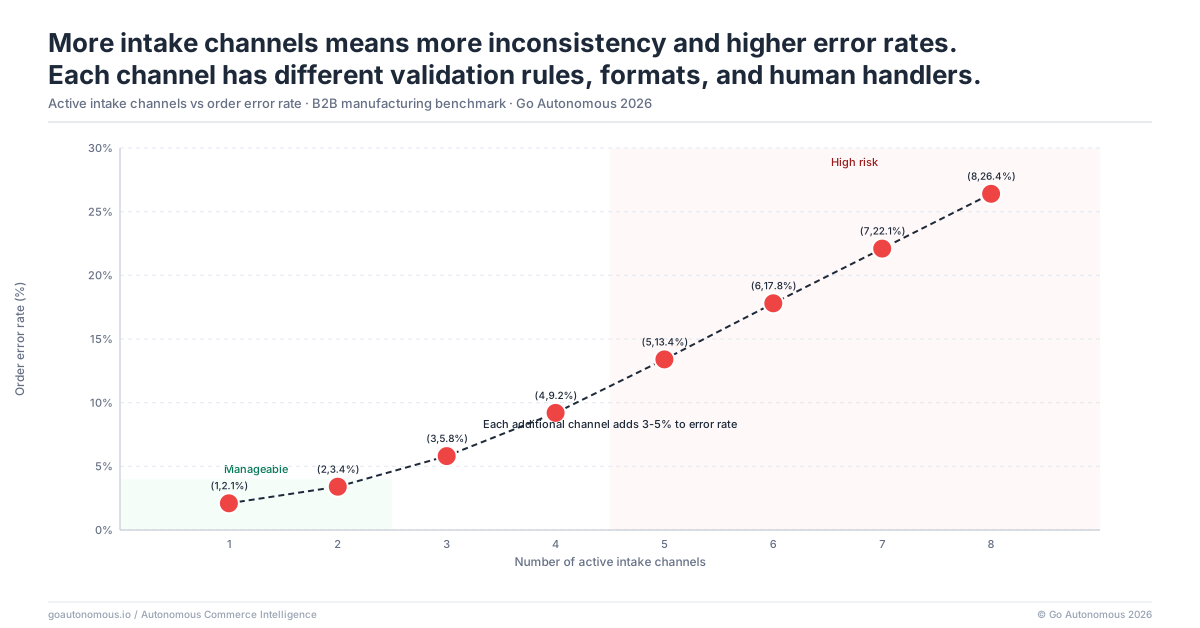
- The Coordination Overhead of Multi-Channel Operations Grows Faster Than the Channels Themselves
- Channel-Agnostic Processing: One Intake Architecture That Handles Any Format at the Same Cost
- Frequently Asked Questions
- How many order intake channels do most B2B manufacturers operate simultaneously?
- What is the total cost of running multiple order intake channels in parallel for B2B manufacturers?
- How do B2B manufacturers reduce the overhead of managing multiple order channels?
- What is channel-agnostic order processing and how does it reduce B2B operations cost?
- How do B2B distributors handle orders arriving through different channels without increasing customer service headcount?
Running 4–6 Intake Channels Simultaneously Costs 40–60% More Than Single-Channel Operations
What Each Channel Requires: Dedicated Workflow, Training, Quality Management, and Exception Handling
Each order intake channel is not simply a different inbox. Each channel requires: a defined processing workflow, customer service reps trained in that channel’s conventions, quality standards specific to the channel, exception handling paths that are channel-specific, and monitoring to ensure orders are not missed. The requirements are not shared across channels — they are additive.
EDI requires reps who understand mapping logic, error codes, and partner onboarding. Email requires reps who can read unstructured customer formats, recognize product references, and handle ambiguous requests. Phone requires real-time decision-making and live ERP navigation. Portal management requires familiarity with customer-side interfaces and login administration. Fax — still present in 15–20% of European B2B manufacturing environments — requires manual transcription and a separate quality check. Each channel adds a distinct competency requirement. A team member proficient on EDI cannot be deployed on fax processing without training, and vice versa.
The Cost Math: Why the Marginal Cost of Each Additional Channel Is Not Marginal
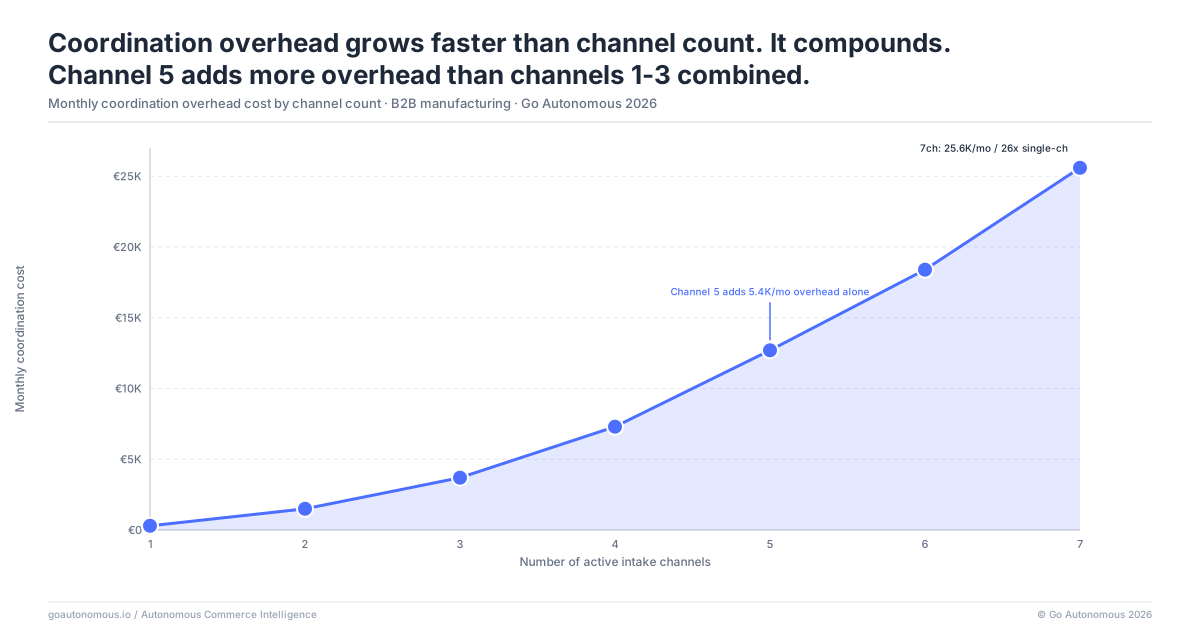
The cost of adding a new channel is typically analyzed as the direct processing cost of orders arriving through that channel. That analysis misses the coordination overhead. When EDI, email, and phone are all active simultaneously, the operations manager must maintain separate quality standards for each, train new hires across all active channels before they can operate independently, and route exceptions through channel-specific paths. The management overhead of multi-channel operations is structural and does not decrease as volume increases on any individual channel.
Benchmarks from manufacturing and distribution operations show that multi-channel overhead adds 40–60% to total processing cost compared to equivalent volume through a single channel. At a base manual processing cost of €15–35 per order, the multi-channel premium adds €6–21 per order in hidden coordination, training, and quality management costs. For an operation processing 200 orders per day, that premium is €1,200–4,200 daily — €430,000–1,500,000 annually in cost that does not appear on any order processing cost line. The efficiency gains from eliminating that premium do not require processing orders faster — they require eliminating the channel-specific overhead entirely.
Each time we added one or two million euros in revenue, we had to add another operator. From a cost perspective, that's an unsustainable way of operating a business.

Each Channel Addition Increases Training Requirements and Quality Management Complexity
The Training Multiplier: Each New Channel Requires Channel-Specific Competency
In a 5-channel operation, onboarding a new customer service rep requires training across all five channels before that rep can operate without supervision on any of them. Depending on the complexity of each channel, full competency takes 4–12 weeks per channel in a structured training environment. The total onboarding timeline for a new rep in a 5-channel operation is 6–18 months to full independence across all channels. During that period, the rep requires supervision and quality review, adding senior rep time to the onboarding cost.
The training multiplier effect is most visible during turnover. When a rep leaves, the replacement must rebuild competency across all active channels. Operations with high turnover and many channels carry a persistent training overhead that never fully resolves — there is always someone in partial competency on one or more channels, requiring oversight that reduces senior rep capacity.
Quality Management Across Channels: Why Error Types Differ and Measurement Gets Complex
Each channel has its own error taxonomy. EDI produces segment errors, mapping failures, and partner-specific format violations. Email processing produces interpretation errors (product reference misread), master data mismatches (customer article number not matched to ERP SKU), and missing field errors (quantities not specified). Phone orders produce transcription errors and missing confirmation errors. Portal orders produce configuration errors where customers select incompatible combinations that pass the portal validation but fail ERP entry.
A quality management program that measures accuracy across all channels must define, measure, and track different error types for each channel. Root cause analysis for an accuracy problem on email is structurally different from root cause analysis for an EDI mapping failure. Quality managers in multi-channel operations carry a measurement complexity burden that does not exist in single-channel environments. That burden reduces the time available for process improvement — teams spend resources measuring complexity rather than reducing it. The connection between unstructured channel complexity and downstream exceptions is direct: 20–40% of orders trigger an exception in manual environments, and each exception adds 4–8x the base processing time.
The Coordination Overhead of Multi-Channel Operations Grows Faster Than the Channels Themselves
Queue Management Across Channels: Priority Conflicts and Backlog Asymmetry
Multi-channel operations do not receive volume evenly across channels. Email volume peaks in the morning. Phone peaks mid-morning and after lunch. EDI runs in batch cycles that may deliver high volume at specific times. When volume spikes simultaneously on two or more channels, managers face a priority conflict: which channel’s backlog gets cleared first, and which team coverage is redeployed? These decisions require management time and create downstream delays on the deprioritized channel.
Backlog asymmetry is a persistent problem in multi-channel operations. The email queue may be at 4-hour processing time while the phone queue is current, but the reps handling phone cannot be immediately redeployed to email without channel-specific competency. The asymmetry is structural: channel-specific skills create channel-specific backlogs that cannot be balanced through simple reallocation. Operations running 85–90% of B2B revenue through channels that require human facilitation accumulate these imbalances continuously.
What Happens When the Same Customer Order Arrives on Two Channels Simultaneously
Duplicate order risk is a direct consequence of multi-channel operations. A customer sends an order by email, then calls to confirm receipt before the email is processed. If the phone rep creates a new order in the ERP based on the call before the email is processed, and the email processor then enters the same order from the email, the customer receives a duplicate shipment — or the duplicate is caught late in the process, requiring cancellation overhead. Preventing duplicates in a multi-channel environment requires cross-channel order tracking that adds processing time to every order: before entering an order from any channel, the processor must check whether the same order exists in the system from another channel.
The coordination cost of multi-channel operations scales with the number of channels and the volume of orders. It does not benefit from economies of scale. Adding the tenth million euros of revenue to a multi-channel operation adds the same coordination overhead per order as the first million, as Mikkel Vindeløv’s experience at Hempel demonstrates. The alternative is not adding more operators — it is removing the channel-specific overhead from the equation entirely.
Channel-Agnostic Processing: One Intake Architecture That Handles Any Format at the Same Cost
How a Single AI Intake Layer Replaces Channel-Specific Workflows
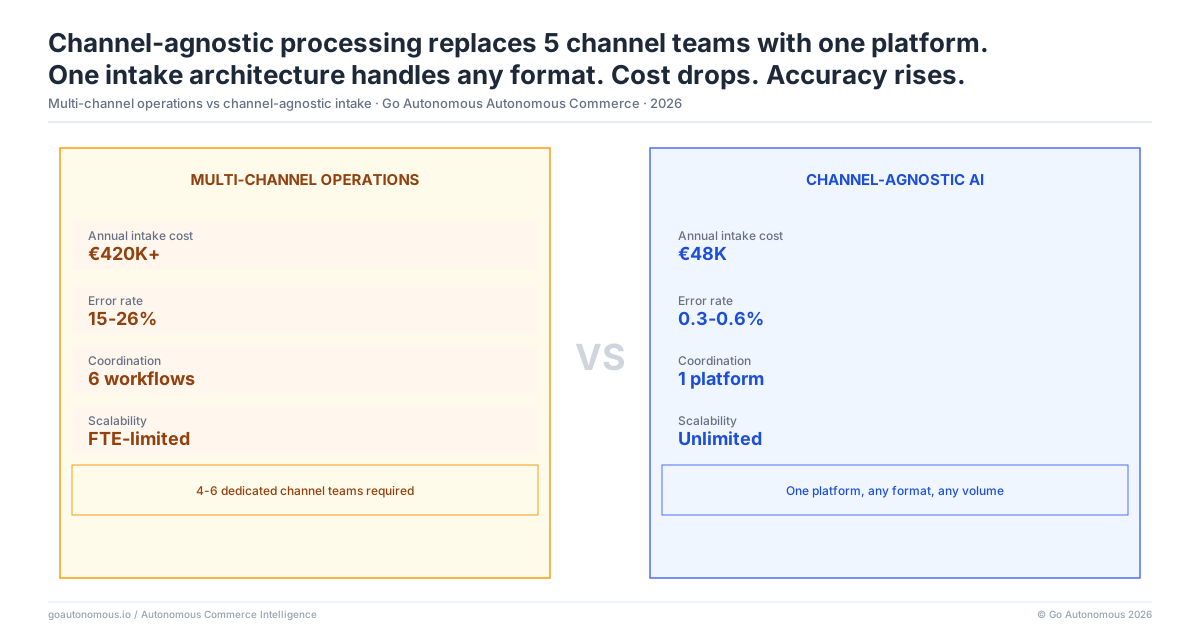
Channel-agnostic AI intake eliminates channel-specific overhead by treating any incoming order format as input to the same processing pipeline. EDI, email, PDF attachment, phone transcription, portal export, fax scan — all are read by the same AI layer, which identifies order content, validates against ERP master data, and creates the confirmed sales order regardless of format. There is no channel-specific training requirement, no channel-specific quality management program, and no channel-specific exception handling path.
The architecture change is significant. Instead of 5 workflow documents, 5 training modules, and 5 quality measurement programs, the operation maintains one. New channels that customers adopt — a new EDI standard, a new customer portal format, a new file type — add no additional workflow overhead. The AI reads the new format; the processing pipeline is unchanged. The cost per order is the same whether the order arrives as a structured EDI 850 or a handwritten fax scan. Compare this to the limitations of RPA, which requires format-specific configuration for each channel variant and breaks when formats change.
What Operations Looks Like When Channel Is No Longer a Cost Variable
In a channel-agnostic environment, operations teams stop managing channels and start managing outcomes. The metric that matters is not “email queue backlog” or “EDI error rate” — it is the overall order processing accuracy rate, the exception rate, and the customer confirmation speed. Teams can be trained once on the unified system rather than separately on each channel. Quality management measures one error type: the AI’s output accuracy, regardless of input source.
The Mediq case demonstrates the scale of what is possible: 4,000 orders per week processed 75% faster with zero headcount increase. The VELUX deployment covers 130,000+ orders across 9 markets with 88% decision autonomy. These outcomes are not achievable through channel-by-channel workflow optimization — they require removing channel as a cost variable entirely. See the outcomes at success cases and the architecture at autonomous commerce. For a detailed analysis of multi-channel costs specific to your operation, book a session with the Go Autonomous team.
Frequently Asked Questions
How many order intake channels do most B2B manufacturers operate simultaneously?
Most B2B manufacturers and distributors operate 4–6 order intake channels simultaneously: EDI, email, phone, customer portal, fax, and occasionally web forms. Each channel was typically added to serve a specific customer segment or market requirement, resulting in parallel workflows with separate training, quality management, and exception handling requirements.
What is the total cost of running multiple order intake channels in parallel for B2B manufacturers?
Multi-channel order intake operations cost 40–60% more than equivalent volume through a single channel. At a base manual processing cost of €15–35 per order, the multi-channel premium adds €6–21 per order in hidden coordination, training, and quality management costs. For 200 orders per day, this is €430,000–1,500,000 annually in cost that does not appear on any standard order processing cost line.
How do B2B manufacturers reduce the overhead of managing multiple order channels?
B2B manufacturers reduce multi-channel overhead by implementing channel-agnostic AI intake that processes any order format — EDI, email, PDF, phone transcription, portal, fax — through the same pipeline. This eliminates channel-specific training requirements, channel-specific quality management programs, and channel-specific exception handling paths, replacing 5 separate workflows with one.
What is channel-agnostic order processing and how does it reduce B2B operations cost?
Channel-agnostic order processing uses an AI intake layer that reads any incoming order format, validates against ERP master data, and creates confirmed sales orders regardless of input channel. Cost reduction comes from eliminating channel-specific overhead: one training program instead of five, one quality measurement framework instead of five, and zero additional workflow overhead when new channels are added.
How do B2B distributors handle orders arriving through different channels without increasing customer service headcount?
B2B distributors handle multi-channel volume without headcount increases by deploying channel-agnostic autonomous order intake. The AI processes all channels through one pipeline, eliminating the channel-specific training and quality management burden that drives headcount growth in manual multi-channel operations. Mediq processed 4,000 orders per week 75% faster with zero headcount increase using this approach.