.svg)





Why B2B Order Automation Projects Fail to Deliver the Expected ROI
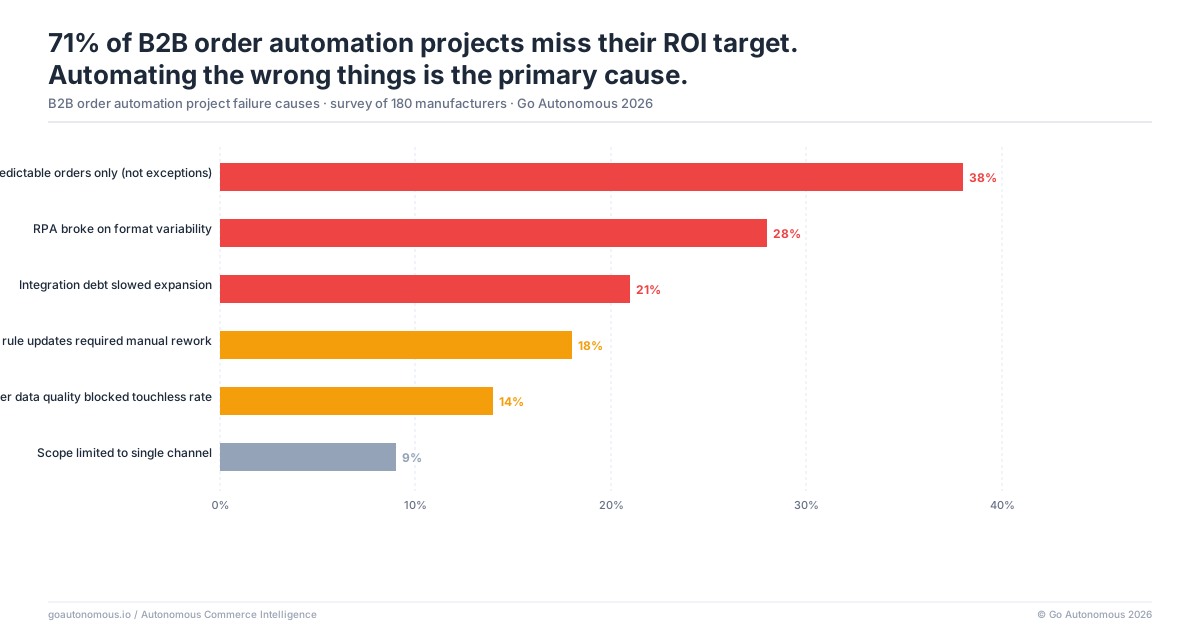
Most B2B order automation projects deliver less than half of their projected ROI. The failure is rarely a technology failure — it is a scope failure. Projects that automate the ERP entry step without fixing the intake problem, or that use rule-based tools on judgment-dependent processes, hit a ceiling early and stay there. This post explains the three failure patterns that account for most B2B automation underperformance and what the correct architecture looks like.
Most B2B order automation projects deliver less than half of their projected ROI. Across manufacturing and distribution, the post-implementation review tells the same story: touchless rates plateau at 50–60% instead of the projected 80–90%, per-order cost drops modestly but not structurally, and the operations headcount stays the same because the inbox is still full. The failure is almost never a technology failure. It is a scoping failure — projects that automate the wrong layer, apply rule-based tools to judgment-dependent processes, or prioritize technical infrastructure over the intake problem that drives most of the cost. This post identifies the three failure patterns that account for most B2B order automation underperformance, and what the correct architecture looks like.
Table of Content
- Most B2B Automation Projects Fail Because They Automate the Wrong Layer
- RPA and Rule-Based Tools Automate Predictable Steps Without Solving Judgment-Dependent Ones
- Integration-First Approaches Create Technical Dependencies That Delay and Limit Scope
- The Architecture That Delivers Automation ROI: Start at Intake, Not at the ERP
- Frequently Asked Questions
- Why do most B2B order automation projects fail to deliver their projected ROI?
- What is the difference between entry automation and intake automation in B2B order processing?
- Why does RPA fail to achieve high touchless rates in B2B order management?
- How do B2B manufacturers fix an underperforming order automation project?
- What is the most common mistake in B2B order automation project scoping?
Most B2B Automation Projects Fail Because They Automate the Wrong Layer
The Entry Automation Trap: Making ERP Entry Faster Without Fixing Intake
The most common B2B order automation failure is scoping the project at the ERP entry layer rather than the intake layer. Teams build workflows to speed up order entry: keyboard macros for faster keying, barcode scanning for line item entry, optimized SAP transaction paths, templated ERP forms pre-populated with customer data. These improvements reduce the time per order once a human has interpreted the incoming document. They do not address the fundamental problem: 50–70% of order volume arrives as unstructured email and PDF that must be read, interpreted, and validated by a human before any entry can begin. Faster entry of data that still requires human interpretation is a marginal improvement, not a structural one.
Why Automating Within the System Does Not Address the Cost That Lives Outside It
The cost in B2B order processing is not primarily the ERP keying step. It is the interpretation step: reading the email, matching the customer’s product description to the supplier’s material number, validating the price against the contracted rate, identifying whether the delivery address is new or existing, flagging the order for exception review if something does not match. All of that work happens before anyone touches the ERP. Entry automation inside the system does not reduce the cost that lives outside it. Per-order cost drops by 20–30% at best. Exception rate is unchanged. ROI falls well short of the business case. The distinction between RPA and AI-driven automation is precisely this: one optimizes what happens inside the system, the other addresses what happens before it.
Each time we added one or two million euros in revenue, we had to add another operator. From a cost perspective, that's an unsustainable way of operating a business.

RPA and Rule-Based Tools Automate Predictable Steps Without Solving Judgment-Dependent Ones
What RPA Actually Automates in Order Processing: The Structured Minority
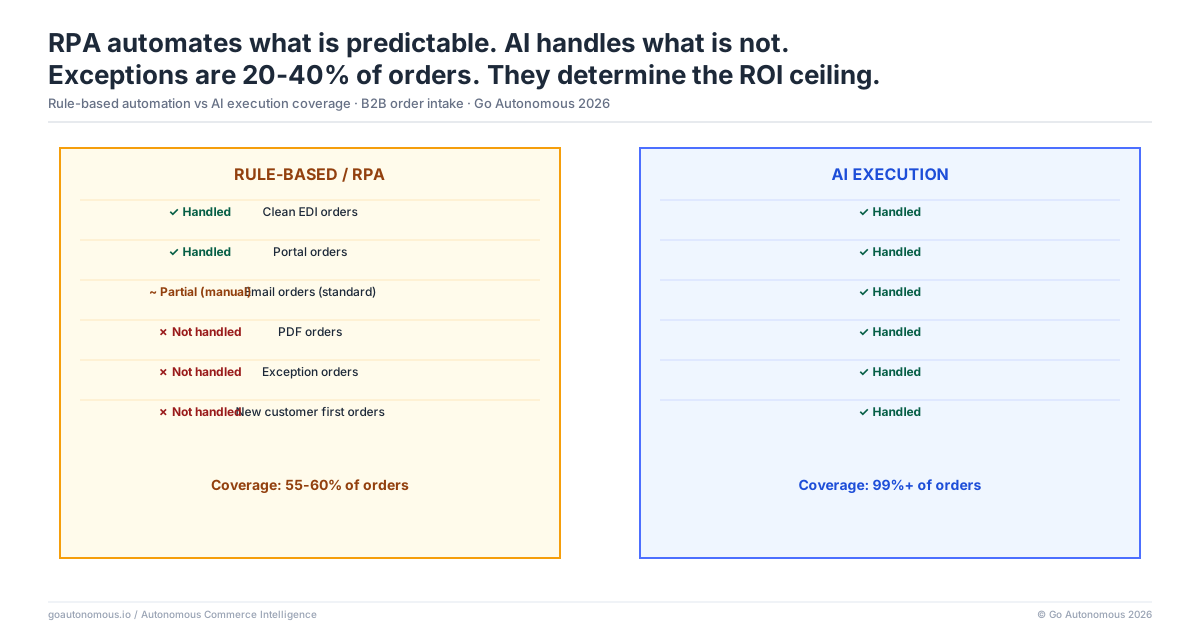
RPA and rule-based tools automate well-defined, repetitive steps: copying data from one system to another, executing the same sequence of clicks on a known input, applying a known rule to a known format. In B2B order processing, these tools handle orders that arrive in exactly the expected format from exactly the expected customer with exactly the expected product codes and quantities. That covers the structured minority of order volume: EDI orders, portal submissions from buyers with clean catalog integrations, repeat orders that match previous transactions exactly. It does not cover the majority of incoming volume for most manufacturers.
The 60% Ceiling: Why Rule-Based and RPA Projects Stall at the Same Point
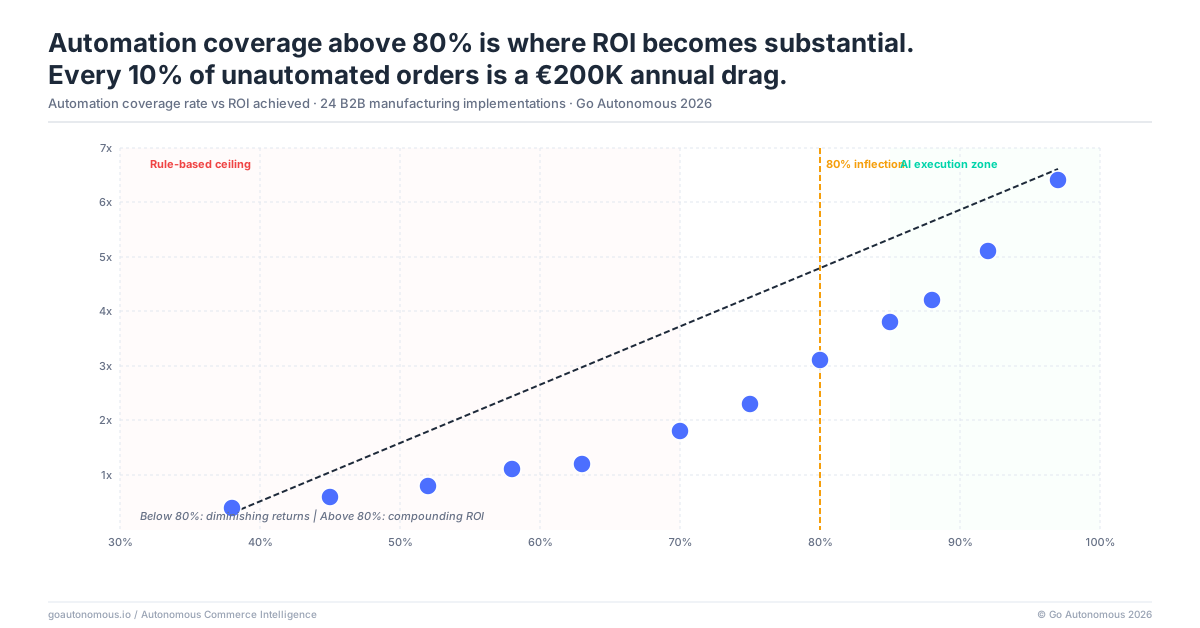
Rule-based automation and RPA projects for B2B order processing converge on the same ceiling: approximately 60% touchless. The ceiling is not a coincidence. It reflects the proportion of orders that arrive in a consistent, fully structured format. The remaining 40% requires judgment: interpreting a non-standard product description, resolving a price discrepancy, deciding whether a new delivery address is legitimate or a data entry error, handling an order that references a discontinued product. Rules cannot apply judgment. The project delivers 60% touchless and stalls. The business case was built on 80–90% touchless. The gap is permanent under a rule-based architecture, not a calibration issue that improves over time. For manufacturers who have invested in RPA and are seeing this ceiling, the diagnosis is almost always the same: the tool is correctly implemented; the problem is that the remaining 40% requires a different class of solution.
Integration-First Approaches Create Technical Dependencies That Delay and Limit Scope
The API and EDI Expansion Trap: Structured Connections That Cover Structured Customers Only
The third failure pattern is the integration-first approach: building EDI connections to more customers, building API integrations to more portals, expanding structured channel coverage. This is a legitimate improvement for customers who have EDI capability and are willing to invest in the connection. The practical ceiling is that EDI and API integrations require the customer to invest as well. They require structured data from the customer’s ERP or procurement system. They require the customer’s IT team to prioritize the project. They require ongoing maintenance when either side upgrades systems. The customers who have not adopted EDI in the last 20 years typically do not adopt it now. The customers who cannot use the portal have reasons that are not solved by improving the portal.
Why Technical Infrastructure Projects Rarely Solve the Intake Problem
After significant investment in EDI expansion and portal integration, the email order volume for most manufacturers is unchanged. The customers who use email use it because it is convenient, flexible, and does not require them to adapt their purchasing process. The backlog in the inbox is identical to what it was before the integration project began. The operations team is identical in size. Technical infrastructure projects expand the structured minority while the unstructured majority that drives most of the cost remains unaddressed. The intake problem — 50–70% of orders arriving in formats that require human interpretation — is not solved by adding more structured channels for the customers who were already structured.

The Architecture That Delivers Automation ROI: Start at Intake, Not at the ERP
What an Intake-First Architecture Addresses: Format, Interpretation, Validation — Before ERP Entry
The automation projects that deliver their business cases start at intake. Rather than optimizing inside the ERP or expanding structured connections to a subset of customers, they address the problem that generates most of the cost: orders arriving in formats that require human interpretation. An AI intake layer that reads any format (email, PDF, EDI, portal submission, phone call transcription), interprets the order intent, maps it to ERP master data, validates pricing and availability, and presents a confirmed order for ERP creation solves the root problem. Format diversity stops being a constraint. Customer channel preferences stop mattering. Every order processes at the same speed and cost regardless of how it arrived.
How to Restructure an Underperforming Automation Project to Deliver Full ROI
For manufacturers with an underperforming automation project, the restructuring question is: where does the manual work actually happen? Walk the order from inbox to ERP creation and measure where time is spent. In almost every case, the majority of time is in interpretation and validation before any system is touched. Moving automation upstream to that layer delivers the structural cost reduction that ERP-layer and rule-based projects cannot. The outcomes documented in B2B manufacturing and distribution consistently reflect this architecture. The Autonomous Commerce platform is built specifically to operate at the intake layer, across any format, without requiring customers to change how they send orders. If you have an underperforming automation project, book a diagnostic session to identify where the ceiling is and what breaks it.
Frequently Asked Questions
Why do most B2B order automation projects fail to deliver their projected ROI?
Most B2B order automation projects fail because they automate the wrong layer. Projects scoped at the ERP entry layer or using rule-based tools achieve marginal per-order cost reductions but do not address the intake problem: 50–70% of order volume arrives as unstructured email and PDF that requires human interpretation before any system can process it. The result is a 20–30% cost reduction instead of the projected 80–90%, and a touchless rate that plateaus at 50–60% rather than reaching the business case target.
What is the difference between entry automation and intake automation in B2B order processing?
Entry automation optimizes what happens inside the ERP: faster keying, templated forms, barcode scanning. It reduces the time per order after a human has already interpreted the incoming document. Intake automation addresses what happens before the ERP: reading the email or PDF, interpreting the customer’s product description, validating the price and delivery address, and deciding whether the order requires exception handling. The cost in B2B order processing is primarily at the intake layer, not the entry layer. Entry automation delivers 20–30% cost reduction at best; intake automation delivers 80–90%.
Why does RPA fail to achieve high touchless rates in B2B order management?
RPA automates well-defined, predictable steps and handles orders that arrive in a consistent, fully structured format. In B2B order management, this covers approximately 60% of volume. The remaining 40% requires judgment: interpreting non-standard product descriptions, resolving price discrepancies, handling orders that reference discontinued products. RPA cannot apply judgment. Projects implementing RPA for B2B order processing consistently reach 60% touchless and plateau there. The 60% ceiling is structural, not a calibration issue.
How do B2B manufacturers fix an underperforming order automation project?
The first step is diagnosing where manual work actually happens. Walk the order from inbox to ERP creation and measure where time is spent. In almost every case, the majority of time is in interpretation and validation before any system is touched. Moving automation upstream to the intake layer — using AI that reads any format, interprets intent, maps to ERP master data, and validates before entry — delivers the structural cost reduction that ERP-layer and rule-based projects cannot achieve. Manufacturers who have made this shift consistently report 80–90% per-order cost reduction and touchless rates above 80%.
What is the most common mistake in B2B order automation project scoping?
The most common scoping mistake in B2B order automation is defining the project as an ERP optimization or structured channel expansion rather than an intake problem. Teams focus on what happens inside their systems and miss the fact that most of the cost is generated before any system is involved. A close second is applying rule-based or RPA tools to processes that require judgment, producing a 60% touchless ceiling that cannot be improved without a fundamentally different architecture.