.svg)





AI Order Management in B2B: Why Decision Support Tools Hit a Ceiling at Scale
The current generation of AI order management tools makes human operators faster. At scale, faster is not enough. This post diagnoses the structural ceiling of decision support and explains why autonomous execution is the only architecture that breaks it.
The question every VP Operations is being asked right now sounds deceptively simple: how much of your order management can AI handle? The honest answer at most manufacturers and distributors is: AI is handling a growing share of the information layer, and almost none of the execution layer. That gap is not a technology lag. It is an architectural choice that most organizations have not consciously made. They have deployed AI order management tools that surface insights, flag exceptions, and recommend actions. They have not deployed systems that act. The distinction is consequential at scale, and this post is about exactly that distinction.
The current generation of AI-assisted order management platforms, from Salesforce Order Management to SAP Intelligent Order Management, from Oracle Order Management Cloud to Microsoft Dynamics 365 Order Management and BlueYonder, share a common design philosophy: augment the human, not replace the human-in-the-loop. That philosophy made sense when AI confidence in complex commercial decisions was limited. It makes less sense when the bottleneck is no longer judgment quality but judgment volume. At 500 orders per day, decision support tools deliver real efficiency. At 5,000 orders per day, they hit a structural ceiling that efficiency alone cannot break through.
Table of Content
- What Is the Difference Between AI-Assisted and Autonomous Order Management?
- Why AI Decision Support Tools Hit a Ceiling at B2B Manufacturing Scale
- Where Named AI Order Management Tools Stop Short of Autonomous Execution
- What Salesforce Order Management Does with AI and Where It Ends
- What SAP Intelligent Order Management Does with AI and Where It Ends
- What Oracle Order Management Cloud Does with AI and Where It Ends
- What Microsoft Dynamics 365 Order Management Does with AI and Where It Ends
- What BlueYonder Order Management Does with AI and Where It Ends
- Order Management Automation Maturity: Five Stages and When to Move On
- How Autonomous Execution Works Above the Decision Support Layer
- What Operational Outcomes Look Like When Order Management Runs Autonomously at Scale
- How Does Autonomous Order Processing Affect Order Confirmation Time for Manufacturers?
- What Is a Realistic Automation Rate for B2B Order Processing?
- How Does Autonomous Execution Enable Revenue Growth Without Proportional Headcount Increases?
- What Happens to Customer Experience When Order Confirmation Becomes Autonomous?
- How Does Autonomous Order Management Affect Working Capital and DSO?
- How to Evaluate Your Order Management Automation Ceiling
- Signal 1: What Percentage of Your Orders Still Arrive by Email?
- Signal 2: Does Your Exception Queue Grow When Order Volume Grows?
- Signal 3: Is Your Headcount per 1,000 Orders Flat or Growing?
- Signal 4: Can You Calculate Your Current Friction Debt?
- How Does Autonomous Commerce Differ from RPA for B2B Order Processing?
- See Where Your Order Management Automation Ceiling Is and What Breaks Through It
- Frequently Asked Questions
- What is autonomous order management for B2B manufacturers?
- What is the difference between AI-assisted and autonomous order processing?
- How does AI order management software work in SAP environments?
- What is a realistic automation rate for B2B order processing?
- What is the Human Dependency Ratio in B2B order management?
- How do you reduce human dependency in B2B order management?
- Why does B2B order processing still require manual intervention even after AI investment?
What Is the Difference Between AI-Assisted and Autonomous Order Management?
AI-assisted order management informs a human operator who then acts. Autonomous order management acts directly, then informs the human only when escalation is genuinely required. The word “assists” is not a marketing softener. It is a precise architectural description of where the system stops and the human begins.
In an AI-assisted model, the system reads the incoming purchase order, extracts the line items, checks the pricing contract, identifies the exception, and presents the operator with a recommended action. The operator reviews the recommendation, approves or modifies it, and confirms the entry. The AI removed some cognitive load. The human remained in the execution chain. Every order still requires a human touch to complete.
In an autonomous execution model, the system reads the incoming purchase order, validates the line items, checks the pricing contract, resolves the exception against codified resolution rules, and writes the confirmed order directly to the ERP. The human receives a notification only when the exception falls outside the system’s resolution boundary. The AI did not assist with the decision. It made the decision and executed it. The operator’s time is reserved for genuine escalations.
How Does AI-Assisted Order Management Work in SAP Environments?
SAP Intelligent Order Management operates as an orchestration layer above SAP S/4HANA. It uses machine learning models to predict fulfillment outcomes, recommend sourcing decisions, and flag order exceptions before they reach the ERP. Operators receive a prioritized exception queue with AI-generated context: why this order flagged, what the recommended resolution is, what similar historical orders did. The operator reviews the queue, approves resolutions, and the ERP executes. The AI layer reduces the time per decision. It does not eliminate the decision requirement. Every exception still requires a human to confirm before SAP executes.
What Is the Human Dependency Ratio in B2B Order Processing?
Human Dependency Ratio (HDR) measures the number of manual decisions required per unit of revenue processed. It is perhaps the most honest metric for any organization claiming to be AI-driven in its order operations. An AI-assisted system may reduce time per decision significantly. If it does not reduce the number of decisions required, the HDR has not improved. Revenue growth still requires proportional decision volume, which requires proportional headcount. HDR exposes the structural reliance that touchless rate and cost per order metrics obscure.
The critical distinction: touchless rate measures whether a human touched the transaction. HDR measures whether the transaction could have completed without a human. A high touchless rate with a high HDR means humans are touching transactions quickly. It does not mean humans are no longer required. “Automation scales labor. Autonomy eliminates dependency.” That sentence is the practical difference between what AI-assisted tools deliver and what autonomous execution achieves.
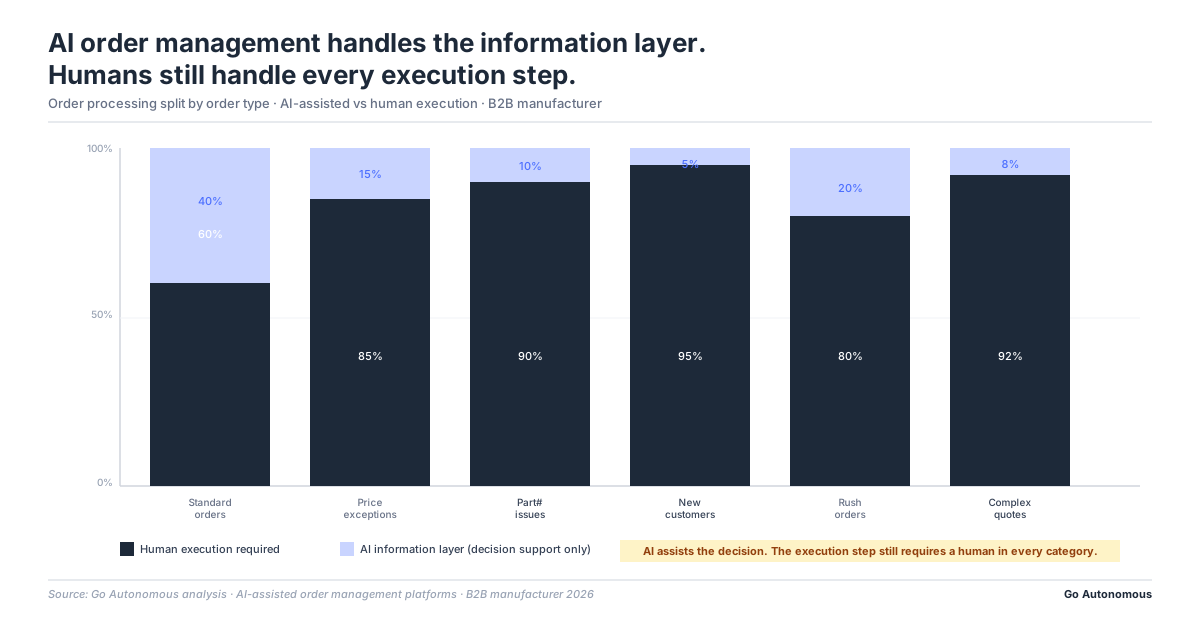
Why AI Decision Support Tools Hit a Ceiling at B2B Manufacturing Scale
The ceiling is not about AI capability. It is about decision volume architecture. Decision support tools are designed to make each human decision faster and better-informed. At low order volumes, this produces meaningful efficiency gains. At high order volumes, the constraint is not the quality of each decision. It is the number of decisions a team can process in a given period.
Why 60% Touchless Rate Is the Practical Ceiling for Decision-Support Order Management
According to APQC benchmarking data on order management performance, best-in-class manufacturers operating with AI-assisted tools achieve touchless rates of 55 to 65 percent. The remaining 35 to 45 percent of orders require human intervention at some point in the processing cycle. Some portion of that non-touchless volume represents genuine exception complexity: pricing disputes, quantity mismatches, delivery conflicts, new customer configurations. A meaningful portion represents decisions the system flagged for human review because the AI confidence threshold was not met, not because the decision was genuinely complex. Decision support tools are conservative by design. They prefer to ask a human rather than act autonomously on borderline cases. At scale, that conservatism becomes a throughput constraint.
How Adding AI Recommendations Reduces Time Per Order but Not Headcount Per 1,000 Orders
A customer service team processing 500 orders per day with an AI decision support tool might reduce average handling time per exception from 12 minutes to 8 minutes. That is a 33 percent productivity gain per operator. The team processes the same volume with fewer hours expended. However, when volume grows to 1,500 orders per day, the team needs to process three times as many exceptions. At 8 minutes each, the workload still scales with volume. The headcount requirement per 1,000 orders processed does not compress. The ratio of operators to orders stays approximately constant, because every order still flows through a human at some point in the exception handling queue.
McKinsey research on B2B sales and operations digitization consistently identifies the inability to decouple revenue growth from operational headcount as the primary ceiling facing manufacturers who have invested in AI-assisted rather than autonomous execution. The productivity gain is real. The structural constraint remains.
What the Human Dependency Ratio Reveals That Touchless Rate Hides
A manufacturer running at 65 percent touchless rate looks efficient on standard O2C dashboards. However, the 35 percent of orders requiring human touch may represent 60 to 70 percent of total processing time if those exceptions are complex. Touchless rate does not weight by complexity or handling time. HDR does, because it measures decisions per unit of revenue rather than transactions per operator. A manufacturer with a high touchless rate but a high HDR has automated the easy orders and left all the hard decisions to humans. When volume doubles, the hard decision queue doubles with it, regardless of what the touchless rate reports.
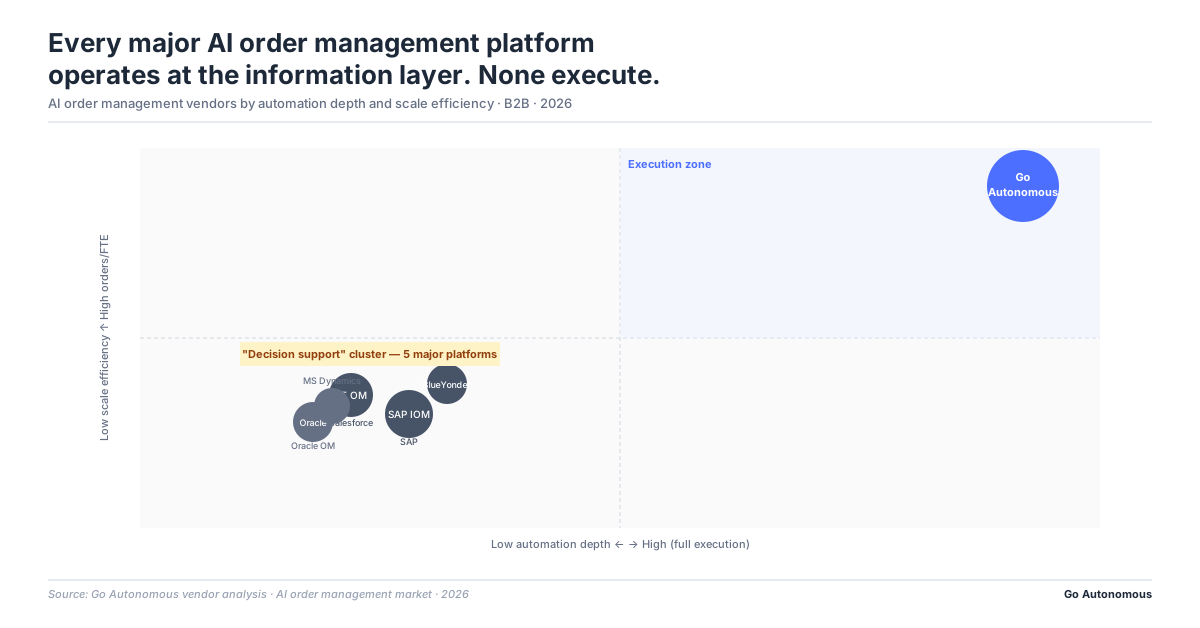
Where Named AI Order Management Tools Stop Short of Autonomous Execution
Each of the major AI order management platforms delivers genuine value within its design boundary. Understanding exactly where each stops is necessary for any VP Operations evaluating whether their current investment can close the scale ceiling or whether an architectural addition is required.
What Salesforce Order Management Does with AI and Where It Ends
Salesforce Order Management integrates with Einstein AI to provide predictive inventory recommendations, automated order routing, and exception prioritization. It excels at managing the post-capture order lifecycle: routing, fulfillment orchestration, and returns management. Its AI layer informs fulfillment decisions and flags service-level risks. Where it stops: Salesforce Order Management assumes the order has already been captured and validated. The pre-capture work, reading the email, interpreting the PDF, validating line items against pricing contracts, resolving extraction discrepancies, occurs upstream of its operational scope. For manufacturers where 50 to 70 percent of orders arrive by email, Salesforce Order Management operates on the portion of the order lifecycle that is not where the confirmation gap lives.
What SAP Intelligent Order Management Does with AI and Where It Ends
SAP Intelligent Order Management (IOM) is SAP’s cloud-native order orchestration layer, designed to sit above SAP S/4HANA and third-party ERP systems. It uses ML models for demand sensing, fulfillment sourcing optimization, and exception management. Its AI capabilities surface promising actions to operators and prioritize exception queues. The architectural boundary: SAP IOM orchestrates orders that are already structured and in the system. It does not read unstructured inbound communications. It does not resolve pre-ERP validation steps. The decision support it provides is downstream of the confirmation gap, not upstream of it.
What Oracle Order Management Cloud Does with AI and Where It Ends
Oracle Order Management Cloud provides AI-driven order promising, intelligent pricing recommendations, and automated exception classification. Within the Oracle ecosystem, it delivers tight integration with Oracle SCM and ERP Cloud. Its AI layer improves decision quality for operators managing fulfillment complexity, multi-currency pricing, and global supply chain sourcing. The ceiling is the same as SAP IOM: Oracle Order Management Cloud operates on orders that have been captured and entered. The intake layer, where email PDFs are read and validated, sits outside its scope. The human dependency in order capture is not reduced by Oracle OM Cloud’s AI features.
What Microsoft Dynamics 365 Order Management Does with AI and Where It Ends
Microsoft Dynamics 365 Order Management, combined with Copilot AI features, provides natural language query, automated order status updates, and AI-assisted exception resolution suggestions. Copilot in Dynamics reduces the time operators spend finding information and drafting responses. It is a productivity tool for the human operator. The design premise is assistance: Copilot helps operators work faster, not replace them. For manufacturers looking to reduce headcount dependency in order capture and validation, Dynamics 365 with Copilot delivers operator efficiency. It does not deliver operator independence.
What BlueYonder Order Management Does with AI and Where It Ends
BlueYonder’s Order Management platform uses ML-driven demand sensing and fulfillment optimization, with particular strength in complex multi-node distribution networks. Its AI layer optimizes sourcing decisions and predicts inventory availability with high accuracy. The scope is fulfillment intelligence: deciding how to fulfill an order that is already in the system, not how to capture and validate an order that arrived as an email PDF. For distributors with complex multi-warehouse fulfillment, BlueYonder’s AI delivers measurable throughput improvement. For distributors with high email order volumes, the pre-capture problem remains unaddressed.
The pattern across all five platforms is consistent. Each delivers AI capability within the post-capture order lifecycle. Each assumes structured input. None addresses the confirmation gap that exists between inbound PO receipt and ERP entry for unstructured channels. That is not a criticism of these platforms. It is a description of their design scope. They solve the problem they were designed to solve. The gap they leave is structural, and it is the gap where Autonomous Commerce operates.
Order Management Automation Maturity: Five Stages and When to Move On
Most manufacturers sit between Stage 2 and Stage 4. Understanding which stage applies and what limits it is the starting point for any architectural evaluation.
| Stage | What it looks like in practice | When to move on |
|---|---|---|
| Stage 1: Manual | Orders received by email or phone. CSR reads, interprets, and manually enters into ERP. No automation. Average handling: 12 to 20 minutes per order. Error rate: 5 to 15 percent before rework. | When order volume exceeds 100 per day or when error rework consumes more than 20 percent of team capacity. Stage 1 cannot scale without proportional headcount growth. |
| Stage 2: Rules-based | Structured EDI orders auto-process. Email orders route to a manual queue. Simple rules handle standard cases: exact SKU match, standard pricing, confirmed delivery date. Exceptions escalate to humans. Touchless rate: 20 to 40 percent. | When exception volume exceeds team capacity during peak periods. Rules-based systems cannot handle linguistic ambiguity, pricing contract complexity, or multi-line exception resolution. They process what fits the rules and stop at everything else. |
| Stage 3: AI-Assisted | AI extracts data from PDFs and emails (ABBYY, Rossum). ML recommends actions on flagged exceptions. Operators work from prioritized exception queues with AI-generated context. Handling time per exception drops to 5 to 10 minutes. Touchless rate: 40 to 55 percent. | When exception queue still exceeds team capacity at peak or when headcount grows proportionally to revenue. Stage 3 optimizes the human decision. It does not remove it. |
| Stage 4: AI-Informed | AI orchestration layer (SAP IOM, Salesforce OM, Oracle OM Cloud) provides predictive fulfillment, automated routing, and exception intelligence. Operators receive enriched decision context. Post-capture processing largely automated. Touchless rate: 55 to 65 percent. Pre-capture still human-dependent. | When pre-capture order intake (email, unstructured channels) remains the primary throughput constraint. Stage 4 tools deliver genuine post-capture efficiency but do not address intake-layer Human Dependency Ratio. |
| Stage 5: Autonomous Execution | Execution layer reads all inbound channels (email PDF, EDI, portal, structured data). Validates against pricing contracts and master data. Resolves standard exceptions per codified rules. Writes directly to ERP. Human involvement limited to genuine out-of-scope exceptions. Touchless rate: 80 to 95 percent. HDR approaches zero for routine order types. | Stage 5 is the target state. The question is not when to move on but how to get here from Stage 4 without disrupting the existing ERP stack. The answer: the autonomous execution layer operates upstream of the ERP, not as a replacement for it. |
Most manufacturers who believe they are at Stage 4 are partially there. Their post-capture order lifecycle is well-orchestrated. Their pre-capture intake layer, the point where email orders arrive and require human interpretation before reaching the ERP, remains at Stage 2 or 3. The Stage 4 platform is doing exactly what it was designed to do. The pre-capture gap is simply outside its design scope.
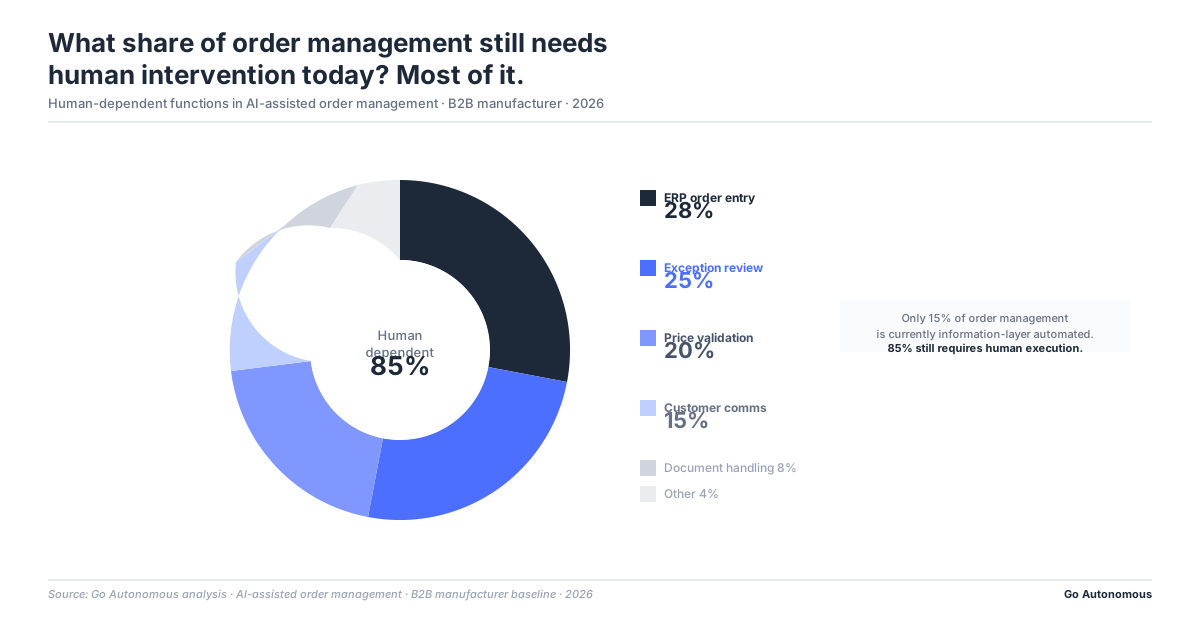
How Autonomous Execution Works Above the Decision Support Layer
Autonomous execution is not a smarter decision support tool. It is a different architectural layer. Understanding where it sits in relation to existing systems is the fastest way to evaluate whether it is additive or disruptive to the current stack.
What Is Autonomous Order Management for B2B Manufacturers?
Autonomous order management in B2B manufacturing is an execution layer that reads inbound purchase orders from any channel (email PDF, EDI 850, customer portal, structured API, EDIFACT), validates them against pricing master data and contract terms, resolves standard exceptions using codified business rules, and writes confirmed orders directly to the ERP without requiring a human decision at any step of the routine flow. The system escalates only when an exception is genuinely outside the resolution rules: a new customer with no pricing record, a quantity that exceeds credit limits, a product that has been discontinued. For all standard cases, the execution happens end-to-end without human involvement.
How Does the Autonomous Execution Layer Connect to SAP S/4HANA and Oracle Order Management?
The Autonomous Commerce platform connects to SAP S/4HANA, Oracle Order Management Cloud, and Microsoft Dynamics 365 via standard API and middleware integration. The autonomous layer sits upstream of the ERP. It does not replace the ERP or modify its data structures. It reads the inbound order, performs all pre-ERP validation and resolution work, and delivers a clean, structured order record to the ERP exactly as a human operator would, but in minutes rather than hours. For organizations running SAP IOM or Oracle OM Cloud as their post-capture orchestration layer, the autonomous execution layer is additive: it solves the intake problem that those platforms were not designed to address, and the structured output it delivers to the ERP is exactly what those platforms need to operate at their best.
For a detailed look at the integration architecture with ERP platforms and existing commercial infrastructure, the Autonomous Execution Fabric white paper covers the five architectural lessons from enterprise deployments, including how the autonomous layer handles multi-ERP environments and complex pricing contract structures.
How Friction Debt Accumulates in Decision Support Architectures
Friction Debt is the total monetary cost of human decisions still happening in the revenue flow. It has three components: decision time (the elapsed wait between a decision being needed and it being made), decision cost (the loaded cost of the people whose judgment is required, multiplied by frequency), and decision drag (the downstream effect on revenue: late confirmations, customer follow-up calls, exceptions that compound into escalations). In a decision support architecture, every exception in the operator queue carries friction debt. The AI layer may reduce decision time by presenting better information. It does not eliminate the wait. The operator still needs to review, judge, and approve. At 500 exceptions per day, that friction is manageable. At 5,000, it is a structural bottleneck on revenue throughput.
“Every data field touched by a human is friction debt.” That sentence describes what decision support tools leave in place. Autonomous execution pays it down by removing the human from the routine execution chain entirely.
Adopting Autonomous Commerce at Danfoss is not just about speed and efficiency. It's about empowering our customer service teams and sales force to focus on building relationships and providing personalized support.

What RPA and Workflow Automation Deliver Compared to Autonomous Execution
The comparison between RPA and autonomous AI execution is relevant here because many manufacturers have RPA-based order processing running in production. RPA tools (UiPath, Blue Prism, Automation Anywhere) automate structured, rule-defined tasks with zero variance tolerance. They are brittle in the face of format changes and completely unable to handle linguistic ambiguity or unstructured input. A rules-based RPA process that reads an EDIFACT file breaks the moment a customer submits a PDF with a non-standard format. Autonomous execution handles format variance natively because it reads with understanding, not just pattern matching. The distinction is not marginal. It is the difference between a system that handles 40 percent of order types automatically and one that handles 90 percent.
What Operational Outcomes Look Like When Order Management Runs Autonomously at Scale
The outcomes from autonomous order management deployments at B2B manufacturers follow a consistent pattern. The specific numbers vary by order volume, channel mix, and exception complexity. The directional results are consistent across deployments.
How Does Autonomous Order Processing Affect Order Confirmation Time for Manufacturers?
Order confirmation time for email and unstructured channel orders compresses from the industry average of 24 to 48 hours to under 30 minutes for the majority of order types. For fully structured EDI and portal orders, confirmation is near-immediate. The compression is not a percentage improvement in human processing speed. It is the result of removing the human from the routine execution flow entirely. The order is received, processed, and confirmed before an operator has opened their email client. Danfoss deployed Autonomous Commerce across 26 countries and reduced order confirmation time to under one minute for qualifying order types, processing across their ERP infrastructure at scale. See the full deployment detail in the Danfoss press release.
What Is a Realistic Automation Rate for B2B Order Processing?
For manufacturers with mature master data and well-codified pricing contracts, autonomous execution achieves 80 to 95 percent straight-through processing rates across all order channels. The remaining 5 to 20 percent represents genuine exceptions: new customer relationships without pricing records, orders with product configuration requirements, unusual delivery constraints, or credit exposure that requires commercial judgment. These are the cases that should be in front of an experienced operator. Everything else should not be. According to Go Autonomous deployment analysis across 30 billion-plus processed B2B transactions, manufacturers who codify their exception resolution rules thoroughly during implementation consistently achieve the higher end of the straight-through processing range within the first 90 days of deployment.
How Does Autonomous Execution Enable Revenue Growth Without Proportional Headcount Increases?
When routine order processing shifts to the autonomous execution layer, the customer service team’s capacity is no longer the throughput constraint. A team of 20 operators managing exceptions at 5 percent of order volume can support five times the order throughput of the same team managing all orders manually. Revenue can double, triple, or grow through acquisition without the same multiple applying to processing headcount. The freed capacity reallocates to commercial activity: proactive customer outreach, complex negotiation support, new customer onboarding. The efficiency gains are direct and measurable within the first operating quarter.
We are constantly exploring new ways to strengthen our operations and better serve our customers. The Autonomous Commerce Platform allows us to scale excellence in customer experience.
What Happens to Customer Experience When Order Confirmation Becomes Autonomous?
Buyers at B2B manufacturers that have deployed autonomous order execution report a qualitatively different experience within weeks of go-live. Order confirmation arrives in minutes rather than hours. Follow-up calls to check order status drop sharply because buyers receive confirmation before they feel the need to call. Customer service interactions shift from reactive status-chasing to proactive commercial conversations. The customer experience improvement is a byproduct of the operational architecture change, not a separate initiative. Faster confirmation, fewer errors, and consistent response times are structural outcomes of removing the human latency from the routine order flow.
How Does Autonomous Order Management Affect Working Capital and DSO?
Faster order confirmation triggers faster fulfillment, which triggers faster invoicing. The compression of the pre-ERP confirmation window, from 48 hours to under 30 minutes, directly reduces the order-to-cash cycle. For a manufacturer with €500M annual revenue, a two-day reduction in average DSO releases approximately €2.7M in working capital. This is a balance sheet benefit that the CFO and Treasury function can quantify independently of the operational savings case. According to Forrester research on automation ROI in B2B operations, organizations that achieve end-to-end automation of order intake and processing consistently report DSO reductions as one of the top three measurable financial outcomes, alongside cost reduction and error rate improvement. The CFO’s AI Mandate white paper covers the full financial case in detail.
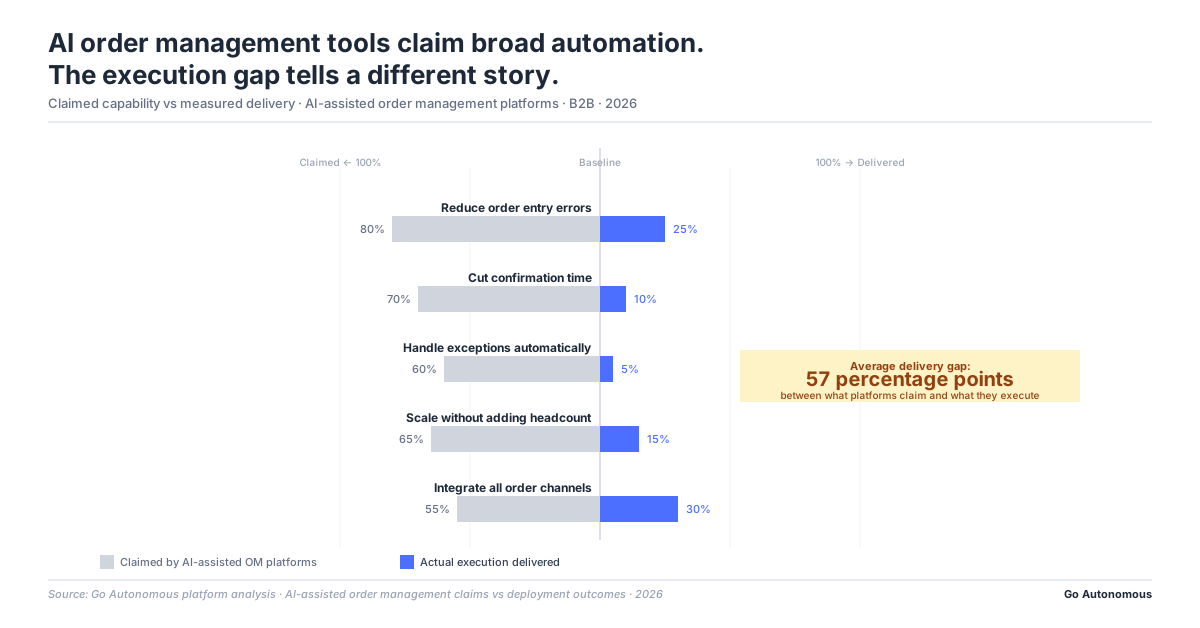
How to Evaluate Your Order Management Automation Ceiling
The question is not whether you have invested in AI order management. Most manufacturers above €500M revenue have. The question is whether that investment is operating at the intake layer or only in the post-capture layer. Four diagnostic signals identify where the ceiling sits.
Signal 1: What Percentage of Your Orders Still Arrive by Email?
If more than 30 percent of your order volume arrives as email or PDF attachments, your AI order management investment is operating downstream of your largest processing constraint. Email orders are the primary source of pre-ERP handling cost, confirmation delay, and error introduction. If your AI platform is post-capture, the email intake problem is unaddressed regardless of how sophisticated your orchestration layer is.
Signal 2: Does Your Exception Queue Grow When Order Volume Grows?
A simple diagnostic: measure your exception queue size in Q4 (peak) versus Q2 (trough). If the queue grows proportionally to order volume, your AI investment is not reducing the human decision requirement per order. It is helping the same number of humans process a growing queue faster. When the queue grows faster than the team can absorb, you have found the ceiling. The answer is not to hire for the peak. The answer is to reduce the exception rate at the intake layer.
Signal 3: Is Your Headcount per 1,000 Orders Flat or Growing?
Track the ratio of customer service and order management FTEs to order volume over 12 to 24 months. If the ratio is stable or growing, your AI investment has not decoupled headcount from volume. If revenue grew 20 percent and the team grew 18 percent, the AI layer added efficiency but not architectural independence. That is valuable, but it is not the ceiling break. The ceiling breaks when revenue grows 20 percent and the team grows 0 to 5 percent, because the execution layer is absorbing the new volume.
Signal 4: Can You Calculate Your Current Friction Debt?
Friction Debt is the total monetary cost of manual decisions in your revenue flow. Calculate it as: total manual touches per week (data field entries, validation reviews, exception approvals, rework corrections) multiplied by average decision time per touch, multiplied by fully loaded cost rate. If this number has not appeared on your operating dashboard, the cost of your current architecture is invisible. That invisibility is itself a signal. Organizations that cannot measure the cost of their Human Dependency Ratio cannot evaluate the ROI of reducing it. The topline growth and margin impact of closing the automation ceiling is directly proportional to the Friction Debt you can identify and quantify.
For a broader look at how AI changes the demand capture equation and what manufacturers are deploying in 2026, see customer success cases across the Nordics, DACH, and Benelux from manufacturers and distributors who have moved from Stage 3 and 4 to Stage 5 execution.
How Does Autonomous Commerce Differ from RPA for B2B Order Processing?
RPA automates repetitive, structured tasks with zero tolerance for format variance. It does not read with understanding. An RPA bot that processes an EDI 850 file will break when a customer submits a PDF with a non-standard layout. Autonomous Commerce reads any inbound format, resolves ambiguity, validates against live contract data, and executes. The RPA vs AI comparison is fundamental: RPA scales a specific task; autonomous execution scales an entire commercial function. The operational difference at scale is not marginal.
See Where Your Order Management Automation Ceiling Is and What Breaks Through It
If your current AI order management investment is operating downstream of your email order intake, the ceiling described in this post is your ceiling. The investment you have made in SAP IOM, Salesforce Order Management, Oracle OM Cloud, or any of the major platforms is sound. Those tools are doing what they were designed to do. The gap is upstream of them, at the intake layer, where unstructured inbound orders require pre-ERP validation and execution before any post-capture AI can add value. Go Autonomous works with 500M to 20B EUR manufacturers and distributors in the Nordics, DACH, Benelux, UKI, and France. If the diagnostic signals in this post describe your operations, we can show you exactly what the autonomous execution layer looks like in your environment: your ERP, your order channels, and your specific exception patterns. Book a conversation with our team.
Frequently Asked Questions
What is autonomous order management for B2B manufacturers?
Autonomous order management is an execution layer that reads inbound purchase orders from any channel, validates them against pricing contracts and master data, resolves standard exceptions using codified business rules, and writes confirmed orders directly to the ERP without requiring a human decision. The system escalates only when an exception falls outside its resolution rules. This is distinct from AI-assisted order management, which informs a human operator who then acts.
What is the difference between AI-assisted and autonomous order processing?
AI-assisted order processing informs a human operator who then makes the decision and executes. Autonomous order processing acts directly, making and executing the decision, then informs the human only when genuine escalation is required. AI-assisted tools reduce time per decision. Autonomous execution removes the decision requirement from the routine order flow entirely. The practical difference at scale: AI-assisted systems still require headcount growth proportional to order volume; autonomous systems do not.
How does AI order management software work in SAP environments?
SAP Intelligent Order Management uses machine learning to prioritize exception queues and recommend fulfillment actions, operating above SAP S/4HANA. It reduces operator decision time by providing AI-generated context for each exception. However, SAP IOM operates on orders already in the system. Pre-capture work, reading email PDFs, validating against pricing contracts, resolving extraction discrepancies, occurs upstream and remains human-dependent unless a separate autonomous intake layer is added.
What is a realistic automation rate for B2B order processing?
For manufacturers with mature master data and well-codified pricing contracts, autonomous execution achieves 80 to 95 percent straight-through processing across all order channels. AI-assisted decision support tools typically achieve 55 to 65 percent touchless rates. The difference is architectural: decision support tools require human confirmation on every exception; autonomous systems resolve standard exceptions without human involvement and escalate only genuinely complex cases.
What is the Human Dependency Ratio in B2B order management?
Human Dependency Ratio measures the number of manual decisions required per unit of revenue processed. It is a more precise measure than touchless rate because it captures whether a transaction could complete without a human, not just whether a human touched it. A high touchless rate with a high Human Dependency Ratio means humans are touching transactions quickly, not that the system can operate without them. Autonomous execution reduces HDR toward zero for routine order types.
How do you reduce human dependency in B2B order management?
Reducing human dependency requires moving from an AI-assisted architecture to an autonomous execution architecture: deploying an intake layer that reads unstructured inbound orders from any channel, validating against live contract data, codifying exception resolution rules so the system resolves standard cases without human approval, and connecting directly to the ERP for writeback. The Human Dependency Ratio drops as more exception types are codified into autonomous resolution rules.
Why does B2B order processing still require manual intervention even after AI investment?
Most AI order management investments operate downstream of the order intake layer. They optimize post-capture processing and exception prioritization for orders already in the ERP. However, 50 to 70 percent of B2B orders arrive as email PDFs and require pre-ERP interpretation, validation, and entry before any post-capture AI can act on them. This pre-capture stage remains human-dependent unless a separate autonomous execution layer is deployed at the intake point.