.svg)





Autonomous Commerce in DACH: Why German and Austrian B2B Manufacturers Are Deploying Now
DACH manufacturers are at a digital commerce inflection point. Regulatory pressure, labour market tightness, and high SAP density are converging to make autonomous order execution the logical next deployment for German and Austrian industrial companies.
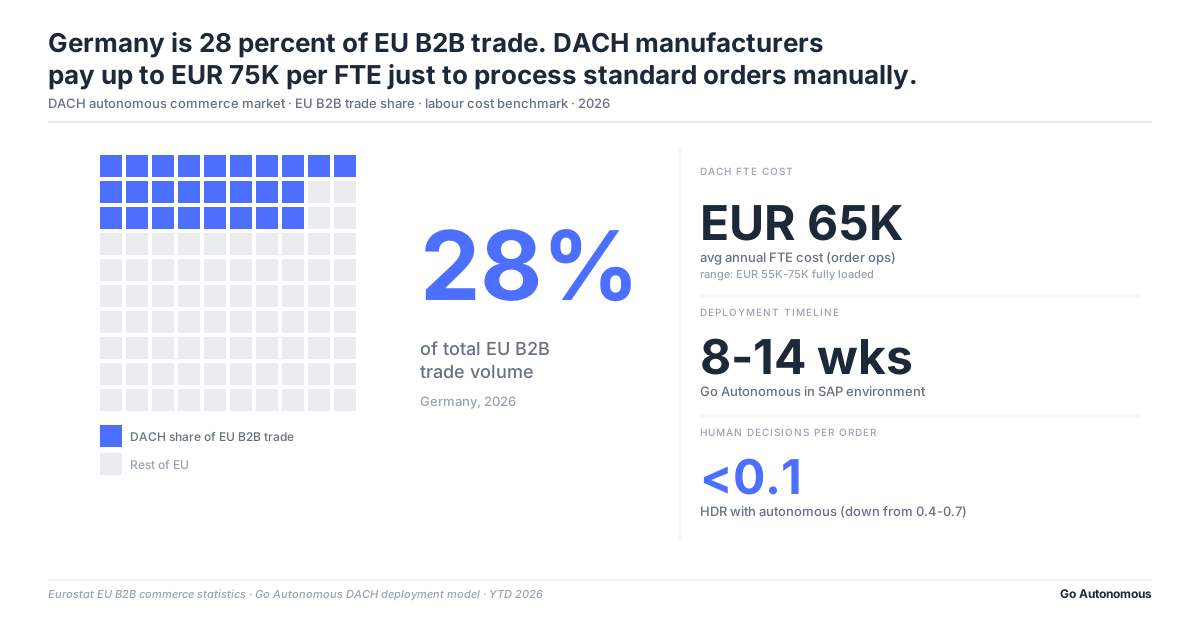
Germany accounts for approximately 28 percent of total EU B2B trade value, yet the autonomous execution maturity of German manufacturers in their commercial operations trails the Nordics by an estimated five to seven years. That gap is closing. The regulatory, economic, and technological forcing functions are now aligned in a way they were not 24 months ago. For VP Operations, Chief Digital Officers, and Order Management Directors at German and Austrian manufacturers, 2026 is not the year to evaluate autonomous commerce. It is the year to deploy it.
This post maps the specific market conditions driving autonomous commerce adoption across DACH, explains what deployment looks like in a SAP-dense German manufacturing environment, and provides a scenario fit framework for evaluating where your organisation sits on the adoption curve.
Table of Content
- The Market Signal: Why 2026 Is the Inflection Year for DACH B2B Order Execution
- What Is Changing and Why DACH Manufacturers Are Acting Now
- What Autonomous Commerce Deployment Looks Like in a DACH Manufacturing Environment
- The DACH Adoption Curve: Who Is Deploying and What Early Movers Are Achieving
- How DACH Manufacturers Should Evaluate and Prioritise Autonomous Commerce Adoption
- See How Autonomous Order Execution Works in a DACH SAP Environment
- What the Board in Frankfurt and Vienna Is Actually Asking
- Frequently Asked Questions
- What is autonomous commerce for German B2B manufacturers?
- How does autonomous order processing work with SAP S/4HANA in DACH?
- What is driving B2B digital commerce adoption in Germany in 2026?
- How does autonomous execution handle German-language email orders?
- What order volume does a DACH manufacturer need to justify autonomous commerce?
- How does the German e-invoicing mandate affect B2B order automation?
- What is the difference between EDIFACT and ANSI X12 EDI for German manufacturers?
- Sources
The Market Signal: Why 2026 Is the Inflection Year for DACH B2B Order Execution
Autonomous commerce adoption in DACH is not primarily driven by technology enthusiasm. It is driven by three converging structural pressures that, taken individually, each creates urgency. Together, they create a deployment window that most German and Austrian manufacturers have not faced before.
What Is Driving B2B Digital Commerce Adoption in Germany in 2026?
The German Wachstumschancengesetz introduced mandatory B2B e-invoicing from January 2025. Every German B2B transaction must now support EN 16931 structured invoicing. The Federal Ministry of Finance has set a phased compliance timeline that requires businesses to be able to receive structured electronic invoices now, and to issue them from 2027 onwards depending on company size. This is not an optional digitisation initiative. It is compliance infrastructure that forces SAP and ERP integration at the transaction layer.
The Peppol network, which underpins cross-border structured invoice exchange across the EU, has seen accelerating German adoption since the mandate came into force. German manufacturers connecting to Peppol to meet the compliance requirement are simultaneously creating the integration fabric that autonomous order execution requires. The same ERP connection that handles structured invoice receipt can handle autonomous order intake. Compliance spend becomes infrastructure spend when the architecture is right.
How Does the German Labour Market Create Pressure for Order Automation?
DACH labour costs are among the highest in Europe for skilled office roles. Customer service representatives, order management analysts, and inside sales support staff in Germany and Austria command fully loaded costs of 55,000 to 75,000 EUR per year, significantly above the EU average for comparable roles. The problem is compounded by availability: skilled CSR and order management staff are scarce in most German industrial cities, particularly in Baden-Wurttemberg, Bavaria, and North Rhine-Westphalia, where manufacturing density is highest.
A German manufacturer processing 600 email orders per day requires a team of 10 to 15 order management staff just to manage intake, depending on order complexity. At fully loaded costs of 65,000 EUR per FTE, that is 650,000 to 975,000 EUR per year committed to the act of receiving revenue. Growth compounds the problem: every additional 100 orders per day adds two to three headcount, assuming no productivity gain. The Human Dependency Ratio at that scale does not improve with volume. It stays fixed or worsens.
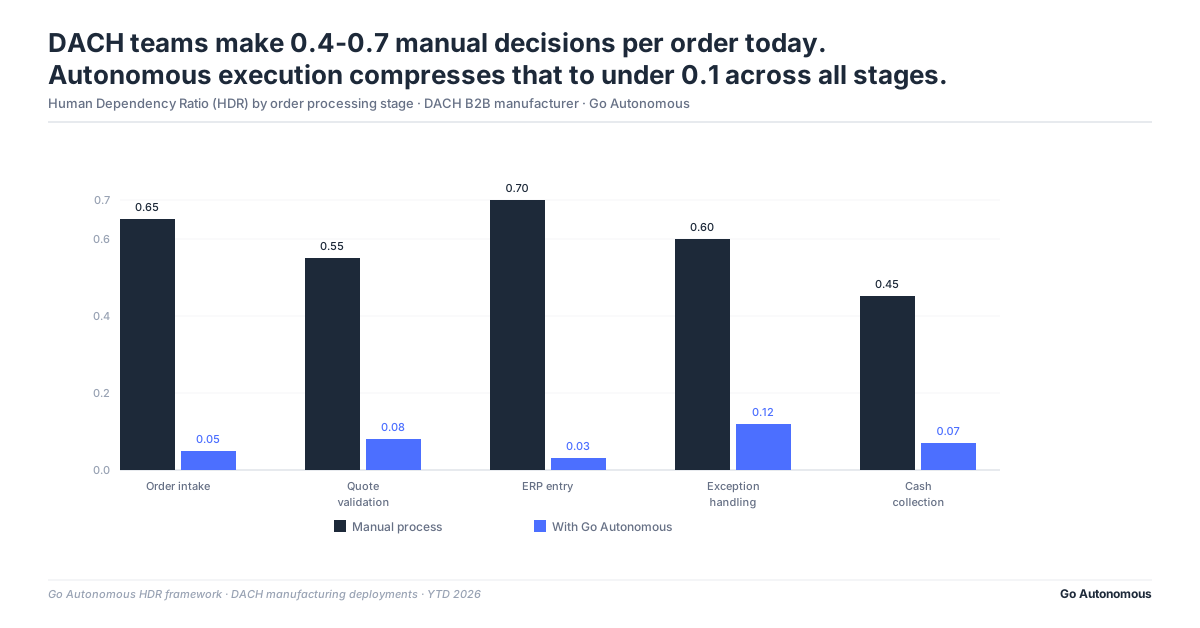
Human Dependency Ratio (HDR) measures the number of manual decisions required per unit of revenue processed. In a high-volume German manufacturing environment with unstructured email order intake, HDR typically runs between 0.4 and 0.7 manual decisions per order, including pricing validation, address resolution, and exception routing. Autonomous execution drives this below 0.1 for standard orders. At scale across 600 orders per day, the difference is 180 to 360 fewer manual decisions every day, compounding over 250 operating days per year.
Energy and production cost pressure since 2022 has further tightened German manufacturers’ operational margins. Efficiency investment has concentrated in production and logistics. The commercial layer, specifically order intake and processing, remains largely manual at most Mittelstand manufacturers. That asymmetry is the gap that autonomous commerce closes.
What Is Changing and Why DACH Manufacturers Are Acting Now
DACH has the highest SAP density of any geography globally. German and Austrian manufacturers run SAP S/4HANA at a higher penetration rate than any comparable industrial region, including the Nordics, Benelux, and the United Kingdom. This is the most important structural fact about DACH autonomous commerce deployment: the integration foundation already exists. The ERP that would receive autonomous order writebacks is already in place at the vast majority of target manufacturers.
How Does SAP Density Affect Autonomous Commerce Deployment in Germany?
SAP S/4HANA is the standard ERP at German and Austrian manufacturers with revenues above 250 million EUR. When autonomous commerce deploys in a DACH environment, the SAP integration layer is not a custom build. Go Autonomous connects to the existing SAP S/4HANA instance via standard APIs to read pricing master data, customer master data, and product catalogue, then writes confirmed orders directly back to the ERP without human intermediation. The infrastructure investment is significantly lower than in markets where ERP fragmentation requires custom connectors.
Industrie 4.0 has matured the manufacturing side of German industrial operations. Production lines run with sensor data, predictive maintenance, and automated scheduling. The commercial layer, specifically the process of receiving and processing customer orders, remains the outlier. Most German manufacturers have invested heavily in making their factories autonomous while the commercial operations team still processes German-language email orders manually. That asymmetry is not sustainable when labour costs and order volumes both trend upward.
What Is the German Mittelstand Digital Commerce Gap?
The German Mittelstand, specifically family-owned industrial manufacturers and distributors with revenues of 500 million to 3 billion EUR, represents the highest-density opportunity for autonomous commerce deployment in DACH. These companies have the order volume to justify autonomous execution, the SAP infrastructure to enable fast integration, and the cost pressure to create internal urgency. However, they lack the internal digital transformation teams that large enterprises have. A 700 million EUR Mittelstand manufacturer typically has a three to five person IT team managing the SAP landscape. They are not building autonomous execution in-house. They are evaluating platforms.
Austrian manufacturers present a very similar profile. The Austrian industrial base, concentrated in Upper Austria, Styria, and Vienna, mirrors the German Mittelstand in SAP penetration, order complexity, and labour cost pressure. Swiss manufacturers share the same operational characteristics, with the addition of CHF-denominated pricing requiring multi-currency handling in autonomous execution. All three markets are deploying on the same technology foundation with minor localisation differences.
Adopting Autonomous Commerce at Danfoss is not just about speed and efficiency. It’s about empowering our customer service teams and sales force to focus on building relationships and providing personalized support.

What Autonomous Commerce Deployment Looks Like in a DACH Manufacturing Environment
Deploying autonomous commerce in a German manufacturing environment is technically distinct from deploying in Nordics or Benelux markets, primarily because of language and EDI standard differences. Understanding these specifics is essential for any VP Operations or Head of Digital evaluating deployment feasibility.
How Does Autonomous Execution Handle German-Language Email Orders?
German-language order processing is the core technical challenge in DACH autonomous commerce deployment. German manufacturers receive between 40 and 60 percent of incoming order volume via unstructured email in German, according to Go Autonomous deployment data across European manufacturing clients. These emails contain product references in German, quantity specifications using German decimal conventions (comma as decimal separator, period as thousands separator), and delivery instructions in German prose. Standard order management software cannot parse this. Rules-based automation fails at the first edge case.
Autonomous execution applies language model reasoning to German-language order emails. The system reads the email, identifies line items, quantities, product references (including German-language product names and catalogue codes), pricing conditions, and delivery requirements. It validates each line against the SAP pricing master for the customer, identifies discrepancies, and either confirms autonomously or routes the specific exception to a human operator with full context. The operator does not re-read the original email. They approve or amend a pre-validated line item.
How Does EDIFACT Differ From North American EDI Standards in DACH Order Automation?
DACH manufacturers use EDIFACT as the dominant EDI standard. EDIFACT is the UN-administered international standard, used across European manufacturing and retail supply chains. It differs from the ANSI X12 standard dominant in North America (EDI 850/855 for purchase orders and acknowledgements). German automotive, chemicals, and industrial manufacturing supply chains run on EDIFACT ORDERS, ORDRSP, DESADV, and INVOIC message types. Autonomous commerce platforms deployed in DACH must handle EDIFACT natively, not as a conversion from ANSI X12.
The typical DACH manufacturer receives structured EDIFACT orders from large key accounts and unstructured German-language email orders from smaller accounts. Autonomous execution handles both channels through the same intake layer: EDIFACT orders are validated automatically with exception flagging, while email orders go through the language processing and validation pipeline described above. For the operator, all orders surface in a single queue regardless of their original format.
The Friction Debt in a typical DACH manufacturing environment accumulates at the intersection of these two channels. Large EDIFACT accounts generate structured data that still requires manual exception handling when pricing deviations occur. Small email accounts generate unstructured data that requires full manual processing. Autonomous execution pays down both categories of friction debt simultaneously.
For manufacturers preparing to deploy the Autonomous Execution Fabric, the DACH integration stack typically involves: SAP S/4HANA as the ERP backbone, EDIFACT as the structured channel, German-language email via standard SMTP integration, and customer portal orders from existing B2B portal investments. All four channels feed into the autonomous intake layer without requiring separate integrations per channel.
The DACH Adoption Curve: Who Is Deploying and What Early Movers Are Achieving
The clearest reference point for DACH-relevant autonomous commerce outcomes is Danfoss, the Danish industrial conglomerate with significant manufacturing and commercial operations across Germany and the DACH region. Danfoss deployed the Go Autonomous platform across 26 countries in one day, including German and Austrian operations. The results are specific: order processing time compressed from 42 hours to under one minute, 80 percent of decisions now execute autonomously, and processing time reduced by 50 percent. The Danfoss case study is the most complete published evidence of what autonomous commerce deployment at DACH scale delivers.
Mediq, the healthcare distribution specialist, achieved 75 percent faster processing across 4,000 orders per week with zero headcount added after deploying autonomous commerce. The Mediq case is relevant for DACH distributors specifically: the healthcare distribution model closely mirrors the operational complexity of German and Austrian industrial distributors, with high SKU counts, contract pricing complexity, and multi-customer delivery requirements.
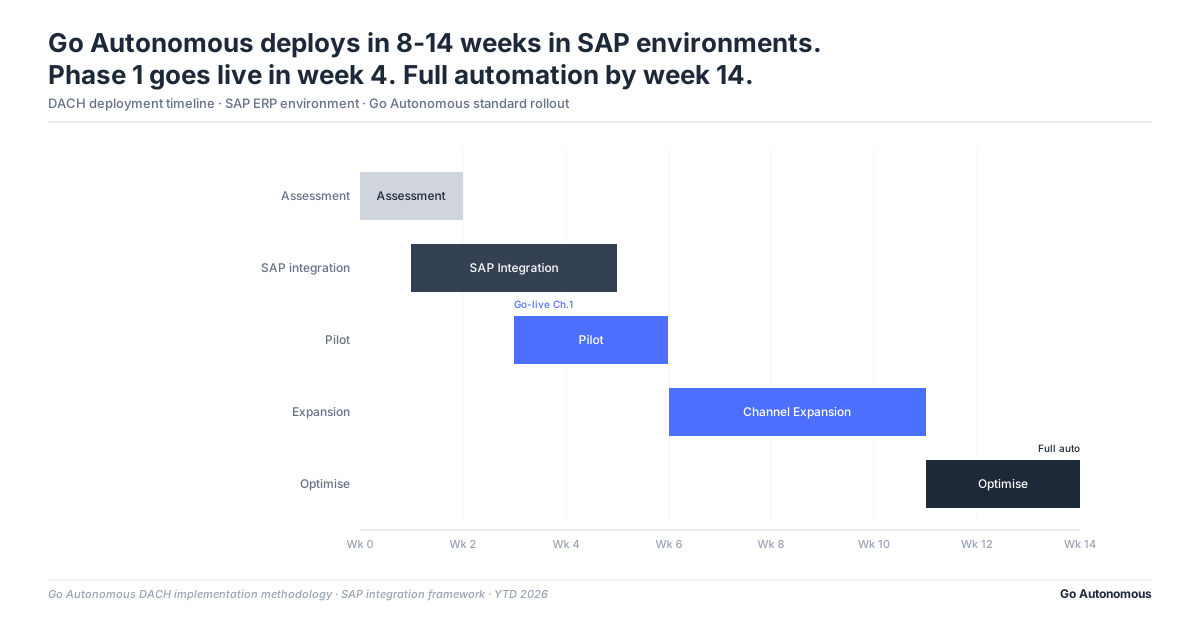
Go Autonomous works with manufacturers and distributors across the Nordics, DACH, and Benelux regions. The DACH pattern in early deployments shows a consistent profile: companies with 300 or more orders per day, SAP S/4HANA already in production, and email as the primary unstructured intake channel. The deployment timeline in a standard DACH SAP environment runs eight to fourteen weeks from contract to live production. The SAP integration is the fastest component because the APIs are standardised. The variable is data readiness: pricing master quality and customer master completeness determine how quickly the autonomous layer reaches production confidence.
Revenue at Rest is the metric that resonates most immediately with German and Austrian CFOs evaluating autonomous commerce. A manufacturer with 400 million EUR annual revenue processing orders at 24 to 48 hour cycle times holds a significant portion of confirmed order value sitting stationary between customer request and ERP entry. Compressing that cycle time to under ten minutes releases working capital that is currently trapped in processing lag. At 400 million EUR annual revenue and a 30-day O2C cycle, each day of compression releases approximately 1.1 million EUR in working capital.
How DACH Manufacturers Should Evaluate and Prioritise Autonomous Commerce Adoption
The decision criteria for DACH autonomous commerce deployment are more specific than the general evaluation framework used in other markets. SAP version, language complexity, EDIFACT coverage, and email order volume each contribute to deployment speed and return timeline. The scenario fit table below maps the most common DACH configurations to their recommended deployment approach.
| Situation | Recommended Approach | Why This Applies |
|---|---|---|
| 500+ orders per day, 40%+ arrive via German-language email | Full autonomous commerce deployment: email AI as primary intake layer | Volume and unstructured channel mix creates the highest ROI opportunity. Processing cost reduction is immediate and measurable. |
| High SAP density, already running S/4HANA, EDI batch processing for large customers | EDIFACT plus autonomous email hybrid: autonomous handles all non-EDI volume | SAP integration is the fastest path to production. EDI customers receive no disruption to existing structured flows. |
| Manufacturing company with seasonal peaks (Q4 order surge common in German industrial) | Autonomous intake as surge buffer: scales without temporary headcount | Peak periods expose manual processing limits fastest. Autonomous execution handles surge volume at the same per-order cost as baseline. |
| Mittelstand distributor with 5 to 15 CSR staff handling order intake | Order management automation as primary initiative: direct headcount ROI | At this size, each CSR freed is commercially meaningful. No enterprise-scale change management required. |
| Early SAP S/4HANA migration in progress | Deploy alongside migration: cleaner integration than retrofitting | ERP migration window is the lowest-cost point to add the autonomous layer. Post-migration retrofit requires duplicate integration work. |
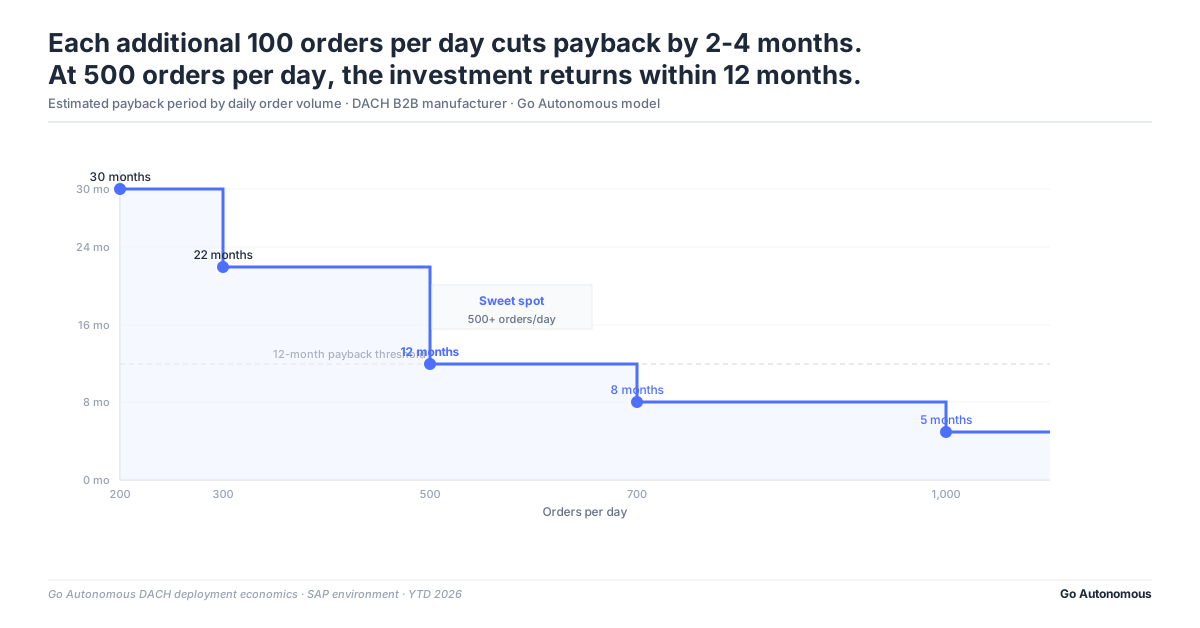
The minimum viable deployment profile for a DACH manufacturer is approximately 200 orders per day with at least 30 percent arriving via unstructured channels. Below that threshold, the return timeline extends beyond 24 months and the business case weakens. Above 500 orders per day with high email volume, payback typically runs under 12 months based on processing cost reduction alone, before working capital release is counted.
For manufacturers with mixed order complexity, the efficiency gains compound when autonomous execution handles the high-volume standard orders and frees the human team to focus on the genuinely complex exceptions that require commercial judgment. The customer experience improvement is also significant: customers who previously waited 24 to 48 hours for order confirmation receive confirmation in minutes, regardless of which channel they used to send the order.
At CWS Hygiene, we’re taking an important first step toward bringing autonomy to our commercial operations. We see Autonomous Commerce as a vital pillar of our enterprise architecture for the future.
For DACH manufacturers evaluating the topline growth and margin management case, the framing shifts from cost reduction to revenue velocity. German manufacturers processing orders faster close the gap between customer demand and confirmed cash. In a competitive market where response speed influences buyer loyalty, the commercial advantage of processing orders in minutes rather than days compounds over time.
See How Autonomous Order Execution Works in a DACH SAP Environment
If your organisation processes German-language email orders manually, runs SAP S/4HANA, and is facing either the e-invoicing compliance deadline or headcount pressure in your order management team, the conditions for autonomous commerce deployment are already in place. Go Autonomous works with 500 million to 20 billion EUR manufacturers and distributors in the Nordics, DACH, Benelux, UKI, and France. We can show you exactly what autonomous execution looks like in your environment: your SAP instance, your EDIFACT and email order channels, and your German-language commercial workflows. The conversation takes 45 minutes and produces a specific deployment assessment. Book a conversation with our team.
What the Board in Frankfurt and Vienna Is Actually Asking
Before any initiative of this scale reaches sign-off at a German or Austrian manufacturer, the same questions surface. Here are the direct answers.
“Are our competitors in Germany already doing this?”
Yes, though disclosure is limited. Manufacturers and distributors across the Nordics, DACH, and Benelux have been deploying autonomous commerce in production since 2023. Danfoss, operating extensively across Germany, is the most publicly documented case. The adoption pattern in DACH follows the Nordic trajectory with a 12 to 18 month lag: large industrial manufacturers move first, Mittelstand manufacturers follow within 12 to 24 months. If you are in the 500 million to 3 billion EUR range and processing more than 300 orders per day, your direct competitors at similar scale are evaluating or have already deployed. The question is not whether to adopt. It is whether to lead or follow.
“How does this integrate with our SAP S/4HANA investment?”
Go Autonomous integrates directly with SAP S/4HANA via standard APIs, reading pricing master data, customer master, and product catalogue, then writing confirmed orders back to the ERP without custom development. The integration does not require SAP customisation or ABAP development. Deployment in a standard DACH SAP S/4HANA environment typically runs eight to fourteen weeks to live production. SAP is not a barrier; it is the integration foundation that makes DACH deployment faster than markets with fragmented ERP landscapes.
“What is the realistic payback timeline for a German manufacturer at our scale?”
For a German manufacturer processing 400 or more orders per day with 40 percent or more arriving via unstructured email, the direct processing cost reduction alone typically delivers payback within 10 to 14 months. Add working capital released through O2C cycle compression and the payback shortens further. At 500 million EUR annual revenue, compressing order-to-cash by five days releases approximately 6.8 million EUR in working capital. The relevant comparison is not the platform cost versus zero. It is the platform cost versus the cost of adding two to three order management headcount per 100 orders of daily volume growth, year over year, in the German labour market.
Frequently Asked Questions
What is autonomous commerce for German B2B manufacturers?
Autonomous commerce for German B2B manufacturers is an AI execution layer that processes incoming orders from all channels, including German-language email, EDIFACT EDI, and customer portals, validates them against SAP pricing and customer master data, and writes confirmed orders directly to the ERP without human handling. It handles standard orders end-to-end and routes only genuine exceptions to operators.
How does autonomous order processing work with SAP S/4HANA in DACH?
Autonomous order processing integrates with SAP S/4HANA via standard APIs. The platform reads pricing master data, customer master, and product catalogue from SAP, validates incoming orders against these sources, and writes confirmed orders back to SAP Order Management without custom ABAP development. In a standard DACH SAP environment, the integration runs to production in eight to fourteen weeks.
What is driving B2B digital commerce adoption in Germany in 2026?
Three forces are converging in 2026: the German mandatory B2B e-invoicing requirement under the Wachstumschancengesetz, which forces SAP and ERP integration as a compliance requirement; DACH labour market tightness that makes growing order management headcount expensive and slow; and high SAP S/4HANA density across German manufacturers that creates a strong integration foundation for autonomous execution.
How does autonomous execution handle German-language email orders?
Autonomous execution uses language model reasoning to parse German-language order emails. The system identifies line items, quantities using German decimal conventions, product references in German, and delivery instructions, then validates each line against the SAP pricing master. Standard orders confirm autonomously. Exceptions, such as pricing deviations or address mismatches, route to a human operator with full context pre-populated.
What order volume does a DACH manufacturer need to justify autonomous commerce?
The minimum viable deployment profile for a DACH manufacturer is approximately 200 orders per day with at least 30 percent arriving via unstructured channels such as email. Below this threshold, payback extends beyond 24 months. Above 500 orders per day with significant email volume, payback typically runs under 12 months on processing cost reduction alone, before working capital release from O2C cycle compression is counted.
How does the German e-invoicing mandate affect B2B order automation?
The German Wachstumschancengesetz requires all B2B transactions to support EN 16931 structured invoicing. This compliance requirement forces manufacturers to build or upgrade SAP and ERP integration at the transaction layer. The same integration infrastructure required for e-invoicing compliance creates the foundation for autonomous order execution, meaning compliance spend becomes architecture spend for manufacturers deploying both simultaneously.
What is the difference between EDIFACT and ANSI X12 EDI for German manufacturers?
EDIFACT is the UN-administered international EDI standard dominant in European manufacturing and retail supply chains, including DACH. ANSI X12 is the standard used in North American supply chains. German manufacturers use EDIFACT message types including ORDERS, ORDRSP, DESADV, and INVOIC. Autonomous commerce platforms deployed in DACH handle EDIFACT natively, covering the structured channel alongside unstructured German-language email intake.