.svg)





Autonomous Commerce in the Nordics: Why B2B Manufacturing Leaders Are Moving First
Autonomous commerce is gaining traction faster in the Nordics than anywhere else in Europe — and for B2B manufacturers and distributors operating at scale, the reasons are structural, not coincidental. This post examines why Nordic industrial leaders are moving first, what operational outcomes they are achieving, and what the shift means for organisations still running on manual order processes.
Autonomous commerce in the Nordics is advancing faster than anywhere else in Europe, driven by a convergence of high labour costs, strong digital infrastructure, and a manufacturing base that has reached the hard ceiling of what human-operated order management can sustain at scale. For B2B manufacturers and distributors processing thousands of orders per week across complex customer portfolios, the question is no longer whether to move to autonomous execution, it is how fast that transition can be completed without disrupting live revenue.
Table of Content
- Why the Nordics Are Moving First on B2B Order Automation
- What Autonomous Commerce Actually Executes in a Nordic B2B Operation
- Nordic Outcomes in Practice: Danfoss, Nilfisk, Hempel, and Mediq
- The Commercial Case: Autonomous Commerce ROI for Nordic Enterprises
- Implementation in a Nordic Manufacturing Environment: What to Expect
- Why the Window for First-Mover Advantage Is Closing
- See Autonomous Commerce in Action at the 2026 Summit
- Frequently Asked Questions
Why the Nordics Are Moving First on B2B Order Automation
The Nordics have long been at the frontier of enterprise digitalisation. Denmark, Sweden, Norway, and Finland consistently rank among the top five most digitally advanced economies in the EU according to the European Commission’s Digital Economy and Society Index. But for B2B digital transformation in the Nordics, the shift to autonomous commerce is being driven by something more specific than general digital maturity: it is being driven by a structural labour and growth constraint that has become impossible to manage through incremental process improvement.
Consider the operating reality for a €1B+ Nordic industrial manufacturer today. Between 85% and 90% of B2B revenue is still human-facilitated, meaning that for every order, quote request, or pricing inquiry coming through email, phone, or portal, a customer service or inside sales representative is manually extracting data, validating it against ERP records, and entering it into the system. Email alone accounts for 50–70% of B2B order and quote volume across European manufacturing. The throughput ceiling is the headcount. And in the Nordics, that ceiling is low and expensive.
The Labour Cost Equation for Nordic B2B Manufacturers
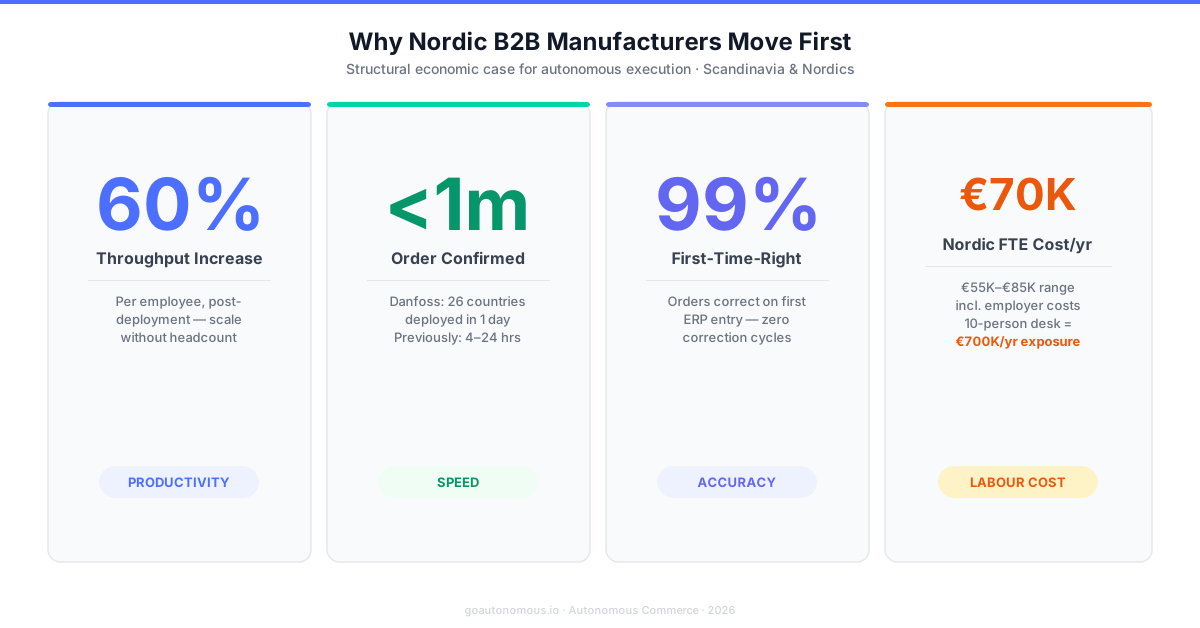
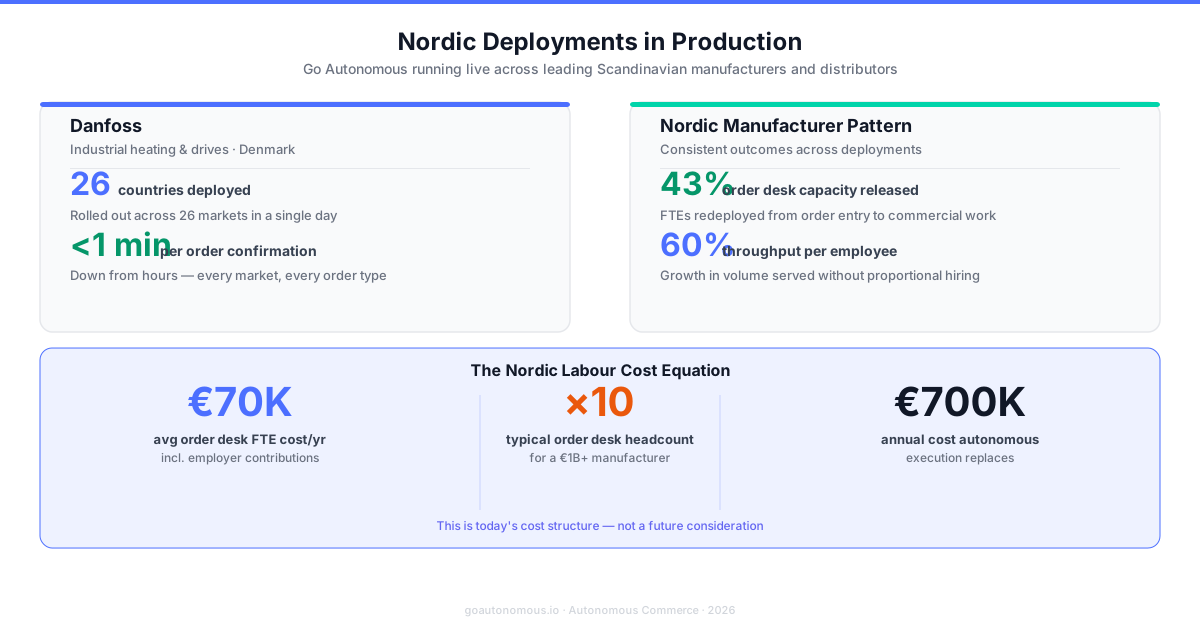
Scandinavian labour markets are among the tightest and most expensive in the world. Average hourly labour costs in Denmark and Norway run significantly above the EU average, and workforce availability in skilled customer operations roles is structurally constrained. For Nordic B2B digital transformation to deliver real margin impact, it cannot depend on a headcount model. The economic case for autonomous order management is direct: organisations that have deployed autonomous execution are seeing 43% of customer operations capacity released from manual processing, capacity that is redeployed into exceptions, strategic accounts, and growth activities rather than routine transaction handling.
The problem compounds with growth. Hempel’s Vice President of Customer Care described the dynamic precisely:
Each time we added one or two million euros in revenue, we had to add another operator. From a cost perspective, that's an unsustainable way of operating a business.

This growth-to-headcount coupling is exactly what autonomous commerce is engineered to break. When order intake, validation, ERP entry, and confirmation are executed by AI agents rather than human operators, revenue can scale without a corresponding increase in customer operations cost. Hempel, the Danish industrial coatings manufacturer, adopted autonomous commerce for order management, full details are in the Hempel press release.
Digital Infrastructure Readiness Across Scandinavia
A secondary driver of early adoption in B2B digital transformation in Scandinavian manufacturing is infrastructure readiness. Nordic enterprises have, on average, higher ERP adoption rates, stronger data governance practices, and more mature IT organisations than their counterparts in Southern or Eastern Europe. SAP and Microsoft Dynamics are deeply embedded across Danish, Swedish, Norwegian, and Finnish manufacturing. This matters for autonomous commerce deployment because the integration layer, connecting the AI execution platform to ERP, CRM, and email infrastructure, is where complexity typically concentrates. When the ERP environment is mature and well-documented, deployment timelines compress significantly. Danfoss, one of the most recognisable names in Danish industrial manufacturing, went live across 26 countries in a single day, a deployment scale that would be impossible without the underlying data and systems foundation that Nordic enterprises have built over decades.
For Danish Industrial Manufacturers: The Order Volume Inflection Point
For Danish B2B commerce automation, the inflection point typically arrives when a manufacturer or distributor crosses a threshold where inbound order volume exceeds what the existing customer operations team can process at the required speed and accuracy. At that point, the organisation faces a binary choice: hire more operators, or change how orders are processed. Given the labour market conditions described above, the hiring path becomes increasingly unviable. Autonomous order management in Denmark is therefore not primarily a technology investment, it is an operational capacity decision made under structural constraint. Organisations that make this decision early gain a compounding advantage: capacity freed from manual processing is redeployed into high-value activities, and the AI execution layer improves as it processes more transactions.
What Autonomous Commerce Actually Executes in a Nordic B2B Operation
Autonomous commerce is not a chatbot, a copilot, or robotic process automation. It is an execution layer, AI agents that receive orders, quotes, price inquiries, and exception requests through any channel (email, EDI, portal, phone transcript), interpret them against the organisation’s ERP data and business rules, and execute the appropriate action end-to-end without human intervention on routine transactions. The distinction matters because it defines what value is actually being delivered. Assistance tools require a human to remain in the loop for every transaction. Autonomous execution removes the human from routine transactions entirely, routing only genuine exceptions, mismatches, missing data, credit holds, to the operator.
For a Nordic manufacturer processing 500 to 5,000 orders per week, this means the platform is executing the full order-to-cash cycle on the majority of that volume. AI-powered order processing in Norway, Sweden, Denmark, and Finland is being deployed across the following transaction types:
- Sales order processing from email: Inbound order emails are parsed, customer and product data validated against ERP, and orders confirmed, the full cycle in under 57 seconds on average. See the email to order automation use case for the technical execution detail.
- RFQ and quote automation: Quote requests received via email or portal are priced, formatted, and returned without operator involvement on standard configurations. Complex or custom quotes are flagged for human review. More on this at the RFQ and quote automation page.
- Order-to-cash execution: From order receipt through fulfilment confirmation and invoice dispatch, the platform manages the full cycle. See how order-to-cash automation works end-to-end.
- Price inquiry handling: Customer pricing requests are resolved against the applicable price list and customer agreement without operator lookup. Details at the price inquiry automation page.
- Claims and dispute resolution: Structured handling of delivery discrepancies and invoice disputes, reducing resolution cycle time significantly. See the claims and dispute automation use case.
- Exception handling and routing: Transactions that fall outside automated resolution parameters are classified, enriched with context, and routed to the appropriate operator, reducing the cognitive load of exception management. Full details at the exception handling automation page.
The platform processes these transaction types across ERP systems including SAP, Microsoft Dynamics, Oracle, Infor, and Salesforce, all of which are in active deployment across the Nordic manufacturing base. The full integrations directory documents the current connector library, including SAP integration and Microsoft Dynamics integration, the two ERP systems most prevalent in Nordic enterprise deployments.
For Norwegian B2B Distributors: Moving Beyond the EDI Myth
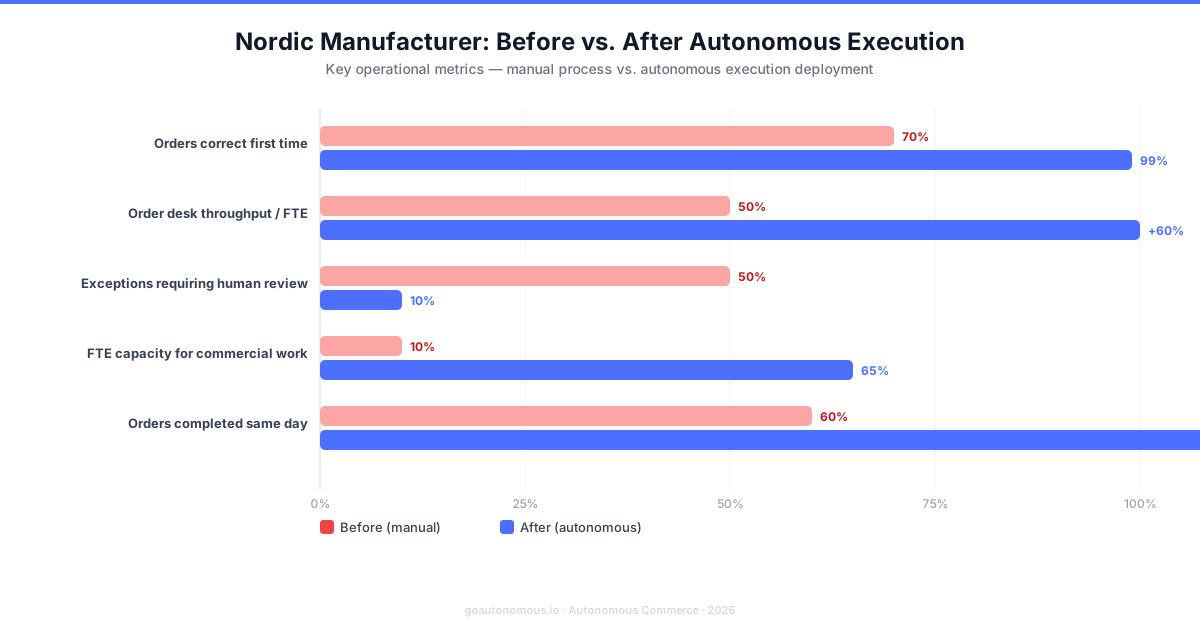
A common assumption among Norwegian industrial distributors is that EDI adoption has already solved the order automation problem. For the largest, most structured customer relationships it has, but EDI covers a narrow slice of actual order volume. The majority of B2B order flow in Norwegian industrial distribution arrives outside EDI: through email, phone orders transcribed manually, customer portals with non-standard formats, and direct ERP-to-ERP connections that break on every master data update. AI order handling for Norwegian industrial companies addresses exactly this long tail, the 60–80% of order volume that EDI never reached and that still consumes the majority of customer operations time. For organisations running at 60% throughput improvement per employee after autonomous execution deployment, the delta from pre-deployment is stark.
For Scandinavian Chemical Companies: First-Time-Right Execution at Scale
In autonomous commerce for Scandinavian chemical companies, the accuracy dimension is as important as the throughput dimension. Chemical distributors and manufacturers face complex order requirements: hazmat classifications, regulatory compliance data, substitute product rules, and multi-warehouse fulfilment logic. Manual order entry in this environment produces error rates that compound downstream, incorrect hazmat codes, wrong lot numbers, compliance documentation gaps. Autonomous execution platforms trained on chemical-specific order logic achieve 99% first-time-right order rates, eliminating the rework cycles that inflate true cost-per-order well beyond the headline labour cost. The white paper on breaking free from manual processes covers the error cost structure in detail for manufacturing and distribution environments.
Nordic Outcomes in Practice: Danfoss, Nilfisk, Hempel, and Mediq
The strongest evidence base for autonomous commerce ROI in Nordic enterprises is not theoretical, it is live, in production, and public. Four Nordic organisations with different industry profiles, geographies, and order complexity profiles have made the transition to autonomous execution and documented the results. Understanding what each of them achieved, and how, provides a practical framework for evaluating the commercial case in a comparable organisation.
Danfoss: 26 Countries, One Day, Sub-Minute Orders
Danfoss is among the most operationally complex B2B manufacturers in Europe. Operating across climate, drives, and power solutions with a global customer base, their order intake challenge involves multiple languages, currencies, product catalogues, and ERP environments. The scale of autonomous execution deployment at Danfoss, live across 26 countries in a single day, demonstrates what is possible when integration is handled by a platform built for enterprise B2B environments rather than assembled from point solutions. Post-deployment, Danfoss customers receive order confirmations in under one minute. The full context of the deployment is covered in the Danfoss press release.
The Danfoss case is particularly instructive for Nordic B2B peers because it addresses the most common objection to autonomous commerce deployment at scale: that complexity makes automation impractical. The argument runs that the variety of customer request formats, product configurations, and ERP edge cases makes full automation impossible beyond a limited scope. Danfoss demonstrates the opposite. Complexity does not preclude autonomous execution, it defines the perimeter of the exception envelope, which in a mature deployment is a small fraction of total order volume. The platform handles the structured majority autonomously; the operator handles the genuinely complex minority with better context than before.
Nilfisk: Autonomous Execution in Professional Cleaning Equipment
Nilfisk, the Danish manufacturer of professional cleaning equipment and solutions, adopted autonomous commerce to transform how orders flow through their customer operations. The deployment addressed a high-volume order environment where the cost of manual processing was compounding with growth, exactly the dynamic that Hempel’s VP described in operational terms. The Nilfisk case demonstrates autonomous commerce deployment in a discrete manufacturing and distribution context, where order patterns are structured but customer diversity creates significant data variability. Full deployment details are in the Nilfisk press release.
Mediq: Healthcare Distribution with Zero Tolerance for Error
Mediq is a leading Nordic distributor of medical and healthcare supplies, an environment where order accuracy is not a commercial preference but a patient safety requirement. The deployment of autonomous commerce at Mediq demonstrates that autonomous execution is viable in high-compliance, zero-error-tolerance environments, not just in lower-stakes industrial distribution. The platform’s ability to achieve 99% first-time-right execution while managing regulatory and compliance data is directly applicable to healthcare distribution requirements. The Mediq press release covers the operational transformation in detail, and the autonomous commerce for medical and healthcare distributors industry page contextualises the deployment within sector-specific requirements.
The Commercial Case: Autonomous Commerce ROI for Nordic Enterprises
Autonomous commerce ROI for Nordic enterprises operates across three distinct value dimensions: cost reduction, revenue acceleration, and working capital improvement. Understanding how each dimension contributes, and how they interact, is essential for building the business case at board and CFO level. The white paper on the CFO’s AI mandate addresses the financial modelling framework in detail.
Cost Reduction: The Capacity Release Effect
The most immediate and measurable ROI component is the release of customer operations capacity from manual transaction processing. When 43% of operator time is freed from routine order handling, the cost structure does not automatically reduce, but it fundamentally changes. Organisations face a choice between reducing headcount, redeploying capacity into higher-value work, or scaling revenue without corresponding headcount growth. In the Nordics, where the cost of customer operations FTEs is among the highest in Europe, even partial capacity release generates material cost savings. The more strategically valuable outcome, however, is the decoupling of revenue growth from headcount growth, the Hempel dynamic described above, resolved at the platform level rather than the hiring level.
Revenue Acceleration: Win Rates and Response Speed
Quote-to-cash automation in Nordics manufacturing has a direct revenue impact that operates independently of cost reduction. When quote response times drop from hours or days to minutes, win rates increase, customers in competitive sourcing situations default to the supplier that responds fastest with an accurate quote. Organisations deploying autonomous commerce for RFQ and quote automation are achieving 18% win rate increases. At scale, this is a significant revenue impact: for a manufacturer with €200M in quoted revenue, an 18% increase in win rate on competitive quotes represents tens of millions in incremental bookings per year. The throughput improvement is equally stark, 60% increase in orders processed per employee, meaning the same commercial team handles substantially more volume without quality degradation.
For AI-Powered B2B Order Management in Denmark and Finland: Working Capital Benefits
A third ROI dimension that is often underweighted in initial business cases is the working capital impact. Manual order processing introduces latency into the order-to-cash cycle at multiple points: order acknowledgement delay, invoice generation delay, dispute resolution delay. Each delay extends the cash conversion cycle. Autonomous execution eliminates processing latency from the controllable portion of the cycle, orders confirmed in under 57 seconds, invoices generated immediately upon shipment confirmation, disputes resolved in structured workflows rather than email threads. For AI-powered B2B order management in Denmark and Finland, where working capital efficiency is a board-level metric at most large industrials, this benefit is increasingly being included in the formal business case alongside the cost and revenue dimensions. The full commercial framework is explored in the era of autonomous commerce white paper.
- Cost dimension: 43% capacity released from manual processing; headcount growth decoupled from revenue growth; cost per order reduced structurally rather than incrementally.
- Revenue dimension: 18% win rate increase on competitive quotes; 60% throughput per employee improvement; 57-second order confirmation enabling faster fulfilment and customer satisfaction.
- Accuracy dimension: 99% first-time-right order rates eliminating downstream rework; error-driven exceptions reduced, freeing operator time for value-adding activities.
- Working capital dimension: Reduced order-to-cash cycle time through elimination of processing latency; faster invoice generation and dispute resolution compressing days sales outstanding.
- Scale dimension: Platform handles volume growth without proportional cost increase; 30B+ transactions already processed globally, demonstrating enterprise-grade reliability at Nordic B2B scale.
Implementation in a Nordic Manufacturing Environment: What to Expect
The most common barrier to initiating an autonomous commerce evaluation at Nordic manufacturers and distributors is not budget or strategic alignment, it is uncertainty about what implementation actually involves, how it interacts with existing SAP or Dynamics environments, and what the transition looks like for the customer operations team. These are operational questions that deserve precise answers.
ERP Integration: SAP and Microsoft Dynamics in the Nordic Context
The Go Autonomous platform integrates natively with SAP and Microsoft Dynamics, the two ERP systems that dominate the Nordic enterprise manufacturing landscape. Integration connects order intake channels (email, portal, EDI, phone) to the ERP’s order management module, with the platform handling interpretation, validation, and exception routing. The approach is non-disruptive to the existing ERP configuration: the autonomous commerce layer sits above the ERP transaction layer, reading from and writing to it through standard APIs rather than modifying the underlying system. This architecture enables deployment without an ERP implementation project, a critical distinction for organisations that cannot afford to destabilise live ERP environments during the transition. The technical architecture is detailed in the Autonomous Execution Fabric white paper.
What the Transition Looks Like for Customer Operations Teams
The operational transition is often described as a shift from a transactional to an exception-management role for customer service representatives. Before autonomous execution, a CSR spends the majority of their day processing routine orders: reading emails, validating product codes, entering quantities, confirming delivery addresses, generating acknowledgements. After deployment, the platform handles this work on routine transactions, and the CSR’s queue consists of exceptions, orders with missing information, pricing disputes, customer-specific configuration requirements, that genuinely require human judgement. This is experienced by most teams as a significant quality-of-work improvement. The volume pressure that characterises high-season order processing periods is absorbed by the platform, not by people. Autonomous execution for Nordic distribution leaders means customer operations teams spend more time on retention, upsell, and exception resolution, activities that generate commercial value rather than consume it.
Autonomous Execution for Nordic Distribution Leaders: The Evaluation Process
For organisations beginning the evaluation of B2B order automation in the Nordics, the starting point is a process assessment that maps current order volume, channel mix, ERP environment, and exception rate. This establishes the baseline against which autonomous execution impact is modelled. Most Nordic manufacturers and distributors operating at €500M+ in revenue discover that the automation opportunity is significantly larger than initial estimates suggest, because the visible cost of manual processing (operator time) is only part of the true cost, which also includes order latency, error rework, quote delays, and the compounding effect of throughput constraints on growth capacity. A formal business impact assessment scopes both the automation opportunity and the expected ROI dimensions across cost, revenue, and working capital. See the full success cases library for detailed outcome documentation from live Nordic deployments, and review the autonomous commerce for industrial manufacturers and autonomous commerce for industrial distributors industry pages for sector-specific context.
Why the Window for First-Mover Advantage Is Closing
Autonomous order processing in Sweden, Denmark, Norway, and Finland is still in the early majority phase, meaning that the organisations moving now are gaining advantages that will be difficult to replicate once the approach is standard practice. Three dynamics make early adoption in Nordic manufacturing digital transformation strategically valuable beyond the direct operational benefits.
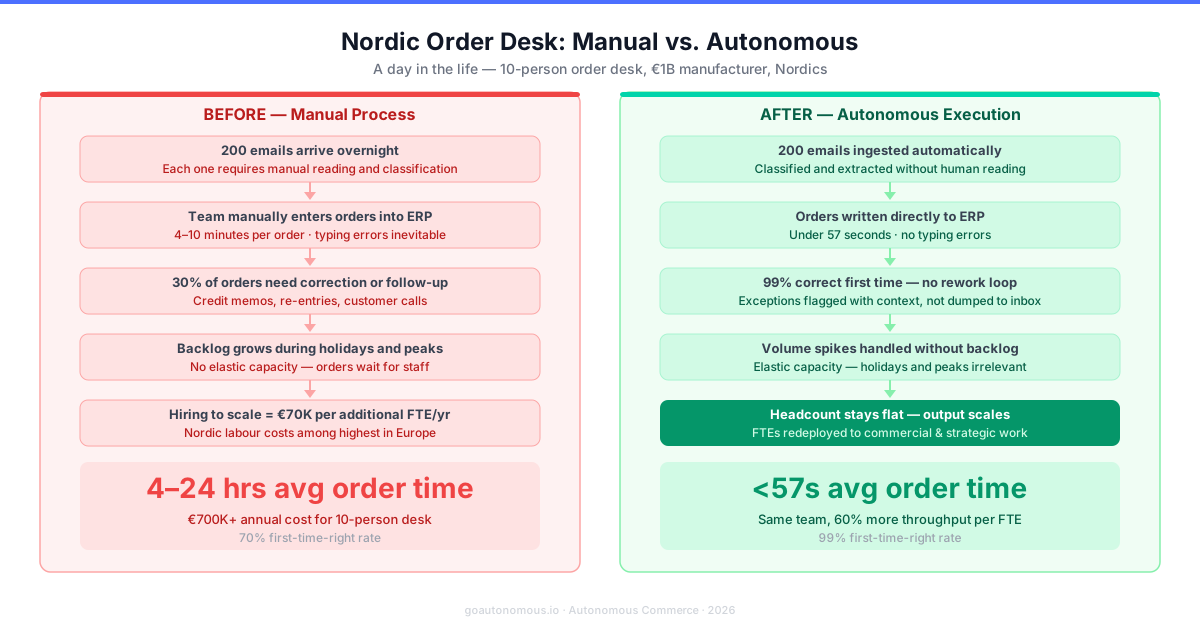
First, customer expectation alignment. B2B buyers increasingly experience consumer-grade digital interactions in their personal purchasing and carry those expectations into their professional procurement. A manufacturer that can confirm a complex industrial order in under a minute, accurately, with full ERP validation, is not merely faster; it is differentiated. Customer retention data from autonomous commerce deployments shows that response speed correlates directly with reorder behaviour, particularly in competitive distribution environments where the same products are available from multiple suppliers.
Second, the talent market is not recovering. The structural constraint on skilled customer operations hiring in the Nordics is not a cycle, it is a demographic reality. Labour force participation rates in the 25–54 cohort are near ceiling in Denmark, Sweden, and Norway. Organisations that delay the transition to autonomous execution are not buying time; they are accumulating operating risk in a headcount-dependent model that will become increasingly fragile. AI-driven B2B operations in the Nordics are a structural response to a structural constraint.
Third, platform maturity is real. The Go Autonomous platform has processed over 30 billion transactions, deployed across organisations operating in 26 countries simultaneously, and is live in some of the most operationally complex B2B environments in Europe. The risk profile of autonomous execution deployment in 2026 is categorically different from what it was three years ago. Early-stage concerns about AI reliability, ERP integration stability, and exception handling completeness have been resolved in production, not in proof-of-concept environments. The five AI lessons for enterprise white paper documents what platform maturity means in practice for organisations evaluating autonomous execution.
See Autonomous Commerce in Action at the 2026 Summit
The Autonomous Commerce Summit 2026 brings together operations and commercial leaders from B2B manufacturing and distribution who are actively transforming how revenue is executed. Hear directly from companies that have made the shift to autonomous execution, and what it means for revenue, cost, and working capital. Attendance is by invitation only.
Request your invitation →
Frequently Asked Questions
Autonomous commerce means that AI agents execute the full order intake, validation, and confirmation cycle end-to-end, without human intervention on routine transactions. For Nordic B2B manufacturers, this translates to order confirmations in under 57 seconds, 99% first-time-right accuracy, and the ability to scale order volume without growing the customer operations headcount. It is not a chatbot or a copilot; it is execution software that replaces the manual processing layer entirely for standard transaction types.
Three structural factors drive early adoption in the Nordics: high labour costs that make headcount-scaling impractical, digital infrastructure maturity (high SAP and Dynamics penetration, strong data governance) that enables faster deployment, and a manufacturing and distribution sector that processes high order volumes with complex product catalogues where manual processing error rates and throughput ceilings create measurable commercial risk. The Nordics also have a cultural track record of early enterprise technology adoption, supported by strong IT organisations and executive buy-in for digital transformation initiatives.
Organisations deploying autonomous commerce typically see outcomes across three dimensions: cost (43% of customer operations capacity released from manual processing), revenue (18% win rate increase from faster quote response, 60% throughput per employee improvement), and accuracy (99% first-time-right orders reducing rework). Working capital benefits from a compressed order-to-cash cycle are an additional dimension that is increasingly included in formal business cases. The specific ROI varies by order volume, average order value, current error rate, and channel mix, a business impact assessment scopes the opportunity for a specific organisation.
The Go Autonomous platform integrates with SAP and Microsoft Dynamics through standard APIs, sitting above the ERP transaction layer rather than modifying it. This means deployment does not require an ERP implementation project. The platform reads from and writes to the ERP’s order management module, handling order intake, validation, and entry, while the ERP remains the system of record for all transaction data. Most Nordic deployments run on SAP S/4HANA or SAP ECC (SD module) or Microsoft Dynamics 365 F&SCM. Integration timelines depend on ERP environment maturity and the complexity of the product and customer master data.
Deployment timelines vary by scope and ERP environment complexity. Danfoss deployed across 26 countries in a single day, an extreme example made possible by mature systems infrastructure and a structured deployment approach. For a mid-size Nordic manufacturer or distributor going live on a primary order channel, initial deployment is typically measured in weeks rather than months. The platform is configured to the organisation’s ERP, product catalogue, customer rules, and exception handling logic before go-live, the deployment scope drives the timeline more than the technology itself.
RPA (Robotic Process Automation) automates fixed, rule-based digital tasks, it mimics what a human does on a screen, following a predetermined script. It breaks when interfaces change and cannot handle variability in input format or content. Autonomous commerce uses AI to interpret intent from unstructured inputs (email text, non-standard order formats, multi-language requests), validate against live ERP data, and execute the appropriate action. It handles variability natively, the core challenge in B2B order processing where the same order arrives in dozens of different formats from different customers. RPA automation rates in B2B order management typically plateau at 30–40% of volume; autonomous execution platforms reach 70–90% because they handle the variability layer.
Go Autonomous publishes case studies and press releases from live Nordic deployments including Danfoss, Nilfisk, Hempel, and Mediq. These cover order management transformation in industrial manufacturing, professional equipment, industrial coatings, and healthcare distribution respectively. The full success cases library at goautonomous.io/success-cases/ documents outcomes across industry types and operational profiles. For organisations evaluating autonomous commerce in their own environment, a business impact assessment maps the specific automation opportunity and expected ROI dimensions.