.svg)





Why Agentic AI Supply Chain Orchestration Falls Short For B2B Commerce Execution
Agentic AI supply chain orchestration is real and valuable. It is not the same as autonomous commerce execution. This post explains the architectural difference, why 85-90% of B2B revenue remains human-facilitated despite orchestration AI investment, and what fills the gap.
Agentic AI supply chain orchestration is advancing quickly, and enterprise investment in it is well-founded. But orchestration solves a different problem from execution. Supply chain AI coordinates what is already inside your planning and procurement systems. It does not read an email from a Danfoss buyer, extract a 47-line order, validate it against live pricing and stock, and write it directly into SAP S/4HANA in 57 seconds. That is Autonomous Commerce execution, and it remains the unaddressed layer across B2B manufacturing and distribution. This post draws the architectural line between the two, explains why 85-90% of B2B revenue is still human-facilitated despite orchestration AI investment, and shows what fills the execution gap.
Table of Content
- What Supply Chain Orchestration Actually Means And What It Leaves Behind
- The Gap Between Orchestrating And Executing B2B Orders
- Where Agentic AI Supply Chain Tools Stop
- What Autonomous Commerce Execution Covers That Orchestration Does Not
- The Business Case: Execution Speed Versus Coordination Overhead
- What B2B Leaders Should Demand From AI In 2026
- Why The Autonomous Commerce Summit 2026 Is Where This Debate Gets Settled
- Sources
- Frequently Asked Questions
What Supply Chain Orchestration Actually Means And What It Leaves Behind
What Is Agentic AI Supply Chain Orchestration?
Agentic AI supply chain orchestration uses autonomous AI agents to coordinate planning, procurement, and logistics decisions across structured enterprise systems. These agents monitor signals, trigger workflows, and replan in real time without human approval at each step. The scope is inventory, demand forecasting, procurement, and logistics coordination. Commercial order execution, meaning reading and confirming customer orders, is outside their scope.
What Orchestration Covers And What It Does Not Touch
The Gartner Magic Quadrant for Supply Chain Planning has tracked this category for over a decade. The use cases are consistent: demand sensing, supplier collaboration, production scheduling, transportation optimization, and inventory rebalancing. These are internal planning workflows. They operate on structured data that already lives inside Oracle, Microsoft Dynamics, or SAP S/4HANA. The data has already been cleaned, normalized, and loaded into the system before orchestration agents ever touch it.
That precondition is critical. Orchestration AI assumes a clean data environment. A Chief Supply Chain Officer investing in orchestration is optimizing a process that already exists in a structured format. That is a legitimate and high-value problem. But it is not the problem that sits at the front of every B2B order intake queue.
The Commercial Execution Layer That Orchestration AI Skips
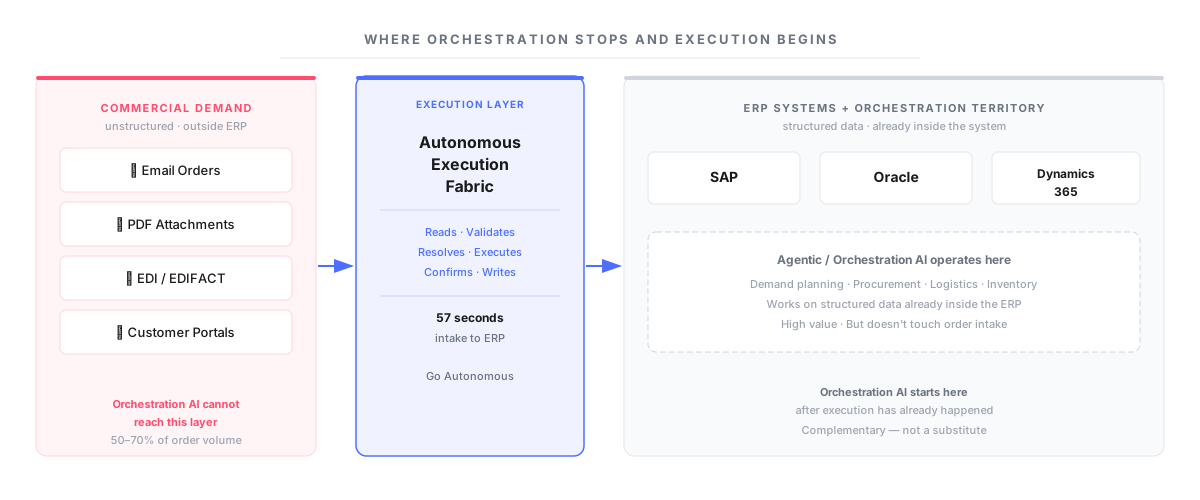
Before any supply chain signal gets processed, a customer order has to enter the system. That entry point is where orchestration AI stops and execution begins. A buyer at a large industrial distributor sends an order by email. The email contains a PDF, a reference number, a free-text note, and a list of part numbers that may or may not match the supplier’s catalog. None of that is structured. None of it is in the ERP. Orchestration AI cannot reach it.
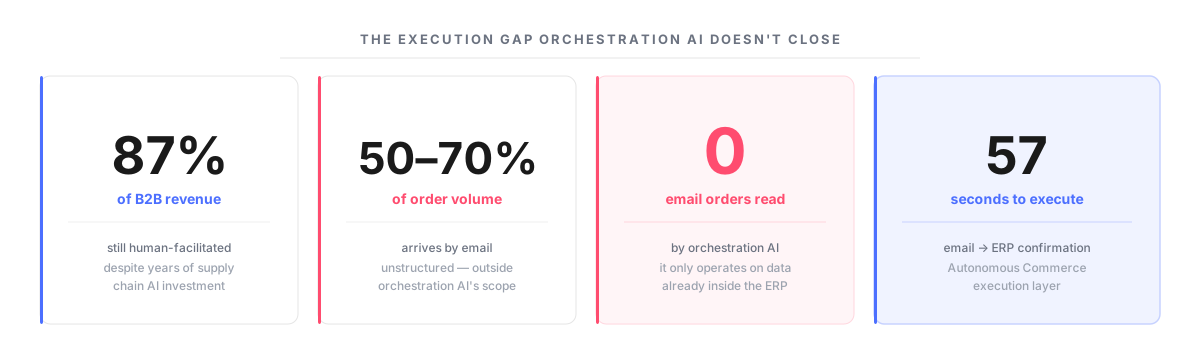
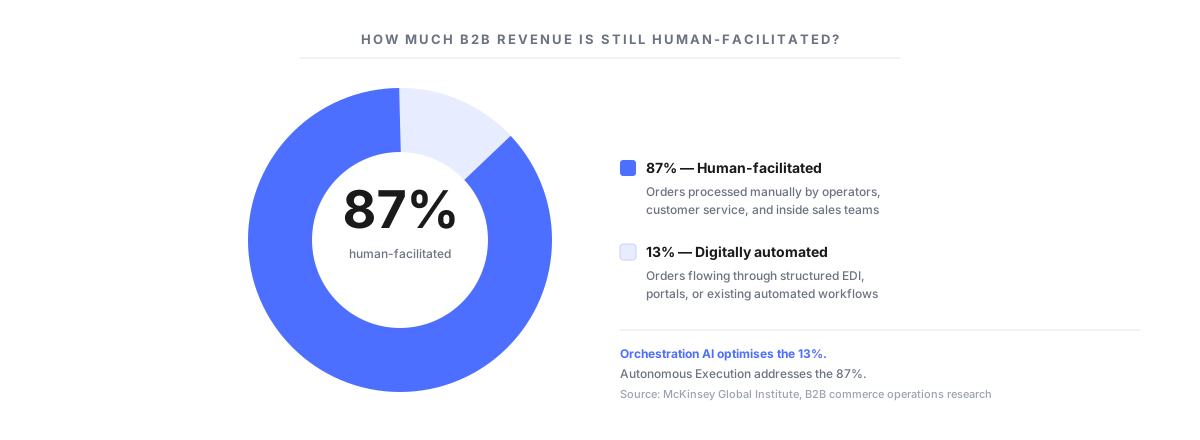
According to McKinsey Global Institute on AI in supply chain, 85-90% of B2B revenue is still executed through human-facilitated processes. That figure holds despite years of supply chain AI investment. The reason is architectural: the investment has gone into optimizing what is already in the system. The intake problem, the commercial last mile, has not been solved by orchestration tools.
The Gap Between Orchestrating And Executing B2B Orders
What Is The Difference Between Supply Chain Orchestration And Order Execution?
Supply chain orchestration coordinates signals and decisions within structured enterprise systems to optimize planning, procurement, and logistics. Order execution reads inbound customer demand in any format, validates it against current pricing and inventory, resolves exceptions, and writes confirmed orders directly into the ERP. Orchestration operates inside the system. Execution operates at the boundary where unstructured commercial demand becomes structured enterprise data.
Why 50-70% Of B2B Order Volume Arrives In Formats Orchestration Cannot Read
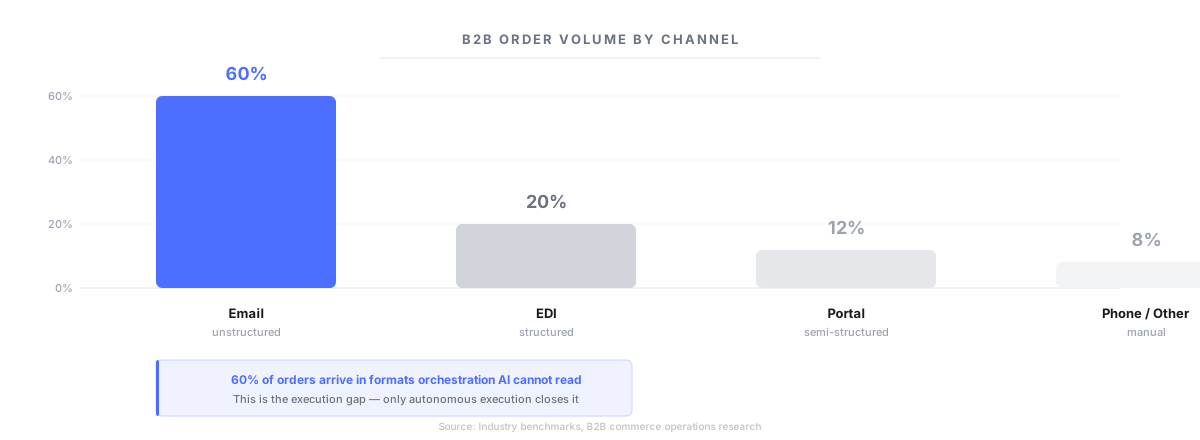
Email remains the dominant channel for B2B orders and quote requests across manufacturing and distribution. Industry benchmarks consistently place email at 50-70% of B2B order and quote volume. This is not a legacy holdover from smaller companies. Large industrial buyers at €500M+ manufacturers send orders by email because the purchasing process involves specification notes, revision references, and pricing queries that do not fit cleanly into EDI 850 or EDIFACT formats.
The result is a structural mismatch. Enterprise software vendors have built increasingly sophisticated orchestration layers on top of structured ERP data. But the commercial demand arriving from customers is still arriving in email inboxes, attached as PDFs, or sent through buyer portals with free-text fields. The Forrester on the future of B2B commerce notes that B2B buyers expect their vendors to handle this complexity without passing it back to the buyer. The burden of format translation sits with the seller. And in most organizations today, that burden sits with a customer service or inside sales team processing orders manually.
What Happens When The Execution Layer Stays Manual
The manual execution layer is expensive and slow. A VP Operations at a mid-size industrial manufacturer will recognize the pattern immediately. The customer service team spends the majority of its time entering orders, resolving discrepancies between what the customer sent and what the system requires, and chasing approvals for exceptions. The order management function is consuming skilled headcount on low-value data entry and format translation work.
The commercial consequences compound over time. Order response time is a competitive metric. When one supplier confirms in minutes and another confirms in hours or days, the faster supplier wins repeat business. Manual execution creates a structural disadvantage in every market where buyers have options. The capacity problem compounds the speed problem: teams that are bottlenecked on order entry cannot handle volume growth without proportional headcount growth. That is an unsustainable operating model.
Where Agentic AI Supply Chain Tools Stop
What Agentic Supply Chain AI Does Well In Planning And Procurement
Agentic supply chain AI has delivered measurable value in planning and procurement workflows. Demand sensing agents can process more signals, react faster to disruptions, and replan with fewer human interventions than rule-based systems. Procurement agents can identify substitution options, trigger RFQ processes, and evaluate supplier responses within defined parameters. These are genuine productivity gains in functions where structured data has always been the norm.
The Deloitte 2025 Global Supply Chain Survey confirms sustained enterprise investment in these capabilities. Planning and procurement have absorbed the majority of AI investment in operations because the data environment is controlled and the use cases are well-defined. That investment is well-placed for those use cases. The problem is not what orchestration AI does. The problem is what it cannot do, and what enterprise buyers sometimes assume it does.
Why The Commercial Last Mile Is A Different Problem
The commercial last mile, from inbound customer demand to confirmed order in the ERP, is architecturally different from the internal coordination problems that orchestration tools solve. The inputs are uncontrolled. Customers send what they send in the format they prefer. The AI system must read email, extract structured order data from PDFs, resolve part number mismatches, validate against live pricing and stock, handle quantity substitutions, and write a confirmed order into the ERP without human intervention. That is not a planning problem. That is an execution problem.
According to IDC on AI in manufacturing market sizing, the commercial execution layer remains significantly underpenetrated by AI investment relative to its revenue impact. The planning and procurement layers have absorbed disproportionate attention because they are easier to instrument. The execution layer is harder. It requires AI that can handle unstructured inputs, resolve exceptions autonomously, and write directly into production ERP environments without a human review step at every exception. That capability set is categorically different from what orchestration tools provide.
What Happens When You Try To Use Orchestration Tools For Order Execution
Organizations that attempt to extend orchestration tools into the execution layer encounter a consistent set of failures. First, the intake problem is not solved. Orchestration tools require structured inputs. Email and PDF orders have to be manually extracted before the tool can process them. The bottleneck moves but does not disappear. Second, exception handling at the commercial layer is fundamentally different from exception handling in procurement. A pricing discrepancy on an inbound customer order requires commercial judgment, not just a replanning signal. Third, direct ERP writeback from an unstructured commercial intake is not an orchestration workflow. It is a transactional execution capability that orchestration platforms were not designed to provide.
The result is a hybrid architecture that still requires human intervention at the most critical point: the moment a customer order enters the system. That is precisely where Autonomous Commerce execution operates. Understanding the distinction between agentic commerce vs autonomous commerce is the foundation for making the right investment decision.
What Autonomous Commerce Execution Covers That Orchestration Does Not
How Does Autonomous Commerce Execution Differ From Supply Chain Orchestration?
Autonomous Commerce execution handles the full commercial intake layer: reading orders in any format, validating them against live ERP data, resolving exceptions autonomously, and confirming orders back to customers with ERP writeback, all without human intervention. Supply chain orchestration handles planning, procurement, and logistics coordination within structured enterprise systems. They solve adjacent problems. Neither replaces the other. But only one addresses the unstructured commercial demand that constitutes 85-90% of human-facilitated B2B revenue.
The Execution Scope: From Email Intake To ERP Confirmation In 57 Seconds
The autonomous commerce platform from Go Autonomous executes the full order intake workflow end-to-end. An order arrives by email, PDF attachment, EDI 850, EDIFACT message, or buyer portal submission. The system reads the input in any format, extracts line items, validates each against live pricing and current stock in SAP S/4HANA, Oracle, or Microsoft Dynamics, resolves part number mismatches and quantity substitutions within defined parameters, and writes a confirmed order directly into the ERP. The customer receives an order confirmation. The process takes 57 seconds. No human touches the transaction.
This is execution, not assistance. The system does not flag the order for a human to approve. It does not draft a response for a customer service agent to review. It executes the order, confirms it, and moves to the next one. That distinction matters because the value of Autonomous Commerce is not in making humans faster. It is in removing humans from the execution loop entirely for the transactions that do not require commercial judgment. That is what autonomous commerce is not automation means in practice.
Agentic Supply Chain Orchestration vs Autonomous Commerce Execution
| Dimension | Agentic Supply Chain Orchestration | Autonomous Commerce Execution |
|---|---|---|
| Primary function | Coordinate planning, procurement, logistics signals | Read, process, and confirm customer orders end-to-end |
| Input requirement | Structured data already in system | Email, PDF, EDI, portal, free-text, any format |
| Commercial execution | Not in scope | Core function |
| ERP writeback | Triggers from clean data | Autonomous direct writeback |
| Order error prevention | Not applicable | 99% first time right |
| Processing speed | Planning cycle time | 57 seconds per order |
| Audience | Supply chain planners, procurement | Order management, customer service, operations |
| Complementary or substitute | Complementary | Different job entirely |
Adopting Autonomous Commerce at Danfoss is not just about speed and efficiency. It's about empowering our customer service teams and sales force to focus on building relationships and providing personalized support.

The Business Case: Execution Speed Versus Coordination Overhead
The ROI Profile Of Orchestration Versus Execution Investment
Supply chain orchestration investments deliver ROI through planning efficiency: better inventory positions, fewer emergency procurement events, lower logistics costs. These are real savings, and they are measurable. The ROI profile is operational. It reduces waste in processes that already work. Execution investment delivers ROI through commercial velocity and capacity expansion. Faster order confirmation means more orders captured before competitors respond. Released capacity means the same team can handle more volume without headcount increases. The ROI profile is commercial and structural.
These are not competing investment cases. A €1B industrial manufacturer benefits from both. But the execution investment has a more direct line to revenue. Order management teams are the bottleneck between customer demand and recognized revenue. Removing that bottleneck produces commercial outcomes that planning efficiency cannot replicate. The autonomous commerce product suite is built specifically for this commercial execution layer, not as a supplement to orchestration but as the solution to the problem orchestration cannot reach.
43% Capacity Released: What Execution-Level Autonomy Produces
When the execution layer operates autonomously, the capacity impact is immediate. Manufacturers running Autonomous Commerce in production report 43% of order management capacity released from routine execution work. That capacity does not disappear. It redeploys to exception handling, customer relationship management, and revenue-generating activities that require human judgment. The team that was processing orders manually is now handling the complex accounts, the large negotiations, and the customer escalations that actually require their expertise.
This is the structural argument for execution-level investment that orchestration tools cannot make. Orchestration makes planning faster and more accurate. Execution removes an entire category of manual labor from the order management function. The scope of the change is different. A Chief Supply Chain Officer comparing the two investments is comparing operational improvement against structural transformation of a core commercial function. See manufacturers running autonomous commerce in production for operational outcomes from live deployments.
18% Win Rate Increase: Why Speed Of Execution Is A Commercial Metric
Order confirmation speed is a commercial metric that most VP Operations teams do not track directly. They track order accuracy, order cycle time, and fulfillment metrics. They do not always track the correlation between response time and win rate. The data from Autonomous Commerce deployments in B2B manufacturing and distribution shows an 18% increase in win rate when execution time drops from hours to seconds. That is a direct commercial consequence of execution speed.
The mechanism is straightforward. In competitive markets where multiple suppliers can fulfill an order, the first confirmation frequently wins the business. A buyer who sends an RFQ to three suppliers and receives a confirmed order from one of them within 57 seconds has a strong incentive to consolidate with that supplier. The other two suppliers are still processing the request manually. The 18% win rate improvement is not a marginal efficiency gain. It is a commercial advantage that compounds across every order that enters the execution layer autonomously. Understanding why order-to-cash automation fails explains why speed alone, without execution accuracy, does not produce these results.
On the biggest orders that we have, we have been able to take out 75% of order handling time. That is phenomenal.

What B2B Leaders Should Demand From AI In 2026
Five Questions That Separate Orchestration Tools From Execution Platforms
When evaluating AI investments in operations and commercial functions, these five questions draw the line between orchestration tools and execution platforms. First: can the system read an inbound email order in any format without a preprocessing step? Second: does the system write confirmed orders directly into the ERP, or does it queue them for human review? Third: what is the exception handling rate, and how are exceptions resolved? Fourth: does the system require structured inputs, or does it handle free-text and PDF natively? Fifth: can the system operate across multiple ERP environments and order channels simultaneously without integration work for each new format?
An orchestration tool will answer no to most of these questions. That is not a failure of the tool. It is a signal that the tool was designed for a different function. An execution platform built for Autonomous Commerce will answer yes to all five. The distinction is architectural, not a matter of configuration or customization.
Why The Most Valuable AI Investment In 2026 Is In The Execution Layer
Enterprise AI investment in 2026 is concentrated in planning, procurement, and internal knowledge management. The execution layer, the commercial intake boundary where customer demand becomes ERP data, remains significantly underinvested relative to its revenue impact. That gap is the strategic opportunity. Organizations that deploy execution-layer AI in 2026 gain a structural advantage that compound over time: faster confirmation, higher win rates, released capacity, and a 99% first time right rate that eliminates rework costs downstream.
The scale of the Go Autonomous network provides additional context: over 30 billion transactions processed across the platform, with live deployments including Danfoss, which processes orders in under 1 minute and went live across 26 countries in a single day. These are not proof-of-concept results. They are production outcomes at enterprise scale. The Welcome to the Era of Autonomous Commerce white paper sets out the strategic case in full.
How Autonomous Commerce And Supply Chain Orchestration Work Together
Autonomous Commerce and supply chain orchestration are not in competition. They operate at different layers of the enterprise and solve different problems. Orchestration manages what happens after an order is in the system: inventory allocation, production scheduling, logistics coordination. Autonomous Commerce manages how the order gets into the system in the first place. When both layers operate autonomously, the result is a fully connected commercial execution environment. Customer demand arrives in any format, enters the ERP in 57 seconds, and immediately triggers the supply chain orchestration workflows that the planning layer is optimized to handle.
The combination removes the manual handoff that currently sits between commercial intake and supply chain execution. That handoff is where cycle time accumulates, where errors enter the system, and where capacity is consumed. Removing it does not require choosing between orchestration and execution. It requires investing in both layers deliberately, with a clear understanding of what each solves.
Why The Autonomous Commerce Summit 2026 Is Where This Debate Gets Settled
The distinction between supply chain orchestration and autonomous commerce execution is one that most enterprise software vendors would prefer you did not ask about. The Autonomous Commerce Summit 2026 brings together operations and commercial leaders from B2B manufacturing and distribution who are asking it directly, in production environments, with real outcomes on the table. If you want to see the execution layer in action, not in a slide deck, this is where that conversation happens. Attendance is by invitation only.
Request your invitation →
Sources
- Gartner: Magic Quadrant for Supply Chain Planning Solutions (2025)
- McKinsey Global Institute: Beyond Automation, How Gen AI Is Reshaping Supply Chains (2024)
- Forrester: FutureProof Your B2B Commerce Strategy to Meet Customers Where They Buy
- Deloitte: 2025 Global Chief Procurement Officer Survey
- IDC: AI in Manufacturing, Market Sizing and Vendor Assessment (2025)
Frequently Asked Questions
Agentic AI supply chain orchestration uses autonomous agents to coordinate planning, procurement, and logistics decisions within structured enterprise systems like SAP S/4HANA or Oracle. It operates on data that is already inside the system. Autonomous Commerce execution handles the commercial intake boundary: reading customer orders in any format, including email, PDF, and EDIFACT, validating them against live ERP data, and writing confirmed orders back to the system without human intervention. They solve different problems at different layers of the enterprise.
Supply chain orchestration AI requires structured data that already exists inside enterprise systems. B2B order execution begins with unstructured inputs: emails, PDF attachments, free-text purchase orders, and EDI formats. Orchestration tools cannot read these inputs natively. They were designed to optimize internal planning and procurement workflows, not to process inbound commercial demand at the intake boundary. The execution problem requires a different architecture.
Industry benchmarks place email at 50-70% of B2B order and quote volume. When PDF attachments, buyer portal submissions with free-text fields, and hybrid EDI formats are included, the majority of B2B commercial demand arrives in formats that require interpretation before they can be processed by structured enterprise systems. This is the intake problem that supply chain orchestration tools are not designed to solve.
The Autonomous Commerce platform reads inbound emails and attachments natively, extracts line-item order data from any format including free-text, PDFs, and EDI 850 or EDIFACT messages, validates each line against live pricing and inventory in the ERP, resolves exceptions within defined parameters, and writes a confirmed order directly into the system. The full process takes 57 seconds and requires no human intervention for standard orders.
Yes. They operate at complementary layers. Autonomous Commerce handles the commercial intake boundary, getting customer demand into the ERP in 57 seconds and in structured form. Supply chain orchestration then coordinates the downstream planning, inventory, and logistics responses to that confirmed demand. When both layers operate autonomously, the manual handoff between commercial intake and supply chain execution is removed, which is where most cycle time and error accumulation occurs.
43% capacity released means that 43% of the working time previously consumed by manual order entry, format translation, and exception routing is freed up when Autonomous Commerce handles routine execution autonomously. That released capacity redeploys to complex account management, large negotiations, exception handling, and customer relationship activities that require human judgment. The order management function transforms from a data entry operation to a commercial execution function.
Enterprise AI investment in B2B operations has concentrated heavily in supply chain planning, procurement, and internal knowledge management. These investments optimize processes that already operate on structured data inside enterprise systems. The commercial intake layer, where customer demand in unstructured formats becomes structured ERP data, has received significantly less AI investment. That is the layer that handles 85-90% of B2B revenue, and it remains primarily manual because orchestration tools were not designed to operate there.