.svg)





Order Reliability AI: Why B2B Manufacturers Need Execution, Not Just Intelligence
Most order reliability AI tells you when an order is wrong after a human has already entered it. That is not reliability. This post explains the difference between order intelligence and order execution, why the gap matters at scale, and what 99% first-time-right actually requires.
Executive Summary: This post is for VP Operations, Chief Supply Chain Officers, and Order Management Directors at B2B manufacturers and distributors who know their order process is broken but have not yet found a solution that actually fixes it. You will learn why order reliability AI that only surfaces insights still leaves humans in the error loop, what execution-first Autonomous Commerce actually does differently, and what 99% first-time-right rate and 57-second order processing look like in a live production environment. If you have invested in automation and still see the same error rates, this post explains why and what to do instead.
Table of Content
- The Order Reliability Crisis In B2B Manufacturing
- What Order Intelligence Gets Wrong
- The Real Cost Of Order Errors At Scale
- What Execution-First Order Reliability AI Looks Like
- 99% First Time Right: How Autonomous Commerce Delivers It
- From 57-Second Orders To Zero Rework: The Execution Stack
- What To Look For In An Order Reliability AI Solution
- See Order Reliability AI In Production At The Autonomous Commerce Summit 2026
- Sources
- Frequently Asked Questions
The Order Reliability Crisis In B2B Manufacturing
Most manufacturers and distributors have invested heavily in automation over the past decade. ERP upgrades, workflow tools, EDI integrations, and AI-powered dashboards have consumed significant budget and project time. And yet, orders still arrive with the wrong part number. Pricing discrepancies still trigger manual review queues. A customer sends a purchase order by email, and three people touch it before it reaches the system. The error rate has not moved. According to Aberdeen Group order accuracy benchmark research, B2B order accuracy problems persist even at companies with mature digital infrastructure. The question is not whether the problem exists. The question is why the tools deployed to fix it have not worked.
What Is Order Reliability AI And Why Does It Matter For Manufacturers?
Order reliability AI is technology that ensures B2B orders are processed correctly, completely, and without human error from receipt through ERP confirmation. It matters for manufacturers because 85 to 90% of B2B revenue is still facilitated by humans, and email accounts for 50 to 70% of order and quote volume, meaning the vast majority of revenue-generating transactions pass through a process that is structurally exposed to error, delay, and rework at every step.
The distinction that determines whether order reliability AI actually works is this: does the system advise humans, or does it execute on their behalf? Advisory AI surfaces flags and recommendations. Execution AI processes the order, validates the data, resolves exceptions, and writes directly to ERP without a human in the loop. Only the second category can deliver consistent reliability at scale.
What Order Errors Cost At Scale In B2B Operations
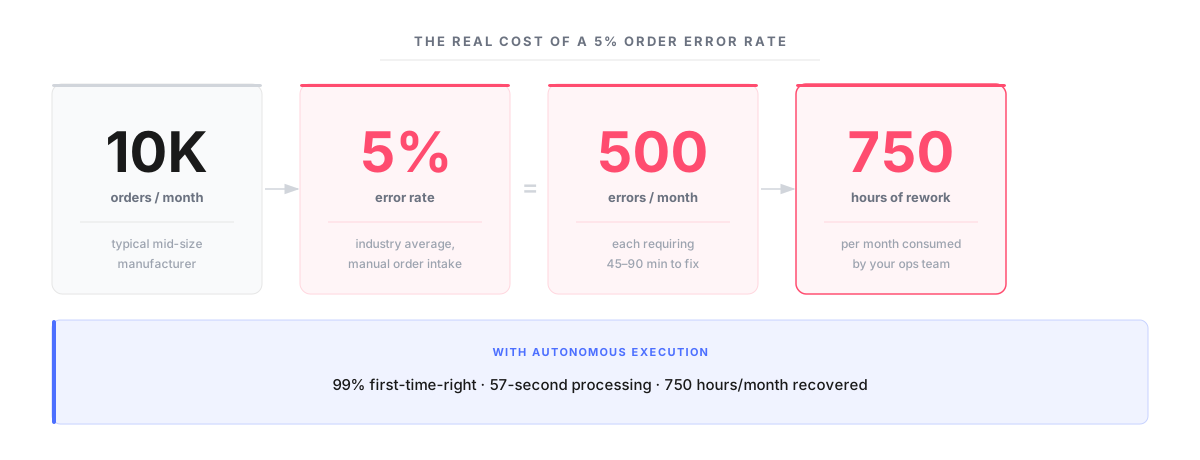
The direct cost of a single order error is straightforward to calculate: rework time, credit note processing, return logistics, and the customer service interaction required to resolve the dispute. In a low-volume operation, these are manageable. At scale, they become structural. A manufacturer processing 10,000 orders per month at a 5% error rate produces 500 errors per month. Each requires an average of 45 to 90 minutes of human intervention across multiple systems. That is 375 to 750 hours of operations capacity consumed monthly by rework alone.
The hidden cost is harder to see but more damaging. According to McKinsey on the cost of manual order processing, companies that rely on manual order handling build teams sized not for growth but for error absorption. Every new revenue target requires proportional headcount to sustain the same error rate. That equation does not scale. It compounds.
Why The Problem Has Persisted Despite Years Of Automation Investment
The reason order reliability problems persist is not a lack of tools. It is a category error in how those tools have been designed. Most automation investments in B2B order management have focused on structured data: EDI 850 and 855 transactions, ERP interface standardization, workflow routing for known exception types. These investments work well inside the boundaries they were built for. But B2B orders do not stay inside those boundaries. They arrive by email in free text. They reference legacy part numbers that require translation. They include pricing that contradicts the current contract. They come from customers who changed their internal purchasing system and whose purchase order format no longer matches the expected template. The automation layer fails at the edge cases, and edge cases in B2B manufacturing are not rare. They are routine.
As Gartner research on order management systems consistently identifies, the gap between what enterprises expect from order automation and what those systems actually deliver in production environments is substantial. The tools that were supposed to fix the problem have instead created a new layer of complexity that still requires human management.
What Order Intelligence Gets Wrong
The market for order management technology has generated a category of products that are often described as AI but function as intelligence layers sitting on top of existing human workflows. These tools monitor, flag, suggest, and report. They do not execute. Understanding the difference between order intelligence and order execution is the most important distinction for any VP Operations evaluating solutions in 2026.
How Does Order Intelligence Differ From Order Execution?
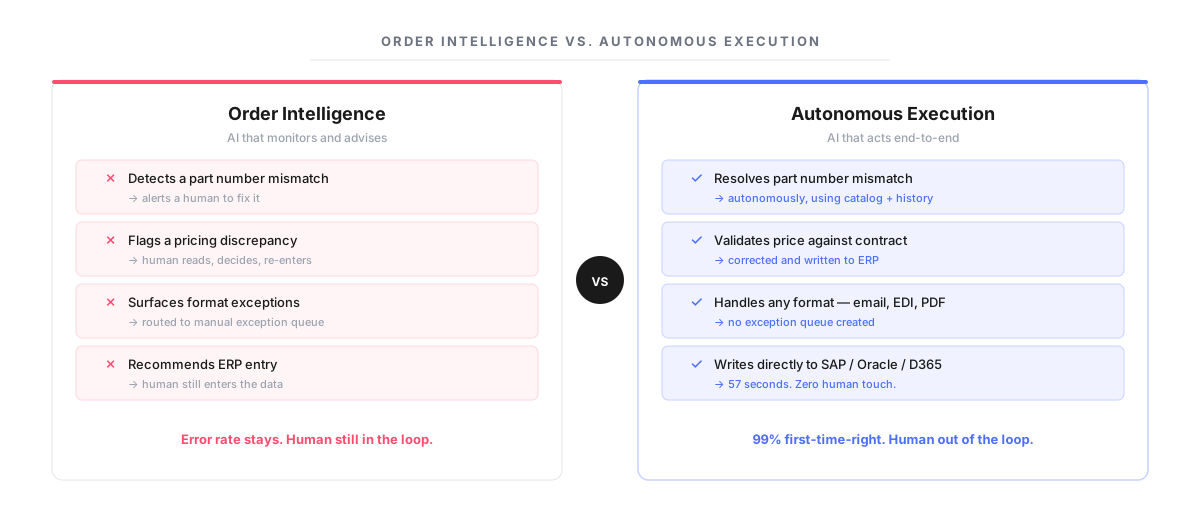
Order intelligence tools detect problems and surface them to humans for resolution. Order execution tools process the order autonomously from intake through ERP confirmation, resolving problems without human involvement. The difference is not incremental. It is categorical. An intelligence tool that flags a part number mismatch still requires a human to correct and resubmit. An execution system resolves the mismatch autonomously using contract data, product catalog matching, and historical precedent, and writes the corrected order to ERP in a single uninterrupted flow.
Why AI That Advises Still Leaves Humans In The Error Loop
Every advisory step in an order process is a point of failure. When an AI system surfaces a recommendation, a human must read it, evaluate it, decide on an action, and execute that action in the system. Each of those micro-steps introduces latency, inconsistency, and error probability. A human following a correct AI recommendation can still enter the wrong data. A human under time pressure may dismiss a flag without fully evaluating it. The advisory model assumes human execution is reliable. The evidence, across thousands of operations, is that it is not.
This is why why order-to-cash automation fails for so many manufacturers is not a technology problem. It is an architecture problem. The tools were built to assist humans, not to replace the human step that generates the errors. As long as the human step remains in the process, the error rate stays with it.
How Autonomous Order Execution Compares To RPA, Workflow Tools, And AI Assistants
RPA (Robotic Process Automation) automates rule-based, structured tasks. It works when inputs are predictable and formats are consistent. B2B order intake is neither. When a customer emails a purchase order in a format RPA was not built to handle, the RPA bot fails and routes to a human exception queue. Workflow tools route documents and assign tasks. They make the human process more organized, not more accurate. AI assistants provide recommendations and natural language interfaces but still depend on human confirmation before any system action takes place.
Autonomous Commerce, the category created by Go Autonomous, operates at a different level. The system reads email, PDF, EDI, portal submissions, and free-text formats. It validates against contracts, product catalogs, and pricing rules. It resolves exceptions autonomously. It writes directly to SAP S/4HANA, Oracle Cloud SCM, Microsoft Dynamics 365, and other ERP systems without requiring human review of the output. The result is an order process where reliability is an outcome of system design, not human diligence.
The Real Cost Of Order Errors At Scale
The finance team can calculate the direct cost of an order error. The operations team lives with the total cost. There is a significant gap between what appears on a line in a cost report and what the full burden of order errors actually does to a manufacturing or distribution operation at scale.
Direct Costs: Rework, Credit Notes, And Returns
Direct error costs fall into three categories. Rework is the labor cost of identifying the error, correcting the order, reprocessing it through the ERP system, and updating the customer. Credit notes are the financial cost of resolving pricing disputes, short shipments, or incorrect items, including the accounts receivable impact of delayed payment while the dispute is open. Returns are the logistical cost of reverse logistics, restocking, and the write-down on goods that cannot be resold in original condition.
Individually, each cost is manageable. Collectively, at volume, they represent a structural drag on margin that most operations teams have come to treat as an unavoidable cost of doing business. It is not unavoidable. It is a consequence of an architecture that has humans processing orders, and it disappears when the architecture changes.
The Hidden Cost: The Operations Team You Scaled To Absorb Errors
The most significant cost of order errors is the team that was built to manage them. In most B2B manufacturing and distribution operations, the customer service and order management team has grown over time in direct proportion to order volume. The assumption embedded in that growth is that each order requires a proportional amount of human attention. That assumption is wrong, but it has become true because the system was designed to require it.
As one VP of Customer Care described the pattern: each time revenue grew by one or two million euros, the team needed another operator. That is the error absorption model made visible. The autonomous commerce platform breaks that equation. When the system executes autonomously, the team is no longer sized for error volume. It is sized for genuine exceptions and strategic customer work.
What 60% Throughput Per Employee Actually Means
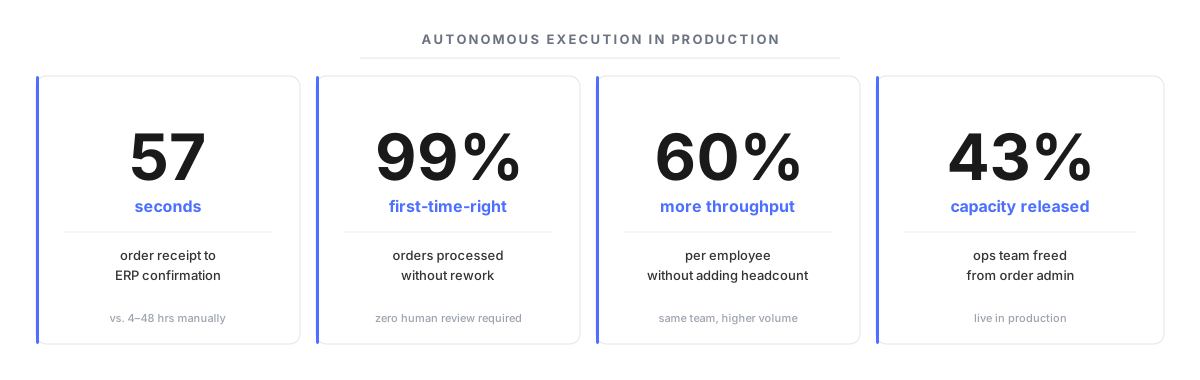
A 60% throughput per employee increase means the same team processes 60% more volume without adding headcount. In a manufacturing operation where order volume is growing and headcount budgets are constrained, that figure represents the difference between scaling commercially and stalling operationally. It also means that when headcount does need to grow, the growth curve is no longer tied to order volume. It is tied to genuine business complexity. That is a fundamentally different cost structure, and it compounds favorably over time as volume continues to grow.
What Execution-First Order Reliability AI Looks Like
Execution-first AI is not a feature. It is an architectural commitment. The system is built from the ground up on the premise that the human step in order processing is the source of error, and therefore the human step must be removed from the process, not assisted or monitored. Understanding what that looks like in practice requires looking at the full execution stack, not just the intake layer.
What Does Execution-First AI Do That Intelligence Tools Cannot?
Execution-first AI reads any format, resolves any standard exception class, validates against live contract and pricing data, and writes the confirmed order to ERP without requiring a human to approve each step. Intelligence tools cannot do this because they were not designed to. They were designed to support human decision-making, which means they require a human in the process. When the goal is 99% first-time-right, that requirement is the obstacle.
The autonomous commerce product suite is built around this execution principle across every touchpoint: orders, quotes, price inquiries, claims, and tender responses. Each module executes, it does not assist.
The Autonomous Commerce Execution Stack From Ingestion To ERP
The execution stack begins at the point of order receipt, regardless of channel. An order arriving by email in free text, a PDF attachment from a customer using a non-standard template, an EDI EDIFACT message, a portal submission, or a manually keyed entry all enter the same ingestion layer. The system extracts structured data from unstructured input using AI trained on B2B commerce document types. It cross-references the extracted data against the customer’s contract, current pricing rules, and product catalog. It identifies discrepancies and resolves them according to predefined resolution logic. It validates the complete order against ERP business rules. It submits the confirmed order directly to the ERP system and returns a confirmation to the customer. That entire sequence takes an average of 57 seconds.
According to Deloitte manufacturing operations AI survey data, end-to-end AI integration across the order lifecycle remains a minority capability in manufacturing. Most implementations stop at the intake or validation layer. The execution layer, where autonomous ERP writeback occurs, is where the reliability gain is realized.
Order Intelligence Tools Vs. Autonomous Execution: A Direct Comparison
| Capability | Order Intelligence Tools | Autonomous Order Execution |
|---|---|---|
| Order intake | Monitors structured inputs | Reads email, PDF, EDI, portal, free-text |
| Error detection | Flags after human entry | Prevents via autonomous validation |
| ERP submission | Human review required | Direct autonomous writeback |
| First time right rate | Depends on human accuracy | 99% in production |
| Exception handling | Surfaces alerts | Resolves autonomously |
| Processing speed | Limited by human speed | 57 seconds average |
| Capacity impact | Marginal reduction | 43% capacity released |
Each time we added one or two million euros in revenue, we had to add another operator. From a cost perspective, that’s an unsustainable way of operating a business.

99% First Time Right: How Autonomous Commerce Delivers It
First-time-right rate is the operational metric that matters most in B2B order processing. It measures the percentage of orders that reach the ERP system correctly on the first submission, without requiring correction, resubmission, credit note, or dispute resolution. Most operations teams know their FTR rate intuitively, even if they do not track it formally. They know it because the error correction workload is constant and familiar. What they may not know is what it takes to reach 99%, and why most tools cannot get there.
What First Time Right Means In B2B Manufacturing Order Processing
First time right in B2B manufacturing order processing means that the order data captured at intake, the pricing applied, the product references resolved, and the ERP record created are all correct without any human intervention to correct errors. A 99% FTR rate at 10,000 orders per month means 100 exceptions per month, not 500 or 1,000. It means the operations team is managing genuine edge cases, not routine data entry errors dressed up as exceptions.
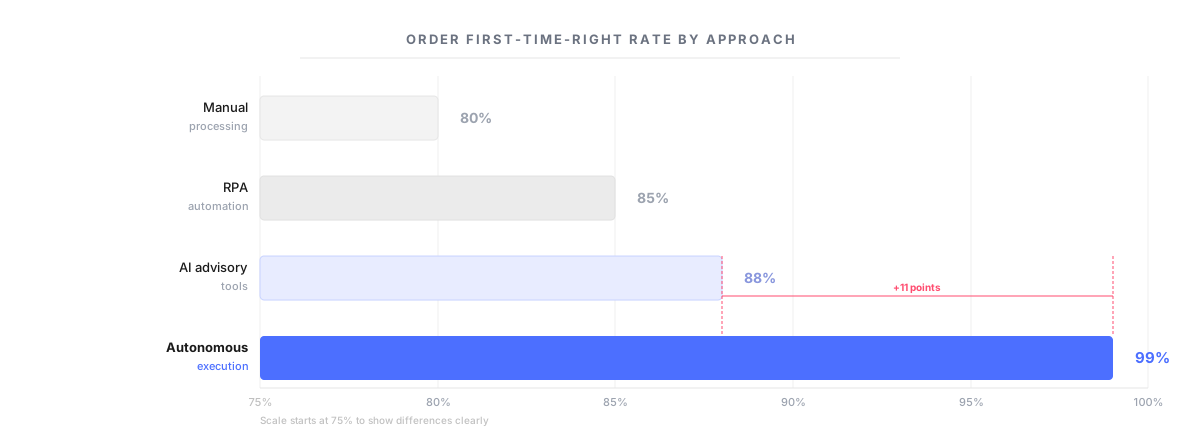
Reaching 99% FTR requires more than better validation. It requires a fundamentally different intake model. Orders must be processed from source, in their original format, with validation applied before ERP entry, not after. The Revolutionizing Order Handling in B2B Commerce white paper details the technical architecture that makes this possible at enterprise scale.
The Iceberg Problem: Why Most Order Reliability Tools Miss The Invisible Complexity
The visible part of an order is a line item with a quantity, a price, and a delivery address. The invisible part is everything the operations team handles to make that line item correct: the customer uses a legacy part number that maps to three current SKUs and the system does not know which one they mean; the price on the purchase order does not match the current contract but is within a tolerance that was agreed verbally six months ago; the delivery address is a new site that was not in the system; the requested delivery date falls on a date when the facility is closed. None of these are unusual. All of them require judgment, context, and system action to resolve.
Most order reliability tools were built to handle the tip of the iceberg: the structured, expected, predictable inputs. The invisible complexity below the waterline is where errors happen, where human time disappears, and where the gap between 85% FTR and 99% FTR actually lives. According to KPMG on AI in B2B customer service operations, the most significant AI-driven improvements in order management come from systems that handle exception complexity autonomously, not systems that route exceptions to humans more efficiently.
How A Leading Industrial Manufacturer Processes Orders In Under One Minute Across 26 Countries
One of the world’s largest industrial manufacturers, a global leader in industrial automation serving customers in over 26 countries, now processes orders in under one minute from receipt to ERP confirmation. That is not a pilot environment result. That is production performance, across a multi-country deployment, live from day one. See the full story in the press release on their autonomous order intake deployment.
What made that result possible was not a better dashboard. It was a system that executes. The manufacturer’s order intake team no longer processes the majority of inbound orders manually. The autonomous system reads the order, validates it, resolves standard exceptions, and confirms to ERP. The team handles the exceptions the system escalates, which are genuinely complex and genuinely require human judgment. The routine work, which was the majority of the workload, has been eliminated from the human queue entirely.
At CWS Hygiene, we’re taking an important first step toward bringing autonomy to our commercial operations. This collaboration reflects our commitment to staying at the forefront of AI, where it actually has an impact.
From 57-Second Orders To Zero Rework: The Execution Stack
The 57-second figure is not a marketing claim. It is a production average across live deployments at enterprise manufacturers and distributors. Understanding what happens in those 57 seconds is the clearest way to see why execution-first architecture produces outcomes that intelligence-first architecture cannot match. In healthcare distribution, a leading European operator has eliminated the manual order handling that previously defined their operations workflow. See their story at the healthcare distribution success case.
What Happens In 57 Seconds From Order Receipt To ERP Confirmation
Second 1 to 8: The order arrives in any format. The ingestion layer reads it and extracts structured data from the unstructured or semi-structured input. An email with a free-text order, a PDF purchase order from a customer template, an EDI 850 transaction, or a portal submission all pass through the same extraction process.
Second 9 to 22: The extracted data is validated against the customer’s contract, current pricing rules, product catalog, and delivery parameters. Discrepancies are identified and routed to the appropriate resolution logic. Part number mismatches are resolved using catalog matching. Pricing discrepancies are evaluated against contract tolerance rules. Missing fields are populated from customer profile data where applicable.
Second 23 to 45: Resolved order data is validated against ERP business rules. The system checks inventory availability, confirms delivery address against approved ship-to locations, verifies credit status, and applies any customer-specific order rules configured in the ERP. Exceptions that cannot be autonomously resolved are escalated to a human queue with full context.
Second 46 to 57: The confirmed order is written directly to the ERP system. An order acknowledgment is generated and returned to the customer. The transaction is logged. The process is complete.
The Rework Elimination Math: 99% FTR At Volume
At 10,000 orders per month, the difference between 90% FTR and 99% FTR is 900 fewer error corrections per month. At an average resolution time of 45 minutes per error, that is 675 hours of operations capacity recovered monthly. At a fully loaded cost of €50 per hour for an operations specialist, that is €33,750 per month in direct labor cost recovered, before accounting for the indirect costs of customer disputes, delayed payments, and return processing. The math compounds. As volume grows, the gap between 90% and 99% FTR grows with it. The operation that runs at 90% FTR at 10,000 orders per month is running a structurally different cost model than the operation that runs at 99% FTR, and that gap widens every quarter.
What 43% Capacity Released Means For Your Operations Team
A 43% capacity release does not mean reducing headcount by 43%. It means that 43% of the team’s current time is being redirected from manual order processing to work that generates more value: complex customer relationships, strategic account management, process improvement, exception resolution for genuinely complex cases. In operations environments where finding and retaining qualified order management staff is a persistent challenge, that capacity release is also a retention lever. The work becomes more varied, more judgment-intensive, and more professionally rewarding. That matters in the labor market that most manufacturers and distributors operate in today.
Reviewing B2B order management software options through the lens of capacity impact, not just feature sets, is how the best operations teams are evaluating solutions in 2026. Features are table stakes. Capacity outcomes are the measure of whether a solution actually works.
What To Look For In An Order Reliability AI Solution
The market for order management AI is crowded and noisy. Every vendor claims reliability. Every demo is designed to show the system working under ideal conditions. Evaluating solutions effectively requires asking questions that the demo environment cannot fake, because the answers require evidence from production deployments at comparable scale and complexity.
Seven Questions To Ask Every Vendor Before The Demo
1. What is your production first-time-right rate at enterprise scale? Not the rate in a controlled environment. Not the rate after a two-year implementation. The rate in production, at enterprise volume, in the first year of live deployment.
2. Can you show me a live production environment at a company in my industry and at my volume? References are not enough. Ask to see the system running live. Vendors who cannot show this have not deployed it at that scale.
3. What percentage of orders require human review in your production deployments? The answer reveals whether the system executes or assists. If more than 10% require human review in a mature deployment, the system is an intelligence layer, not an execution layer.
4. How does the system handle orders that do not match your expected input format? Free-text email, non-standard PDF templates, and legacy EDI formats are the norm in B2B manufacturing. If the answer is that those go to an exception queue, the system has not solved the core problem.
5. What is the time from contract signature to live order processing? Long implementation timelines indicate a system that requires extensive configuration to handle the complexity of your specific environment. That complexity is what makes order processing difficult in the first place, and a system that requires you to simplify your environment to use it has the relationship backwards.
6. How does the system integrate with SAP S/4HANA or Oracle Cloud SCM? ERP integration is where order reliability is ultimately realized. A system that processes orders accurately but requires a human to enter them into ERP has solved the wrong half of the problem.
7. What does your service model look like after go-live? Order volumes change. Customer behavior changes. Product catalogs change. A system that was configured for your environment at go-live but requires expensive professional services to adapt to changes is a system that will degrade over time.
Why Production Proof Matters More Than Demo Performance
Demo environments are curated. They show the system processing a clean purchase order from a customer whose data is perfectly structured, in a format the system was built to handle, with no edge cases, no contract complexity, and no history of exceptions. Production environments are none of those things. The gap between demo performance and production performance in order management AI is significant, and it is the gap that operations teams discover after signature, when the project is already committed.
The only evidence that matters is what the system does in production, at volume, in an environment that resembles yours. That is the standard that separates genuine execution capability from a well-designed demonstration. Go Autonomous processes over 30 billion transactions globally, which means there is substantial production evidence available. Ask for it.
How To Evaluate First Time Right Rate In A Real Deployment
Evaluating FTR rate in a real deployment requires clarity on what counts as first time right. Some vendors count an order as first time right if it reaches ERP without a system error, even if the data it contains is incorrect and requires manual correction afterward. Others count it only if the order is confirmed by the customer without any dispute. The most meaningful definition is the strictest one: the order was processed correctly, completely, and without human intervention from receipt through ERP confirmation, and the customer did not raise a discrepancy.
Ask vendors for their FTR rate under this strict definition, at a reference customer in a comparable industry, audited over a minimum of six months of production operation. If they cannot provide this, they have not demonstrated reliability. They have demonstrated that the system works in conditions they control. Reliability means it works in conditions your customers create.
See Order Reliability AI In Production At The Autonomous Commerce Summit 2026
The Autonomous Commerce Summit 2026 brings together VP Operations, Chief Supply Chain Officers, and Order Management Directors from B2B manufacturing and distribution who are actively closing the gap between order intelligence and order execution. If you want to see what 99% first time right and 57-second order processing look like in live production environments, not in a vendor demo, this is where that conversation happens. Attendance is by invitation only.
Request your invitation →
Sources
- Gartner: Market Guide for Distributed Order Management Systems (2025)
- McKinsey & Company: Human + Machine, A New Era of Automation in Manufacturing
- Deloitte: 2025 Smart Manufacturing and Operations Survey
- KPMG: Global Customer Experience Excellence Report 2024–2025
- Aberdeen Group: Supply Chain and Order Management Benchmark Research
- Go Autonomous: Revolutionizing Order Handling in B2B Commerce (White Paper)
Frequently Asked Questions
Order reliability AI is technology that ensures B2B orders are processed correctly and completely from receipt through ERP confirmation. It differs from traditional order automation in that it handles unstructured inputs like email and PDF, resolves exceptions autonomously, and writes directly to ERP without requiring human review. Traditional automation handles structured, predictable inputs and fails at the edge cases that represent the majority of real-world order complexity.
B2B order errors persist after automation investment because most tools were designed to assist humans rather than replace the human step that generates errors. RPA and workflow tools handle structured, predictable inputs but fail when orders arrive in non-standard formats. AI advisory tools surface flags but still require human action to resolve them. As long as humans remain in the execution loop, the error rate stays with them.
99% first time right means that 99 out of every 100 orders are processed correctly, completely, and without human intervention from receipt through ERP confirmation, with no subsequent customer dispute. At 10,000 orders per month, 99% FTR means 100 exceptions per month versus 1,000 at 90% FTR. That difference represents hundreds of hours of operations capacity and significant direct cost savings.
Autonomous order execution achieves 57-second order processing by handling all steps in a single uninterrupted automated flow: intake from any format, data extraction and structuring, validation against contracts and product catalogs, exception resolution using predefined logic, ERP business rule validation, and direct ERP writeback with customer confirmation. No human review step is required in the standard flow, which eliminates the latency that human processing introduces.
Yes. Autonomous Commerce execution platforms integrate directly with SAP S/4HANA, Oracle Cloud SCM, Microsoft Dynamics 365, and other major ERP systems. The integration enables direct autonomous writeback, meaning the system confirms orders directly into ERP without requiring a human to enter or approve the data. ERP integration is where order reliability is ultimately realized, and any solution that does not include direct ERP writeback has not solved the full problem.
Order intelligence tools detect problems and surface them to humans for resolution. Autonomous order execution processes orders without human involvement from intake through ERP confirmation. The key difference is that intelligence tools keep humans in the error loop by requiring human action to resolve every flag, while autonomous execution removes humans from routine processing entirely and only escalates genuine exceptions that require human judgment.
Manufacturers deploying autonomous order execution recover an average of 43% of their order management team’s capacity. At 10,000 orders per month, moving from 90% to 99% first-time-right eliminates approximately 675 hours of error correction work per month. That capacity can be redirected to complex customer relationships, strategic account management, and exception resolution for genuinely complex cases, rather than routine data correction.