.svg)





B2B Tender and RFQ Automation: How Autonomous Commerce Handles What CPQ and ERP Can’t
RFQ and tender workflows are the most complex and costly transactions in B2B commerce — and the tools most manufacturers rely on, CPQ and ERP, were never built to handle them. This post explains why autonomous commerce closes the gap, and what end-to-end RFQ automation looks like in practice.
For most B2B manufacturers and distributors, RFQ and tender workflows represent the highest-value, highest-risk transactions in their entire commercial operation. They also represent the transactions most likely to be handled by a combination of inbox monitoring, spreadsheet tracking, and manual follow-up calls, because the tools that were supposed to solve this problem never quite did. CPQ was built for outbound quoting. ERP was built for confirmed order processing. Neither was designed for the unstructured, multi-round, deadline-driven reality of request for quote automation in manufacturing. Autonomous Commerce is. This post explains where the gap is, why it matters commercially, and how purpose-built RFQ automation closes it end to end.
Table of Content
- The RFQ Problem in B2B Manufacturing and Distribution
- Where CPQ and ERP Stop Short of Real RFQ Automation
- How Autonomous Commerce Handles RFQ and Tender Workflows End to End
- The Sectors Where RFQ Automation Matters Most
- Measuring the Commercial Impact of RFQ Automation
- Integration, Implementation, and What to Expect
- Frequently Asked Questions
- See Autonomous Commerce in Action at the 2026 Summit
The RFQ Problem in B2B Manufacturing and Distribution
B2B tender management is not a niche edge case. In sectors like aviation MRO, electrical components distribution, and specialty chemicals, RFQ volume can represent the majority of commercial activity, and missing a response deadline or losing track of a revision round does not just affect a single transaction. It affects a relationship, a contract renewal, and a customer’s willingness to include you in future tender rounds. The commercial stakes are high, the operational complexity is real, and the tools most organizations have in place were simply not designed for this type of workflow.
Why RFQ Automation Is Harder Than Standard Order Automation
A standard sales order arrives with a known part number, an agreed price, and a clear quantity. The ERP processes it. The challenge with request for quote automation is categorically different. An RFQ arrives with uncertainty baked in at every level, uncertain parts matches, uncertain pricing, uncertain timeline, and often uncertain scope. Handling it requires intelligence, not just throughput.
Here is what makes automated RFQ response structurally harder than order processing:
- Multi-round communication loops: A typical RFQ does not resolve in one exchange. It begins with an initial request, generates clarification questions, triggers a revised quote, and may go through multiple negotiation rounds before acceptance or rejection. Each round arrives via a different channel, email, PDF attachment, EDI message, or customer portal, and must be correlated back to the original request.
- Partial and non-standard parts matching: Customer parts lists rarely use your catalog numbers. Aviation MRO buyers send AOG (aircraft on ground) requests with OEM part numbers, cross-references, and free-text descriptions. Electrical components distributors receive spreadsheets with manufacturer part numbers that may have equivalents, superseded variants, or substitution options that must be evaluated.
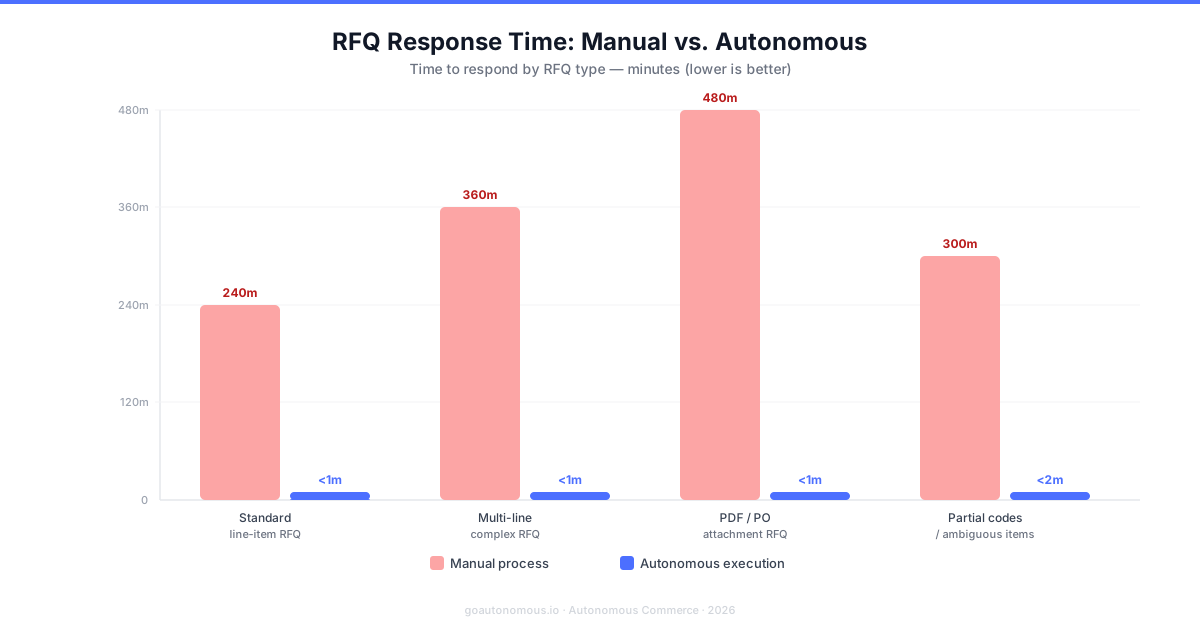
- Tight response deadlines with no margin: RFQ response windows of 24 to 48 hours are common in aerospace and MRO. Missing the window does not mean a delayed transaction, it means you are removed from the tender round entirely. Intelligent RFQ processing must be fast enough to meet these windows even when volume spikes.
- Complex customer-specific pricing logic: Unlike standard orders that apply contracted pricing, RFQ responses often involve custom price calculation, based on volume, urgency premium, availability, margin targets, and customer tier. This logic cannot be hardcoded into ERP price lists and is too nuanced for standard CPQ product rules.
- Multi-party internal approval: High-value tenders require approval from sales management, finance, or product management before a quote is issued. Routing these approvals manually through email chains is a primary source of delay and missed deadlines.
- Unstructured intake formats: Unlike EDI orders that arrive in a defined schema, RFQs come in as free-text emails, scanned PDF forms, Word documents with customer letterhead, and spreadsheet attachments, sometimes all in the same request. Autonomous RFQ management must read and interpret all of these without human intervention.
Taken together, these factors mean that even a relatively well-run B2B sales operation is spending significant human capacity managing RFQ workflows that could, and should, be executed automatically. Research from the Hackett Group consistently shows that best-in-class procurement and order management organizations spend a fraction of the labor hours on transactional processing compared to their peers, precisely because they have removed the manual bottlenecks from structured intake workflows. RFQ automation is the last major frontier where most manufacturers have not yet made that shift.
The Scale of the Unstructured Intake Problem
Email remains the dominant channel for B2B order and quote intake, accounting for an estimated 50 to 70 percent of B2B order and quote volume across manufacturing and distribution sectors. For RFQs specifically, the proportion is even higher, because RFQs by their nature resist the structured EDI or portal workflows that handle simpler order types. A buyer sending a complex 200-line tender document is not going to type it into your supplier portal. They are going to send it as a PDF or a spreadsheet attached to an email, and that email is going to land in someone’s inbox, where it waits for a human to open it, parse it, check stock and pricing, and compose a response.
At scale, this is not a workflow. It is a bottleneck. A €500M+ manufacturer processing hundreds of RFQs per week across multiple sales territories is effectively running its highest-value commercial transactions through the least efficient possible channel. The commercial cost is not just labor, it is missed deadlines, slow response times that cost win rates, and the opportunity cost of skilled sales staff spending their time on data entry rather than relationship management and deal strategy.
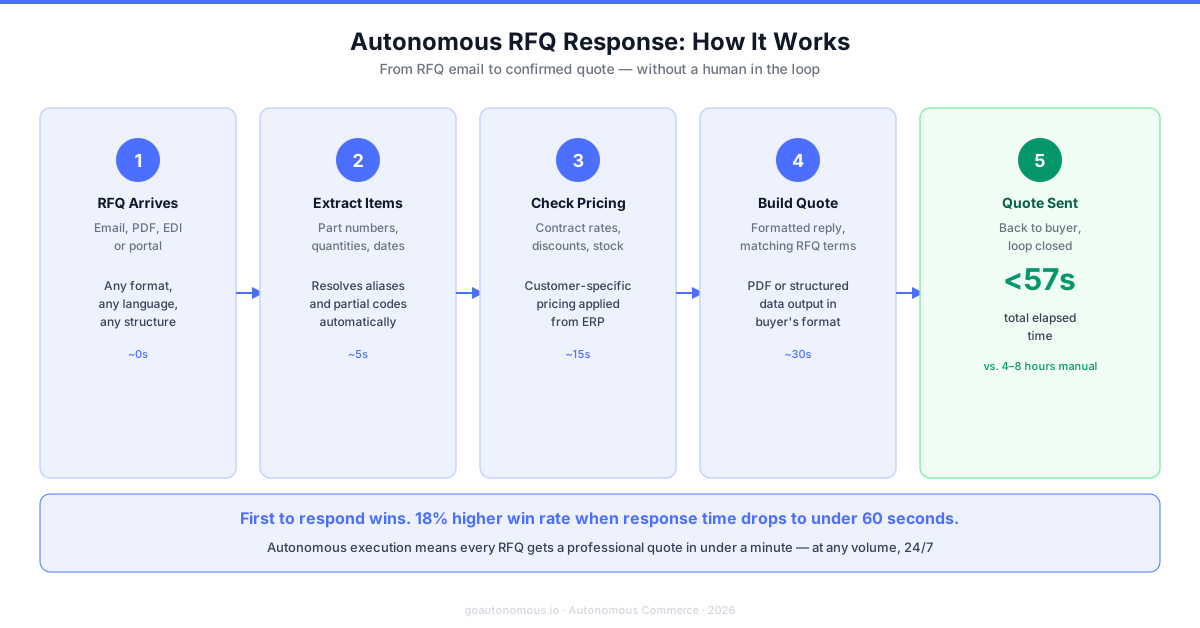
According to industry benchmarks, 85 to 90 percent of B2B revenue remains human-facilitated, which means that for most manufacturers, automating even a substantial portion of the RFQ workflow represents one of the largest available levers for improving commercial capacity and win rates simultaneously. That is the core commercial case for B2B tender automation.
Each time we added one or two million euros in revenue, we had to add another operator. From a cost perspective, that's an unsustainable way of operating a business.

Where CPQ and ERP Stop Short of Real RFQ Automation
The first question most commercial and operations leaders ask when RFQ automation comes up is: “Can’t our CPQ do this?” or “Shouldn’t the ERP handle it?” These are reasonable questions, both systems are expensive, deeply embedded, and theoretically connected to the pricing and inventory data needed to respond to an RFQ. But neither system was designed for the problem at hand, and understanding exactly where they stop short is essential to understanding why autonomous commerce fills the gap rather than competing with either tool.
Why CPQ Was Not Built for Inbound RFQ Processing
CPQ, Configure, Price, Quote, is an outbound quoting tool. It was designed to help sales reps build accurate quotes for customers by guiding them through product configuration, pricing rules, and approval workflows. The CPQ process begins with a human sales rep who has already decided to create a quote. They open the CPQ system, select products, configure options, and the system generates a formatted quote document.
An inbound RFQ inverts this entire model. The request arrives first, from the customer, in the customer’s format, using the customer’s part numbers and terminology. The supplier’s system must interpret the request, map it to catalog items, calculate pricing, and generate a response. CPQ has no intake layer. It cannot read an email. It cannot parse a PDF. It cannot match customer part numbers to internal catalog entries. It cannot initiate a response workflow unless a human manually enters the request into the system first. That manual entry step is precisely the bottleneck that automated RFQ response is designed to eliminate.
CPQ also typically lacks the multi-round state management that RFQ workflows require. When a customer responds to your initial quote with a counter-proposal, revised quantities, substitution requests, or price negotiation, CPQ has no native mechanism to correlate the incoming response to the original quote, update the workflow state, and route the revision appropriately. That correlation happens manually, in a sales rep’s inbox, which is again exactly where autonomous RFQ management aims to operate.
Why ERP Was Not Built for Pre-Confirmation RFQ Workflows
ERP systems are built around confirmed transactions. The moment a customer submits a purchase order, the ERP has a role: stock reservation, fulfillment scheduling, invoicing, and delivery tracking. Before that confirmation, during the RFQ and tender phase, the ERP’s role is largely passive. It can provide pricing data and availability lookups, but it cannot orchestrate the pre-confirmation workflow.
For B2B tender management automation beyond ERP, the critical gap is exactly this pre-confirmation phase. The RFQ arrives, must be interpreted, matched, priced, approved, and responded to, all before the ERP’s transaction logic is relevant. Organizations that try to use the ERP as an RFQ management tool typically end up creating manual workarounds: creating sales quotation records in the ERP for every incoming RFQ (high administrative overhead), or bypassing the ERP entirely and managing RFQs in email and spreadsheets (no visibility, no SLA tracking, no data).
Neither approach scales. And neither approach gives commercial leadership the visibility they need to understand win rates by customer segment, response time performance by product category, or the distribution of RFQ complexity that determines staffing requirements. That analytics gap, addressed by tools like Decision Analytics within the Autonomous Commerce platform, is as significant as the operational bottleneck itself.
How Autonomous Commerce Handles RFQ and Tender Workflows End to End
Autonomous Commerce is not a layer on top of CPQ or ERP. It is an execution fabric that operates across the entire pre-confirmation commercial workflow, reading requests from wherever they arrive, executing the logic required to generate a compliant response, and routing exceptions to humans only when genuine human judgment is required. For autonomous RFQ handling for large B2B enterprises, this means a fundamentally different operational model: the system handles the standard cases at machine speed, and humans focus on the exceptions that genuinely require their attention.
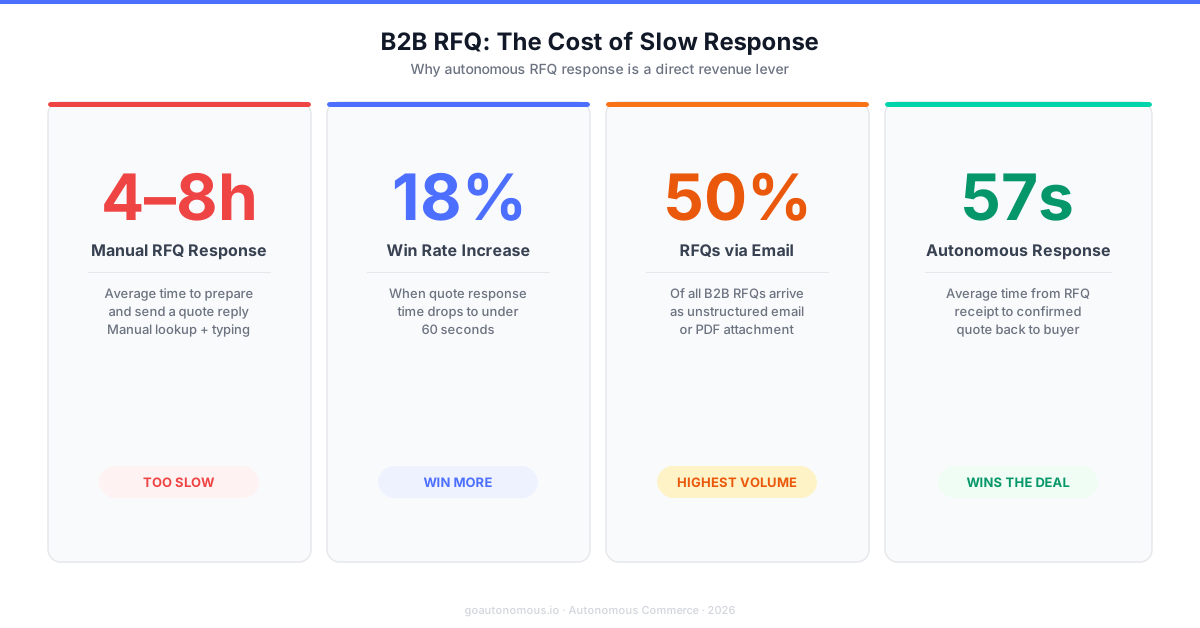
Here is how intelligent RFQ processing works in practice, from initial receipt to confirmed response:
- Intake and classification: The RFQ arrives via email, EDI, PDF, customer portal, or API. The Autonomous Commerce platform reads the incoming request regardless of format, classifies it as an RFQ (versus a standard order, price inquiry, or claims document), and initiates the appropriate workflow. For email-based RFQs, the dominant intake channel, this means reading the email body and any attachments, extracting structured data from unstructured text, and creating a traceable workflow record. The RFQ and Quote Automation use case is built for exactly this intake complexity.
- Parts matching and catalog resolution: Customer line items are matched to the internal product catalog using a combination of exact part number matching, cross-reference databases, and semantic similarity matching for free-text descriptions. Partial matches, superseded part numbers, and substitution candidates are flagged with confidence scores rather than silently accepted or rejected. For aviation MRO buyers sending AOG requests with multiple OEM cross-references, this step alone can eliminate hours of manual lookup work per request.
- Pricing and availability calculation: Once line items are resolved, the platform executes pricing logic against current inventory positions, customer-specific contracted rates, volume thresholds, urgency premiums, and margin rules. This is not a static price list lookup, it is dynamic execution of the same logic a skilled inside sales rep would apply, but at machine speed and with complete consistency. Price inquiry automation for standard items is addressed through the dedicated Price Inquiry Automation workflow.
- Compliance and format validation: The generated quote response is validated against any customer-specific formatting requirements, regulatory compliance fields (particularly relevant in aerospace, where airworthiness documentation and traceability requirements attach to parts responses), and internal approval thresholds. Responses that meet all criteria are prepared for issue. Responses that require exception handling, items below minimum margin, customer-requested substitutions, or lines where availability is uncertain, are routed to the appropriate human reviewer with full context.
- Approval routing for exceptions: Rather than routing every RFQ through a human approval queue (which eliminates the speed benefit of automation), the platform applies intelligent exception logic. Only the responses that genuinely require human input are escalated, and they are escalated with full context: the original request, the proposed response, the specific lines that triggered the exception, and the recommended action. This is what makes Pulse, the real-time monitoring layer, commercially valuable: operations teams see exactly what is automated, what is in exception, and why.
- Response generation and dispatch: Approved responses are formatted in the customer’s preferred format and dispatched through the appropriate channel, email reply, EDI acknowledgment, or portal submission. Response timestamps, line-item details, and delivery commitments are logged for SLA tracking and performance analytics.
- Multi-round tracking and correlation: When the customer responds to the initial quote, with a revision request, a partial acceptance, or a counter-proposal, the platform correlates the incoming communication to the original workflow record, updates the state, and initiates the appropriate next step. This multi-round state management is one of the most technically distinctive aspects of autonomous commerce for complex RFQ workflows, and it is precisely what CPQ and ERP cannot provide natively.
- Conversion to confirmed order: When the RFQ resolves to acceptance, the confirmed order is passed downstream to the ERP for fulfillment processing. The transition from pre-confirmation to confirmed is seamless, and the ERP receives a clean, structured order record without manual re-entry. This integration, including native connectors to SAP, Oracle, Microsoft Dynamics, and Infor, is a core capability of the Autonomous Commerce platform.
The end-to-end flow described above is not theoretical. It is running in production at manufacturers and distributors processing thousands of RFQ line items per day. The commercial results, including a documented 18 percent increase in win rate and 43 percent of commercial capacity released from transactional processing, reflect what becomes possible when the bottleneck of manual RFQ handling is removed from the workflow entirely. For a broader view of how this execution model performs across order types, the Revolutionizing Order Handling in B2B Commerce white paper provides detailed analysis of the operational and commercial impact.
The Sectors Where RFQ Automation Matters Most
While tender processing manufacturing is a challenge across virtually every B2B sector, certain industries carry a disproportionate concentration of RFQ complexity, both in terms of transaction volume and the technical difficulty of each individual request. These are the sectors where the cost of manual RFQ handling is highest, and where AI-powered RFQ processing in manufacturing delivers the clearest commercial return.
For Aviation and Aerospace Distributors
Aviation MRO (Maintenance, Repair and Overhaul) procurement is one of the most demanding RFQ environments in any industry. AOG (Aircraft on Ground) situations create emergency procurement requests with response windows measured in hours, not days. Parts traceability requirements, airworthiness certificates, batch records, dual-release documentation, attach to every line item in a compliant aerospace quote response. And the parts lists themselves are notoriously complex: OEM part numbers, manufacturer cross-references, alternate part authorities, and repair agency certifications all need to be evaluated as part of the quoting process.
A leading aerospace MRO distributor processing thousands of line items per day across multiple customer accounts cannot afford to treat each request as a manual task. The volume alone makes manual processing economically unviable; the deadline pressure makes it commercially catastrophic. Go Autonomous has documented the specific dynamics of aviation commerce in depth, both the operational noise created by high-volume unstructured intake and the transformation that autonomous quote and order handling enables. The The Noise Crisis in Aviation Commerce white paper details how aviation MRO distributors are managing this challenge, and the Transforming Aviation Operations white paper provides the operational transformation framework.
For aviation distributors specifically, the ROI case for automated RFQ response for B2B manufacturers is compelling: every AOG request that is processed in minutes rather than hours is a potential customer retained, a relationship deepened, and a contract renewal secured. The blog post on Transforming Aviation Operations: The Impact of Autonomous Quote and Order Handling explores this in further detail, and the Aerospace Xelerated press release highlights Go Autonomous’s growing footprint in the aerospace sector.
For organizations still evaluating the relevance of channel modernization to aviation procurement, the question of EDI is worth addressing directly. Many aviation MRO networks still rely heavily on legacy EDI connections that were designed for a simpler transaction environment. As explored in Is It Finally Time for EDI to Face Its Extinction?, the limitations of EDI-only approaches to B2B transaction processing are becoming increasingly apparent as the complexity and volume of RFQ workflows grow beyond what EDI schemas were designed to handle.
For Electrical Components Manufacturers and Distributors
The electrical components sector is characterized by enormous product catalog depth, frequent supersession and cross-reference complexity, and a customer base, panel builders, OEMs, system integrators, that sources from multiple suppliers simultaneously and awards business based on a combination of price, availability, and response speed. RFQ automation for electrical components distributors is not a future capability consideration, it is a current competitive differentiator.
A €500M+ electrical components distributor receiving hundreds of RFQs per week faces a fundamental capacity problem. Each RFQ may contain dozens or hundreds of line items, each of which requires a part number lookup, an availability check, a pricing calculation, and potentially a cross-reference evaluation if the requested part is superseded or out of stock. Multiplied across a large customer base, this represents tens of thousands of individual data lookups per week, all of which, under a manual model, require human attention.
The Autonomous Commerce platform’s approach to this sector is built around the Autonomous Commerce for Electronic Component Distributors capability, which addresses the full catalog complexity of electrical distribution, from standard catalog items to configured assemblies and customer-specific part number mappings. When the system processes an RFQ with 200 line items in seconds rather than hours, the commercial impact is immediate and measurable: faster response times, higher first-time-right rates, and sales staff freed to focus on customer relationships rather than data entry.
For Chemical and Specialty Materials Distributors
Chemical manufacturing and specialty materials distribution adds a further layer of complexity to RFQ processing: regulatory documentation. Every quote response in a regulated chemical context may need to include or reference Safety Data Sheets, compliance certifications, import/export documentation, and hazardous materials handling requirements. These documentation requirements vary by customer, by destination market, and by product category, and they cannot be omitted from a compliant tender response without risk of rejection or regulatory exposure.
For tender automation for industrial distributors operating in the chemical sector, autonomous commerce handles this documentation complexity as part of the standard quote generation workflow, not as a manual add-on step. The Autonomous Commerce for Chemical Manufacturers capability is built around the compliance and documentation requirements specific to this sector, ensuring that automated quote responses meet the same compliance standards as manually produced ones.
The commercial case in chemicals is particularly strong because tender lead times in this sector are often longer than in aviation or electronics, giving autonomous systems more time to process complex requests, but the approval and compliance requirements make manual processing disproportionately expensive. A response that requires compliance sign-off on every line item is exactly the type of workflow where intelligent exception routing pays dividends: the system handles the straightforward lines automatically and flags only the lines that genuinely need compliance review.
For Spare Parts and MRO Industrial Distributors
Industrial spare parts and MRO distribution combines the urgency of aviation AOG procurement with the catalog complexity of electrical components, and adds the challenge of serving customers who are often themselves in production environments where downtime is extremely costly. An OEM sending an emergency RFQ for critical machine components does not want to wait 48 hours for a quote. They want a response in under an hour, with availability confirmation, lead time, and price, and they want the order confirmed immediately if the quote is accepted.
The Autonomous Commerce for Spare Parts and MRO Distributors capability addresses this environment directly. The ability to process an RFQ in seconds, from email receipt to formatted quote response, is not just an efficiency metric in this context. It is a win/loss determinant. Customers who source from multiple suppliers in parallel will award the business to the first qualified supplier to respond with a complete, accurate quote. Speed of response is a primary competitive variable, and order automation manufacturing at the RFQ stage is the direct lever for improving it.
Danfoss, operating across 26 countries and processing orders in under one minute, demonstrates what this execution standard looks like at global enterprise scale. When a customer anywhere in that network sends an RFQ, the expectation is not “we will get back to you”, it is a response in minutes, with an accurate quote that reflects current pricing, availability, and delivery commitments. That expectation, once met consistently, becomes the baseline for the customer relationship.
Measuring the Commercial Impact of RFQ Automation
The commercial case for autonomous RFQ management is not primarily a cost reduction story, though cost reduction is a real and measurable outcome. The more compelling case is revenue impact: win rates, response speed, and the ability to compete for tender opportunities that would previously have been passed over because the operational capacity to respond was not available.
Win Rate and Response Speed
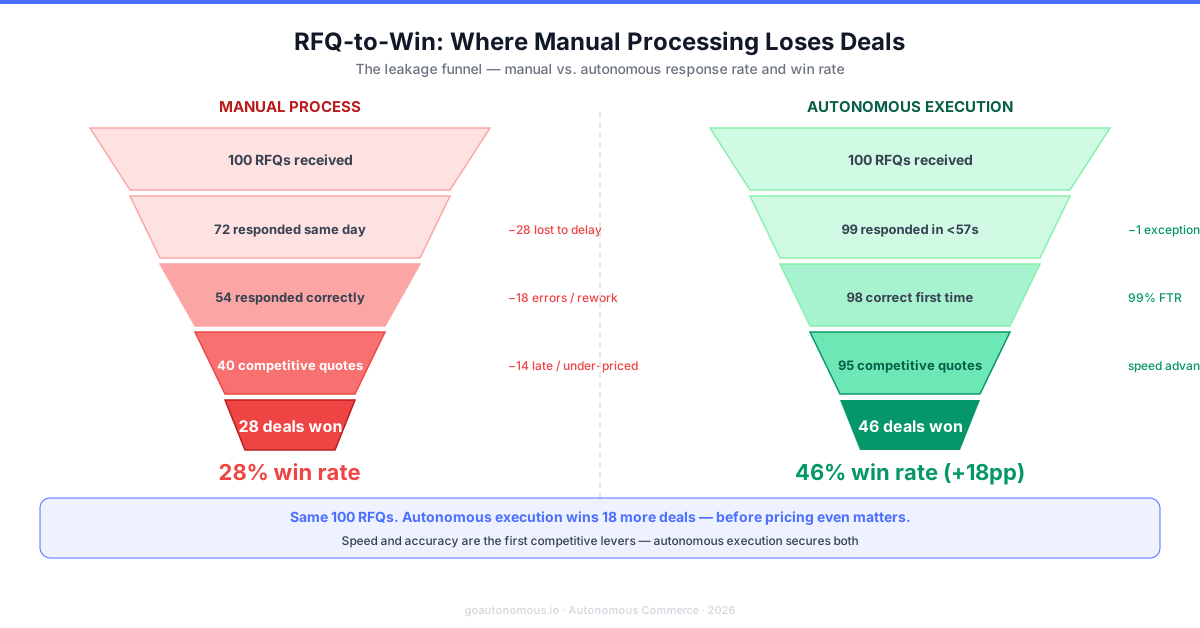
A documented 18 percent increase in win rate is among the most commercially significant outcomes attributable to autonomous order and quote handling. The mechanism is straightforward: faster, more accurate quote responses win more business in competitive tender situations. When a manufacturer or distributor can respond to an RFQ in under an hour, consistently, at scale, regardless of request volume on any given day, it changes its competitive position in markets where response speed is a differentiator.
Research from AeroDynamic Advisory on aviation MRO procurement consistently highlights response time as one of the top three supplier selection criteria for MRO buyers, alongside price and parts availability. In a sector where AOG situations create urgent procurement needs, the supplier that responds first with a qualified quote has a structural advantage, and that advantage compounds over time as buyers develop preferred supplier relationships with distributors who can be relied upon to respond quickly and accurately.
Capacity Release and Scalability
The 43 percent of commercial capacity released from transactional processing is the operational complement to the win rate improvement. When inside sales and customer service teams are no longer spending the majority of their time on RFQ data entry, parts lookup, and quote formatting, that capacity is available for higher-value activities: account development, complex negotiation, customer education, and strategic opportunity management.
This capacity release also directly addresses the scaling problem that the Hempel quote above illustrates so clearly. Adding revenue without adding headcount requires automation of the transactional work that currently scales linearly with volume. B2B tender automation is the mechanism that breaks that linear relationship, allowing commercial volume to grow without a proportional increase in operational cost.
For manufacturers and distributors operating in multiple markets, the DACH region, the Nordics, Benelux, and UKI are among the highest-density markets for complex B2B commerce, the scalability benefit is particularly significant. A single automation layer can handle RFQ intake from all markets simultaneously, applying market-specific pricing and compliance rules without requiring dedicated headcount per territory.
First-Time-Right Rate and Error Reduction
A 99 percent first-time-right rate in automated order and quote processing eliminates a category of cost that is often invisible in manual process accounting: the cost of errors. A quote response with incorrect pricing, wrong part numbers, or missing compliance documentation does not just fail to win the business, it actively damages the customer relationship and creates downstream work (corrections, re-submission, apology conversations) that consumes exactly the kind of skilled sales time that should be applied to value-adding activities.
In aviation MRO specifically, errors in quote responses carry regulatory risk beyond the commercial cost. An airworthiness documentation error on a quoted part is not just a customer service problem, it is a compliance exposure. The 99 percent first-time-right rate that autonomous commerce delivers is as much a risk management metric as a quality metric in these environments. For a comprehensive view of how intelligent transaction processing achieves this accuracy level, see the success cases documentation.
Integration, Implementation, and What to Expect
One of the most common questions from commercial and operations leaders evaluating RFQ automation is how the platform integrates with existing ERP and CRM infrastructure. The answer is that Autonomous Commerce is designed as a complementary execution layer, not a replacement for either the ERP or the CRM. It connects upstream (to email, EDI, and customer portals for intake) and downstream (to ERP for order confirmation) without requiring changes to either system’s core configuration.
Native integrations with SAP, Oracle, Microsoft Dynamics, Infor, and Salesforce mean that for the majority of enterprise B2B manufacturers and distributors, the integration architecture is pre-built. The deployment focus is on configuring the business logic, pricing rules, exception thresholds, approval routing, customer-specific requirements, rather than building connectivity from scratch.
Implementation timelines vary by complexity, but the pattern documented across Go Autonomous deployments is consistent: early results are visible within weeks of go-live, not months or years. The Danfoss deployment across 26 countries in a single day illustrates what is achievable at the fast end of the implementation spectrum when the integration architecture is sound and the business logic is well-defined.
For organizations evaluating their starting point, the RFQ and Quote Automation use case is typically the highest-ROI entry point, addressing the intake bottleneck directly and delivering measurable win rate and capacity improvements from the first month of operation. From there, the platform extends naturally to adjacent workflows: sales order automation, claims and dispute automation, and email-to-order automation for the full range of inbound commercial transaction types.
For industrial manufacturers specifically, the Autonomous Commerce for Industrial Manufacturers page provides sector-specific capability detail, and the Autonomous Commerce for Industrial Distributors page covers the distribution-specific considerations around catalog management, multi-supplier sourcing, and customer portal integration.
Frequently Asked Questions
RFQ automation for B2B manufacturers means that incoming request for quote documents, whether they arrive by email, PDF, EDI, or customer portal, are read, interpreted, matched to catalog, priced, and responded to automatically, without requiring manual intervention from inside sales or customer service teams. The automation handles standard cases at machine speed, and routes genuinely complex exceptions to human reviewers with full context. The commercial outcome is faster response times, higher win rates, and significant capacity release from transactional processing work.
Standard order automation handles confirmed purchase orders, documents that arrive with known part numbers, agreed prices, and clear quantities. The ERP can process these with minimal intervention. RFQ automation operates in the pre-confirmation phase: it must read unstructured requests, match customer part numbers to internal catalog entries, calculate custom pricing, manage multi-round communication loops, and route approvals, all before a confirmed order exists. This is categorically more complex than order processing, which is why it requires a purpose-built autonomous commerce layer rather than ERP or CPQ.
Autonomous commerce maintains stateful workflow records for every active RFQ. When a customer responds to an initial quote with a revision request, counter-proposal, or partial acceptance, the platform correlates the incoming communication to the original workflow record, updates the state, and initiates the appropriate next step, whether that is a revised quote, an availability check, or a routing to a human reviewer for negotiation. This multi-round state management is one of the core capabilities that distinguishes autonomous commerce from CPQ or ERP-based approaches.
The platform applies intelligent exception logic to identify RFQ lines or requests that require human judgment, items below minimum margin, customer-requested substitutions not in catalog, lines where availability is uncertain, or requests that trigger regulatory compliance review. These exceptions are routed to the appropriate human reviewer with full context: the original request, the proposed response, the specific lines that triggered the exception, and the recommended action. The goal is not to automate everything, but to automate everything that does not genuinely require human judgment, which in a well-configured deployment is the large majority of requests.
Autonomous commerce operates as a complementary execution layer that connects upstream to email, EDI, and customer portals for intake, and downstream to ERP systems for order confirmation. Native integrations are available for SAP, Oracle, Microsoft Dynamics, Infor, and Salesforce. The ERP’s role does not change, it continues to process confirmed orders, manage inventory, and handle fulfillment. What changes is the pre-confirmation workflow: the autonomous commerce layer handles everything from RFQ intake to order confirmation, then passes a clean confirmed order to the ERP without manual re-entry.
Documented outcomes from autonomous commerce deployments include an 18 percent increase in win rate, 43 percent of commercial capacity released from transactional processing, 99 percent first-time-right rate on automated responses, and orders processed in under 57 seconds from receipt to confirmation. The ROI case combines revenue impact (faster response times win more competitive tenders) with cost impact (transactional capacity released to higher-value activities) and risk reduction (error rates eliminated from the quoting process). For large B2B manufacturers processing significant RFQ volume, the financial impact is material within the first months of operation.
Aviation MRO and aerospace distribution, electrical components distribution, chemical and specialty materials manufacturing, and industrial spare parts distribution see the highest ROI from RFQ automation, because these sectors combine high RFQ volume with high per-request complexity (traceability documentation, cross-reference matching, custom pricing, tight deadlines). However, any B2B manufacturer or distributor with significant inbound RFQ volume, particularly where email is the dominant intake channel, will find autonomous RFQ management delivers measurable commercial and operational improvement.
See Autonomous Commerce in Action at the 2026 Summit
The Autonomous Commerce Summit 2026 brings together operations and commercial leaders from B2B manufacturing and distribution who are actively transforming how revenue is executed. Hear directly from companies that have made the shift to autonomous execution, and what it means for revenue, cost, and working capital. Attendance is by invitation only.
Request your invitation →