.svg)





B2B Order Automation In 2026: What Manufacturers Get Wrong When Evaluating AI
Most B2B order automation evaluations optimize for integration capability and vendor reputation. Neither criterion predicts whether the tool will actually remove humans from the order processing loop. This post explains what manufacturers get wrong and what a rigorous 2026 evaluation looks like.
Most B2B order automation evaluations optimize for integration capability and vendor reputation. Neither criterion predicts whether the tool will actually remove humans from the order processing loop. The AI vendor landscape in 2026 is more crowded and more confusing than it has ever been, and manufacturers are making expensive evaluation mistakes as a result. This post explains exactly what those mistakes are, what questions to ask instead, and what rigorous evaluation looks like when the goal is autonomous execution rather than assisted processing.
Table of Content
- Why Most Manufacturers Are Evaluating B2B Order Automation Wrong
- The Five Questions Most B2B Order Automation Vendors Cannot Answer
- Question 1: Does Your System Execute Orders Or Assist With Them?
- Question 2: What Is The First Time Right Rate In Production, Not In Demos?
- Question 3: How Does Your System Handle Unstructured Email Orders?
- Question 4: How Does The System Encode Customer-Specific Pricing And Product Logic?
- Question 5: What Is The Go-Live Timeline For A Deployment Of Our Scale?
- RPA Versus Automation Versus Autonomous Execution: Why The Category Matters
- What A Real B2B Order Automation Evaluation Should Include
- The Hidden Costs Of Getting B2B Order Automation Wrong
- What 99% First Time Right And 57-Second Orders Actually Require
- A Checklist For Evaluating B2B Order Automation In 2026
- Evaluate B2B Order Automation In Production At The Autonomous Commerce Summit 2026
- Sources
- Frequently Asked Questions: B2B Order Automation In 2026
Why Most Manufacturers Are Evaluating B2B Order Automation Wrong
What Is B2B Order Automation And Why Has Evaluation Become So Difficult?
B2B order automation is the use of software to receive, interpret, validate, and submit customer orders into an ERP system without requiring manual operator input. In 2026, evaluation has become difficult because the vendor landscape conflates three fundamentally different categories: RPA tools, workflow automation platforms, and autonomous execution systems. Each solves a different problem, but all are marketed using the same language.
That definition matters because the evaluation criteria appropriate for an RPA tool are the wrong criteria for an autonomous execution platform. Yet most procurement teams apply the same scorecard to all three categories. The result is that manufacturers select tools that perform well in demos and fail in production.
Consider the scale of the problem: McKinsey on automation in manufacturing operations has documented consistently that 85 to 90% of B2B revenue is still human-facilitated. That number has not changed materially in five years despite significant investment in automation tooling. The reason is not a shortage of tools. The reason is that manufacturers keep selecting tools that assist humans rather than replace the work humans are doing.
The Default Evaluation Criteria That Miss The Point
The typical B2B order automation evaluation scorecard looks roughly like this: ERP integration breadth, number of supported input formats, ease of configuration, vendor references, implementation timeline, and total cost of ownership. These criteria are not wrong. They are simply insufficient. None of them measure the only thing that actually matters in production: what percentage of orders does the system process from receipt to ERP submission without a human touching it?
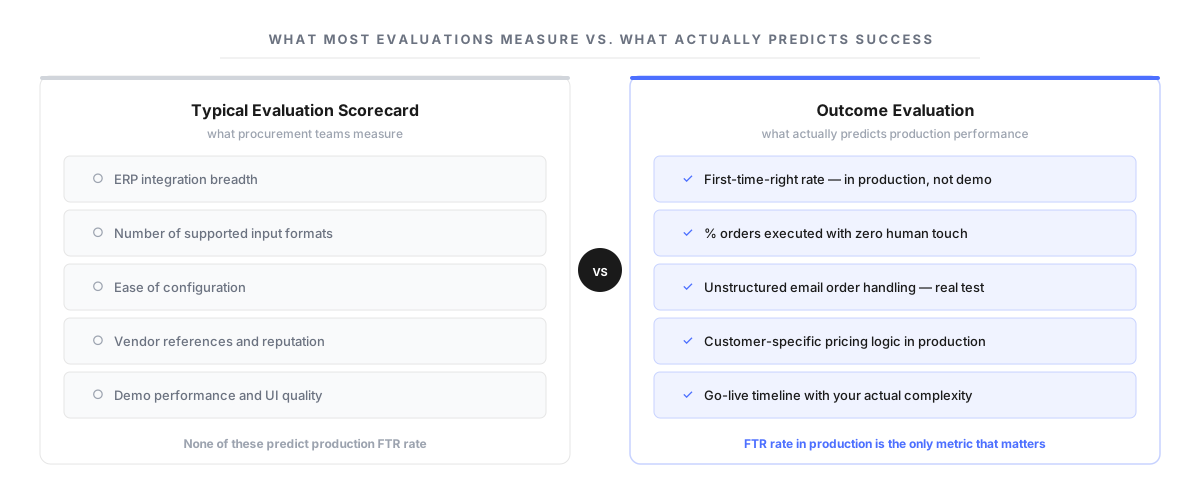
That metric is called the first time right rate, or FTR rate. It is the single most predictive indicator of whether an automation investment will deliver capacity release at scale. Yet it appears on very few evaluation scorecards, and when buyers do ask for it, most vendors cannot provide a verified production figure.
The Gartner on evaluating AI automation vendors framework distinguishes between capability evaluation and outcome evaluation. Most B2B order automation evaluations are pure capability evaluations. They assess what a system can theoretically do. Outcome evaluation requires asking what the system demonstrably does in live production environments with real customer order complexity.
The Demo Problem: Why Vendor Demos Never Show Production Complexity
Every vendor demo in B2B order automation shows the same thing: a clean, structured order arriving in a standard format, being processed in seconds, and appearing correctly in the ERP. The demo is not false. It is simply not representative of production reality.
Production reality includes customers sending orders as free-text emails with no PO number, product descriptions that do not match any item in the catalogue, pricing that reflects a negotiated contract the system has never seen, and quantities expressed in units that do not match the ERP unit of measure. It includes EDIFACT messages with non-standard field mappings, EDI 850 purchase orders with customer-specific segment requirements, and PDF attachments that are scanned images of handwritten forms.
According to research on B2B commerce operations, email accounts for 50 to 70% of B2B order and quote volume. That means the majority of real order intake arrives in the format most likely to break a demo-grade automation system. Vendors know this. That is why demos use clean data.
The solution is not to ask vendors to improve their demos. The solution is to stop evaluating on demos entirely. For more on this, see what manufacturers actually need in B2B order management software.
The Five Questions Most B2B Order Automation Vendors Cannot Answer
These five questions are designed to surface the gap between a vendor’s demo capability and their production performance. A vendor who cannot answer all five clearly and with verified production data is not ready for enterprise deployment at scale.
Question 1: Does Your System Execute Orders Or Assist With Them?
This question sounds simple. It is not. Most vendors will answer “execute” regardless of what their system actually does. The follow-up is: what percentage of orders in a production environment are submitted to the ERP with zero human input between receipt and ERP writeback?
A system that flags exceptions for human review, routes ambiguous orders to an operator queue, or requires a human to click confirm before ERP submission is an assistance system, not an execution system. The distinction is architectural, not a matter of degree. Assistance systems scale linearly with headcount. Execution systems do not.
The autonomous commerce platform built by Go Autonomous is designed around execution-first architecture: the system submits orders to the ERP without requiring a human in the loop. That architectural commitment is what produces the throughput and capacity release numbers that matter at enterprise scale.
Question 2: What Is The First Time Right Rate In Production, Not In Demos?
Ask for this number in writing, from a named production customer, with the measurement methodology explained. A first time right rate measures how often an order flows from intake to ERP submission without error, exception, or human correction. In production, with real customer order complexity, this rate varies significantly across vendors.
A 99% first time right rate in production is not a marketing aspiration. It is an architecture outcome. It requires that the system correctly resolve product identification, pricing logic, unit of measure conversion, customer-specific business rules, and ERP field mapping without human intervention on 99 out of every 100 orders. That level of FTR rate requires investment in training data, ERP integration depth, and exception resolution logic that most vendors have not made.
If a vendor cannot provide a verified FTR rate from production, treat that as a disqualifying response. The absence of this data means either the system has not been deployed at meaningful production scale, or the rate is not high enough to share. Neither scenario is acceptable for enterprise procurement.
Question 3: How Does Your System Handle Unstructured Email Orders?
Email is the dominant order channel in B2B manufacturing and distribution. It is also the hardest channel to automate, because emails do not conform to any standard. A customer email order might contain informal product descriptions, negotiated pricing that differs from list price, partial PO references, non-standard units of measure, and free-text notes that contain operationally critical information.
Ask the vendor to demonstrate their system processing a batch of ten real email orders from your actual customer base: different customers, different formats, different levels of structure. Observe whether the system resolves each order autonomously or whether it flags and routes to human review. The proportion of orders resolved autonomously in this test is your real FTR rate for email intake.
For a deeper analysis of RPA vs AI for order management and why the architectural difference matters for email specifically, the comparison is worth reviewing before finalizing your evaluation criteria.
Question 4: How Does The System Encode Customer-Specific Pricing And Product Logic?
Every large manufacturer operates with a complex web of customer-specific pricing agreements, volume discounts, contractual price lists, and product substitution rules. These rules are not static. They change with every contract renewal, every pricing update, and every new product introduction. The automation system must apply the correct rules at the moment of order processing, not the rules that were current when the system was configured.
Ask vendors specifically: how does pricing logic stay synchronized with SAP S/4HANA or Oracle Cloud SCM pricing master data? How does the system handle a product that has been superseded by a replacement item? How does it apply a customer’s contracted price when that price is stored in a custom pricing condition table?
Vendors whose systems require manual rule updates to reflect pricing changes are not operating at autonomous execution standard. Real-time ERP synchronization is the baseline requirement for a system that will process thousands of orders per day with consistent accuracy.
Question 5: What Is The Go-Live Timeline For A Deployment Of Our Scale?
Implementation timelines in B2B order automation vendor proposals are almost universally optimistic. The realistic timeline depends on three factors: ERP integration complexity, customer base variability, and the quality of the vendor’s pre-built connectors for your specific ERP version and configuration.
Ask for a reference customer with a similar ERP environment and a similar volume of customers and SKUs. Ask how long their implementation actually took, not how long it was projected to take. Ask specifically about the time required to train the system on your specific customer order patterns versus the time required for technical integration.
According to Deloitte on AI procurement and order management, the majority of AI implementation delays in manufacturing originate in data readiness and ERP integration complexity rather than in the AI layer itself. A vendor who quotes a six-week go-live without having conducted a thorough ERP architecture review is not giving you an honest answer.
RPA Versus Automation Versus Autonomous Execution: Why The Category Matters
What Is The Difference Between RPA, Workflow Automation, And Autonomous Execution?
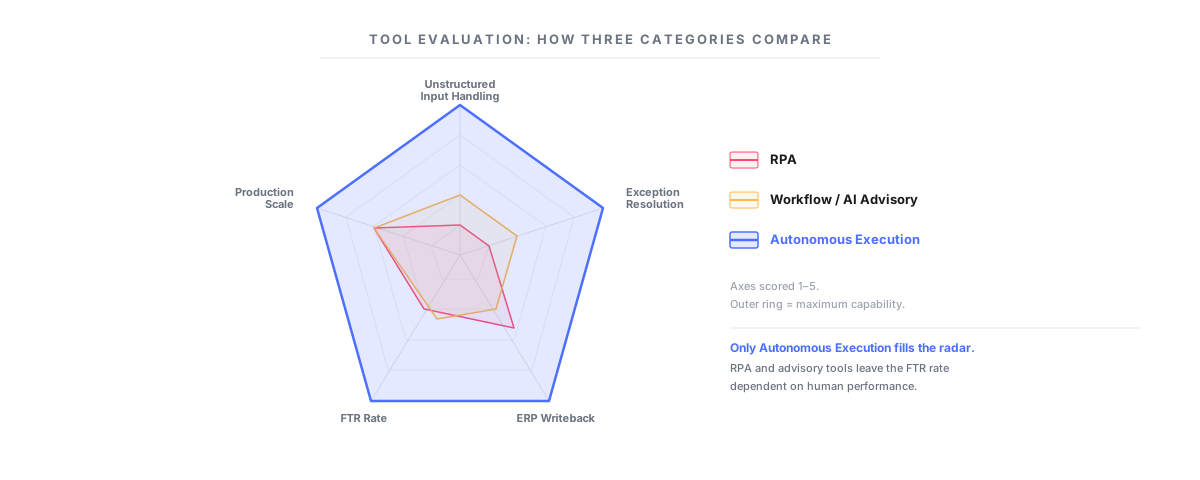
RPA (Robotic Process Automation) mimics human actions on screen-based interfaces. It is rule-based, brittle on format changes, and requires structured input. Workflow automation routes defined tasks through predefined approval and processing steps. Autonomous execution uses AI to interpret any input format, resolve ambiguity, apply business rules, and complete the transaction in the ERP without human intervention. These are three different categories solving three different problems.
The reason the category matters for B2B order automation evaluation is that each category has a fundamentally different ceiling. RPA scales only to the extent that inputs remain structured and consistent. Workflow automation scales only to the extent that processes remain within predefined paths. Autonomous execution scales across the full variability of real B2B order intake: any format, any customer, any complexity level.
Why RPA Breaks Where B2B Order Automation Needs To Work
RPA tools were designed for back-office processes with fixed formats and defined rules. B2B order intake is the opposite environment. Order formats change when customers change their ERP systems. Product descriptions in customer orders rarely match catalogue descriptions exactly. Pricing in orders reflects negotiated terms that change every quarter.
The result is that RPA deployments in order management require continuous maintenance as customer ordering patterns evolve. Every time a customer changes their purchase order format, an RPA rule breaks. Every time a product is renamed in the catalogue, an RPA mapping fails. The maintenance burden grows proportionally with the number of customers and SKUs, which means the system that was supposed to reduce labor ends up requiring a dedicated team to maintain it.
This is the pattern documented in why order-to-cash automation fails: the tooling is technically capable, but the maintenance model makes it economically unsustainable at scale.
RPA Vs Traditional Automation Vs Autonomous Execution: The Comparison
| Dimension | RPA | Traditional Workflow Automation | Autonomous Order Execution |
|---|---|---|---|
| Input requirement | Structured, fixed format | Semi-structured, defined workflow | Any format: email, PDF, EDI, free-text |
| Exception handling | Fails or flags | Routes to human | Resolves autonomously |
| Format variability | Brittle on changes | Limited | Handles full variability |
| ERP writeback | Bot-triggered, human review | Workflow-triggered, review required | Autonomous direct submission |
| First time right rate | Depends on input quality | Depends on rule coverage | 99% in production |
| Processing speed | Script-limited | Workflow-limited | 57 seconds |
| Best use case | Repetitive, fixed-format tasks | Defined process automation | B2B order intake, execution, confirmation |
What A Real B2B Order Automation Evaluation Should Include
How To Run A Production Proof Test, Not A Demo
A production proof test replaces the vendor demo with a controlled live test using your actual order data. The test is structured as follows: provide the vendor with a representative sample of 200 to 500 orders from your real customer base, covering the full range of formats, customers, and complexity levels you process in a normal month. Ask the vendor to process this batch in a sandboxed version of your ERP environment and to report the FTR rate, the exception rate, the exception resolution method, and the total processing time.
Compare the results across vendors using a consistent scoring methodology. The FTR rate is the primary metric. The exception handling approach is the secondary metric: what happens to the orders the system cannot process autonomously? Are they routed to a human queue, and if so, what is the expected volume and handling time?
This test is more expensive to run than a demo evaluation. It takes longer and requires more internal coordination. It also gives you the only data that actually predicts production performance. The investment is proportional to the decision size: a B2B order automation platform will process tens of thousands of orders per month and will directly affect customer experience, revenue capture, and operational cost. Evaluating it on demo data is not commensurate with that level of risk.
The Format Coverage Test Most Evaluations Skip
The format coverage test is a structured assessment of how many of your actual incoming order formats a given system can process autonomously. Start by cataloguing your real intake formats: email free-text, email with PDF attachment, scanned PDF, EDI 850, EDIFACT ORDERS, eCommerce portal orders, customer-specific XML, and any others that represent more than 1% of your volume.
For each format, ask the vendor to demonstrate autonomous processing using real examples from that format category. Document the FTR rate per format. This will reveal format-specific weaknesses that aggregate FTR rates conceal. A vendor with a 95% aggregate FTR rate might have a 40% FTR rate on email free-text, which is your highest-volume channel. The aggregate number looks acceptable. The per-format breakdown reveals a significant operational problem.
The autonomous commerce product suite from Go Autonomous is built to handle the full range of B2B order intake formats without per-format configuration or training. That capability is what makes a 99% FTR rate achievable across a diverse customer base with varied ordering behaviour.
How To Assess Exception Rate And ERP Integration Depth
Exception rate and ERP integration depth are the two technical dimensions most likely to determine whether a B2B order automation platform delivers its promised FTR rate in your specific environment. Exception rate measures how often the system encounters an order it cannot process autonomously. ERP integration depth measures how completely the system can access and apply the business rules stored in your ERP.
For ERP integration depth, ask specifically: does the system read pricing conditions directly from SAP S/4HANA or Oracle Cloud SCM, or does it use a static pricing export that requires periodic refresh? Does it access the material master for product validation, or does it use a separate product catalogue? Does it write directly to the ERP sales order module, or does it use an iPaaS middleware layer that introduces latency and potential failure points?
Each layer of middleware between the automation system and the ERP is a failure point and a latency source. Direct ERP integration is architecturally superior for the use case of B2B order automation. Vendors who rely on iPaaS connectors for ERP writeback are making a capability tradeoff that affects both processing speed and first time right rate.
Each time we added one or two million euros in revenue, we had to add another operator. From a cost perspective, that’s an unsustainable way of operating a business.

The Hidden Costs Of Getting B2B Order Automation Wrong
Why The Wrong Tool Costs More Than The License Fee
The direct cost of a failed B2B order automation deployment is the license fee and implementation cost. The indirect costs are significantly larger and are rarely included in pre-purchase financial modelling. They include: continued headcount cost for the order processing team that was supposed to be released, maintenance cost for the rules and mappings that require ongoing updates, the cost of orders that fail silently and result in delayed shipments or missed revenue, and the opportunity cost of a multi-year delay to a real automation outcome.
According to Forrester Total Economic Impact of order automation methodology, the total cost of a failed automation deployment typically runs two to three times the original license fee when all indirect costs are included. For a €500M manufacturer processing several thousand orders per day, the indirect cost of a failed deployment can reach seven figures within twelve months.
The most effective way to avoid this cost is to require production evidence before signing. Manufacturers running autonomous order execution in production have already absorbed the deployment risk. Their experience is the most reliable evaluation data available.
The Headcount Trap: When Automation Still Requires People
The headcount trap is the situation where an automation system has been deployed, the vendor considers the implementation successful, and the manufacturer discovers that full-time operators are still required to manage the system’s exception queue. The automation has not removed humans from the loop. It has changed the nature of their work from processing orders to reviewing and resolving exceptions. The headcount has not been released. In many cases, the team is now managing both the automation system and the residual manual volume.
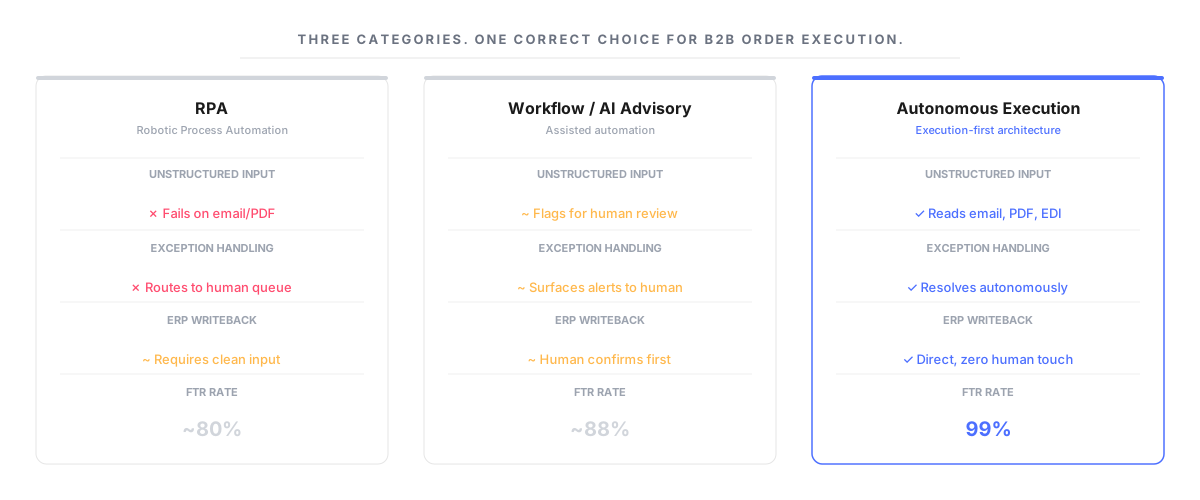
This outcome is not a failure of implementation. It is a predictable consequence of deploying an assistance system when the goal was an execution system. An assistance system is designed with the assumption that a human will remain in the loop for exceptions. An execution system is designed with the assumption that exceptions should be resolved by the system, not routed to a human.
The KPMG B2B digital transformation benchmark reports that the majority of AI automation initiatives in B2B customer service and order management fall into the assistance category by design, which is why they consistently fail to deliver the headcount and capacity outcomes promised in business cases.
What 43% Capacity Released Tells You About The Right Tool
A 43% capacity release in an order processing team is a specific, measurable outcome. It means that fewer than half of the original team hours are now required to process the same order volume. The team has not been replaced. Their capacity has been released to higher-value work: exception handling that requires judgment, customer relationship management, and commercial activities that drive revenue rather than process transactions.
This level of capacity release is only achievable with an execution-first architecture. An assistance system that handles 70% of orders autonomously and routes 30% to human review does not release 43% of capacity. The human team is still managing a substantial exception queue. The net capacity release, accounting for the time required to manage and configure the automation system, is typically in the 15 to 20% range for assistance-based systems.
For a manufacturer evaluating B2B order automation, the question is not whether to automate. The question is whether to select a system that will deliver 20% capacity release or 43% capacity release. The difference in business case value over a five-year horizon is significant. See the Breaking Free from Manual Processes white paper for the detailed financial framework.
We are constantly exploring new ways to strengthen our operations and better serve our customers. The Autonomous Commerce Platform allows us to scale excellence in customer experience. Digitizing the domain knowledge and best practices with Go Autonomous helps us to speed up processes, reduce manual work, and improve the overall customer experience.
What 99% First Time Right And 57-Second Orders Actually Require
Why These Are Architecture Outcomes, Not Marketing Numbers
A 99% first time right rate and order processing in 57 seconds are not aspirational benchmarks. They are the measurable output of a specific architectural approach to autonomous order execution. Understanding what architecture produces these numbers is the most reliable way to evaluate whether a vendor can deliver them in your environment.
The 99% FTR rate requires three architectural capabilities working together. First, the system must correctly identify products from any description format: catalogue number, free-text description, legacy part number, or customer-specific nomenclature. Second, it must apply the correct pricing at the moment of processing, reading directly from the live ERP pricing master rather than from a cached export. Third, it must validate the order against business rules and resolve exceptions internally rather than routing them to a human queue.
The 57-second processing time is an outcome of execution-first architecture combined with direct ERP integration. It eliminates the latency introduced by human review queues, approval workflows, and middleware layers. An order arrives, is processed, and is submitted to the ERP in under a minute. For customers who currently wait hours or days for order confirmation, this represents a transformation in the commercial relationship, not an incremental improvement.
What Execution-First Architecture Looks Like In Production
Execution-first architecture means the system is designed from the ground up with the assumption that human intervention is the exception, not the default. Every component is optimized to resolve ambiguity autonomously rather than to flag it for human review. Product identification uses a combination of semantic matching, historical order pattern analysis, and real-time ERP master data access. Pricing applies contractual rules directly from the ERP pricing engine. Validation checks against ERP inventory and delivery capability in real time.
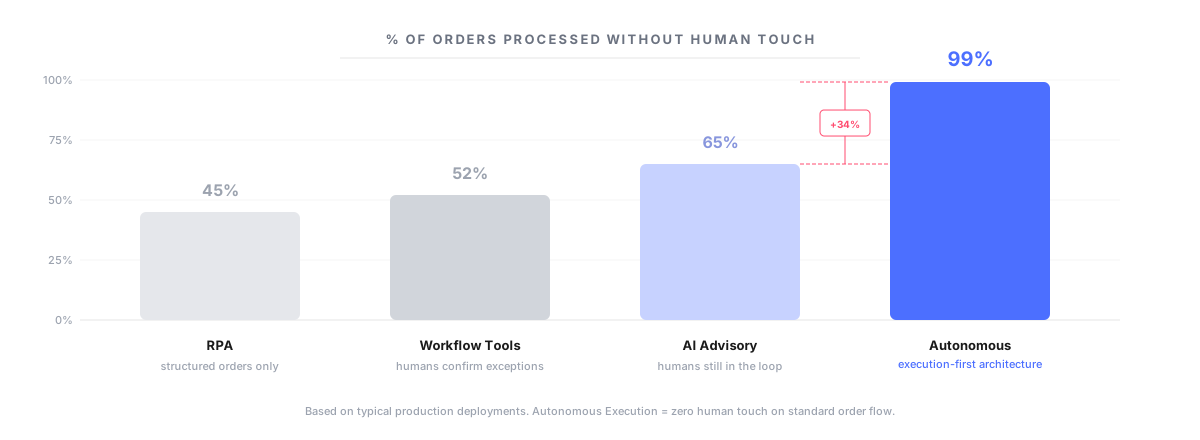
The contrast with assistance-first architecture is significant. Assistance-first systems are designed to surface information for a human decision-maker. They improve the speed at which a human can process an order. Execution-first systems are designed to make the decision. They remove the human from the processing loop entirely for the large majority of orders.
A 60% throughput increase per employee is one measurable outcome of deploying execution-first architecture at scale. The team is doing more with the same resources, not because they are working faster, but because the system is handling the volume that previously required their time.
Why 30B+ Transactions Processed Is The Volume Benchmark That Matters
Volume benchmarks matter in B2B order automation because scale reveals brittleness. A system that performs at 99% FTR on 10,000 orders per month may perform very differently on 500,000 orders per month across thousands of distinct customers with varying formats and pricing structures. The only reliable evidence that a system maintains performance at enterprise scale is actual enterprise-scale transaction volume.
When a platform has processed more than 30 billion transactions, that number is not a marketing figure. It is evidence of architectural durability. It means the system has encountered and resolved the full range of real-world B2B order complexity across multiple industries, ERPs, geographies, and customer types. That experience is encoded in the system’s ability to handle edge cases that newer platforms have never encountered.
For enterprise manufacturers evaluating B2B order automation in 2026, transaction volume history is a legitimate evaluation criterion. Ask every vendor for their total transaction volume in production and their average FTR rate across that volume. The answers will differentiate quickly between demo-grade platforms and production-grade platforms.
A Checklist For Evaluating B2B Order Automation In 2026
Ten Questions To Bring Into Every B2B Order Automation Evaluation
The following ten questions are designed to replace demo-based evaluation with outcome-based evaluation. Bring these into every vendor conversation. The answers, and whether a vendor can answer them at all, will tell you more than any demonstration.
- What is your verified first time right rate in a named production environment at a manufacturer of comparable scale and complexity to ours?
- What percentage of orders does your system process with zero human input between receipt and ERP submission?
- How does your system handle email orders with no PO number, non-catalogue product descriptions, or customer-specific pricing that differs from list price?
- How is your pricing logic synchronized with live ERP pricing master data, and how often does that synchronization occur?
- What is your direct ERP integration architecture for SAP S/4HANA or Oracle Cloud SCM, and does your system write directly to the ERP or through an iPaaS middleware layer?
- What is your go-live timeline for a deployment of our order volume and ERP complexity, based on comparable reference customers, not on projected timeline?
- What happens to orders your system cannot process autonomously: are they resolved by the system or routed to a human review queue?
- What is the total transaction volume your platform has processed in production across all deployments?
- Can you provide a reference customer who will speak specifically about their exception rate and their headcount change twelve months after go-live?
- What is the maintenance model for format and rule changes when customers change their ordering systems or when we change our ERP configuration?
What Good Answers Look Like And What Should Disqualify A Vendor
Good answers to these questions are specific, verifiable, and come with named references. A vendor who answers question one with a percentage but cannot name the customer or provide a contact for verification is not giving you usable data. A vendor who answers question seven by describing a human review queue as a feature rather than a failure mode is telling you their system is an assistance platform, not an execution platform.
Disqualifying responses include: FTR rates expressed as ranges without a floor, go-live timelines that are not backed by comparable reference customers, exception handling processes that default to human review, and ERP integration architectures that rely on periodic data exports rather than real-time synchronization. Any of these responses indicates a system that will not deliver enterprise-grade autonomous execution in production.
How Autonomous Commerce Answers Each Question
Go Autonomous, as the category creator of Autonomous Commerce, answers each of these ten questions with production evidence. The 99% first time right rate comes from named production deployments at enterprise manufacturers. The 57-second processing time is measured in live environments, not controlled demos. The 43% capacity release is a verified outcome, not a projected business case figure. Orders are processed by the system, not routed to human review queues. ERP integration is direct, real-time, and covers the full pricing and product master data required for autonomous execution.
The 18% win rate increase achieved by customers using autonomous order execution reflects a specific commercial mechanism: when customers receive order confirmation in 57 seconds rather than hours or days, their propensity to place repeat orders and to consolidate purchasing with that supplier increases measurably. Speed and accuracy in order execution are not just operational outcomes. They are commercial outcomes.
Danfoss processes orders in under one minute and went live across 26 countries in a single day. These are not pilot results or proof-of-concept outcomes. They are production results from one of the world’s largest industrial manufacturers. For a Director of Order Management or VP of Operations evaluating B2B order automation in 2026, this is the benchmark against which every other vendor response should be measured.
Evaluate B2B Order Automation In Production At The Autonomous Commerce Summit 2026
The most reliable way to evaluate B2B order automation is to see it running in production, at real order volumes, with real customer complexity. The Autonomous Commerce Summit 2026 brings together operations leaders from B2B manufacturing and distribution who have already made this decision and are running autonomous order execution in live environments. If you are in evaluation mode and want production evidence rather than vendor demos, this is where that conversation happens. Attendance is by invitation only.
Request your invitation →
Sources
- Gartner: Market Guide for Distributed Order Management Systems (2025)
- McKinsey & Company: Human + Machine, A New Era of Automation in Manufacturing
- Deloitte: 2025 Global Chief Procurement Officer Survey, AI and Automation Priorities
- Forrester: FutureProof Your B2B Commerce Strategy, Future of Order Automation
- KPMG: Global Customer Experience Excellence Report 2024–2025