.svg)





Order-to-Cash Cycle Time in B2B Manufacturing: 2026 Benchmarks
Order-to-cash cycle time in B2B manufacturing averages 30–45 days from order receipt to payment collection. For manufacturers operating at scale, each day of cycle time represents significant working capital trapped in the process. This post benchmarks O2C cycle time in 2026, maps where the time accumulates, and shows what operations at the fast end of the range do differently.
Order-to-cash cycle time in B2B manufacturing averages 30–45 days in 2026. For a manufacturer with €100M in annual revenue, each day of cycle time traps approximately €275K in working capital. The gap between a 25-day and a 45-day O2C cycle is €5.5M in permanently trapped working capital — a structural financing cost created by preventable process inefficiency. The two controllable phases, order processing and invoicing, account for 5–10 days of that gap and are compressible to near-zero with autonomous execution.
Table of Content
- Average Order-to-Cash Takes 30–45 Days in B2B Manufacturing: Working Capital Trapped in Each Cycle Day
- Order Processing and Invoicing Are the Two Longest Lags in the O2C Cycle
- Order Processing Errors Are the Primary Cause of Extended O2C Cycles: Each Error Adds 7–14 Days
- Compressing O2C Cycle Time by Automating the Two Controllable Phases
- The Autonomous Execution Fabric: Commercial Execution Across the Full O2C Cycle
- Frequently Asked Questions
- What is the average order-to-cash cycle time for B2B manufacturers in 2026?
- How does order processing time affect order-to-cash cycle length in B2B manufacturing?
- What is the working capital impact of reducing order-to-cash cycle time in B2B manufacturing?
- How do B2B manufacturers compress order-to-cash cycle time without changing payment terms?
- What are the main causes of extended order-to-cash cycles in B2B distribution operations?
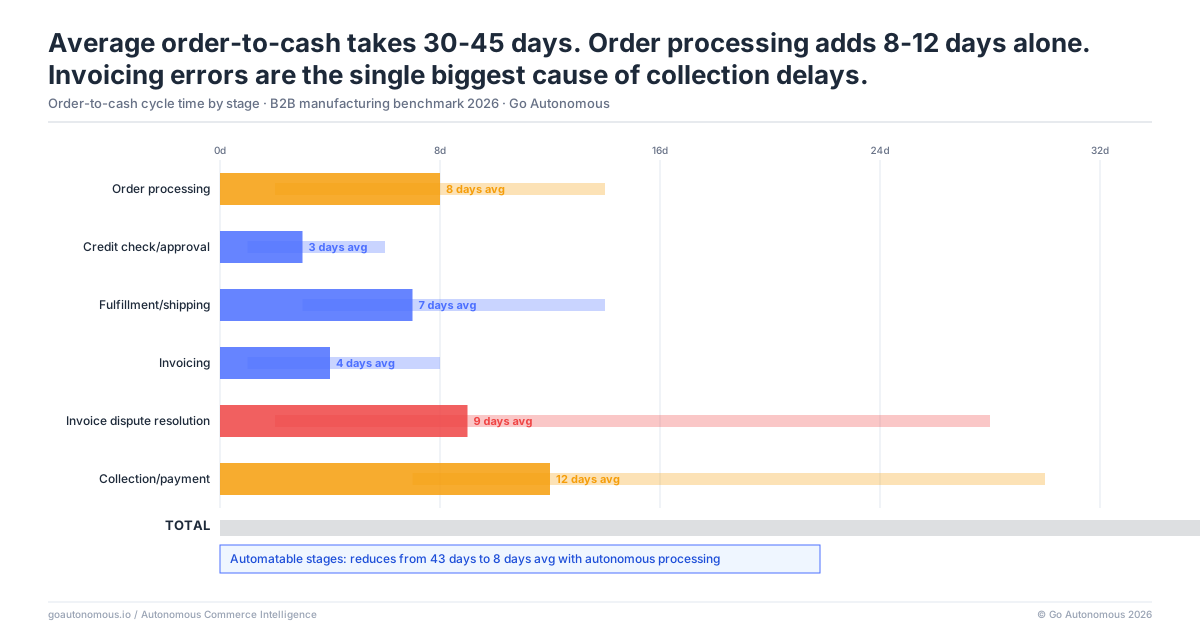
Average Order-to-Cash Takes 30–45 Days in B2B Manufacturing: Working Capital Trapped in Each Cycle Day
How O2C Cycle Time Is Measured — and Where Most Operations Miss the Full Range
Order-to-cash cycle time encompasses the full process from order receipt to payment collection: order processing, order confirmation, production or picking, shipment, invoicing, and payment receipt. The measurement start point matters. Many operations measure from confirmed sales order to payment, omitting the order processing lag at the front end. That omission understates the true cycle and the working capital impact. The accurate measurement begins the moment an order arrives, not the moment it clears the queue.
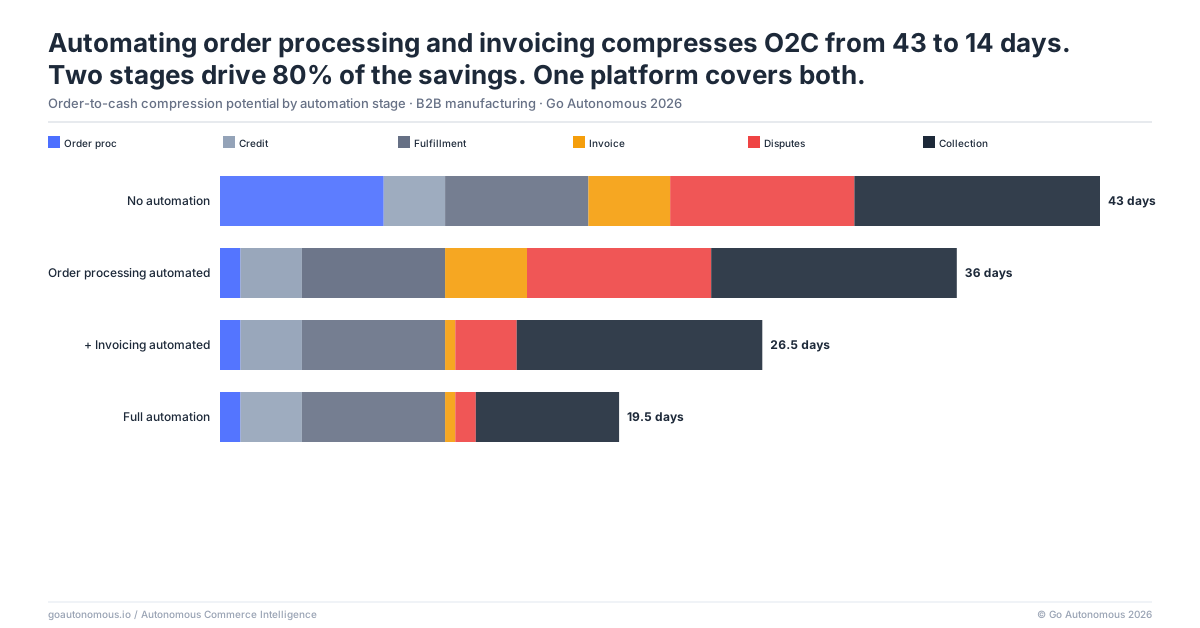
The 2026 benchmark range for B2B manufacturers is 30–45 days as a median. Operations at the fast end of the distribution run 20–25 days. Operations at the slow end run 50–60 days. The variance is not primarily explained by product complexity or logistics geography — it is explained by process architecture. The fast operations have eliminated avoidable lags at the front end (order processing) and back end (invoicing). The slow operations have not.
The Working Capital Calculation: What Each Cycle Day Costs at Scale
The working capital calculation is direct: annual revenue divided by 365 gives the daily revenue value tied up per cycle day. At €100M revenue, each day of O2C cycle time represents €274K in working capital that has shipped but not yet been collected. At €500M revenue, each day represents €1.37M. CFOs who have not benchmarked their O2C cycle time against peers have likely accepted a structurally elevated working capital requirement as a baseline condition rather than a solvable problem.
The efficiency gains available through cycle compression compound with scale. A €500M manufacturer that compresses its O2C cycle by 7 days releases €9.6M in working capital permanently. That capital does not need to be financed. The cost of capital avoided is recurring. The investment required to achieve it is one-time.
Each time we added one or two million euros in revenue, we had to add another operator. From a cost perspective, that's an unsustainable way of operating a business.

Order Processing and Invoicing Are the Two Longest Lags in the O2C Cycle
Where O2C Time Goes: The Distribution Across Processing, Fulfillment, and Collection
The O2C cycle has three main phases. Order processing runs from order receipt to confirmed sales order. Fulfillment runs from confirmed order to shipment. Collection runs from invoice issuance to payment receipt. Fulfillment time is typically 3–10 days and is constrained by production schedules and logistics — not meaningfully compressible without capital investment in manufacturing or warehousing capacity. Collection time is constrained by contracted payment terms, typically 30 days. These phases are largely fixed given existing operations.
The compressible phases are order processing (currently averaging 24–48 hours but technically reducible to under 60 seconds) and invoicing lag (typically 3–7 days between shipment confirmation and invoice issuance, compressible to same-day). Between them, these two phases account for 5–10 days of O2C cycle time that serve no commercial purpose and create no customer value. They persist because manual processes cannot execute at machine speed.
Why Invoicing Lag Persists Even When Fulfillment Is Efficient
Invoicing lag is the least examined contributor to extended O2C cycles. Most operations have reasonable fulfillment visibility but poor invoice issuance discipline. The shipment is confirmed. The goods have left the warehouse. The clock on collection has started from the customer’s perspective — but the invoice has not been issued yet. The customer cannot pay an invoice that has not arrived.
Invoicing lag persists for structural reasons: invoicing teams process in batches, ERP systems require manual triggering of invoice generation, or invoices are held pending final price confirmation when order pricing was uncertain at entry. Each of these causes is addressable. Automated invoice generation triggered by shipment confirmation in the ERP eliminates the lag entirely. The invoice is issued within hours of shipment, not days. Payment terms begin running on day one rather than day four or seven.
Order Processing Errors Are the Primary Cause of Extended O2C Cycles: Each Error Adds 7–14 Days
How a Wrong Order Creates a Re-Processing Event That Extends the O2C Timeline
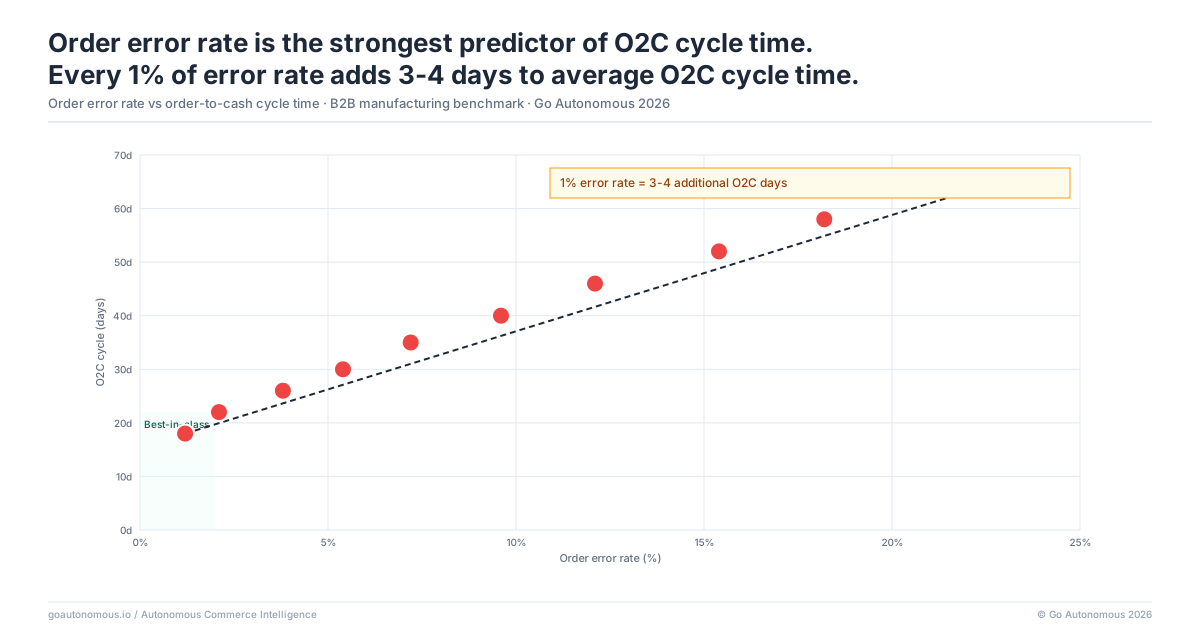
The largest single driver of extended O2C cycles beyond the benchmark range is order processing errors. A wrong product entered into the sales order requires a return authorization after delivery, a replacement shipment, and a corrected invoice. Each step in that sequence adds time. The original invoice cannot be collected because the delivered goods do not match the order. The replacement shipment adds fulfillment cycle time. The corrected invoice restarts collection. Net impact: 7–14 days added to the O2C cycle for one order error.
For operations processing 1,000 orders per week with a 5% manual error rate, 50 orders per week are in error-extended O2C cycles at any point in time. The aggregate working capital trapped in error-extended cycles is not a marginal adjustment — it is a structurally elevated requirement caused by preventable entry failures. The Nilfisk case demonstrates the operational cost of this pattern at scale.
The Invoice Dispute That Adds 14+ Days to an Already-Closed Shipment
Pricing errors at order entry are a separate failure mode from fulfillment errors but have comparable O2C impact. A pricing error surfaces when the customer receives an invoice that does not match their purchase order or contracted price. The customer’s accounts payable team places the invoice on hold pending resolution. The supplier’s finance team opens a dispute resolution process. Account managers are pulled in. Resolution requires producing the correct pricing documentation, issuing a credit note, and reissuing the correct invoice.
Resolution time for a pricing dispute in B2B manufacturing is typically 10–20 additional days beyond the base O2C cycle. For a customer with 30-day payment terms, a pricing dispute means the invoice may not be paid for 45–60 days from shipment — or longer if the dispute requires escalation. The compounding effect on working capital at high order volumes is material and entirely avoidable. The cost scales directly with revenue, as Mikkel Diness Vindeløv’s observation above captures precisely.
Compressing O2C Cycle Time by Automating the Two Controllable Phases
What Autonomous Order Processing Delivers: From 48-Hour Confirmation to Sub-60-Second
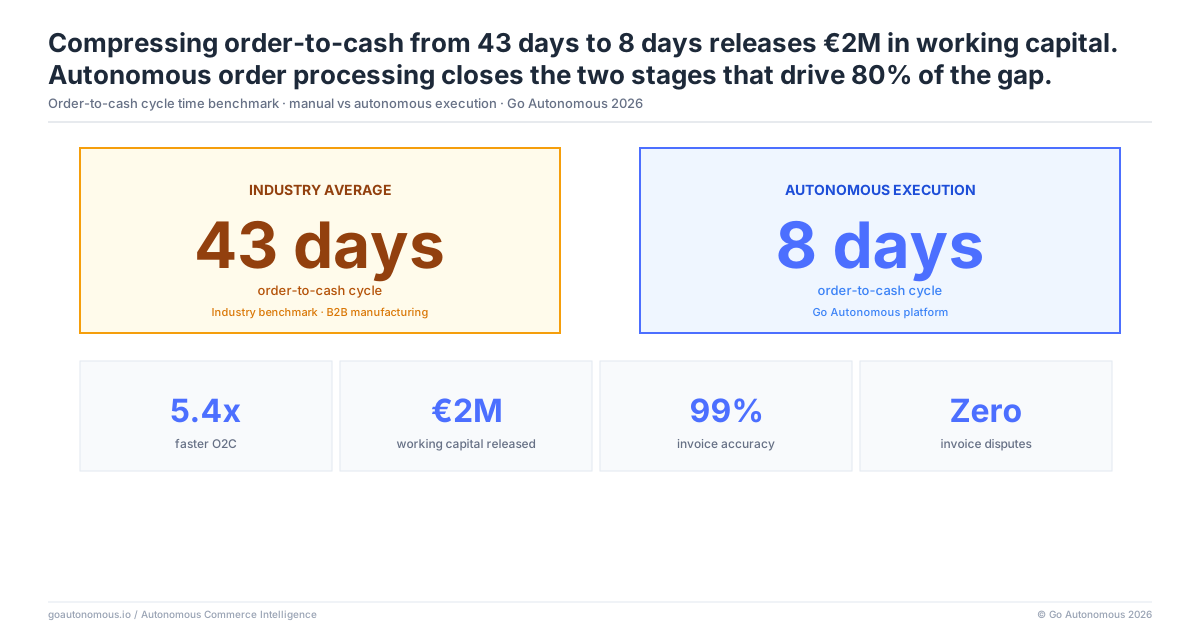
Autonomous order processing eliminates the confirmation delay at the front of the O2C cycle. When an order arrives by email, EDI, portal, or any unstructured channel, the AI reads the order, validates it against the customer master and product catalog, applies contracted pricing, and creates the confirmed sales order in the ERP — in under 60 seconds. Fulfillment can begin immediately. The 24–48 hour processing lag at the front of the cycle is eliminated, not compressed.
The downstream effect on O2C cycle time is multiplicative, not additive. Eliminating the 24–48 hour processing lag means fulfillment starts earlier. Fulfillment completing earlier means the shipment trigger fires earlier. The invoice is generated earlier. The payment clock starts earlier. The total cycle compression from removing the front-end processing lag is greater than the processing lag itself, because every subsequent step starts from an earlier baseline. Danfoss reduced order processing from 42 hours to under 1 minute, enabling same-day confirmation across 26 countries.
What Same-Day Invoicing Delivers: The Working Capital Release When Invoicing Follows Shipment
Automated invoice generation triggered by shipment confirmation closes the invoicing lag at the back of the O2C cycle. The moment the ERP records the shipment, the invoice is generated, validated against the confirmed order pricing, and issued to the customer — the same day. Payment terms begin running from day one of the customer receiving the invoice rather than day four or seven.
The Autonomous Execution Fabric: Commercial Execution Across the Full O2C Cycle
The order processing and invoicing improvements described in this post are one layer of the Autonomous Execution Fabric: a full commercial execution layer that connects directly to your SAP, Oracle, or Microsoft Dynamics environment and executes every inbound commercial transaction without manual assembly. The Fabric reads orders from every intake channel (email, EDI, customer portal, and direct API), validates them against your pricing and customer master data, creates confirmed sales orders, and triggers invoice generation at shipment — without a human in the processing chain.
The Fabric handles more than order intake and invoicing. The same execution layer processes pricing requests, quote responses, returns authorizations, credit notes, and contract tenders. Each of these transaction types shares the same structural bottleneck described in this post: manual assembly steps that introduce delays, selection errors, and exception queues. The Autonomous Execution Fabric applies the same model across all of them — direct ERP integration, automated processing, and human review only where genuine commercial judgment is required.
The O2C cycle time problem is not isolated to order processing. Operations with 24–48 hour order confirmation lags typically have comparable lags in quote response, return processing, and credit note issuance — because the same structural gap applies. When manual processing is the model, every commercial transaction type accumulates delay. The Autonomous Execution Fabric closes the gap across all commercial transaction types, which is why the working capital and cycle time improvements compound beyond what order automation alone produces.
Combined, autonomous order processing and same-day invoicing can compress the O2C cycle by 5–10 days. At €100M revenue, 5 days of cycle compression releases €1.375M in working capital permanently. At €500M revenue, the release is €6.85M. This is not a one-time improvement — the working capital is freed on every order cycle going forward. The financial case for autonomous commerce is not limited to cost reduction: it includes a permanent improvement in working capital efficiency. To see how this applies to your operation, book a session with the Go Autonomous team.
Frequently Asked Questions
What is the average order-to-cash cycle time for B2B manufacturers in 2026?
The average order-to-cash cycle time for B2B manufacturers in 2026 is 30–45 days from order receipt to payment collection. Operations at the fast end of the benchmark range run 20–25 days; operations at the slow end run 50–60 days. The variance is driven primarily by process architecture — specifically order processing speed and invoicing lag — rather than product complexity or logistics geography.
How does order processing time affect order-to-cash cycle length in B2B manufacturing?
Order processing time adds directly to O2C cycle length by delaying the start of fulfillment. A 24–48 hour order processing lag means fulfillment begins 1–2 days later than necessary, which delays shipment, delays invoice issuance, and delays payment. Autonomous order processing compresses this lag to under 60 seconds, allowing fulfillment to begin immediately and compressing the total cycle by more than the processing lag alone.
What is the working capital impact of reducing order-to-cash cycle time in B2B manufacturing?
Each day of O2C cycle time traps approximately one day’s worth of revenue in working capital. For a €100M manufacturer, each cycle day represents roughly €275K in trapped working capital. Compressing the O2C cycle by 5 days releases €1.375M permanently. At €500M revenue, a 5-day compression releases €6.85M. The released working capital reduces financing requirements on a recurring basis.
How do B2B manufacturers compress order-to-cash cycle time without changing payment terms?
The two phases of the O2C cycle that can be compressed without changing payment terms are order processing and invoicing lag. Autonomous order processing compresses confirmation from 24–48 hours to under 60 seconds. Automated invoice generation triggered by shipment confirmation eliminates the 3–7 day invoicing lag. Together, these two changes can compress the total O2C cycle by 5–10 days without touching contracted payment terms.
What are the main causes of extended order-to-cash cycles in B2B distribution operations?
The main causes of extended O2C cycles in B2B distribution are: order processing errors requiring re-processing and replacement shipments (each adding 7–14 days), pricing errors triggering invoice disputes and payment holds (adding 10–20 days), invoicing lag between shipment and invoice issuance (3–7 days), and front-end order processing delays from manual entry queues (24–48 hours). The first two are driven by manual entry error rates and are eliminated by autonomous order processing.