.svg)





New B2B Customer Onboarding Time: 2026 Benchmark and the Hidden Operational Cost
Getting a new B2B customer to the point where their first order processes cleanly — without manual intervention, without exceptions, without master data lookups — takes 4–8 weeks for most manufacturers and distributors. That window is not primarily a commercial onboarding problem. It is an operational one. This post benchmarks B2B customer onboarding time in 2026, breaks down where the time goes, and calculates the revenue cost of each week of delay.
For most manufacturers and distributors, a new B2B customer takes 4–8 weeks before their orders process without manual intervention. That delay is not a commercial problem: it is an operational one. The master data setup, pricing configuration, and item reference mapping required before any order clears an ERP cleanly are sequential, manual, and slow. Each week of that window is a week of deferred revenue and elevated processing cost. This post benchmarks the full onboarding timeline in 2026, maps where the time actually goes, and quantifies what each delayed week costs.
Table of Content
- New B2B Customers Take 4–8 Weeks Before Their Orders Process Without Manual Intervention
- Each Week of Onboarding Delay Is a Week of Manual Processing and Delayed Full Revenue Recognition
- The Master Data Setup Is the Longest Step: ERP Configuration Takes 2–4 Weeks Alone
- Automated Onboarding Reduces Time-to-First-Clean-Order From 6 Weeks to Under 1 Week
- Frequently Asked Questions
- How long does new customer onboarding take in B2B manufacturing before first orders process cleanly?
- What is the revenue cost of slow customer onboarding in B2B manufacturing?
- What are the main bottlenecks in B2B customer operational onboarding?
- How do B2B manufacturers reduce new customer onboarding time without increasing operations headcount?
- How does automated order intake reduce B2B customer onboarding time in distribution operations?
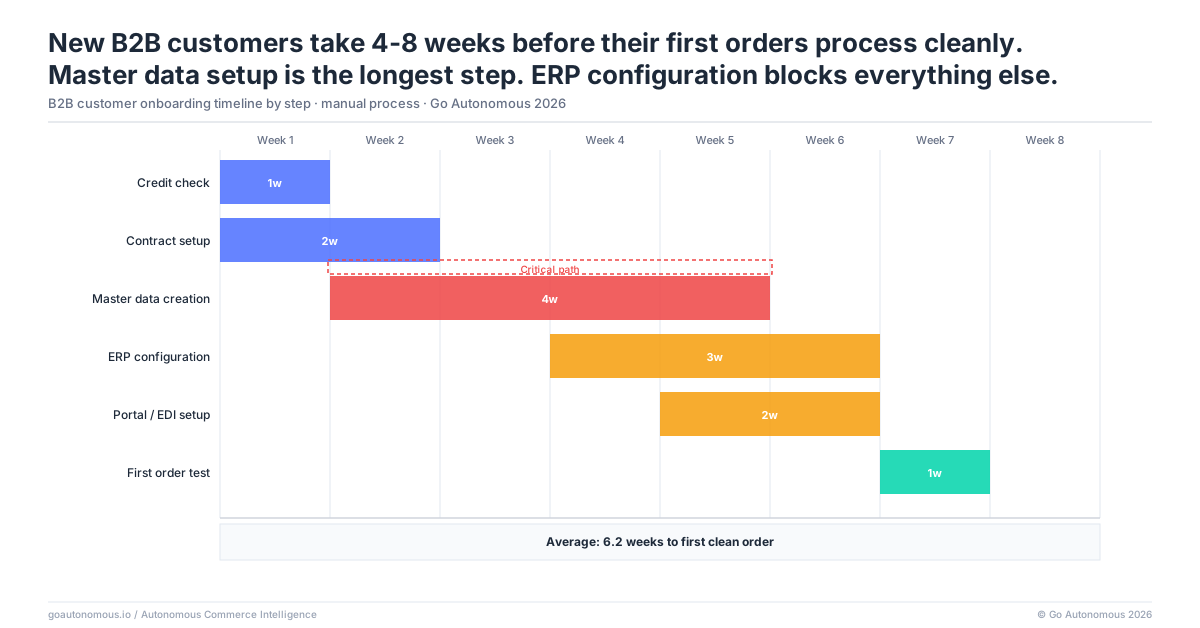
New B2B Customers Take 4–8 Weeks Before Their Orders Process Without Manual Intervention
What Operational Onboarding Actually Covers: Master Data, Pricing, Format Mapping, and Test Orders
Commercial onboarding moves quickly. Signing contracts, activating the account, issuing credentials: these steps complete within days. Operational onboarding, the work required before the new customer’s orders process cleanly through the ERP, is a different sequence entirely.
Operational onboarding includes: creating the customer master record in the ERP, setting up customer-specific pricing conditions, mapping the customer’s product references to the supplier’s item master, configuring delivery addresses, establishing payment terms, and processing test orders to validate the setup. Each step has predecessors. Pricing cannot be configured until the customer account exists. Item reference mapping cannot begin until the first purchase orders arrive with the customer’s product codes. Test orders cannot run until all preceding steps are complete.
Until this full sequence is complete, every order from the new customer requires manual intervention: lookups, corrections, and exception handling that would not exist for an established account. Understanding the efficiency cost of that intervention is the starting point for calculating what slow onboarding actually costs.
Why Commercial Onboarding and Operational Onboarding Move at Different Speeds
The commercial team that closes the deal and the operations team responsible for ERP setup operate on different timelines and different incentive structures. Sales closes and moves on. Operations inherits a setup task that is neither urgent nor visible until something breaks.
In practice, new customer master data setup is queued alongside routine data maintenance work. There is no SLA. No one owns the revenue cost of delay. The result is that commercial onboarding and operational onboarding diverge: the account is “live” commercially for weeks before it is live operationally. Every order placed during that window lands in the exception queue.
Each time we added one or two million euros in revenue, we had to add another operator. From a cost perspective, that's an unsustainable way of operating a business.

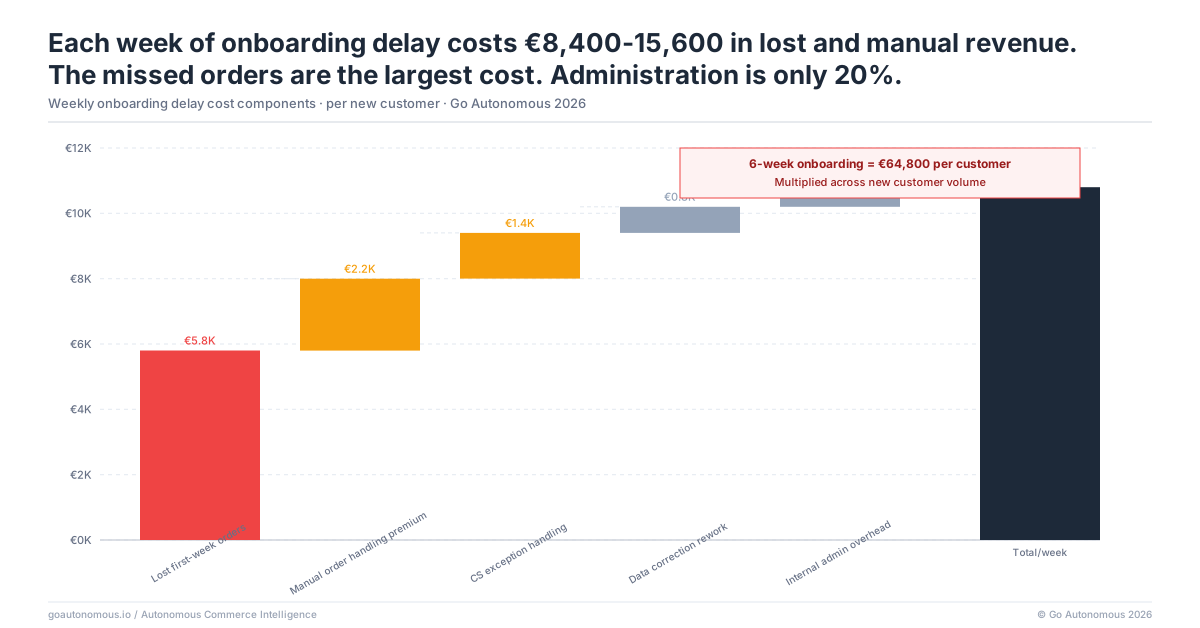
Each Week of Onboarding Delay Is a Week of Manual Processing and Delayed Full Revenue Recognition
The Revenue Calculation: What a 6-Week Onboarding Period Costs a €500K Annual Account
The revenue cost of slow onboarding is rarely calculated explicitly, but the arithmetic is straightforward. A new account expected to generate €500K annually runs at roughly €10K per week of steady-state volume. A 6-week operational onboarding period, during which the customer cannot place full-volume orders without manual intervention, defers €60K in first-year revenue.
That €60K does not disappear permanently. But it slides into a later quarter, disrupting revenue recognition and complicating forecasts. For a portfolio of 20 new accounts per year at this size, the aggregate deferral exceeds €1M annually. This figure never appears on a risk register because no single owner is accountable for the gap between commercial close and operational readiness.
Why Operations Delays Revenue Recognition Without Appearing on Any Risk Register
Beyond deferred revenue, the onboarding window creates early-relationship friction that is costly in a different way. Orders placed during the onboarding period have higher error rates than established account orders because they are processed manually by reps who have never handled this customer before. Wrong product codes, incorrect pricing, misrouted deliveries: these errors occur in the first weeks of a relationship, when the customer’s impression of supplier reliability is being formed.
Customers who experience poor early-order accuracy develop lasting perceptions of supplier operational quality. The commercial team that signed the account delivers it to operations expecting smooth processing. When the first 6 weeks involve repeated exceptions, the relationship starts damaged before it has generated meaningful revenue. The customer experience cost of that friction compounds over the lifetime of the account.
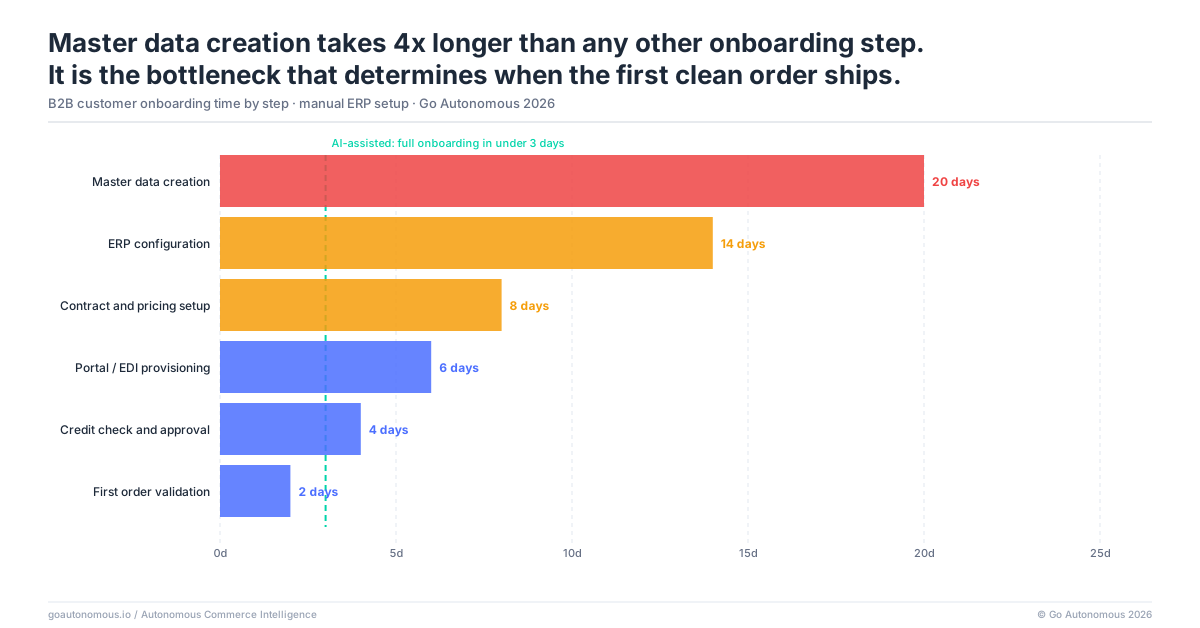
The Master Data Setup Is the Longest Step: ERP Configuration Takes 2–4 Weeks Alone
What Creating a New Customer Master Record Actually Involves in Enterprise ERP Environments
In enterprise ERP environments, creating a new customer master record involves far more than entering a company name and address. Pricing conditions must be created for every product category the customer purchases. Delivery locations must be configured. Payment terms must be entered and linked to the appropriate credit management rules. Tax and regulatory fields must be configured for the customer’s country and VAT status. Each field has dependencies and validation rules that prevent shortcuts.
For manufacturers managing this in SAP or Oracle, the process typically takes 10–15 business days with a trained admin working the setup alongside other responsibilities. In environments with strict change management controls, records require secondary approval before activation, adding further elapsed time. The 2–4 week estimate for master data setup alone reflects the realistic pace of this process in mid-to-large enterprise operations, not a theoretical minimum.
Item Reference Mapping: The Step That Cannot Be Completed Until the First Orders Arrive
Item reference mapping is the step that introduces a second delay wave after initial master data setup. Most B2B customers use their own internal product codes on purchase orders. These codes must be mapped to the supplier’s item master before the ERP can process the order automatically. The mapping table cannot be built until the customer sends purchase orders containing their product codes.
This creates a structural dependency: the first 1–3 orders from any new customer require manual exception handling regardless of how well the master data is configured, because the item reference mapping does not yet exist. Operations teams manage this by maintaining informal “new customer watch lists,” identifying new account orders before they hit the exception queue and handling them manually. That workaround scales poorly as customer acquisition grows. Understanding how autonomous commerce breaks this dependency is central to closing the onboarding gap.
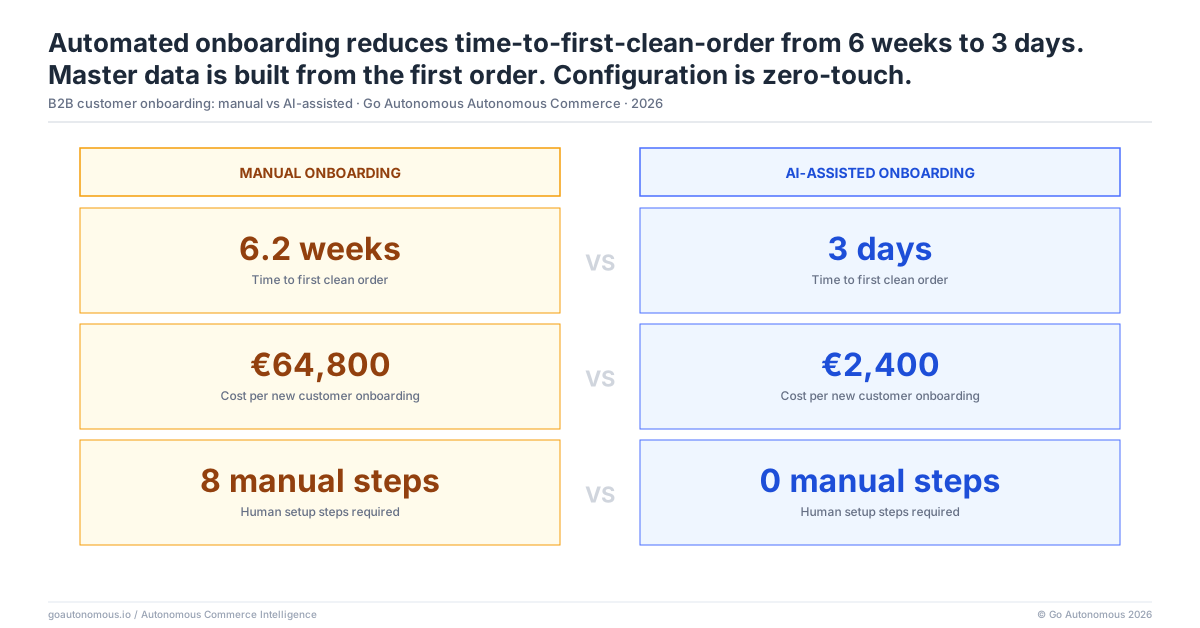
Automated Onboarding Reduces Time-to-First-Clean-Order From 6 Weeks to Under 1 Week
How AI Builds Customer Master Data From the First Inbound Order
Automated onboarding inverts the sequence. Rather than requiring the master data setup to be complete before the first order processes, the AI reads the first inbound purchase order from the new customer, extracts all relevant data: company name, billing and shipping addresses, VAT number, payment terms from the PO header, product references from line items, and proposes a complete customer master record for review and confirmation.
Item reference mapping is built from the same document. The operations team reviews and approves the proposed record rather than building it from scratch. By the time the first order is confirmed, the ERP master record is complete and the item reference map is established. The second order processes cleanly without intervention. The circular dependency between order processing and master data setup dissolves.
What Sales and Operations Teams Gain When Onboarding Is No Longer the Bottleneck
When time-to-first-clean-order drops from 4–8 weeks to under 1 week, both teams gain something concrete. Sales teams close accounts knowing that operational readiness will follow within days, not weeks. The gap between commercial promise and operational delivery closes. Revenue recognition accelerates: the €60K deferred on a €500K account over a 6-week onboarding window is recovered in the same quarter.
Operations teams stop managing new-customer watch lists and manual exception queues for accounts that should process automatically. Early-order accuracy matches established account accuracy from the first order. Customer relationships begin cleanly. Review how manufacturers and distributors have restructured their order operations at Go Autonomous success cases, and see the full efficiency picture at efficiency gains.
If slow onboarding is compressing your first-year revenue per account and creating operational debt before a customer relationship has started, book a conversation with Go Autonomous to see the onboarding acceleration in a live environment.
Frequently Asked Questions
How long does new customer onboarding take in B2B manufacturing before first orders process cleanly?
In B2B manufacturing and distribution, new customer operational onboarding takes 4–8 weeks before the first orders process without manual intervention. This includes ERP master data setup, pricing configuration, item reference mapping, and test order validation. Commercial onboarding — contracts and credentials — moves faster, but the operational setup that determines clean order processing takes considerably longer.
What is the revenue cost of slow customer onboarding in B2B manufacturing?
For a new account generating €500K annually, a 6-week onboarding period defers approximately €60K in first-year revenue. Across a portfolio of 20 new accounts per year at this size, aggregate deferred revenue exceeds €1M annually. Beyond deferred revenue, slow onboarding creates early-order error rates 2–3x higher than established accounts, damaging the customer relationship before it generates meaningful volume.
What are the main bottlenecks in B2B customer operational onboarding?
The main bottlenecks in B2B customer operational onboarding are: ERP master data setup (10–15 business days in enterprise environments), customer-specific pricing configuration, and item reference mapping. Item reference mapping is particularly disruptive because it cannot be completed until the first purchase orders arrive, meaning the first 1–3 orders from any new customer require manual handling regardless of how well the ERP is configured.
How do B2B manufacturers reduce new customer onboarding time without increasing operations headcount?
B2B manufacturers reduce onboarding time without adding headcount by automating the ERP master data creation process. AI-assisted onboarding reads the first inbound purchase order from a new customer, extracts customer details and product references, and proposes a complete customer master record for review. This replaces weeks of sequential manual setup with a review-and-confirm workflow, reducing time-to-first-clean-order from 4–8 weeks to under 1 week.
How does automated order intake reduce B2B customer onboarding time in distribution operations?
Automated order intake reduces B2B customer onboarding time by building the customer master record and item reference mapping from the first inbound order, rather than requiring those steps to be completed before the order can be processed. In distribution operations, this inverts the traditional sequence: instead of completing setup then processing orders, the system creates the setup during first-order processing. Onboarding time drops from 4–8 weeks to 2–5 days.