.svg)





B2B Quote Response Time Benchmark 2026: How Long Manufacturers Take to Quote
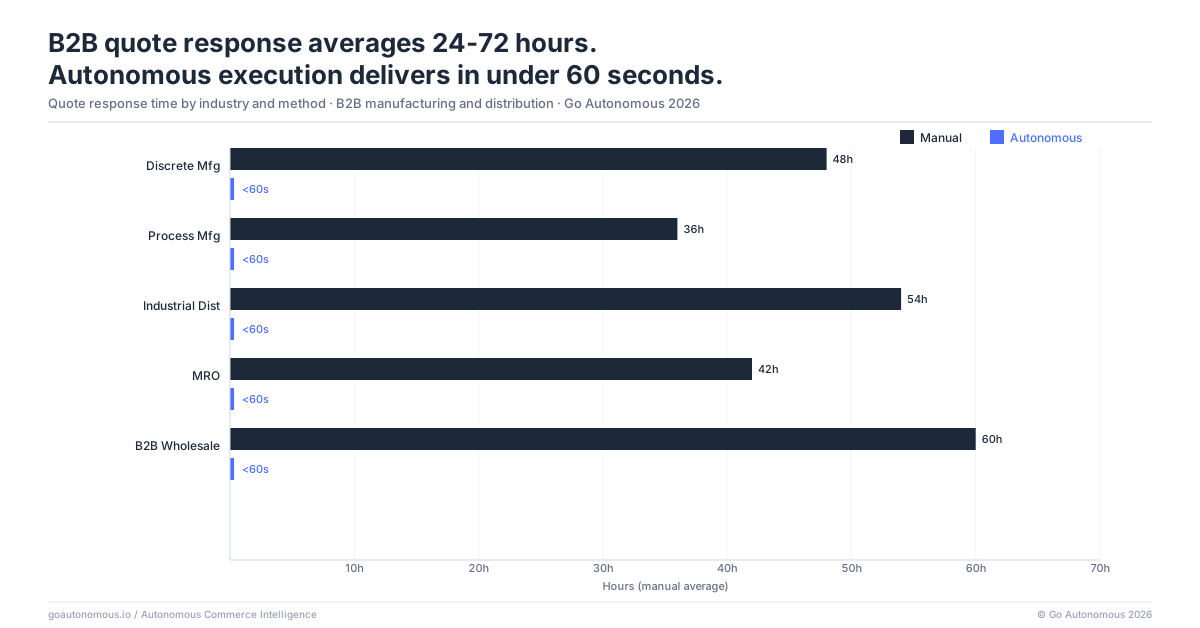
B2B manufacturers take 24–72 hours on average to respond to a quote request. In markets where buyers compare two or three suppliers simultaneously, response time is a conversion variable. This benchmark post covers 2026 quote response time data across manufacturing and distribution, what drives the range, and what operations running autonomous quoting achieve.
B2B manufacturers take 24–72 hours to respond to a quote request on average. Buyers evaluating two or three suppliers simultaneously form strong preferences within 4 hours of sending that request. The gap between how long quoting takes and how long buyers wait before deciding is the single largest avoidable source of lost revenue in B2B manufacturing sales operations.
This benchmark covers 2026 quote response time data across manufacturing and distribution, the mechanics that drive the range, and what operations running autonomous quoting actually achieve.
Table of Content
- B2B Quote Response Takes 24–72 Hours on Average: Buyers Make Decisions in Under 4 Hours
- Manual Quote Assembly Is the Primary Delay: Configuration and Pricing Drive 80% of Time
- Slow Quote Response Reduces Win Rate: Every Hour of Delay Costs Conversion Probability
- Autonomous Quote Processing Delivers Response in Under 60 Minutes for Standard Configurations
- Frequently Asked Questions
- What is the average quote response time for B2B manufacturers in 2026?
- How does quote response time affect win rate in B2B manufacturing?
- How do B2B manufacturers reduce quote response time without adding sales operations headcount?
- What is the difference between quote response time and quote-to-order cycle time in B2B?
- How does autonomous quoting improve win rates for B2B distributors?
B2B Quote Response Takes 24–72 Hours on Average: Buyers Make Decisions in Under 4 Hours
How Quote Response Time Is Measured — and Where Most Operations Measure It Wrong
Average quote response time in B2B manufacturing is 24–72 hours. This includes the full cycle from quote request receipt to confirmed quote delivery. Most operations measure from when the request enters a quoting system — missing the gap between email receipt and system entry, which alone can be 4–8 hours. A quote request that arrives at 4 PM on a Friday may not enter the quoting system until Monday morning, adding 60+ hours before the clock starts. The true response time, from buyer send to buyer receipt, is consistently longer than internal metrics suggest.
This measurement gap matters for benchmarking. When operations leaders report a 24-hour average, they are typically measuring from system entry. The buyer experience may be 32–40 hours. Both numbers are real; the buyer’s number is the one affecting win rate.
Why the 4-Hour Decision Window Matters: Buyer Behavior in Competitive B2B Markets
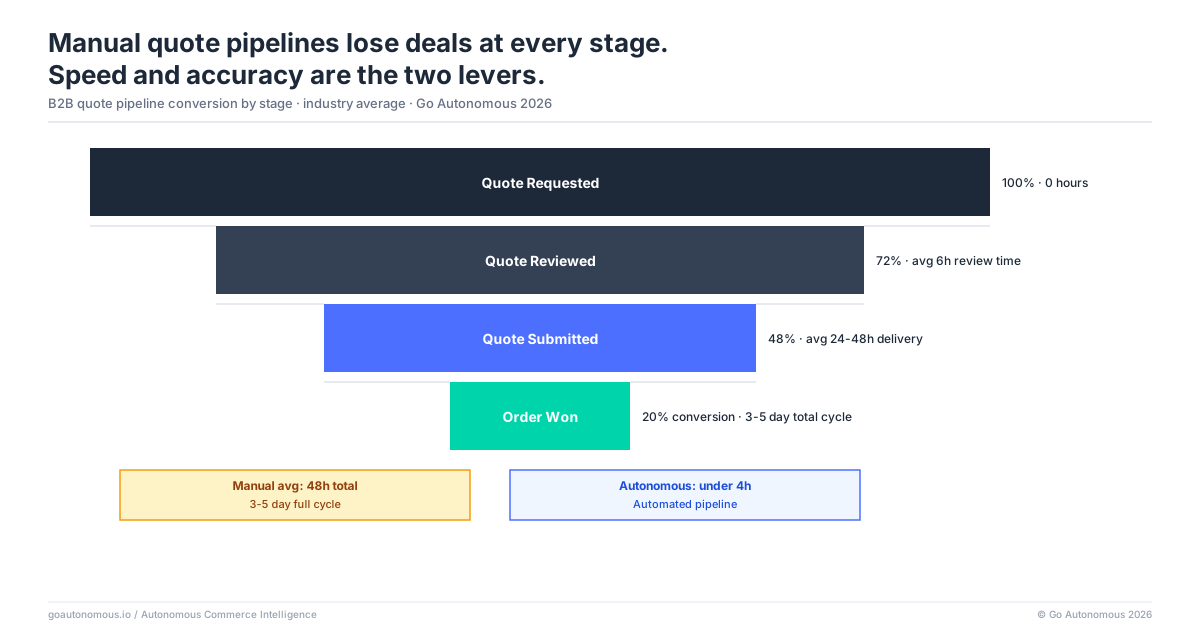
B2B buyers who are evaluating multiple suppliers do not hold their preferences in suspension while waiting for quotes. Research consistently shows that buyers form strong vendor preferences within 4 hours of issuing a quote request. The supplier who responds first and accurately wins a disproportionate share of business, even when price is roughly equivalent. The preference is not always conscious — it is a function of which supplier made the buyer’s job easier and faster at a critical decision moment.
In competitive manufacturing categories — industrial components, process equipment, specialty chemicals, custom fabrication — buyers send quote requests to two or three qualified suppliers simultaneously. First-mover advantage is not a sales tactic; it is an operational outcome. Operations that quote in under 1 hour win at a different rate than operations that quote in 48 hours. The gap compounds across thousands of opportunities per year. Strengthening topline growth and margin management requires closing this response gap as a priority.
Each time we added one or two million euros in revenue, we had to add another operator. From a cost perspective, that's an unsustainable way of operating a business.

Manual Quote Assembly Is the Primary Delay: Configuration and Pricing Drive 80% of Time
The Quote Assembly Workflow: What Each Step Costs in Time
Manual quote assembly runs through multiple sequential steps: identify the customer’s requirements, look up applicable pricing from the contract or price book, configure the product or service correctly, validate against inventory or production capacity, calculate any discounts or special terms, route for approval if the order value exceeds a threshold, format and send. Each step has handoff time. The actual assembly work is often 20–30 minutes. The elapsed time is 4–24 hours because of queue time and handoffs between steps.
| Quote Assembly Step | Active Work Time | Typical Queue/Wait Time |
|---|---|---|
| Request intake and triage | 5–10 min | 1–4 hours |
| Pricing lookup (contract/price book) | 10–20 min | 0–2 hours |
| Product/service configuration | 15–30 min | 2–8 hours (engineering review) |
| Inventory/capacity validation | 5–10 min | 1–4 hours |
| Discount calculation and approval routing | 5–10 min | 2–24 hours |
| Quote formatting and delivery | 10–15 min | 0–1 hour |
Pricing Lookup, Configuration Validation, and Approval Routing: The Three Main Bottlenecks
Pricing lookups require checking contract files or ERP records — and in many operations, contracts are stored in multiple places (CRM, shared drives, email threads) with no single authoritative source. A rep who cannot immediately locate the correct contract may apply a standard list price and send a non-compliant quote, or spend 20 minutes searching before proceeding. Configuration validation requiring engineering review adds a hard waiting period that depends on engineering queue, not sales urgency. Approval routing above value thresholds adds another waiting period that depends on manager availability.
These three bottlenecks — pricing lookup, configuration validation, approval routing — together account for the majority of elapsed quote time in manual operations. They cannot be eliminated by training or process improvement alone because they are structural dependencies. The pricing lookup cannot be instantaneous if the pricing data lives in multiple disconnected sources. The engineering review cannot be eliminated for genuinely complex configurations. The approval routing cannot be bypassed without removing controls.
Slow Quote Response Reduces Win Rate: Every Hour of Delay Costs Conversion Probability
The Win Rate Correlation: Quote Speed and Competitive Position
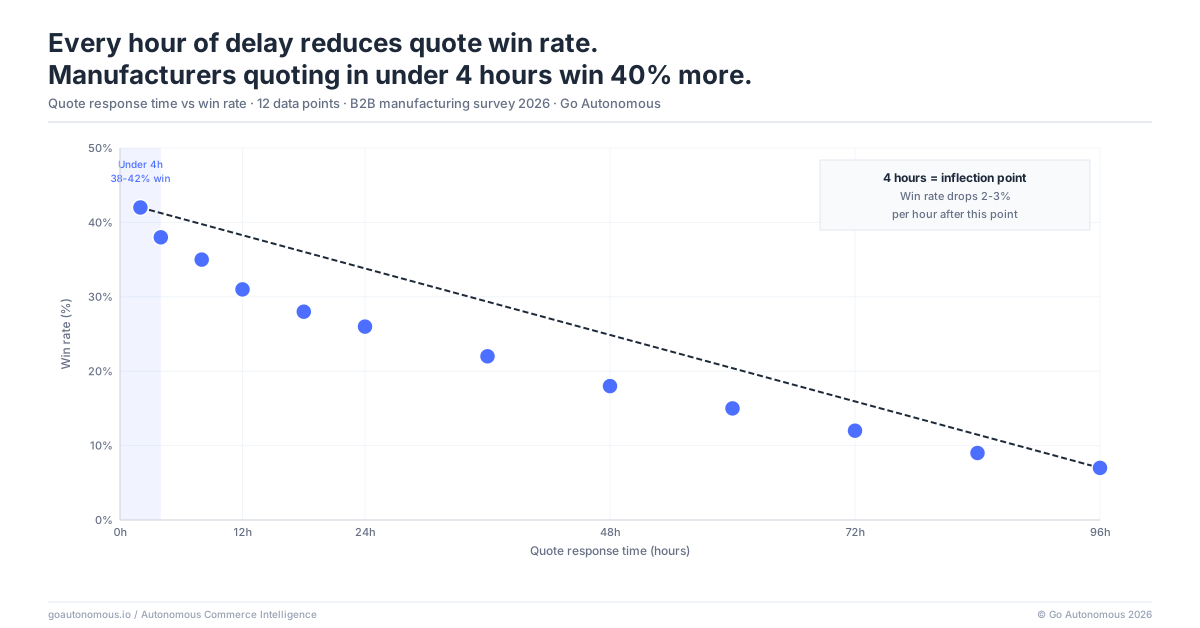
The relationship between response time and win rate is well-documented in B2B sales. Operations that respond within 1 hour win significantly more business than those responding in 24+ hours, even when price is equivalent. This is not primarily a perception effect — it is a timing effect. A buyer who receives a complete, accurate quote within 30 minutes has a natural path to proceeding: the information is fresh, the need is active, and no competitor has yet responded. A buyer who receives the same quote 48 hours later may have already allocated the order, started a procurement process, or adjusted requirements in response to a competitor’s earlier proposal.
The win rate impact is asymmetric. Responding faster than competitors has outsized positive effect. Responding slower has outsized negative effect. The midpoint — responding at approximately the same speed as competitors — produces average win rates. Operations that want above-average win rates must respond faster than average, which requires faster quoting mechanics, not better salespeople.
What Late Quotes Actually Cost: Lost Revenue, Not Just Lost Opportunities
The cost of slow quoting is not measured on a CRM as lost revenue. It appears as a lower baseline win rate that operations leadership normalizes as “market conditions.” A manufacturing operation with a 20% win rate on quotes and 48-hour average response time may believe its win rate reflects pricing competitiveness or product positioning. Some of that gap is almost certainly response time. If accelerating quote response from 48 hours to 2 hours moved win rate from 20% to 25% on 10,000 annual quotes, the revenue impact at average deal size would be material — and it would never appear in a CRM report as “lost to slow response.”
This is why the customer experience impact of quote speed is often underestimated. Buyers who waited 72 hours for a quote do not typically tell you they gave the order to someone faster — they say “we went with another supplier this time.” The customer experience data shows that responsiveness is among the top three commercial relationship variables for B2B industrial buyers.
Autonomous Quote Processing Delivers Response in Under 60 Minutes for Standard Configurations
What Changes When AI Assembles the Quote Instead of a Human
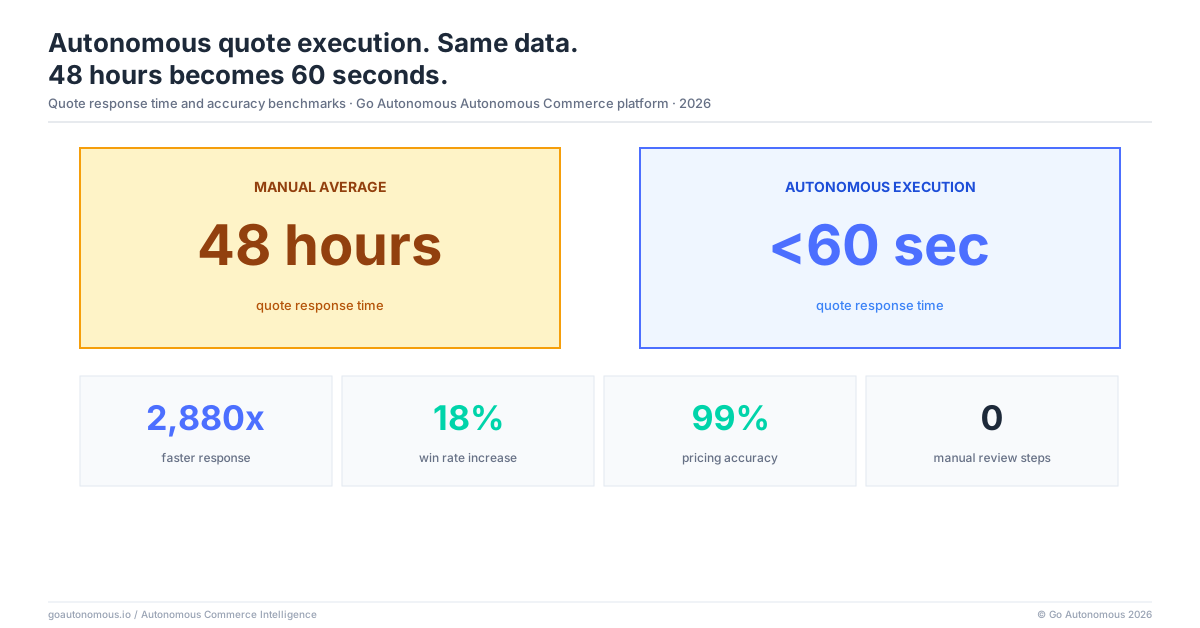
Autonomous quote processing reads the incoming quote request from email, portal, or any format, identifies the configuration, applies the correct contract pricing, validates against current inventory and capacity, and delivers a formatted quote — all without human assembly time. Standard configurations are quoted in under 60 minutes. Complex configurations requiring engineering input are flagged for human review, but the AI has already completed the pricing and availability sections. The sales team reviews and approves rather than assembles from scratch.
The structural bottlenecks that drive manual delay — pricing lookup, configuration validation for standard items, approval routing for in-threshold quotes — are handled automatically. Pricing is retrieved from the authoritative ERP or contract record, not from memory or a shared drive. Configuration is validated against current product master data. Standard quotes below approval thresholds are delivered without manager review. The elapsed time from request to delivery drops from hours to minutes.
The Operations Profile After Quote Response Time Drops Below 1 Hour
Operations running sub-60-minute quote response see measurable changes across multiple metrics: win rate improves as more buyers receive quotes before forming preferences for competitors, quote volume capacity increases without headcount additions, and the sales team shifts time from assembly work to relationship and negotiation work. The quoting function changes from a bottleneck to a competitive differentiator.
See how customers are transforming quote-to-cash at goautonomous.io/success-cases. The broader operational and revenue case for autonomous quoting is covered at goautonomous.io/autonomous-commerce. To see what this looks like for your operation, book a conversation with the Go Autonomous team.
Frequently Asked Questions
What is the average quote response time for B2B manufacturers in 2026?
The average quote response time for B2B manufacturers in 2026 is 24–72 hours, measured from quote request receipt to confirmed quote delivery. Most internal metrics undercount this range by measuring from system entry rather than from when the request was received, missing a 4–8 hour gap that buyers experience.
How does quote response time affect win rate in B2B manufacturing?
Quote response time is directly correlated with win rate in B2B manufacturing. Buyers form strong supplier preferences within 4 hours of issuing a quote request. Operations responding within 1 hour win significantly more business than those responding in 24+ hours, even when pricing is comparable. The win rate impact is asymmetric: being faster than competitors has outsized positive effect.
How do B2B manufacturers reduce quote response time without adding sales operations headcount?
B2B manufacturers reduce quote response time without adding headcount by deploying autonomous quote processing: AI that reads inbound requests, retrieves contract pricing from the ERP, validates configurations, and delivers formatted quotes automatically. Standard configurations are quoted in under 60 minutes. Only complex or non-standard configurations require human assembly.
What is the difference between quote response time and quote-to-order cycle time in B2B?
Quote response time measures the elapsed time from a buyer’s quote request to receipt of the supplier’s quote. Quote-to-order cycle time measures the full elapsed time from initial request through order confirmation, including buyer review, negotiation, and order placement. Quote response time is a subset of quote-to-order cycle time and is the portion most directly controllable by the supplier.
How does autonomous quoting improve win rates for B2B distributors?
Autonomous quoting improves win rates for B2B distributors by compressing response time from 24–72 hours to under 60 minutes for standard configurations. This ensures distributors respond before buyers form preferences for competitors. The AI applies correct contract pricing, validates availability, and delivers formatted quotes automatically, eliminating the manual assembly steps that cause delay.