.svg)





B2B eCommerce vs. Autonomous Commerce: Why a Customer Portal Does Not Close the Order Intake Gap
B2B eCommerce and Autonomous Commerce solve different problems. Portals serve customers who want to self-serve. Autonomous execution handles the other 70 to 80 percent: email orders, EDI exceptions, custom requests, and complex pricing.
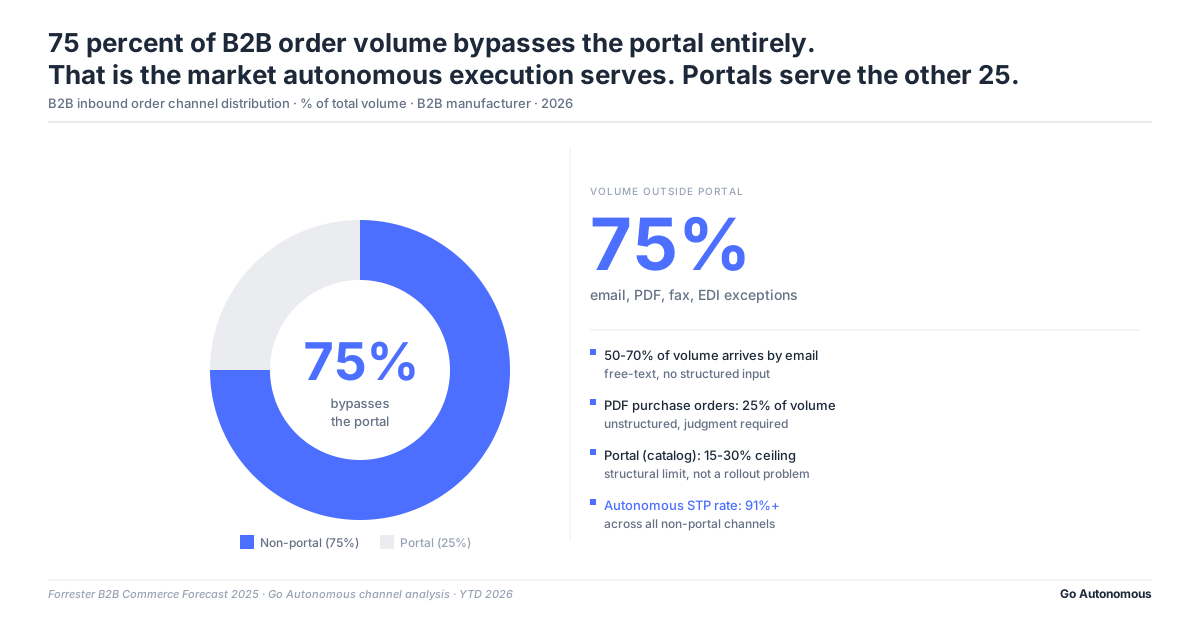
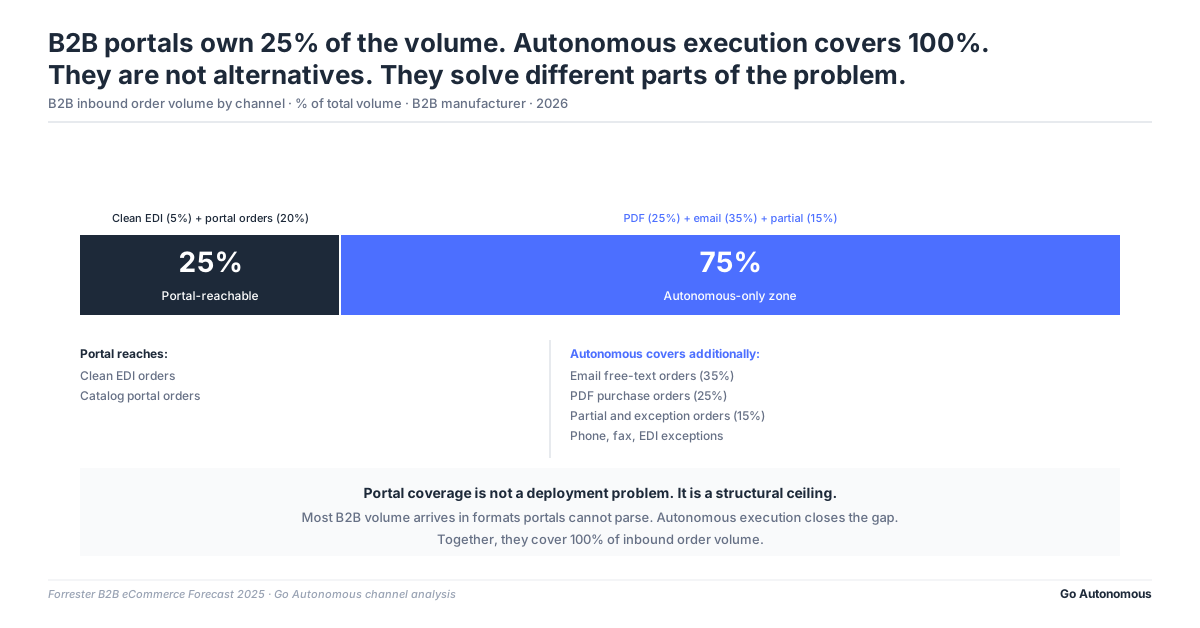
A decade ago, the strategic priority for B2B manufacturers was building a digital self-service portal. The logic was clear: shift demand capture to digital channels, reduce inbound call volume, let customers order on their own terms. Many companies invested heavily. Most saw portal adoption plateau at 15 to 25 percent of incoming order volume. The other 75 percent still arrives via email, EDI, phone call, and spreadsheet attachment. That is not a technology failure. It is a channel reality that no B2B eCommerce platform was designed to solve.
This post draws a sharp line between what B2B eCommerce does well and where it stops, explains what autonomous commerce executes that a customer portal cannot, and provides a before/after operational picture for manufacturers evaluating both in the same stack.
Table of Content
- The Choice B2B Manufacturers Are Actually Facing in Order Intake
- What B2B eCommerce Does Well, and Where Portal Coverage Ends
- What Autonomous Commerce Executes That a B2B Portal Cannot
- Before and After: How Order Intake Changes When Autonomous Execution Joins the Portal
- See How Autonomous Execution Completes Your Order Intake Stack
- Who Should Act Now, and Who Can Wait
- Frequently Asked Questions
- What is the difference between B2B eCommerce and Autonomous Commerce for manufacturers?
- Why do B2B customer portals have low adoption rates in manufacturing and distribution?
- How does autonomous commerce handle email orders that B2B portals cannot?
- Can autonomous commerce and B2B eCommerce work together in the same order management stack?
- What percentage of B2B orders typically come through a self-service portal?
- Why does autonomous order execution complement rather than replace a B2B customer portal?
- Sources
The Choice B2B Manufacturers Are Actually Facing in Order Intake
The framing of B2B eCommerce versus autonomous commerce as competing choices is the first mistake most manufacturers make when evaluating their order intake architecture. They address different problems. B2B eCommerce captures demand from digitally-mature customers ordering standard catalog items through a structured channel. Autonomous commerce executes all incoming order volume regardless of channel, format, or customer digital maturity. These are not alternatives. They address different segments of the same inbound revenue flow.
The question worth asking is not which to choose. It is which problem each one solves, and whether your current stack leaves a gap between them.
What Is the Difference Between B2B eCommerce and Autonomous Commerce for Manufacturers?
B2B eCommerce covers the structured, self-serve segment of incoming order demand. A customer logs into the portal, browses the catalogue, selects standard products, confirms pricing, and submits the order. The portal handles it end-to-end. Autonomous commerce covers the unstructured, non-portal segment: German-language email orders, EDIFACT exceptions, blanket PO call-offs with custom line items, PDF attachments with handwritten quantities, and phone orders transcribed into an order entry system. Most manufacturers receive 70 to 85 percent of their order volume through these non-portal channels, regardless of how long the portal has been live.
What B2B eCommerce Does Well, and Where Portal Coverage Ends
B2B eCommerce platforms are genuinely strong at what they were designed to do. Adobe Commerce (Magento), Salesforce Commerce Cloud, SAP Commerce Cloud, OroCommerce, and Sana Commerce all handle structured catalogue orders, tiered pricing display, customer self-service, and online payment processing with varying degrees of sophistication. For manufacturers with a clean, standardised catalogue and a segment of digitally-mature buyers, portal investment generates real returns: fewer inbound calls, faster standard order processing, better catalogue discoverability.
Why Do B2B Customer Portals Have Low Adoption Rates in Manufacturing and Distribution?
B2B portal adoption rates plateau at 15 to 30 percent in most manufacturing and distribution deployments, even after years of investment. The reason is structural, not behavioural. The customers who most need a portal, those placing standard repeat orders for catalogue products, often already have EDI connections and see no reason to switch. The customers placing the complex orders, those with custom pricing, special delivery conditions, or multi-line blanket call-offs, cannot use the portal because it does not support their order type. The result is that portal adoption concentrates in a narrow middle band of accounts that are neither large enough for EDI nor complex enough to require human handling.
The B2B portal paradox compounds this: the customers who generate the highest order volume and require the most support are the least likely to be fully self-serve capable. A €100M account placing complex quarterly call-offs will not migrate to a portal. Their procurement team has an existing workflow, their ERP sends EDIFACT or purchase order PDFs, and their buyer contacts your inside sales team directly for non-standard requests. Portal investment does not reach them. Manual processing does not shrink. The Human Dependency Ratio stays flat or rises with volume.
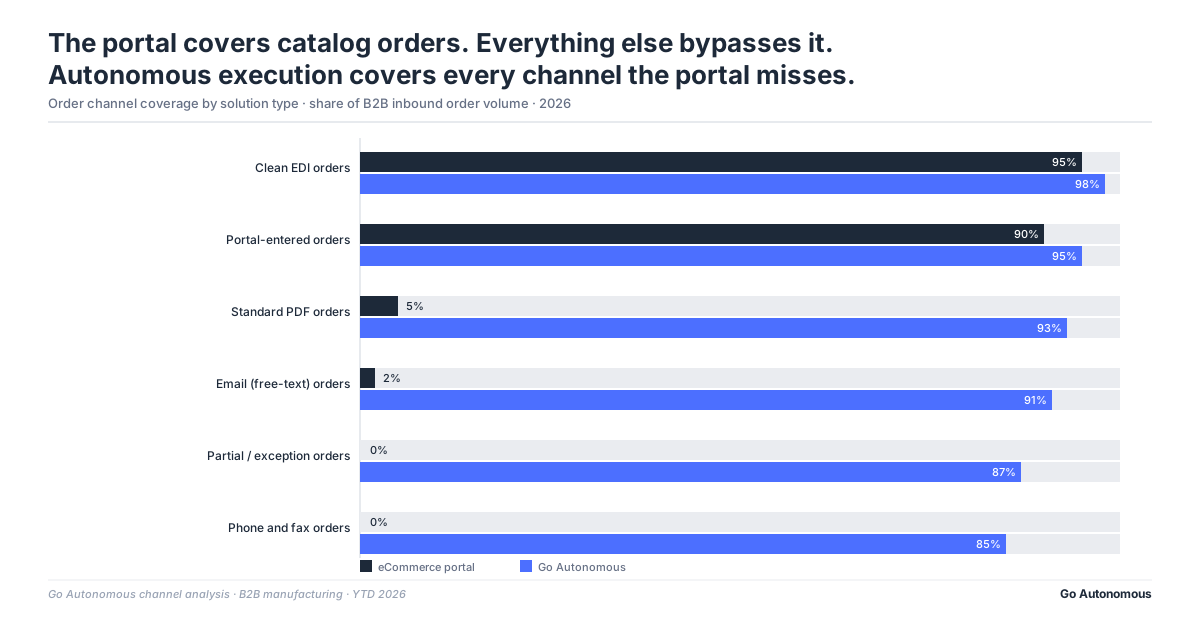
Beyond customer adoption, portals have a hard ceiling on what they can handle even for willing users. Unstructured orders, pricing complexity from tiered contracts, blanket PO call-offs, exception handling, and ERP writeback for non-portal channels all remain manual. The commercial operations team does not shrink because a portal went live. It shrinks only when the volume that bypasses the portal is handled by something other than a human.
What Autonomous Commerce Executes That a B2B Portal Cannot
Autonomous commerce is an execution layer, not a channel. It does not replace the portal. It handles everything that arrives outside it.
How Does Autonomous Commerce Handle Email Orders That B2B Portals Cannot?
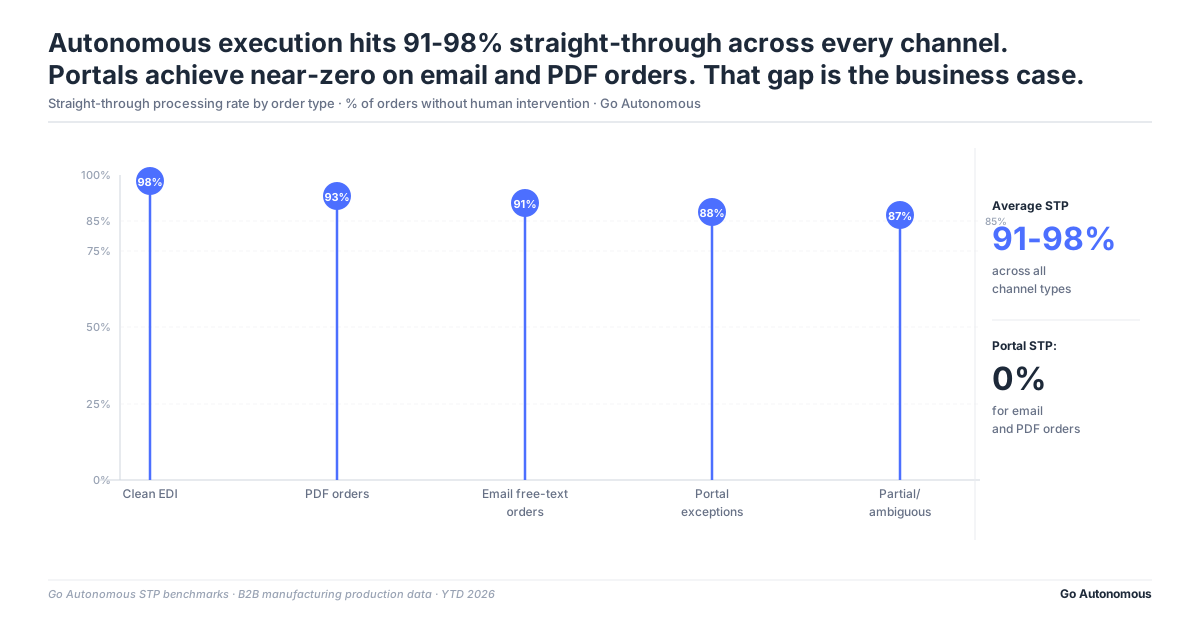
Autonomous commerce reads unstructured order emails, regardless of language or format, extracts line items, quantities, product references, delivery dates, and pricing conditions, validates each line against the ERP pricing master, and either confirms the order autonomously or routes specific exceptions to a human operator. The operator receives a pre-validated exception with full context. They do not re-read the original email or re-enter data. They approve or amend a specific line. This is the process that no B2B eCommerce platform handles, because portals operate on structured input from a logged-in user clicking through a catalogue. They have no mechanism for ingesting an unstructured email and writing back to an ERP.
The channel coverage extends beyond email. Autonomous commerce handles EDI exceptions (EDIFACT ORDERS with pricing deviations or unresolvable product codes), phone order transcripts entered through a web form or integrated telephony, PDF purchase orders attached to emails, and fax orders where legacy customers still use them. Every channel feeds the same intake layer. Every confirmed order writes back to SAP S/4HANA, Oracle Order Management Cloud, or Microsoft Dynamics 365 Order Management via direct API integration.
The distinction between automation and autonomy matters precisely here. Rules-based automation tools such as UiPath, Blue Prism, and Automation Anywhere can process structured, template-consistent inputs efficiently. When the email format changes, when a German customer uses a regional product code abbreviation, or when a pricing exception falls outside the rule set, the automation fails and a human must intervene. Autonomous execution handles edge cases by reasoning about intent, not matching against templates. As the Go Autonomous platform puts it: automation scales labour, but autonomy eliminates dependency. The RPA versus AI execution distinction is not a marketing claim. It determines whether the system degrades at the exception boundary or handles it.
For manufacturers who have invested in document capture and intelligent document processing tools such as ABBYY, Hyperscience, or Rossum, the distinction is also relevant. IDP extracts data from documents. It does not validate against ERP pricing, resolve mismatches, confirm orders, or write back to the system of record. IDP produces structured data. Autonomous commerce produces confirmed orders.
Adopting Autonomous Commerce at Danfoss is not just about speed and efficiency. It's about empowering our customer service teams and sales force to focus on building relationships and providing personalized support.

Before and After: How Order Intake Changes When Autonomous Execution Joins the Portal
The operational picture changes significantly when autonomous execution handles the non-portal volume that currently runs through your commercial operations team. The table below maps the dimensions that matter for a VP Operations or Order Management Director evaluating both in the same stack.
| Order intake dimension | B2B eCommerce only | Autonomous Commerce added |
|---|---|---|
| Channel coverage | Portal only: 15 to 30 percent of incoming order volume | All channels: email, EDI, portal, phone, fax. Full coverage regardless of customer format preference. |
| Format handling | Structured catalogue orders only. No unstructured input. | Any format including unstructured PDF, German-language email, EDIFACT exception, blanket PO call-off. |
| Customer scope | Digitally-mature, self-serve ready segment only | All customers regardless of digital maturity or procurement process |
| Exception handling | Manual escalation to CSR team for every non-portal order | Autonomous resolution for pricing, quantity, and master data exceptions. Human handles only unresolvable cases. |
| ERP integration | Frontend display only. ERP writeback for non-portal orders still manual. | Direct ERP writeback: SAP S/4HANA, Oracle Order Management Cloud, Microsoft Dynamics 365 |
| Headcount impact | Reduces call-in standard orders. Back-office team size for non-portal volume unchanged. | Reduces order management headcount requirement for all non-portal volume. CSR team handles genuine exceptions only. |
| Order processing time | Instant for portal orders. Hours to days for non-portal volume handled manually. | Minutes for autonomous orders across all channels. Portal speed unchanged. |
The before/after picture clarifies why the two are complementary rather than competing. The portal accelerates the structured, self-serve segment. Autonomous execution accelerates everything else. A manufacturer deploying both reaches near-full order intake coverage: fast structured orders through the portal, fast unstructured orders through autonomous execution, and a commercial operations team focused on the exceptions that genuinely require human judgment.
The Danfoss deployment illustrates this at scale. Operating across 26 countries, Danfoss processes 80 percent of order decisions autonomously, with order processing time compressed from 42 hours to under one minute. The Danfoss case study documents a deployment that spans multiple channels including portal, EDI, and email, with autonomous execution handling the full non-portal and EDI-exception volume.
Nilfisk, deploying autonomous commerce for order management, freed significant working capital and reduced manual processing steps by more than half. The Nilfisk deployment demonstrates the pattern common across manufacturers: portal investment was already in place, but the non-portal order volume remained a manual bottleneck until autonomous execution was added. The two systems operate in parallel, each handling their respective channel segment.
Can Autonomous Commerce and B2B eCommerce Work Together in the Same Order Management Stack?
Yes, and most deployments of autonomous commerce at manufacturers with existing portal investments operate exactly this way. The portal handles the structured self-serve segment. Autonomous execution handles the email, EDI exception, and phone order volume. Both write confirmed orders to the same ERP instance. The commercial operations team receives a unified order queue from all channels, with exceptions flagged and pre-validated regardless of their origin. The ERP sees clean, confirmed orders from both channels. The customer experiences consistent confirmation speed regardless of which channel they used.
For manufacturers evaluating the era of autonomous commerce, the architectural shift is from single-channel portal investment to full-coverage execution. Portal plus autonomous execution is the complete stack for manufacturers with mixed order channels. Autonomous execution alone is the starting point for manufacturers whose customer base is not portal-ready. The customer success cases span both configurations.
The metric that captures what changes is Friction Debt: the total monetary cost of manual decisions still happening in the revenue flow. A portal reduces friction debt for the self-serve segment. It leaves friction debt unchanged for the 70 to 85 percent that bypasses it. Autonomous execution pays down the friction debt on the non-portal volume. Together, the two systems drive friction debt toward zero across the full order intake surface.
See How Autonomous Execution Completes Your Order Intake Stack
If your portal adoption has plateaued below 30 percent and your commercial operations team is growing to handle the non-portal volume, you already know the gap this post describes. The question is not whether autonomous execution would help. It is what it looks like in your specific stack: your ERP, your existing portal, your primary unstructured channels. Go Autonomous works with 500 million to 20 billion EUR manufacturers and distributors in the Nordics, DACH, Benelux, UKI, and France. We can show you exactly how autonomous execution integrates alongside your existing portal investment, what the non-portal channel coverage looks like in practice, and what processing time looks like after deployment. Book a conversation with our team.
We are constantly exploring new ways to strengthen our operations and better serve our customers. The Autonomous Commerce Platform allows us to scale excellence in customer experience.
Who Should Act Now, and Who Can Wait
This is a decision framework, not a push. The criteria below are honest. If you recognise your situation in the “act now” column, the architecture case is clear. If your situation genuinely fits the “wait” criteria, the priority is probably something else.
Act now if:
- 40 percent or more of your incoming order volume arrives outside your portal (email, EDI exceptions, phone). Your CSR team is the primary intake layer for the majority of your orders.
- Your commercial operations headcount grows at the same rate as your order volume. Revenue growth requires proportional FTE growth because the processing ceiling does not move without it.
- Customers experience variable service quality based on which channel they used to send the order. Portal orders confirm in minutes. Email orders confirm in hours or days. That inconsistency shows up in customer satisfaction scores.
- Portal adoption has plateaued below 30 percent despite years of investment and customer onboarding effort. The plateau is not a training problem. It is a channel reality problem that autonomous execution addresses from the other direction.
- You are planning an ERP migration to SAP S/4HANA or Oracle Order Management Cloud. The migration window is the lowest-cost moment to add the autonomous execution layer. Retrofitting post-migration requires duplicate integration work.
You can wait if:
- More than 70 percent of your order volume already processes via structured EDI or portal with near-zero exceptions. Your commercial operations team handles genuine exceptions only, not routine order entry.
- Your total order volume is under 100 orders per day and fully standardised. At that volume, the processing cost savings do not justify the deployment timeline.
For most manufacturers processing 200 or more orders per day with mixed channels, the “wait” criteria do not apply. The gap between portal coverage and total incoming volume is the gap autonomous execution closes. The operational efficiency gains and the customer experience improvements both compound the longer the non-portal volume grows without an execution layer behind it.
Frequently Asked Questions
What is the difference between B2B eCommerce and Autonomous Commerce for manufacturers?
B2B eCommerce captures structured demand from digitally-mature customers ordering catalogue products through a self-service portal. Autonomous commerce executes all incoming order volume regardless of channel or format, including unstructured email, EDI exceptions, PDF attachments, and phone orders. They address different segments of the same order intake problem and are designed to work together, not as alternatives.
Why do B2B customer portals have low adoption rates in manufacturing and distribution?
B2B portal adoption plateaus at 15 to 30 percent in most manufacturing deployments because the customers generating highest order volume, those with complex pricing, custom line items, or blanket PO call-offs, cannot fully use a portal. Large accounts use EDI and are not migrating. Complex accounts require non-standard handling the portal does not support. Portal investment reaches only the narrow middle band of accounts.
How does autonomous commerce handle email orders that B2B portals cannot?
Autonomous commerce reads unstructured order emails in any language, extracts line items, quantities, product references, and delivery conditions, validates each line against the ERP pricing master, and either confirms the order autonomously or routes specific exceptions to a human operator with full context pre-populated. No portal can ingest unstructured email input and write back confirmed orders to an ERP.
Can autonomous commerce and B2B eCommerce work together in the same order management stack?
Yes. Most manufacturers deploying autonomous commerce already have a B2B portal in production. The portal handles the structured self-serve segment. Autonomous execution handles email, EDI exception, and phone order volume. Both write confirmed orders to the same ERP instance, whether SAP S/4HANA, Oracle Order Management Cloud, or Microsoft Dynamics 365. The commercial team receives a unified order queue regardless of channel origin.
What percentage of B2B orders typically come through a self-service portal?
Most B2B manufacturers report portal adoption of 15 to 30 percent of total incoming order volume after sustained investment and customer onboarding. The remaining 70 to 85 percent arrives via email, EDI, phone, and other non-portal channels. This ratio persists regardless of portal maturity because the non-portal volume comes from customers whose procurement workflows are not portal-compatible.
Why does autonomous order execution complement rather than replace a B2B customer portal?
A B2B portal accelerates structured orders from self-serve-capable customers. Autonomous execution accelerates everything else: unstructured email, EDI exceptions, phone orders, and complex order types the portal cannot handle. The portal cannot be extended to cover non-portal channels because those channels require reasoning about unstructured input, not structured form submission. Each solution addresses a distinct segment of the same inbound revenue flow.