.svg)





RPA vs. AI Agents for B2B Order Processing: A Decision Framework for Operations Leaders
RPA reduced keystrokes in a more predictable era of B2B order processing. This post gives Operations Directors a clear framework for deciding when RPA still works, when it hits a structural ceiling, and what AI agents deliver that rule-based automation cannot.
A decade ago, a B2B manufacturer invested six figures and eighteen months deploying RPA across its order intake process. Bot coverage reached 65 percent of incoming transactions. The project was declared a success. Today, that same manufacturer processes a higher share of its orders manually than it did before the RPA program launched, because email volume has doubled, PDF attachments have proliferated, and the exception queue that bots cannot handle has grown faster than the structured inputs they can.
That story is not unusual. It describes a structural tension that Operations Directors across B2B manufacturing and distribution are navigating in 2026: RPA was designed for a different order environment. The question is not whether RPA worked. It did, in its context. The question is whether that context still describes your operation, and if not, what the architecture that fits the current reality actually looks like.
This post answers a specific decision question: should you be evaluating AI agents alongside or instead of RPA for B2B order processing? It names the tools in both categories, describes what each delivers, explains where each stops, and gives you a framework for deciding where you sit on that spectrum.
Table of Content
- The Choice B2B Operations Leaders Are Actually Facing in 2026
- What RPA Delivers for B2B Order Processing, and Where It Hits Its Ceiling
- What AI Agents Deliver: The Execution Layer RPA Cannot Reach
- The Decision Framework: RPA vs. AI Agents for B2B Order Processing
- Evaluate Whether Your Order Processing Architecture Has Hit the RPA Ceiling
- Who Should Act Now, and Who Can Wait
- Frequently Asked Questions
- What is the difference between RPA and AI agents for B2B order processing?
- When does RPA stop being enough for B2B order management?
- How do AI agents handle unstructured order inputs that RPA cannot process?
- What is the Human Dependency Ratio and why does it matter for evaluating RPA vs AI agents?
- What is Friction Debt in B2B order processing and how is it calculated?
- How long does it take to deploy AI agents for B2B order processing?
- Which B2B manufacturers and distributors are the right fit for autonomous order execution?
The Choice B2B Operations Leaders Are Actually Facing in 2026
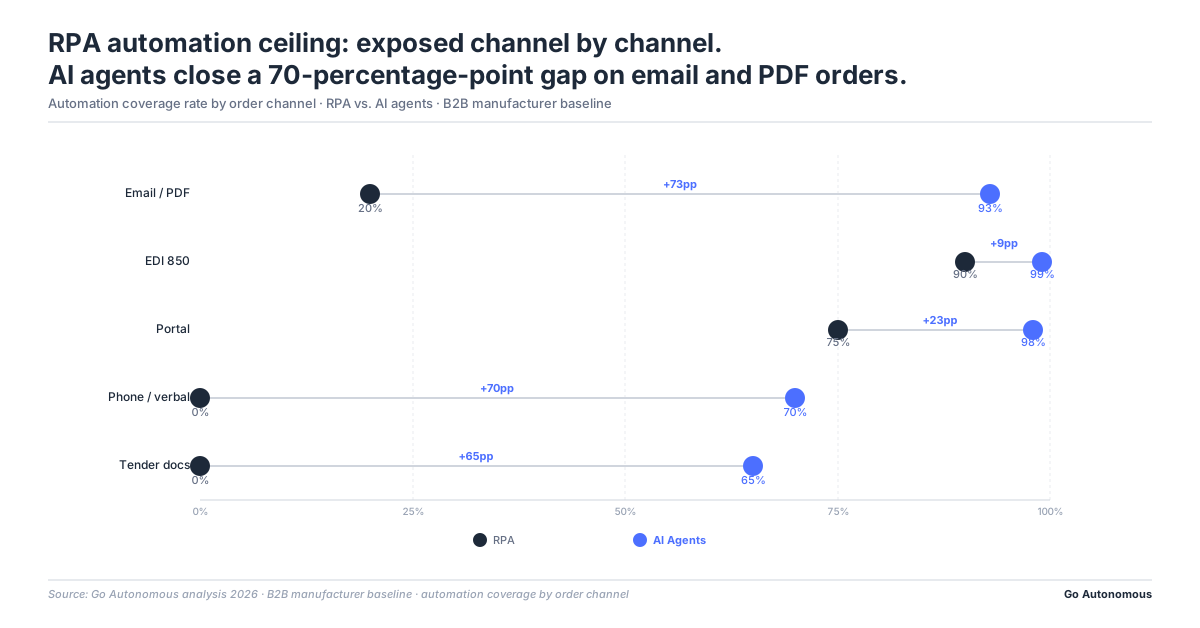
The RPA vs. AI agents question for B2B order processing is not a technology debate. It is an architecture decision with a direct commercial consequence. Between 50 and 70 percent of B2B order volume still arrives via email and PDF, according to Go Autonomous deployment data across 30 billion-plus processed B2B transactions. Exception rates at manufacturers and distributors processing complex commercial orders run between 20 and 40 percent of all incoming orders. Neither of those figures fits the operational profile that RPA was designed to serve.
RPA tools including UiPath, Blue Prism, and Automation Anywhere were built on a core assumption: that inputs are structured, channels are controlled, and rules can be written in advance to cover the meaningful variation in a workflow. For large portions of back-office processing, that assumption holds. For commercial B2B order management, it increasingly does not.
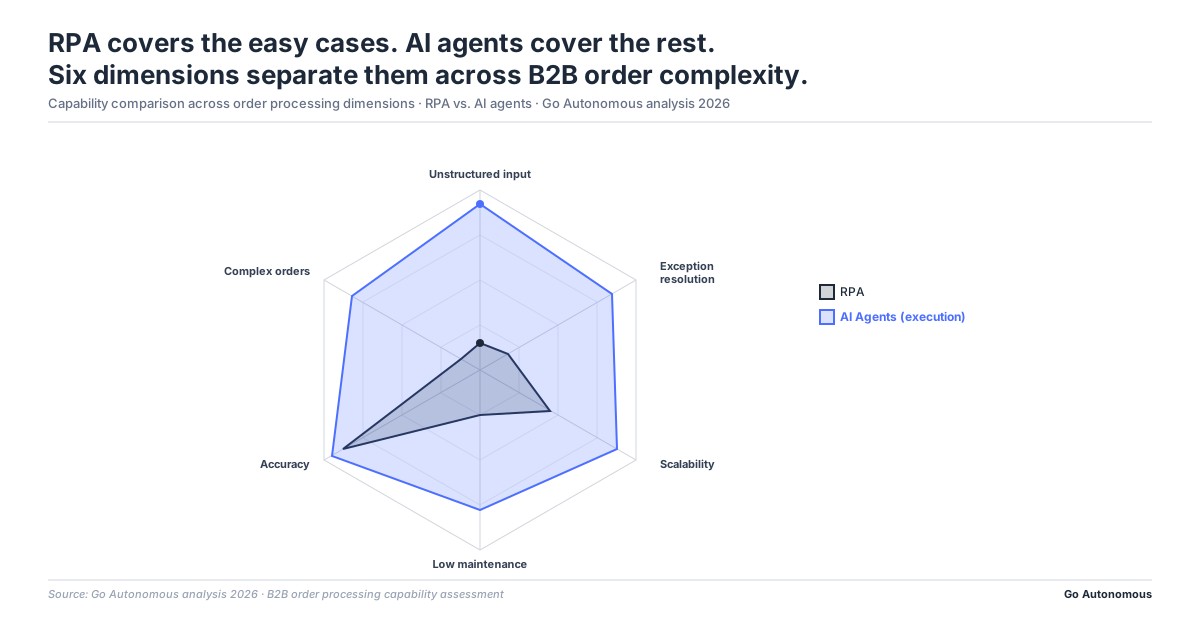
The contrast that matters is not speed. Both categories can move fast on structured inputs. The contrast is cognitive scope: what the system can handle autonomously when the input is ambiguous, incomplete, or exception-bound. That is the decision axis.
What is the difference between RPA and AI agents for B2B order processing?
RPA automates structured, rule-defined tasks by mimicking human interaction with existing interfaces. AI agents for B2B order processing execute commercial transactions end-to-end, including reading unstructured inputs like email and PDF, resolving exceptions against pricing and catalog data, and writing confirmed orders back to the ERP without human intervention. The difference is not speed. It is cognitive scope: RPA follows rules; AI agents apply judgment within defined policy boundaries.
That distinction is precise and consequential. A UiPath bot can copy an order number from a portal screen into SAP S/4HANA faster than any operator. It cannot read a customer email that says “please send us the same order as last quarter but swap the 40mm fittings for 50mm and apply our Q3 contract pricing,” parse the intent, identify the correct SKUs, validate the pricing agreement, and confirm the order. That gap is where 60 to 80 percent of commercial order handling cost lives in most B2B operations.
What RPA Delivers for B2B Order Processing, and Where It Hits Its Ceiling
RPA delivers measurable value in the right operational context. For manufacturers and distributors with high-volume, structured EDI flows or clean portal-submitted orders, RPA can drive touchless rates above 80 percent. It eliminates keystrokes, reduces data-entry errors on predictable fields, and compresses cycle time on the transactions it can process. Those are real outcomes. They are also the full ceiling of what rules-based automation can reach.
When does RPA stop being enough for B2B order management?
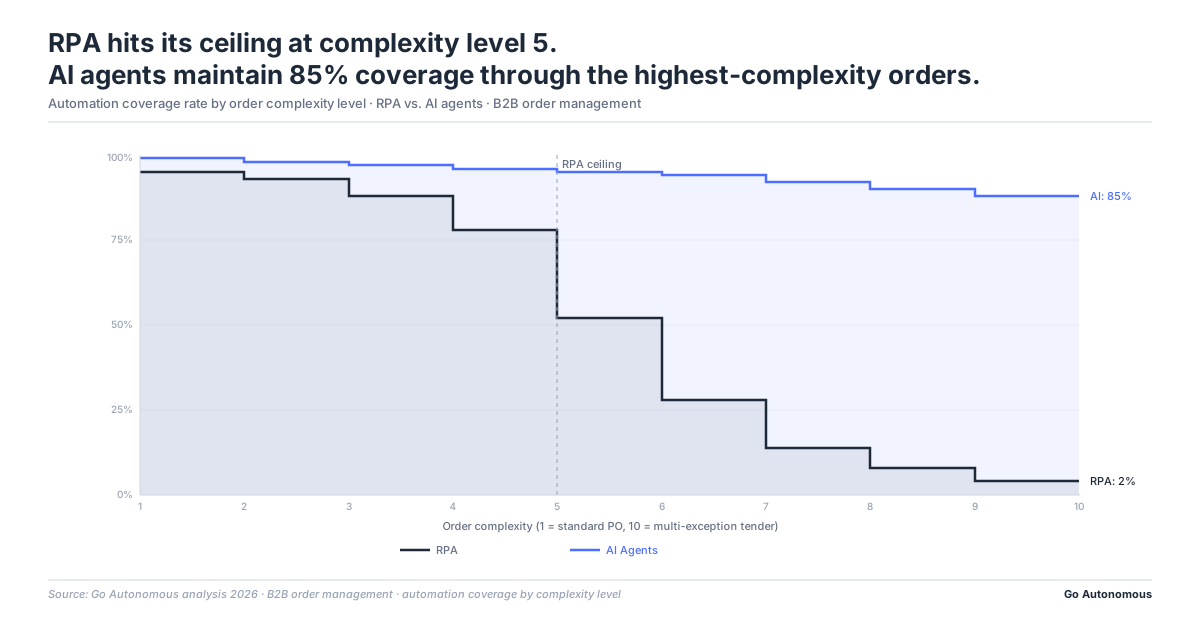
RPA stops being enough for B2B order management when exception rates exceed 20 percent of incoming volume, when email and PDF are primary inbound channels, or when pricing complexity and catalog variability outpace the rule set. At that point, the exception queue grows faster than bot coverage expands, and the net reduction in manual handling is negligible or negative despite significant RPA investment.
The structural limit of RPA in commercial order processing runs through three failure modes.
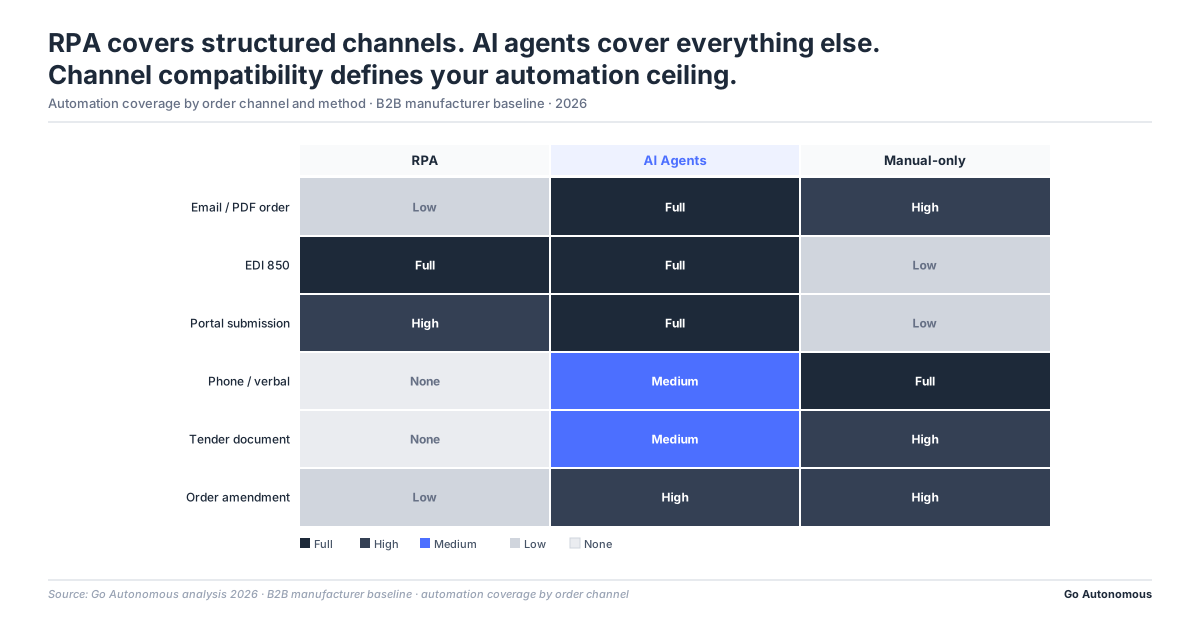
First: channel dependency. RPA operates on structured interfaces. It reads fixed-field EDI files, standardized portal submissions, and screen-scrapes from known UI layouts. Email inboxes, PDF attachments, and fax-converted documents sit outside that boundary. Automation Anywhere and Blue Prism both offer document processing add-ons, and ABBYY, Rossum, and Hyperscience provide intelligent document processing (IDP) layers that can be bolted on to extend RPA reach into unstructured documents. However, these are capture tools. They extract data fields. They do not execute the transaction. A human still makes the commercial judgment on every exception those tools cannot confidently classify, which, in complex B2B environments, is a substantial share of total volume.
Second: exception ownership. RPA routes what it cannot process to a human queue. Every rule added to reduce that queue introduces new boundary conditions that generate new exceptions. Operations teams running mature RPA programs describe a dynamic where bot maintenance consumes an increasing share of the productivity gains the bots were deployed to produce. The rule set grows. The exceptions it fails to anticipate grow with it. The queue does not shrink.
Third: the Human Dependency Ratio does not move. Human Dependency Ratio (HDR) measures the number of manual decisions still required per unit of revenue processed. RPA reduces keystrokes. It does not reduce HDR. Every exception that reaches a human queue represents a manual decision the system could not make. If HDR is not declining as RPA coverage expands, the operation has built a larger automation layer on top of the same human decision dependency it started with.
Human Dependency Ratio (HDR) is the number of manual decisions required per unit of revenue processed. It measures whether a system is truly autonomous or merely automated. HDR declines as the system takes on more commercial judgment; it holds flat or rises when automation only handles structured inputs while humans continue to own exception decisions. For manufacturers processing complex commercial orders, HDR is the metric that exposes where autonomous execution ends and human dependency begins.
The honest version of this ceiling: RPA scales labor. It does not eliminate the dependency on human judgment in commercial order processing. That distinction is the core of the decision framework.
Adopting Autonomous Commerce at Danfoss is not just about speed and efficiency. It's about empowering our customer service teams and sales force to focus on building relationships and providing personalized support.

How do AI agents handle unstructured order inputs that RPA cannot process?
AI agents handle unstructured order inputs by applying natural language understanding and contextual reasoning, not rule-matching. They read customer emails, interpret intent, resolve line-item ambiguities against the product catalog and pricing master, validate against the customer’s contract terms, and execute the transaction end-to-end with ERP writeback, without a human in the loop for inputs that fall within defined policy boundaries.
This matters because the operational reality of B2B order processing in manufacturing and distribution is fundamentally unstructured. Customer service teams at €500M-plus manufacturers receive orders in the same email thread that contains an amendment, a complaint, and a delivery question. Attachments include PDFs with incorrect SKU codes, handwritten notes, and pricing references that do not match the current system of record. EDI 850 purchase orders arrive with line items that call out blanket PO call-off quantities against contracts that were renegotiated three months ago.
None of that is an edge case. It is the mainstream of commercial order intake at industrial scale. RPA and AI agents differ on exactly this axis: one requires structured input to function; the other is built to execute despite the absence of structure.
What AI Agents Deliver: The Execution Layer RPA Cannot Reach
The Autonomous Commerce platform represents the execution layer that sits between commercial intent (what the customer sent) and commercial execution (the confirmed order in the ERP). It does not replace SAP S/4HANA Order Management, Oracle Order Management Cloud, or Microsoft Dynamics 365. Those platforms validate and record the transaction. Autonomous Commerce reads the signal, resolves the ambiguity, and delivers a clean, policy-compliant transaction to the ERP for processing, without a human decision at every step.
The distinction between an execution layer and a task layer is specific. RPA is a task layer. It automates individual steps in a workflow that was already defined by human architecture. An AI execution layer takes ownership of the commercial outcome, applying judgment across the full transaction rather than executing individual defined steps. When a customer submits an order via email with three line-item exceptions, the AI agent resolves those exceptions against the pricing master, validates the substitutions against catalog availability, applies the correct contract-tier pricing, and confirms the order. No human queue. No escalation. No processing lag.
Friction Debt is the metric that captures what this costs when it is absent. Friction Debt measures the total monetary cost of human decisions still happening in the revenue flow. Every exception routed to a human queue, every pricing mismatch resolved by a senior operator, every order held pending clarification accumulates as friction debt on the operating cost line. RPA does not reduce friction debt in complex order environments. It shifts it from data entry to exception handling. The debt remains. It simply changes address.
Friction Debt is the total monetary cost of manual decisions that remain embedded in the revenue flow. It accumulates across three components: decision time (the wait between a decision being needed and a decision being made), decision cost (the fully loaded cost of the people required to make it), and decision drag (the downstream commercial impact of late decisions on orders, quotes, and customer retention). Every data field touched by a human is friction debt.
For manufacturers and distributors operating across multiple geographies, channel diversity compounds the problem. A Danfoss-scale operation processes orders across 26 countries, with customer communication arriving in multiple languages, against pricing structures that vary by region and contract tier. The Danfoss case, documented on the Go Autonomous site, reflects the structural shift from human-dependent order intake to autonomous execution at exactly this level of commercial complexity. The results demonstrate what that shift delivers at scale: order confirmation time fell from 42 hours to under one minute, 80 percent of transactional decisions now execute without human input, and overall processing time reduced by 50 percent across 26 countries deployed simultaneously. The investment thesis was not speed. It was eliminating the human dependency in the transaction layer so that customer-facing teams could allocate their capacity to relationship and strategic account work.
AI-driven automation serves as a powerful motivator for process optimization. With immediate and tangible results that are transparent to all stakeholders, the impact of master data cleanup and enrichment is unmistakable.
At Mediq, processing approximately 4,000 orders per week in a regulated healthcare distribution environment across the Nordics, order handling time on the largest orders fell by 75 percent with no headcount addition. The organization decoupled revenue growth from staffing cost entirely, the structural outcome that rules-based automation cannot reach. The white paper The Autonomous Execution Fabric: Five AI Lessons on Enterprise AI addresses the implementation reality: how autonomous execution integrates with existing ERP infrastructure, what master data requirements look like in practice, and how the policy-embedding process works for commercial transactions. It is the architectural reference for Operations Directors evaluating whether this layer fits their current technology environment.
The Decision Framework: RPA vs. AI Agents for B2B Order Processing
Which is better for B2B manufacturers: RPA or AI agents for order processing?
For B2B manufacturers, the answer depends on the nature of order inputs and the exception rate. RPA is better suited to high-volume, fully structured flows with predictable EDI or portal submissions and exception rates below 10 percent. AI agents are the correct architecture when email and PDF represent more than 30 percent of inbound order volume, exception rates exceed 20 percent, or the commercial complexity of orders exceeds what a rule set can govern reliably. Most manufacturers processing over 500 orders per week operate in the second category.
The table below maps the specific dimensions that determine which architecture fits your operation.
| Dimension | RPA (e.g. UiPath, Blue Prism, Automation Anywhere) | AI Agents (Autonomous Commerce) |
|---|---|---|
| What it handles | Structured, rule-defined tasks on known interfaces and formats | Full commercial transactions including unstructured inputs, ambiguity resolution, and exception execution |
| Input types supported | EDI files, portal-submitted orders, structured forms, screen-scrape targets | Email, PDF, EDI 850/855, EDIFACT, portals, fax-converted documents, multi-channel in parallel |
| Exception handling | Routes exceptions to human queue; cannot resolve ambiguous inputs autonomously | Resolves exceptions against pricing master, catalog, and contract data within defined policy boundaries |
| Human decision dependency | Reduces data-entry keystrokes; HDR does not decline on exception-heavy order flows | Drives HDR toward zero for in-policy transactions; humans handle genuine out-of-policy escalations only |
| ERP integration depth | Screen-scrape or API trigger for defined fields; writeback limited to configured data fields | Full ERP writeback (SAP S/4HANA, Oracle Order Management Cloud, Microsoft Dynamics 365) including line-item resolution and contract validation |
| ROI driver | FTE hours saved on structured data entry; error reduction on predictable fields | Friction Debt reduction, HDR compression, capacity released from exception handling, working capital improvement via faster order-to-cash |
| Scale ceiling | Exception queue grows proportionally with volume; RPA maintenance overhead rises with rule set complexity | Scales with volume without proportional headcount or rule-set growth; policy updates govern new scenarios |
| Deployment timeframe | 6,18 months for enterprise deployment; ongoing rule maintenance required | Phased deployment from 8,16 weeks for initial channels; policy configuration drives scope expansion |
What is the Human Dependency Ratio and how does it measure the RPA vs. AI agents decision?
The Human Dependency Ratio measures total manual decisions per unit of revenue processed. It is the single most useful metric for evaluating whether an automation investment is delivering autonomy or merely redistributing manual work. If RPA coverage is above 60 percent but HDR is flat or rising, the operation has automated the structured inputs and concentrated the human decision load on the exception volume that RPA cannot reach. That is not an automation failure. It is a scope mismatch between the tool and the operational reality.
The lightning strike line is: Automation scales labor. Autonomy eliminates dependency. RPA and AI agents differ on exactly this axis. Both move transactions faster on structured inputs. Only one of them reduces the decision dependency that generates manual handling cost at commercial scale.
For context: a manufacturer processing 800 email orders per day at an average of 12 minutes of manual handling per order commits approximately 1,600 person-hours per week to execution that generates zero commercial value. At a fully loaded cost of 45 EUR per hour, that is 3.7 million EUR per year in friction debt on the order intake layer alone. RPA reduces that number on the share of orders that are fully structured. It does not compress the cost on the exception-bound majority. Autonomous execution changes the scope of what qualifies as a human decision, not just the speed of processing the ones that remain.
See case studies from Danfoss, Nilfisk, Mediq, and the broader Go Autonomous customer outcomes for directional evidence of what HDR compression looks like in production deployments across Nordics, DACH, and Benelux manufacturers and distributors operating at this scale.
Where do IDP tools like ABBYY and Rossum fit in this comparison?
Intelligent document processing tools including ABBYY, Rossum, and Hyperscience extend RPA’s reach into unstructured document inputs by extracting data fields from PDFs, scanned documents, and non-standard forms. They are capture tools. They identify and extract content. They do not resolve the commercial ambiguity in that content, validate it against pricing and catalog master data, or execute the transaction. A human still owns the exception judgment after the IDP layer extracts the fields it cannot confidently classify. In most B2B manufacturing environments, that exception share is 25 to 40 percent of document volume, according to Go Autonomous deployment data. IDP reduces manual extraction time. It does not change the HDR on the transactions it cannot fully classify.
The architecture question, then, is not whether to add an IDP layer to RPA. It is whether the commercial outcome requires execution-layer judgment or only extraction-layer capability. For operations where the gap between extraction and execution is large, adding IDP extends the RPA ceiling modestly. It does not remove it.
Evaluate Whether Your Order Processing Architecture Has Hit the RPA Ceiling
If your operation processes 500 or more orders per week and email or PDF represents a meaningful share of inbound volume, the patterns in this post describe your operational reality. The RPA ceiling is not a failure of implementation. It is a constraint of scope. Rules-based automation was designed for a more structured world. Commercial B2B order processing in 2026 is not that world.
Go Autonomous works with €500M to €20B manufacturers and distributors in the Nordics, DACH, Benelux, UKI, and France. The conversation we have with Operations Directors at this scale is not about replacing what is working. It is about identifying where the execution ceiling sits and what the architecture looks like beyond it: your ERP, your order channels, your commercial workflows, and your current exception volume. Book a conversation with our team.
Who Should Act Now, and Who Can Wait
This is not a push to replace RPA programs that are delivering results. It is a framework for identifying whether your current architecture fits the commercial reality of your order environment.
Act now if:
- You are processing 500 or more orders per week and exception rates exceed 20 percent of total inbound volume
- Email and PDF are primary inbound order channels and volume is growing quarter on quarter
- RPA coverage is above 60 percent but Human Dependency Ratio is not declining, meaning manual decision volume is not compressing despite automation investment
- An ERP migration or platform refresh is 6 to 18 months away, creating a natural integration window for a new execution layer
- Revenue is growing but customer service headcount is growing in parallel, a reliable signal that processing complexity is outpacing automation coverage
You can wait if:
- Order volume is under 100 per week and fully structured via EDI or customer portal, with exception rates below 10 percent
- Current touchless rate is above 85 percent and exception complexity is genuinely low, meaning the same rule set handles new scenarios without accumulating a growing backlog
- You are mid-ERP implementation with no stable workflow architecture yet, the execution layer configuration requires stable ERP writeback targets and a defined pricing master
How to apply this framework in a practical evaluation
The fastest diagnostic is a three-number check. First, calculate your current HDR: take total manual decisions logged in your exception queue over a 30-day period and divide by total revenue processed in that period. If HDR has not declined over the past 12 months despite automation investment, you have reached the RPA scope boundary. Second, measure the share of inbound orders arriving via email or unstructured PDF. If that share exceeds 30 percent, RPA coverage will remain bounded regardless of rule-set expansion. Third, calculate the fully loaded cost of your current exception handling headcount. That number is your friction debt baseline. Autonomous execution pays it down. Additional RPA rules redistribute it.
Operations leaders who have completed that calculation are the ones building the business case for an execution layer. Those who have not are often surprised by how large the friction debt number is when they first put it on paper. The Friction Debt blueprint page provides the formula and the calculation framework in full.
Sources
- McKinsey Operations Insights, research on intelligent process automation and the limits of rules-based approaches in commercial operations
- Forrester Research: Automation, market analysis on RPA adoption, ceiling patterns, and the transition to AI-native process execution
- Go Autonomous deployment data across 30 billion-plus processed B2B transactions, source for email channel share (50,70%), exception rate benchmarks (20,40%), and HDR movement patterns in manufacturer deployments
Frequently Asked Questions
What is the difference between RPA and AI agents for B2B order processing?
RPA automates structured, rule-defined tasks by mimicking human interaction with existing interfaces and fixed-format inputs like EDI files and portal submissions. AI agents for B2B order processing execute full commercial transactions including unstructured inputs like email and PDF, resolve line-item exceptions against pricing and catalog data, and write confirmed orders back to the ERP without human intervention. The difference is cognitive scope: RPA follows rules; AI agents apply judgment within defined policy boundaries.
When does RPA stop being enough for B2B order management?
RPA stops being enough for B2B order management when exception rates exceed 20 percent of incoming volume, when email and PDF represent more than 30 percent of inbound order channels, or when pricing and catalog complexity generates more variation than a static rule set can govern. At that point, the exception queue grows faster than bot coverage expands and net manual handling reduction stalls despite ongoing RPA investment.
How do AI agents handle unstructured order inputs that RPA cannot process?
AI agents handle unstructured order inputs using natural language understanding and contextual reasoning rather than rule-matching. They read customer emails, interpret order intent, resolve line-item ambiguities against the product catalog and pricing master, validate against contract terms, and execute the transaction with ERP writeback. For inputs that fall within defined policy boundaries, no human intervention is required at any step in the process.
What is the Human Dependency Ratio and why does it matter for evaluating RPA vs AI agents?
The Human Dependency Ratio (HDR) is the number of manual decisions required per unit of revenue processed. It is the most direct measure of whether automation is delivering genuine autonomy or redistributing manual work. RPA reduces data-entry keystrokes but does not compress HDR in exception-heavy order environments because humans still own every decision the rule set cannot resolve. AI agents drive HDR toward zero for in-policy transactions by taking on the exception judgment that RPA routes to human queues.
What is Friction Debt in B2B order processing and how is it calculated?
Friction Debt is the total monetary cost of human decisions embedded in the revenue flow. It accumulates across three components: decision time (the wait between a decision being needed and a decision being made), decision cost (the fully loaded cost of the people required), and decision drag (the downstream commercial impact of late decisions on orders and customer retention). To calculate it: multiply manual exception touches by average decision time per touch, then multiply by the fully loaded hourly cost rate for the team handling exceptions.
How long does it take to deploy AI agents for B2B order processing?
Deployment of an AI execution layer for B2B order processing typically follows a phased approach: initial channel configuration and ERP integration in 8 to 16 weeks, followed by policy configuration for pricing and catalog rules and progressive scope expansion across channels and order types. The timeline depends on ERP environment stability, master data quality, and the commercial complexity of the order types in scope. A stable ERP writeback target and a defined pricing master are prerequisites for effective deployment.
Which B2B manufacturers and distributors are the right fit for autonomous order execution?
Autonomous order execution is the right fit for B2B manufacturers and distributors processing 500 or more orders per week where email and PDF represent a significant share of inbound volume, exception rates exceed 20 percent, and RPA coverage is high but Human Dependency Ratio is not declining. Companies at 500 million EUR in revenue and above, particularly those in industrial manufacturing and distribution with multi-channel, multi-geography order flows, represent the primary operational profile where autonomous execution delivers structural HDR compression.