.svg)





Human Dependency Ratio: How B2B Manufacturers Measure Execution Autonomy Beyond Touchless Rate
Human Dependency Ratio measures the number of manual decisions required per unit of revenue processed, giving B2B manufacturers a more honest view of execution autonomy than touchless rate alone. This post explains the formula, the critical distinction from touchless rate, and what a declining HDR looks like in practice.
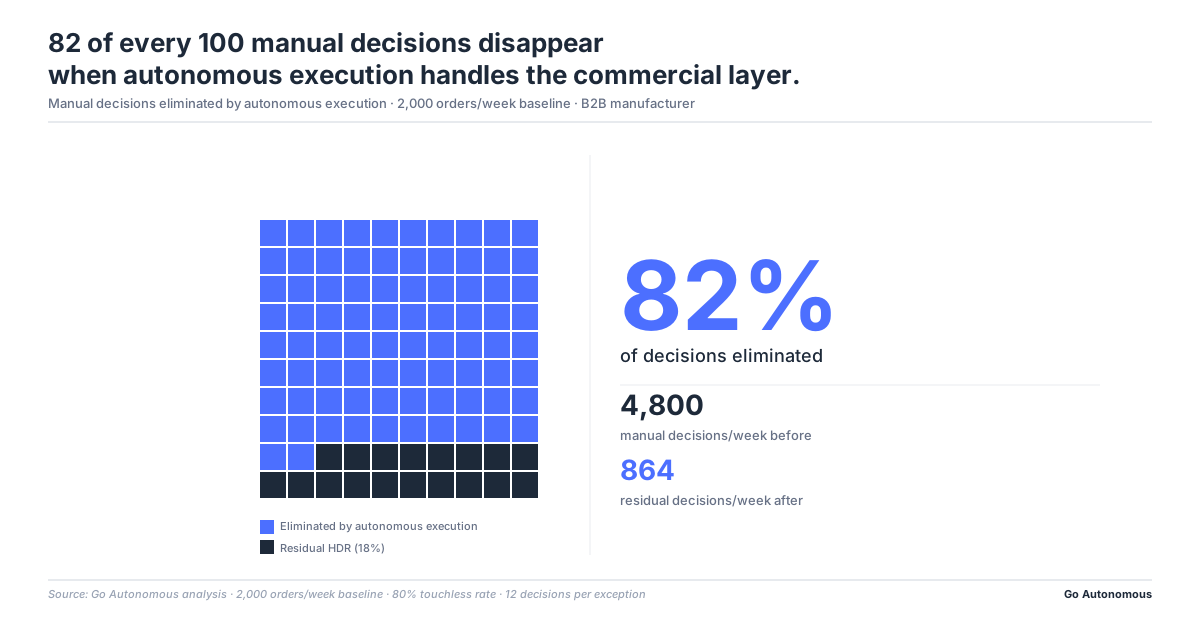
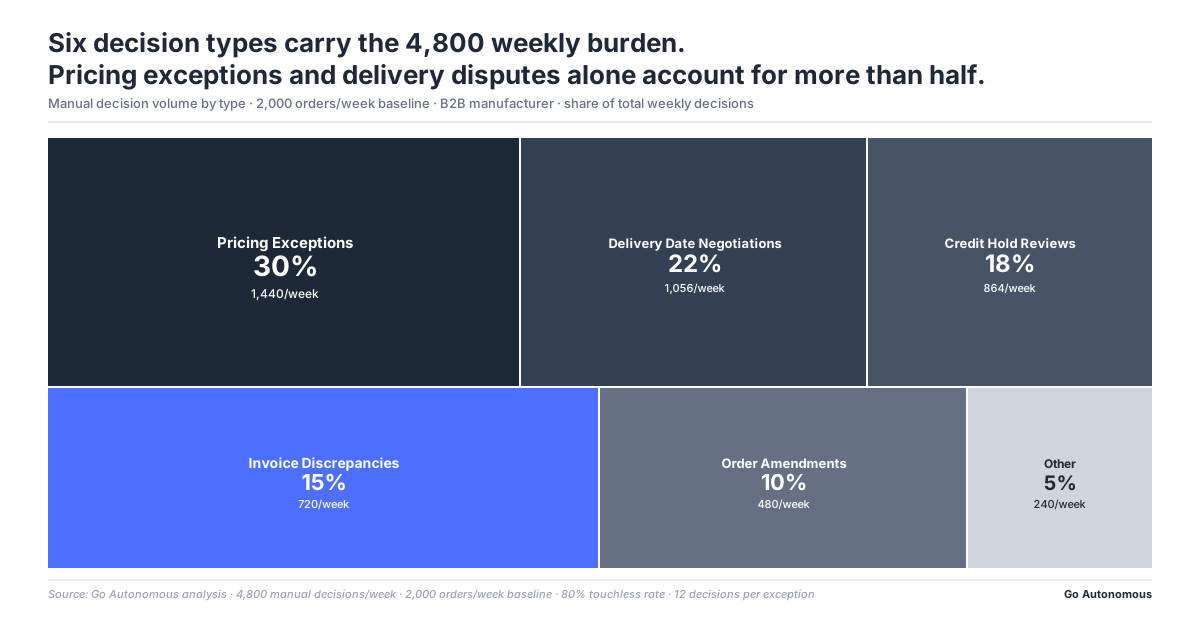
A manufacturer processing 2,000 orders per week with an 80% touchless rate looks impressive on paper. However, if every non-touchless order triggers an average of 12 manual decisions across pricing exceptions, delivery date negotiations, and credit hold reviews, that manufacturer is generating roughly 4,800 manual decisions per week. If revenue grows 25% next year and the touchless rate stays flat, those decisions grow proportionally. The system has not become more autonomous. It has become larger.
This is the measurement gap that Human Dependency Ratio was designed to expose.
Table of Content
- What Is Human Dependency Ratio (HDR) in B2B Manufacturing?
- Why Touchless Rate Is Not the Same as Execution Autonomy
- How to Calculate Human Dependency Ratio for B2B Order Management
- What a Declining HDR Looks Like in Practice for B2B Manufacturers
- Measure Your Human Dependency Ratio Before Your Competitors Do
- Frequently Asked Questions
- What is Human Dependency Ratio in B2B manufacturing?
- How do you calculate Human Dependency Ratio for order management?
- What is the difference between touchless rate and Human Dependency Ratio?
- Why does touchless rate not measure AI autonomy accurately?
- How does Autonomous Commerce reduce Human Dependency Ratio?
- What is a good Human Dependency Ratio target for a B2B distributor?
What Is Human Dependency Ratio (HDR) in B2B Manufacturing?
What is Human Dependency Ratio in B2B order processing?
Human Dependency Ratio (HDR) is the number of manual decisions required per unit of revenue processed. It measures the cognitive load embedded in your commercial execution layer: specifically, how many times a human must intervene, decide, or approve for revenue to move from demand signal to confirmed cash. The lower the ratio, the closer the system is to genuine autonomous execution. The goal is to drive it as close to zero as possible.
HDR is defined in the Autonomous Commerce Blueprint as a stage-segmented metric. A VP Operations can calculate HDR for the full order cycle, or isolate it by commercial workflow: HDR for quotes, HDR for order intake, HDR for invoice exceptions, HDR for dispute resolution. Each stage exposes a different layer of structural dependency.
The formula is straightforward:
HDR = Total manual decisions / Total revenue (in the same period)
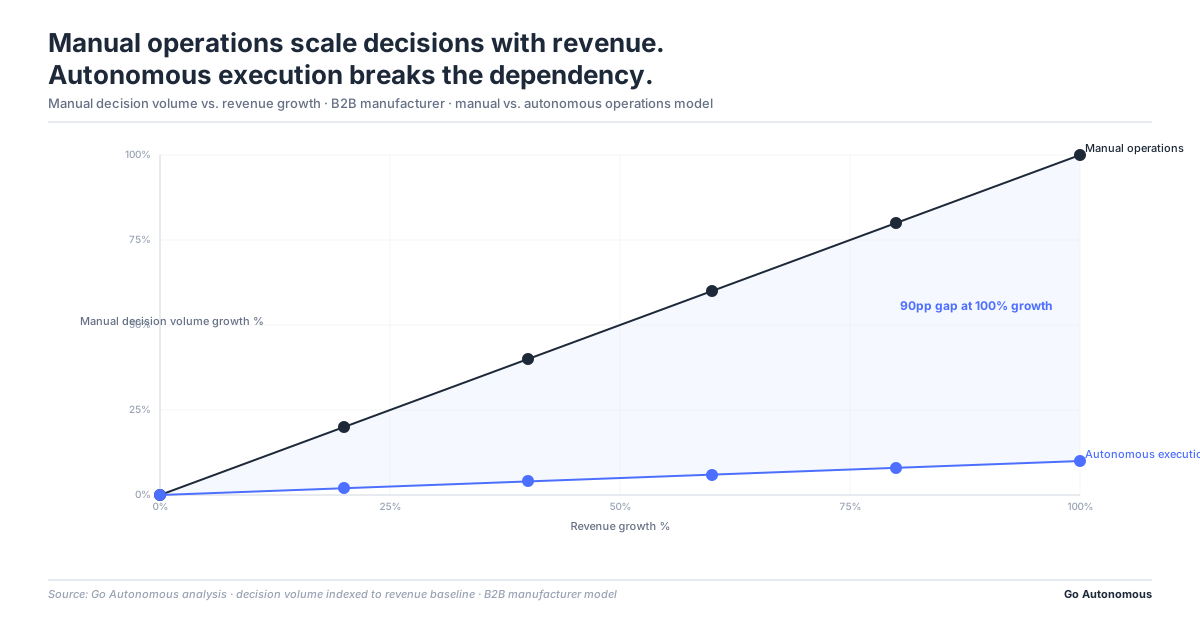
What makes HDR powerful is the denominator. By anchoring manual decisions to revenue rather than order volume, the metric reveals whether autonomy is scaling with the business or simply hiding behind growth. If revenue doubles and HDR stays constant, the organization has not gained autonomy. It has scaled dependency.
Why Touchless Rate Is Not the Same as Execution Autonomy
What is the difference between touchless rate and Human Dependency Ratio?
Touchless rate measures whether a human touched the transaction. HDR measures whether the transaction could have completed without a human. These are different questions, and the difference has strategic consequences for any B2B manufacturer claiming to be AI-driven.
A touchless rate of 80% tells you that 80% of orders moved through without a human touch point. It says nothing about what happened in the remaining 20%. If those orders each required 15 separate decisions routed across three teams before resolution, the touchless rate is still 80% and the HDR is catastrophically high.
Two manufacturers with identical 80% touchless rates can have radically different Human Dependency Ratios depending on how their exception queues are structured. One organization has standardized its exception categories and configured autonomous resolution for 90% of them. The other routes every exception to a senior coordinator for judgment. Same touchless rate. Fundamentally different levels of autonomy.
Why does touchless rate undercount manual decisions in exception-heavy B2B workflows?
Touchless rate is a binary measure: either the order was touched or it was not. It cannot capture exception complexity, decision frequency, or escalation depth. In B2B manufacturing and distribution, exception-heavy workflows are the norm. EDI 850 orders arrive with pricing mismatches against the SAP pricing master. Blanket PO call-offs reference part numbers that have been superseded. Multi-line orders split across fulfillment locations require manual routing decisions at the line level.
Each of these exceptions generates multiple decisions. A single order can sit at 80% touchless rate while contributing dozens of manual decisions to the weekly HDR count. According to McKinsey’s operations research, B2B companies with complex order environments spend a disproportionate share of commercial operations cost on the exceptional minority of orders precisely because decision complexity compounds at each escalation step.
HDR captures what touchless rate cannot: the structural reliance on human judgment that persists even when most orders flow cleanly.
HDR vs. Touchless Rate: A Direct Comparison
| Dimension | Touchless Rate | Human Dependency Ratio |
|---|---|---|
| What it measures | Whether a human touched the transaction | How many manual decisions each unit of revenue requires |
| Exception handling visibility | Counts exceptions but not their decision depth | Captures decision frequency and complexity within exceptions |
| Distinguishes automation from autonomy | No | Yes |
| Improves with AI assistants (copilot tools) | Marginally, if fewer reviews are flagged | No: AI assistants reduce time per decision, not decision count |
| Improves with autonomous execution | Yes | Yes: decisions are eliminated, not just accelerated |
| Revenue-scaled | No: order-based percentage | Yes: anchored to revenue, reveals scaling behavior |
| What “good” looks like | 85%+ touchless is a common benchmark | Declining HDR as revenue grows; approaching zero at full autonomy |
The critical insight: automation scales labor, autonomy eliminates dependency. Touchless rate measures the first. HDR measures whether the organization has achieved the second.
Adopting Autonomous Commerce at Danfoss is not just about speed and efficiency. It's about empowering our customer service teams and sales force to focus on building relationships and providing personalized support.

How to Calculate Human Dependency Ratio for B2B Order Management
How do you calculate Human Dependency Ratio for order management?
Calculating HDR requires two inputs: a rigorous count of manual decisions and a clean revenue figure for the same period. The calculation itself is simple. The discipline is in defining what counts as a manual decision before you start counting.
A manual decision is any moment where a human must exercise judgment before the transaction can advance. System-generated validations do not qualify. A rule in SAP S/4HANA Order Management that automatically blocks an order for a credit limit breach is not a manual decision. The coordinator who then reviews the block, calls the customer, and releases the order has made two or three manual decisions from a single transaction. That distinction matters when you are trying to understand where structural dependency lives.
Work through the following five steps to establish your baseline HDR:
- Define a manual decision for your commercial workflow. Align on the definition across order management, customer service, and finance before counting begins. Disputed definitions produce disputed results.
- Count total manual decisions across quotes, order intake, invoice exceptions, and disputes for a defined period. Four weeks or one fiscal quarter produces a stable baseline.
- Divide by total revenue processed in the same period. Express as decisions per million EUR of revenue for executive-level clarity.
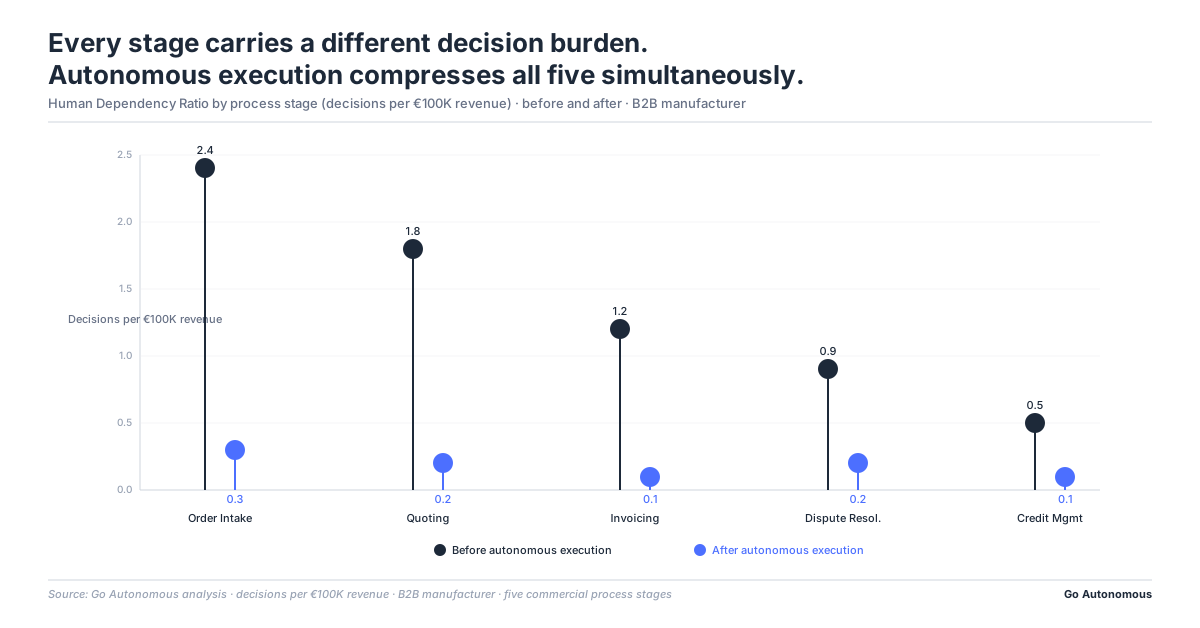
- Segment HDR by workflow stage. Stage-level HDR reveals where dependency is concentrated. Order intake HDR and invoice exception HDR typically differ by an order of magnitude in complex distribution environments.
- Track the trend as revenue changes. A declining HDR as revenue scales is evidence of genuine autonomous execution. A constant or rising HDR is evidence of a scaled treadmill.
For most B2B manufacturers operating with mixed-channel order intake (EDI, email, customer portal, phone), the initial HDR calculation surfaces a number that surprises even experienced operations leaders. The hidden decision load in exception queues, pricing disputes, and EDIFACT parsing errors is rarely visible in standard O2C reporting. It becomes visible the moment you count it against revenue.
HDR also interacts directly with Revenue Velocity: the rate at which revenue moves from demand signal to confirmed cash. If HDR does not decline as revenue scales, Revenue Velocity is capped regardless of pipeline volume. The organization fills the funnel at the top while a decision bottleneck slows throughput at the execution layer.
What a Declining HDR Looks Like in Practice for B2B Manufacturers
How does autonomous commerce reduce Human Dependency Ratio?
Autonomous execution reduces HDR by eliminating the decision, not by accelerating the human who makes it. This is the distinction between deploying a copilot tool and deploying Autonomous Commerce. A copilot that presents a coordinator with a recommended resolution faster still requires the coordinator to judge, approve, and act. The decision count does not change. HDR does not change. Only the time per decision changes.
Autonomous execution embeds the judgment in the system. Pricing policies are codified so the platform resolves pricing mismatches without routing them to a human. Exception categories are classified and handled by the execution layer, with only genuinely novel exceptions surfaced for human review. The customer service team stops being the decision layer and starts being the relationship layer. That is the operational state where HDR actually declines.
What this looks like across commercial workflows in practice:
- Quote HDR: Pricing inquiries that previously required a pricing analyst to calculate and approve are resolved autonomously. HDR for quotes drops as the share of autonomously-priced RFQs rises. Human time concentrates on strategic accounts and non-standard configurations, where relationship context genuinely improves the outcome.
- Order intake HDR: EDIFACT and EDI 850 orders with line-level discrepancies are resolved by the execution layer against the pricing master in SAP S/4HANA or Oracle Order Management Cloud without coordinator intervention. Manual decisions concentrate in genuinely ambiguous cases, not in routine exception categories.
- Invoice exception HDR: Credit hold reviews, quantity variance flags, and delivery discrepancy disputes that previously circulated across three teams are handled at the execution layer, with a full audit trail and ERP writeback, before a human is ever notified.
- Dispute HDR: Claims processing that once required a senior coordinator to adjudicate each case is handled autonomously for standardized claim types. Complex multi-party disputes still route to humans. But the volume of cases requiring human judgment falls sharply.
The aggregate result: revenue grows without a proportional increase in manual decisions. HDR declines. Operational capacity that was committed to decision-making gets released to higher-value commercial activity. That is what distinguishes an autonomous organization from one that has simply built a bigger treadmill.
Go Autonomous deployment analysis across more than 30 billion processed B2B transactions shows that the steepest HDR reductions occur not from increasing touchless rate, but from restructuring how exceptions are categorized and resolved. Manufacturers and distributors that invest in codifying their exception handling policies before deployment consistently see faster HDR improvement than those that deploy AI on top of unstructured exception workflows.
Danfoss demonstrates this at scale. Deploying autonomous execution across 26 countries simultaneously, the organization reduced order confirmation time from 42 hours to under one minute, with 80 percent of transactional decisions now executing without human input and a 50 percent reduction in overall processing time. HDR for order intake fell sharply as the execution layer absorbed the standard transaction population. At Mediq, processing approximately 4,000 orders per week in healthcare distribution across the Nordics, order handling time on the largest orders dropped by 75 percent with no additional headcount added. Both organizations shifted from a model where more revenue meant more coordinators, to one where more revenue required more configured policies. The operational model changed at the architectural level, not just the process level.
We are constantly exploring new ways to strengthen our operations and better serve our customers. The Autonomous Commerce Platform allows us to scale excellence in customer experience.
Read how Nilfisk adopted Autonomous Commerce for order management and what scaling excellence in customer experience required at operational level.
Sources
Measure Your Human Dependency Ratio Before Your Competitors Do
The manufacturers and distributors that are building durable competitive advantage in commercial operations are not the ones with the highest touchless rate. They are the ones whose HDR declines quarter over quarter as revenue scales. That is the metric that separates genuine autonomous execution from automation dressed up as AI. If your organization is growing revenue but has not measured whether manual decisions are growing at the same rate, you do not yet know whether you have an autonomous system or a larger dependency structure. Go Autonomous works with 500M to 20B EUR manufacturers and distributors across the Nordics, DACH, Benelux, UKI, and France. We can help you calculate your baseline HDR across quotes, order intake, and exception workflows, then show you exactly what declining it looks like in your ERP environment, your order channels, and your commercial operations. Book a conversation with our team.
Frequently Asked Questions
What is Human Dependency Ratio in B2B manufacturing?
Human Dependency Ratio (HDR) is the number of manual decisions required per unit of revenue processed. It measures the cognitive load embedded in commercial execution, specifically how many times a human must intervene or approve for revenue to move from demand signal to confirmed cash. Lower HDR indicates higher execution autonomy. The formula is: total manual decisions divided by total revenue in the same period.
How do you calculate Human Dependency Ratio for order management?
Count every manual decision across quotes, order intake, invoice exceptions, and disputes for a defined period, typically four weeks or one fiscal quarter. Divide by total revenue processed in the same window. Segment by workflow stage to identify where dependency is concentrated. Track the ratio as revenue changes: a declining HDR as revenue grows is evidence of genuine autonomous execution.
What is the difference between touchless rate and Human Dependency Ratio?
Touchless rate measures whether a human touched the transaction. Human Dependency Ratio measures whether the transaction could have completed without a human. A transaction can be touched by a human and still flow; a transaction with human dependency cannot progress without one. Two manufacturers with identical 80% touchless rates can have radically different HDRs depending on how their exception queues are structured and how many decisions each exception generates.
Why does touchless rate not measure AI autonomy accurately?
Touchless rate is a binary measure: the order was either touched or not. It cannot capture exception complexity, decision frequency, or escalation depth. In complex B2B order environments, a small percentage of non-touchless orders can generate the majority of manual decisions. Touchless rate reports the exception volume; HDR reports the decision load those exceptions generate. AI autonomy requires reducing decisions, not just touches.
How does Autonomous Commerce reduce Human Dependency Ratio?
Autonomous Commerce reduces HDR by eliminating decisions, not by accelerating the humans who make them. Pricing policies, exception categories, and resolution workflows are codified in the execution layer. The system resolves standardized exception types without human intervention, with ERP writeback and full audit trail. Only genuinely novel cases surface for human review. As policy coverage expands, the volume of decisions requiring human judgment falls and HDR declines.
What is a good Human Dependency Ratio target for a B2B distributor?
There is no universal benchmark because HDR depends on order complexity, channel mix, and product configuration. The relevant target is directional: HDR should decline as revenue grows. An organization at the beginning of an autonomous execution program will have a higher HDR than one 18 months into deployment. The strategic goal is a trend line that approaches zero decisions per revenue unit as more exception categories are codified and handled autonomously.