.svg)





Revenue at Rest: The Hidden Cost of Stalled Commercial Value in B2B Order-to-Cash
Revenue at rest is the trapped commercial value sitting idle inside your order-to-cash process, costing you margin, working capital, and customer confidence. This post defines the metric, explains how it accumulates in B2B manufacturing and distribution, and shows what autonomous execution does to stop it.
85 to 90 percent of B2B revenue still moves through channels that require human facilitation at every step. Not because manufacturers and distributors lack technology. Because the technology they have validates transactions, it does not execute them. The gap between a confirmed order and a processed order is where commercial value stalls. That stalled value has a name: Revenue at Rest.
This post defines the metric precisely, explains the three consequences it creates in B2B order-to-cash, and shows how to calculate it in your own operations. It is written for VP Operations, Order Management Directors, and CFOs at manufacturers and distributors in the €500M to €20B range who are carrying more trapped value than their dashboards are showing them.
Table of Content
- What is Revenue at Rest in B2B Order Management?
- Why Revenue at Rest Accumulates in B2B Manufacturing and Distribution
- How to Calculate and Identify Revenue at Rest in Your Operations
- What Autonomous Commerce Does to Revenue at Rest
- See What Revenue at Rest Is Costing Your Operations
- Frequently Asked Questions
- What is Revenue at Rest in B2B order management?
- How is Revenue at Rest different from sales backlog?
- How do you calculate Revenue at Rest in an order-to-cash process?
- What causes Revenue at Rest to grow in B2B manufacturing?
- How does autonomous order processing reduce Revenue at Rest?
- How does Revenue at Rest affect a company's cash conversion cycle?
What is Revenue at Rest in B2B Order Management?
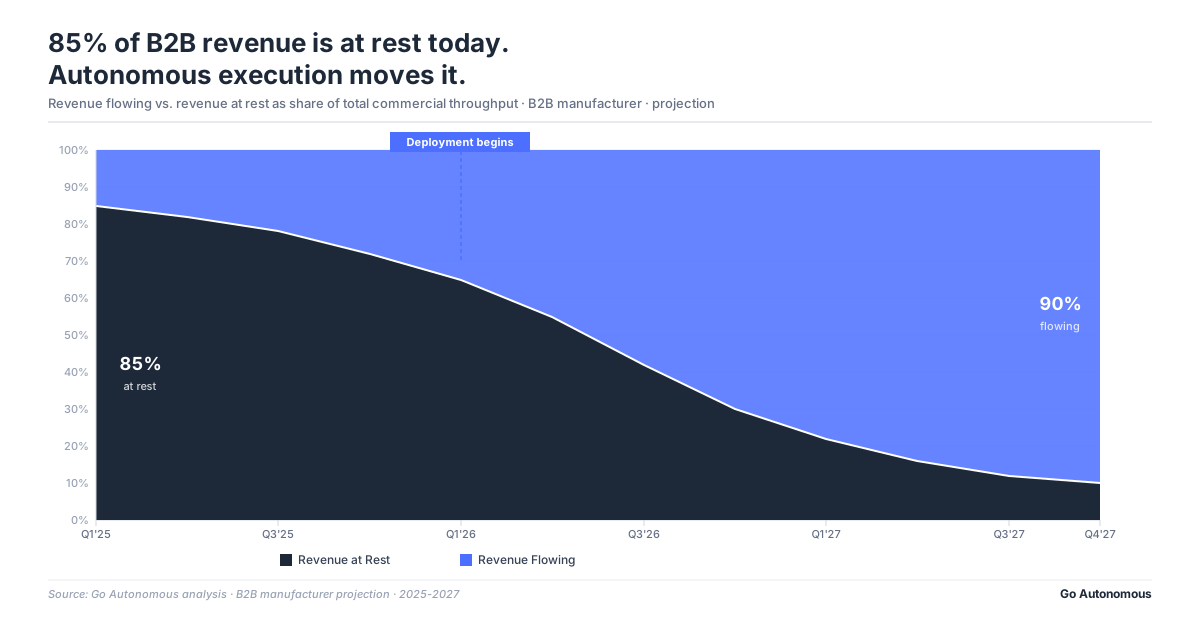
Revenue at Rest is revenue that exists but is not moving. It is trapped inside enterprise processes, parked, sitting still, waiting for a human to move it to the next step. Examples include quotes sitting in inboxes for days, tenders piling up because the team cannot process them fast enough, orders stuck in review cycles, and eCommerce orders waiting to be released in the ERP. It is the most direct measure of what manual execution costs a business at the commercial layer.
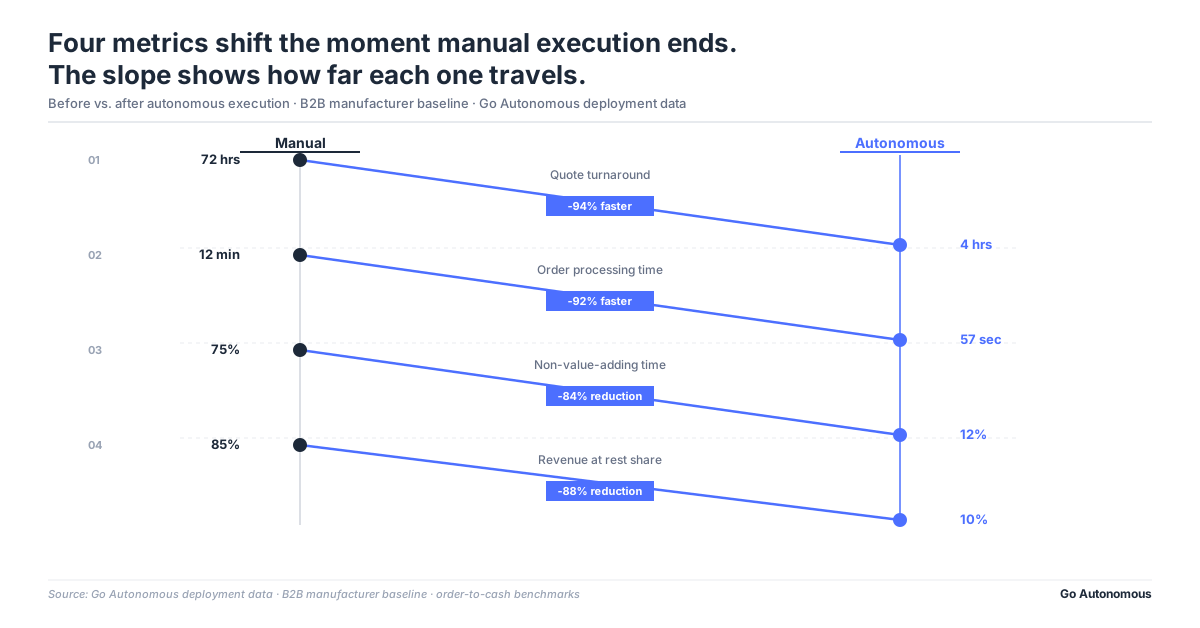
The consequence is threefold. First, you lose revenue on quotes and tenders you could not turn around fast enough. Second, your cost to serve is excessive because your people spend up to 75 percent of their time on non-value-adding activities. Third, your cash conversion cycle stretches because revenue is stuck in delays, checks, approvals, and decisions. Customers feel all of it.
What is the difference between Revenue at Rest and backlog?
Revenue at Rest is not backlog. Backlog is expected volume in the pipeline, committed demand awaiting scheduled fulfillment. Revenue at Rest is trapped economic value that should be moving and is not. A backlog is planned. Revenue at Rest is a failure state: transactions that are past their processing threshold and have not advanced because a human has not yet acted on them.
This distinction matters operationally. Backlog is a capacity signal. Revenue at Rest is a friction signal. You manage backlog by adding capacity. You eliminate Revenue at Rest by removing the dependency on human intervention for every transaction step. Managing the two the same way is one of the core reasons operations teams add headcount without improving throughput.
How does manual order processing create Revenue at Rest in B2B distribution?
Manual order processing creates Revenue at Rest because every transaction stage requires a human decision before it can advance. An email order arrives in a shared inbox. It waits for someone to open it, interpret it, match it to the correct customer master record, validate pricing, check stock, and enter it into SAP S/4HANA or Oracle Order Management Cloud. At each of those steps, the transaction is at rest. The revenue exists on paper. It is not moving toward cash.
In a B2B distribution environment processing 300 to 600 email orders per day, a team operating at 80 percent capacity leaves dozens of transactions in queue at any given moment. Each queued transaction represents confirmed demand that is not yet executing. The sum of those transactions, weighted by their value and measured against the processing SLA, is the Revenue at Rest figure for that day.
Why Revenue at Rest Accumulates in B2B Manufacturing and Distribution
The root cause is architectural. SAP S/4HANA, Oracle Order Management Cloud, and Microsoft Dynamics 365 all validate and record transactions efficiently. None of them read an email, interpret a handwritten PO, reconcile a pricing discrepancy in an attached PDF, or decide whether an exception warrants escalation. That interpretation layer still sits entirely with human operators. So the ERP records the transaction after a human has prepared it, but the gap between order receipt and ERP entry is pure Revenue at Rest.
Three structural forces accelerate accumulation at scale.
- Channel fragmentation: Orders arrive via EDI 850, EDIFACT, email, customer portal, eCommerce, and phone. Each channel has different data formats, different validation requirements, and different exception patterns. Teams cannot standardize handling across all of them simultaneously without adding headcount per channel.
- Exception volume: According to APQC benchmarking data, exception rates in B2B order management average 15 to 30 percent of total order volume at manufacturers with complex pricing structures. Each exception requires a human decision. Each decision is a pause point where the transaction sits at rest.
- Linear scaling dependency: Revenue growth in manual operations requires proportional headcount growth to maintain processing velocity. When headcount does not scale as fast as revenue, Revenue at Rest grows to fill the gap. This is not a people problem, it is an architecture problem.
Each time we added one or two million euros in revenue, we had to add another operator. From a cost perspective, that's an unsustainable way of operating a business.

What causes Revenue at Rest to grow as B2B revenue scales?
Revenue at Rest grows as B2B revenue scales because the processing infrastructure does not scale at the same rate as order volume. Each new revenue euro brings additional transactions, additional exceptions, additional validation requirements. The human team that handled 200 orders per day at 80 percent utilization is now handling 280 orders per day at 110 percent. Transactions queue. Processing times stretch. Quotes that needed a 4-hour turnaround get answered in 48 hours. Some do not get answered at all.
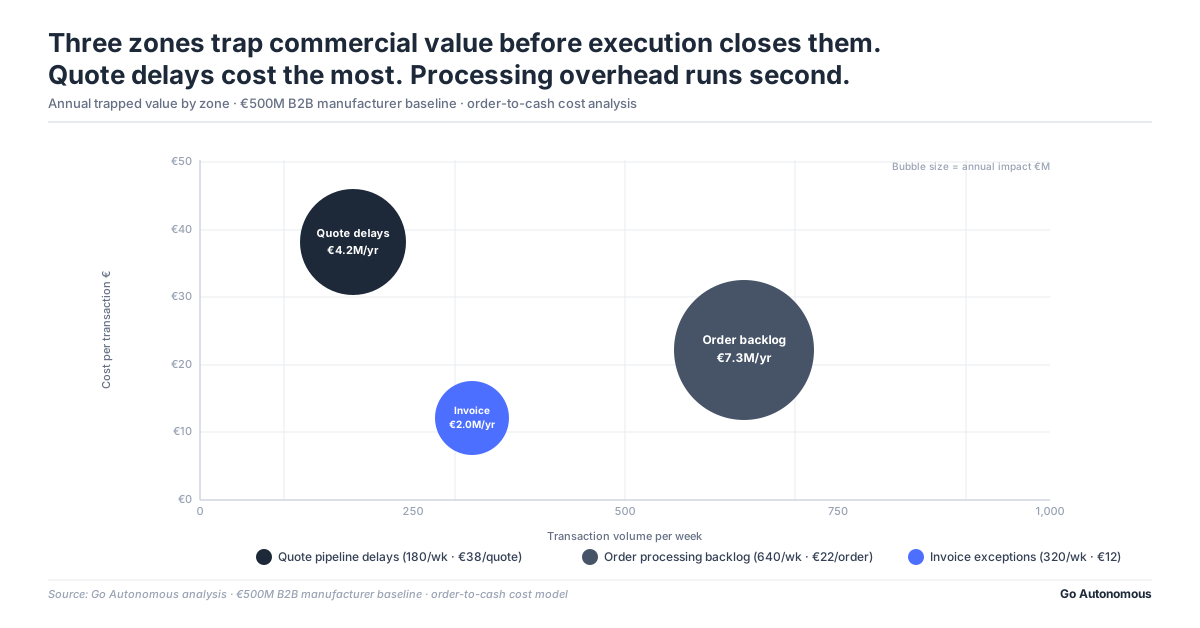
This is the dynamic that makes Revenue at Rest a strategic indicator, not just an operational one. At low revenue scales, it is a daily operations problem. At €500M and above, it becomes a structural drag on topline growth and margin management. The companies that have not measured it have simply absorbed the cost into their headcount line and their lost-bid rate. The number is there, it is just not labeled.
Related to this is Friction Debt: the total monetary cost of human decisions still happening in your revenue flow. While Revenue at Rest measures the stock of trapped value at any given moment, Friction Debt measures the cumulative operating cost of the decisions that created it. Together they give operations and finance leadership a complete picture of what manual execution actually costs.
How to Calculate and Identify Revenue at Rest in Your Operations
The formula is straightforward. Revenue at Rest at any given moment equals the sum of transaction value for all transactions where the current stage waiting time exceeds the defined SLA or processing threshold. It applies across the full order-to-cash cycle.
How do you calculate Revenue at Rest in an order-to-cash process?
To calculate Revenue at Rest, take every in-progress transaction across your commercial operations, identify the stage each transaction is currently in, measure how long it has been waiting at that stage, compare it to your defined SLA for that stage, and sum the value of every transaction that is past its threshold. The result is the amount of commercial value your business has earned but has not yet moved.
The calculation applies across five transaction categories:
- RFQs and POs waiting in inboxes, quote requests and purchase orders that have arrived but have not yet been opened, validated, or entered into the system
- Orders pending manual validation, transactions in the ERP queue awaiting confirmation that pricing, inventory, and customer data are correct
- Orders blocked by exceptions, transactions that have hit a routing rule, a pricing discrepancy, or a credit hold and are waiting for a human decision to unblock them
- Invoices in dispute or awaiting approval, completed orders where the invoice has not cleared, delaying cash receipt and extending the cash conversion cycle
- eCommerce orders pending ERP release, orders confirmed on the digital channel that have not yet been written back to the ERP for fulfillment triggering
A manufacturer processing 500 orders per week with an average order value of €8,000 and a 20 percent exception rate carries approximately 100 blocked transactions at any given moment during peak processing periods. At the average value, that is €800,000 in Revenue at Rest, on a single week’s volume. For a business with more complex pricing structures or higher EDI 850 volumes, the figure compounds further.
The formula also exposes the cash conversion cycle impact directly. According to McKinsey’s research on working capital efficiency, companies that compress order-to-cash cycle times by reducing manual processing stages release meaningful working capital, in the range of days of DSO translated to cash. For a €1B revenue manufacturer, each day of DSO reduction corresponds to approximately €2.7M in released working capital. Revenue at Rest is the operational variable that drives DSO in the wrong direction.
| Transaction Stage | Manual O2C (Typical Wait) | Autonomous Execution (Typical Wait) | Revenue at Rest Impact |
|---|---|---|---|
| Email order intake | 2 to 24 hours | Under 60 seconds | High: high-volume, high-frequency accumulation |
| EDI order validation | 1 to 4 hours | Under 2 minutes | Medium: structured but exception-prone |
| Exception resolution | 24 to 72 hours | Minutes to 4 hours (human review flagged automatically) | Very high: single largest source of trapped value |
| Invoice approval | 48 to 96 hours | Under 1 hour (policy-driven auto-approval) | High: direct DSO and cash conversion impact |
| eCommerce ERP release | 2 to 8 hours | Real-time writeback | Medium: growing as digital channel share increases |
What Autonomous Commerce Does to Revenue at Rest
“If revenue isn’t moving, it’s not revenue. It’s inventory.”
That framing is not rhetorical. Inventory has carrying costs. It ties up working capital. It ages. Revenue at Rest behaves the same way: it ties up cash, it creates service-level risk, and it degrades in value as quote windows close and customer patience runs out. The operational response cannot be more people. The architecture has to change.
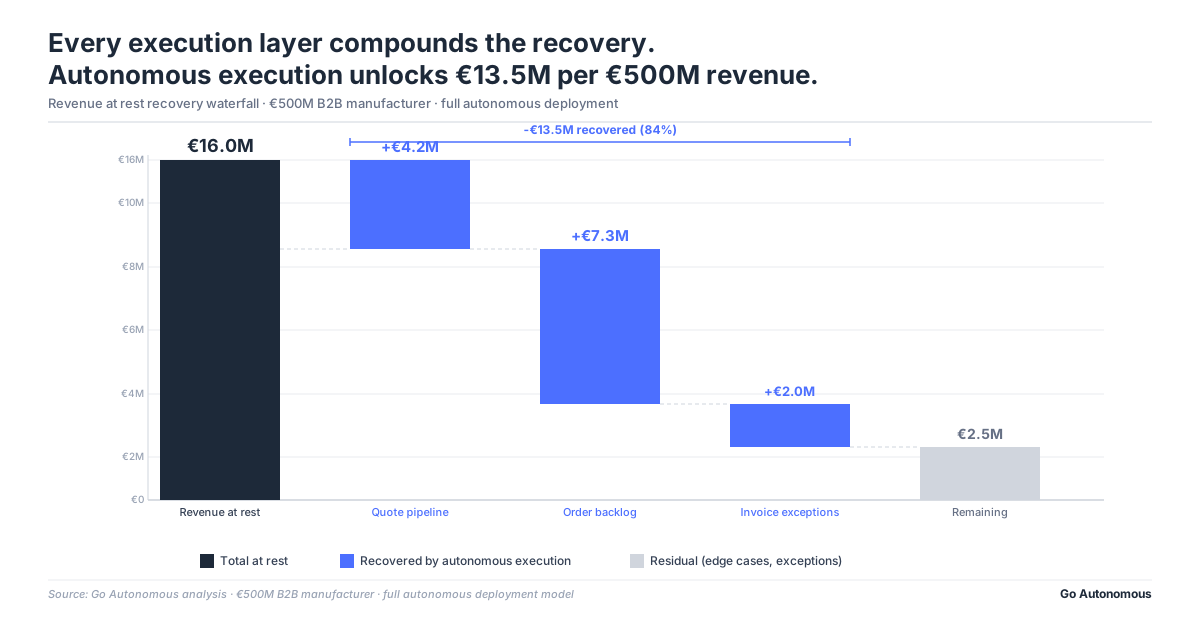
The Autonomous Commerce platform addresses Revenue at Rest by removing the human dependency from the execution layer entirely for transactions that fall within defined policy. Orders that arrive by email, EDI, or customer portal are read, validated, matched, and entered into the ERP without a human touching them. Exceptions are routed immediately, not queued, to the right operator with full context, resolution options, and a suggested action. The system does not replace the operator’s judgment on genuine edge cases. It eliminates the processing delay on the 70 to 85 percent of transactions that do not need human judgment.
The distinction matters when comparing this to RPA-based approaches. RPA tools like UiPath, Blue Prism, and Automation Anywhere automate defined sequences of manual steps. They reduce processing time on structured transactions. However, they do not handle unstructured inputs, they do not interpret context, and they do not make decisions on exception cases. When an email order contains a pricing discrepancy or a non-standard product reference, an RPA bot stops and routes to a human. Revenue at Rest continues to accumulate at the exception layer, which is precisely where the highest-value transactions tend to sit.
Autonomous Commerce does not automate the steps. It executes the outcome. The transaction either completes, or it surfaces to a human with a clear decision frame. That is an architectural difference, not a capability upgrade. It is the difference between accelerating a manual process and replacing the dependency on manual intervention altogether.
Automating customer requests comes with at least two substantial benefits. Being able to answer customers faster drives lead times down and sales up.
Manufacturers and distributors running autonomous execution report measurable compression of Revenue at Rest within the first production quarter. At Danfoss, order confirmation time fell from 42 hours to under one minute across 26 countries deployed simultaneously, with 80 percent of transactional decisions now executing without human input and a 50 percent reduction in overall processing time. At Mediq, processing approximately 4,000 orders per week across the Nordics in healthcare distribution, order handling time on the largest orders dropped by 75 percent with no additional headcount added. See also Nilfisk and the broader customer success cases from Go Autonomous deployments across Europe. The pattern is consistent: Revenue at Rest drops sharply in the first 90 days as the execution layer takes over the transaction categories with the highest wait times. The operational efficiency gains follow from that compression directly.
For operations leaders who want to understand the full execution architecture before evaluating, the Autonomous Execution Fabric white paper covers how autonomous execution integrates with existing ERP infrastructure, how exception policies are codified, and what the deployment path looks like for a manufacturer already running SAP S/4HANA or Oracle Order Management Cloud.
Sources
- McKinsey Operations Insights, Working Capital and Order-to-Cash Efficiency Research
- APQC Order Management Benchmarking, Exception Rate and Processing Cost Data
See What Revenue at Rest Is Costing Your Operations
If your team is managing order intake from multiple channels, handling a meaningful exception volume, and adding headcount each time revenue grows, you are carrying Revenue at Rest. The question is not whether it exists. The question is what it is worth at your order volume and average transaction value. For a €500M to €2B manufacturer, the figure is typically in the millions per quarter, absorbed into the operating cost structure and never surfaced as a distinct line. Go Autonomous works with manufacturers and distributors in the €500M to €20B range across the Nordics, DACH, Benelux, UKI, and France. If the patterns described in this post apply to your operations, we can show you exactly what autonomous execution looks like in your environment: your ERP, your order channels, and your commercial workflows. Book a conversation with our team.
Frequently Asked Questions
What is Revenue at Rest in B2B order management?
Revenue at Rest is revenue that exists but is not moving. It measures the total commercial value trapped inside enterprise processes, quotes sitting in inboxes, orders pending manual validation, exceptions awaiting human decision, invoices in approval queues, where each transaction has exceeded its defined processing SLA. It is a measure of what manual execution costs at the commercial layer.
How is Revenue at Rest different from sales backlog?
Backlog is planned volume in the pipeline, committed demand awaiting scheduled fulfillment. Revenue at Rest is a failure state: transactions that should be progressing and are not because no human has yet acted on them. Backlog is a capacity signal. Revenue at Rest is a friction signal. They require different responses: backlog calls for capacity planning, Revenue at Rest calls for removing execution dependency.
How do you calculate Revenue at Rest in an order-to-cash process?
Sum the order value of every in-progress transaction where the current stage wait time exceeds the defined SLA. Apply this across all transaction categories: RFQs and POs in inboxes, orders pending manual validation, orders blocked by exceptions, invoices in dispute or approval, and eCommerce orders pending ERP release. The total is your Revenue at Rest figure at that moment.
What causes Revenue at Rest to grow in B2B manufacturing?
Revenue at Rest grows when processing capacity does not scale with order volume. Three structural forces drive it: channel fragmentation requiring different handling per format (EDI, email, portal, eCommerce), high exception rates in complex pricing environments (15 to 30 percent of orders at many manufacturers), and the linear dependency between headcount and throughput that manual execution creates. As revenue grows, trapped value compounds unless the execution architecture changes.
How does autonomous order processing reduce Revenue at Rest?
Autonomous order processing removes the human dependency from the execution layer for transactions within defined policy. Orders from email, EDI, and customer portals are read, validated, and entered into the ERP without manual steps. Exceptions are routed immediately with full context rather than queued. This eliminates processing delay on the 70 to 85 percent of transactions that do not require human judgment, reducing Revenue at Rest sharply within the first 90 days of deployment.
How does Revenue at Rest affect a company’s cash conversion cycle?
Revenue at Rest extends the cash conversion cycle by introducing delay at every stage between order receipt and invoice payment. Each hour a transaction sits at rest adds to the effective DSO. For a manufacturer with significant order volume, this translates directly to working capital tied up in the order-to-cash pipeline. Compressing Revenue at Rest, by removing the manual processing stages that create it, reduces DSO and releases working capital without changing credit terms or customer behavior.