.svg)





Why 85–90% of B2B Revenue Never Reaches Oracle Order Management Automatically
Oracle Order Management does what it was built to do: process confirmed, structured, digital orders. But 85–90% of B2B revenue arrives as emails, PDFs, and phone calls that Oracle was never designed to handle. This post explains what manufacturers are actually replacing in 2026, and why autonomous commerce is the execution layer that closes the gap.
Oracle Order Management is a mature, well-engineered system that handles structured order processing reliably at enterprise scale. Yet across Nordics, DACH, and Benelux, manufacturers running Oracle ERP are deploying autonomous commerce platforms alongside it, not to replace Oracle, but to solve the problem Oracle was never designed to address: 85–90% of B2B revenue that arrives through email, phone, PDF, and unstructured channels before it ever reaches the ERP. This post explains the real boundary of Oracle OMS, what manufacturers are actually replacing in 2026, and how the pre-ERP execution layer changes the economics of B2B order management entirely.
Table of Content
- Oracle Order Management: What It Does Well, and Where It Stops
- What Manufacturers Are Actually Replacing in 2026
- Oracle OMS vs. Autonomous Commerce: Scope, Overlap, and Complementarity
- How Autonomous Commerce Integrates With Oracle
- Real-World Deployment Patterns: What Manufacturers Are Seeing
- Evaluation Criteria for Oracle OMS Alternatives in 2026
- The Economics of Post-Oracle Order Management
- Frequently Asked Questions
Oracle Order Management: What It Does Well, and Where It Stops
Oracle Order Management, whether deployed as part of Oracle E-Business Suite, Oracle Cloud Order Management (formerly Oracle CPQ and Order Cloud), or Oracle Fusion, is purpose-built for one task: processing confirmed, structured, validated orders through fulfilment workflows. It handles order capture from digital channels, orchestration across fulfilment systems, pricing and availability checks, ATP (Available to Promise) logic, and downstream ERP execution. For orders that arrive in a clean, structured, digital format, Oracle OMS does its job well.
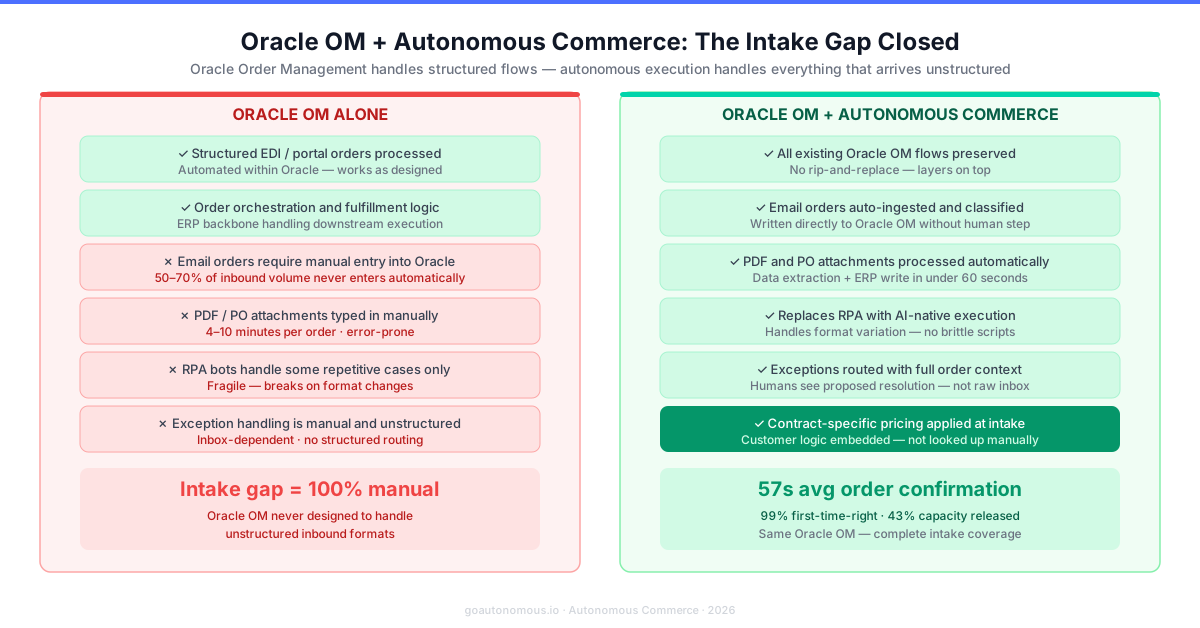
The problem is not Oracle. The problem is that the vast majority of B2B revenue does not arrive in a clean, structured, digital format. According to industry research, Forrester’s B2B Commerce Forecast, 85–90% of B2B revenue remains human-facilitated, meaning it flows through emails, phone calls, PDFs, portals requiring manual entry, and EDI exceptions that require human interpretation before they can be processed. Oracle Order Management sits downstream of all of this. It receives orders only after a human has read the email, matched the product code, confirmed pricing, and typed the order into the system. Oracle never sees the original intake at all.
The Intake Gap: Where Oracle OMS Limitations Begin
Every manufacturer running Oracle Order Management has the same operational reality: a team of customer service representatives who spend their days translating incoming orders into formats Oracle can consume. An email arrives from a distributor with a PDF attachment, a mix of customer part numbers and descriptions, quantities, requested delivery dates, and special shipping instructions. None of this goes directly into Oracle. A person reads it, interprets it, resolves ambiguities, matches product codes against the customer’s agreed catalogue, checks pricing against the customer’s contract, and then creates the sales order in Oracle. Only then does Oracle do its job.
This intake layer is invisible in most Oracle implementations, it does not appear in Oracle dashboards, it does not show up in order management KPIs, and it is rarely modelled in TCO calculations for Oracle OMS deployments. But it is where the cost accumulates. It is where SLA misses originate. And it is where headcount scales linearly with revenue growth, making operational leverage impossible.
For manufacturers evaluating an Oracle order management alternative, understanding this design boundary is essential. Oracle Order Cloud and Oracle E-Business Suite OMS are not failing when they cannot process an unstructured email, they were simply not designed for that task. What manufacturers are discovering in 2026 is that the layer before Oracle needs its own purpose-built solution.
Oracle OMS Limitations for B2B Distributors on E-Business Suite
For B2B distributors still running Oracle E-Business Suite (EBS), the Oracle OMS limitations for B2B distributors tend to manifest differently than in cloud deployments. EBS was designed for a world where EDI was the primary electronic channel and orders arrived in structured formats. The modern reality, where 50–70% of order and quote volume flows via email, according to operational benchmarks from IDC’s B2B Operations Research, was not the environment EBS was architected for. The result is a persistent and growing backlog of manual processing work that sits entirely outside the ERP layer, often managed through shared inboxes, spreadsheets, and internal workarounds that have accumulated over years of workaround-upon-workaround.
B2B distributors running Oracle EBS at scale, particularly in industrial distribution, spare parts, and MRO, report that their email-to-order process is the primary operational constraint on growth. Adding revenue means adding operators. The ratio is roughly linear: more customers, more email volume, more headcount needed to keep SLAs in range. This is the pattern that autonomous commerce was built to break.
For Manufacturers Running Oracle Order Cloud
Oracle Order Management Cloud, Oracle’s SaaS order management offering, provides more modern capabilities than EBS, including better API connectivity, cloud-native architecture, and improved omnichannel order orchestration. For manufacturers who have migrated to Oracle Cloud, the structured-order processing problem is better solved. But the unstructured intake problem remains identical. Oracle Order Cloud receives orders through APIs, portals, and EDI. It does not receive emails. It does not interpret PDFs. It does not understand that a customer’s “24V motor controller, standard spec, 50 units” maps to SKU XYZ-4421 at a specific contracted price. That translation still happens outside Oracle, through the same manual process it always has.
Manufacturers running Oracle Order Cloud who are evaluating Oracle order cloud alternatives are not typically dissatisfied with Oracle’s order orchestration capabilities. They are dissatisfied with the total picture: Oracle handles 10–15% of their order volume automatically (the digital, structured orders), while 85–90% of volume still requires human processing before Oracle sees a single data record. The alternative they are looking for is not a replacement for Oracle’s orchestration layer, it is a purpose-built layer that handles the intake, interprets the unstructured inputs, and feeds Oracle with clean, validated orders it can process immediately.
What Manufacturers Are Actually Replacing in 2026
The framing of “replacing Oracle order management” is misleading and worth correcting directly. Manufacturers running Oracle in 2026 are not ripping out their ERP. Oracle EBS and Oracle Cloud are deeply embedded systems managing inventory, finance, fulfilment orchestration, and downstream logistics. The investment in Oracle is not going away, and for most manufacturers, nor should it. What is being replaced, or more precisely, what is being eliminated or transformed, is the manual intake operation that sits upstream of Oracle.
Replacing Manual Intake Teams, Not Oracle
In practical terms, what manufacturers deploying autonomous commerce alongside Oracle are replacing is the manual order entry function. The team, customer service representatives, inside sales operators, order desk staff, who currently spend the majority of their working hours reading emails, matching part numbers, checking pricing, and entering orders into Oracle. This is not a small function. For a €1B+ manufacturer with high order volume, this team can run to dozens of people, generating significant fixed cost that scales directly with revenue volume.
The economic case for autonomous order management alongside ERP is straightforward: if autonomous commerce can handle 80–90% of the intake and entry work automatically, reading the email, interpreting the PDF, matching the customer’s part numbers to internal SKUs, applying contracted pricing, validating the order, and creating it directly in Oracle, then the cost structure of order management changes fundamentally. Capacity is released. Headcount can be redeployed to exception handling, customer relationships, and revenue-generating activities. And order response times collapse from hours to under a minute.
Each time we added one or two million euros in revenue, we had to add another operator. From a cost perspective, that's an unsustainable way of operating a business.

This is the pattern that repeats across manufacturers in the Nordics, DACH, and Benelux: revenue growth forces a choice between hiring more operators to maintain SLAs or accepting degraded response times and the customer churn that follows. Neither is acceptable at scale. Autonomous commerce changes the equation by decoupling order volume growth from headcount growth.
Replacing Legacy RPA in the Order Intake Layer
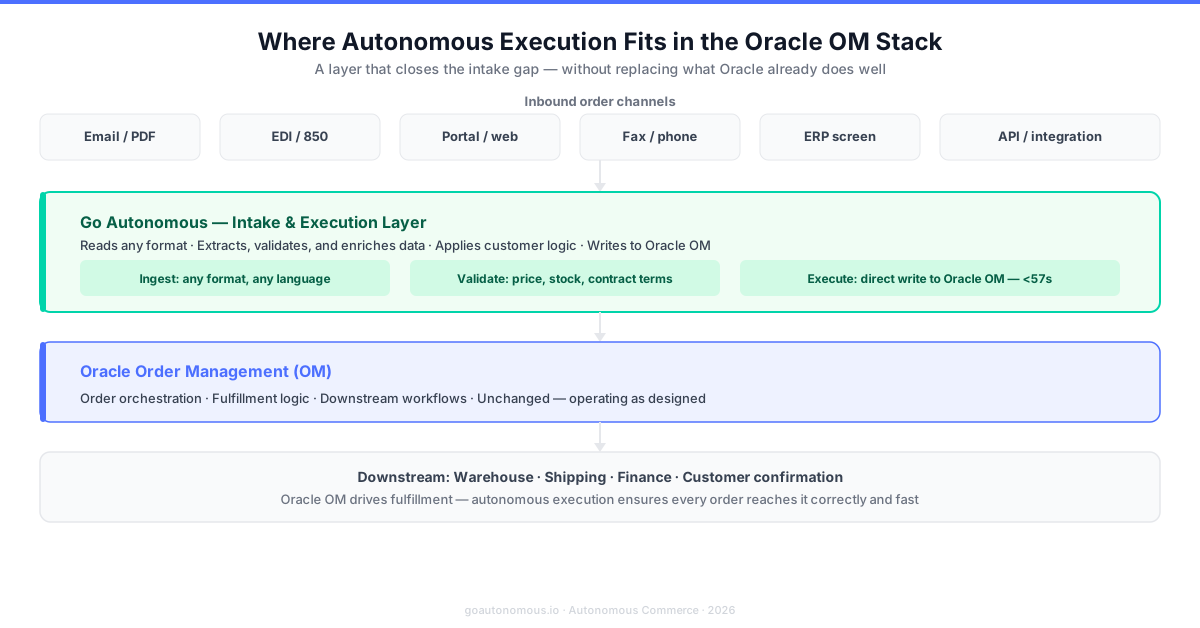
A second pattern in 2026: manufacturers who previously deployed RPA (robotic process automation) in the order intake layer are replacing those implementations with autonomous commerce. RPA was positioned in the 2018–2022 period as the answer to manual order entry, scripted bots that could navigate Oracle screens and enter orders automatically, provided the input was sufficiently structured. The real-world experience with RPA in order management has been documented extensively, including in our analysis of RPA vs AI in B2B order processing. RPA is brittle: it breaks when email formats change, when customers send new PDF templates, when order content is ambiguous or requires interpretation. Maintenance cost accumulates rapidly. Exception rates remain high. And for unstructured email-based orders, the majority of B2B order volume, RPA never delivered the promised automation rates.
Autonomous commerce replaces RPA in the intake layer with AI-native execution that can handle unstructured inputs, interpret natural language, resolve ambiguities, and create clean orders in Oracle without scripted rules or rigid templates. Where RPA required the input to fit the script, autonomous commerce understands the input regardless of format. This is the architectural difference that makes the economics work at scale. For a deeper look at why this matters, see our analysis of why order-to-cash automation fails for manufacturers when built on the wrong foundation.
For Companies Evaluating Oracle OMS Alternatives
Companies actively evaluating Oracle OMS replacement options in 2026 are generally looking at two distinct scenarios. The first is augmentation: keeping Oracle as the ERP and order orchestration layer and deploying autonomous commerce as the intake execution layer that feeds it. Oracle continues to own everything from order creation through fulfilment and invoicing. Autonomous commerce owns the unstructured world before that. The second scenario is consolidation: for companies on aging Oracle EBS implementations that are also evaluating ERP migration, the question becomes whether to invest in a new ERP first or to deploy autonomous commerce on top of the existing ERP as an intermediate step that delivers immediate ROI while the longer migration is planned. Both are valid paths, and both are being actively deployed by manufacturers across Europe.
For distributors and manufacturers in the industrial distribution segment, the augmentation path has been the dominant pattern, Oracle remains the system of record, and autonomous commerce handles the intake layer that was previously done by operators. For industrial manufacturers with high SKU complexity and a mix of structured and unstructured order channels, the value is particularly pronounced because the product-matching and pricing interpretation work, previously the most time-consuming part of manual order entry, is exactly what autonomous AI execution handles best.
Oracle OMS vs. Autonomous Commerce: Scope, Overlap, and Complementarity
Understanding where Oracle Order Management ends and where autonomous commerce begins is the clearest way to frame the architecture decision facing manufacturers in 2026. These are not competing systems fighting for the same territory. They address different problems in the order lifecycle, and the most effective deployments treat them as complementary layers in a single execution stack.
The Scope Boundary: A Practical Comparison
The scope boundary can be stated simply: Oracle Order Management processes orders that have already been captured, validated, and structured. Autonomous commerce captures, interprets, validates, and structures orders from unstructured sources, then delivers them to Oracle for processing. The table below maps the division of responsibility across the order lifecycle.
| Capability Area | Oracle Order Management | Autonomous Commerce (Go Autonomous) |
|---|---|---|
| Structured order intake (API, portal, EDI) | Yes, core capability | Supported, passes to Oracle |
| Email and PDF order intake | No, not designed for this | Yes, core capability |
| Customer part number matching | Requires clean data at entry | Yes, AI-native resolution |
| Pricing and contract interpretation | Applies rules to structured inputs | Yes, interprets unstructured pricing context |
| Order validation and error resolution | Downstream validation rules | Pre-ERP validation and exception resolution |
| Order orchestration and fulfilment | Yes, core Oracle capability | Delegates to Oracle or ERP |
| Available to Promise (ATP) logic | Yes, Oracle-native | Queries Oracle/ERP for ATP data |
| Quote processing and RFQ handling | Limited (CPQ add-on required) | Yes, RFQ and quote automation native |
| Claims and dispute intake | Not typically in scope | Yes, claims and dispute automation |
| Price inquiry handling | Not in scope | Yes, price inquiry automation |
| ERP bi-directional integration | Is the ERP layer | Certified Oracle integration |
This scope mapping shows why the framing of “replacing Oracle” misses the point. Autonomous commerce does not touch Oracle’s core value, order orchestration, ATP logic, fulfilment management, inventory and finance integration. It handles the world that Oracle cannot: the unstructured, human-language, PDF-and-email world where 85–90% of B2B revenue actually originates.
What Goes Well: Where Oracle OMS Remains Strong
It is worth being explicit about where Oracle Order Management remains the right tool. Manufacturers should not undermine Oracle’s role in the stack, they should extend it. Oracle excels in the following areas, which autonomous commerce does not attempt to replicate:
- Complex order orchestration across multiple fulfilment warehouses and logistics providers
- Available to Promise (ATP) calculations against real-time inventory and production schedules
- Downstream ERP integration: finance, invoicing, accounts receivable, general ledger
- Structured EDI order processing at high volume
- Order fulfilment status tracking and customer-facing order visibility portals
- Complex pricing rules, volume discounts, and rebate calculations on structured inputs
- Compliance, audit trail, and reporting for structured order data
- Integration with Oracle manufacturing modules (MRP, production scheduling)
None of these capabilities are in scope for autonomous commerce to replace. The architecture question is not Oracle vs. autonomous commerce, it is how to connect autonomous commerce’s intake execution with Oracle’s fulfilment execution through a clean, bi-directional integration that preserves Oracle as the system of record while eliminating the manual work that currently bridges the gap between the two.
How Autonomous Commerce Integrates With Oracle
The technical architecture of deploying autonomous commerce alongside Oracle Order Management follows a consistent pattern. Go Autonomous connects to Oracle through certified ERP integration, reading master data (customer records, product catalogues, pricing contracts) from Oracle and writing completed, validated orders back to Oracle for fulfilment processing. From Oracle’s perspective, it receives a clean, validated sales order, indistinguishable from an order entered manually by an operator, but created in seconds rather than minutes or hours, and without human intervention for the 80–90% of orders that fall within learned patterns.
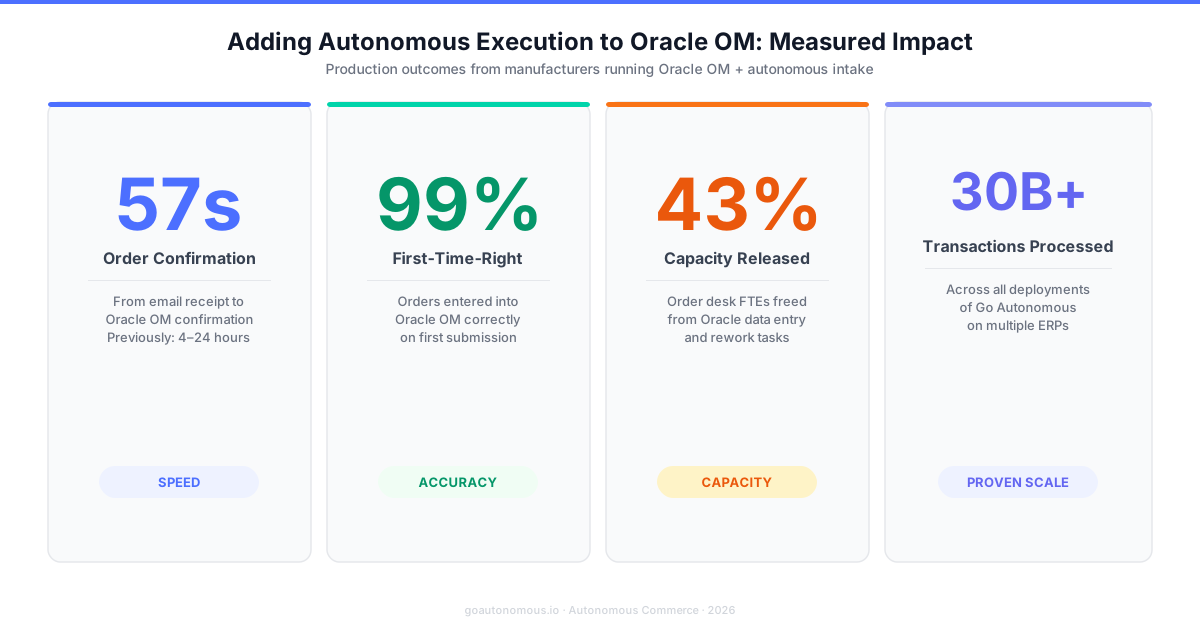
The integration is bi-directional: autonomous commerce also queries Oracle for order status, confirmation details, ATP availability, and pricing data, enabling it to provide immediate order acknowledgements to customers and resolve ambiguities against live ERP data. For manufacturers concerned about data integrity and the risk of incorrect orders entering Oracle, the architecture includes pre-ERP validation gates, every order is validated against Oracle master data before creation, with exceptions routed to human review rather than creating incorrect records in the ERP.
Go Autonomous also integrates with SAP, Microsoft Dynamics, Infor, and other ERP systems, so manufacturers running mixed ERP environments or evaluating ERP migration can deploy autonomous commerce as the intake layer regardless of which ERP is downstream. The full integrations portfolio covers the major ERP and CRM systems used by European B2B manufacturers and distributors.
Deployment Steps: Autonomous Commerce Alongside Oracle OMS
For manufacturers evaluating how to deploy autonomous commerce alongside Oracle, the implementation sequence follows a consistent pattern that minimises ERP risk while delivering fast ROI:
- ERP master data integration: Connect Go Autonomous to Oracle, syncing customer master data, product catalogues, pricing contracts, and order templates. This is typically the most time-consuming phase but critical for accurate matching and pricing.
- Email channel onboarding: Configure Go Autonomous to receive order and quote emails from the primary customer-facing inboxes. This is where the majority of unstructured order volume lives and where the fastest ROI is generated.
- AI training on order patterns: The autonomous commerce platform learns the order patterns for each customer, typical SKUs, quantities, pricing, and special handling requirements. This phase determines the final automation rate.
- Supervised parallel running: Go Autonomous processes orders in parallel with manual operators, with human review of every autonomous action. This phase builds confidence in automation accuracy and identifies edge cases before full deployment.
- Graduated autonomy deployment: Automation rates are gradually increased as confidence thresholds are reached, with exceptions, orders outside learned patterns, continuing to route to human operators for handling.
- Oracle order creation: Validated orders are written directly to Oracle as confirmed sales orders, maintaining Oracle as the unmodified system of record for fulfilment, invoicing, and downstream ERP processes.
The full deployment cycle from contract signature to live autonomous order processing is typically measured in weeks, not months. The ERP integration is a configuration exercise, not a development project, Go Autonomous ships certified Oracle connectors, not bespoke integrations. For manufacturers who have experienced multi-year ERP implementation cycles, this timeline is often the most surprising element of the commercial conversation.
Real-World Deployment Patterns: What Manufacturers Are Seeing
The deployment patterns for autonomous commerce alongside Oracle are converging around a small number of configurations that have proven out in live production environments across European B2B manufacturers and distributors. The outcomes are measurable and consistent.
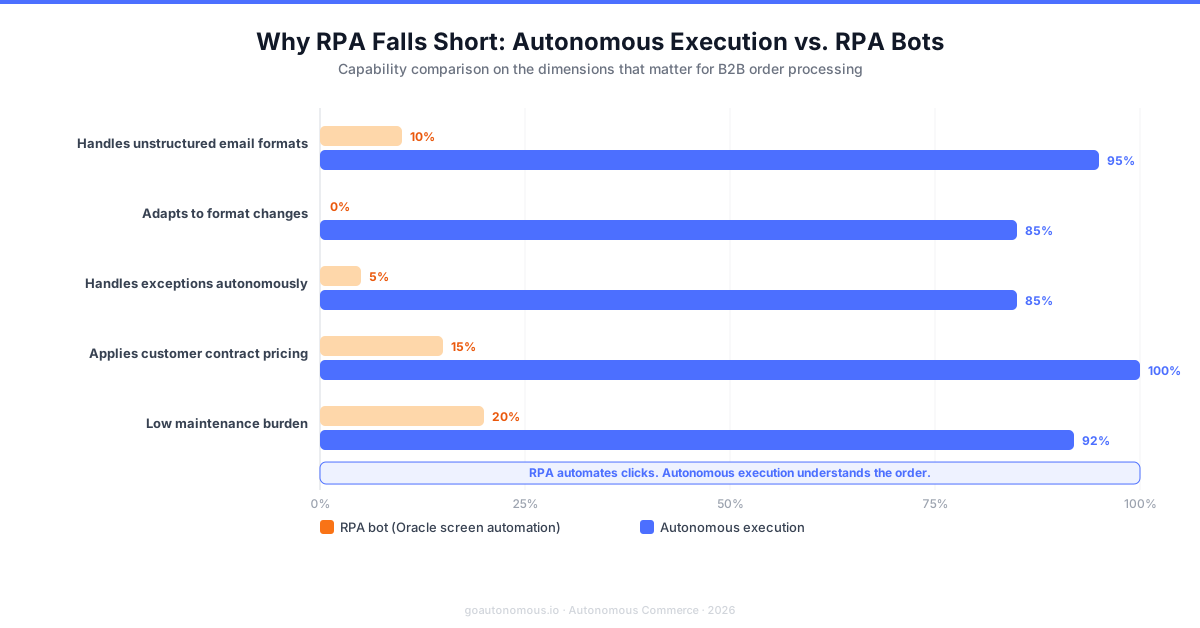
Across deployments, the performance metrics that manufacturers report consistently include: orders processed in under 57 seconds end-to-end from email receipt to Oracle sales order creation; 43% of customer service capacity released from manual order entry to higher-value activities; 99% first-time-right order accuracy (orders created in Oracle without manual correction); and 18% increase in win rate on quoted orders, driven by response time improvements. For context on how this compares to the current state, the 2026 B2B order management benchmark documents the operational baseline that most manufacturers are starting from.
Danfoss, a global industrial manufacturer operating across 26 countries, deployed autonomous commerce and went live across all markets in a single day, a deployment speed that illustrates the configuration-based architecture that makes rapid rollout possible. Orders that previously required minutes of manual processing are now completed in under one minute, at scale, without adding headcount as revenue grows.
Mediq, a leading healthcare distribution company, transformed its order handling with autonomous commerce, demonstrating the pattern across distribution: high order volume, complex customer-specific catalogues, and a manual intake team that was struggling to scale. CWS Hygiene, a European services company, partnered with Go Autonomous to deploy autonomous commerce across its B2B order operations, again, not replacing the ERP, but eliminating the manual layer between customer emails and the system of record. More deployment examples are available at Go Autonomous success cases.
For CFOs evaluating the financial case, the CFO’s AI Mandate white paper provides the ROI framework: headcount cost avoided, SLA improvement impact on customer retention, and working capital effects of faster order-to-cash cycles. The master data management in autonomous commerce white paper addresses the data quality concerns that ERP-focused IT organisations typically raise when evaluating pre-ERP execution platforms.
Evaluation Criteria for Oracle OMS Alternatives in 2026
Manufacturers evaluating Oracle order management alternatives in 2026 are applying a different set of criteria than they would use for an ERP replacement. The evaluation is not about order orchestration features, Oracle handles those, it is about intake execution capability, ERP integration quality, and the speed and reliability of AI-driven order processing against real-world B2B order complexity.
The criteria that matter most in live evaluations, based on the pattern of questions from manufacturers running Oracle:
- Unstructured input handling: Can the platform process emails, PDFs, scanned documents, and phone-to-text orders without template matching or rigid formatting requirements? The ability to handle the full range of real customer communication formats, not just clean PDF orders, determines the achievable automation rate.
- Customer part number resolution: B2B orders typically use customer-specific part numbers that bear no relationship to internal SKUs. The platform’s ability to maintain and learn customer-to-internal mapping, and to resolve ambiguous references without human intervention, is a critical quality gate.
- Oracle ERP integration depth: A certified, bidirectional Oracle integration that reads master data and writes validated orders is non-negotiable. Point-to-point API integrations built on custom development are a maintenance liability; pre-built certified connectors are the correct architecture.
- Exception handling transparency: Every autonomous system will encounter orders it cannot process with sufficient confidence. The evaluation question is not whether exceptions occur, they will, but how they are surfaced, routed, and resolved. Platforms that route exceptions to human review with full context preserve operator effectiveness; platforms that silently fail or block orders create SLA risk.
- Automation rate at realistic order mix: Vendors will quote automation rates from their best deployments. The correct evaluation methodology is to run a proof of concept against a representative sample of the manufacturer’s actual order history, including the complex, ambiguous, multi-line orders that operators find most time-consuming, not just the clean orders that any system can handle.
- Time to value: For a deployment alongside an existing Oracle ERP, implementation should be measured in weeks. If an Oracle order management alternative vendor is proposing a 12-month implementation timeline, that is a signal about the architecture, configuration-based platforms deploy in weeks; heavily customised platforms do not.
Go Autonomous provides the operator-facing layer where exceptions are managed, automation rates are monitored, and configuration is handled. For IT and operations teams evaluating the platform, it provides the oversight and control model that enterprise deployments require alongside the autonomous execution that handles the routine processing. For a broader view of the order-to-cash automation scope that autonomous commerce covers, the use case documentation maps the full execution range from intake through fulfilment.
Analyst frameworks for evaluating OMS platforms include the Gartner Magic Quadrant for Order Management, which provides useful context for traditional OMS vendors, and the Forrester Wave for B2B Commerce Solutions. It is worth noting that both analyst frameworks were built primarily around structured digital order management, the intake execution problem that autonomous commerce addresses is a relatively recent addition to analyst coverage, reflecting the shift in how manufacturers are thinking about the pre-ERP execution problem.
The Economics of Post-Oracle Order Management
The economic case for deploying autonomous commerce alongside Oracle is distinct from the economic case for an ERP replacement. ERP replacement projects are capital-intensive, multi-year programmes with uncertain ROI timelines and significant operational risk during transition. Deploying autonomous commerce as a pre-ERP execution layer is a different kind of investment: configuration-based, measured in weeks for deployment, and generating measurable ROI from the first weeks of live operation as manual processing hours are replaced by autonomous execution.
The financial mechanics are straightforward. Customer service teams in high-volume order environments typically spend 60–80% of their working hours on order entry, confirmation, and routine enquiry handling, tasks that autonomous commerce handles automatically. Releasing that capacity does not necessarily mean headcount reduction (though it can): more commonly, it means redeploying operators to exception handling, customer relationship management, and revenue-generating activities that create value beyond order processing. The throughput effect, processing 60% more order volume per employee, means that revenue can grow without corresponding growth in operations headcount, which is the structural change that makes autonomous commerce compelling at scale.
Working capital is a secondary benefit that CFOs track alongside the headcount story. Faster order-to-cash cycles, orders processed in under a minute rather than hours or days, compress the receivables cycle, reduce outstanding invoices, and improve cash conversion. For a manufacturer processing thousands of orders per day, the aggregate working capital effect of consistently fast order processing is material. The platform has processed over 30 billion transactions, providing the scale evidence that enterprise-grade operations require.
For manufacturers with complex Oracle environments who are also managing SAP instances in business units, SAP integration is available on the same platform, meaning that autonomous commerce can serve as a unified intake execution layer across a mixed ERP estate, creating a single point of control for the unstructured order channel regardless of which ERP system a particular business unit or region runs.
Frequently Asked Questions
The first limitation most manufacturers encounter is not a software defect, it is a design boundary. Oracle Order Management processes structured, confirmed orders that arrive through digital channels (API, portal, EDI). It does not process unstructured orders that arrive via email, PDF, phone, or other human-mediated channels. For most B2B manufacturers, 85–90% of order volume flows through exactly these channels, meaning the vast majority of orders require manual intervention before Oracle ever sees them. The practical manifestation: a growing team of operators whose primary job is to translate incoming emails and PDFs into Oracle sales orders. As revenue grows, this team must grow proportionally, making operational leverage impossible without a pre-ERP execution layer.
No. Autonomous commerce and Oracle Order Management address different problems in the order lifecycle and are designed to work together, not compete. Oracle Order Management owns the fulfilment orchestration layer: order processing, ATP logic, inventory management, downstream ERP integration for finance and logistics. Autonomous commerce owns the intake execution layer: reading emails and PDFs, interpreting unstructured order content, matching customer part numbers, applying contracted pricing, validating the order, and creating it in Oracle as a clean sales order. Oracle continues to be the system of record for every order. Autonomous commerce eliminates the manual work that currently happens between the customer’s email and Oracle’s order creation screen.
Go Autonomous connects to Oracle through a certified, bidirectional ERP integration. The platform reads master data from Oracle, customer records, product catalogues, pricing contracts, order templates, and uses this data to interpret and validate incoming orders. Validated orders are written back to Oracle as confirmed sales orders, with full audit trail and data integrity preserved. The integration works with Oracle E-Business Suite, Oracle Cloud Order Management, and Oracle Fusion. From Oracle’s perspective, it receives clean, validated sales orders, the same format as manually entered orders, at the speed and volume that autonomous processing enables. Configuration-based connectors mean deployment is measured in weeks, not months.
Manufacturers deploying autonomous commerce alongside Oracle are replacing the manual intake operation that sits upstream of Oracle, not Oracle itself. Specifically: the order entry function performed by customer service representatives and inside sales operators who currently read emails, match part numbers, check pricing, and type orders into Oracle. In many organisations, legacy RPA implementations that were deployed to automate parts of this process are also replaced, as autonomous AI execution handles unstructured inputs that RPA’s scripted approach cannot. The result is that Oracle continues to run unchanged while the manual work that feeds it is eliminated or substantially reduced.
The ROI of deploying autonomous commerce alongside Oracle OMS comes from three primary sources. First, direct labour cost: customer service and order entry capacity released from manual processing, typically 40–60% of current headcount hours, either redeployed to value-adding activities or avoided in future hiring as volume grows. Second, revenue impact: faster order response times (under 57 seconds vs. hours of manual processing) reduce order loss from SLA failures and improve win rates on quoted opportunities, deployments show an 18% increase in win rate. Third, working capital: faster order-to-cash cycles from autonomous processing compress the receivables cycle. Combined, these effects deliver payback periods that are typically measured in months for high-volume manufacturers, not years.
The most important evaluation criteria for Oracle order management alternatives in 2026 are: (1) Unstructured input handling, can the platform process real B2B order formats including emails, PDFs, and freeform text without rigid templates? (2) Customer part number resolution, can the platform maintain and learn customer-to-internal SKU mappings and resolve ambiguous references autonomously? (3) Oracle ERP integration depth, certified, bidirectional integration that preserves Oracle as the system of record, not bespoke custom integration. (4) Exception handling transparency, clear routing of exceptions to human review with full context, not silent failure. (5) Achievable automation rate against your actual order mix, require a proof of concept on real historical order data, not vendor-supplied samples. (6) Time to value, configuration-based platforms deploy in weeks; long implementation timelines indicate architectural complexity that will compound over time.
Yes. Distributors running Oracle E-Business Suite face the same fundamental intake problem as manufacturers running Oracle Cloud, often in a more acute form because EBS was designed for a world where EDI was the primary electronic order channel. The email and PDF order volume that represents the majority of modern B2B distributor order flow was not the architecture Oracle EBS was built for. Autonomous commerce integrates with Oracle EBS through the same certified connector architecture, reading master data and writing validated orders to EBS order entry. The deployment pattern for distributors typically starts with email order automation, the highest-volume, highest-effort manual process, and expands to include RFQ handling, claims processing, and price inquiry automation as the platform learns customer patterns and builds automation confidence.