.svg)





CPQ vs. Autonomous Commerce: Why Configure-Price-Quote Falls Short for B2B Manufacturers
CPQ software solves the configuration and pricing challenge at the quoting stage — but it was never built to handle the unstructured order intake that defines real B2B manufacturing. This post explains exactly where CPQ stops and where Autonomous Commerce picks up.
CPQ software promised to fix the quoting problem for B2B manufacturers, and in many ways, it delivered. Configuration logic, pricing rules, and guided selling workflows are real and valuable capabilities. But CPQ for manufacturers has a structural blind spot: it was designed to support a clean digital sales funnel that most B2B manufacturers simply do not have. When 85–90% of B2B revenue is still human-facilitated, orders arriving by email, phone, EDI, and customer portals, CPQ handles only a fraction of the execution problem. Autonomous Commerce is built for the rest: the intake, interpretation, matching, validation, and ERP execution that CPQ can’t touch.
Table of Content
- What CPQ Actually Does, and What It Was Built For
- The CPQ Gap: Why Configure-Price-Quote Limitations Are Structural, Not a Patch Problem
- CPQ vs. Autonomous Commerce: A Direct Comparison
- Why B2B Manufacturers Are Moving Beyond CPQ Alone
- Quote-to-Cash Automation Beyond CPQ: What the Architecture Looks Like
- Real-World Outcomes for Manufacturers Who Have Moved Past CPQ Alone
- Practical Next Steps for Manufacturers Evaluating Their Quoting and Order Automation Strategy
- Frequently Asked Questions
- See Autonomous Commerce in Action at the 2026 Summit
What CPQ Actually Does, and What It Was Built For
Configure-Price-Quote (CPQ) software emerged to solve a specific problem: B2B products are complex, pricing rules are layered, and sales reps were making expensive mistakes generating quotes manually. CPQ software B2B vendors like Salesforce CPQ, SAP CPQ, and Oracle CPQ built tools to encode product logic, enforce pricing governance, and generate accurate quotes at speed. For the right use case, they work well.
What CPQ Does Well
Configure-Price-Quote solutions shine in environments where a sales representative is actively driving a structured opportunity. The core value stack of any mature CPQ platform includes:
- Product configuration engines, rule-based logic that prevents incompatible product combinations and guides reps through valid configurations
- Pricing rules and discount governance, tiered pricing, customer-specific rates, approval workflows, and margin guardrails
- Quote document generation, branded PDFs, proposal templates, e-signature integrations
- CRM integration, tight coupling with Salesforce, SAP, or Microsoft Dynamics for pipeline visibility
- Guided selling, prompting reps with recommended products, bundles, and upsell paths
These are genuine capabilities. For companies with a direct field sales motion, configure price quote manufacturing workflows can meaningfully reduce quote cycle time and improve accuracy. Gartner has consistently identified CPQ as a high-value investment for complex selling environments, and the market has responded, with CPQ for distributors and manufacturers representing a multi-billion-dollar software segment.
The Assumptions Built Into Every CPQ System
But every CPQ system is built on assumptions that break down in most real-world B2B manufacturing environments. CPQ assumes:
- A sales representative initiates the process by opening a CRM record and building a quote manually
- The customer submits their request through a structured channel, a CRM-connected portal, a direct sales conversation, or a demo session
- Product information is clean, standardized, and matchable to a catalog
- The quote, once approved, transitions cleanly into an order in the ERP
In a SaaS company with a structured sales funnel, these assumptions hold. In a Nordic industrial manufacturer processing 2,000 orders a week from 400 customer accounts across six countries, with orders arriving by email in three languages, referencing legacy part numbers, and requiring ERP validation before confirmation, none of them hold. This is the CPQ gap that RFQ and quote automation built on autonomous principles is designed to close.
The CPQ Gap: Why Configure-Price-Quote Limitations Are Structural, Not a Patch Problem
CPQ limitations in manufacturing are not the result of bad software or poor implementation. They are structural. CPQ was designed to augment a human sales rep, not to replace the human in the loop. That distinction matters enormously when you are trying to scale B2B quote and order volume without scaling headcount.
The Unstructured Intake Problem
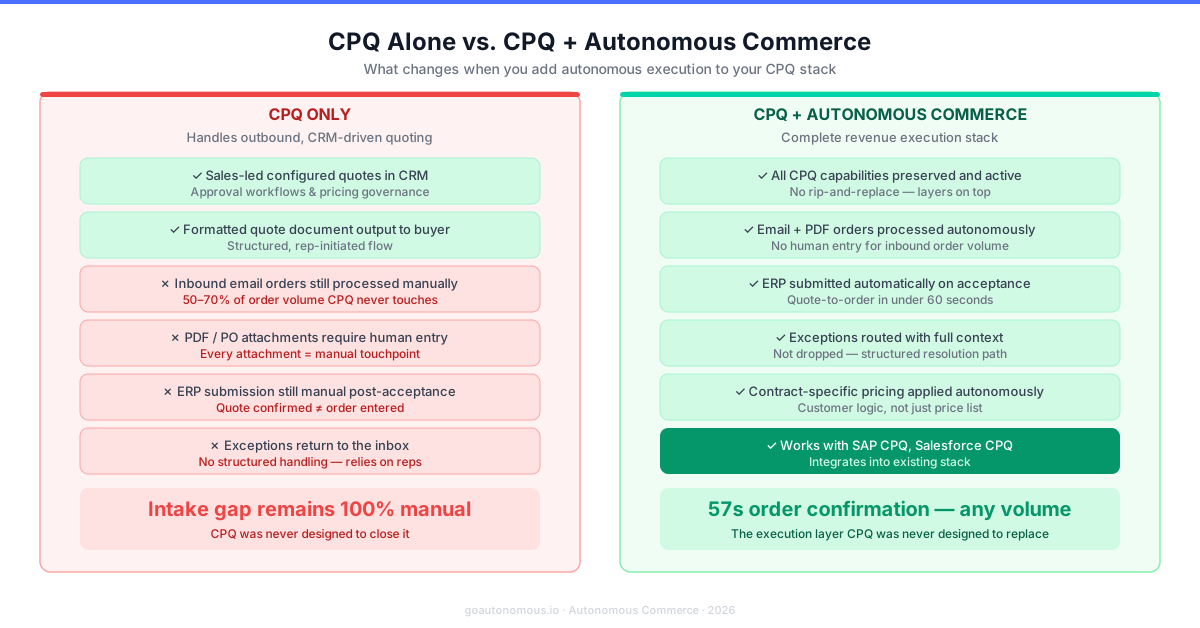
According to multiple industry analyses, including research from Aberdeen Group and Forrester, email remains the primary channel for B2B order and quote submission, representing 50–70% of total order volume at most industrial manufacturers and distributors. These emails are not formatted. They do not arrive with clean SKUs, quantities, and delivery dates in machine-readable form. They arrive as PDFs, freeform text, scanned purchase orders, and multi-line Excel attachments written in whatever format the buyer’s procurement team standardized a decade ago.
CPQ software B2B vendors have built no meaningful capability to handle this. CPQ integration with ERP is designed for the output side of quoting, pushing a confirmed quote into SAP or Oracle as a sales order. It is not designed to ingest an unstructured incoming request, interpret it, match line items to catalog entries, validate against inventory and lead times, and execute the order entry. That requires a fundamentally different class of software: one built around autonomous execution rather than assisted quoting. The distinction between these two paradigms is explored in depth in why Autonomous Commerce is not the same as automation.
For Industrial Manufacturers: The Scale Trap
Industrial manufacturers face a specific version of this problem that CPQ for manufacturers was never designed to address. When order volume grows, new customers, new markets, new product lines, the operational response has always been the same: hire more customer service representatives to handle the intake. CPQ helps the front-end sales team work faster. It does not reduce the backroom operational headcount required to process what the sales team generates.
Each time we added one or two million euros in revenue, we had to add another operator. From a cost perspective, that's an unsustainable way of operating a business.

This is the scale trap. CPQ software improves quoting efficiency for the rep who builds the quote. But the order still needs to be received, interpreted, and entered. A manufacturer processing high volumes of inbound orders from industrial customers across multiple geographies cannot solve the intake problem with better quoting software alone. What they need is email-to-order automation that operates without human intervention, reading the incoming request, matching it to catalog and customer master data, and executing the ERP entry in full. That is a different class of capability entirely.
For B2B Distributors with High Order Volume
For high-volume B2B distributors, CPQ limitations in manufacturing hit differently. Distributors often handle thousands of order lines per day across hundreds of SKUs and dozens of supplier relationships. Their challenge is not product configuration complexity, it is order processing throughput. CPQ for distributors was never optimized for this use case. The Forrester Wave on CPQ consistently rates platforms on configuration depth and pricing sophistication, not on unstructured document processing speed or autonomous ERP entry.
Distributors that have moved to autonomous order intake report 60% throughput improvements per employee, not because they bought better CPQ software, but because they removed the human touchpoint from routine order processing entirely. Sales order automation at this level operates on a fundamentally different principle: autonomous execution, not assisted quoting. The results from companies like Mediq, detailed in the Mediq Autonomous Commerce case study, demonstrate what becomes possible when distributors stop trying to solve an execution problem with a quoting tool.
For Companies Running Salesforce CPQ or SAP CPQ
For organizations already running Salesforce CPQ or SAP CPQ, the instinct is often to extend the platform, add more integrations, build more connectors, train more users. This approach hits a ceiling quickly. Salesforce CPQ is excellent at managing structured opportunities in a CRM. SAP CPQ handles complex variant configuration for SAP-native environments. Neither was designed to autonomously process an inbound email order, match free-text product descriptions to ERP catalog entries, handle exceptions, and confirm back to the customer, all without human intervention.
The reality is that the Salesforce integration layer and the SAP integration layer in an Autonomous Commerce platform sit alongside existing CPQ investments, not against them. Autonomous Commerce does not require ripping out CPQ. It handles the intake and execution layer that CPQ leaves exposed, and passes the confirmed, structured output to whichever ERP or CRM system already governs the business.
CPQ vs. Autonomous Commerce: A Direct Comparison
Understanding why CPQ software B2B implementations leave manufacturers exposed requires a direct comparison of what each approach actually covers. The following comparison is not a vendor evaluation, it is a functional scope map. The question is not which product is better; it is which problem each product was designed to solve.
Scope and Trigger
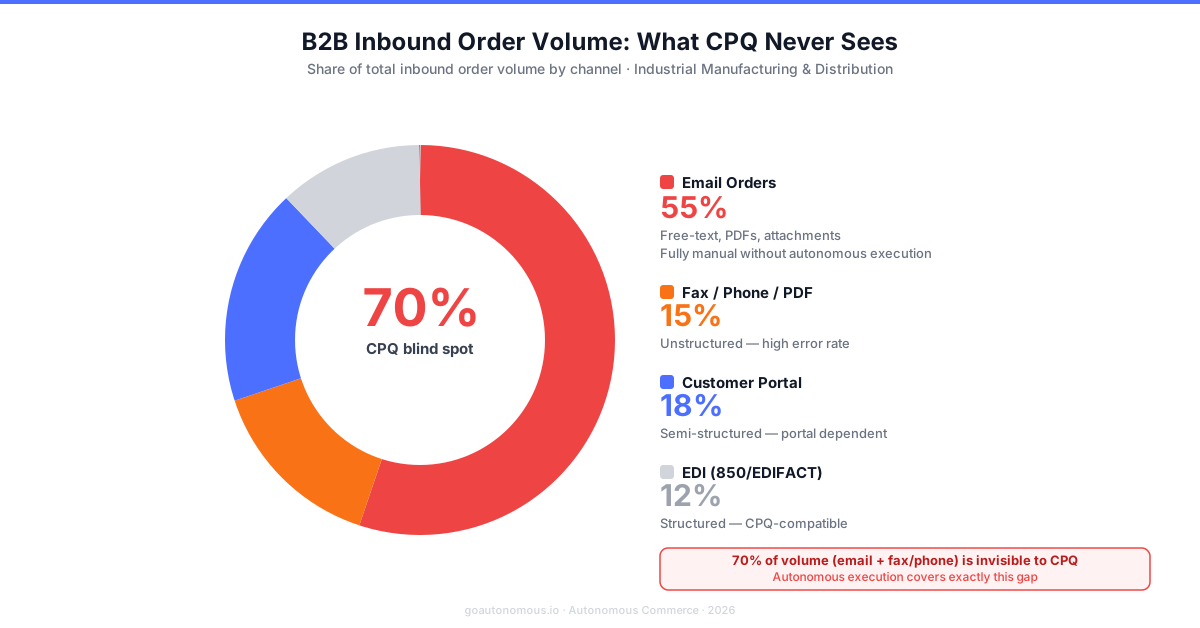
CPQ is triggered by a human sales representative opening a quoting session. The human initiates the process, selects a customer record, and begins configuring a product. CPQ software then assists, validating combinations, applying pricing rules, generating the output document. The human remains in the loop at every meaningful decision point.
Autonomous Commerce is triggered by an incoming commercial event, an email, an EDI message, a portal submission, a phone transcript. The system autonomously reads, interprets, and executes the appropriate commercial response without waiting for a human to initiate a workflow. For manufacturers handling thousands of routine orders per week, this is the difference between a scaling business and a headcount trap.
Input Format
CPQ requires structured input. The sales rep selects from a product catalog, enters quantities, applies configurations. The system cannot read a PDF purchase order, interpret a free-text email, or parse a legacy customer part number and match it to a current SKU. This is not a limitation CPQ vendors are racing to fix, it is simply outside the design scope of configure price quote manufacturing platforms.
Autonomous Commerce is built from the ground up to handle unstructured inputs. Natural language orders, PDFs, Excel attachments, EDI files, web forms, the platform reads all of them, extracts the commercial intent, and maps it to the structured data the ERP requires. This is the core capability described in the white paper Breaking Free from Manual Processes: replacing the human interpretation layer with an autonomous one.
ERP Execution Depth
CPQ integrates with ERP to push confirmed quotes as sales orders. CPQ integration ERP is a one-way handoff: the structured, human-approved quote moves into the ERP system for fulfillment. CPQ does not validate against live inventory, does not execute order confirmation, and does not handle exception routing when the ERP rejects a line item.
Autonomous Commerce executes bidirectionally in the ERP. It pulls master data, validates line items against current catalog and stock, applies customer-specific pricing rules, routes exceptions for human review when needed, and writes the confirmed order back, all without a human intermediary for routine transactions. The result is a 99% first-time-right rate on processed orders and documented order cycle times under 57 seconds. This level of ERP execution depth is covered in detail on the Order-to-Cash Automation use case page.
Handling Exceptions and Claims
CPQ routes exceptions through approval workflows, a discount above threshold triggers a manager approval in CRM. This is governance over the quoting process, not autonomous exception resolution.
Autonomous Commerce handles the full exception surface of B2B order management: wrong part numbers, pricing mismatches, short-ship scenarios, delivery date conflicts, and claims and dispute automation. Exceptions that cannot be resolved autonomously are routed to a human with full context, not a blank email forwarded from a shared inbox.
Why B2B Manufacturers Are Moving Beyond CPQ Alone
The market for B2B quoting automation is shifting. CPQ vendors have been consolidating, Oracle acquired CPQ vendors, Salesforce built CPQ natively, SAP extended its CPQ capabilities into the broader Intelligent Enterprise suite. But consolidation has not solved the intake problem. If anything, it has deepened it: larger platform vendors have invested in making CPQ more powerful within its existing scope, not in expanding that scope to cover unstructured order intake.
Meanwhile, the operational pressure on manufacturers and distributors has intensified. Customers expect faster confirmations. Procurement teams submit orders through whatever channel is most convenient for them, not whatever channel is most convenient for the supplier’s CPQ implementation. The competitive advantage in B2B commerce increasingly belongs to the companies that can confirm, execute, and fulfill faster than anyone else, regardless of how the order arrived.
This is precisely why comparisons like RPA vs. AI in B2B operations matter: businesses that invested in RPA-based order processing found the same ceiling as CPQ, a tool optimized for structured inputs in a world defined by unstructured ones. The pattern is consistent. And it is why the conversation around why order-to-cash automation fails for manufacturers keeps returning to the same root cause: applying structured-data tools to unstructured-data problems.
The Real Cost of the CPQ Gap
The cost of CPQ limitations in manufacturing is not always visible in a single line of the P&L. It accumulates across three dimensions:
- Headcount cost, customer service and inside sales teams grow proportionally with order volume because someone has to handle everything CPQ cannot reach. Industry benchmarks suggest 85–90% of B2B revenue remains human-facilitated. That ratio does not improve with CPQ alone.
- Error cost, manual interpretation of unstructured orders generates entry errors that drive returns, re-shipments, credit notes, and customer dissatisfaction. Companies that have deployed autonomous order processing report 99% first-time-right rates, compared to industry averages that are significantly lower for manual intake operations.
- Speed cost, customers placing high-frequency, routine orders do not want to wait for a rep to log into CPQ and generate a quote. They want confirmation in minutes. Autonomous Commerce delivers orders confirmed in under 57 seconds. CPQ, by definition, cannot: it requires a human to initiate the session.
For manufacturers operating in competitive industrial markets, where customer retention correlates directly with speed and accuracy of order execution, this cost gap compounds over time. A leading Nordic manufacturer that deployed Autonomous Commerce alongside its existing ERP stack did not retire its CPQ investment; it added the execution layer that CPQ was never designed to provide, and saw 43% of operational capacity released from routine order processing to higher-value commercial work.
Autonomous Commerce as the Completion Layer
The framing that resonates most clearly with operations and commercial leaders at B2B manufacturers is this: CPQ is a sales productivity tool. Autonomous Commerce is an execution infrastructure. They solve different problems and they serve different parts of the revenue process. The question is not which one to choose, it is whether the organization has addressed both the quoting problem and the intake-and-execution problem.
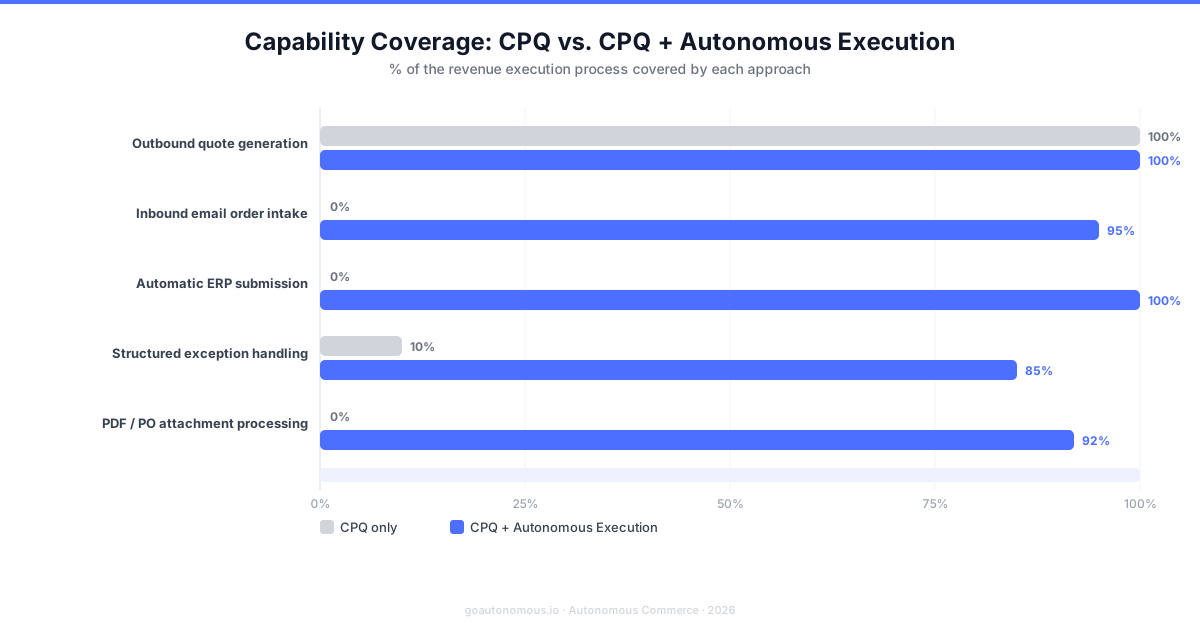
Most €500M+ manufacturers have addressed the quoting problem. Very few have addressed the execution problem at the level that autonomous commerce enables. The Autonomous Commerce Flow platform is specifically designed to execute this intake-to-ERP workflow autonomously, handling email, EDI, portal, and voice inputs, matching to master data, validating, executing, and confirming, all without the human handoffs that limit CPQ-only environments.
Grundfos, one of the world’s largest pump manufacturers, has taken a step in this direction, partnering with Go Autonomous for AI-assisted case creation and management. The pattern is consistent across the industry: large manufacturers with existing ERP and CRM investments are not replacing CPQ. They are adding the autonomous execution layer that CPQ leaves absent.
Quote-to-Cash Automation Beyond CPQ: What the Architecture Looks Like
For manufacturers evaluating B2B CPQ alternatives or looking to extend their existing CPQ investment, understanding the architecture of autonomous quote-to-cash is essential. This is not a replacement architecture, it is a completion architecture. The components that Autonomous Commerce adds to an existing CPQ and ERP stack are precisely those that CPQ omits.
The Autonomous Quote-to-Cash Stack
A complete autonomous quote-to-cash workflow for a B2B manufacturer typically involves the following layers:
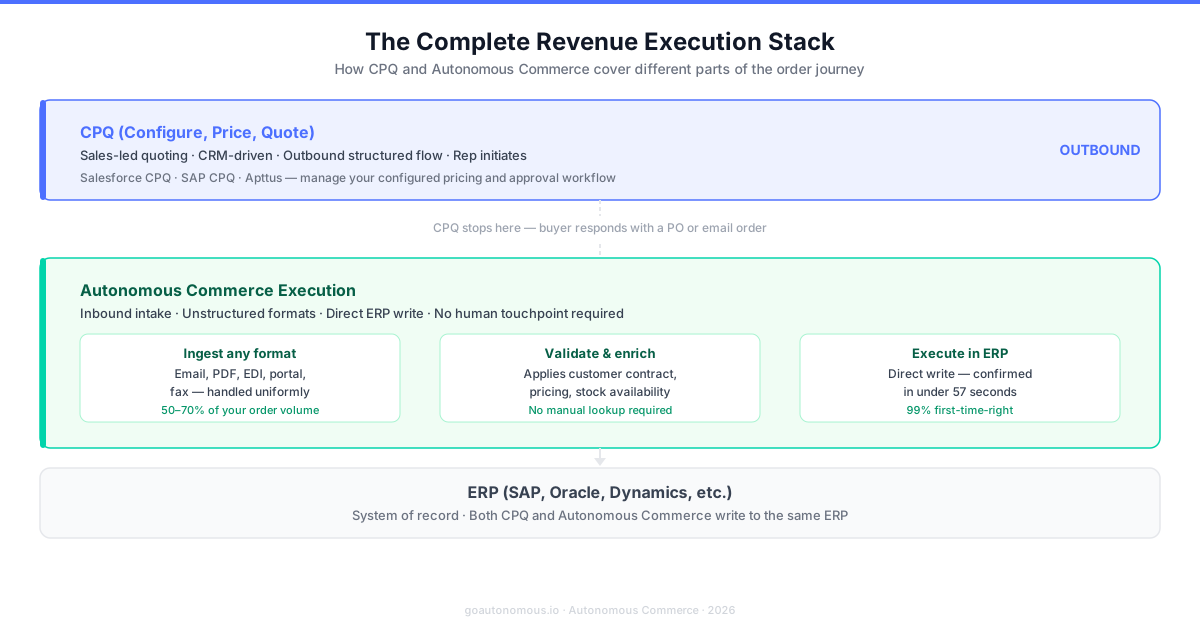
- Intake layer, captures incoming commercial requests from all channels: email (including PDF and Excel attachments), EDI, web portals, and API. This is the layer CPQ does not have.
- Interpretation layer, uses AI to extract commercial intent from unstructured inputs: identifying product references (including legacy and customer-specific part numbers), quantities, delivery requirements, and pricing expectations.
- Matching and validation layer, maps extracted data to ERP master data: catalog matching, customer master validation, inventory and lead time checking, pricing rule application.
- Execution layer, writes the confirmed order or quote to the ERP, triggers fulfillment workflows, and sends structured confirmation to the customer. This is where autonomous pricing B2B becomes real: pricing is applied and confirmed autonomously for routine transactions, with human escalation only for edge cases.
- Exception routing layer, exceptions that cannot be resolved autonomously are surfaced to a human operator with full context, structured for rapid resolution rather than manual reconstruction from an email thread.
CPQ software B2B implementations cover steps 3 and 4, but only for the structured, rep-initiated quote workflow. Steps 1 and 2 are entirely absent. Steps 4 and 5 are partially covered in the outbound direction only. Autonomous Commerce covers all five steps, for all incoming commercial requests, regardless of format or channel.
Integration with Existing CPQ and ERP Systems
A question that arises consistently among manufacturers evaluating CPQ vs autonomous commerce is whether deploying an autonomous execution layer requires replacing existing CPQ or ERP systems. The answer is no. Autonomous Commerce is designed to integrate with the systems already in place, including SAP, Oracle, Microsoft Dynamics, Infor, and Salesforce.
The deployment model is additive. CPQ continues to handle the structured, rep-driven quoting workflow it was designed for. Autonomous Commerce handles the unstructured, high-volume, intake-driven order and quote execution workflow that CPQ cannot reach. The two systems complement each other in the same way that a CRM complements an ERP: each handles a distinct part of the commercial process, and the integration between them is what creates a complete revenue execution stack.
For manufacturers in the industrial and chemical sectors, where both complex custom quoting and high-volume routine ordering coexist, this layered architecture is not a theoretical ideal, it is the operational reality. The Autonomous Commerce for Industrial Manufacturers page covers the specific deployment patterns for this segment. For distributors handling high-velocity SKU volume, the architecture is described in detail on the Autonomous Commerce for Industrial Distributors page.
The Price Inquiry and RFQ Execution Gap
One of the most under-discussed CPQ limitations in manufacturing is the price inquiry workflow. A large proportion of inbound commercial contacts at B2B manufacturers are not orders, they are price inquiries. A customer asks for a price on a set of items. A procurement team sends an RFQ with 200 line items. A distributor checks availability and pricing before placing a bulk order.
CPQ software handles the structured quotation response once a rep has received and interpreted the inquiry. It does not autonomously process the inbound inquiry, pull pricing from the ERP, validate against customer-specific contract rates, and send a formatted response, without a human in the loop. Autonomous pricing B2B at this level requires the same intake and interpretation capabilities as order processing. The Price Inquiry Automation use case page documents exactly how this works in practice, including response time benchmarks.
Real-World Outcomes for Manufacturers Who Have Moved Past CPQ Alone
The business case for autonomous quote processing and order management sits on a set of outcomes that CPQ, by itself, cannot generate. These are not projections, they are measured results from manufacturers and distributors that have deployed Autonomous Commerce alongside or in place of CPQ-only approaches.
Danfoss, one of the world’s largest engineering companies, went live across 26 countries in a single day. Orders that previously required multiple human touchpoints and significant cycle time now complete in under one minute. The scale of the deployment, and its speed, is only possible because the underlying architecture executes autonomously, without requiring a human to initiate or manage each transaction. This is the operational reality that CPQ integration ERP, by itself, cannot achieve.
Across the manufacturing and distribution sector, the pattern of outcomes from autonomous commerce deployments is consistent:
- 18% win rate increase, faster quote response directly correlates with higher win rates in competitive B2B quoting environments
- 43% capacity released, customer service teams previously dedicated to manual order intake are redeployed to higher-value commercial activities
- 99% first-time-right, autonomous ERP entry eliminates the error cascade that flows from manual interpretation of unstructured orders
- Orders executed in 57 seconds, from inbound email to confirmed ERP entry, without human intervention for routine transactions
- 60% throughput improvement per employee, measured across high-volume distributor deployments where order volume previously scaled linearly with headcount
None of these outcomes are achievable with CPQ software alone, because CPQ does not address the intake and execution layer where these gains are generated. They are the result of autonomous execution at the order and quote processing layer, not assisted quoting at the rep interaction layer. Additional validated success cases are documented at goautonomous.io/success-cases/.
Practical Next Steps for Manufacturers Evaluating Their Quoting and Order Automation Strategy
For operations leaders, commercial directors, and IT teams at B2B manufacturers evaluating their current quote-to-cash automation stack, the assessment framework is straightforward. The core question is not whether CPQ is the right tool, for complex, rep-driven quoting, it often is. The question is whether the organization has addressed the full execution surface of its commercial operations, including the high-volume, unstructured, intake-driven workflows that CPQ was never designed for.
Diagnostic Questions for Manufacturers and Distributors
The following questions diagnose the CPQ gap in practical terms. If the answer to any of these is yes, the organization has execution exposure that CPQ alone will not resolve:
- Do more than 20% of inbound orders or quote requests arrive by email, as PDFs, or in formats that require human interpretation before ERP entry?
- Is customer service headcount growing in proportion to order volume, rather than decoupled from it?
- Are order entry errors, wrong part numbers, pricing mismatches, delivery date conflicts, generating a significant credit note or re-shipment burden?
- Do customers complain about slow order confirmation, even for routine repeat orders?
- Is the organization running CPQ for field sales but still relying on manual processes for inside sales and customer service order intake?
If these symptoms are present, the solution is not a CPQ upgrade or a better CPQ integration ERP connector. The solution is an autonomous execution layer that handles the intake and processing surface that CPQ was not built to cover. The white paper Revolutionizing Order Handling in B2B Commerce provides a detailed analysis of what this transition looks like architecturally and operationally for manufacturers at different stages of digital maturity.
The Migration Path: Keeping CPQ, Adding Execution
The migration path for most manufacturers is not a wholesale replacement of CPQ. It is a targeted deployment of autonomous execution capability in the specific workflows where CPQ leaves a gap. In practice, this means:
- Audit the full order and quote intake surface, identify what percentage of volume arrives through channels that CPQ cannot reach
- Quantify the operational cost of manual processing in those channels, headcount, error rates, cycle times
- Identify the ERP and CRM systems that Autonomous Commerce needs to integrate with, SAP, Oracle, Salesforce, Dynamics, Infor
- Deploy autonomous intake and execution for the highest-volume, lowest-complexity order types first, the repeatable, routine transactions where automation generates immediate ROI
- Extend to more complex workflows, RFQ processing, price inquiry automation, claims and exceptions, as the platform proves its value in the high-volume routine tier
This approach preserves existing CPQ investments, minimizes disruption to field sales workflows that depend on CPQ, and generates measurable ROI from the autonomous execution layer within the first months of deployment. For manufacturers in sectors like chemicals, spare parts, and electronic components distribution, this staged approach aligns with the industry-specific deployment patterns described on the Autonomous Commerce for Chemical Manufacturers and Autonomous Commerce for Electronic Component Distributors pages.
Frequently Asked Questions
CPQ (Configure-Price-Quote) is a sales productivity tool that helps sales representatives configure complex products, apply pricing rules, and generate quote documents. It requires a human to initiate the process and operates on structured inputs. Autonomous Commerce is an execution platform that processes incoming commercial requests, orders, quotes, price inquiries, from unstructured channels like email, EDI, and portals, and executes them autonomously in the ERP without requiring human initiation for routine transactions. CPQ optimizes the quoting process. Autonomous Commerce executes the intake and fulfilment process that CPQ leaves uncovered.
CPQ remains the right tool when a human sales representative is driving a structured opportunity with a complex product configuration requirement. Industries with deep variant configuration needs, specialty machinery, custom industrial equipment, project-based engineering sales, benefit from CPQ’s rule-based configuration engines and discount governance workflows. CPQ is also valuable when pricing approval workflows and guided selling capabilities are a priority for the field sales team. The issue is not that CPQ is wrong; it is that CPQ alone is insufficient when the majority of order volume arrives through unstructured channels.
CPQ for manufacturers was designed for rep-initiated, structured quoting workflows. It cannot autonomously process incoming emails, PDFs, EDI files, or portal submissions. It does not read unstructured purchase orders, match free-text line items to ERP catalog entries, or execute autonomous order confirmation. When 50–70% of B2B order volume arrives by email and 85–90% of B2B revenue remains human-facilitated, CPQ software alone leaves a large execution gap that requires significant manual headcount to fill. That headcount scales with revenue, creating the cost and capacity trap that autonomous order processing resolves.
Autonomous Commerce integrates with existing CPQ and ERP systems as a complementary execution layer, not a replacement. It connects with SAP, Oracle, Microsoft Dynamics, Infor, and Salesforce via standard integration frameworks. CPQ continues to handle rep-driven structured quoting. Autonomous Commerce handles the intake and execution of unstructured inbound orders and quotes, reading, interpreting, validating, and writing to the ERP autonomously. The two systems occupy different parts of the commercial workflow and do not conflict.
Yes. Autonomous Commerce does not require replacing CPQ. Most manufacturers that deploy Autonomous Commerce keep their existing CPQ platform for the structured, rep-driven quoting workflows it was designed for. Autonomous Commerce adds the intake and execution capability for the high-volume, unstructured order and quote workflows that CPQ cannot handle. The result is a complete revenue execution stack: CPQ for complex quoting, Autonomous Commerce for autonomous order and quote processing, and the ERP as the system of record for both.
The ROI profile of CPQ versus Autonomous Commerce reflects their different scopes. CPQ improves quoting accuracy and sales rep efficiency, measurable in reduced quote errors, faster quote cycle times, and improved pricing governance. Autonomous Commerce generates ROI at the operational execution layer: 43% capacity released from manual order processing, 99% first-time-right order entry, 18% win rate improvement from faster response times, and order cycle times under 57 seconds. For manufacturers where manual order intake is a significant cost centre, the operational ROI of autonomous execution typically exceeds the productivity ROI of CPQ by a substantial margin.
Quote-to-cash automation covers the full commercial execution cycle from initial customer request through order confirmation, fulfillment, invoicing, and payment. CPQ covers one segment of this cycle, the quoting stage. True quote-to-cash automation requires autonomous execution across the entire arc, including unstructured order intake, ERP validation, exception handling, and confirmations. Autonomous Commerce extends CPQ’s reach by covering the intake and execution stages that CPQ omits, completing the quote-to-cash automation picture for manufacturers and distributors operating at scale.
See Autonomous Commerce in Action at the 2026 Summit
The Autonomous Commerce Summit 2026 brings together operations and commercial leaders from B2B manufacturing and distribution who are actively transforming how revenue is executed. Hear directly from companies that have made the shift to autonomous execution, and what it means for revenue, cost, and working capital. Attendance is by invitation only.
Request your invitation →