.svg)





Autonomous Commerce Is Not Automation: The Distinction That Reframes Your Operations Strategy
Most B2B manufacturers and distributors are investing in automation when they need autonomous execution. This post explains the architectural difference — and why it determines whether your operations can scale.
Every week, a COO or VP Operations at a €500M manufacturer tells us they have already automated their order processing. They mean an RPA script extracts order lines from PDFs. Or an EDI integration eliminates re-keying. Or a rules engine auto-confirms orders below a certain value. These are real improvements. However, they are not autonomous commerce. The difference is not semantic. It is architectural, and that gap determines the ceiling of what your commercial operations can reach.
Table of Content
- What Everyone Gets Wrong About B2B Automation
- The Task Automation Trap: Why RPA and Rules-Based Tools Break at the Edge Case
- What Autonomous Commerce Actually Does: An Operational Definition
- The Execution Layer vs the Task Layer: An Architecture Comparison
- Why This Distinction Matters for Manufacturers and Distributors Right Now
- How Autonomous Commerce Coexists With Your ERP and Existing Systems
- See Autonomous Commerce in Action at the 2026 Summit
- Frequently Asked Questions
What Everyone Gets Wrong About B2B Automation
When manufacturers and distributors talk about B2B automation, they mean one of three things. First, replacing manual data entry with a bot. Second, connecting two systems via API so data flows without human copying. Third, creating a rule that triggers an action when certain conditions are met. Each of these improves a specific task. However, none of them removes the workflow’s dependence on human judgment at every non-standard moment.
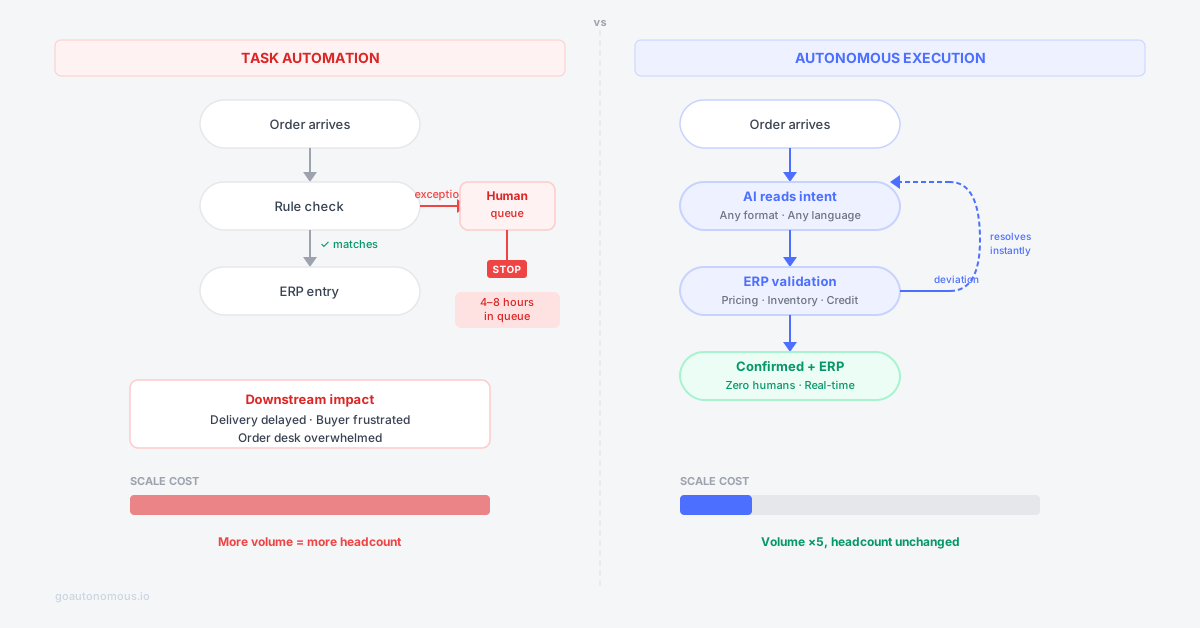
The distinction matters because B2B commercial operations are not mostly standard moments. A distributor processing 1,500 orders per week sees 30–40% of those orders require exception handling before confirmation. A mismatched part number. A pricing discrepancy. A delivery window outside standard terms. An EDI message with a missing field. Automation handles the 60–70% that fit the rules. The remaining 30–40% lands in a queue. As a result, human operators spend their days resolving ambiguity, and that is the ceiling automation cannot break.
Automation replaces a task. Autonomous commerce executes commercial intent.
The conceptual difference is precise. Automation asks “what rule applies here?” and executes it. Autonomous commerce asks “what does this customer want?” and executes that end-to-end. The first is reactive and brittle. The second is intentional and adaptive.
For example, when a customer sends an email order with non-standard product descriptions, an automation tool has no matching rule. The order enters a manual queue. An autonomous commerce platform handles it differently. It reads the email, recognises the customer, and maps the non-standard descriptions to catalog SKUs using that account’s purchase history. It validates pricing against the relevant contract tier. It checks availability in the ERP. Then it sends an order confirmation, without a human making a single decision. The difference is not about removing steps. It is about removing the human decision point entirely from standard flows.
Why the distinction is architectural, not semantic
This architectural gap matters because automation and autonomous commerce require entirely different infrastructure investments. Automation builds on rules, connectors, and templates. It deploys quickly for well-defined use cases. However, every new edge case demands a new rule or template, and maintenance debt accumulates as the exception library grows.
Autonomous commerce builds on an AI execution layer that reasons about intent, reads context, and acts across multiple systems without a predefined decision tree. Implementation takes longer, not because of technical complexity, but because the system must learn your product catalog, pricing tiers, customer rules, and ERP logic. Once live, however, it does not require rules maintenance as business conditions change. It learns from new patterns and extends its coverage automatically.
The hidden cost of building on rules
Specifically, consider the maintenance burden over a three-year horizon. A manufacturer at the task layer writes and maintains a growing rules library. Every new pricing exception, every new product category, every new customer segment adds another rule. After three years, that rules library is often the largest single source of system fragility in commercial operations.
By contrast, a manufacturer at the execution layer redirects that same time toward genuine commercial judgment, pricing strategy, customer segmentation, resolving the hard exceptions. Consequently, the execution layer grows more capable as the business evolves. The rules library grows more brittle. If you want to understand the full architectural difference, the Welcome to the Era of Autonomous Commerce white paper maps it in full for operations and commercial leaders.
The Task Automation Trap: Why RPA and Rules-Based Tools Break at the Edge Case
RPA was genuinely transformative when it arrived in B2B commercial operations. For manufacturers with high volumes of repetitive, structured data entry, RPA eliminated significant manual labor from invoice processing, order entry, and reconciliation. The ROI case was clear. Deployment was fast. Early results validated the investment.
However, RPA was designed for a world where the exception rate is low and edge cases are predictable. In B2B manufacturing and distribution, neither condition holds reliably. Complex pricing structures, multi-line purchase orders referencing customer-specific part numbers, blanket PO call-offs against annual contracts, mixed-channel intake from EDI, email, and portal simultaneously, these are not edge cases. They are the daily operating reality for most companies in this space.
The 30–40% exception rate that automation does not solve
Industry analysis consistently shows that manufacturers and distributors handling complex B2B orders see exception rates of 30–40% across their order intake. Automation addresses the 60–70% that flow cleanly through rules. As a result, the exception volume stays constant regardless of how much automation the company deploys.
This creates a structural scaling problem. If your order volume doubles, your exception volume doubles with it. You cannot automate your way out of this ceiling without reducing the exception rate itself. Reducing exceptions requires an AI layer that reasons about ambiguity, not a rules layer that rejects it. The efficiency case for autonomous execution is precisely this: not just automating clean orders, but resolving complex ones without human intervention.
What a non-standard purchase order looks like to an automation system
Consider a realistic scenario. A key account submits a 150-line PO via email. The product descriptions use the customer’s internal naming convention, not your catalog codes. Three lines reference items superseded by updated part numbers. One line requests a quantity that triggers a volume discount tier negotiated in a contract update three months ago. The delivery date falls outside your standard lead time for two line items.
A rules-based automation system touches this order and routes it to the manual queue. Nothing in the rule library covers this combination. An operator now spends 45 minutes resolving each element manually: cross-referencing part numbers, checking the contract update, confirming stock on long-lead items, calculating whether partial delivery is acceptable. That 45 minutes is the real cost of the automation ceiling.
Why the exception library never stops growing
Moreover, the exception problem compounds over time. Every catalog change, every customer that renegotiates terms, every new market you enter, each event creates new exception patterns that fall outside the current rules. Your operations team resolves them manually. Occasionally someone writes a new rule. More often, the resolution stays informal.
An autonomous execution platform, by contrast, learns from each resolved exception. Consequently, its coverage expands with every new pattern your business encounters, rather than requiring manual rule updates. That is a fundamentally different operating dynamic. The platform gets better at handling your specific business complexity as your business evolves. Read more about the execution architecture →
Our customers increasingly demand solutions that not only digitalize but also truly automate and create value. Autonomous Commerce is the key to achieving this. By integrating this technology into our portfolio and advisory model, we can help our customers with a broader range of services.
What Autonomous Commerce Actually Does: An Operational Definition
Autonomous commerce is the end-to-end execution of B2B commercial processes, order intake, validation, pricing, confirmation, and fulfillment trigger, by an AI layer that operates across all transaction channels without requiring a human decision point on standard and near-standard flows. It is not a workflow tool. It is not a copilot that assists a human operator. It is not an automation layer that handles clean orders and rejects everything else. It is an execution system.
For a COO managing 2,000 orders per week, the practical definition is this: autonomous commerce happens when a customer submits an order, by any channel, and the next human who touches it is either the warehouse team preparing the shipment or, in genuine exception cases, an operator holding a focused decision that the system has already scoped and pre-resolved. Everything in between, the reading, the matching, the validation, the pricing check, the acknowledgment, happens without a human.
Intent recognition across EDI, email, eCommerce, and agentic channels
What separates autonomous commerce from automation is that it operates at the level of intent, not instruction. An EDI 850 message, an email with a PDF attachment, a portal order, and, increasingly, a purchase request from an AI buying agent all express the same commercial intent. A customer wants to buy something, at a price, on a timeline. The channel is incidental. The intent is consistent.
Automation handles each channel separately, with distinct rules and connectors for each input format. Autonomous commerce unifies them at the intent layer. Specifically, the system does not care whether the instruction arrived as structured EDI data or natural language. It reads commercial intent and executes against it using your pricing, your inventory, and your customer relationship context.
End-to-end execution without a human decision point on standard flows
The “end-to-end” framing is precise, not aspirational. It means the system takes responsibility for the entire commercial transaction from intake to confirmation. Not just the extraction step. Not just the matching step. The whole sequence, including decisions about order validity, pricing accuracy, availability, and customer acknowledgment.
The human operator receives the exceptions that require genuine judgment. They do not receive the volume that requires mechanical processing. For a COO at a €500M manufacturer, this has a direct headcount implication. If autonomous execution handles 85–90% of orders without human intervention, the operations team that once processed 2,000 orders can handle 4,000, or 8,000, without adding staff. The ceiling that automation could never break disappears entirely. See how manufacturers and distributors are achieving this today →
How this plays out in a real manufacturing environment
In practice, consider a manufacturer running autonomous execution across 20+ countries. Orders arrive via EDI from large enterprise accounts, via email from mid-market distributors, and via portal from digitally-enabled accounts. All three channels feed into the same execution layer. The system processes each order in real time, validating against the relevant pricing structure, checking inventory, confirming with the customer.
Meanwhile, the operations team monitors the exception queue. That queue contains genuine ambiguities: a substitution request where the customer must choose between two alternative SKUs, a credit hold query that requires a commercial call. Everything else the platform handled without them. As a result, the operations team’s role shifted from order processing to commercial judgment. That shift is the outcome autonomous commerce delivers.
At CWS Hygiene, we're taking an important first step toward bringing autonomy to our commercial operations. This collaboration reflects our commitment to staying at the forefront of AI, where it actually has an impact.
The Execution Layer vs the Task Layer: An Architecture Comparison
To make this concrete, compare the two architectures side by side. The differences are not theoretical, they show up in daily operations, in maintenance effort, and in your ability to scale without adding headcount.
Five operational differences that define the ceiling
Task automation architecture: A series of point-to-point integrations and rules engines. Each rule handles a specific input condition and produces a specific output. The system operates as a decision tree, fast and reliable within its defined paths, brittle when inputs fall outside them. Exceptions route to humans as unresolved inputs.
Autonomous execution architecture: An AI reasoning layer sits above your existing systems, ERP, CRM, pricing engine, inventory. It reads inputs from any channel, interprets intent, executes decisions by reading and writing to connected systems of record, and routes only genuine ambiguities to operators with context pre-loaded. It does not replace your ERP. It acts as an intelligent execution layer above it.
In practice, the operational differences are significant:
- Maintenance burden: Automation requires ongoing rule maintenance as business conditions change. Autonomous execution learns from new patterns without manual rule-writing.
- Exception handling: Automation routes exceptions to humans unresolved. Autonomous execution resolves or pre-resolves exceptions before handoff.
- Channel coverage: Automation requires separate connectors per channel. Autonomous execution operates at the intent layer across all channels.
- Scaling: Automation scales linearly, more volume requires more rules and more human capacity for exceptions. Autonomous execution scales non-linearly, the AI layer absorbs volume with diminishing human intervention.
- Future-readiness: Automation has no design path for AI buyer agents entering your order channel. Autonomous execution handles them natively as another expression of commercial intent.
Where automation belongs, and where it does not
This is not an argument that automation has no place in your stack. Point-to-point integrations, API connectors, and basic rules engines belong in every modern B2B technology environment. However, they belong at the infrastructure layer, not at the commercial execution layer.
Building your commercial operations strategy on task automation is similar to building a supply chain on spreadsheets. It works at small scale.It becomes a ceiling at larger scale. It grows progressively more expensive to maintain as complexity increases. Therefore, the question is not whether to automate. It is whether you are building at the task layer or the execution layer, and whether that choice will define your commercial operations ceiling for the next five years.
Why This Distinction Matters for Manufacturers and Distributors Right Now
The strategic urgency of this distinction has increased sharply in 2025–2026. Two forces are converging that make the automation-versus-autonomous-execution question more consequential than it was three years ago.
Agentic buying is entering your order channel in 2026
Gartner estimates that AI agents will command $15 trillion in B2B purchases by 2028. AI-powered purchasing agents that browse supplier portals, request quotes, and submit orders on behalf of enterprise buyers are already in production deployment at a growing number of companies. By 2026, procurement organisations in the industries Go Autonomous serves are running pilots or live deployments of AI buying agents.
For manufacturers and distributors, this means your order intake channel will include machine-generated purchase requests. These are not EDI messages, they are not structured data in a known format. They are natural language expressions of commercial intent from an AI acting on behalf of a buyer. Your automation layer has no rule for this. Your autonomous execution layer handles it natively, because it already operates at the intent level.
Consequently, companies that build autonomous execution capacity in 2025–2026 will serve AI-powered buyers seamlessly when those buyers arrive in volume. Companies still running rules-based automation will face a choice: build a new system for the new channel or manually route every AI-sourced order to a human queue. Neither outcome is competitive.
Building at the task layer creates a compounding disadvantage
Most B2B manufacturers and distributors currently investing in commercial operations technology are investing in automation, RPA, ERP workflow modules, rules-based order management upgrades. This reflects where vendor marketing has focused and where ROI has historically been clearest. However, it creates an opportunity for companies willing to build at the execution layer instead.
If your competitors build at the task layer and you build at the execution layer, you create a structural speed advantage in commercial operations that compounds over time. Your cost per order decreases. Your quote response time compresses. Your ability to serve complex orders without adding headcount expands your commercial capacity without expanding your cost base. This is not a marginal efficiency gain. It is a structural shift in what your commercial operations can do. The window for building this advantage before it becomes table stakes is measured in months, not years. See the revenue and margin implications of autonomous execution →
How Autonomous Commerce Coexists With Your ERP and Existing Systems
The most common objection we hear from COOs and CIOs is that they cannot replace their ERP. This is correct, and autonomous commerce does not require it. The most important architectural clarification is this: autonomous commerce is not a replacement for your ERP, your CRM, or your existing order management infrastructure. It is an execution layer that operates above them.
Your ERP is the system of record, it holds your inventory data, your pricing, your customer accounts, your fulfillment logic. The autonomous execution layer reads from and writes to your ERP as a native participant in your order flow. When the platform processes an order, it checks availability in your ERP, validates pricing against your pricing master, triggers the confirmation workflow in your ERP, and records the transaction. The ERP remains authoritative throughout.
The three-phase deployment model for manufacturers
In practice, deployment for most manufacturers and distributors follows three phases:
- Connect: The execution layer connects to your ERP (SAP, Oracle, Microsoft Dynamics) and your order intake channels, EDI, email, eCommerce portal. No rip-and-replace. No data migration. The connection is additive.
- Learn: The system learns your catalog, your pricing tiers, your customer base, and your exception patterns. Autonomous coverage grows from a baseline toward 80–90% for standard and near-standard orders.
- Operate: The autonomous execution layer handles the standard volume. The operations team handles genuine exceptions. Over time, as the system learns from resolved exceptions, autonomous coverage increases further.
Furthermore, the deployment model does not require a multi-year transformation program. It does not require replacing your ERP or retraining your sales operations team on a new platform. The investment is in the execution layer, not in rebuilding the underlying systems that have taken years to configure. For more on how this integration model works in practice, the Autonomous Execution Fabric white paper documents five lessons from enterprise AI deployments including ERP integration architecture.
How to assess whether you are operating at the task layer or the execution layer
Three diagnostic questions identify your current state:
- What is your exception rate? If more than 20% of orders require human intervention before confirmation, you are at the task layer regardless of how much automation you have deployed.
- What happens when order volume doubles? If the honest answer involves adding operations headcount proportionally, you are at the task layer. If the answer involves the autonomous layer absorbing volume without headcount scaling, you are at the execution layer.
- Can your system process a natural language order from an AI buying agent? If not, you have a channel gap that automation cannot fill, only an intent-layer execution system can.
If these questions reveal a task-layer ceiling, the path forward is not more automation. It is building, or buying, the execution layer that replaces the ceiling with a scalable commercial operations architecture. Start the conversation with the Go Autonomous team →
See Autonomous Commerce in Action at the 2026 Summit
The Autonomous Commerce Summit 2026 brings together COOs, CIOs, and VP Operations from B2B manufacturing and distribution who are actively moving from task automation to autonomous execution. Hear directly from operations leaders who have broken through the automation ceiling. Attendance is by invitation only.
Request your invitation →
Frequently Asked Questions
B2B automation replaces specific repetitive tasks, data entry, file transfer, rule-based approvals, within a manually managed workflow. Autonomous commerce executes the entire commercial process end-to-end: reading order intent from any channel, validating against pricing and inventory, confirming with the customer, and triggering fulfillment, without a human decision point on standard orders. Automation removes steps. Autonomous commerce removes the human from the process loop for most transactions.
RPA executes predefined rules against structured inputs. It is reliable when inputs are predictable, but it cannot interpret ambiguity or handle exceptions, it routes them to humans. Autonomous commerce is built on AI reasoning, not rules execution. It interprets commercial intent from any input format, resolves near-standard exceptions autonomously, and escalates to humans only when genuine judgment is required. RPA-based order processing leaves exception rates at 30–40%. Autonomous commerce reduces them to 10–15% or less.
No. Autonomous commerce operates as an execution layer above your existing ERP, SAP, Oracle, Microsoft Dynamics, or equivalent. It reads from and writes to your ERP as a native participant in your order flow but does not replace it. Your ERP remains the system of record for inventory, pricing, customer accounts, and fulfillment logic.
Rules-based automation can only handle inputs that match a predefined condition. When an order contains ambiguity, non-standard product descriptions, pricing discrepancies, delivery requests outside standard terms, the rule has no match and routes the order to a human queue. Autonomous commerce reasons about intent using context from customer history, contract terms, and catalog structure. It resolves most ambiguities without human input. For cases it cannot resolve with high confidence, it surfaces a focused query to a human with context pre-populated.
AI buying agents submit purchase requests in natural language or semi-structured formats that fall outside the design parameters of rules-based EDI and email automation. Autonomous commerce handles them natively because it operates at the intent layer rather than the format layer. A purchase request from an AI buyer is another expression of commercial intent, the same reasoning engine that interprets an ambiguous email order applies to an AI-generated request.
Autonomous commerce unifies all B2B transaction channels through a single execution layer: EDI, email, eCommerce portals, and agentic channels. Each channel delivers commercial intent in a different format. The autonomous execution layer interprets intent regardless of format, eliminating the need for separate rules, connectors, and manual queues per channel.
Most manufacturers and distributors achieve initial live operation, with the autonomous layer processing a meaningful portion of order volume, within weeks of go-live. Autonomous coverage for standard and near-standard orders typically reaches 80–90% within the first months as the system learns the catalog, pricing tiers, and customer-specific patterns. The deployment model is additive and does not require replacing your ERP.